J. L. BELL is a Massachusetts writer who specializes in (among other things) the start of the American Revolution in and around Boston. He is particularly interested in the experiences of children in 1765-75. He has published scholarly papers and popular articles for both children and adults. He was consultant for an episode of History Detectives, and contributed to a display at Minute Man National Historic Park.

Subscribe thru Follow.it


•••••••••••••••••


Showing posts with label John Gridley. Show all posts

Monday, December 02, 2019

“For being accessory in beating Mr. Otis”

Back in September, before other Sestercentennial anniversaries came along, I started to explore the 5 Sept 1769 brawl in the British Coffee-House between James Otis, Jr., leader of the Boston Whigs, and John Robinson, one of His Majesty’s Commissioners of Customs.

As those two gentlemen were going at each other with canes and fists, other men intervened. The most energetic on Otis’s side was young John Gridley, identified here. On 6 September, Dr. Thomas Young wrote to John Wilkes that Gridley “had the ulna of his right arm fractured in the fray.”

The Whigs complained that several officers of the British army, navy, or Customs took Robinson’s side, but the one they named was William Burnet Brown, a native of Salem who had married and moved to Virginia. As I discussed here, he was probably visiting Boston to finish selling his New England property.

Interestingly, several recent authors credit Benjamin Hallowell, Jr., comptroller of the Boston Customs office, for breaking up the fight. I’ve read more anecdotes about Hallowell getting into disputes than stopping them, so this offers a novel perspective on him. Unfortunately, I haven’t been able to find the contemporaneous source for that detail.

Robinson went into hiding after the brawl, probably moving out to Castle William, the Customs officers’ usual refuge, which was now in army hands. That kept him beyond the reach of Whig magistrates or writs. Otis’s supporters therefore focused their legal efforts on William Burnet Brown. In fact, some people accused Brown of having attacked Otis himself.

On 6 September the merchant John Rowe wrote in his diary: “this afternoon the sheriff took Mr. Brown, Esq., formerly of Salem, for being accessory in beating Mr. Otis; he was carried to Faneuil Hall.” Sheriff Stephen Greenleaf was acting on a legal complaint sworn out by John Gridley, not making an arrest on his own authority the way police do now.

The magistrates overseeing the hearing at Faneuil Hall that evening were justices of the peace Richard Dana and Samuel Pemberton. Dana was a highly respected member of the Boston judiciary. Pemberton was a magistrate of long standing and a selectman. However, they were also both known for challenging Crown decrees and ignoring complaints from British officers. They were the Whig activists’ go-to magistrates, as the cases of Capt. John Willson, Ens. John Ness, and John Mein show.

In an attempt to counterbalance such magistrates, Gov. Francis Bernard had appointed James Murray (1713-1781) as a justice of the peace in the previous year. Murray was a Scottish gentleman who had settled in North Carolina in 1735, becoming a member of the governor’s council there. However, he didn’t do nearly so well financially as his little sister Elizabeth did in Boston, so in 1765 Murray moved north to join her.

In 1769 Elizabeth (Murray Campbell) Smith was widowed for a second time and decided to visit family in Britain, leaving her brother to manage her extensive property. They had already rented one large building to the British army; locals called that “Smith’s barracks” or “Murray’s barracks.” The public knew Justice James Murray supported the Crown in other ways.

On the evening of the 6th, Murray was taking a walk around the Town House when a gentleman named Perkins told him that Brown had been taken to Faneuil Hall. At the end of the month Murray wrote:
consulting my feelings for another's distress more than my own safety, [I] went directly to the Hall to attend the proceedings. Soon as the multitude perceived me among them, they attempted repeatedly to thrust me out, but were prevented by Mr. [Jonathan] Mason, one of the selectmen, calling out, “For shame, gentlemen, do not behave so rudely.”
What had started as a personal fight between two gentlemen had grown into a legal case. And now it was threatening to become a public fight that would make Boston look like a lawless place.

TOMORROW: Inside and outside Faneuil Hall.

Friday, October 25, 2019

“Count Brown” of King William County, Virginia

In 1767, William Burnet Brown moved out of Massachusetts.

He sold his father’s country house on Folly Hill, “Browne Hall,” to his cousin William Browne, by then one of Salem’s representatives on the Massachusetts General Court. [That meant this property went from William Browne to his son William Burnet Brown to his cousin William Browne, causing immense headaches for future chroniclers.]

It looks like Brown sold his mansion in Salem to his aunt Elizabeth, mother of William Browne, who had remarried Epes Sargent and then been widowed again. She eventually sold that property to her son Paul Dudley Sargent, later a colonel in the Continental Army.

William Burnet Brown, his wife Judith, and their infant children moved to her home colony of Virginia. He bought the King William County estate called Elsing Green from Carter Braxton, a politician who would become one of the signers of the Declaration of Independence. Braxton might have needed cash in 1767 because he was caught up in treasurer John Robinson’s embezzlement of colonial funds.

The mansion house of Elsing Green is shown above. It was built beside the Pamunkey River in the late 1710s. Around it were dependencies, one of those buildings dating to the 1690s; gardens; and fields of tobacco. The estate rested, of course, on the backs of the black workers enslaved there. In the early 1780s the state tax assessors counted seventy-five people working a thousand acres.

Soon Brown brought his sister Mary, his only surviving sibling, to live at Elsing Green. Their voyage in late 1767 was delayed by a storm that blew their ship aground near Stonington, Connecticut. The 24 Dec 1767 Boston News-Letter reported that all the passengers and “the Baggage and Horses of Mr. Brown” were safe.

Living in colonial Virginia was quite different from living in colonial Massachusetts, but the shift was probably not so drastic for William Burnet Brown as it would have been for others. He was an Anglican, not a Congregationalist, so the church worship was the same. He had grown up immensely rich and being served by enslaved black domestic servants. He now had to run a large agricultural plantation, but his wife and her Carter relatives no doubt helped him adjust to the Virginia way of doing things. He became a justice of the peace, and eventually his neighbors called him “Count Brown” for his wealth.

Brown still owned real estate up north. An attorney advertised in the 27 Jan 1769 Connecticut Journal of New Haven about a large amount of property for sale in that colony.

Brown was probably visiting Boston on business of that sort in September 1769 when he happened to witness the fight between James Otis, Jr., and John Robinson (no relation to the late Virginia treasurer). Why he got involved, swinging his cane and striking John Gridley, is unclear. But it caused some legal difficulties in the following weeks, as I’ll soon discuss.

Brown returned to Virginia, and I’ve seen no evidence that he ever visited Massachusetts again. He was never politically active. The only time his name appeared in the newspapers during the Revolutionary War was in 1779 when he advertised “a fine black horse” called Othello for either stud (“will cover mares for 20 dollars the leap”) or sale (for three payments spread out over up to ten years).

William Burnet Brown died in the spring of 1784, aged only forty-five. He was buried at Elsing Green. His daughter Judith married Robert Lewis, a nephew of George Washington. Without surviving sons, Brown willed the plantation to a grandson on condition that the child take his name. The name of William Burnet(t) Brown(e) has therefore been passed on to this day.

Saturday, October 19, 2019

“Mr. Otis made a Trip (as they call it) at Mr. Robinson”

In the 25 Sept 1769 Boston Gazette, printers Benjamin Edes and John Gill ran two more eyewitness accounts of the fight between James Otis, Jr., and John Robinson.

One came from Thomas Brett, a merchant from Ireland. He said that on 5 September he was “in a Shop almost opposite the British Coffee-House” when he heard “an unusual Noise” that made him go look to see what was happening.

When I entered the Coffee-Room I perceiv’d two Gentlemen fighting with each other, the rest of the Company round them. I perceived several people rush upon Mr. Otis but in particular when Mr. Otis made a Trip (as they call it) at Mr. Robinson, which I believe would have brought him to the ground if he had not been supported by many people, who held him up.
Brett described John Gridley’s attempt to intervene, how “several people with Sticks struck” at him, and how he was shoved out of the building. Otis was shoved out at the same time, Brett said—a detail not in Gridley’s recollection.

And I don’t recall Gridley mentioning this moment, either:
Mr. Gridley in a short Time made his Appearance the second Time with his Arm (if I don’t mistake) tied up, and his Face very much disfigured with Blood, who said they were all a Pack of cowardly Rascals to take such an Advantage of a single Man, and told them altho’ one of his Arms were disabled, he would fight any cowardly Rascal of them all:
The Irish merchant also remarked on another man in the coffee-house, not previously mentioned:
I heard Mr. John Mein say that he was very glad if Mr. Otis had got much more; but said he was sorry for Mr. Gridley, as he believed he was an honest Fellow. I heard him say to some other Man he lost some Wine about it, but should pay it with the greatest Pleasure.
Mein, a Scottish bookseller and printer, had been carrying on a feud with Otis, Edes, and Gill since early 1768. That, too, had turned violent (Mein clubbed Gill because Edes had refused to confirm that a particular newspaper attack on Mein had come from Otis). So just as Mein was pleased to see Otis get beat up, Edes and Gill were probably happy to drag Mein into that affair.

“Upon the whole, as I was a Stander-by,” Brett concluded his affidavit; “in my Opinion there was foul Play shewn to Mr. Otis.” He signed that document on 21 September in front of justices Richard Dana and Samuel Pemberton, respectable officials who were always sympathetic to the Whig party line.

TOMORROW: Another witness, another accusation.

Sunday, October 13, 2019

“I rushed in between the said Otis and Robinson”

On 18 Sept 1769, the Boston Gazette’s front page featured an item of local news. Usually the Boston dispatches ran on page 3 or so, after reports reprinted from newspapers in other cities, because the local news was freshest. But Edes and Gill put this piece in type early on. They knew they had to run it.

The article was a legal affidavit from John Gridley, the young merchant who had thrust himself into the fight between James Otis, Jr., and John Robinson back on 5 September.

Gridley testified that he had been passing by the door of the British Coffee-House on King Street and saw Otis and Robinson “engaged in Discourse, and by their Words and Gestures he perceived they were in great Warmth.” They were talking about “a Gentleman’s Satisfaction” and agreed to go out of the room.

Gridley went on:
Mr. Otis on saying the last Words was retiring to go out at the Door which leads into the Entry, and was hindered by Mr. Robinson’s Attempt to take him by the Nose, which Mr. Otis prevented by holding his Cane before him.

Mr. Robinson then closed in upon said Otis and struck him with a Stick, which Mr. Otis returned with his Stick, and reciprocal Blows passed, which lasted about One Minute, and neither seemed to have the Advantage:

Then they were disarmed of Sticks, and engaged with Fists, which being perceived by some of the Spectators, (most of whom were of the Army, Navy and Revenue) they endeavoured by pushing and pulling the said Otis, to prevent his beating the said Robinson.

Immediately on seeing such foul Play (the Door of the Coffee-House being open as usual) I stepped into the Room and cried out, it was dirty Usage to treat a Man in that Manner; and on saying this, I rushed in between the said Otis and Robinson; but on going between them I felt some Person pull me by the right Shoulder, I instantly disengaged myself from the Person who had me by the Shoulder, and took Mr. Robinson by the Collar, and he, in twitching, and I in holding, tore his Coat, near or quite down to his Pockets:

I immediately received two Blows on my Head, with some Weapon from the right, by a Person who appeared standing on a Bench; the Blood which issued from my Wounds instantly filled my Eyes: I then lifted my right Hand to strike a Person who was pulling me, but who I could not see so as to know, by reason of the Blood which covered my Sight: As I lifted up my right Hand, I received a Blow from some Weapon just above the Joint of my Wrist Bone, which broke it.

I was then turned out out of the Coffee-Room Head and Shoulders by the said Persons, or some of them: I then went into said Room again, and was turned out by the Persons aforesaid: As I went in the last Time I took a Stick off the Floor (on which lay 5) hoping by that Means to find out at least one of those who had so basely and meanly abused me, that I might have reasonable Satisfaction:

I then went in at the Entering Door of the Coffee-House (not the Door which leads into the Coffee-Room) and met Mr. Otis, and told him he had better go into the front Room, set down and compose himself; which he did for about 2 Minutes: I also told him that I would defend him from any farther Abuse, as far as I was able; who replied “I am much obliged to you”—! A Person (unknown to me) told him he had better go and get his Wounds dressed; upon which he went off.—

He further saith, that after his receiving the Blows on his Wrist as aforesaid, he heard divers Voices hollow out, KILL-HIM! KILL-HIM! and I make no doubt they meant said Otis, as they were done beating me, and continuing to beat him when they thus cried out Kill Him! Kill Him!
That last detail of hearing people shout about killing was crucial to the Whigs’ claim that Otis’s enemies had tried to assassinate him in the coffee-house. It’s notable, however, that Gridley said nothing the attackers wielding “Cutlasses,” as stated in their first newspaper report of the brawl.

Gridley signed this affidavit on 13 September, eight days after the fight. The justices of the peace involved were Richard Dana and Dr. Belcher Noyes (c.1708-1785), both middle-of-the-road Whigs. In fact, Dana had overseen a hearing to arrest one of the men who had allegedly attacked Otis and Gridley. I’ll discuss that soon.

Gridley’s affidavit was in part a response to another account of the event that had already appeared in the newspapers—from the opposite side.

COMING UP: An innocent bystander?

Saturday, October 12, 2019

“A young Gentleman, Mr. John Gridley”

As I quoted yesterday, the earliest newspaper reports on the British Coffee-House brawl between James Otis, Jr., and John Robinson said that “A young Gentleman, Mr. John Gridley,” waded into the fight on Otis’s side.

Who was John Gridley? Having researched Boston’s Gridley families because of their connection to the Continental artillery, I can say this isn’t a simple question. They were an old New England clan with the annoying habit of having lots of children and few given names. At any one time there were multiple John, Richard, and Samuel Gridleys.

Period sources provide a couple of clues about this John Gridley. First, the fact that the newspapers consistently call him a “young Gentleman” gives a hint about his class. Second, in a letter to John Wilkes in London, Dr. Thomas Young stated that he was “a nephew to the famous attorney of that name”—Jeremy Gridley (1702-1767), who had trained Otis in the law.

In a footnote to an article about Dr. Young published by the Colonial Society of Massachusetts, Henry H. Edes wrote, “The only John Gridley of whom any record is found in Boston who may have been the person mentioned in the text was John, son of Isaac and Sarah (Porter) Gridley, who was baptized 16 October, 1737,” in the New South Meetinghouse.

Isaac Gridley, born in 1703, was indeed a younger brother of the attorney and older brother of the artillery officer. He became a ropemaker. Among his many real-estate transactions catalogued by Annie Haven Thwing, he sold John Gray property in the center of Boston that probably became part of the ropewalk where fights broke out before the Boston Massacre. After 1748 Isaac was legally referred to as “Isaac Gridley, Esq.,” indicating that society saw him as a gentleman.

John Gridley thus inherited a certain status. He married Mercy Bartlett of Newton on 18 Mar 1761. Four years later his name appeared on advertising for fishing nets and other cordage, so he had probably started to help run his father’s business. Isaac died in April 1767.

The Boston town meeting elected a John Gridley as a Clerk of the Market in March 1768. This was a low-level position that showed the respect of the town. Some men chosen for it moved up in government and others, like Gridley, simply served out the year.

When Gridley barged into the British Coffee-House on 5 Sept 1769, he was thirty-one years old—not exceptionally “young” but still part of the rising generation. He wasn’t out of place in a genteel establishment or in Boston’s business center.

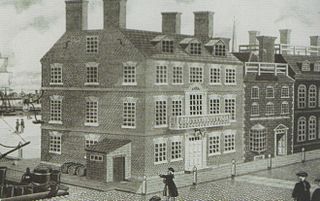
A few months later, Gridley got involved with another milestone event in Boston’s pre-Revolutionary turmoil. On the evening of 5 Mar 1770, he was in the Bunch of Grapes tavern (shown above) with three other men when they heard the fire alarm. Gridley offered to go find out what was happening. Outside the Customs house he saw Pvt. Hugh White facing off against a crowd comprised mostly of “Little trifling boys.”

Gridley walked on, then came back when he saw a squad of British soldiers arrive. He even “walked betwixt the two ranks” as the men loaded their muskets. By this time, Gridley thought the crowd was full of “Mother Tapley’s boys,…boys as big as I am.” (No one can find that expression anywhere else in the entire corpus of English literature, and it needed to be explained at the trial.)

The soldiers’ attorneys called “John Gridley Merchant” to testify for their defense. He described hearing locals speak of attacking the main guard. He said the crowd doubled to about fifty people, some at the back throwing snowballs. And:
As I stood on the steps of the Bunch of Grapes tavern; the general noise and cry was why do you not fire, damn you, you dare not fire, fire and be damned. These words were spoke very loud, they might be heard to the Long wharff.
That sort of testimony was helpful to the defense and the royal cause in general, but Whig commentators don’t seem to have singled out Gridley’s testimony for criticism.

Nonetheless, in the next couple of years Gridley left Boston on some sort of business in the Caribbean. He never returned. The Boston Gazette and Evening-Post of 12 Apr 1773 reported that “Mr. John Gridley, Merchant,” had died in the West Indies.

TOMORROW: Gridley’s testimony about the brawl.

Friday, October 11, 2019

“Others struck with Cutlasses, Canes and other Weapons”

Boston newspapers published three detailed descriptions of the fight between Customs Commissioner John Robinson and Boston representative James Otis, Jr., on 5 Sept 1769.

The first appeared on 11 September, as Edes and Gill’s Boston Gazette printed an anonymous news report that of course supported Otis. Picking up right after Robinson tried to pull his opponent's nose, it said:
…failing in the Attempt, he [Robinson] immediately struck at him [Otis] with his Cane, against which Mr. Otis defended himself, and returned the Compliment.

A close Engagement then ensued, and Mr. Otis having disarmed his Antagonist, several Persons in the Room prevented Mr. Otis from having fair Play, some of whom held him, while others struck with Cutlasses, Canes and other Weapons; and the Cry was Kill him! Kill him!
At this point, the Gazette writer said, “A young Gentleman, Mr. John Gridley,” came into the room and tried to protect Otis, but “was also attacked in the Manner Mr. Otis was.”

The crowd grew. “Robinson and those who were with him, retired through the back Door of the Coffee-House.—Mr. Otis and Mr. Gridley were carried off much wounded.”

The same column declared that most of the men in the room were “Officers of the Army, Navy and the Revenue.” The writer insisted that “the Plan of the intended and nearly executed Assassination of Mr. Otis, was concerted in Palmer’s Pasture.”

I’ve found a couple of references to that spot of Boston real estate. Once indeed a pasture, by 1769 it was a remnant empty lot on Pearl Street. The owner by inheritance was Thomas Palmer (1743-1820, shown above), who had married into the Royall family of Medford and later became a Loyalist. Palmer was also distantly related to the Hutchinson family.

However, I think the real significance of “Palmer’s Pasture” was that Palmer was the landlord of Customs Commissioner Charles Paxton. The 11 September Boston Gazette also included a paragraph said to have been “received from the Country before the Exploit on Tuesday Evening last.” It spoke of “Sir Charles Froth” (Paxton) and “Shan Ap-Morgan” (Robinson), who was supposedly going around “heavily armed” and making threats against “Candidus” (Samuel Adams).

In sum, the Gazette writer was broadly hinting that the Customs Commissioners had planned the violence in the British Coffee-House, with hopes of killing Otis. Which would have been quite the coincidence since Otis had threatened violence against Robinson just one week before in the same newspaper.

TOMORROW: But what did John Gridley say?