J. L. BELL is a Massachusetts writer who specializes in (among other things) the start of the American Revolution in and around Boston. He is particularly interested in the experiences of children in 1765-75. He has published scholarly papers and popular articles for both children and adults. He was consultant for an episode of History Detectives, and contributed to a display at Minute Man National Historic Park.

Subscribe thru Follow.it


•••••••••••••••••


Showing posts with label Peggy Hutchinson. Show all posts

Wednesday, August 26, 2020

“Nothing Remaining but the bare walls & floors”

As evening fell on Monday, 26 Aug 1765, crowds started to gather on the streets of Boston.

It was twelve days after the town’s first big protest against the Stamp Act and the provincial stamp agent, Andrew Oliver. Back then, some men had threatened to attack Lt. Gov. Thomas Hutchinson’s house in the North End as well but had been dissuaded.

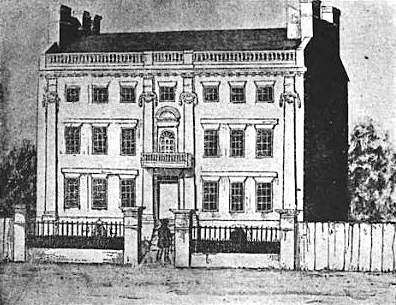
This time, the crowd first went to the home of Customs official Charles Paxton. His landlord convinced them not to harm that property, as I wrote back on the sestercentennial of that event. But the men did more damage at the houses of William Story, Benjamin Hallowell, and Ebenezer Richardson. Then they headed up to the Hutchinson mansion.

The lieutenant governor left several descriptions of the night which, since he was a royal official and historian, have always been included in the story of the Revolution. Here, from the Colonial Society of Massachusetts’s ongoing project to publish Hutchinson’s letters, is one of his most detailed descriptions of the event, in a letter to Richard Jackson in London dated 30 August:
In the evening whilst I was at supper & my children round me somebody ran in & said the mob were coming.

I directed my children to fly to a secure place & shut up my house as I had done before intending not to quit it but my eldest daughter [Sally] repented her leaving me & hastened back & protested she would not quit the house unless I did. I could not stand against this and withdrew with her to a neighbouring house where I had been but a few minutes before the hellish crew fell upon my house with the Rage of devils & in a moment with axes split down the door & entred.

My son [which one?] being in the great entry heard them cry damn him he is upstairs we’ll have him. Some ran immediately as high as the top of the house others filled the rooms below and cellars & others Remained without the house to be employed there.

Messages soon came one after another to the house where I was to inform me the mob were coming in pursuit of me and I was obliged to retire thro yards & gardens to a house more remote where I remained until 4 o’clock by which time one of the best finished houses in the province had nothing Remaining but the bare walls & floors.

Not contented with tearing off all the wainscot & hangings & splitting the doors to pieces they beat down the partition walls & altho that alone cost them near two hours they cut down the cupola or lanthern and they began to take the slate & boards from the roof & were prevented only by the approaching day light from a total demolition of the building. The garden fence was laid flat & all my trees &c broke down to the ground. Such ruins were never seen in America.

Besides my plate & family pictures houshold furniture of every kind my own my children and servants apparel they carried off about £900— sterling in money & emptied the house of every thing whatsoever except a part of the kitchen furniture not leaving a single book or paper in it & have scattered or destroyed all the manuscripts & other papers I had been collecting for 30 years together besides a great number of publick papers in my custody.

The evening being warm I had undressed me & slipt on a thin camlet surtout over my wastcoat, the next morning the weather being changed I had not cloaths enough in my possession to defend me from the cold & was obliged to borrow from my friends.

Many articles of cloathing & good part of my plate have since been picked up in different quarters of the town but the furniture in general was cut to pieces before it was thrown out of the house & most of the beds cut open & the feathers thrown out of the windows.

The next evening I intended with my children to Milton but meeting two or three small parties of the Ruffians who I suppose had concealed themselves in the country and my coachman hearing one of them say, there he is, my daughters were terrified & said they should never be safe and I was forced to shelter them that night at the castle.
Hutchinson detailed his losses in a petition to the Massachusetts General Court, to be read here. That document indicates that the mansion was also home to:
  • Hutchinson’s sister-in-law, Grizzell Sanford
  • sons Thomas (aged 25), Elisha (22), and William Sanford (13)
  • daughters Sally (21) and Peggy (11)
  • housekeeper Rebeckah Whitmore
  • maid Susannah Townsend
  • coachman Moses Vose
  • “negro” Mark 
  • Mrs. Walker, “a widow woman to whom I had allowed a living in the house several years”
For more detail about the house and its furnishings, see John W. Tyler’s analysis, “Such Ruins Were Never Seen in America.”

Saturday, October 10, 2015

“A person more suitable to your birth & rank”

Yesterday I quoted a letter that Gov. Thomas Hutchinson received from William Fitzwilliam on 6 Apr 1771, asking for his youngest daughter Peggy’s hand in marriage.

As I said, Hutchinson knew that that young man was the son of a nobleman back in Britain. For many colonial politicians, the prospect of allying his family with the imperial aristocracy would have been very enticing.

Hutchinson wasn’t that sort of person. He loved his daughter dearly, and he also loved his late wife, who had died giving birth to her. He no doubt knew that the marriage of two young people who had never even spoken was unlikely to lead to happiness. A native Bostonian, Hutchinson collected offices at home but showed no ambition to join the noble class in Britain.

The governor was also a firm believer in the social order, and that gave him a way to let Peggy’s suitor down easy. He wrote back the same day:
I am not insensible that such an Alliance as you have proposed would be doing the greatest honour to me & my Family.

I am at the same time very sensible that it cannot be approved of by the Noble Family to which you belong—In my station, from Respect to My Lord FitzWilliam I should think it my duty to do all in my power to discourage one of his Sons from so unequal a match with any person in the Province and I should most certainly be highly criminal if I should countenance & encourage a match with my own daughter

I hope Sir you will think this a sufficient reason for my not acceding to your proposal & sincerely wish you happy in a person more suitable to your birth & rank & who may be approved of by your Honorable Parent

I have the honor to be
Sr. Yr. most obedt.
humble Sert.
Thomas Hutchinson
This action turned out to benefit Gov. Hutchinson in a small way. On 8 Nov 1774, after moving to London, he visited the British politician George Onslow. At the end of that conversation, which seems to have been full of mutual flattery, came this exchange, as Hutchinson recorded it in his diary:
He thanked me for conducting an affair of his nephew, Ld FitzWilliam’s son, in America. I had forgot he was his nephew. He hoped to cultivate an acquaintance, &c.
Peggy Hutchinson joined her father in London. She died three years later, never having married.

TOMORROW: Who was William Fitzwilliam?

Friday, October 09, 2015

“I have had the honor of seeing miss Hutchinson”

Among the creepier items in the Massachusetts Archives is this letter to Gov. Thomas Hutchinson from 1771:
Sir

The various methods there are of writing on the following subject, makes me rather at a loss which to take, as I am a stranger to you,—but as the nature of it requires plain dealing, I shall take the liberty to consider you as a friend, and write to you as such:—

You will prehaps Sir think it rather strange, and be much surprised at the receipt of this letter; particularly as I am going to ask a great favor;—no less Sir than the honor of an alliance to your family;—

I have had the honor of seeing miss Hutchinson, but never in my life spoke to her—I need not tell you I admire her, when I say I wish to call her mine;—on seeing her the first time, I determin’d to endeavour to cultivate her acquaintance, but have not been so happy as to succeed;—therefore I should wish as the most honorable method of proceeding, to get acquainted with her through the means of her Father; and I should be happy in obtaining your permission Sir to visit her:—

I would more on the occasion, but yet not near so much as what I could say to you in person;—therefore Sir if you’ll favor me with a line, directed to me at Mr Perkins near the old Brick meeting House, I will do myself the honor of waiting on you, any time you’ll apoint.

You will find me act, from beginning to end, as a man of honor, and I am very certain that you, on your part, will do the same:

I have the honor to remain with the utmost esteem and respect
Sir
Your very obedient and
most hble Sert.
Wm. Fitzwilliam

April ye. 6th 1771
“Miss Hutchinson” was the governor’s favorite daughter, Peggy, born in 1754 and thus only in her late teens. What were Hutchinson’s thoughts as he read this young man’s expression of interest in marrying her when he’d never even spoken to her?

Complicating matters was Fitzwilliam’s social standing—he was the son of a British peer, and thus an enticing prospect for a colonial politician with social ambitions.

TOMORROW: The governor’s reply.