J. L. BELL is a Massachusetts writer who specializes in (among other things) the start of the American Revolution in and around Boston. He is particularly interested in the experiences of children in 1765-75. He has published scholarly papers and popular articles for both children and adults. He was consultant for an episode of History Detectives, and contributed to a display at Minute Man National Historic Park.

Subscribe thru Follow.it


•••••••••••••••••


Showing posts with label Caesar Rodney. Show all posts

Tuesday, September 15, 2026

New York City Has Fallen

On 15 Sept 1776, 250 years ago today, the Continental Army withdrew from the southern end of Manhattan Island, leaving the city of New York to the British army.

That’s an orderly way to describe what happened. Here’s Gen. George Washington’s official dispatch to John Hancock and the Continental Congress the next day:
in the morning they began their Operations—Three Ships of War came up the North River as high [as] Bloomingdale which put a total stop to the removal by Water of any more of our provision &c. and about Eleven OClock those in the East River began a most severe and Heavy Cannonade to scour the Grounds and cover the landing of their Troops between Turtle-Bay and the City, where Breast Works had been thrown up to oppose them.

As soon as I heard the Firing, I road with all possible dispatch towards the place of landing when to my great surprize and Mortification I found the Troops that had been posted in the Lines retreating with the utmost precipitation and those ordered to support them, [Samuel Holden] parson’s & [John] Fellows’s Brigades, flying in every direction and in the greatest confusion, notwithstanding the exertions of their Generals to form them.

I used every means in my power to rally and get them into some order but my attempts were fruitless and ineffectual, and on the appearance of a small party of the Enemy, not more than Sixty or Seventy, their disorder increased and they ran away in the greatest confusion without firing a Single Shot—

Finding that no confidence was to be placed in these Brigades and apprehending that another part of the Enemy might pass over to Harlem plains and cut off the retreat to this place, I sent orders to secure the Heights in the best manner with the Troops that were stationed on and near them, which being done, the retreat was effected with but little or no loss of Men, tho of a considerable part of our Baggage occasioned by this disgracefull and dastardly conduct—

Most of our Heavy Cannon and a part of our Stores and provisions which we were about removing was unavoidably left in the City, tho every means after It had been determined in Council to evacuate the post, had been used to prevent It. We are now encamped with the Main body of the Army on the Heights of Harlem where I should hope the Enemy would meet with a defeat in case of an Attack
William Douglas, a Connecticut militia colonel whose troops had been guarding an area near Kip’s Bay, told his wife that “my Left wing gave way” under the initial artillery fire:
I Lay myself on the Right wing, wateing for the boats untill Capt. [Jonas] Printice Came to me and told if I ment to Save my Self to Leave the Lines for that was the orders on the Left and that they had Left the Lines. I then told my men to make the best of their way as I then found I had but about ten Left with me.
Caesar Rodney, one of Delaware’s delegates to the Congress, was in the region, and he gathered this information:
the Ships…began a verry heavy Fireing at Turtle-Bay, to Scour the Country previous to their landing the troops, but hurt no Body that I Can hear of—When the Fireing ceased their Troops began to Land and ours to Run as if the Devil was in them in Spite of all the Genel. Could do. They never fired one Gun—

General Whashington haveing discovered their intention to Land at that place, and haveing properly disposed of his troops in case of an Attempt in either or both the other places, ordered a Reinforcement and set out there himself. However before he Got to the place, met our people runing in Every direction. He Endeavoured by persuasion, Threats &c. to get them back, but all to no purpose, in Short they Run till they left the General to Shift for himself—
A story went round that Gen. Washington was so angry that he threw his hat on the ground and shouted, “Are these the men with which I am to defend America?” (per Gen. William Heath) or “Good God, have I got such troops as those?” (per George Weedon). No one who was with Washington at the time described him behaving that way. But of course those men had other things on their minds—and may have thought such behavior was perfectly understandable.

Wednesday, July 08, 2026

Counting Votes in Independence Hall

As quoted yesterday, Edward Rutledge hoped that John Jay would return to the Continental Congress by 1 July so he could help to argue against declaring independence, at least at that time.

Jay didn’t make it, and on that date the delegations in Philadelphia took a test vote in their committee of the whole.

Nine colonies voted for independence. Four voted otherwise.

Rutledge’s South Carolina voted against. That colony contained the fourth largest port in North America and was very tied in with trade to the Caribbean and Africa.

Pennsylvania voted against independence. Its large delegation was split. Such heavyweights as John Dickinson and Robert Morris opposed the measure while a minority including Benjamin Franklin favored it.

Delaware had sent three delegates to Congress, but only two were present. Those men, Thomas McKean and George Read, disagreed. As a result, that delegation had to abstain.

New York also abstained because its delegates had received no guidance from its provincial congress. That colony contained the second-largest port along the coast, under imminent threat from the British military.

The vote was thus 9 delegations for independence, 2 against, and 2 abstaining.

The committee of the whole thus supported independence, but a big chunk of the Middle Colonies, including the two largest cities, were missing from the pro-independence bloc. There was no formal requirement that the vote be unanimous, but everyone realized that reporting disunity would hamper any ongoing resistance to the Crown.

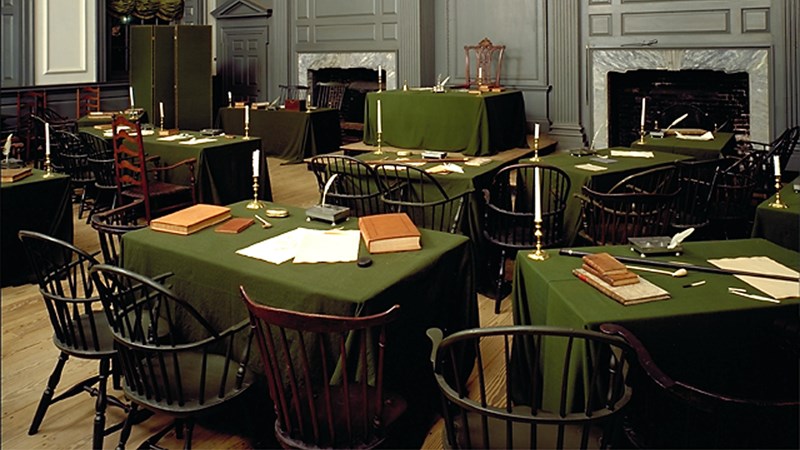
The next day, Caesar Rodney returned from Delaware, “detained by thunder and rain,” as he wrote. McKean later said his colleague appeared “at the State-house door, in his boots and spurs.” Rodney’s arrival tipped the Delaware delegation into the pro-independence camp.

10 – 2 – 1.

Rutledge saw the trend. He decided that the danger of displaying disunity was worse than the danger of declaring independence before finishing the Articles of Confederation and Perpetual Union. He moved for a new vote, signaling that South Carolina would switch to approval.

11 – 1 – 1.

Thinking along the same lines, Dickinson and Morris chose not to attend the 2 July session of the Congress. That meant most of the Pennsylvania delegates in the assembly hall supported independence, changing that colony’s vote.

12 – 0 – 1.

The Congress could thus report that the vote for independence was unopposed.

Friday, September 13, 2024

“Boston was quiet & no hurt done”

On 8 Sept 1774, two days after the men at the First Continental Congress heard dire reports about the Crown military attacking Boston, accurate information arrived in Philadelphia.

The army had not killed half a dozen civilians. The navy had not bombarded the town. In fact, over two tense days nobody had been hurt at all.

Robert Treat Paine recorded the new news in his diary:
By the Post came advice from N. York that a person had arrived from Boston & Newport since the time Supposed in [Israel] Putnams Letters & that Boston was quiet & no hurt done.
John Adams did likewise, characteristically with more emotion:
The happy News was bro’t us, from Boston, that no Blood had been spill’d but that Gen. [Thomas] Gage had taken away the Provincial Powder from the Magazine at Cambridge [sic]. This last was a disagreable Circumstance.
Roger Sherman of Connecticut wrote the next day:
We were Alarmed a few Days ago with a report that Boston was fired upon by the Land and Sea forces, but it has been Since Contradicted.
Also on 9 September, Caesar Rodney of Delaware wrote about news from Massachusetts: ”A letter to Mr. [Thomas] Cushing by Express from Boston informs that all is Quiet as Yet…” He went on to discuss other forms of resistance snarling up the Suffolk County court sessions and mandamus Council.

People in the eighteenth century were used to hearing false reports and contradictory information to sort out. They knew that news could take days and weeks to travel, and be garbled along the way. They must have been used to rethinking how they understood distant events based on new facts.

Nonetheless, those reports of the British military attacking Boston must have tinged how the delegates at this Continental Congress viewed the ongoing dispute with the Crown. The news arrived just as those men were getting acquainted and setting out the rules for their body.

On 6 September, the same day that the false rumors prompted the Congress to adjourn early, Samuel Adams was proposing that the Rev. Jacob Duché, an Anglican, lead the body in prayer. As I wrote way back here, that “masterly stroke of policy” helped allay worries that the New Englanders were all religious bigots who would drag the whole continent into an unnecessary fight. And now Adams’s home town was under attack?

Philadelphians began to ring their church bells “muffled” in mourning for the Boston dead. According to Silas Deane, Christopher Gadsden (shown above) of South Carolina was “for taking up his Firelock, & marching direct to Boston.” John Adams wrote, “Every Gentleman seems to consider the Bombardment of Boston, as the Bombardment, of the Capital of his own Province.”

Then came the better news. Deane reported, “The Bells of the City are now ringing a peal of Joy on Acct. of the News of Boston’s having been destroy’d being contradicted.” The Congress didn’t have to consider military matters after all. At least, not right away. But for a couple of days, the delegates had faced the possibility of a war against the imperial government. Could their actions keep that from happening, or did they need to prepare for it—or was it possible to do both?