


J. L. BELL is a Massachusetts writer who specializes in (among other things) the start of the American Revolution in and around Boston. He is particularly interested in the experiences of children in 1765-75. He has published scholarly papers and popular articles for both children and adults. He was consultant for an episode of History Detectives, and contributed to a display at Minute Man National Historic Park.

Subscribe thru Follow.it


•••••••••••••••••


Showing posts with label Johnson Moulton. Show all posts

Monday, May 24, 2021

The Continental Officers Inoculated in May 1776
On 24 May 1776, Dr. Isaac Foster of the Continental Army discovered that Dr. Azor Betts had inoculated four officers against smallpox, and also against Gen. George Washington’s orders.

Those men were identified in the commander’s papers as “Lt Colonel Moulton, Capt. Parks, Doctor Hart and Lieut. Brown.”

It might be no surprise those all appear to be Massachusetts officers. Not only did Massachusetts supply the bulk of the Continental Army in early 1776, but its officers still tended to follow their own counsel.

Lt. Col. Johnson Moulton (d. 1793) came from York in the district of Maine. He gained the rank of captain during the French and Indian War, and on 21 Apr 1775 he led a militia company south toward Boston. When he and those men returned home after four days, Moulton discovered that James Scamman had already started to recruit a regiment from the area, which proceeded to the siege of Boston.

In May, Moulton presented Gen. Artemas Ward with a letter from some neighbors suggesting he should be colonel and Scamman his second-in-command. Instead, the Massachusetts Provincial Congress went with Col. Scamman and Lt. Col. Moulton. Then Scamman behaved embarrassingly at the Battle of Bunker Hill. Though acquitted of the charge of “backwardness,” he left the Continental Army at the end of the year.

Moulton remained with the army, but he also remained a lieutenant colonel, assigned to the 7th Continental Regiment under Col. William Prescott. Immediately after the British evacuated Boston, Washington ordered that regiment to head to New York and start fortifying the city. On 7 April they were assigned to build breastworks on Governor’s Island.

(There was another lieutenant colonel named Moulton in the New York campaign: Stephen Moulton of Stafford, Connecticut, captured at White Plains. But in May he was representing his town in the Connecticut assembly, so he couldn’t have been getting inoculated in New York.)

Warham Parks (1752–1801) of Westfield and the Harvard College class of 1773 was a captain in Col. Ebenezer Learned’s 3d Continental Regiment. He became a major in the 4th Massachusetts Regiment at the start of 1777.

After being wounded at the Battle of Saratoga, Parks resigned his commission the following March. Washington personally asked him to remain, but he replied, “I am bound in Conciense & honor to Resign my Small Command to those who have health of Body & firmness of mind Sufficient to Carry them through the hardship and dangers of a Soldiers Life.”

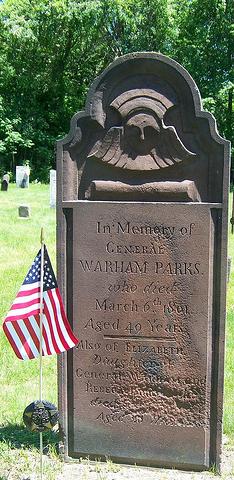
Parks returned to his home town, married, and started to win elected and appointed offices. In 1782 he became the brigadier general of the Hampshire County militia and also presided over the court-martial that Col. Paul Revere requested after the Penobscot expedition. His second wife was a daughter of Nathaniel Gorham, president of the Continental Congress in 1786. Parks’s grave marker appears above.

Dr. John Hart (1751–1836) was born in Ipswich and moved to Maine for medical training and his early practice. He became surgeon in Col. Prescott’s regiment in May 1775 and served in that and other Continental regiments until June 1784. After the war he settled in Reading, served in the state senate, and was active in the Massachusetts Society of the Cincinnati.

(Again, it’s possible this patient was Dr. Josiah Hart of Connecticut instead, but the surgeon in Prescott’s regiment seems more likely.)

As for “Lieut. Brown,” that man is impossible to identify with certainty. As of January 1776 Prescott’s regiment contained:
  • 1st Lt. Benjamin Brown (1745–1821) of Myrifield (later incorporated as Rowe), who later became a captain and served until July 1779.
  • 1st Lt. Joshua Brown (1742-1817) of Stow, a veteran of the last war and another captain until mid-1779.
  • 2nd Lt. Samuel Brown (1752-1819) of Concord. (Not be confused with Lt. Samuel Brown [1749-1828] of Acton, who was a prisoner at Québec at this time.)
What does identifying those men tell us about their choice to inoculate? First, most of them (or all, if the lieutenant was Benjamin Brown) came from parts of Massachusetts remote from Boston. They were thus less likely to have been exposed to smallpox or had a chance to be inoculated against it.

Second, these were officers, not enlisted men. One was a second-in-command of a regiment. Another was a doctor himself. They had all reenlisted in the Continental Army and would continue to serve on many campaigns. They were clearly committed to the cause. There’s little doubt they sought inoculation so as to be more useful for the army, not less.

Third, none of these four men died from the inoculation. At the end of June they were healthier than before.

Finally, and perhaps most important, there’s no record that these men were punished for convincing Dr. Betts to inoculate them. Some were promoted in the next couple of years. Gen. Washington even asked one to remain in the army. Even though they had disobeyed the commander-in-chief’s order, the commander-in-chief appears to have forgiven them.

TOMORROW: Who took the blame.

Friday, June 19, 2015

“Backwardness in Colonel Scammans”?

On 12 July 1775, five days after confirming the court-martial sentence of Capt. John Callender, Gen. George Washington issued orders for the trial of another Continental Army officer:

A General Court Martial of the Line to sit at Head Quarters, in Cambridge, to morrow morning at Nine OClock, to try Col. Scammons of the Massachusetts Forces accused of “Backwardness in the execution of his duty in the late Action upon Bunkers-hill”. The Adjutant of Col. Scammon’s regiment, to warn all Evidences [i.e., witnesses], and persons concern’d to attend the court.
The regimental adjutant was a man named George Marsden.

Col. James Scamman (also spelled Scammans, Scammon, and Scammons) commanded a regiment made up of men from Maine and New Hampshire. While the fight raged on Breed’s Hill in Charlestown, he had led his men to Cobble Hill, on the west side of the Charlestown Neck, and stayed there for a while. Then when he finally moved them onto the Charlestown peninsula, Scamman went no farther than the brow of the taller Bunker’s Hill before ordering everyone to turn around and retreat.

In his defense, Scamman said had been ordered “to the hill,” and at first he thought that meant Cobble Hill because people feared British regulars would land at nearby Lechmere’s Point. Some of his witnesses, such as Drummer Henry Foss, backed him up on that.

However, it’s clear that other men in Scamman’s regiment supported the complaints against him. Those soldiers were already split over whom they’d signed up to fight under—Scamman or his lieutenant colonel, Johnson Moulton. In their testimony, some junior officers hinted that the colonel didn’t move as quickly as he should have, or noted that other provincials moved on to Breed’s Hill even as Scamman said that was too dangerous. For example:
Ensign Joshua Trafton deposed, about two of the clock (afternoon) we marched from Cambridge to Lechmere’s-Point, where we found Gen. [John] Whitcomb who expressed much surprise at finding Col. Scammans take post there. We remained on the Point fifteen minutes and then marched to a small hill below Prospect-Hill. We continued on the small hill about half an hour or more; during which time Col. Scammans sent two Serjeants to Bunker’s-Hill, to know if his regiment was wanted.

We took the nearest road to Bunker’s-Hill, as I suppose; and before we got to the top of the hill, Colonel ordered a retreat. I cannot say whether the breastwork was forced or not at that time. We saw many men retreating down the hill who said they had spent all their ammunition; some told us that the enemy had retreated and begged us to push on. As we turned off the small hill, a regiment marched by us towards Bunker’s-Hill. As we marched from Cambridge we heard the regulars were landing at Lechmere’s Point and at Charlestown. Col. Scammans made the greatest despatch from the small hill to Bunker’s-Hill.

I saw no other instance of backwardness in Colonel Scammans, except his long stay at the small hill, which appeared to me unnecessary. As we retreated a number of men advanced up in an irregular manner.
Shortly after this Scamman accused Trafton of “abusive Language” and later of “offering to strike his Colo,” both charges apparently involving Trafton’s disdain for the colonel. But the court-martial boards went easy on the junior officer—suggesting they thought his disrespect for Scamman had a solid basis.

TOMORROW: The main witness accusing Col. Scamman of backwardness was none other than the regimental adjutant, George Marsden.

Monday, March 25, 2013

Capt. Samuel Leighton and His Regiment

Will Steere at the Seth Kaller Inc. dealer in historic documents alerted me to some recent offerings that shed a little light on the siege of Boston. They are more of the papers of Capt. Samuel Leighton (1740-1802) of Kittery, Maine. His men came from that area and Portsmouth, New Hampshire. One can find them all at the Seth Kaller site by searching for the keyword “Leighton.”

This company was part of the regiment of Col. James Scamman (1742-1804). Documents in the Massachusetts archives indicate that some officers and men in that regiment wanted their colonel to be Johnson Moulton, a veteran of the French & Indian War who had mustered a minute company on 21 Apr 1775 and marched south. By the time Moulton returned home four days later, however, Scamman was evidently recruiting.

Moulton signed on to Scamman’s regiment as lieutenant colonel on 2 May but brought Gen. Artemas Ward a letter from prominent neighbors dated three days later recommending that he be made colonel. “There is a considerable number of good men enlisted already, with a view of said Moulton being their Colonel,” the letter closed. Scamman could be lieutenant colonel, they suggested.

The Massachusetts Committee of Safety was convinced enough to ask Scamman to step aside in a 7 May letter. But he didn’t. Instead, he marched his regiment to Cambridge and mustered them there on 23 May.

The committee decided that they couldn’t remove Scamman without his cooperation. They certified his regiment as “nearly full” and recommended commissions for his officers. On 29 May, Moulton was officially made the regiment’s lieutenant colonel. Later the Continental Congress issued the equivalent commissions. Leighton’s commission as a Continental captain, dated 1 July, is quoted here.

By then, Leighton’s company had been involved in the fight for Hog Island but not in the Battle of Bunker Hill for reasons explained here. According to a muster roll Leighton prepared, three of his men had deserted, two reportedly on 1 July.

TOMORROW: More of Capt. Leighton’s documents.