


J. L. BELL is a Massachusetts writer who specializes in (among other things) the start of the American Revolution in and around Boston. He is particularly interested in the experiences of children in 1765-75. He has published scholarly papers and popular articles for both children and adults. He was consultant for an episode of History Detectives, and contributed to a display at Minute Man National Historic Park.

Subscribe thru Follow.it


•••••••••••••••••


Showing posts with label John Brockington. Show all posts

Wednesday, June 01, 2011

Back to Brockington

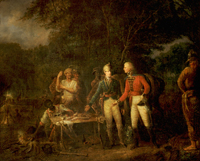
I started this series of sweet-potato postings with a descendant’s claim that the “British officer” in John Blake White’s painting of Francis Marion (shown here, courtesy of the U.S. Senate) actually showed Loyalist John Brockington, Jr., coming home after the war.

I still haven’t see the article that presents that claim, but context makes it seem very unlikely to me.

That scenario would mean that Samuel Weaver told of participating in a sweet-potato meal during the war, and the Rev. Mason Weems described such a meal, and many publications reprinted Weems’s description of the meal—yet White chose to paint a similar meal that no one else recorded for decades.

The painting shows Marion welcoming a red-coated gentleman to his table, but the descendant claimed that Brockington had invited Marion to share the food, which doesn’t fit the imagery.

Furthermore, White lived until 1859, long after engravings based on his painting appeared with captions identifying Marion’s guest as a British officer, and he didn’t correct that identification. When the painter’s son Octavius White donated the canvases to the U.S. Capitol in 1899, he described it as “the famous one representing General Marion inviting a British officer to share his meal of sweet potatoes.”

It seems more likely that Brockington’s descendants grew up in South Carolina surrounded by copies of White’s iconic image (it was even on some Confederate currency), and came to interpret it as showing their ancestor meeting Marion. I suspect that was a “Grandmother’s tale,” originally meant for the children in one family but told to the world after those children grew up.

Perhaps Brockington did meet Marion when he returned to South Carolina. But after the war there would have been no need for two gentlemen of considerable fortune (as measured by their human property) to eat sweet potatoes in the woods.

Thursday, May 26, 2011

A Latter-Day Claim to Gen. Marion’s Sweet Potatoes

Last month at Blog, or Die, Michael Aubrecht wrote about John Blake White’s paintings of Francis Marion inviting a British officer to join him in a dinner of roasted sweet potatoes. Longtime Boston 1775 readers might recall that a ceremony about the version of that painting in the U.S. Capitol prompted some postings on the semi-legendary figure of Marion’s enslaved servant Oscar.

The Senate’s webpage on that painting and Aubrecht’s posting both cite an article about the underlying historic incident in the South Carolina Historical Society’s Carologue magazine for 1999. (Both webpages have typos that date the article to 1989, but the former also has the correct citation.) I haven’t found an online version of that article, Nell Weaver Davies’s “New Facts about an Old Story,” but Aubrecht describes its latter-day interpretation of the painting:
James P. Truluck, a descendant of the alleged British Officer,…[stated that] Captain John Brockington, Jr.—a landowner, slave-owner, and Tory sympathizer, who had fought against the “Swamp Fox”—was the legendary officer depicted in the piece. He added that his ancestor had been among the Tories that were banned to Nova Scotia after Continental forces assumed control of South Carolina.

In an effort to regain his land and reputation, Brockington returned to the colonies to refute his Loyalists ways and repay any claims that were made against him. After receiving a pardon, he and his slaves headed home and traveled through the swamps to avoid confrontation. It was while preparing their own camp meal that Truluck states Marion found them (resulting in the painted scene).
I’m baffled by Trulock’s claim, as best I understand it. It seems clear that White, painting around 1820, illustrated a specific episode described in Mason Weems’s Life of Gen. Francis Marion.

TOMORROW: Parson Weems and General Marion.