J. L. BELL is a Massachusetts writer who specializes in (among other things) the start of the American Revolution in and around Boston. He is particularly interested in the experiences of children in 1765-75. He has published scholarly papers and popular articles for both children and adults. He was consultant for an episode of History Detectives, and contributed to a display at Minute Man National Historic Park.

Subscribe thru Follow.it


•••••••••••••••••


Showing posts with label Mary Butler. Show all posts

Thursday, November 13, 2025

The Vanishing of Mary Wenwood?

As recounted earlier, Gen. George Washington had Mary Wenwood brought his headquarters to answer questions about a ciphered letter she had given to her former husband to pass on.

The woman held out against the general’s questioning for hours. But still under guard the morning after she arrived, she gave up the name of the cipherer: her lover, Dr. Benjamin Church.

After that, Mary Wenwood fades from the historical record. She had every reason to adopt a low profile. Gen. Washington kept her name out of his official report and paperwork. No surviving informal comment on the episode mentions her name. 

But men had a lot to say about her character. Indeed, just as she vanished as a person, she started to appear as a character in a moral fable—the downfall of a doctor.

James Warren, speaker of the Massachusetts house, called her “a suttle, shrewd Jade” and “an Infamous Hussey.” The Rev. Ezra Stiles of Newport said she was “a Girl of Pleasure,” and had carried the ciphered letter “in her stocking on her Leg.” How did he know?

Lt. Ebenezer Huntington of Norwich, Connecticut, told his brother: “the Plot was discoverd by his [Church’s] Miss who is now with Child by him and he owns himself the father (for he has Dismissed his Wife).” Huntington was stationed in Roxbury, far from Washington’s headquarters, and had no link to people in the case. No one closer to the investigation said the woman was pregnant. Some other details in Huntington’s account are wrong. Therefore, unless other evidence turns up, I think this was probably baseless gossip.

Here are further facts possibly about Mary Wenwood.

The 14 December 1775 New-England Chronicle reported that the Cambridge post office was holding mail for a woman named Mary Butler—which was Mary Wenwood’s maiden name.

Mary was the most common given name for women, and Butler a fairly common surname. Wainwood/Wenwood/Wanewood was much less common. Indeed, all mentions of “Wenwood” and its variants in late-1700s New England newspapers lead back to Godfrey Wenwood, Mary’s former husband.

That said, Newport vital records show that another Mary Wenwood, wife of Frederick Wenwood, gave birth to a baby girl named Mary in December 1785, and that couple baptized a baby girl named Mary (perhaps a new one) in June 1787. Even an uncommon name isn’t necessarily unique.

The most tantalizing clues are that a Mary Wainwood/Wanewood was in and out of the Boston almshouse after the war:
  • Admitted 6 May 1785, left 30 May 1786.
  • Admitted 29 Feb 1792.
  • Admitted 12 Jan 1793.
  • Admitted 25 Apr 1797, died 23 May 1797.
And that last entry stated that the woman was from Rhode Island.

Wednesday, November 12, 2025

“Tradition gives us a graphic scene connected with her arrest”

In his biography of George Washington, published in the late 1850s, Washington Irving included a vivid description of how Mary (Butler) Wenwood was brought to the commander-in-chief’s headquarters.

Irving wrote:
Tradition gives us a graphic scene connected with her arrest. Washington was in his chamber at head-quarters, when he beheld from his window, General [Israel] Putnam approaching on horseback, with a stout woman en croupe behind him. He had pounced upon the culprit.

The group presented by the old general and his prize, overpowered even Washington’s gravity. It was the only occasion throughout the whole campaign on which he was known to laugh heartily.

He had recovered his gravity by the time the delinquent was brought to the foot of the broad staircase in head-quarters, and assured her in a severe tone from the head of it, that, unless she confessed everything before the next morning, a halter would be in readiness for her.

So far the tradition;…
This anecdote is consistent with other stories about Putnam.

However, there’s no contemporaneous support for this tale, nor did Irving explain how he came by all those details, especially the picture of the general laughing in his own bedroom.

In fact, even Irving seemed dubious, twice labeling this story “tradition.” But he couldn’t resist including it.

And some other authors, including George Washington Greene, repeated it in their books.

It can serve to signal how Mary Wenwood was about to be transmuted from a real woman into the embodiment of all female dangers.

Tuesday, November 11, 2025

“i expeted you would have arote to me be for this”

Several of the questions after my talk in Watertown about Dr. Benjamin Church, Jr., involved his lover Mary (Butler) Wenwood.

Unfortunately, we have lots of rumors and little hard evidence about this woman, and I’m wary of overstating what we know. But I can share some more information and leads for further research.

We have a note in Mary Wenwood’s own handwriting, preserved in the George Washington Papers at the Library of Congress.

This note is undated, but it appears to have prodded her former husband, Godfrey Wenwood, into showing a ciphered letter she’d previously left with him to the Patriot authorities in Rhode Island. That happened in September 1775, so it’s likely Mary Wenwood wrote this note that month.

She addressed it “To Mr. godfrey wenwood / Baker / in Newport” but added no signature. Neither the handwriting nor spelling is clear:
Dear sir—

i now Sett Down to right a fue Lines hoping thay will find [you] in good helth as thay Leave me

i expeted you would have arote to me be for this But now i expet to Sea you hear every Day i much wonder you never Sent wot you promest to send if you Did i never reseve it so pray Lett me know By the furst orpurtnuty wen you expet to be hear & at the Same time whether you ever Sent me that & wether you ever got a answer from my sister i am a litle unesey that you never rote

thar is a serten person hear wants to Sea you verey much So pray com as Swon as posebell if you righ[t] Direct your Lettr to mr Ewerd Harton Living on Mr t apthorps farm in Little Cambrig
It’s tempting to treat personal details in the letter—the “sister,” “the serten person hear [who] wants to Sea you verey much”—as clues. But those could just as well have been parts of a cover story, to fool Godfrey or someone else who might see the note into thinking it’s all about a family matter.

The real tenor of this note is anxiety about having received no answer to the earlier, ciphered letter. Mary was even suspicious that Godfrey hadn’t sent it on (which he hadn’t). She wanted to know what was happening. Dr. Church was probably hoping some money was on its way to him.

The information about how to send a reply to Mary Wenwood must therefore have been sincere. “Little Cambridge” was the portion of that town on the south side of the Charles River which we now call Brighton. The local historian Lucius Paige found an Edward/Edmund Horton living there in 1776.

The note suggests Horton was living on the estate of Thomas Apthorp (1741–1818), one of several younger sons of Charles and Grizzell Apthorp. In 1858 the Rev. Nicholas Hoppin wrote, “James and Thomas Apthorp Esqrs., brothers of the missionary [Rev. East Apthorp], also had houses…in what is now Brighton, then called Little Cambridge,” but James (1731–1799) moved to Braintree in 1768.

That same year, Thomas lobbied to become a deputy paymaster for the army, as his father had been. With that affiliation, he would have been inside Boston when the war broke out, and he would leave with the British troops in March 1776. Horton might have been looking after Apthorp’s country estate.

Mary Wenwood could have been living on that estate, or she could have been living nearby. Godfrey showed up at her home toward the end of September, asking about the ciphered letter. Mary refused to answer his questions. So Gen. George Washington ordered her brought to his headquarters.

TOMORROW: Rumors and unanswered questions.

Monday, November 10, 2025

“Writing this has employed a day”

Dr. Benjamin Church, Jr., used a variety of ways to send messages into Boston after the start of the war, including:
  • crossing the siege lines himself in April 1775 and pretending to have been placed under arrest.
  • having a letter “sewed in the waist of [a paid confederate’s] breeches.” That unnamed man was stopped and “confined a few days,” but the letter wasn’t found.
  • possibly piggybacking on a letter from Gen. Charles Lee that Church arranged to be sent into Boston in early July.
  • meeting a Crown agent in Salem. William Warden told the Loyalists Commission “he was sent by General [Thomas] Gage to Salem and Marblehead to receive intelligence from Dr. Benjamin Church, but failed to execute his business.” Church wrote in July, “I have been to Salem to reconnoitre, but I could not escape the geese of the capitol.”
  • asking Gen. George Washington’s staff to send in a letter through the channel they established to communicate to their agent, John Carnes. That document was sent through the hands of military secretary Joseph Reed, Lt. Col. Loammi Baldwin, a man named Tewksbury raising sheep what’s now Winthrop, and a waterman going into Boston.
  • And of course asking his mistress, Mary (Butler) Wenwood, to arrange for someone she knew in Newport, Rhode Island, to deliver a letter to a royal official there to pass into Boston. Unluckily for them, she chose her ex-husband, Godfrey Wenwood.
Of those communications, only the last letter survives and can be connected with a transmission route because it was intercepted, proving to be Church’s undoing.

For that letter through Newport, Dr. Church used a cipher for added security. One of the many fine questions asked after yesterday’s presentation on Dr. Church was if there were any other ciphered letters from him in Gen. Gage’s papers. I don’t think there are others. And in fact, since the one that incriminated Dr. Church was never delivered, there aren’t any at all.

As part of his defense Dr. Church displayed and translated a letter from his brother-in-law, John Fleeming, written using the same cipher. The doctor said Fleeming had asked him to use the cipher. That letter survives only in printed translations. Earlier Church told Washington that he had received and destroyed another ciphered letter from Fleeming, but that might have been the same one he later displayed.

In General Gage’s Informants, Allen French identified other letters from Dr. Church in the general’s papers on the basis of internal detail (the writer was about to leave for Philadelphia) or handwriting. Those were all in plain English.

As is the long letter written on 24 Sept 1775 and published in Henry Belcher’s The First American Civil War, which I identified in this post as probably Church’s last report to his royal handlers.

It appears, therefore, that Church used the cipher only in exchanges with Fleeming. Why not all the time?

One reason is that having a cipher and sending lots of coded letters might have raised questions. In one of those letters in Gage’s files Church said that an encounter with an angry man named Timothy had prompted him to destroy his cipher lest people suspect him.

Another factor may simply have been time. It took extra effort to copy each letter symbol by symbol. In the intercepted letter the doctor complained, “Writing this has employed a day.”

We might say that using every means to conceal a spy letter would be time well spent. But in Church’s case, the cipher roused Godfrey Wenwood’s suspicions and was soon broken, but the letters the doctor sent in other ways remained secret for over a century.

Sunday, November 09, 2025

“Let not that man be trusted who can voilate private faith”

The Massachusetts Whigs were flabbergasted by the evidence that Dr. Benjamin Church, Jr., was corresponding with someone behind enemy lines.

By the fall of 1775, those men had worked alongside Dr. Church for a decade. He had helped to compose instructions for representatives, correspondence to Whigs in Britain, and political verse for engravings.

The doctor had delivered the Massacre memorial oration in 1773. He had represented Boston in the Massachusetts Provincial Congress and then the General Court, serving on the most sensitive committees.

His fellow legislators had chosen Church to take important documents to the Continental Congress in Philadelphia, and then to escort Gen. George Washington across the state from Springfield. He was serving as the top doctor in the Continental Army.

Church’s erstwhile colleagues wrote to each other in astonishment.

One group of Massachusetts Patriots who didn’t express such surprise, however, were the Massachusetts Whigs’ wives.

Those women had noted Church’s habit of extramarital affairs, rumored as early as 1769. By 1774 he was maintaining a mistress outside of Boston. To other men’s wives, the doctor’s betrayal of Sarah Church made it easy to believe he’d betrayed his political movement as well.

Abigail Adams wrote to her husband John on October 9:
You have doubtless heard of the viliny of one who has professd himself a patriot, but let not that man be trusted who can voilate private faith, and cancel solem covanants, who can leap over moral law, and laugh at christianity.
Mercy Warren, wife of Massachusetts house speaker James Warren, added her voice three days later:
I fear a Late Instance of perfidy and Baseness in one who Rancked Himself among the Friends to the Rights of society and the Happiness of the Community Will occasion many Inviduous Reflections from the Enemies of the American Cause.

I was Ever sorry that there should be one among the Band of patriots Whose Moral Character was Impeachable for when the Heart is Contaminated, and the Obligations of private Life Broken through, And the man has thrown of[f] the Restraints Both of Honour and Conscience with Regard to His own Domestic Conduct, what Dependance is to be Made on the Rectitude of His public Intentions.
Abigail Greenleaf, wife of the publisher Joseph Greenleaf, wrote to her brother Robert Treat Paine on 14 October:
How Sir, did you receive the news of the Perfidy & treachery of Docter Church? Was it not in Silent astonishment? It will I believe, bow down the grey hairs of his Father & Mother, with Sorrow to the grave. His Poor wife too, is an object of the Pitty, & Compassion of every one. She still Loves him, tho, he has treated her in so base a manner. If she looses her senses I think twill not be strange; but it will be melancholy.
Abigail Adams came back to the topic on 21 October:
What are your thoughts with regard to Dr. Church? Had you much knowledg of him? I think you had no intimate acquaintance with him.

“A foe to God was ne’er true Friend to man
Some sinister intent taints all he does.”
The wise response to such questions from a spouse was of course: ‘I agree with you, dear. I barely knew the man. You’re so right.’

Wednesday, January 24, 2024

“Breathe their Last within the walls of his Detestable General Hospital”

As I quoted yesterday, in September 1775 commanders of the northern wing of the Continental Army besieging Boston were upset with how Surgeon-General Benjamin Church was ordering sick and wounded men moved to his hospitals in Cambridge.

Gen. John Sullivan and Dr. Hall Jackson complained that there were sick people at those hospitals! Meaning men would be more likely to catch infections there than anywhere else.

In addition, the doctors looked down on New Hampshire men as country bumpkins, and Dr. Church and his assistant surgeons weren’t as skilled as Jackson himself.

Well, Jackson didn’t come right out and say that last part (Sullivan did), but on 16 September he lambasted the central army hospitals this way:
Not an Officer or Soldier [from New Hampshire] will go to the Cambridge Hospital, they had much rather provide for themselves at Mistick at any expense, or even die in Camp with their friends than be forced into a General Hospital cram’d with the sick of 25,000 Troops; and attended by strangers from polite Places, who have never been used to the inquisitiveness and impatience of poor Country People, and are in general to apt to conster their simplicity into impertinence: it is the mind of General Sullivan, and all the Officers from New Hampshire, that unless some alteration is made, another Regiment will never be raised in that Colony.

Capt. [Henry] Dearbourn, with many others, are gone to Canada, for no other reason than to avoid the Sickness of our Camp, and dread of the general Hospital.

The arts, contrivance, and hypocricy, of some of the M—u—setts Patriots is dam—a—ble to the last degree. “A Struggle for Liberty”!—good God! my Soul abhors the Idea! If methodically to kill the wounded; to starve the sick, and languishing because they cannot Diet on Salt Pork, or will not submit to be severed from their dearest friends and relations, if these (my Dear Friend) are the Characteristicks of an Army raised for the defence of Liberty, I frankly confess I have no claim to an employment in the glorious Cause.
When Jackson wrote those words, however, the army had already formally looked into the dispute. On 7 September, Gen. George Washington laid set out a formal process in his general orders:
Repeated Complaints being made by the Regimental Surgeons, that they are not allowed proper Necessaries for the Use of the sick before they become fit Objects for the General Hospital: And the Director General of the hospital complains, that contrary to the Rule of every established army, these Regimental Hospitals are more expensive than can be conceived; which plainly indicates that there is either an unpardonable Abuse on one side, or an inexcusable neglect on the other—

And Whereas the General is exceedingly desirous of having the utmost care taken of the sick (wherever placed and in every stage of their disorder) but at the same time is determin’d, not to suffer any impositions on the public;

he requires and orders, that the Brigadiers General with the commanding Officers of each Regiment in his brigade; do set as a Court of enquiry into the Causes of these Complaints, and that they summon the Director General of the hospital, and their several Regimental Surgeons before them, and have the whole matter fully investigated and reported—This enquiry to begin on the left of the Line to morrow, at the hour of ten in Genl Sullivan’s brigade.
That inquiry ended a week later with Church being cleared of all charges. Jackson’s letter was thus carrying on an argument he had already officially lost.

There must have been similar disputes in other parts of the army because Washington ordered the same sort of inquiry in Gen. William Heath’s brigade in the central part of the lines, then in the brigades on the south wing. The commander-in-chief evidently felt that this process would force everyone to an agreement.

The second inquiry likewise ended in praise for Church. But by then the surgeon-general had left the front, pleading illness. Church even sent in his resignation from Taunton. Adjutant-General Horatio Gates wrote the doctor a flattering letter urging him to come back.

Then suddenly the conflict was resolved by an outside factor: The baker Godfrey Wenwood came to Washington’s headquarters from Newport with a ciphered letter that his ex-wife had asked him to send into Boston. Under questioning, that woman, née Mary Butler, admitted she had handled the letter for her lover—Dr. Church!

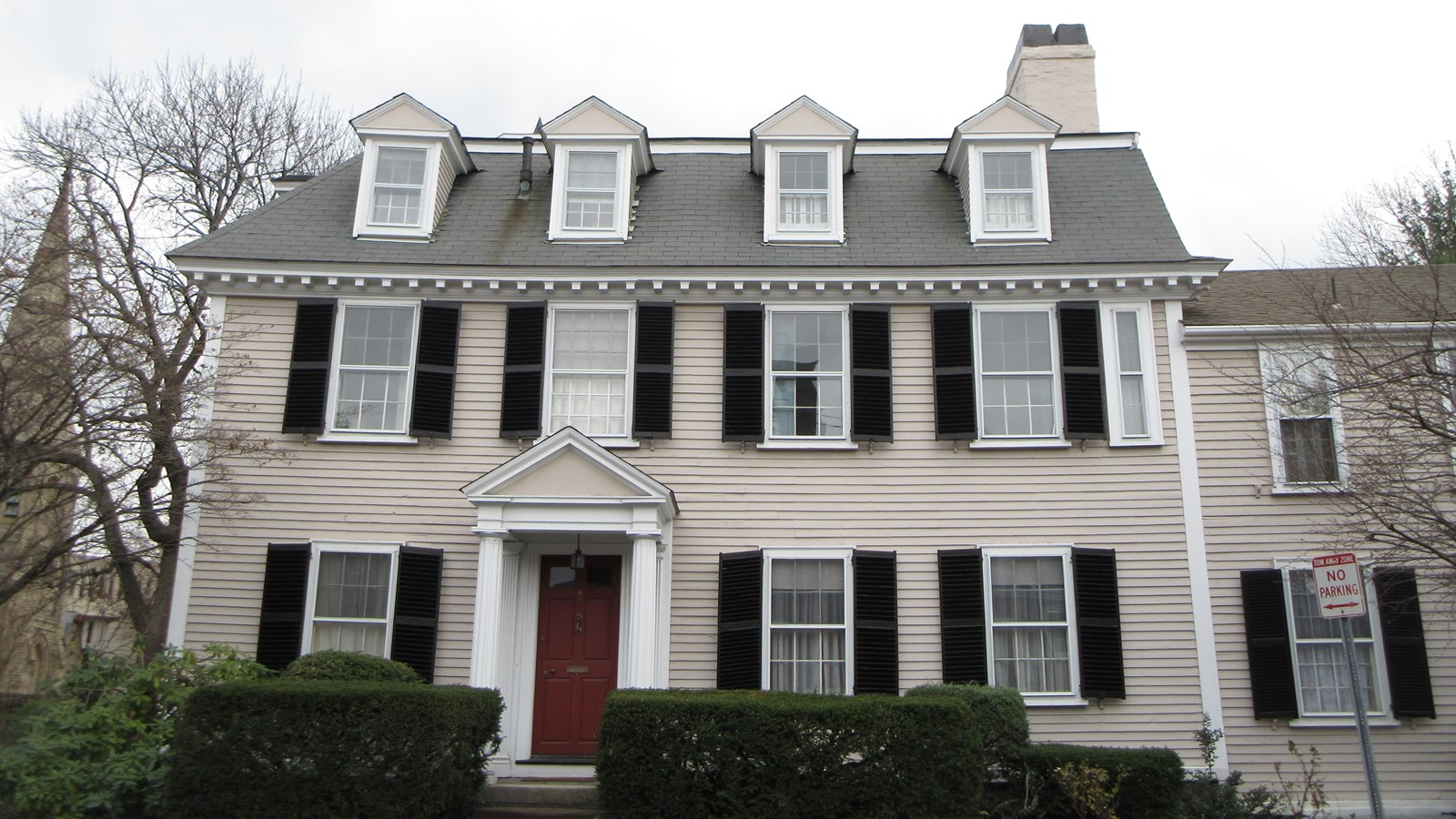
The 30 September inquiry in Gen. Joseph Spencer’s brigade was called off “on account of the Indisposition of Dr Church.” That phrase in Washington’s general orders was cover for the fact that Church was under arrest in one of his hospital buildings (shown above) for secretly corresponding with the British military.

On 4 October, Sullivan wrote in triumph:
You will by this Post Receive Intelligence from head-Quarters of Dr. Church’es having been detected in holding a Treasonable Correspondence with the Enemy—his Behaviour Towards our Sick & wounded long since Convinced me that he either was void of humanity and Judgment, or that he was Determined by untimely Removals & Neglect of Duty to Let all those under his care breathe their Last within the walls of his Detestable General Hospital.
On 17 October, Dr. Hall Jackson returned to Portsmouth. Since June, he had been working with no rank or salary. The next month, New Hampshire’s provincial government recognized his service with a commission as chief surgeon for the colony’s troops and back pay.

COMING UP: Back to Capt. Sylvanus Lowell, wounded in 1773. But first, a Sestercentennial event.

Saturday, February 04, 2023

“To write one time no want of powder and at another not so great a plenty”

The 23 July 1775 letter from Dr. Benjamin Church, Jr., that I quoted yesterday never made it into Boston.

Church gave it to his mistress in Little Cambridge, Mary Butler, and she asked her ex-husband in Newport, the baker Godfrey Wenwood (or Wainwood), to pass it on to royal officials to take into Boston.

Instead, the baker sat on the document. But Dr. Church couldn’t know that. Just a few days later, he discovered a quicker way to send messages into Boston, piggybacking on Gen. George Washington’s own espionage route.

Eventually, Dr. Church realized the letter he’d sent by his mistress had never arrived, and he asked her about it. She asked her ex-husband. He grew even more suspicious and took the document to Rhode Island’s Patriot authorities on 26 September.

That set in motion the chain of events that led to the deciphering of the letter, Washington’s interrogation of Mary Butler, and Dr. Church’s arrest by the end of the month.

That summer, Church had sat through a series of inquiries about how he as Surgeon General ran the Continental Army hospitals. (Regimental surgeons disliked him encroaching on their territory.) On 19 September, Church asked for a leave to visit his family in Rhode Island. The next day, he sent Gen. Washington his resignation. Adjutant General Horatio Gates cited the commander’s “his unwillingness to part with a good officer” and asked Church to reconsider.

On 24 September, Dr. Church sent a new letter full of intelligence about the Continental camp into Boston. We know this one arrived because it survives in Gen. Thomas Gage’s files.

Among many other things, Church discussed the Continental gunpowder supply. As I quoted yesterday, back in July he had said there was lots of powder. In late September he wrote:
the Accot I sent you that our Army was Supplyed largely with powder is not so, instead of our peoples having Ninety Tons of powder from Philadelphia they did but Nine as I find by the Commessary and from New York Six for Sixty as is declared all over the Camp, but when it got down here it was no more than I now write you, they have got some little from different Quarters by some means but I am bould to say, not enough to stand a long Siege. We are made to believe that we are to have large Quantitys in a very short time, they have sent different ways, that I know, for powder and without every good look out they will get [difficulties?],

You will think me an odd fellow to write one time no want of powder and at another not so great a plenty—but Sir, never was a people lead on blindfold and so imposed on as this people have been with respect to Arms and Amunition: I am not alone in this matter I heard Mr. [John] Hancock Say the very day he came from Congress that we had more Powder on the Road coming to the Camp, than we could Expend in one twelve months, this was believed by all coming from Hancock.

The Army begin to inquire for themselves, about these matters, and are not satisfied to find themselves so deceived in a matter of so much importance. but our Chiefs say, it is absolutely necessary, nay Justifiable for such reports when all is at Stake, and the Courage of the Soldiers must be kept up high by some means or other.
This letter would have completely destroyed Church’s claim that his July letter showed he was exaggerating the Continental Army’s strength. After he learned about the gunpowder shortage, he passed that news on to the British commander.

It also hints at another source on the Continentals’ confidence about their gunpowder: none other than John Hancock, chair of the Congress. He visited Cambridge in mid-July and surely met with his longtime colleague there. Shortly afterward, Church sent his original dispatch describing how “Powder mills are erected and constantly employed.” By September, the doctor no longer believed that.

TOMORROW: More from Dr. Church’s letter.

Wednesday, October 23, 2013

New Study of Dr. Benjamin Church

John A. Nagy has written two books on espionage in the Revolutionary War: Invisible Ink: Spycraft of the American Revolution and Spies in the Continental Capital: Espionage Across Pennsylvania During the American Revolution.

For his third, he turned to the first notable Patriot to be revealed (somewhat) as secretly slipping information to the Crown: Dr. Benjamin Church, Spy: A Case of Espionage on the Eve of the American Revolution.

I say “somewhat” because Gen. George Washington and Massachusetts General Court couldn’t come up with ironclad proof of Church’s treachery. He admitted to sending his brother-in-law John Fleeming a letter in cipher that described the Continental Army in detail. But that description overstated the American strength. Did Church actually believe the figures he wrote? Was he communicating in some previously arranged code? Or was he playing a double game, trying to bluff the British out of attacking the Continental siege lines?

In the end, the American authorities couldn’t answer those questions solidly enough to convict Church of spying. (It didn’t help that the Continental Congress’s committee to write regulations for the army, originally chaired by Washington, hadn’t taken the possibility of such betrayal into account.) The Congress ordered Church confined without trial, tried to exchange him for a British officer, and finally sent him into exile.

The Revolutionary generation wrote a lot about Church, but much of it seems rooted in guesswork tinged by hindsight rather than hard evidence. Research over the past hundred years, especially after Gen. Thomas Gage’s intelligence files became available, has shed more light on the doctor’s activities. It’s clear now that Church was disclosing sensitive information to Gage before the war began. But how long before? How much did he reveal? What were his motives, and did they change?

John Nagy has gone back over all the evidence that’s come out about Church. This is the first commercial book to use my study’s revelation that Dr. Church’s mistress, who betrayed him under pressure from Gen. Washington, was most likely Mary (Butler) Wenwood of Marblehead, estranged wife of Newport baker Godfrey Wenwood. The book is sure to be thorough.

And who knows? More information may yet surface. At his blog Ed Witek has just shared images of the doctor’s younger brother Edward and his family. Edward is the doctor’s only close blood relative for whom we have a portrait, so peering at his face is the closest we’ll probably come to looking Dr. Benjamin Church in the eyes.