J. L. BELL is a Massachusetts writer who specializes in (among other things) the start of the American Revolution in and around Boston. He is particularly interested in the experiences of children in 1765-75. He has published scholarly papers and popular articles for both children and adults. He was consultant for an episode of History Detectives, and contributed to a display at Minute Man National Historic Park.

Subscribe thru Follow.it


•••••••••••••••••


Showing posts with label Sarah Bradlee Fulton. Show all posts

Thursday, November 21, 2019

Inspecting the Tea Party House

In the 1890s the old Bradlee house at the corner of Hollis and Tremont Streets became known as the “Tea Party House.” Until it was leveled in 1898, it was on lists of what tourists should see in Boston. Even after that, people sold souvenir photos and postcards. The Bradlee home was a setting in the 1899 teen novel When Boston Braved the King.

All that celebrity was based entirely on stories that Sarah Bradlee Fulton’s family shared with the world starting in 1873 but really taking off after 1884. As I’ve noted, there’s no documentation to support the stories.

So what do I make of the family lore about Fulton, particularly that she, her husband, and her brothers participated in the Boston Tea Party?

On the one hand, there’s definite contemporaneous evidence that Sarah’s brother David was involved in the Revolutionary movement. He was sued for tarring and feathering a Customs sailor. He saw another Customs man aim a gun at him. He lifted Crispus Attucks’s body off King Street. You can’t get more involved in the street-level resistance than that.

Furthermore, as I’ll discuss tomorrow, David Bradlee remained part of that crowd of pushy mechanics-class Patriots as the war began. So if I wanted someone to toss the East India Company’s tea into the harbor in 1773, Bradlee would be one of the first guys I’d go to.

On the other hand, no one publicly connected the Bradlee family to the Tea Party in the first century after the event. David Bradlee lived until 1811. He and his sons remained prominent in Boston’s business community and civic government well into the nineteenth century. If they talked about him helping to destroy the tea, Benjamin Russell or whoever else published the first list of Tea Partiers in 1835 would probably have heard about it.

Likewise, there’s no question that Sarah Bradlee Fulton lived through the American Revolution. She had brothers in Boston during the most tumultuous years. Her house in Medford was close to the siege lines. As a wife, mother, and farmer, she undoubtedly went through a lot of anxiety, and it would be great to know what she experienced. That doesn’t mean she disguised her brothers to look like Indians, scared off British soldiers, or carried secret messages across the Charles River for George Washington.

In the end, I’m not convinced by the legends of Sarah Bradlee Fulton. I can’t disprove them, but that’s not my job. It’s the responsibility of authors retelling those stories to assess and support them with evidence, and the mere fact that some of her descendants grew up hearing those narratives isn’t enough to convince me.

For me the stories about Sarah Bradlee Fulton, her husband, her brothers, and her punchbowl fit into a genre I call “grandmother’s tales.” Fulton was indeed a grandmother, widowed in 1790 and probably helping to raise descendants for her remaining forty-six years. I suspect she told her grandchildren and great-grandchildren stories of the Revolution, inspired by history but exaggerated, massaged, or wholly invented for better effect. Fulton wasn’t necessarily aiming to put herself and her family into the history books. She simply wanted to entertain, education, and inspire those children at home.

But then those children grew up with Grandma’s stories as part of their understanding of their family and their country. As adults, with the centenary of the Revolution coming around, they retold those stories for the public. Because they believed those stories and believed they were important.

With enough insistent retelling, those tales found a wider audience in post-Centennial Massachusetts and America. They hit a chord with the public, especially women looking for a model female Patriot of a certain type.

Meanwhile, evidence for David Bradlee’s street actions, which frankly weren’t so savory, was confined to archives. In 1965 The Legal Papers of John Adams included the documents linking Bradlee to the George Gailer and Ebenezer Richardson mobbings. It took another thirty-five years before someone [well, me] wrote an article stringing all his appearances together. But his sister Sarah was already famous.

TOMORROW: David Bradlee in and after the war.

Wednesday, November 20, 2019

The Legends of Sarah Bradlee Fulton

Helping her husband and brothers prepare for the Boston Tea Party wasn’t the only patriotic activity that descendants credited Sarah Bradlee Fulton with doing.

In addition, her grandson John A. Fulton, her brother’s great-grandson Samuel Bradlee Doggett, and local hsitorians told these stories about her:
  • She “heard the alarm of Paul Revere” from her house in Medford “on the east side of Main street about one hundred and fifty feet south of the bridge, on the south side of what is now [1897] Tufts place.”
  • The Fultons’ house then “became the headquarters of General [John] Stark’s New Hampshire regiment.”
  • After the Battle of Bunker Hill, “At sunset the wounded were brought into town, and the large open space by Wade’s Tavern between the bridge and South street was turned into a field hospital. Surgeons were few, but the women did their best as nurses. Among them, the steady nerves of Sarah Fulton made her a leader. One poor fellow had a bullet in his cheek, and she removed it; she almost forgot the circumstance until, years after, he came to thank her for her service.”
  • “During the siege of Boston detachments of British soldiers often came across the river under protection of their ships, searching for fuel in Medford.” These redcoats seized a wagon load of wood from her husband John Fulton, and Sarah “flung on a shawl and went in pursuit. Overtaking the party, she took the oxen by the horns and turned them round. The men threatened to shoot her, but she shouted defiantly as she started her team, ‘Shoot away!’ Astonishment, admiration, and amusement were too much for the regulars, and they unconditionally surrendered.”
  • Gen. George Washington gave Maj. John Brooks, later a Massachusetts governor, dispatches to deliver “inside the enemy’s lines.” Because John Fulton was too sick to do that, Sarah walked alone “to the water-side in Charlestown” and “rowed across the river,” returning home at dawn.
  • Washington visited the Fultons in thanks for this mission, and they served him punch from a “new punch-bowl” with a “little silver-mounted ladle.” Descendants saved the bowl, ladle, and chair Washington sat in.
  • The Marquis de Lafayette visited the Fultons decades later.
As with the lore about the Tea Party, no one has offered contemporaneous or documentary evidence to support any of these stories.

To be sure, we wouldn’t expect formal documentation on some of these events, but the historical record offers reasons for doubt. For example, what records survive put Col. Stark at the Admiral Vernon tavern and the Isaac Royall House in Medford. The idea that squads of British soldiers were landing in that town, full of Continental troops, to seize wagonloads of wood is outlandish even before we get to Fulton cowing an armed squad into giving up.

Nonetheless, the legend of Sarah Bradlee Fulton had a lot of appeal in the late nineteenth century. This was the period of Colonial Revival, when dramatic and sentimental stories of the Revolution were popular. It was also a time of growing activism by women, whether or not tied to suffrage. A story about a woman taking an active role in the resistance to the Crown, while remaining within the feminine sphere, served a cultural need.

The Daughters of the American Revolution was founded in 1890. A few years later, women in Medford formed a chapter they named after Sarah Bradlee Fulton. All the quotations above come from the speech of Helen Tilden Wild at that chapter’s formal inauguration in January 1897, as published in the D.A.R.’s American Monthly Magazine.

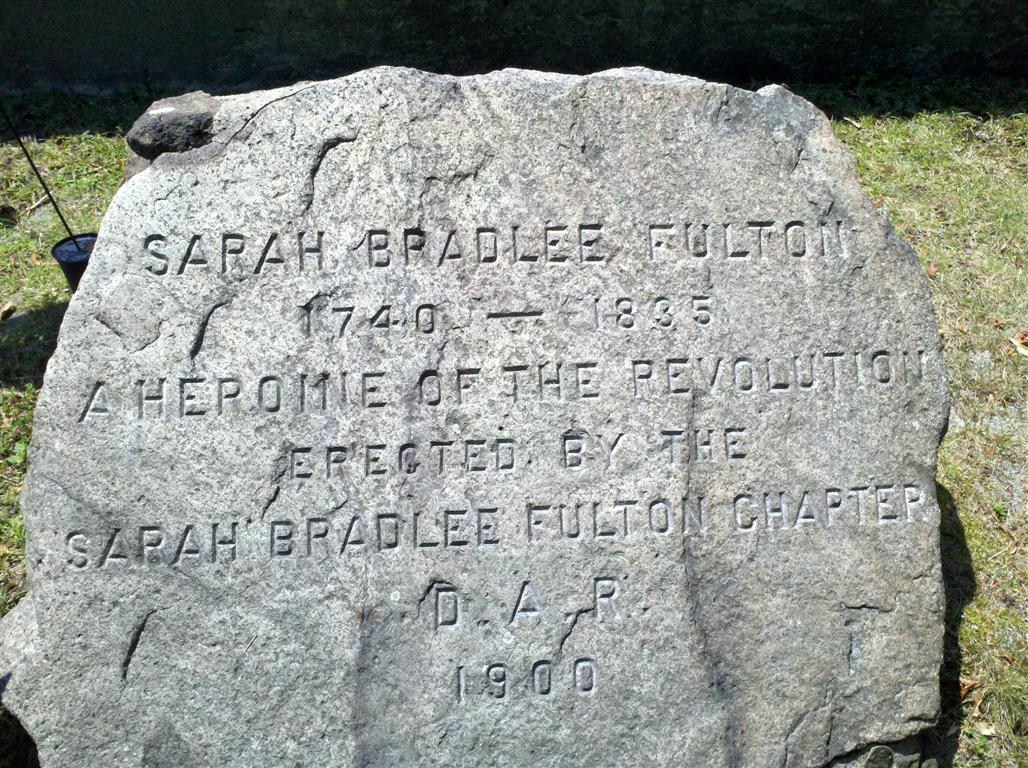
That ensured that Fulton had a constituency to keep her legend alive. In 1900 the Medford D.A.R. chapter graced the town cemetery with the stone marker shown above, calling Fulton “A Heroine of the Revolution.” She was also dubbed “Mother of the Boston Tea Party.” In 1919 the Bloomington, Indiana, D.A.R. chapter produced a three-act play about Sarah Bradlee Fulton to benefit wounded soldiers and sailors.

Monuments to Sarah Bradlee Fulton remain today. In addition to that stone marker, Fulton Street in Medford is named for her. Since 2006, the punchbowl she supposedly used when Washington visited has been in the collection at Mount Vernon. Fulton has her own Wikipedia page, and many other webpages hold her up as an exemplary female Patriot.

And it’s all based on family lore published a century or more after the events.

TOMORROW: Assessing the Bradlees.

Tuesday, November 19, 2019

“A family mansion with a history of the stirring times”

Yesterday I quoted a letter that appeared in the Boston Evening Traveler on the day after the centenary of the Boston Tea Party. It described how a young woman named Sarah Bradlee helped prepare her four brothers and future husband to disguise themselves as they destroyed the tea and to conceal themselves afterward.

That letter offered no evidence for its story beyond the belief of a descendant, and there were discrepancies between its details and the historical record. Nonetheless, a young Bostonian named Samuel Bradlee Doggett picked up on the tale. He spent decades repeating, and perhaps improving, the account.

In his 1894 book A History of the Doggett-Daggett Family, Doggett described himself this way:
Born [29 May 1858] and always living in a family mansion with a history of the stirring times of the Revolution, and associated in early life with those who could tell of those times, he developed an interest in ancestry, which resulted first in a short account of the Bradlee family, printed in 1878, and since that time in the accumulation of material for the present work.
The house Doggett referred to appears above in a photograph from the Digital Commonwealth collection. Nathaniel Bradlee built that home about 1770, and it stood on the corner of Hollis and what became Tremont Street until 1898.

The Traveler letter said Sarah Bradlee was active “at her father’s house,” which would have been difficult since he’d lived in Dorchester and died five years before. Doggett fixed that by stating that Bradlee had disguised the men in her brother’s house—the very house he lived in.

As a genealogist Doggett also corrected the timing of Sarah Bradlee’s marriage. She and her husband, John Fulton, married more than a decade before the Tea Party rather than afterward. In Doggett’s telling, the fact that she lived in Medford and had small children didn’t stop her from going to her brother-in-law’s house in Boston to help on the night of the Tea Party.

Doggett first printed his version of the lore as a single sentence in his History of the Bradley Family (1878), quoting from the Traveler letter (while leaving out the awkward incongruous bits). A few years later he communicated with Francis S. Drake, who retold the story in Tea Leaves (1884), incorporating detail that first appeared in the Traveler letter.

According to Drake, all four Bradlee brothers “lived in the house yet standing, on the southerly corner of Hollis and Tremont Streets.” (Nathaniel did, and Josiah, aged nineteen, might have. David and Thomas were married with families and homes of their own.) The Tea Leaves version:
Their sister, Sarah, assisted her husband, John Fulton, and her brothers, to disguise themselves, having made preparations for the emergency a day or two beforehand, and afterwards followed them to the wharf, and saw the tea thrown into the dock. Soon returning, she had hot water in readiness for them when they arrived, and assisted in removing the paint from their faces. As the story goes, before they could change their clothes, a British officer looked in to see if the young men were at home, having a suspicion that they were in the tea business. He found them in bed, and to all appearance asleep, they having slipped into bed without removing their “toggery,” and feigning sleep. The officer departed satisfied. Mrs. Fulton helped to dress the wounds of the soldiers who were in the battle of Bunker Hill. She died in Medford, Mass., in 1836, and is the authority for the above statement.
Since Doggett wasn’t born until 1858, there must have been some intervening transmission to him. There were direct descendants old enough to have heard from Sarah Bradlee Fulton herself, such as grandson John A. Fulton of Cambridge.

The most dramatic detail of this story—how “a British officer looked in” suspiciously—makes little sense since in 1773 the one British regiment in Massachusetts was stationed out on Castle Island. Lt. Col. Alexander Leslie provided a report on the tea destruction for the royal government from that perspective, but he wrote nothing about officers searching houses in Boston.

Other versions of the tale presented that detail in different ways. The 1873 Traveler version said, “a spy or officer…put his head within the door.” In an 1893 Boston Post article that referenced Doggett, “an indignant Britisher…insisted on doing a thorough search.” An 1897 article for the American Monthly magazine by Helen Tilden Wild, reprinted in the Medford Historical Society Papers, said, “a spy…peered in at the kitchen window.”

In 1896 a number of American newspapers, including the Omaha World-Herald, printed an article describing a conversation with Doggett, his father, and John A. Fulton at age 91. The writer presented Sarah Bradlee Fulton’s story in her voice, not saying whether her descendants supplied those words or the journalist came up with them. In this version, “some soldiers or spies” came into the kitchen of that old house on Hollis and Tremont. Again, there was no evidence offered to corroborate that detail beyond the belief of descendants and its dramatic power.

TOMORROW: The legends of Sarah Bradlee Fulton.

Monday, November 18, 2019

The Bradlee Family and the Tea Party

Last week I discussed David Bradlee, a tailor who showed up at three violent episodes in Boston within five months of late 1769 and early 1770.

Bradlee has also been linked to the Boston Tea Party, along with his brothers, brother-in-law, and sister Sarah. Indeed, Sarah Bradlee Fulton has been latterly dubbed the “Mother of the Boston Tea Party.”

That’s a relatively recent tradition. The earliest printed link between the Bradlee family and the destruction of the East India Company tea that I’ve found appeared in the 17 Dec 1873 Boston Evening Traveler—i.e., a century and a day after the actual event. It was a letter from someone in Medford who signed herself “E.M.G.”

A little digging tells me that letter came from Eliza M. Gill (1851-1924), a schoolteacher in Medford and later clerk at the town hall. She was the longtime secretary of the Medford Historical Society and a co-founder of the town’s chapter of the Daughters of American Revolution.

On the hundredth anniversary of the Tea Party, Gill wrote this letter to the Traveler editors:
I venture to send you the following facts of family history imparted to me by descendants, still living, of men who took part in the Boston tea party.

On the evening of the 16th December, 1773, Miss Sarah Bradlee, at her father’s house, assisted her four brothers, Nathaniel, Josiah, David and Thomas Bradlee, and John Fulton, whom she afterwards married, to disguise themselves as Indians, and saw them start to go to the wharf to take part in throwing the tea overboard.

She soon after followed and witnesses the emptying of the tea chests into Boston harbor. Before its conclusion, however, she returned home, and filling the copper vessels with water, had everything ready on the arrival of her friends, to remove all appearances of their disguise. In ten minutes nothing could be seen that would give any clue that any member of that household had participated in the bold affair. The light in the house, however, attracted the attention of a spy or officer, who put his head within the door, but seeing nothing to excite suspicion, left the party unmolested. The descendants of John Fulton are living in Medford, by one of whom the above was related.

That same evening Peter Harrington, a patriotic and enterprising citizen of Watertown, left his home also to go to Boston and take part in the same affair. His descendants are living in Watertown and Medford, one of whom I am, being the grand-daughter of his twelfth and youngest child, Eliza Harrington.
The letter didn’t offer evidence of the Bradlees’ or others’ participation in the Tea Party. Gill simply stated that at the outset as a fact. She asked readers to take her word as a descendant of Peter Harrington that he had helped to destroy the tea.

The Bradlee family story, also taken from a descendant, offered more vivid details. However, those details created holes. Gill said Sarah Bradlee was active “at her father’s house.” Her father had lived in Dorchester and died in 1768. Gill said Bradlee “afterwards married” John Fulton. That couple had married in 1762 and settled in Medford ten years later, having five children by the time of the Tea Party.

TOMORROW: But that didn’t stop the story from spreading.