J. L. BELL is a Massachusetts writer who specializes in (among other things) the start of the American Revolution in and around Boston. He is particularly interested in the experiences of children in 1765-75. He has published scholarly papers and popular articles for both children and adults. He was consultant for an episode of History Detectives, and contributed to a display at Minute Man National Historic Park.

Subscribe thru Follow.it


•••••••••••••••••


Showing posts with label George Washington. Show all posts

Wednesday, September 23, 2026

Thomas Lynch and the Continental Army’s Black Soldiers

On 23 Oct 1775, Thomas Lynch, Jr., and two of his colleagues in the Continental Congress, Benjamin Harrison and Benjamin Franklin, conferred with Gen. George Washington and political leaders of the New England colonies about setting up the Continental Army for the coming year ahead.

Most of the current army’s enlistments ran out in December. Only the rifle companies from Pennsylvania, Virginia, and Maryland had enlisted on different terms. They had promised to serve for twelve months, or until the middle of 1776.

One of the many questions that October conference considered was:
Ought not Negroes to be excluded from the new Inlistment especially such as are Slaves—all were thought improper by the Council of Officers?
Washington’s generals had followed his lead in voting to exclude black soldiers, though there were some opposing voices, as I discussed back here.

Thomas Lynch, as a southern planter and politician, almost certainly supported the idea of keeping black men out of the army. His fellow South Carolinian, Edward Rutledge, had even proposed pushing black soldiers out in September and “was strongly supported by many of the Southern Delegates,” according to the notes of Richard Smith of New Jersey.

That makes Lynch’s letter to Washington on 8 December particularly interesting. By then the general was worried that not enough men of any sort would re-enlist for the new year. If the British heard about an incredible shrinking enemy, Washington feared, in January they would charge out of Boston and Charlestown and overwhelm the thin Continental lines.

Lynch wrote to the commander:
I shall not take upon me to advise. tis as improper as needless. your Rifle Men, Negroes, & Deserters may in proper passes defend your artillery Ammunition & Stores[.] shoud your Lines be deserted, & the glorious, golden opertunity of ending the War be lost, let not Hope be lost also.
Somehow Lynch believed that the “Negroes” in the Continental ranks would still be available to Washington, along with the riflemen (whose enlistments were still in force) and “Deserters.”

It’s such a brief comment that it’s hard to know what Lynch was thinking. Did he expect the black soldiers would be in the same boat as the deserters, with nowhere else to go? Was he so used to ordering around enslaved people that he automatically assumed Washington could demand the “Negroes” stay?

Either way, Lynch’s remark was a backhanded acknowledgment that the Continental Army did have soldiers of African heritage, despite Rutledge’s efforts, and that they might be most valuable in the worst emergency.

Friday, September 18, 2026

Lund Washington’s Letter Mentioning William Lee’s First Wife

On 30 Dec 1775, Lund Washington wrote a letter to his distant cousin George, who was also his employer.

George was off in Cambridge commanding the Continental Army. As his cousin’s plantation overseer, Lund caught him up on various details of the operations at Mount Vernon.

As published in the Papers of George Washington in the 1980s and shared at Founders Online, that letter ended abruptly:
I will have gravel Carted for the walks. One of the men that went out with James Cleveland left him when he found they were likely to suffer.
There was no signature. “This document is incomplete,” said the editors, nonetheless adding a period to the end.

That letter was in the collection of Mount Vernon Ladies’ Association. At some point in the next quarter-century, scholars must have gotten a better look at it. Perhaps it had been mounted or otherwise sealed off.

Today Mount Vernon shares a scan of that page, plus the opposite side with the rest of the letter.

It turns out Lund Washington continued his sentence on the next page: “…were likely to suffer for want of provisions.” (George Washington had sent James Cleveland out to his Ohio claims.)

Later the letter says:
if it will give Will any pleasure he may be told his wife and child are both very well.
Directed to Gen. Washington from Mount Vernon, that comment had to refer to William Lee, his body servant, one of the few other people to make the trip to Massachusetts. It’s the only evidence to indicate that William, born about 1751, had married and fathered a baby before the war.

I didn’t know this source when I wrote about William Lee in a report for the National Park Service on Washington in Cambridge. That report highlights how in February 1776 the general paid Margaret Thomas to make shirts for Lee, years before the man told Washington that he and Thomas had married during the war. We don’t have any documents saying when Lee’s first marriage ended.

Mary V. Thompson, the Mount Vernon historian specializing in its enslaved community, cited Lund Washington’s 30 Dec 1775 letter in a 2014 article for the Journal of the American Revolution. It’s informed other writing about William Lee since, such as his entry at the Encyclopedia of Virginia.

However, Mount Vernon doesn’t share a transcript of the full letter. There’s no indication at Founders Online, which is based on the printed Washington Papers, that a more complete text exists. Rotunda’s index for William Lee doesn’t note this letter among the documents referring to the man.

The result is a scholarly paradox. Lund Washington’s letter to his cousin is now available for anyone to read. But half of it—perhaps the most interesting half—is impossible to find through the standard way to access George Washington’s correspondence.

Tuesday, September 15, 2026

New York City Has Fallen

On 15 Sept 1776, 250 years ago today, the Continental Army withdrew from the southern end of Manhattan Island, leaving the city of New York to the British army.

That’s an orderly way to describe what happened. Here’s Gen. George Washington’s official dispatch to John Hancock and the Continental Congress the next day:
in the morning they began their Operations—Three Ships of War came up the North River as high [as] Bloomingdale which put a total stop to the removal by Water of any more of our provision &c. and about Eleven OClock those in the East River began a most severe and Heavy Cannonade to scour the Grounds and cover the landing of their Troops between Turtle-Bay and the City, where Breast Works had been thrown up to oppose them.

As soon as I heard the Firing, I road with all possible dispatch towards the place of landing when to my great surprize and Mortification I found the Troops that had been posted in the Lines retreating with the utmost precipitation and those ordered to support them, [Samuel Holden] parson’s & [John] Fellows’s Brigades, flying in every direction and in the greatest confusion, notwithstanding the exertions of their Generals to form them.

I used every means in my power to rally and get them into some order but my attempts were fruitless and ineffectual, and on the appearance of a small party of the Enemy, not more than Sixty or Seventy, their disorder increased and they ran away in the greatest confusion without firing a Single Shot—

Finding that no confidence was to be placed in these Brigades and apprehending that another part of the Enemy might pass over to Harlem plains and cut off the retreat to this place, I sent orders to secure the Heights in the best manner with the Troops that were stationed on and near them, which being done, the retreat was effected with but little or no loss of Men, tho of a considerable part of our Baggage occasioned by this disgracefull and dastardly conduct—

Most of our Heavy Cannon and a part of our Stores and provisions which we were about removing was unavoidably left in the City, tho every means after It had been determined in Council to evacuate the post, had been used to prevent It. We are now encamped with the Main body of the Army on the Heights of Harlem where I should hope the Enemy would meet with a defeat in case of an Attack
William Douglas, a Connecticut militia colonel whose troops had been guarding an area near Kip’s Bay, told his wife that “my Left wing gave way” under the initial artillery fire:
I Lay myself on the Right wing, wateing for the boats untill Capt. [Jonas] Printice Came to me and told if I ment to Save my Self to Leave the Lines for that was the orders on the Left and that they had Left the Lines. I then told my men to make the best of their way as I then found I had but about ten Left with me.
Caesar Rodney, one of Delaware’s delegates to the Congress, was in the region, and he gathered this information:
the Ships…began a verry heavy Fireing at Turtle-Bay, to Scour the Country previous to their landing the troops, but hurt no Body that I Can hear of—When the Fireing ceased their Troops began to Land and ours to Run as if the Devil was in them in Spite of all the Genel. Could do. They never fired one Gun—

General Whashington haveing discovered their intention to Land at that place, and haveing properly disposed of his troops in case of an Attempt in either or both the other places, ordered a Reinforcement and set out there himself. However before he Got to the place, met our people runing in Every direction. He Endeavoured by persuasion, Threats &c. to get them back, but all to no purpose, in Short they Run till they left the General to Shift for himself—
A story went round that Gen. Washington was so angry that he threw his hat on the ground and shouted, “Are these the men with which I am to defend America?” (per Gen. William Heath) or “Good God, have I got such troops as those?” (per George Weedon). No one who was with Washington at the time described him behaving that way. But of course those men had other things on their minds—and may have thought such behavior was perfectly understandable.

Tuesday, September 08, 2026

“The British Empire Strikes Back” in New Jersey, 6–8 Nov.

The next Pursuit of History Weekend session is called “The British Empire Strikes Back,” and it will cover the New York and New Jersey campaigns from August 1776 to January 1777.

Here’s how we’re describing the developments of 250 years ago:
Even as the United States declared their independence, the British military returned to New York. Starting in August 1776, Gen. William Howe pushed Gen. George Washington off Long Island, off Manhattan Island, and down into New Jersey. The Continental Army struggled through battles at Brooklyn, Harlem Heights, White Plains, and Fort Washington.

By late December, the Congress was evacuating Philadelphia, Washington was estranged from top aides, and Continental soldiers’ enlistments were about to run out. Only by counterattacking Gen. Cornwallis and his Hessian vanguard at Trenton and Princeton did Washington reenergize the American cause.
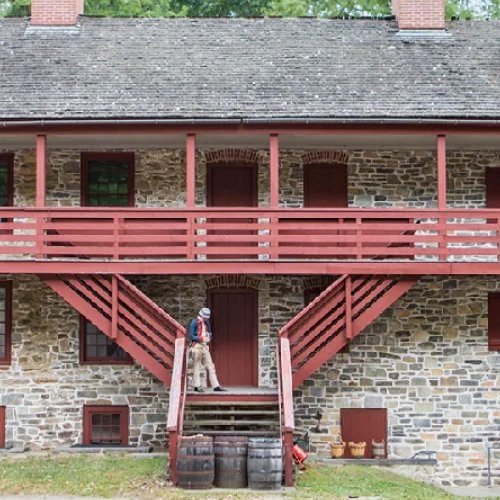
Our main meeting space for this weekend will be the Old Barracks Museum in Trenton, New Jersey, built to house troops in the French and Indian War. On 6–8 November, we’ll visit sites of fighting in that city; Washington Crossing, Pennsylvania; and Princeton, New Jersey. 

Here are some of the experts I’m eager to hear from:
  • Ricardo Herrera, Ph.D., joins the Pursuit of History Weekends as a program director and faculty member. He is Senior Historian at the George Washington Leadership Institute at George Washington’s Mount Vernon, having previously served as Professor of Military History at the U.S. Army War College and as an Armor and Cavalry officer. For the U.S. Army Center of Military History Rick wrote The New York Campaign 1776 (2026).
  • Friederike Baer, Ph.D. (friederikebaer.com), is the author of Hessians: German Soldiers in the American Revolutionary War (2022), honored with the American Revolution Round Table of Philadelphia’s Annual Book Award and the Society of the Cincinnati Prize. She is a Professor of History at Penn State University Abington College.
  • Benjamin L. Carp, Ph.D. (benjamincarp.com), wrote The Great New York Fire of 1776 (2023) and Rebels Rising: Cities and the American Revolution (2007), and other award-winning studies of the American Revolution. He holds the Daniel M. Lyons Chair in American History at Brooklyn College within the City University of New York.
  • William L. “Larry” Kidder, M.A. (wlkidderhistorian.com), has written several books about the Revolutionary War, including Ten Crucial Days: Washington’s Vision for Victory Unfolds, Crossroads of the Revolution: Trenton 1774–1783, and Revolutionary Princeton 1774–1783. He is a veteran of both the U.S. Navy and forty years of teaching high school.
  • Phillip Papas, Ph.D., explored the life of the Continental Army’s most confounding commander in Renegade Revolutionary: The Life of General Charles Lee (2014). Also author of That Ever Loyal Island: Staten Island and the American Revolution (2007), Papas is Senior Professor of History in the Economics, Government, and History Department at Union County College.
We’re still finalizing the schedule with the venues, but I expect to give some brief presentations as well.

Pursuit of History Weekends are limited to about forty people to facilitate discussion with speakers and among attendees. As of this holiday weekend, only ten slots are left.

For more information and to register, please visit this webpage.

Sunday, August 30, 2026

Long Island Has Fallen

On the morning of 30 Aug 1776, 250 years ago today, Gen. William Heath was stationed at Kingsbridge, New York, on the Hudson River just north of Manhattan Island.

Heath wrote urgently to his commander-in-chief:
A very Extraordinary Report has Just Spread here, that whether True or false we are as yet uncertain That Long-Island is Evacuated by Our Troops. . . .

I am in Anxiety Untill I hear from you
This letter is transcribed at Founders Online, and the Massachusetts Historical Society has digitized Heath’s copy.

Likewise, Abraham Yates, Jr., head of the New York committee of safety, wrote to the commander from the same place:
In our way to Fishkill agreable to an adjournment of the Convention, we are informed that the Army is removed from Long Island to the City of New York—

an anxiety to know the fact, as well as to be informed wether you think any measures necessary for us to take—Induces us to trouble your Excellency at this time for an answer hereto—

We have ordered last Night all the Militia of the Counties of Ulster, Dutchess, Orange and Westchester to be ready at a Minutes warning, with five days provisions.
Gen. George Washington wrote back to Yates:
Circumstanced as this Army was in respect to Situation Strength &c., it was the unanimous advice of a Council of General Officers to give up Long-Island, and not by divideing our Force be unable to resist the Enemy in any one point of Attack, this reason added to some others, particularly the fear of haveing our Communication cut of from the Main (of which there seemed to be no Small probability) and the extreame fatigue our Troops were laid under in guarding such extensive Lines, without proper Shelter from the weather, induced the above Resolution.

It is the most intricate thing in the World Sir to know in what manner to conduct ones self with Respect to the Militia, if you do not begin many days before they are wanted to raise them, you cannot have them in time, if you do they get tired and return, besides being under very little Order or Government whilst in Service—

However if the Enemy have a design of serveing of Us at this place as we apprehended they meant to do on Long-Island—it might not be improper to have a body in readiness to prevent or retard a Landing of them on the East of Harlem River, if need be—

In haste & not a little fatigued, I remain with great Respect & Esteem Sir Yr Most Obedt Hume sert…
Washington let the adjutant general, Joseph Reed, reply to Heath:
The Report of the Evacuation of Long Island last night is true—it was a Measure founded in the fullest Necessity after the Surprize of our Troops last Tuesday [the Battle of Brooklyn], by which the Flower of our Army & some of our best Officers were lost.

add to this that the constant Rains upon Troops without Cover has so spoil’d the Ammunition & enfeebled the Men that had the Enemy attempted to force our Lines they must have done it with great Ease. The Ships have also been trying to get up the whole Week, which if they could effect our Communication would have been cut off and the whole Army must have surrendered at Discretion.

Under these Circumstances the remaining General Officers were unanimously of Opinion that it was absolutely necessary to retreat which was done so as to bring off all our Ammunition & Artillery except the heavy Pieces & most of our Provisions—

Our Situation is in all Respects critical Ld. Stirling & Gen. [John] Sullivan are both Prisoners—the latter was permitted to come out this Morning on his Parole with a Message from Ld. Howe. This is the Substance of what has passed in this important Week.

Thursday, July 16, 2026

New Signage Installed at the President’s House During the Night

Since September 2025 I’ve been following the dispute over displays at the President’s House, part of Independence National Historical Park in Philadelphia.

Reflecting its overall ideology, the Trump White House ordered the National Park Service to replace signs discussing how that site had been a site of enslavement when George and Martha Washington lived there in the 1790s.

Because the city of Philadelphia had participated in creating the exhibit, it claimed legal standing to sue for the signs to be restored. A district judge agreed. A higher judge stopped the restoration process. Over the last month the full circuit ruled that the federal government could control the site and remake the signage.

Yesterday WHYY reported: “Workers replaced the remaining exhibits overnight Tuesday.”
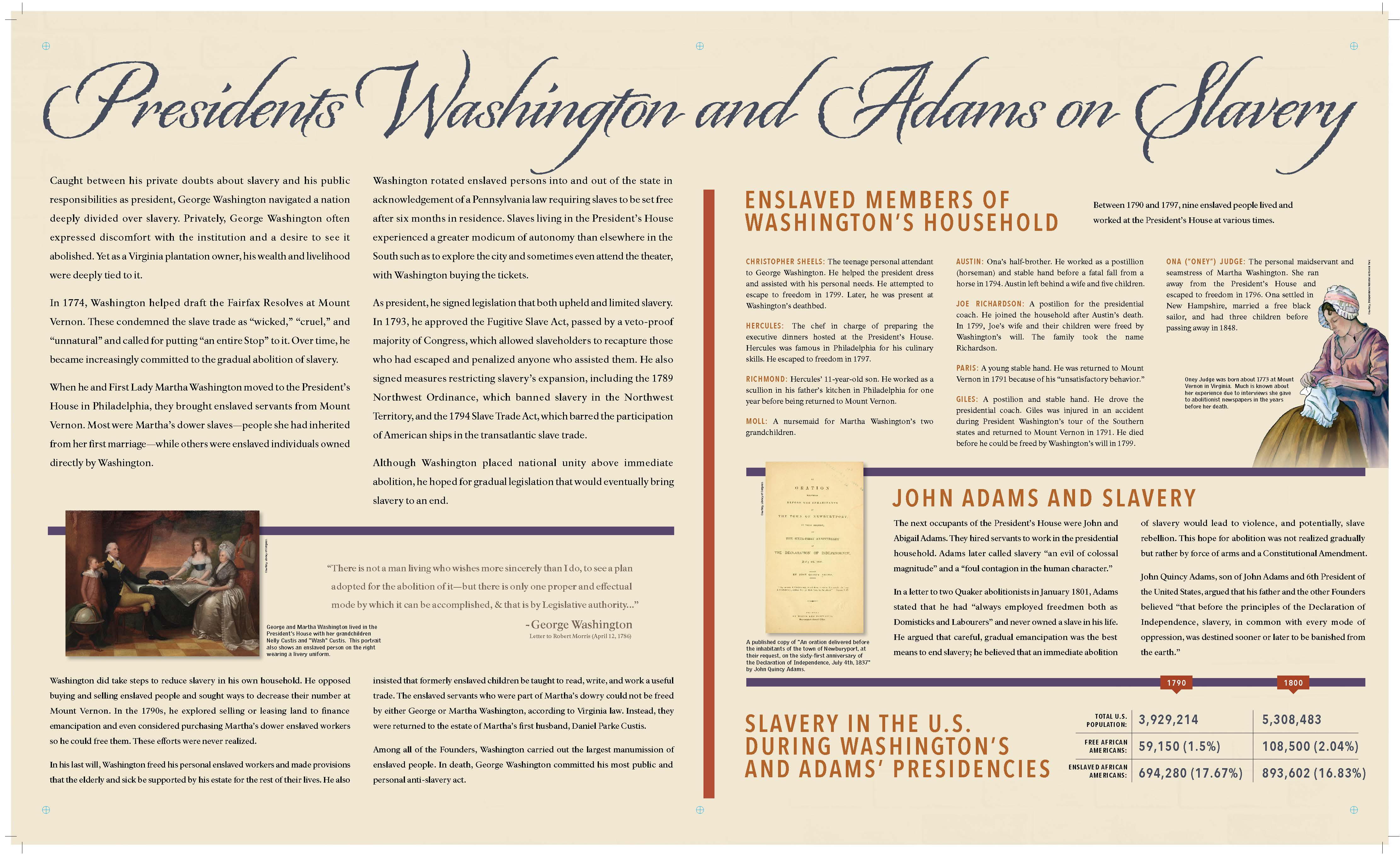
The new exhibit retains references to slavery and those enslaved by Washington while serving as president in Philadelphia, but it devotes significantly more space to the history of the executive mansion and the early presidency. A panel that had been titled “The Dirty Business of Slavery,” for example, has now been replaced by signage that reads, “Celebrating Independence Throughout the Years.”

It also softens Washington’s views on slavery compared to the previous display.

“In 1774, Washington helped draft the Fairfax Resolves at Mount Vernon,” one panel reads. “These condemned the slave trade as ‘wicked,’ ‘cruel,’ and ‘unnatural’ and called for putting ‘an entire Stop’ to it. Over time, he became increasingly committed to the gradual abolition of slavery.” . . .

on Wednesday, several armed members of the National Park Service Police were seen vigilantly watching over the site.

Park service officials stopped one activist, Dr. Sandra Shachar-Krasnoff of Philadelphia, after she briefly taped a piece of paper with “the excavation revealed a kitchen and a slave quarters below the president’s house site” to one of the walls.

She was fined $310.
The photo above, taken by Abraham Gutman for the Philadelphia Inquirer, shows a federal officer writing a citation for Dr. Shachar-Krasnoff. The Inquirer also reported that the N.P.S. installed security cameras at the outdoor site last week, ostensibly because the All-Star Game was about to be played in the city. So there’s no doubt the government will surveil the walls more tightly.

The park website displays eleven large new panels, but the Inquirer states there are also “more than a dozen smaller panels that detail governmental processes, the lives of various historical figures, and a panel dedicated to the escape of Ona Judge and Hercules [Posey], two people enslaved by Washington who fled to freedom.”

All told, says the Inquirer, “the new exhibits mostly offer a broad timeline of U.S. history that significantly strays from the original intent of the President’s House as outlined in the park’s foundation document in 2017: ‘It would explore the historic context of the site in the context of its ties to slavery and the lives of the enslaved who lived at the site.’”

There’s already an effort to have Philadelphia erect a historic marker about Hercules Posey outside of federal control, like one already up for Ona Judge.

Monday, July 13, 2026

“Headquarters of a Revolution” in Cambridge, 19 July

On Sunday, 19 July, the Longfellow House–Washington’s Headquarters National Historic Site in Cambridge will host a commemoration called “Headquarters of a Revolution: Washington’s Arrival in Cambridge,” coinciding with the 251st anniversary of the new commander-in-chief’s first week living in that mansion.

Here are the events scheduled for that day, including two from me.

10 A.M. to 3 P.M.
Living History
On the Lawn

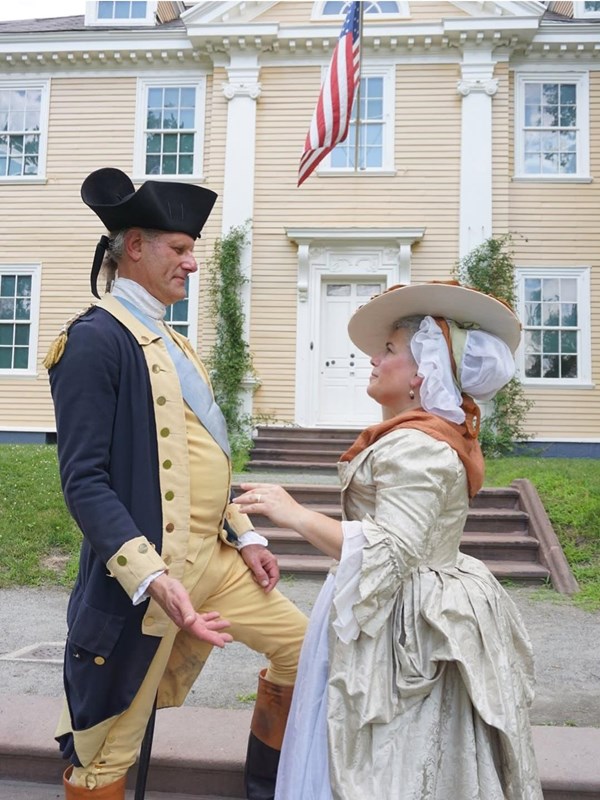
Interact with living historians John Koopman (as George Washington) and Sandy Spector (as Martha Washington), including a noontime Q&A with Mrs. Washington. Free family activities and a story walk available all day.

10 and 11:30 A.M., 2:30 P.M.
House Tour: Headquarters of a Revolution
Starting in the Visitor Center

General George Washington’s Cambridge headquarters was a testing ground for many of the ideals, institutions, and questions that still define our nation. This conversational tour with an N.P.S. ranger explores Cambridge Headquarters as a hub of revolutionary activity, where generals, enslaved people, paid laborers, poets, Indigenous diplomats, politicians, and soldiers shaped history—and how later generations would shape its memory.

10:15 A.M.
Get Ready with Martha
Carriage House

Learn all about the clothing of 1775 as Mrs. Washington finishes dressing for her day. There will be some stories and some gossip, too! Sandy Spector is a Boston-based historian, researcher, and interpreter, and has been a Revolutionary War reenactor since 2000. She spends most of her time researching and interpreting Mrs. Washington and has been portraying Martha—alone or with George—in numerous states and venues for the past 10 years.

11:30 A.M. to 12:15 P.M.
The Last British Army to Come Through Cambridge
Carriage House

In November 1777, nearly 6,000 soldiers of the king arrived in Cambridge. With them came about a thousand women and children. These weren’t invaders but prisoners of war, British and German, captured at Saratoga. Top officers were housed in mansions along “Tory Row” while enlisted men went into the leftover barracks on Prospect and Winter Hills. Over the next few months Cambridge, Charlestown, and neighboring towns had to adjust to a new population under guard. J. L. Bell explores what we should remember about this “Convention Army” as we approach the 250th anniversary of its arrival.

12:30 to 1:15 P.M.
“Though Dwelling in a Land of Freedom”
Carriage House

Join poet, educator, and Darby Vassall descendant Denise Washington for an exploration of Revolutionary-era freedom struggles surrounding Washington’s Headquarters through the lens of Anthony, Cuba, and Darby Vassall, as well as Phillis Wheatley Peters.

1:30 to 3 P.M.
The Black Patriots of Lexington – Silas Burdoo
Carriage House

This film explores the role that third-generation Lexington resident Silas Burdoo played in the Revolutionary War, starting with the battle on 19 Apr 1775. Burdoo was a grandson of Ann and Philip Burdoo, who married in Medford in 1704 and then purchased 40 acres in Cambridge Farms, which became Lexington. This film screening will be followed by a discussion with Zine Magubane, professor of historical sociology at Boston College, and Sean D. Osborne, producer of the Black Patriots of Lexington YouTube series.

3 P.M.
What Washington Saw on Cambridge Common
Walking Tour starting at the gate at the southern tip of the common

What did the center of Cambridge look like in July 1775? Since April, the town had been the base of the New England army besieging Boston, with war transforming the community. On this walking tour J. L. Bell looks at sites in and around the common, including the first headquarters, buildings turned into barracks, and the Continental artillery’s lost laboratory. How well do the Washington Elm and the Revolutionary monuments that dot the common memorialize the men who were actually there?

All of these events are free, as organized by the National Park Service.

Saturday, June 27, 2026

New Boston Museum Exhibits to Visit During the Sestercentennial

Two venerable Boston museums are unveiling big reworked exhibit spaces for the Sestercentennial.

At Revolutionary Spaces’ Old South Meeting House, “Ruckus!” opens formally on 2 July. This is a 25-minute “immersive” show that
drops you right into the heart of the debate and defiance that once filled this iconic space, where ordinary people set extraordinary change in motion.

From the floorboards to the balconies, you will be surrounded by dynamic sound, lighting, and projected animations of fiery revolutionaries, determined citizens, and some unlikely troublemakers whose courage shook these walls.
Revolutionary Spaces encourages people to buy tickets in advance since space at each showing is limited. Arrive around the top of the hour, and the show begins at fifteen minutes past. Tickets include admission to all of Old South’s exhibits and the Old State House.

“Ruckus!” includes loud noises and dynamic lighting to reflect the intensity of the story it tells. It therefore might not be comfortable all visitors. Revolutionary Spaces also offers “Sensory-Friendly Mornings” at the Old State House each month.

The Museum of Fine Arts has reopened its “Art of the Americas: 1700–1800” galleries with a new, hemispheric approach. Thomas Sully’s massive painting of Washington crossing the Delaware stayed where it is, but lots of other iconic artworks are arranged in a new way.

The museum says:
The MFA’s reimagined galleries of 18th-century Art of the Americas bring together works from across North, Central, and South America, and the Caribbean—including works by Native American and Indigenous makers. Together, the eight spaces in this suite, organized by theme, explore how artists have contributed to, or in some cases resisted, ideas of nationhood and identity. Visitors can immerse themselves in expansive versions of familiar stories, discovering the interconnectedness of the Americas and its history, institutions, and people.
The galleries have the themes of “Power and Resistance,” “History and Mythmaking,” “Asian Styles in the Americas,” “Boston’s World,” “Something’s Brewing” (not revolutions but caffeinated beverages), “Communities of Makers,” “Families at Home,” and “Copley’s Ambition.”

Sunday, June 14, 2026

Forgetting the Faiths of New England’s Revolutionary Founders

Thomas Lecaque, professor of history at Grand View University in Iowa, wrote at Religion Dispatches about the Pentagon’s recent move to “reduce the list from over 200 unmanageable categories to 31.”

After pointing out several ways the administration has promoted Christian nationalism over other religious approaches, Lecaque wrote:
[Assistant to the Secretary of Defense for Public Affairs Sean] Parnell’s statement feints at pluralistic neutrality, but stating that the Chaplain Corps is there to “provide the best spiritual care to our warfighters” suggests that what military personnel of all (real) religious backgrounds—which includes lots of kinds of Christians; agnostics, atheists, and Other Religions-ists; as well as Sikhs, Jews, Muslims (that one had to hurt), Hindus, Buddhists, and Baha’i—are really entitled to is Christianity-inflected pastoral care.

Guess who didn’t make the list, though?

Unitarian Universalists, Congregationalists, and Deists. Which, if you’re keeping score at home, you’ll recognize as the religious affiliations of Founding Fathers John Adams, Samuel Adams, Benjamin Rush, Paul Revere, Ethan Allen, Benjamin Franklin, Thomas Paine, Hugh Williamson, James Wilson—and possibly of Thomas Jefferson, James Monroe, and George Washington (who were raised Anglican, and, as historians have noted, demonstrated Unitarian, Deist, and/or semi-secular leanings).
This decision seems to reflect both the prejudices and the ignorance of Defense Secretary Pete Hegseth, who back in April solemnly read out quasi-Biblical lines from the Japanese action movie Karate Kiba, filtered through the U.S. action movie Pulp Fiction.

Lecaque went on to say, “We could argue these exclusions don’t matter—in a country that ‘to bigotry gives no sanction, to persecution no assistance,’ the Founders’ religious commitments (or lack thereof) should be immaterial.” He thus correctly quoted President Washington’s letter to the Touro synagogue in Newport. “But for an administration whose officers and supporters keep talking about Originalism as if it’s real (it’s not), people trying to wrap this country in the flag and the cross for its birthday party, the irony and hypocrisy somehow still manage to sting amidst larger horrors.”

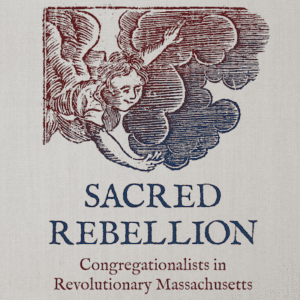
Meanwhile, the Congregational Library in Boston has announced it will reopen its free exhibition “Sacred Rebellion: Congregationalists in Revolutionary Massachusetts” on eight dates in June, July, and August. On each of those days there will also be a curator’s tour for $5 at 1 P.M.

Monday, June 08, 2026

“Washington and slavery have always been particularly instructive”

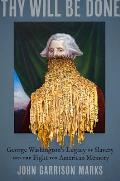
At Commonplace, Karin Wulf of the John Carter Brown Library interviewed John Garrison Marks about his new book, Thy Will Be Done: George Washington’s Legacy of Slavery and the Fight for American Memory.

Wulf started with an introduction reiterating that talking about the Washingtons’ slaveholding is far from new in American culture:
As anyone reading this will likely know, and as John Marks notes below, a remarkable volume of important research detailing George Washington’s (and Martha Dandridge Custis Washington’s, and their family’s) investment in slavery has been published over the last two decades. In conjunction with critical work on other “founders,” namely Thomas Jefferson, this work has helped usher in a shift in public perspective that has been greeted with angst by those who either didn’t know or don’t want to know about the foundational role of slavery at the founding, but also by relief among the many who did and do.

This book is different. It takes up the question of how this very specific issue about the first president—his role as an enslaver—was debated over centuries. In other words, this was not a phenomenon that leapt upon a settled historical narrative unbidden from the culture wars or the specific spate of racial violence that called forth the Black Lives Matter movement. For me, there was another dimension.

As soon as I heard about John’s project some time ago, I was intrigued in part because at one point I checked out a number of copies of Washington’s will printed in the 19th and 20th centuries. Why, I wondered, were so many people keen to have to hand a copy of what Washington willed? In part it has to do with the vexed issue of manumission. John shows, in this book that helps us to see historical memory in motion, Washington and slavery have always been particularly instructive.
In the interview, Marks noted three ways Americans have discussed George Washington’s connection to slavery. Some complain about exploitation and hypocrisy, some insist on reverence for the other things he did, and some argue we should focus on how he moved away from slavery over his lifetime. “What was really fascinating in researching the book was how early and consistently all three of these perspectives appeared in the record,” Marks added, finding examples of each approach in the period of his death.

Friday, May 29, 2026

Meeting the Real Samuel McClellan

Yesterday’s post introduced Samuel McClellan (1730–1807) of Woodstock, Connecticut, the captain of a militia troop of horse in 1774.

McClellan was a shopkeeper and landowner in his small town. After the Revolutionary War he became a brigadier general in the state militia.

The McClellans remained locally important, and one of his great-grandsons was Gen. George B. McClellan of the Union Army and the 1864 Presidential race.

As often happens in that situation, Samuel McClellan’s descendants were influential enough to get their understanding of his role in the Revolution into local histories and biographical profiles when primary sources were hard to consult. For example, the 1902 National Cyclopedia of American Biography said:
On Oct. 13, 1773, he was commissioned captain of a fine troop of horse, raised in the towns of Pomfret, Woodstock, and Killingly, and led it Boston on receipt of the news of the battle of Lexington. He passed through the battle of Bunker hill uninjured, and in commemoration of that his wife planted three elm trees in front of residence, which attained great size and were standing when Gen. George B. McClellan visited Woodstock in 1884.
Ellen Douglas Larned’s History of Windham County, Connecticut: 1760–1880 says there were originally four elms.

The latest version of that lore is Samuel McClellan’s Wikipedia page, which as of this week says:
In 1775 Major Samuel McClellan led 184 men at the Battles of Lexington and Concord. He played a prominent role in the Battle of Bunker Hill, and after achieving the rank of lieutenant colonel in 1776, colonel in 1777, and brigadier general of the 5th Brigade in 1779, his regiment of the Connecticut Militia was stationed near New Jersey. McClellan was solicited by General George Washington to join the Continental Army and was offered a commission, but his domestic and business affairs compelled him to refuse.
That overstates the facts in multiple ways, starting with how McClellan wasn’t commissioned a major in the militia until October 1775.

News of the outbreak of war in Massachusetts didn’t reach Woodstock until 20 April, after the fighting was over, so there was no way men from that town were “at the Battles of Lexington and Concord.” Col. Israel Putnam was one of the first men from Connecticut to respond. On 21 April he wrote from Concord to say that the Massachusetts Provincial Congress hoped that Connecticut would send 6,000 men for “a standing Army.”

Putnam added as a postscript: “The Troops of Horse are not expected to come until further notice.” But Capt. McClellan had already led his 184 mounted men north into Massachusetts. That’s shown by Connecticut records of militia service, as tabulated here.

However, those same records also show that McClellan was paid for only eight days of service. Like most of his neighbors, he went home when it was clear the emergency had passed. Some men stayed or returned and enlisted in what became the New England army. McClellan didn’t.

There’s no evidence putting McClellan at the Battle of Bunker Hill or on the siege lines around Boston at the time. That undercuts the claim he “played a prominent role” in the battle, but it does explain how he remained “uninjured.”

Later in the war McClellan did mobilize with his militia regiment for short assignments in the Northern Department. He also served in the Connecticut assembly and as a commissary. In that last capacity his name comes up in Washington’s papers, but there’s no direct written solicitation from the commander for McClellan to join the Continental Army.

McClellan apparently left a fowling-piece, made by the Massachusetts gunsmith Joel White, equipped with a bayonet mount and bearing the initials “SMC.” That’s been displayed as a weapon from the Battle of Bunker Hill. McClellan may well have carried it during the Revolutionary War, but not at that fight.

Wednesday, May 20, 2026

“Entirely useless by breaking off the Trunnions”

Yesterday I started quoting a 29 Apr 1776 letter from the Rev. Dr. Samuel Cooper to Samuel Adams about Boston’s defenses soon after the British military left.

That letter goes on to say:

The Enemy employ’d no little Time in…destroying the Guns: The Trunnions of all of which, except 8 or so, they entirely knock’d off, besides spiking up the Touch holes in the most effectual Manner.
“Trunnions” was a term technical enough not to appear in Dr. Samuel Johnson’s dictionary. Merriam-Webster now defines them as the pivots on which something can be rotated or tilted, particularly the “two opposite gudgeons on which a cannon is swiveled.” (And it defines “gudgeons” as pivots.)

This overhead view of a cannon might convey the information better.
A gun carriage held a cannon by the two horizontal trunnions. They provided the fulcrum that allowed gunners to point the cannon up or down. A cannon without its trunnions was a heavy metal tube, very hard to mount and impossible to aim. Or, as Gen. George Washington deemed the broken guns left behind in Boston, “entirely useless.”

British artillerists broke trunnions to keep the rebels from having useful weapons. In Concord on 19 Apr 1775, Ens. Henry DeBerniere reported, “Capt. [Mundy] Pole of 10th regiment…knock’d the trunnions off three iron 24 pound cannon and burnt their carriages.”

With little other choice, the Continental Army still tried to use such damaged artillery pieces. Dr. James Thacher reported that the army started out with “a few old honey-comb iron pieces, with their trunnions broken off.” The doctor was pleased when Capt. John Manley and Col. Henry Knox brought in some intact guns.

Given that expertise, and necessity, on 24 March Washington expressed hope that Boston’s broken and spiked cannon “may be made serviceable again.” But how?

TOMORROW: A genius appears.

Thursday, May 14, 2026

Twenty Years of Boston 1775

Twenty years ago today, on 14 May 2006, I posted my first item on this blog.

That post was a link to an article I’d written for the magazine then called New England Ancestors, now American Ancestors, published by the New England Historical and Genealogical Society.

The original link broke. A subsequent link from 2012 broke. But Boston 1775 is still here.

That article described how a message from Dr. John Homans to his mentor, Dr. Joseph Gardner, in the first days of the Revolutionary War was detoured by the duplicitous Dr. Benjamin Church, Jr.

Last August I revealed other messages that Dr. Church diverted into the files of Gen. Thomas Gage, from Boston magistrate Edmund Quincy to his daughter Dorothy and her fiancé, John Hancock.

Tonight I’m speaking in Stoneham about how Dr. Church managed to infiltrate Gen. George Washington’s network for sneaking intelligence out of besieged Boston before the Continentals realized their surgeon-general as a spy.

One way to look at this situation is that after twenty years of daily blogging I’m still working the same ground.

Another is that Dr. Benjamin Church’s treachery is an endless source of revelations and fun.

Saturday, May 09, 2026

Declarations of Independence around Boston—Collect Them All!

To commemorate the 250th anniversary of the Declaration of Independence, multiple institutions in greater Boston have collaborated to lay out a Declarations Trail—exhibits of different significant copies of that document.

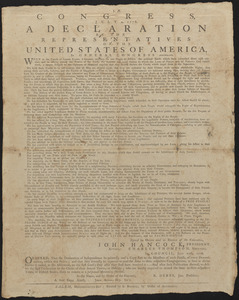
The Leventhal Map Center at the Boston Public Library has opened “Declarations: Printing a New Nation” with eight printings from broadsides and newspapers, along with maps showing the spread of that news. It will be up through 13 September. Shown here is the library’s copy of the Declaration as printed by Ezekiel Russell for the newly independent Massachusetts government.

The Boston Athenaeum exhibit “Imagined Nation” displays early printings in the context of such items as George Washington’s copy of Thomas Paine’s Common Sense, maps of the young republic, and World War II–era posters. That runs through November.

The Massachusetts Historical Society’s “1776: Declaring Independence” display, up through December, includes “handwritten copies of the Declaration by John Adams and Thomas Jefferson as well as multiple early printings, including a rare Dunlap broadside.” That was the first official presentation of the text, commissioned from printer John Dunlap by the Continental Congress in July 1776.

In Cambridge, three parts of the Harvard University library system are creating linked displays. The university archives is offering “Harvard and the American Revolution.” Next week the Harvard Map Collection will open “Charting Independence.” And starting on 18 May the Houghton Library will host “War of Words,” a display assembled by curator John Overholt to feature “the posters, pamphlets, newspapers, and images that brought news of the American Revolution to those who lived through it.”

In addition to the sites on the Declarations Trail, the Commonwealth Museum regularly displays Mary Katherine Goddard’s official reprinting of the Declaration signed by John Hancock and sent to the state in 1777.

And the “The Road to Revolution: Massachusetts and the Independence Movement” exhibit in Revolutionary Spaces’s Old State House, drawing on material from the M.H.S., includes a “rare 1776 Boston broadside printing of the Declaration of Independence.”

Most of those exhibits are free to the public. Many have special tours, talks, and workshops scheduled as well.

In a parallel initiative, five Revoloutionary-era institutions with admission fees—the Paul Revere House, Old State House, Old North Church, Old South Meeting-House, and King’s Chapel—have combined to offer visitors the Boston 250 Pass with a 10% on regular adult admission.

Friday, May 08, 2026

“The only ‘emancipation’ relevant to this site was Ona Judge’s own”

On 21 April, the Philadelphia Inquirer shared an opinion piece about the President’s House exhibit by Sharon Ann Holt, a public historian recently retired from Penn State Abington.

Holt was previously director of education and interpretation at the Historical Society of Pennsylvania and director at the Sandy Spring Museum in Maryland. She’s the author of Freedom Pay: North Carolina Freedpeople Working for Themselves, 1865–1900.

The web headline for Holt’s essay is “We can’t give in to the Trump administration’s attempts to make the history of slavery invisible in Philadelphia.” I don’t know if it appeared in the newspaper’s print edition, and the webpage now behind a paywall unless one has a guest link. So here’s an extended extract:
The digital images posted on the Park Service’s website make it clear that, under Donald Trump, the first priority of the Park Service seems to be to make enslaved people and slavery itself as invisible as possible. Panels that discussed the lives of urban enslaved people, Philadelphia’s free Black community, the Washingtons’ enslaved “family,” fugitives from enslavement (and the laws Washington signed to reclaim them) have all disappeared. The rich biographies of Christopher Sheels, Hercules, Richmond, Austin, Giles, Ona Judge, Joe Richardson, Moll, and Paris have shrunk to single sentences. . . .

So what stories are they telling? George and Martha’s determination to flout Pennsylvania’s six-month limit on holding people in slavery is reframed as a lovely gift of theatre tickets rather than their cynical move to get enslaved people across the river to New Jersey, thus restarting the six-month residential countdown. I’m surprised the Park Service left out the Washingtons’ “kind” willingness to let enslaved workers visit their families left behind in Virginia, which worked the same trick.

If Park Service bureaucrats value relevance, I challenge them to explain the transformation of the story about 18th-century slavery at the President’s House into a puzzling evocation of the Emancipation Proclamation of the 19th century and the Civil Rights Movement of the 20th century. Is it that, to them, all stories having to do with African Americans belong in the same place? They must think so, because they have randomly added completely irrelevant references to Frederick Douglass, the Civil War, the Rev. Dr. Martin Luther King Jr., the Underground Railroad, and Abraham Lincoln to the history of the President’s House.

Worse, the Park Service has embraced sentimental claims that Washington, Thomas Jefferson, and James Madison all “had their doubts” about slavery from the beginning.

None of those “doubts” persuaded the Founders to end slavery when they could have, either in our founding documents or in their own personal lives. None of the 19th- and 20th-century stories that the Park Service has shoehorned into their new panels ever involved the President’s House at all. The only “emancipation” relevant to this site was Ona Judge’s own self-liberation — the very story the Park Service has all but erased.

Speaking of irrelevance, the opening panels are even more laughable. Park Service interpreters have decided to feature discussions of the 1876 Centennial, the 1926 Sesquicentennial, and the 1976 Bicentennial, all of which happened long after the President’s House had been remodeled into oblivion or entirely demolished. . . .

If the judges choose these new panels to replace the ones taken down earlier this year, they will disparage millions of Americans who have struggled since 1776 to improve on the shaky foundations the founders laid. The President’s House should honor those struggles, alongside the nine people enslaved there by George and Martha Washington.
While Holt directs her critique at the National Park Service, which produced this revised signage, it’s clear that agency was working under directives from the White House. Based on what sort of historical presentations the White House has produced on its own, N.P.S. historians undoubtedly worked hard to drag this material into the realm of historical fact, even if it’s far from complete and relevant.

Thursday, May 07, 2026

A Closeup Look at the President’s House in Philadelphia

I’ve been following the story of the President’s House site within Independence National Historical Park.

That structure marks the residence of George Washington and John Adams before the District of Columbia was built and also memorializes the people enslaved to the Washingtons who lived and worked there.

In September, we first learned that White House policy was putting pressure on the park to change the signage on that site. In January, the signs were taken down.

In February, after the city of Philadelphia filed a lawsuit, a judge ordered the signs be put back up. But then a higher judge halted that process while also requiring those signs already restored to remain. The U.S. Circuit Court has upheld that stasis.

Last month I traveled to Philadelphia for the Pursuit of History’s weekend examining the creation of the Declaration of Independence. One morning I walked through the President’s House.

Most of the frames for signs are empty; the few panels that have been restored appear to be almost random. In some of the blank spaces people had posted small images of the missing signs. While I was there, a local taped a large sheet of paper in another space along with two markers, inviting people to share their own thoughts on the controversy. I presume those unofficial displays are taken down each evening and replaced each day.

In April the National Park Service unveiled new draft signage, created (by people unknown) to please the White House. Those panels now appear on the webpage for the President’s House Site. WHYY reported:
The new panels include references to slavery, the Underground Railroad and figures like Frederick Douglass. Like the previous panels, they also make mention of the nine enslaved people held by Washington while he was president and living in Philadelphia.

However, they would have changed the overall tone of the site, softening and significantly reducing references to slavery, and shifting the focus toward the “anti-slavery sentiments” of the slave-owning Founding Fathers. For example, text on one notes that the U.S. Constitution did not contain the word “slavery,” and another one argues that Washington had “doubts” about the institution.
Local critics called that revision “whitewashing” and “maliciously outrageous.”

TOMORROW: A historian’s take.

Tuesday, March 24, 2026

“Fire Ships and fire Rafts, covered by the Smoke of Cannon”?

After evacuating Boston on 17 Mar 1776, the British military was gone—and yet not gone.

The troops, their families, their support staff, royal appointees, and more than a thousand Loyalists had embarked on more than a hundred ships, but those ships were bobbing in the outer harbor.

People worried that the army or navy would attack Boston or other coastal towns, either for supplies or for revenge. The Continental forces had a few armed schooners, good for capturing isolated merchant ships but not up to taking on a royal frigate, much less a fleet.

On 21 March, Josiah Quincy wrote to Gen. George Washington about what he could see from Braintree:
Since the Ships and Troops fell down below, we have been apprehensive of an Attack from their Boats, in Pursuit of live Stock; but, yesterday in the Afternoon, we were happyly relieved, by the Appearance of a number of Whaleboats, streching across our Bay, under the Command (as I have since heard) of the brave Lieut. Colo. [Benjamin] Tupper, who in the forenoon had been cannonading the Ships, with one or more field Pieces from the east Head of Thompson’s Island; and, I suppose, last Night cannonaded them again from the same Place, or from Spectacle Island.

This judicious Manœuvre had its genuine Effect; for, this Morning, the Admiral [Molyneux Shuldam], and all the rest of the Ships, except one of the Line came to sail, and fell down to Nantasket Road; where a countless Number is now collected:

In Revenge for their burning the Castle last Night; were we provided with a sufficient Number of fire Ships and fire Rafts, covered by the Smoke of Cannon from a few Row Gallies; this Night, might exhibit, the most glorious Conflagration, that was ever seen upon the watery Element, and the probable Consequences of it, a Period to the present War, otherwise, Humanity revolts at the Destruction of so great Number, even of our Enemies.
A fireship, as Samuel Johnson defined it, was “A ship filled with combustible matter to fire the vessels of the enemy.” Sometimes they carried not just combistibles but explosives. The tactic was to send such a ship toward a group of enemy vessels, set it afire, and get off safely while it continued on. A flaming fireship was probably the most fearsome single weapon of eighteenth-century warfare. Even if it didn’t damage enemy ships, they had to scramble to stay out of its way, and captains might decide to move on.

It seems significant that the Americans at this time wrote mostly about “fire Rafts.” That seems like a cheaper form of fire ship, not able to carry as much or be steered as easily, dependent on prevailing currents.

Quincy was a senior member of the Massachusetts Council and energetic supporter of the war. Gen. Washington wrote back to him on 24 March, 250 years ago today: 
The continuance of the Fleet in Nantasket Road affords matter for Speculation—it surpasses my comprehension—and awakens all my Suspicions—I have taken every step in my power to guard against Surprizes, but the temper of your People, seems to me to be, to apprehend no danger till it stares them in the Face—

I do not think there is cause to apprehend such Marauding parties as you dread—if any stroke is aimd, it will be a capitol one, for which reason I wish to be much upon my guard; & therefore have appointed Guard Boats, lookouts, &ca—there is one evil I dread, & that is their Spies, I could wish therefore that the most attentive watch was kept to prevent any Intercourse between the Ships & Main
He urged Quincy to set up a shore guard watching for such infiltrators, promising to pay those men’s wages.

Washington sent that reply through Gen. Artemas Ward and added this order for his second-in-command:
As these favourable Winds do not waft the fleet from Nantasket, my Suspicion’s are more and more roused. I wish therefore the Fire Rafts talkd of by Colo. Tupper, could be attempted in a Windy, or dark Night, I think this would discover their designs if no other good effect resulted from it.
TOMORROW: The next day’s action.

Sunday, March 15, 2026

“After Evacuation” in Cambridge, 19 Mar.

On Thursday, 19 March, I’ll speak at Longfellow House–Washington’s Headquarters National Historic Site on the topic “After Evacuation: What Came Next for General Washington and the American Colonies.”

Back in January I spoke in that same space about Col. Henry Knox’s “Fine Train of Artillery” and the end of the siege of Boston. Here’s the video of that presentation. This talk will pick up when that left off.

Here’s our event description:
On March 17, 1776, the British military pulled out of Boston, giving General George Washington his first victory of the Revolutionary War. Already, however, he was positioning the Continental Army for the redcoats to return. Meanwhile, the political atmosphere had changed, sending the thirteen colonies in a new direction. This year’s annual Evacuation Day talk explores how much changed during the siege and what lay ahead as the Washingtons left Cambridge.
One detail I haven’t decided whether to include is the honorary doctorate that Harvard College conferred on Washington on 3 Apr 1775, as discussed back here. This was the first time the college gave an LL.D. degree.

The Rev. Dr. Samuel Cooper wrote in his diary about signing the handwritten diploma on 4 April. Then Cooper went to Cambridge to say farewell to the general and presumably help to deliver that document, only to find that Washington was already on his way south. No word about how the diploma eventually made its way to the man.

To reserve a seat at my talk on Thursday, or learn about how to look in online, go to this page.

Friday, March 13, 2026

A Council of War in Roxbury

Early on the morning of 13 Mar 1776, 250 years ago today, Gen. Artemas Ward received a note from Stephen Moylan, muster-master general of the Continental Army, who was acting as an aide to George Washington, commander-in-chief.

Moylan wrote:
His Excellency the General, wants to Consult with you, General [John] Thomas, & General [Joseph] Spencer upon many matters & as he does not think it prudent at this time, that you all Should be So far as Cambridge from your posts, I have it in Comand to inform you that he will Call at your house or General Thomas’s this day at ten ôClock, where he will expect to meet you & them
I imagine a bit of a scramble that morning as the generals on the southern wing of the Continental siege lines prepared to receive their boss.

(It’s notable that Moylan didn’t mention Joseph Frye, a colonel ranked as a brigadier under Ward. The commander didn’t much like Frye. He had served in the summer of 1775, gone home when he didn’t get a Continental commission, and come back in February 1776. On 7 March, Gen. Washington told Joseph Reed that Frye “has not, and I doubt will not, do much Service to the cause—at present he keeps his Room, & talks learnedly of Emeticks Catharticks &ca. For my own part I see nothing but a declining life that matters him.”)

When Gen. Washington came to Roxbury, he brought Gens. Israel Putnam, William Heath, John Sullivan, Nathanael Greene, and Horatio Gates—all the generals present at the siege. They held a council of war in Ward’s headquarters. (The picture above shows that house in the mid-1800s after a lot of modification.)

The record of that council shows that Washington asked for advice on three questions:
  • Should he order part of the army to head to New York to guard that city in case the British military struck there next?
  • If the British evacuated Boston, should he leave part of the army there to guard the town?
  • If the British lingered in Boston, should he order the army to try fortifying Nook’s Hill, as they had on 9–10 March (with the loss of four men)?
The council of war concluded:
  • The rifle battalion should march immediately to New York, to be augmented by militia troops from that and neighboring colonies.
  • There would be no need to leave Continental troops in Boston since the Massachusetts militia could guard it.
  • If the British troops were still in Boston on 14 March, the army would go back onto Nook’s Hill.
Once again, the siege was over, and yet not over.

Wednesday, March 11, 2026

Events about Washington in Boston and Cambridge

Here are two events accessible online in the next two days that explore the start and peak of George Washington’s national career.

Wednesday, 11 March, 6 to 7 P.M.
The Siege of Boston: An Ending and Beginning
online via the Boston Public Library

National Park Service rangers will explore the siege of Boston—its origins, impacts, and conclusion—and how the departure of the British military from Boston would influence the pivotal year of 1776 and the rest of the Revolutionary War. Register here.

Thursday, 12 March, 6 to 7:30 P.M.
Travels with George: In Search of Washington and His Legacy
Cambridge Public Library in-person and online

Retrace President Washington’s post-inaugural journeys and explore how he sought to unite a fragile new nation, featuring:
  • Peter Drummey, Chief Historian of the Massachusetts Historical Society (ret.) 
  • Nathaniel Philbrick, author of Travels with George: In Search of Washington and His Legacy, along with many other New York Times bestselling books
The public is welcome to attend this event in the library auditorium or register to watch online through this page.