


J. L. BELL is a Massachusetts writer who specializes in (among other things) the start of the American Revolution in and around Boston. He is particularly interested in the experiences of children in 1765-75. He has published scholarly papers and popular articles for both children and adults. He was consultant for an episode of History Detectives, and contributed to a display at Minute Man National Historic Park.

Subscribe thru Follow.it


•••••••••••••••••


Showing posts with label Mary Katherine Goddard. Show all posts

Saturday, May 09, 2026

Declarations of Independence around Boston—Collect Them All!
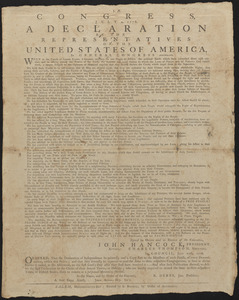
To commemorate the 250th anniversary of the Declaration of Independence, multiple institutions in greater Boston have collaborated to lay out a Declarations Trail—exhibits of different significant copies of that document.

The Leventhal Map Center at the Boston Public Library has opened “Declarations: Printing a New Nation” with eight printings from broadsides and newspapers, along with maps showing the spread of that news. It will be up through 13 September. Shown here is the library’s copy of the Declaration as printed by Ezekiel Russell for the newly independent Massachusetts government.

The Boston Athenaeum exhibit “Imagined Nation” displays early printings in the context of such items as George Washington’s copy of Thomas Paine’s Common Sense, maps of the young republic, and World War II–era posters. That runs through November.

The Massachusetts Historical Society’s “1776: Declaring Independence” display, up through December, includes “handwritten copies of the Declaration by John Adams and Thomas Jefferson as well as multiple early printings, including a rare Dunlap broadside.” That was the first official presentation of the text, commissioned from printer John Dunlap by the Continental Congress in July 1776.

In Cambridge, three parts of the Harvard University library system are creating linked displays. The university archives is offering “Harvard and the American Revolution.” Next week the Harvard Map Collection will open “Charting Independence.” And starting on 18 May the Houghton Library will host “War of Words,” a display assembled by curator John Overholt to feature “the posters, pamphlets, newspapers, and images that brought news of the American Revolution to those who lived through it.”

In addition to the sites on the Declarations Trail, the Commonwealth Museum regularly displays Mary Katherine Goddard’s official reprinting of the Declaration signed by John Hancock and sent to the state in 1777.

And the “The Road to Revolution: Massachusetts and the Independence Movement” exhibit in Revolutionary Spaces’s Old State House, drawing on material from the M.H.S., includes a “rare 1776 Boston broadside printing of the Declaration of Independence.”

Most of those exhibits are free to the public. Many have special tours, talks, and workshops scheduled as well.

In a parallel initiative, five Revoloutionary-era institutions with admission fees—the Paul Revere House, Old State House, Old North Church, Old South Meeting-House, and King’s Chapel—have combined to offer visitors the Boston 250 Pass with a 10% on regular adult admission.

Thursday, January 15, 2026

Sneff on Mary Katherine Goddard in Essex, Connecticut, on 18 Jan.

On Sunday, 18 January, Emily Sneff will speak to the Essex (Connecticut) Historical Society and guests on “The Woman Who Printed the Declaration”—the printer, newspaper publisher, and postmaster Mary Katherine Goddard.

Born in New London, Connecticut, Goddard created the first broadsides of the Declaration of Independence to include the names of all the men who had signed the document (up to early 1777).

She had previously printed the Declaration in her newspaper, and she handled other jobs for the Continental Congress. At that time, the Congress had moved out of Philadelphia as the British army pushed south.

Sneff will contrast Goddard’s printings with publications of the Declaration from other printers, including a female printer on the other side of the Atlantic.

Emily Sneff earned her Ph.D. in History from William & Mary studying the spread of the Declaration around the world. Her book When the Declaration of Independence Was News will be published by Oxford University Press in April 2026.

This talk is scheduled to start at 3:30 P.M., with doors at Essex Meadows opening at 3. It is free and open to the public, but the society asks attendees to register for a seat in advance.

Thursday, October 10, 2024

The Sloppiness of the “God Bless the USA Bible”

The “God Bless the USA Bible” has been in the news a lot, most recently because of the revelation that all the books have been printed in China.

This Bible includes the King James Version of the English text, thus omitting the deuterocanonical books that appear in the Septuagint and in Roman Catholic Bibles.

On the other hand, this volume includes some texts that aren’t in any Christian canon, as its website boasts:

  • Handwritten chorus to “God Bless The USA” by Lee Greenwood
  • The US Constitution
  • The Bill of Rights
  • The Declaration of Independence
  • The Pledge of Allegiance
At least, that’s what the publisher claims.

In fact, the volume doesn’t offer the entire U.S. Constitution. That document includes the Bill of Rights and all the other ratified amendments, which have the same constitutional weight as the text composed in Philadelphia in 1787.

This Bible leaves out every amendment after the first ten. Some people have suggested some nefarious intent in omitting the amendments on ending slavery, equality under the law, income tax, Presidential term limits, and the like. But the omission is just due to ignorance and carelessness.

We can see the same sloppiness in how this Bible presents the signatures at the bottom of the Declaration of Independence, as shown in this screenshot from a review video by Tim Wildsmith.
The right-hand column has two sections headlined “New Hampshire,” and there’s no section headlined “New York.” Instead, “New York” appears toward the bottom of the second column in the same style as the signers’ names.

Part of the blame for that mistake belongs to the signers themselves. Some of them sorted themselves out by state, but the New Englanders mixed together on the right, and the Delaware delegation didn’t succeed in separating from Pennsylvania in the middle. There are no state labels on the famous signed copy. Mary Katherine Goddard’s print shop added those for a 1777 broadside, and they appear (in different form) on the National Archives transcript.

Whoever was tasked with preparing this Bible, either in the U.S. of A. or in China, apparently downloaded text with the state labels but then didn’t format it properly.

Another of the news stories about this Bible is how Oklahoma’s school superintendent solicited bids for Bibles with “only the King James Version” but also “copies of The United States Pledge of Allegiance, The U.S. Declaration of Independence, The U.S. Constitution, and The U.S. Bill of Rights” (P.D.F. download). After criticism that that was an obvious ploy to send $3 million in public funds to the publisher of the “God Bless the USA Bible,” the state government amended its specifications.

Of course, the “God Bless the USA Bible” would not have met those specs if Oklahoma had strictly applied them since it includes only part of the U.S. Constitution.

Not to mention that this state government appears to be favoring one form of religion over others, in violation of one part of the Constitution the volume actually does contain.

Thursday, July 30, 2015

Remembering Mary Katherine Goddard the Right Way

Earlier this month the Baltimore Sun reported on the installation of a historical plaque in a downtown Rite-Aid pharmacy.

That drugstore is on the probable site of the Goddard print shop in 1777. On 18 January of that year, Mary Katherine Goddard issued a broadside reprinting the Declaration of Independence with the names of all the Continental Congress delegates who had signed the document so far.

The Sun article has such headlines as “How a Baltimore woman defied the Redcoats” and “See how Mary Katherine Goddard helped win the Revolutionary War.”

It quotes Andrew Carroll, author of Here Is Where and promoter of this plaque, saying that her printing “was a total act of defiance. She was saying, ‘I’m stepping forward and I’m putting my life at risk in the expectation that other people will do the same. There's no turning back now.’”

Printing the Declaration, the article says, “put her life at risk.” An official at the Maryland Historical Society states of Goddard, “If the war had ended differently, the signers would have been convicted and hanged for treason, and she probably would have been hanged as well.”

For the record we should note that:
  • There were no redcoats in Baltimore to defy. The British army was no closer than Princeton, New Jersey, that month, and it never attacked or occupied Baltimore.
  • The British authorities had just held New Jersey signer Richard Stockton in custody and did not try or hang him.
  • There’s no example of the Crown executing an American printer for supporting independence or printing the Declaration. In fact, many British printers reprinted that text because it was significant news.  
  • While making the Declaration look nice for the Congress no doubt suggested support for its cause, Goddard’s status as a woman would have given her more insulation from political accusations—not that she was ever in British custody to be so accused.
Goddard’s work as both printer and postmaster was undoubtedly significant and deserves to be remembered. But the rhetoric around the installation of this plaque seems unduly sensational.