J. L. BELL is a Massachusetts writer who specializes in (among other things) the start of the American Revolution in and around Boston. He is particularly interested in the experiences of children in 1765-75. He has published scholarly papers and popular articles for both children and adults. He was consultant for an episode of History Detectives, and contributed to a display at Minute Man National Historic Park.

Subscribe thru Follow.it


•••••••••••••••••


Showing posts with label Ebenezer Turell. Show all posts

Sunday, October 22, 2023

Peone on “Invisible Agents,” 25 Oct.

On Wednesday, 25 October, the Congregational Library and Archives in Boston will host an online presentation by Dr. Tricia Peone on “Invisible Agents: Witchcraft in Congregational Church Records.”

The event description:
Today, people typically think of the Salem witch trials and little else when the history of witchcraft is mentioned. In fact, the belief in magic, witchcraft, ghosts, and other invisible agents of Satan continued to affect congregations beyond Salem well into the eighteenth century.

Join Dr. Tricia Peone, Project Director for New England’s Hidden Histories at the C.L.A., as she explores two lesser-known cases of witchcraft that took place in Massachusetts and New Hampshire in the decades after Salem. Drawing from examples in Congregational church records, she will discuss how people determined whether or not witchcraft was the cause of their problems and how they dealt with this continuing threat to their communities.
This is interesting in that the Salem Witch Trials quickly became an embarrassment for New England culture. The government authorities started to release and pardon the accused (those who were left). By the Revolutionary period, people on both sides of the political divide used that episode as an example of public hysteria. Indeed, I suspect that the Salem trials would be as obscure as every other early modern witch hunt if it weren’t for the quick backlash.

This presentation might cover a case in Littleton that the Rev. Ebenezer Turell wrote about skeptically in 1728. Turell left a mark on Boston 1775 earlier this season as I analyzed his grad-school notebooks.

This online event is scheduled to start at 1:00 P.M. Register for the link here.

Saturday, September 16, 2023

“A Sett of Controversial Discourses agreed upon by the Society”

In October 1722, almost a year after being inoculated against smallpox, Ebenezer Turell found a new use for his notebook.

He wrote out what he called “An account of a Society in Har: Colledge.” This was a more serious endeavor than the Telltale essay exchange the previous year.

Ten young men from the Harvard College class of 1721 plus four from nearby classes pledged to meet regularly for intellectual pursuits. One might share “a Discourse of about Twenty minuits,” or the group could engage in philosophical disputations, readings, and epistles.

They also promised “That if we see or hear of any Extraordinary Book, we will give ye best account we can of it to ye Society.”

As an example of what this society (formally) talked about, Turell’s two lectures were:
1 Upon Light, a Phisico-Theological Discourse
2 Upon Providence.
The group was still meeting in October 1723 when Turell took the lead in a new format, combining the discourse and the disputation into a single discussion:
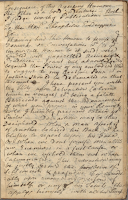
E T read a Lecture to show that it is a point of Prudence To prove & Try all Doctrines in Religion, wch was to serve as an Introduction to a Sett of Controversial Discourses agreed upon by the Society to be successivly carried, one every week.
The last record is from January 1724 when the group agreed on topics for upcoming lectures and discussions. There’s no record of those meetings, however. It’s possible Turell switched to another notebook since he was coming close to the pages he’d already filled with the Telltale material, and that second document didn’t survive. It’s also possible this extracurricular activity just petered out in the winter of 1724 as members moved on.

In 1909 William C. Lane pointed out to the Colonial Society that nearly all the young men in that society went on to be ministers. Those included the Rev. Dr. Charles Chauncy and the Rev. Ebenezer Pemberton of Boston and the Rev. John Lowell (shown above) of Newburyport, ancestor of the celebrated Lowell family.

Ebenezer Turell himself started to train for the pulpit under the Rev. Benjamin Colman of the Brattle Street Meeting in Boston. He became the minister in Medford in 1724, and Colman’s son-in-law two years later. Jane (Colman) Turell shared Ebenezer’s love of writing, though she had a religiously anxious life until she died in 1735.

Turell remarried twice, each time to women in the upper class. As a minister he was a firm Old Light and later a supporter of the Whigs. The Medford congregation granted him a pension in 1773, the year before he preached his last sermon, and he died in 1778. In all, the current church says, Turell oversaw the construction of two church buildings, admitted 323 communicants, baptized 1,037 people, and married 220 couples.

Friday, September 15, 2023

“Argumentive dialogue concerning inoculation”

The Telltale essays by Harvard College students in Ebenezer Turell’s notebook come to a stop on 1 Nov 1721.

In the preceding month, 411 people in Boston had died of smallpox. The epidemic had been spreading and killing since April.

People at Harvard were contracting the disease, including the maid of undergraduate Samuel Mather (1706–1785).

Samuel’s father, the Rev. Cotton Mather, had heard about inoculation against smallpox from his enslaved servant Onesimus and then from reading accounts of the procedure in Turkey. He urged Dr. Zabdiel Boylston to try this approach infecting people with a mild case of the disease in hopes of immunizing them for life.

In June 1721, Boylston inoculated his young son, an enslaved man, and that man’s son. When they didn’t die, he and Mather went public. Boston’s selectmen told him to stop. Boylston didn’t, inoculating young Samuel Mather among others.

Dr. William Douglass opposed inoculation with his pen and his authority as a Scottish-educated physician. The Rev. Benjamin Colman (shown above) supported Boylston and Mather with his Narrative of the Method and Success of Inoculating the Small-pox in New England. Other doctors and ministers divided on the question.

In that atmosphere, around the start of November Ebenezer Turell opened his Telltale notebook from the other end and wrote out a fourteen-page “Argumentive dialogue concerning inoculation between Dr. Hurry and Mr. Waitfort.” Dr. Hurry was, of course, eager for the new procedure, and Mr. Waitfort was still hanging back.

The dialogue consisted of exchanges like this one:
W[aitfort:…] He that bring sickness upon himself Voluntarily Breaks one of the divine Commandment (the 6th)…

H[urry:] I never heard yt the Bringing Sickness upon our selves was a Breach of ye Divine Law Absolutly for by vomitting Purging letting of Blood &c We make our selves sick and that voluntarily too
In the end Dr. Hurry prevailed. The essay concluded with this verse:
Theres none but Cowards fear ye Launce,
Heroes receive ye Wound
With rapturous joy they Skip & Dance,
While others hugg ye Ground.
According to Dr. Boylston’s published account, on 23 November he “inoculated Mr. Ebenezer Pemberton, and Mr. John Lowel, each about 18.” Both those young men were in Turell’s college class and in his circle. (Indeed, I suspect this John Lowell was the student he started the Telltale with.)

The next day, he administered the procedure to a Harvard professor, a tutor, and seven students, including “Mr. Ebenezer Turil.”

Turell went back into his notebook and added that his “Argumentive dialogue” was “Compos’d about three weeks before I was inoculated.”

TOMORROW: Ebenezer Turell’s Society.

Thursday, September 14, 2023

Theophilus Evedropper and the Chair Lifters

As I wrote yesterday, on 9 Sept 1721 a Harvard College student—quite possibly Ebenezer Turell—using the signature “Telltale” wrote a short essay inviting a friend to write back about “The shamfull impertinences & monstrous inconsistencies yt daily perplex us.”

Instead, someone else found that note and wrote back. Turell didn’t record the reply.

“Telltale” then wrote directly to his target reader, “J. L.”—perhaps John Lowell, like Turell in the Harvard class of 1721. (The president of the college then was John Leverett, but he seems a less likely addressee.) That second letter said: “If you have any inclination for an epistolary correspondence with me you may deposit your Letters in that Famous tree call’d the Pliable Crotch on Monday Ev’ning.”

J. L. did write back, and other authors joined in the exchange, sharing essays over such pen names as Blablonge and Courage. Telltale himself also used the name Theophilus Evedropper. He collected the essays in a notebook under date headings with classical or literary mottos underneath, imitating British magazines like the Spectator.

Evidently someone else at Harvard was circulating similar essays under the title “The Censure or Muster Roll.” The 30 September offering from Telltale was devoted to criticizing this rival, as in: “The Subject he would treat of is Learning wch I entirly forgott before I had finish’d the first Page.”

Other essays appear to lampoon fellow students, and it’s not clear whether those were friendly joshing within the group or snaps at rivals. By October, the articles veer toward setting up a group called the Spy Club (and sniping at something called the Mock Club).

The Harvard Archives has called the Telltale material “the first student publication” at the college. However, there’s no suggestion the material was ever printed, and I’m not convinced it counts as a publication without more copies. It definitely appear to be an extracurricular activity, however.

John Lowell and Ebenezer Turell were in the college class of 1721, which meant they had graduated by September when these essays started to circulate. They were probably still in Cambridge, reading for their master’s degrees. It’s possible that the greater freedom accorded graduates empowered them to write and share these essays.

On the other hand, the Telltale articles do offer some glimpses of life that seems undergraduate (and remember that at this time most college students were what we think of as high-school age):
There [are] a number of Persons in Colledge who delight in nothing so much as in doing Mischief. This is what they call clean, showing their Parts &c. The great Number of these Persons adds to the Vexation. They are of very different inclinations & each of ym has his particular Art wherin he excells.

I was t’other Day in Company with some of them who go by the Name of Chair Lifters. These Cowards attack you while you are sitting in a Chair (a most defenceless Posture) flinging you to the Ground with Great Violence. For wch Sometimes you[r] Head, arms and Posteriors curse them a fort night after. . . .

There a[re] Divers other Troblesome Fellows of other Species…as rappers, clappers, Trippers, nippers, Thigh Duffers, Stroakers, Pokers, &c all of them when I have opportunity shall be satyrically animadverted upon.
All in all, the Telltale appears to have been motivated by a wish to chide others into proper behavior rather than the satirize the powerful. In that respect, among Boston-area writing it was more like the establishment Boston News-Letter and Boston Gazette than the cheeky New-England Courant.

TOMORROW: Serious matters.

Wednesday, September 13, 2023

“Essay’d on the following Saturdays”

The Boston News-Letter was launched in 1704, the first ongoing newspaper in British North America.

The Boston Gazette followed in 1719. Like the News-Letter it was a weekly licensed by the province and indeed funded by government officials.

On 7 Aug 1721 James Franklin began the New-England Courant with the support of several gentlemen opposed to Boston’s Puritan orthodoxy. That meant poking fun of government officials, Congregationalist ministers, and their public concerns, such as the Rev. Cotton Mather’s ludicrous support for smallpox inoculation. 

Slightly more than a month after the Courant began running, a group of Harvard College students started “a Paper call’d the Telltale, or Criticisms on the Conversation & Beheavour of Schollars to promote right reasoning & good manner.”

The text of this “Paper” survives because Ebenezer Turell (1702–1778, shown here) from the Harvard class of 1721 copied the contents from Saturday, 9 September 9, to Wednesday, 1 November, into a little notebook. Indeed, Turell might have been the organizer of the Telltale to begin with.

That document came to the Harvard University library almost two centuries later, and it’s now digitized. Back in 1909 William C. Lane did a presentation on the manuscript to the Colonial Society of Massachusetts, and we can read his text here, including transcriptions of some parts of the Telltale.

As the Telltale told its own history, the first item was a little handwritten essay titled “The Preface”:
Tis a common observation, he yt remarks ye Folly of others has his own severly remark’d upon. However abjiciendus Timor quoties urget necessitas [throw away disgrace whenever necessity urges]. The shamfull impertinences & monstrous inconsistencies yt daily perplex us must have their career obstructed by some seasonable animadversions wch (Divino anuente numine [with God’s divine approval]) shall be essay’d on the following Saturdays.

Perhaps your enquiries will run more after my Person than the reason of my Discourses. But take this Caution. I am so envelop’d with clouds & vizards yt the most piercing eye can[not] distinguish me from Stoughton’s Hall. In this I am happy. What I intend is for the benefit of the Society & tho in some passages I may seem pritty facetious (wch erroneously call light & vain) It must be attributed to my natural constitution. I hope ther’s no Gentleman (I know ther’s none of worth) will be my antagonist in so laudable an undertaking. But if any man will appear so vain & foolish I defy his strength & Laugh att his attempt.

I would propose and desire ye Gentlemen of Witt & good Sense (of whom we have a considerable number) would unite in the Servasable affair & assume their rights in the other 5 Days. The time yt would be taken up in this matter would not amount to above an hour in a week, & yet how great the advantage!

Sign’d Telltale
The author of that notice left it “upon a pair of Stairs.” Someone picked it up and wrote something underneath in reply. But that someone wasn’t the person that Telltale wanted to hear from.

TOMORROW: “that Famous tree call’d the Pliable Crotch”.

Friday, June 12, 2020

“The grand source of most of the Evils we groan under”

The same 14 Dec 1747 issue of the Boston Post-Boy that leaked Gov. William Shirley’s letters about riots the previous month also reported on how the Town House in Boston had burned down.

As good descendants of Puritans, the people of Massachusetts couldn’t help but worry that fire might be a sign of divine displeasure at how some of them had been behaving.

On 28 December, a day before issuing a new message to mollify the Boston town meeting, Gov. Shirley issued a proclamation for a public fast in one month. He noted:
the continued and growing Calamities of the War; and the many Difficulties and Embarrassments which attend our Publick Affairs, and in the signal Frown of Divine Providence in the Destruction of the Court-House by Fire, and therein of a great Part of the publick Records of the Province, and other useful and valuable Writings.
On the designated fast day, 28 Jan 1748, ministers in every Massachusetts town preached on how the people should improve themselves.

In Cambridge, the Rev. Nathaniel Appleton (1693-1784, shown above) spoke on The Cry of Oppression where Judgment is Looked for, and the Sore Calamities Such a People May Expect from a Righteous God. In Charlestown, the Rev. Thomas Prentice preached The Vanity of Zeal for Fasts without True Judgment, Mercy and Compassions. In Medford, the Rev. Ebenezer Turell published a Brief and Plain Exhortation to His People on the Late Fast, a condensed version of his sermon.

All three of those clergymen pointed to the same problem. Was it rioting? Spending too much on luxury goods? New Light enthusiasm? Old Light recalcitrance? No, it was that burdensome sin—allowing the value of paper money to depreciate!

“For one and all agree,” Appleton declared from his pulpit, “that the Sinking of the Value of these Bills below what is expressed in the Face of them, is the Cause of the present Complaints and Cries that are heard in the Land.”

“We find GOD complaining most grievously, of his people Israel, Amos viii.5. for their not dealing with just Measures and Weights according to the fixed Standard,” Prentice preached; “…and such like Instability, either in the Measure of Commodities, or in the Weight and Value of Money, is a most dreadful Injustice.”

Turell explained that “the grand source of most of the Evils we groan under at this Day” was “our Medium of Exchange, unstable as Water, and variable as the Wind. . . . We trade and traffick, buy and sell by this Measure, and so we daily oppress one another.”

This was a long-standing challenge to the Massachusetts economy. Without enough specie (gold and silver coinage) to keep commerce going, the province issued notes on paper. Those notes never traded at quite their nominal value, and as time went on the bills came to be worth less and less.

That was a problem for people who had fixed incomes—particularly ministers who had negotiated set salaries with their congregations when they assumed their pulpits.

In his speech to the Massachusetts General Court on 3 February, Gov. Shirley devoted a whole paragraph to both “the extraordinary Emissions of Paper Money, whereby the Value thereof for all Occasions of Life is sunk so low and is still sinking,” and “the Difficulties, which many of the Ministers of the Gospel within this Province are brought under, thro’ the great Depreciation of the Bills of Credit.”

Thus, the question of rebuilding the Town House in Boston or building a new legislative meeting hall somewhere else was also a question of adding to the public debt just when that was becoming a real problem for influential people in the colony.

TOMORROW: Back to the Massachusetts house’s discussion.