J. L. BELL is a Massachusetts writer who specializes in (among other things) the start of the American Revolution in and around Boston. He is particularly interested in the experiences of children in 1765-75. He has published scholarly papers and popular articles for both children and adults. He was consultant for an episode of History Detectives, and contributed to a display at Minute Man National Historic Park.

Subscribe thru Follow.it


•••••••••••••••••


Showing posts with label religion. Show all posts

Tuesday, August 18, 2026

“‘Subject’ to an authority founded on the late Declaration of Independence”

During the siege of Boston, Benjamin Davis, Sr., signed up for the Loyal American Association, which appears to have been a pro-Crown militia.

We have these companies’ rolls but little other information on what they actually did, if anything. But membership is a useful yardstick for Loyalism.

According to Todd Braisted’s On-Line Institute for Advanced Loyalist Studies website, Davis was listed as a sergeant in the Third Company, headed by Adino Paddock. Hopestill Capen, a fellow Sandemanian, was also a fellow sergeant.

Benjamin Davis, Jr., joined the Second Company under Capt. Abijah Willard at the rank of private. He was around nineteen years old, thus of prime military age.

In 1776 both father and son evacuated Boston with the British military. Then they headed back to New York to be part of the British military’s return to the newly-declared independent U.S. of A. After their ship was captured, both were locked up in the Boston jail starting in July.

In the Massachusetts state archives, and published in Peter Force’s American Archives, is a long letter dated 10 Oct 1776 to James Bowdoin, who happened to be a senior member of the Massachusetts Council. The signature as transcribed was “Benj’a Davis, Jun.” However, the writer refers to “my son” and “the property which I left in my store in Boston, in March past, worth about a thousand pounds sterling,” so it must have come from Benjamin, Sr.

This letter lays out Benjamin Davis’s religious motivation for remaining loyal to the royal government, to the extent that he refused to recognize the authority of his captors, even to ask for his release:
There is a proverb that it will be well for me to attend to, as it is applicable to one in my present situation: “The fear of man bringeth a snare.” [Proverbs, 29:25] I consider myself now to be wholly in the power of the people, and that there is no legal authority for me to apply to for relief. The present distressed situation I am in, and the method pointed out to me in order to get relieved, are such as makes it necessary for me to be much on my guard, lest I get ensnared.

I am bound by God’s law to “be subject to the higher power;” [Romans 13:1] and I have much more to dread from the disobedience of his commands than I can have to fear from those who may be offended at me because I cannot in conscience be “subject” to an authority founded on the late Declaration of Independence. I am very sorry I am placed in such a situation, as though designed to compel me to take such a step for my enlargement as would be in me a breach of God’s law.

To compel me to act or do, contrary to the dictates of my conscience, any one thing that shall carry with it any authority founded on the Declaration of Independence, until the same be recognized and fully settled so as to become my duty to be “subject,” would be the same, and I see no odds, as if I was in Spain or Portugal and committed to the Inquisition as a heretick, and they were to inflict on me the most cruel tortures in order to compel me to deny the faith.
I’m sure Bowdoin didn’t expect that!

Davis pointed out that he wasn’t demanding his confiscated property since doing so would be another form of recognizing the local courts. He probably knew that also meant fewer locals would see him as an enemy.

The letter continued:
I profess myself a liege subject of his Majesty King George III, founded on this principle, that all who are born within his dominions or realm he has a claim upon as his rightful and lawful subjects; that the Provinces and Colonies in North America make a part of his realm.

I was born in this Province; of course allegiance is due from me to him, nor can it be dissolved but by his consent, or by a revolution taking place within the Kingdom, or the Government fixed and established, in which case it would be dissolved. I am bound by God’s law to “honour the King,” and to be subject to the legislative authority of Great Britain as “the higher power.”

I cannot, in any way, be aiding or assisting in any plan or scheme for bringing about any revolution in the Empire upon any pretence whatsoever, without breaking a positive law of God. But whenever any revolution does take place within the Kingdom, and the Government becomes fixed and established, be the cause that brings it about what it may, I shall then be bound in conscience to be “subject” to its authority, for they will then become the “higher power” in the Apostle’s sense.
That’s Sandemanian doctrine.

Davis said he didn’t desire “being abroad” in Boston, lest people think he was trying to convert them or spy on them; that “would be as unbecoming as to be an informer against my neighbour, who may be concerned in an illicit trade.” But he also said he hoped to “take lodgings in town.”

Finally, Davis suggested that “my son, together with myself and servant, could be exchanged for any prisoners in the hands of his Excellency General [William] Howe, at New-York.”

TOMORROW: Petitions.

Wednesday, August 12, 2026

Benjamin Davis, Jr., at the Boston Massacre

On 4 Apr 1756, Trinity Church in Boston recorded the baptism of “Benjamin Davis, Son of Benj. & [blank].”

Benjamin, Jr.’s mother was Elizabeth (Phillips) Davis, a convert to the Church of England. She bore a third child in 1757 but must have died in the few years following.

Presumably Benjamin, Jr., was baptized a few days after birth, meaning he was born in the spring of 1756. However, when he died on 28 Dec 1836, Boston newspapers reported that he was eighty-one, so it’s also possible his baptism was delayed a few months.

In 1762 Benjamin, Sr., married a second time, to Anstis Greenleaf, daughter of Suffolk County sheriff Stephen Greenleaf. She died in 1764, after giving birth, and Benjamin, Sr., remarried again to Alice Whipple of Rhode Island—and we all know how that turned out.

As a teenager, Benjamin, Jr., was present at the shooting on King Street in March 1770. He was called to testify at the soldiers’ trial, identified as “son to Mr. Davis a former witness.”

Here, as taken down by John Hodgson, is what Benjamin, Jr., experienced:
On the evening of the 5th March last, near the bottom of Royal exchange-lane, I saw a mob by Mr. [John] Greenleaf’s, I went right along into King street, I saw the Sentinel [Hugh White]; a barber’s boy [Edward Garrick] was there crying, and said the Sentry had struck him, and asked him what business he had to do it:

I went home and staid at the gate in Green’s lane some time,

Samuel Gray (one of the persons killed that night in King-street) came along, and asked where the fire was?

I said there was no fire, it was the soldiers fighting, he said, damn it, I am glad of it, I will knock some of them on the head; he ran off, I said to him, take heed you do not get killed in the affray yourself, he said, do not fear, damn their bloods.

Q. Had he a stick in his hand?

A. He had one under his arm.

Q. What sort of a stick was it?

A. I did not take notice.

Q. How long was this before the firing?

A. I do not suppose he could have got into King-street two minutes before the firing.
Benjamin’s father was also observing the action from a different angle, and his uncle Edward’s family had a clear view across the street at the Customs office. They were all defense witnesses at various trials.

TOMORROW: Fire!

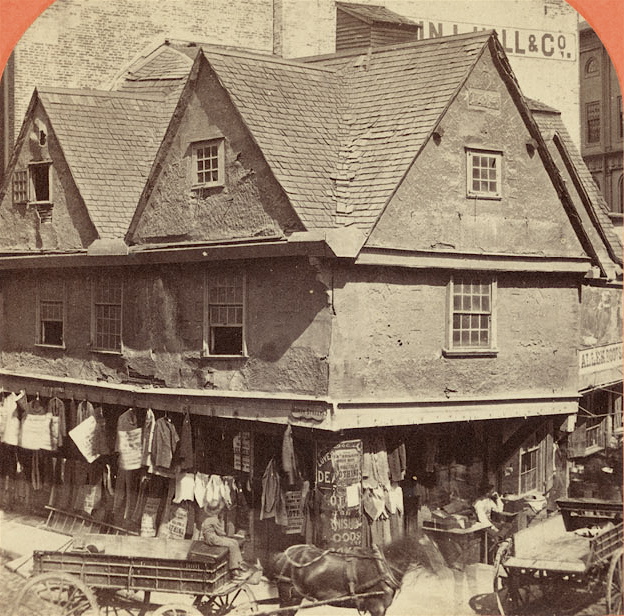
(Based on Benjamin’s quick description, I’m guessing he first spotted the crowd near John Greenleaf’s apothecary store, which survived into the late 1800s as the Old Feather Store at Dock Square, shown above.)

Monday, August 10, 2026

Listening to Abigail Adams on Paper

A comment about yesterday’s quotation from Abigail Adams has prompted me to veer off into some linguistic digging.

Referring to Benjamin Davis, apparently notorious for taking gingerbread from refugees, Adams wrote: “How many little ones can say I was an Hungry & you gave me no Bread, but inhumanely took what little I had from me.”

The Massachusetts Historical Society shared a scan of this letter, so we can confirm she spelled the words that way.


As a minister’s daughter, Adams knew her Christian scripture. But she wasn’t quoting the King James Bible exactly. Matthew 25:42 says: “For I was an hungred, and ye gave me no meat:…” According to linguists, “an” was a form of the prefix “a,” as in “times’s a-wasting,” adapted to go before an H.

Adams instead used the form “an hungry,” which this linguistic website defines in its single-word form as “an obsolete word for hungry that is allowed to stay in Webster's Third New International Dictionary because it shows up in Shakespeare (Coriolanus I:i:209).” Did Adams misremember the Biblical verse? Or were people in the mid-1700s people reading the phrase that way?

Discussing Abigail Adams’s expressions leads me to Susan Walsh and Christopher S. Davis’s Adams Letters and Language podcast, hosted on YouTube. Walsh portrays Adams, along with being a librarian and educator. Davis is a historical dialect coach who studied 18th-century New England speech for the Boston Tea Party Ships & Museum.

On Saturday I heard their presentation at History Camp Boston, which will become a future podcast episode. Each episode includes a reading of John and Abigail Adams’s in period style “as well as discussion of the history, themes, and linguistics revealed by the letters.”

Since I’ve been impressionistically opining on how people really spoke in Revolutionary America since 2008, I look forward to hearing a more expert discussion.

Saturday, August 08, 2026

“Fell in with two Arm’d Schooners”

Yesterday I wrote about Benjamin and Edward Davis, two brothers who were mercantile partners in Boston until religion and Revolutionary politics split them apart.

Benjamin became a Sandemanian, devoutly guided not to oppose British Crown policies by, for instance, signing on to the non-importation boycotts.

Edward remained an Anglican, attending Trinity Church. By late 1774 the Whigs coopted him into helping to enforce their strongest boycott, the Continental Association.

Both brothers remained in Boston during the siege. But when the British military evacuated, Edward stayed while Benjamin sailed away to Halifax, Nova Scotia. In April 1776 the Patriot authorities ordered magistrates to question Edward about his loyalty, but evidently he passed muster.

Around the start of July, Benjamin Davis boarded the ship Peggy, headed for New York. Along with him came his son Benjamin, Jr., who turned twenty that year; an enslaved man; half a dozen other Loyalist men; and a few Loyalist women.

Evidently those refugees saw business opportunities supplying the huge British and Hessian army assembling at New York. The Peggy was loaded with provisions, including 2,648 “mutton hams,” 311 “tierces salted beef,” fish, flour, snuff, cloth, stockings, and a large quantity of alcohol in various forms.

The Peggy also carried six 3-pounder and two 2-pounder cannon. It sailed in convoy with dozens of other merchant ships and troop transports, all escorted by two Royal Navy warships. The sea voyage probably seemed safe.

We have the ship captain’s account of what happened next:
I James Kennedy, Master of the Ship Peggy, in the Merchant Service, declare that I left Hallifax about the first Inst. [i.e., of this month] under Convoy of the Renown of Fifty Guns, with a Fleet of sixteen [torn] Transports containing the 42nd & 71 Scotch Regiments & Fraziers new rais’d Regiment, about 3000 in all, & three Large Ships with Hessian Troops on board, about 600 in all, & one Ship with 5 companys of English foot Guards, & four Victualling Ships, the whole Fleet bound for New York.

Off Nantucket Shoals we fell in with the Flora Frigate of Thirty Guns & four Transports with Highland Troops, these had been in Boston Bay, where they got information from a Fisherman that the Town was Evacuated, on which they Stood for Hallifax untill they met with us, they then joyn’d our Fleet for New York.

The Scotch Troops were all to be of Coll [Archibald] Campbells division (of the Grand Army in America, the whole of which Army I was informd, would by the last of July, amount, to 50,000.) the Hessian Troops left England about the 12th of May, some of the Officers informd me they came out with 304 Sail under the Command of Commodore Hawtham [William Hotham], on board of whom were 10,000 Foreign Troops & some English Troops (number unknown).

last Fryday sennight [19 July] in a gale of wind & thick weather I lost the Fleet & on monday [22 July] I fell in with two [American] Arm’d Schooners, Capts. [John] Skimmer & [Samuel] Tucker, to whom I surrendered after a short engagement, in which I had only one man Wounded.

The day after the Fleet left Hallifax, I saw from my Deck forty Sail of Ships standing in for that Harbour, & which I suppose to be part of the Fleet under Commodore Hawtham.
Skimmer commanded the Franklin and Tucker the Hancock, schooners originally launched under the authority of the Continental Army commander. They were now sailing for Massachusetts.

The Patriot authorities who took Capt. Kennedy’s deposition were evidently pumping him for intelliegence on what other British ships and troops were out there rather than details of his engagement with the schooners.

For Benjamin Davis, all that mattered now was that he was a prisoner of the state he’d left four months before.

TOMORROW: The gingerbread man.

Friday, August 07, 2026

“The extraordinary self-denials and usages of the Sandemanians”

Hopestill Capen wasn’t the only Sandemanian clapped into the Boston jail in the summer of 1776, as discussed yesterday.

Another merchant who had joined that sect, Benjamin Davis (1729–1805), had been locked up since 26 July.

Like Capen, Davis was from an old New England family. For years he and his brother, Edward Davis (1730–1811), ran a mercantile firm located on the “South Side of the Town Dock.”

Among the European goods Benjamin and Edward Davis advertised for sale were coal, ale, cheese, snuff, salt, and stoneware. In return, they offered farmers money for flaxseed and potash.

Family sources say the Davis brothers’ partnership came apart during the non-importation campaign of 1768–70. Indeed, as of May 1771 the shop on “the South Side the Dock” was “Benj. Davis’s Store.” Having advertised their firm for many years, the brothers’ names appeared in only one more newspaper notice together: in August 1772 they offered “Two new Copper Stills & Worms,” perhaps their last joint property.

The Davis brothers definitely started to split politically in those years. On 28 Oct 1769, Edward was one of three angry merchants who confronted printer John Mein about how he was printing Customs house records. Mein stated, “Davis first made a push at me with his Cane which struck me on the left side of the belly.”

On 5 Mar 1770, Benjamin Davis was out in the evening about nine o’clock as locals faced off against soldiers at the Customs office. According to Robert Treat Paine’s notes from Capt. Thomas Preston’s trial, Davis testified: “Some body clap’d me on sholder and asked me if I would go and help fight the Soldiers. I said no.” He was a defense witness in the Boston Massacre trials.

Meanwhile, Edward Davis was watching the dispute with other merchants from the stoop of Edward Payne’s house, opposite the Customs office. At a bail hearing for Edward Manwaring in April and then at Manwaring’s trial, Davis and members of his family testified that they had seen no guns fired from the Customs building. In fact, Davis said that “soon after the firing he saw two women standing in the chamber of the Custom-house…with their hands under their aprons, in the posture of spectators.”

After the death of his wife, the former Ruth Vassall, in January 1774, Edward became a more active Whig. By the end of the year he was serving on Boston’s committee to enforce the Continental Association boycott.

In contrast, once Benjamin joined the Sandemanians in the 1760s, he appears to have sworn off actions to resist the royal government. In October 1774, John Andrews reported, “Ben Davis has let his Store on the Dock for the use of the troops.” He signed the usual Loyalist addresses and protests.

The mercantile house wasn’t the only partnership Benjamin Davis gave up for his faith. He married his third wife, Alice Whipple, daughter of a former lieutenant governor of Rhode Island, in 1768. According to family lore published by the Colonial Society of Massachusetts:
The lady’s amour propre was offended and her philosophy over-taxed by the extraordinary self-denials and usages of the Sandemanians. Following the example of the early Christian Church, it was their custom to hold a love-feast on Sunday at one another’s houses, at which only Sandemanians were present. The wives who were not members of the Sect, naturally did not take kindly to their exclusion from their own tables, and, at last, the third Madam Davis felt constrained to return to her family, thus, practically, deserting her husband.

A legal divorce being then unobtainable, the Sandemanians took the matter under consideration and concluded to sanction another matrimonial alliance on the part of Mr. Davis, declaring his to be one of those cases where voluntary abandonment by the wife justifies the dissolution of the marriage tie in the sight of Heaven.
Benjamin Davis didn’t actually remarry, though.

Unlike Capen, Davis chose to sail away to Nova Scotia with the British military in March 1776. But then he got on a ship headed to New York, presumably to help supply or administer Britain’s reinvasion.

TOMORROW: Captured at sea.

(The John S. Copley portrait above shows Anstice [Greenleaf] Davis, Benjamin’s second wife, courtesy of the Brooklyn Museum. She died in 1764, only two years after their marriage.)

Thursday, August 06, 2026

Hopestill Capen from the Cornfields to the Jail

On 6 Aug 1776, 250 years ago today, authorities in Boston locked merchant Hopestill Capen (1731–1807) in jail for “aiding and abetting those called enemies to the Colonies.”

For decades Capen had run his dry goods business at the sign of the Cornfields in a building he owned, now known as the Union Oyster House. He served as a militia officer and held minor town offices.

Late in 1769 Capen took on Benjamin Thompson as an apprentice, but that arrangement didn’t last long. The merchant later reportedly told the teenager’s mother “he oftener found her son under the counter, with gimblets, knife, and saw, constructing some little machine, or looking over some book of science, than behind it, arranging the cloths or waiting upon customers.”

from 1771 until just before the war, one of Capen’s tenants in the building was the Whig printer Isaiah Thomas.

During that time, Capen had become known as a mild Loyalist. He signed the complimentary addresses to Gov. Thomas Hutchinson and Gen. Thomas Gage, and he joined the protest against the Solemn League and Covenant.

Capen chose not to evacuate with the British military in 1776, however. Unlike many Loyalists, he had deep family roots in Massachusetts, and all his property was there.

In April 1776 the Massachusetts House directed the Suffolk County justices and sheriff to detain and question dozens of individuals suspected of disloyalty. Capen was fifth on that list, showing his prominence in town.

But it wasn’t until the summer, after Massachusetts had declared independence from the Crown, that the Council ordered those authorities to lock Capen up. No one ever appears to have ever produced evidence of him “aiding and abetting” Crown forces, but he did refuse to pledge allegiance to the new state.

Capen presented himself as a conscientious objector, motivated by religion. In the 1760s he had joined Boston’s small Sandemanian sect, and he said that his faith required him to stay out of the war.

Some analysts have described the Sandemanians as pacifist because of statements like Capen’s. But he wasn’t opposed to military action in principle. He’d been an active member of the Ancient and Honorable Artillery Company as well as the colonial militia, and during the siege he became a sergeant in a Loyal Associated Volunteers under Capt. Adino Paddock.

Rather, the Sandemanian creed said believers should be loyal to the government in control on the grounds that it must be divinely ordained. With the war still going on, and thus divine will not yet clear, Capen insisted that he couldn’t promise his allegiance to the U.S. of A.

Wednesday, August 05, 2026

“Transmitted to us, their Posterity, a fair and rich Inheritance”

The American Scholar just published Robert A. Gross’s essay “Gratitude Isn’t Everything,” considering the start of the American Revolution in contrast to Vice President J. D. Vance’s one-way demands for gratitude.

American Patriots felt obligations to their ancestors who established the colonies, and to their further ancestors who established the British constitution as they understood it. But to them those obligations called for resistance to Parliament’s new laws, not simple loyalty to the government.
In the Revolutionary movement it was a mark of militancy to appeal to the ancestors in protests against British policies. Such statements rehearsed the history of New England from the Puritans’ first settlements down to the latest generation.

Lexington elaborated on this narrative in January 1773. The saga opened as the Puritans fled the tyranny of Charles I and Archbishop Laud, made the hazardous Atlantic crossing, and carved out new homes in the American wilderness. “Our worthy ancestors … [endured] many Struggles with their Enemies in the Face of every Danger and at the expence of much Treasure and Blood,” the Lexington town meeting declared. They thereby “secured to themselves, & transmitted to us, their Posterity, a fair and rich Inheritance, not only of a pleasant fertile Land, but also of Invaluable Rights & Priviledges both as Men & Christians, as stated in the Royal Charter of this Province, and … [guaranteed] by the Faith of the British Crown & Kingdom.” So precious a legacy came as a sacred trust. It was the townspeople’s duty to protect and preserve this birthright of liberty and pass it on intact to the next generation. To do otherwise would betray their very character as a people.

The rhetoric of filial duty became ubiquitous in 1774–75 and with good reason. To punish the Bay Colony for the Tea Party and to curb what royal officials deemed a disorderly democracy, Britain effectively revoked the revered 1691 Massachusetts Charter. Under the Massachusetts Government Act (MAGA), the Crown took over the hiring and firing of all judicial officials and excluded the assembly from its previous role in choosing the provincial council, the upper chamber of the general court. Most important, the new law barred town meetings without the governor’s consent, except for an annual session to elect municipal officials.

MAGA was a direct attack on local autonomy and on popular influence in government. To the inhabitants, these arbitrary changes, imposed from above, amounted to disinheritance, and as worthy heirs of virtuous forefathers, they rose up in outrage.
One result of Parliament’s overreach, Gross argues, was to spur the Patriots into adopting a broader view of their cause, not linked to one nation’s history. The article quotes Dr. Joseph Warren’s praise for a “universal enquiry into the rights of mankind in general” as well as the rights of British subjects.

Eventually that produced the natural-rights argument of the Declaration of Independence, which could inspire many later movements, not bound to Britain or the limits of eighteenth-century society.

The current administration may invoke the Founding, but in disregarding the natural rights of anyone who’s not an American citizen, that administration is showing contempt for the philosophy the Founders came to champion.

Tuesday, July 21, 2026

America250’s Christian Comics

When Boston 1775 last looked in on America250, the commemorative campaign of the Congressionally-established Semiquincentennial commission, the Trump White House was trying to replace it with its own Freedom250 campaign.

And, of course, its own merchandise for sale.

America250 continues to issue material, though. Among the products bearing its brand and sold through its website is a series of comic books about American history.

That line has included fifteen comics about 36 pages long, a collection of ten of those comics which cover the settlement and founding periods, and a graphic novel on the U.S. Constitution.

The America250 website doesn’t offer clear info on contents and credits, and not all the titles are available there anymore. Its publishing partner, Kingstone, offers all the titles, and at lower prices.

Journalist and historian Colin Woodard recently looked at those comics for Talking Points Memo and reported:
The comics — beautifully executed and bearing the America250 logo — were produced by Kingstone, a Christian publisher best known for its 2000-page, 10,000 panel graphic interpretation of the Bible. . . .

The series — drawn by a world-class Brazilian artist [Joe Bennett] who lost his gig with Marvel comics over antisemitic imagery in cartoons championing Jair Bolsonaro — devotes five volumes to the colonial era, its characters, themes and settings carefully curated to depict the eventual creation of the United States as an outgrowth of divine will and intervention. They all take place north of the Mason-Dixon line, with the action rarely leaving the confines of New England, the only part of colonial North America where Calvinists were the dominant political and cultural force. . . . More glaring is the omission of the origin stories of all of the colonies south of New England — home to most of colonial America’s inhabitants — which don’t fit so well into Kingstone’s narrative. . . .

Miracles abound in the story. Among those explicitly called out in the comics: a young George Washington surviving a rain of French bullets in a 1755 raid; Jefferson writing “all men are created equal” even though he was a slaveowner; the dense fog that fell to protect Washington’s army’s retreat across the East River during the Battle of Long Island; the reversal of fortune allowing Washington’s [sic] victory at the Battle of Saratoga in 1777; the early start to the 1781 hurricane season and the bad decisions made by British generals that facilitated the final British defeat at Yorktown; Franklin’s suggestion that delegates pray to find a compromise solution on legislative representation at the Constitutional Convention; and the Constitution itself, because of its alleged brilliance.
Woodard also detailed many ways the Constitution graphic novel promotes particular positions on today’s political issues, from a historically unfounded reading of the Fourteenth Amendment to opposition to gun regulations, reforming the Electoral College, and expanding the Supreme Court.

Sunday, June 14, 2026

Forgetting the Faiths of New England’s Revolutionary Founders

Thomas Lecaque, professor of history at Grand View University in Iowa, wrote at Religion Dispatches about the Pentagon’s recent move to “reduce the list from over 200 unmanageable categories to 31.”

After pointing out several ways the administration has promoted Christian nationalism over other religious approaches, Lecaque wrote:
[Assistant to the Secretary of Defense for Public Affairs Sean] Parnell’s statement feints at pluralistic neutrality, but stating that the Chaplain Corps is there to “provide the best spiritual care to our warfighters” suggests that what military personnel of all (real) religious backgrounds—which includes lots of kinds of Christians; agnostics, atheists, and Other Religions-ists; as well as Sikhs, Jews, Muslims (that one had to hurt), Hindus, Buddhists, and Baha’i—are really entitled to is Christianity-inflected pastoral care.

Guess who didn’t make the list, though?

Unitarian Universalists, Congregationalists, and Deists. Which, if you’re keeping score at home, you’ll recognize as the religious affiliations of Founding Fathers John Adams, Samuel Adams, Benjamin Rush, Paul Revere, Ethan Allen, Benjamin Franklin, Thomas Paine, Hugh Williamson, James Wilson—and possibly of Thomas Jefferson, James Monroe, and George Washington (who were raised Anglican, and, as historians have noted, demonstrated Unitarian, Deist, and/or semi-secular leanings).
This decision seems to reflect both the prejudices and the ignorance of Defense Secretary Pete Hegseth, who back in April solemnly read out quasi-Biblical lines from the Japanese action movie Karate Kiba, filtered through the U.S. action movie Pulp Fiction.

Lecaque went on to say, “We could argue these exclusions don’t matter—in a country that ‘to bigotry gives no sanction, to persecution no assistance,’ the Founders’ religious commitments (or lack thereof) should be immaterial.” He thus correctly quoted President Washington’s letter to the Touro synagogue in Newport. “But for an administration whose officers and supporters keep talking about Originalism as if it’s real (it’s not), people trying to wrap this country in the flag and the cross for its birthday party, the irony and hypocrisy somehow still manage to sting amidst larger horrors.”

Meanwhile, the Congregational Library in Boston has announced it will reopen its free exhibition “Sacred Rebellion: Congregationalists in Revolutionary Massachusetts” on eight dates in June, July, and August. On each of those days there will also be a curator’s tour for $5 at 1 P.M.

Wednesday, June 10, 2026

Three Podcast Episodes

Producing a podcast strikes me as a lot of work, but speaking about Boston history on other folks’ podcasts is always fun.

Here are three episodes I’ve recorded in the last few months. Enjoy all you can.

“The Spark: How Boston Ignited the American Revolution” on The Object of History from the Massachusetts Historical Society

We ask several historians for their thoughts on why Boston helped light the spark of the American Revolution. Was there something unique about Boston's community or geography that made it prone to a rebellious spirit? We sit down with J. L. Bell, Historian of the Revolutionary Era in Massachusetts, Garrett Dash Nelson, President & Head Curator at the Leventhal Map & Education Center at the Boston Public Library, and Kathryn Lasdow, Assistant Professor of History and Director of Public History at Suffolk University, to answer this question.
I’d already been mulling about “Why did the Revolutionary conflict flare up in Boston?” when the invitation to explore that question arrived. Hear my threefold answer and more.

“Boston” on History’s Greatest Cities from History Extra
As one of the oldest cities in the United States, Boston played a pivotal role in the outbreak of the American Revolutionary War, as well as the signing of the Declaration of Independence that followed. In this episode of History’s Greatest Cities, Paul Bloomfield is joined by writer John Bell to explore the storied history of the capital of Massachusetts. Together, they wander through Boston’s oldest neighbourhoods, tracing the story of this harbour city from its pre-colonial roots, through Puritan settlement, to its rise as a major port and administrative centre of the British Atlantic world.
This podcast asks its guests to answer a series of questions, from major events to foods a visitor mustn’t miss.

“Not What You Hurd” on Antiques Roadshow Detours from GBH
In the world of rare silver, American Colonial silver is the stuff collectors dream of. So, when a pair of drinking vessels or “canns,” complete with intricate engraving by a master Boston craftsman, were discovered during ROADSHOW’s visit to Akron in 2023, expert Nick Dawes examined the cups’ clues to reveal both the silver’s early-American history and extraordinary value. But does Nick’s tale of the tankards hold water? Join host Adam Monahan as he searches for the untarnished truth, picking through the many stories, half-truths, and wishful legends in a quest for what may or may not have been lost to history forever.
My voice pops up occasionally on this episode, leaving more time for the fine local historians Joel Bohy and Caitlin DeAngelis.

Saturday, June 06, 2026

“The wider transatlantic workers’ struggle that helped make the American Revolution”?

Jacobin just published Tom Cutterham’s essay “Class Struggle Was a Crucial Part of the American Revolution,” reflecting his upcoming book, Empire Ablaze: The American Revolution and the Atlantic Working Class.

The article begins:
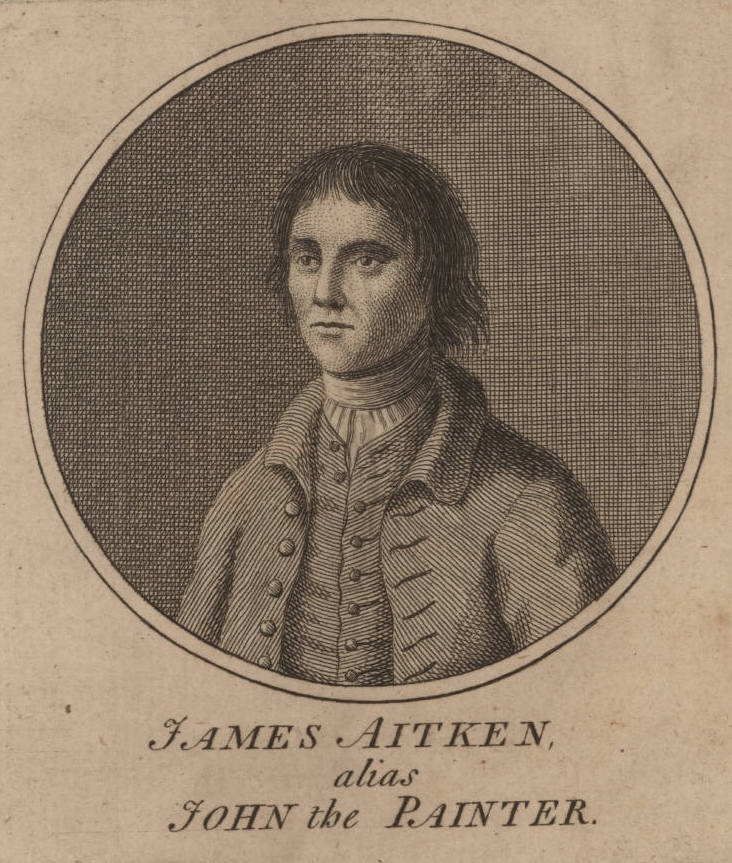
Late in 1776, with the War of Independence underway in the American colonies, a twenty-four-year-old housepainter named James Aitken walked into Britain’s most important naval dockyard and set it on fire. The damage was significant: estimates for repairs were twice the value of the tea destroyed at Boston harbor three years earlier.

The sense of threat experienced by Britain’s ruling elite was also profound. Few people today remember Aitken’s acts of sabotage against the British war machine. But they deserve recognition as part of the wider transatlantic workers’ struggle that helped make the American Revolution.
Aitken is the subject of one of my favorite books on the Revolution, Jessica Warner’s The Incendiary. But I’m not convinced he’s good evidence of a transatlantic political movement, even though he did start his life in working-class Scotland, was in Pennsylvania during the first years of the Continental Congress, and then returned to Britain to support the American cause. Aitken didn’t connect with other activists, except for Silas Deane in Paris. He seems to have been socially inept. Aitken was a movement of one.

Likewise, something seems to be missing from the article’s description of the Gordon Riots:
In London too, the long-standing collaboration between laborers, artisans, and the commercial middle class proved a point of fracture as the possibility of revolution grew too close for comfort. When huge crowds took to the streets in the summer of 1780, burning the home of the Lord Chief Justice, throwing open prison gates, and attacking centers of imperial power like the East India Company offices, it seemed as though the “general effort” [Catharine] Macaulay had called for might finally be at hand.
Those riots were spurred by support for a rather mad aristocrat’s protest against a new British law granting more political rights to Catholics. Though the violence threatened the political establishment, was it really for the benefit of the working class?

I expect Cutterham’s longer book addresses the details of these cases. And I don’t disagree that economic friction between the working class and their employers (still called “masters” in many fields) was part of the Revolutionary era. But so were a bunch of other factors that may have driven events more and certainly muddy the waters. Cutterham’s points are worth considering with care.

Friday, June 05, 2026

“I know that our way will bring us there”

Yesterday’s posting mentioned the Rev. Samuel Ashbow, a Baptist minister from the Mohegan community in Connecticut.

A lot of information about Ashbow comes from Samson Occom and the Christian Indians of New England by W. DeLoss Love (1899). Both Ashbow and Occom studied with the Rev. Eleazer Wheelock and worked on his conversion missions before breaking with him theologically and organizationally.

The Rev. David McClure (1748–1820, shown here) also left a glimpse of Ashbow in his diary. This passage comes from the summer of 1768 when McClure was an undergraduate at Yale College. He “took a ride to the Sea Shore & in company with Mr. Chester Bingham tarried a few days at Narraganset,” the Native community in what’s now Charlestown, Rhode Island.
Sabbath, attended the Indian meeting, at their meeting house, which was small & about the size of a common school house. About 50 Indians were present. They were mostly elderly people. They sung, prayed & exhorted. There were 4 or 5 who exhorted. The principal speaker was called Sam’l Ashpo.

They were all very earnest in voice & gesture, so much so that some of them foamed at the mouth & seemed transported with a kind of enthusiasm. When they prayed, all spake audibly, some in english & some in Indian. It was indeed a confused noise. . . .

I stood near to Ashpo, and noticed the following expressions in his prayer er in confession of sins. We must allow for grossness of the style, from his imperfect knowledge. “Lord, thou knowest what a poor vile sinner I have been; how I have been a vile drunkard, and like a beast have lain drunk in my own spue, all night at taverns and on the road; but O Lord, thou has forgiven me my sins, for the sake of our blessed Saviour Jesus Christ, who can save the vilest sinner” &c.— . . .

As a sample of their ready wit even in serious things, among other instances, after meeting passing the house of one of the speakers, standing in his door, He said to me, “How do you like our way of worship?[”] I replied some things are very good; but would it not be more edifying, in prayer for one to pray & the congregation to join?—He replied “that will never do. Must make ’em all pray. Plaguy apt to cheat.”

When in the Meeting, one of the Exhorters addressed me & my companion, & said “this is the way that we Indians have to get to Heaven. You white people have another way. I don't know but your way will bring you there, but I know that our way will bring us there.”
Though McClure was contemptuous about the worshippers’ “simple and vulgar” way of expressing their understanding, I thought the metaphors he recorded them using were actually quite evocative.
One of the exhorters said, “I have been up the North ward in the french war, and when cold weather come on orders come—Go into winter quarters. This was dreadful news, to stay there all winter in cold & hunger; but soon word come again, strike your tents & home boys home. Then was all glad, and so it is with a christian going to Heaven.”

Another said, “I have been to New Port & down the wharf, & seen a ship just going to sea. There friends shake hands, and cry farewell, soon the sails are up & the wind comes & she goes, & all hands huzza, (hurraw) so it is with a christian going to Heaven.”
Three or four of Ashbow’s sons died fighting for the Continental cause, starting with Samuel, Jr., at Bunker Hill. He remained in Connecticut after the war while many other Christian Natives in the northeast, including Occom, were pushed to the Brotherton community in upstate New York and then on to Wisconsin. 

Thursday, June 04, 2026

Up and Down the River Screening and Discussion in Charlestown, 11 June


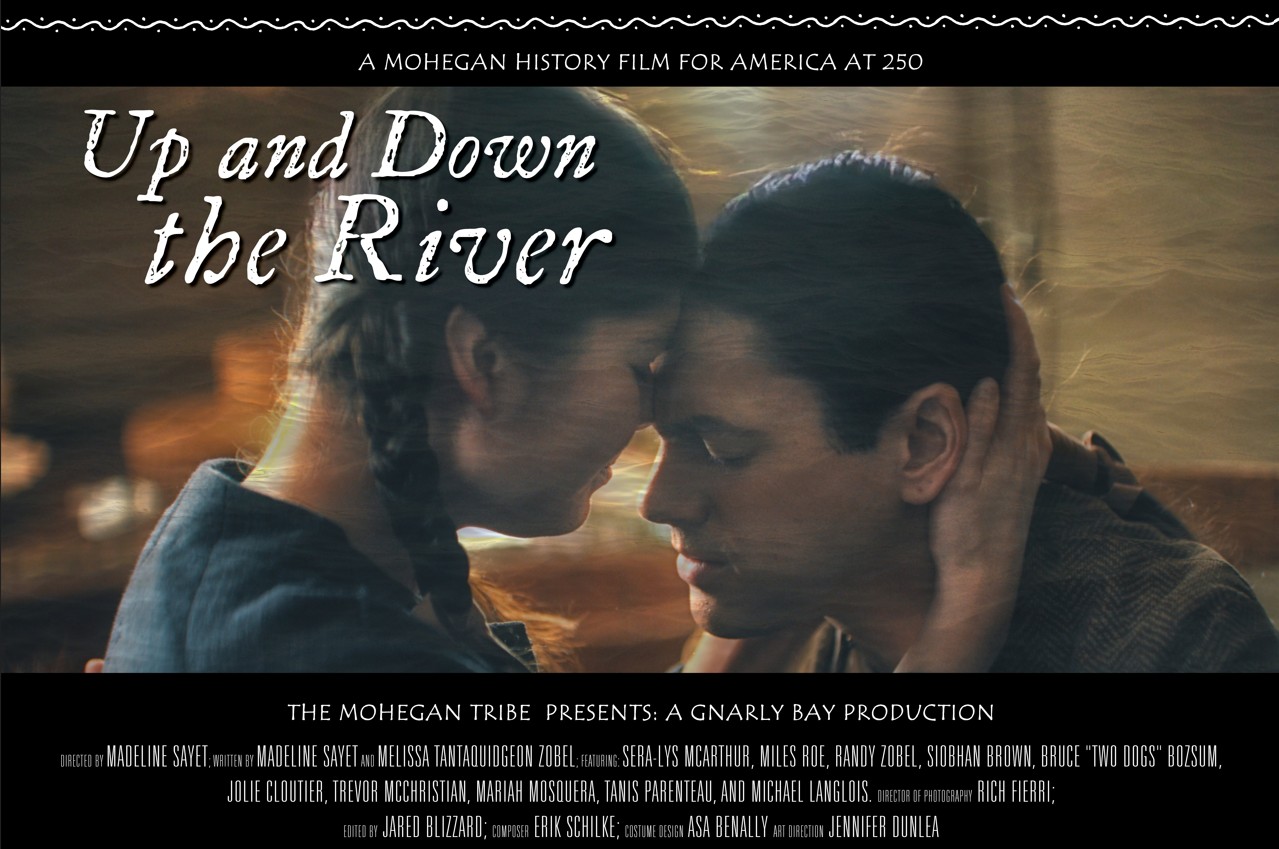
On Thursday, 11 June, the National Parks of Boston and Bunker Hill Community College will host a screening and discussion of the new short film Up and Down the River, dramatizing the choices of Mohegan people during the American Revolution.

This movie was directed by Madeline Sayet and co-written by her and her mother, Melissa Tantaquidgeon Zobel, vice chair of the Mohegan Council of Elders. It stars several Native actors from the Mohegan and other communities.

The film description says:
Spanning the colonial and American Revolutionary eras, Up and Down the River delves into the difficult decisions made by members of the Mohegan Tribe at these pivotal periods in both tribal and U.S. history. Featured in this film is the Ashbow family, including Hannah and her son Samuel Ashbow, Jr. Choosing to fight alongside the American colonists, Samuel Ashbow, Jr., died at the Battle of Bunker Hill in 1775, becoming one of the first Indigenous soldiers to die in the American Revolution.
Ashbow’s father was the Rev. Samuel Ashbow (1718–1795) of New London, Connecticut.

After the film showing, there will be a reflective conversation between Zobel and endawnis Spears, Practitioner in Residence for Tribal Engagement at Brown University and Co-Founder and Director of Programming and Outreach at the Akomawt Educational Initiative.

This program will begin at 6 P.M., with doors open half an hour before. It’s scheduled to last ninety minutes. The showing and discussion are free to the public, but registration is required.

Saturday, May 16, 2026

“To Vax or Not to Vax” walking tour in Boston, 17 May

On Sunday, 17 May, the Partnership of Historic Bostons is offering a walking tour titled “To Vax or Not to Vax: Smallpox in Early Boston.”
The organization says:
The subject of our newly revised walking tour is smallpox, one of the great killers of the 17th century. This European disease found fertile ground in the growing colonies in New England, with the most devastating effects suffered by Native Americans who had no immunity. Up to 90% of the Massachusett Tribe, whose land included Boston and Charlestown, perished, their villages lying empty and providing English colonists with unoccupied land for reasons that Puritans saw as providential.

English colonists had some immunity but, even so, successive generations suffered wave after wave of deadly smallpox outbreaks. . . .

During the tour, we will investigate how the colonists saw smallpox and tried to contain it, and how smallpox roiled their society in a number of ways. Had God handed the Shawmut peninsula over to them by clearing out the Native population, or was he punishing them with the same pestilence for not sufficiently following His word? Could smallpox be successfully treated by medical methods practiced since the time of the Romans, or would new, more radical methods (some employed by Africans, including Cotton Mather’s enslaved African Onesimus, and Turks) prove more effective?
This tour is led by Michael Prochilo. It will start outside of Park Street Station at 2:30 P.M. and is scheduled to last 90 ninety minutes. Because of construction projects, the route is not wheelchair-friendly. Participants are reminded to bring water [Sunday might bring our first 80°F. days this year] and wear comfortable shoes.

Tuesday, May 05, 2026

Upcoming Talks in Woburn and Stoneham

As April started, I planned to spend just a few days on the capture of the Elizabeth, one of the Loyalist evacuation fleet.

I expected to focus on that brig’s two most prominent passengers, Crean Brush and William Jackson, and then sail on.

But then other passengers—the Wheatons, the Hills—turned out to have their own stories, which hit some of my prime interests: espionage, mythmaking, and other suspect behavior.

So here it is early May, and I haven’t even gotten to the legal wrangling around the Elizabeth and its cargo, which took months to settle in 1776 and could take many days to recount.

But I’ll break off from that topic to announce a couple of public talks next week (speaking of espionage, mythmaking, and other suspect behavior).

Tuesday, 12 May, 6:30 to 8 P.M.
Before He Was Count Rumford: Benjamin Thompson’s American Youth
Woburn Public Library, Fireplace South Gallery

Even as a teenager and young man, Woburn’s own Benjamin Thompson was intelligent, ambitious, and full of trouble. This talk tracks the future count through his failed apprenticeships (he blew himself up only once) to his youthful marriage, dealings with royal governors, and first known affair. The outbreak of war in Massachusetts presented young Thompson with bigger dangers—and opportunities.

This talk is free to the public. Register for a seat here. There are no plans to record this talk.

Thursday, 14 May, 7 to 8:30 P.M.
George Washington’s Spy—and Stoneham’s Minister?
Stoneham Historical Society and Museum

Twelve days after arriving in Massachusetts as the new commander-in-chief of the Continental Army, George Washington paid a man to go into Boston and secretly report on British “movements & designs.” For two centuries that person’s name remained hidden. Recent research reveals that he was John Carnes, a grocer with an unusual past: he had started his career in the 1750s as Stoneham’s minister. This talk uncovers Carnes’s background, his role in the first Continental spy network, and what happened to him when the British commander had his own spy among the Massachusetts Patriots.

This event is free, with donations welcome. Doors will open at 6:45 P.M. for museum viewing, and there will be a brief historical society business meeting at 7:15 before the presentation at 7:30. Again, I don’t think this talk will be recorded. [UPDATE: There are now plans to record this talk for sharing later on StonehamTV.]

Tuesday, February 10, 2026

Parson Parsons and His Sons

Jonathan Parsons was born in West Springfield in 1705, the son of a church deacon. As an adolescent he “worked at a trade,” but a Yale tutor named Jonathan Edwards persuaded him to try college.

Parsons graduated at the late age of twenty-four. He then studied more theology under Edwards, who had become the minister at Northampton.

In 1731 Parsons took the pulpit himself in the town of Lyme, Connecticut. He married Phebe Griswold, from a prominent local family, and they started having children—thirteen in all, but six died in infancy.

The children who grew up were four sons, born every two years from 1733 to 1739 (Marshfield, Jonathan, Samuel Holden, and Thomas), and three daughters, born 1748 to 1755 (Phebe, Lucia, and Lydia).

At Lyme the Rev. Mr. Parsons also got caught up in the “New Light” revival inspired by his old mentor Edwards and further inspired by the Rev. George Whitefield, who came through town in 1740. Parsons was soon known for his energetic preaching and evangelical outreach.

In 1745 the minister’s fervor grew too much for his congregation, and they decided on a separation. Parsons moved his family to Newbury to preach to a small “New Light” congregation that set itself up as Presbyterian, independent of New England’s independent network.

That meeting grew, erecting what’s now called the Old South Presbyterian Church in Newburyport in 1756. Whitefield died during a visit to Parsons in 1770 and was buried in its crypt. The minister’s wife Phebe died later the same year. He married the widow Lydia Clarkson of Portsmouth, New Hampshire, in 1771. 

Of the Parsons sons, Marshfield and Samuel Holden moved back to their birthplace of Lyme. Marshfield was a merchant and with his succession of four wives kept a tavern. Samuel Holden graduated from Yale and became a lawyer. Jonathan, Jr., and Thomas kept Newbury as their base and went to sea.

In particular, Thomas Parsons had a son by his first wife, Mary Gibson, and four daughters by his second wife, Sarah Sawyer. The New-Hampshire Gazette shows a captain named Thomas Parsons sailing out of Portsmouth harbor:
  • on the Charming Sally to Guadaloupe in 1762.
  • on the Success to Dominica and the West Indies in 1769.
  • on the Three Friends to the West Indies and Guadaloupe in 1770.
In February 1772, according to secondary sources, Capt. Thomas Parsons took a schooner out of Newburyport for another voyage to the Caribbean. He never came home.

TOMORROW: Mystery off Cape Sable.

Saturday, January 24, 2026

Talking about “The Spark” on The Object of History

Last April I spoke at the U.S.S. Constitution Museum by invitation of the Paul Revere House on the topic “The Reasons for Revere’s Ride.”

I decided not to stick to the events of 1774–75, or even 1765–75. I dug further back into why Boston, of all the parts of the British Empire, was the epicenter of resistance to the Crown’s new revenue measures.

My first reason was: Puritanism, and its effects. Later came: General Economic Anxiety. And a crucial ingredient for heightening the crisis: Crown Crackdowns.

That talk wasn’t recorded, and I started thinking about turning it into an article. But before I could get around to that, folks at the Massachusetts Historical Society invited me to speak about the same question for their podcast, The Object of History.

Here’s what the M.H.S. has just announced for “The Spark: How Boston Ignited the American Revolution”:
Season 5 of The Object of History is dedicated to topics related to the American Revolution. On this first episode, we ask several historians for their thoughts on why Boston helped light the spark of the American Revolution. Was there something unique about Boston's community or geography that made it prone to a rebellious spirit?

We sit down with J. L. Bell, Historian of the Revolutionary Era in Massachusetts, Garrett Dash Nelson, President & Head Curator at the Leventhal Map & Education Center at the Boston Public Library, and Kathryn Lasdow, Assistant Professor of History and Director of Public History at Suffolk University, to answer this question.
And here’s the link.

Friday, January 16, 2026

“Hopes for the deluded Inhabitants of New-England”?

Looking at the Rev. Charles Inglis’s political writing in 1774 led me to another pamphlet from that year: A Letter from a Veteran, to the Officers of the Army Encamped at Boston.

This political essay started off by reiterating a lot of British Whig understandings. But about halfway through it veered into an argument that the political leaders of New England had gone far beyond those principles, driven by the same fanaticism as their Puritan ancestors.

The author concluded that Massachusetts deserved to be restrained by force—though he also cautioned his fellow army officers from going too far themselves, or behaving impolitely.

Here’s a sampling:
THE Principles of Mr. [John] Locke, are noble, benevolent, and in general true, or ought to be so; but the Application of them to particular Cases, is wild and Utopian; even in Idea and in Practice, dangerous to the extremest Degree. Adopted in private Life, they would introduce perpetual Discord; in the State perpetual Anarchy. The least Failure in the reciprocal Duties of Worship and Obedience in the matrimonial Contract, would justify a Divorce. In the political Compact, the smallest Defect in the Prince, a Revolution.

Now I cannot think so ill of this Country [America] as to believe there are many People in it, like the Men [Jonathan] Swift speaks of, who used to swear “the more Revolutions the better.” The Web is too finely spun, for common Use; subject every Moment to be torn in Pieces, even by the gentlest Hand; and fit only for the Cabinets of the Curious. . . .

We have many of us lived in the Pleasures of their Society, shared in the Hospitality of their Tables, and in the Offices of their Friendship. We have been long good Friends, may we ever remain so. Let us hope that they will remember, there is a golden Mean in every Thing, in Liberty, even in Virtue itself; that the Fit of Peevishness and Passion will subside, before it is too late, and give Place to sober and cool Reflection; and that the delightful Current of Peace and Tranquillity, may return once more into its old Channel.

WOULD to God we could form the same Hopes for the deluded Inhabitants of New-England; but they have already advanced too far to retreat; the Sword is suspended over their Heads by a single Hair, and nothing but the immediate Hand of Heaven, can avert the Misery that awaits them. . . .

CAN we wonder at these infatuated unhappy People? Descended as they are, from Men who carried their Notions in Religion, to the wildest Fanaticism; their Principles in Government, to the utmost possible extreme of Liberty; dropt in a Corner of the World, uncontroled for Generations, by the Authority of the parent Country, inheriting such dangerous Opinions; by the Blood of their Ancestors, imbibing them from the Breasts of their Mothers, until, by the Contagion of general Manners, and by the pious Aid of the very Men who were consecrated to instruct their Consciences, in Morality and the Meekness of the Gospel, it ripened into Sedition, as the immediate Word of God, as if they had heard it with their own Ears, from the burning Bush, and ended in Rebellion.

To Men born and educated under such Circumstances, excluded in a great Measure by their Situation, from the beneficial Intercourse and Examination of the Effects of different Opinions and Principles; it is not easy to emerge from Darkness to Light, and to see the World in its true Colours.

The Popularity of their old Government, and the interior Policy of their Townships, have contributed much to their Blindness; from these they have collected all the technical Terms in Politicks, and a huge Stock of sonorous Words, which serve them for Logick; have the same Effect upon their Understandings, and a much greater upon their Passions. . . .

LET us, Gentlemen, who are the Instruments of this Punishment, act our Parts in this sad Scene like brave Soldiers, like true Gentlemen, not like Rioters; Gibes, Reproaches, hard Names, make no Part of the Punishment alloted them; the dispassionate Judges of our merciful Courts, are Counsel for the very Criminals whom the Laws enjoin them to condemn; these are not Times for Merriment and Buffoonery, let us reserve our Wit and our Humour, if we happen to have it, for the Tables of our Friends.
TOMORROW: The responses.

Monday, December 29, 2025

Wartime with “A New-York Freeholder”

“A New-York Freeholder” didn’t continue his newspaper debate with Israel Putnam, quoted over the last two days.

Hugh Gaine had published long essays from the “Freeholder” addressed “To the Inhabitants of North-America” in five successive issues of the New-York Gazette from 12 September to 10 October. One of those essays even crowded out other items.

The main target of the “Freeholder” was the Continental Congress and the ideology that led to it. His last essay criticized military preparations in New England and calls for non-importation. He treated Putnam’s letter about the “Powder Alarm” as simply a symptom of a deeper problem.

The “New-York Freeholder” was the Rev. Charles Inglis (1734–1816), recently made the senior curate at Trinity Church in New York. He was a native of Ireland but attached to the Anglican Church, even arguing for the unpopular idea of bishops in North America.

(This was not the Charles Inglis who commanded H.M.S. Lizard in 1770–71, H.M.S. Salisbury in 1778–80, and H.M.S. St. Albans in 1780–83, and who made one previous appearance on Boston 1775.)

According to the Rev. Mr. Inglis, he ceased his “Freeholder” essays after deciding that the Congress was hopelessly committed to “revolt and independency,” based on its adoption of the Suffolk Resolves and the proclamations it issued in mid-October 1774. So he never responded to Putnam.

After Thomas Paine issued Common Sense in early 1775, Inglis composed a reply titled The Deceiver Unmasked, printed by Samuel Loudon. Soon after copies were advertised for sale, Patriots broke into Loudon’s shop, seized all the copies, and burned them. Inglis was able to have the pamphlet reprinted in Philadelphia under the title The True Interest of America Impartially Stated.

In mid-1776, Gen. George Washington attended Trinity Church. As the minister told it, a lesser American general asked him to omit the usual prayers for the king from the service. Inglis defiantly refused. A few months later, the British military kicked the Continentals out of the city.

Inglis spent the rest of the war inside British-occupied New York, having become the rector of Trinity Church. In June–July 1782 he pulled out the “New-York Freeholder” name again for six essays in Rivington’s New-York Gazette.

The next year Inglis and his family moved to Britain, though most of the Trinity Church congregation went to Halifax. In 1787 the Crown sent him back across the Atlantic to be bishop of Nova Scotia—the first Anglican bishop in North America.

Thursday, December 25, 2025

John Rowe’s Christmas Gift to Himself

On 25 December 1775, 250 years ago today, the Boston merchant John Rowe began a new volume of his daily diary.

The Massachusetts Historical Society has preserved and digitized that document, so that page is available here with a good crowd-sourced transcription.

Rowe wrote:
Monday December 25. 1775 Christmas Day — The Weather A Little Moderated but Cold W W —

I went to Church this morning. Mr. [William] Walter Read prayers & Mr [Samuel] Parker preachd A very Good Sermon from the 2d Chapter of St Lukes Gospell and 14th. Verse Glory to God in the Highest and on Earth Peace Good Will towards Men.

I dind at home with Mrs. Rowe the Revd Mr Parker & Jack Rowe and spent the Evening at home with Richd Greene Mrs. Rowe & Jack Rowe

I Staid & partook of the Sacrament

The Mony gather’d for the Use of the Poor of this church amo to Sixty Dollars —
Rowe was an Anglican, a vestryman at Trinity Church. Unlike the colony’s more numerous Congregationalists, he and his fellow parishioners observed Christmas. But of course Christmas in a besieged town wasn’t a terrifically joyous occasion; “Peace [and] Good Will towards Men” were in short supply.

Rowe’s diary entry for this day is innocuous. This volume raises questions mainly in how the previous volume, covering the days from 1 June to 24 December 1775, is missing. What did Rowe do during the siege? How closely did he cooperate with the royal authorities? What sentiments did he express about the Battle of Bunker Hill and other fatal fights?

The only previous volume of the diary to go missing covered 18 Aug 1765 to 10 Apr 1766, a gap starting shortly before the attack on Thomas Hutchinson’s house. (The lieutenant governor suspected Rowe was somehow behind that attack.) Rowe’s numbering indicates that he filled 138 pages in those eight months.

In contrast, Rowe wrote only 72 pages in the missing volume from late 1775, which would be by far the shortest volume in his journal. Still, those pages would be good to have.

We know John Rowe altered a 1775 diary entry to reverse what he first wrote about the Massachusetts Provincial Congress’s fast day. We know his description of his speech during one of the 1773 tea meetings doesn’t match what an observer in the room reported. It’s easy to imagine, therefore, that Rowe at some point looked at what he wrote about the Stamp Act and its opponents, and about the early months of the war, and decided that those pages no longer reflected his views. Or how he wanted people to view him.