J. L. BELL is a Massachusetts writer who specializes in (among other things) the start of the American Revolution in and around Boston. He is particularly interested in the experiences of children in 1765-75. He has published scholarly papers and popular articles for both children and adults. He was consultant for an episode of History Detectives, and contributed to a display at Minute Man National Historic Park.

Subscribe thru Follow.it


•••••••••••••••••


Showing posts with label Cape Cod. Show all posts

Friday, July 10, 2026

Musical Offerings across Massachusetts

Theaters on either side of Massachusetts are offering Revolutionary musicals in this Independence Day season.

Through Sunday, 19 July, at the Kathleen E. McDermott Auditorium in Great Barrington, John Alan Segalla’s new musical Rebel Town is being staged under the direction of Michael Siktberg.

This show is set in 1773 and looks at the disputes leading up to the destruction of the tea. The main characters are carpenter William Grey, his wife Sarah, and apprentice Peter Slater, presumably based on the ropemaker’s boy of that name. Among the historical figures in the cast are Mercy Warren, Samuel Adams, John Hancock, Paul Revere, Francis Rotch, Gov. Thomas Hutchinson, and Gen. Thomas Gage.

On Cape Cod, the Academy of Performing Arts in Orleans is producing 1776, with music and lyrics by Sherman Edwards and a book by Peter Stone. This production, directed by Joan Baird, also runs through 19 July.

Staged on Broadway in 1969 and filmed in 1972, 1776 dramatizes the process of declaring independence. Most of the characters are delegates to the Continental Congress, starting with John Adams, Thomas Jefferson, Benjamin Franklin, and John Dickinson. Abigail Adams and Martha Jefferson appear as well.

In Boston’s North End, the Paul Revere House is hosting a hammered dulcimer concert by Dave Neiman on Saturday, 18 July, from 1 to 3 P.M.

Saturday, April 11, 2026

“Itt’s said she has a large quantity of the Stolen goods”

It didn’t take long for New England Patriots to realize that Cdre. John Manley’s capture of the Elizabeth on 2 April 1776 was a big deal.

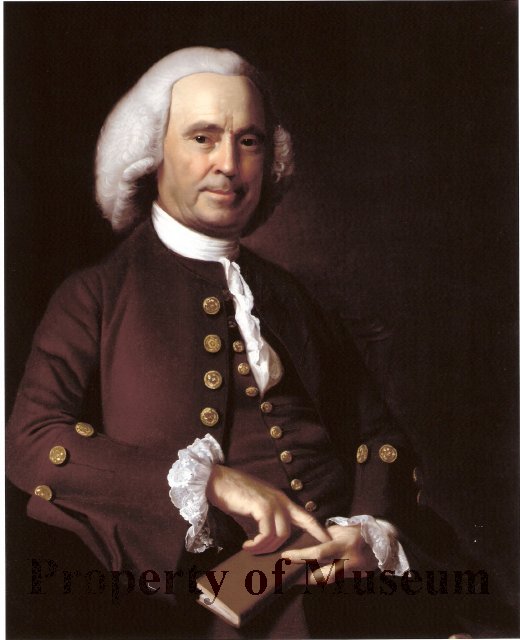
On 6 April, Isaac Smith, Sr. (1719–1787, shown here courtesy of the Yale University Art Gallery), wrote to his niece Abigail’s husband, John Adams, from Salem:
Commodore Manleys fleet has taken a brigantine bound to Halifax on board of which is Bill Jackson and all his Effects and itt’s said she has a large quantity of the Stolen goods—

and there is on board likewise One Greenbrush, receiver general of the stolen goods and has distinguisht himself in that way by demanding People’s propaty from them. Itts said he came from York and itts said those Carpenters and runagarders from that way has behaved worse than any Others.—

A sloop is on shore at the Cape, beleive nothing very Valuable on board but itt Appears they (the inhabitants) went away in a most dismal Cituation, not haveing even Water sufficient and crowded and some sick with the small pox.
That sloop was the Sally, commissioned by Jolley Allen and captained by no one who knew what he was doing, as described back here.

As a merchant in Boston before the siege, Isaac Smith knew William Jackson and his troubles well. But Smith wasn’t familiar with Crean Brush, who had arrived from New York after the siege began—hence his reference to the man as “One Greenbrush.”

John Rowe was all too familiar with Brush, having watched that royal appointee confiscate some of his property. On 8 April he wrote in his diary with surprising calm:
Capt. Manly is come to Town & brings the Accot. of his Taking Crian Brush Wm. Jackson & Twenty other passengers in A Brigg bound with The Fleet—

This Vessell tis Said has Twenty five Thousand pound Sterling On board—in English Goods & Other Merchandise—

among the Prisoners is A Sergiant & 12 Men of the Kings Troops
On 8 April Rowe added:
There is a Confirmation of Crean Brush & Wm. Jackson being taken & also My Negro Fellow Adam
Adam was one of the four enslaved people found aboard the Elizabeth. Remarkably, this is the only time in his published diary that Rowe mentioned the man. We therefore have no clue about how he came to be on the brig. Had Adam asked to evacuate the town, or had Rowe sent him away?

TOMORROW: Following the money.

Wednesday, April 01, 2026

“This captain of ours was at the greatest loss”

Yesterday I started to tell the story of how Jolley Allen evacuated Boston with the British fleet in March 1776—or tried to.

Quoting Allen’s own narrative of course gives away the fact that he survived to tell his tale. But it’s such a sarcastically detailed account that I can’t resist.

We left Allen on the morning after the British ships left Boston harbor. Along with his large family and almost two dozen other people, he was on sloop Sally, and it was sinking.

Allen had come to the realization that the man he’d hired to captain that vessel, Robert Campbell, knew nothing about navigating the ocean or even how a sailing ship worked.

That meant for a tense few hours in the early morning of 28 Mar 1776. But then at seven o’clock Campbell “said he saw a vessel.”

Allen urged Campbell to chase after it. Campbell replied that “did not understand steering the vessel he was in, so well as he knew how to give directions to another.” Allen pointed out that he hadn’t hired anyone else who knew how to steer it any better.

Some time later, Campbell announced “he thought he never saw so large a Ship before.” Allen looked and saw the man was pointing at a stretch of land.
I applied to him and asked him what land he thought it was. He told me that he was fully convinced that it was Nantucket. I told him, if that was the case, we must all perish very soon; for the amazing rocks and shoals that lay off Nantucket I could remember very well, as I saw them above Twenty-Two years ago on my passage when I came from London. . . .

This captain of ours was at the greatest loss to know what to do in this situation, seeing land, for want of a map (which I am of opinion had there been one on board he knew no more what to do with than a rat).
The two men called everyone up on deck to discuss what to do. Some passengers feared drowning most. Some had more fear of falling into rebel hands—though Nantucket would prove to be neutral territory for most of the war. Allen advocated running the sloop on shore. Campbell suggested going back out to sea and hoping a Royal Navy ship would come by. Showing their confidence in the captain, the group voted to try the shore.

With the help of a handy current, the Sally moved inland, then struck a sandbar “violently either seven, eight, or nine different times.” Waves lifted the sloop over the bar, but the anchor caught for a while. About 2 P.M. the sloop reached calmer water
with all our sails hoisted, as we had hoisted in Nantasket Road; some all the way up, some half the way up, and some not a quarter of the way up; torn, to appearance, into ten hundred thousand pieces, all flying.

The captain says to me, by way of adviseing with me, seeing no boat come off to us, whether or no we had not better hoist a signal of a white sheet or table-cloth, to let them know we was in distress for want of a boat. The answer I made him was that I thought the above signals was quite sufficient
Eventually a man appeared on shore. The people on the Sally waved. More men appeared. Those men stood and talked with each other.
At last, to our great joy, we saw a cart with a boat (or cano) in it drawn by ten oxen, and six men more, which came down to our assistance. They soon got the boat into the sea, and two men in it to know from whence we came.
Those two oarsmen hadn’t had smallpox, and one of the women on board was dying from the disease (though Allen didn’t come right out and say that). So the passengers had to wait for two different men with immunity to bring out the rowboat. At about seven in the evening the locals started to ferry the people on the Sally to shore. Allen wrote:
I asked them the name of the place; they told me it was Cape Cod. I told them my captain told me, and insisted upon it, that this place was Nantucket. They answered me that Nantucket was above four days’ sail from Cape Cod with a fair wind.
Allen and Campbell hadn’t managed to escape rebel Massachusetts. They hadn’t even managed to get out of Cape Cod Bay.

TOMORROW: More Loyalists at sea.

Wednesday, March 25, 2026

“Near or quite fifty Sail are got out to Sea”

Lt. Nahum Ward, son of Gen. Artemas Ward, carried Gen. George Washington’s letter (quoted yesterday) to Josiah Quincy, Esq. (shown here), of Braintree on 24 Mar 1776.

The squire, encouraged, started to make detailed notes about what the British fleet was doing out on the Nantasket Road, the shipping channel in the outer harbor.

“The Admiral [Molyneux Shuldam] has a Signal now flying at his main top mast Head,” Quincy wrote the next day, 250 years ago today. “I wish it was in my Power to construe it.” Yes, that would have been more helpful.

But then he saw movement.
11 OClock. This Moment an Explanation of the above Signal occurrs: Part of the Fleet are come to Sail: I shall proceed, journalwise, to inform your Excellency of their Movements, ’till the Bearer, who is gone to see Colo. [Benjamin] Tupper, returns.

1 OClock They are still coming to sail: near or quite fifty Sail are got out to Sea; about half of them Brigs, Schooners, and Sloops; one or two Frigates, and the remainder Transport Ships; their Course shaped for Cape Cod: May not this Division be bound for Martha’s Vineyard, and the Islands in that Sound to procure fresh Provision for the Fleet, which is to rendevous at Hallifax, and from thence to proceed to Quebec?

3 OClock My Servant, who was directed to take an Account of the Number that have sailed, informs me, there are in all fifty two: One transport Brig: is just arrived: . . .

5 OClock The Adml has just now hoisted another Signal a Pendant under his Flagg two more Ships are under Sail going out of the Harbor: 7 O’Clock, Mr Ward & Colo. Tupper are just arrived: They are of Opinion, that the Ships which sailed to Day, have carried off the Tories, and are bound with them to Lewisburgh.

Tuesday Morng [26 March] Mr Ward’s tarrying in Town, gives me a further Opportunity to inform your Excellency that the Fleet, consisting of about 100 Sail, chiefly large Ships, remain as they were last Night.

10 OClock The same Signal is now flying at the Admiral’s Main top mast Head as was hoisted yesterday morning: Scarce hoisted before it was lower’d again, & in abt ½ an hour a blew [blue] flag is flying at mizen Top mast Head and a Pendant at his mizen Peek.

11 O’Clock The above Signals are changed, for a red Ensign hoisted just under his Mizen Yard: A signal is just now hoisted upon the Top of the Light House, for Vessels in the Offing; and immediately followed, by a blew broad Pendant from the middle of the Tower: In less than 10 Minutes the Signal first mentioned vizt a Pendant is flying from his main top mast Head.

12 O’Clock A red Ensign is now flying at his mizen top mast Head; a blew Ensign at his starboard mizen Shrouds, and a pendant thrown out between, by hand, & immediately taken in again.

2 OClock The 60 gun Ship in King Road is come to Sail & going down to Nantasket: The Admiral’s red Ensign is struck; the blew one remains: a large transport Ship and a Brig are just arrived within the Light.
Quincy wasn’t sure all that detail could be useful, but he promised Washington he’d keep sending it until the general said otherwise. He really wanted to be part of the effort to defeat the British.

About half of the fleet had moved off, heading for the safe port of Halifax, Nova Scotia. Most of the rest would follow by the end of 26 March. A few warships stayed behind to patrol Boston harbor.

TOMORROW: Aboard one of those ships.

Tuesday, June 18, 2024

“Delivered to said linzee two hundred and seven sheep”

In January 1791, Capt. John Linzee, R.N., wrote that in the following month he planned to make his second return to Boston since the end of the American War.

As I described yesterday, Linzee’s wife, the former Susannah Inman, had settled in that port with most of their children in a house left to her by the merchant John Rowe.

According to Royal Navy records, John Linzee resigned from the service in September 1791. (Other sources say he retired after events of the following year, but this looks more authoritative.)

The captain settled in Boston, and Susannah Inman gave birth to a son on 7 Aug 1792.

After that, John Linzee went through a string of hardships.

First, on 30 August, Joseph Tucker of Dartmouth sued the captain for the cost of sheep he had collected back on 1 May 1775. In September, Suffolk County sheriff Jeremiah Allen reported arresting Linzee on a writ, though he let the man go on bail.

At first Linzee argued that he had been and remained “a Subject of the King of Great Britain and not a Citizen of this Commonwealth,” so the case should be handled in the federal system. The Barnstable County court refused.

Ebenezer Meiggs of Rochester provided the most coherent description of the dispute:
I being at one of the Elizabeth Islands Called Peek [Penikese? Pasque?] in Company with Joseph tucker of Dartmouth I heard one John Linzee a Captain of a brittish ship of war bargain with said tucker for two hundred and seven sheep for which he agreed to give two dollars for Each sheep besides or without the wool

accordingly the said tucker delivered to said linzee two hundred and seven sheep on board his ship and as the said Linzee was in a hurry to gett them a board he ordered them to be got aboard before they ware all Shorn Promissing said tucker that he would take his shearers on board the ship next morning and that they might take the wool of them or he would Pay the value of it

accordingly the sheep ware Put on board with the wool on as many as one hundred and I helped get them on board but the next morning the said Linzee hove up and went off without fetching the Shearers on board or Paying for the sheep
Linzee denied ever having made such a deal.

Back on 31 May 1775, islander Elisha Nye had lodged a similar complaint against Capt. Linzee for taking sheep and calves off “one of the Elizabeth Islands, commonly called Naushan [Nashawena].” Like Tucker, Nye felt that he and Linzee had agreed on terms, only for the navy to grab livestock and sail away. That complaint went to the Massachusetts committee of safety and then into a file, and it doesn’t appear to have come up during Tucker v. Linzee.

Undoubtedly in May 1775 Capt. Linzee was acting on behalf of the Crown. His assignment was to collect food for the besieged Boston garrison. By coming to live in Massachusetts with his wife and children, however, the retired captain had made himself vulnerable to a personal lawsuit.

In May 1793, a Barnstable County jury found against Linzee and ordered him to pay Tucker £150 and costs.

According to family historian John William Linzee, “the debt was paid by Captain Linzee out of his own private purse, and there is no evidence that he was ever reimbursed by the English government.” Neither is there documentation in that history of Linzee’s payment, however.

But by 1793 that court case was the least of the captain’s troubles.

TOMORROW: Deaths in the family.

Sunday, May 19, 2024

“The taste of their fish being altered”

Just because the British Empire was sliding toward internal warfare in 1774, that was no reason to stop laughing about the news.

Here are a couple of items that appeared in New England newspapers 250 years ago.

The first must have originated in a London newspaper. The earliest North American reprinting I’ve found is in John Dunlap’s Pennsylvania Packet on 18 Apr 1774. Four days later it appeared in both Isaiah Thomas’s Massachusetts Spy and Timothy Green’s Connecticut Gazette of New London, followed by other papers.

Jan. 28. Letters from Boston complain much of the taste of their fish being altered: Four or five hundred chests of tea may have so contaminated the water in the harbour, that the fish may have contracted a disorder not unlike the nervous complaints of the human body. Should this complaint extend itself as far as the banks of Newfoundland, our Spanish and Portugal fish trade may be much affected by it.
Needless to say, even 340 chests of tea dumped off Griffin’s Wharf weren’t really enough to affect the New England fisheries.
Earlier this month artist Cortney Skinner shared this clip from the 9 May 1774 Boston Gazette. It appeared on page 3 right after a political essay and right before the many mercantile ads it resembled.

This notice reads:
WANTED immediately,
A long, strong BOOM,
that will reach from Cape-Cod to Cape-Ann.———
Any Person having such an One to dispose of, will meet with a good Price, by applying to
N***H.
N. B. The Distance is only 18 Leagues.
This was a poke at Lord North’s plan to close Boston harbor to shipping. Unofficial hints of the Boston Port Bill had started to arrive, and Edes and Gill wanted readers to laugh at the folly of that policy.

The same satirical ad appeared the next day in Samuel and Ebenezer Hall’s Essex Gazette of Salem.

Then the text was reprinted (though no longer looking like an advertisement) in the 16 May New-York Gazette, the 18 May New-Haven Post-Boy and Pennsylvania Journal, and the 23 May Newport Mercury. For readers without so much maritime experience, the capper became “The Distance only 54 miles.”

When the Royal Navy and Customs service really did shut down the port of Boston in June, though, suddenly the situation didn’t seem so laughable.

Tuesday, April 30, 2024

“The healing power of Mesmerism and Pure Water”

At the end of the year 1840, Walton Felch, “Teacher of the Science of PHRENOLOGY, otherwise known as the author of a new theory of language,” came to Worcester.

Felch’s advertisement in the Worcester Palladium, illustrated with a man’s profile, stated that he had “been employed, within the last 2 years, to deliver nearly 40 courses of from six to eight Lectures, before not less than 11 or 12,000 persons.”

He now offered the people of Worcester his expertise on:
Phrenology, and its Application
to Government, Education, Social Intercourse, the Philosophy of Language, and of Rhetoric, and the Moral, Intellectual, and Physical Improvement of Mankind.
And the first lecture in the Town Hall was absolutely free, if that’s how you wanted to spend the evening of 25 December.

In April 1842 Felch offered eight lectures on phrenology in Boston’s North End, followed by seven in the vestry of the Fifth Universalist Church. After that, notices of his talks stop appearing in newspapers.

Felch continued to show an interest in phrenology. In November 1851, he assisted another practitioner, Dr. Noyes Wheeler, in lectures in Boston and then served as “chairman” of a meeting of Wheeler’s friends voting him a commendation.

By that time, however, Walton Felch had moved on to some other forms of healing. The first sign of this appears in a curious stretch of newspaper items in 1847 that stars with the 26 March Barre Gazette report of a robbery of James H. Desper’s store of goods and silver worth about $112.

Two weeks later, the Barre Patriot reported that “Dr W. Felch” had helped to found the Barre Falls Lyceum for the “easterly part of town.” He became its president, and Desper was steward. (I can’t help but wonder if that was the result of some dispute within the Barre Lyceum.)

On 28 May the Barre Gazette ran a notice saying:
Veto! Veto!! Veto!!!!

I, JAMES H. DESPER of Barre, having lately heard a variety of Reports apparently designed to raise a public prejudice against Dr. W. Felch, and theredy [sic] hinder him from giving proofs of the healing power of Mesmerism and Pure Water as applied by himself;—1st, that he was turned out of my house; 2d, that he injured the health of my wife and others while boarding here;—3d, that he has been suspected of breaking open our store, &c. &c. I hereby give notice, and my wife sets her signature with mine, that all these reports are most villainous falsehoods; which character, we doubt not, is common to all the reports against the same individual. . . .

And the enemies of reform ought to know that persecution is very much like a kicking gun—there is only one thing certain about it—that is, the kicking over of the fool that fires it off.
“Pure Water” was a sign that Felch, now styling himself a physician, had adopted hydrotherapy as his principal field.

In 1850 the Water-Cure Journal and Herald of Reform reported that “Dr. W. Felch” had just opened the Green Mountain Water-Cure in North Adams. That year’s U.S. Census located Felch in Adams.

In 1854 both the Water-Cure Journal and William Garrison’s Liberator told readers that Dr. Felch was the physician at the new Cape Cod Water-Cure in Harwichport. “Ellen M. Smith, (a young lady of medical education,)” was his assistant, though elsewhere listed as a hydropathic physician herself.

To be sure, the Boston Semi-Weekly Advertiser for 28 Jan 1854 said “Dr. W. FELCH, of Cambridge,” was lecturing every Sunday “on the Philosophy and Evidence of Ghost-seeing.” I can’t say for sure that was Walton Felch, but the 1855 state census and 1860 federal census found him and his second wife Nancy in Boston. His son Hiram had become a city official.

(I’m assuming Walton Felch was not the “W. Felch” quoted in advertisements for “Dr. Hill’s Cordial Balm of Syriacum” in 1855, stating he “had the misfortune to contract the veneral affection of the most aggravated character.” Mostly because this writer had nothing to say about his own medical knowledge.)

By 1870 Hiram Felch had moved out to Boxborough, and Walton and Nancy were back in the Coldbrook Springs part of Oakham.

In 1872, now over eighty years old, Felch made his will. He left his books to be divided equally among Nancy and three grown children and his real estate to be sold to support his widow.

Walton Felch died in Boxborough later that year, apparently visiting his son; his body was returned to “Coldbrook” for burial. That May, the Massachusetts Spy reported that the man’s estate included $700 in real estate and $300 in personal property.

TOMORROW: But what happened to the British soldiers’ skulls?

Saturday, October 07, 2023

Dr. Henry Burchsted and the Whale

On 9 Dec 1755, Richard Pratt of Lynn wrote in his journal:
Was a Whale taken up at Sea and Brought in To Kings-Beach abought 75 feet Long
King’s Beach now straddles Lynn and Swampscott, but at this time Swampscott had not yet broken off.

The 15 December Boston Gazette reported:
We hear that a large Whale 75 Feet in length, was drove ashore dead on Lynn Beach a few Days ago.
The same day’s Boston Evening-Post added:
’Tis said she is claimed by a Cape-Cod Man, who struck her on the Banks, and 2 of his Irons were found in her. Several curious Persons from this Town have been down to view her.
Almost seventy-five years later, Alonzo Lewis shifted the whale’s gender and added a new detail as he wrote in his History of Lynn (1829):
Dr. Henry Burchsted rode into his mouth, in a chair drawn by a horse; and afterward had two of his bones set up for gate posts, at his house in Essex street, where they stood for more than fifty years.
Dr. Burchsted (1719–1807) was a third-generation physician. His grandfather had reportedly immigrated from Silesia about 1685. His father had died earlier that year. At least one of his brothers also went into medicine.

Because there’s a line of overlapping Henry Burchsteds, their genealogy isn’t entirely clear, but it looks like this physician married Anna Potter in 1742 and had a child, naturally named Henry, a short time later. At the start of the Revolutionary War, Dr. Burchsted owned one slave.

The doctor’s striking gate of whalebones “disposed in the form of a gothic arch” stood near the foot of High Rock, now a park with a tall stone observatory.

The doctor’s son Henry grew up to become a shoemaker on Boston Street, and another physician bought the house with the whalebone gate. That landmark was really helpful, local chroniclers said, for people trying to find their way to the fortune-teller Moll Pitcher, who lived in a small cottage nearby.

(The photo above shows not Dr. Burchsted’s gate, which is long gone, but a similar arch erected in front of the Captain Edward Penniman House in the Cape Cod National Seashore in 1969. This picture was taken shortly before those bones were taken down in 2018 because they were deteriorating, also after about fifty years.)

Tuesday, July 25, 2023

“Castaway on the Back of Cape-Cod”

On Thursday, 1 Oct 1767, the biggest local story in the Boston News-Letter was the weather:
The Beginning of last Week we had here very serene pleasant Weather, until Wednesday Evening, when at about 8 o’clock came on, and continued for several Hours, a most violent Storm of Wind and Rain, with some Thunder and Lighting…
Among the consequences lower down in that paragraph:
Capt. Coffin in a Schooner loaded with Oil was castaway on the Back of Cape-Cod, the Cargo and People saved, and in hopes of getting the Vessel off.
In fact, for all the worry during the storm about ships, fishing vessels, and pleasure boats, “Through the Goodness of Divine Providence no Lives were lost” at sea. (A father and son, aged 84 and 52 respectively, both died after losing their separate ways on roads north of Boston.)

Four days later, on 5 October, the Boston Post-Boy followed up on that story:
Capt. Coffin in a Schooner loaded with Oyl, was cast ashore in the Storm mentioned in our last, on the Back of Cape Cod; but the Vessel has since been got off, and arrived here Yesterday.
That incident fits the details reported in the Newport Mercury on 21 December, as quoted yesterday:
Messrs Hussey and Coffin,…belonging to Nantucket, being bound from thence to Boston, narrowly escaped being cast away on Cape-Cod, in one of the late Storms; upon their Arrival, being at Mr. [John] Wheatley’s, and, while at Dinner, told of their narrow Escape
Unfortunately, none of these newspaper items gives Coffin’s or Hussey’s full names. And lots of men from Nantucket shared those surnames, their families intermarrying just to confuse matters further.

However, for his recent Odyssey of Phillis Wheatley David Waldstreicher spotted that on 7 October the merchant John Rowe wrote in his diary that he “Din’d at home with Stephen Hussey, Abisha Folger junr Richard Coffin Isaac Paddock All four from Nantucket.” That was three days after “Capt. Coffin” and his oil had arrived safely in Boston.

What’s more, in September 1775 Stephen Hussey and Richard Coffin were co-owners of a whaling brig named the Mayflower, according to British Treasury records.

So it looks like the two men from Nantucket who told their story of nearly being shipwrecked on Cape Cod in late September 1767 were most likely Stephen Hussey and Richard Coffin.

This was probably the same Stephen Hussey (1735–1805) who “was a blacksmith, shipsmith, and whaling merchant.” Having been elected to represent his town at the Massachusetts Convention of 1768 and the Provincial Congress, he became the island’s first Customs Collector under the new federal government.

TOMORROW: The Newport connection?

Thursday, December 15, 2022

“Another Vessel took the Tea on board”

Four ships carrying British East India Company tea set out for Boston in 1773, but only three made it.

The fourth was the William, captained by Joseph Loring, son of the man who built the Loring-Greenough House in Jamaica Plain.

As with the other three ships, tea was just part of the William’s cargo. It also carried hundreds of glass globes that Boston had ordered for its first street lamps.

On 2 December, Loring ran aground off the northern tip of Cape Cod near Provincetown. The next day, bad weather damaged the William, ensuring it wouldn’t complete its voyage. Most of the cargo, however, was still intact. Over the next couple of weeks, people took off as much as they could.

Jonathan Clarke salvaged most of the tea on behalf of his family firm, one of the original tea consignees. In his Journal of the American Revolution article, James R. Fichter calculated that Clarke managed to secure 54 of 59 chests of tea on the William.

Three or four containers wound up in other people’s hands. That situation set up a new tempest as Massachusetts Patriots tried to keep anyone from selling any surviving tea, even if it had bypassed the tea tax. Mary Beth Norton described those efforts in her book 1774. Peter Drummey covered a local angle in this talk for the Jamaica Plain Historical Society.

It took a while for Clarke to find a ship with a crew willing to carry his rescued tea chests into Boston harbor. We glimpse that situation in this 3 Jan 1774 report in the Boston Evening-Post:
Last Saturday [i.e., 1 January] a Vessel arrived here from Cape-Cod with Part of the Cargo of Capt. Loring’s Brig lately stranded there, among which are the Lamps for the Use of the Town.—Another Vessel took the Tea on board, which, we hear, is intended to be landed at the Castle.
Citing a document preserved in Britain’s India Records papers, Fichter explained what ultimately happened to those chests in his article “The Tea That Survived the Boston Tea Party.”

The 6 January Massachusetts Spy included a detail about the first ship’s arrival from the Cape that the Evening-Post left out:
Last Saturday arrived a vessel with the goods saved out of the Brig William, Capt. Loring, lately cast away at Cape-Cod; and the same evening was visited by a number of Indians, who made thorough search, but found no tea.
Again, this is evidence of Bostonians using “Indians” as a way to refer to locals enforcing the loyal tea boycott by force without acknowledging those men were locals enforcing the loyal tea boycott by force. I doubt these inspectors were disguised with paint and costumes. Instead, everyone knew they’d be better off keeping those men’s identities secret.

Thursday, March 04, 2021

Ripples from the Boston Tea Party in 1774

Without the Boston Massacre reenactment looming over my schedule this year, I’ll devote the next few days to the events of early March 1774.

That was less than three months after the Boston Tea Party, and the ripples from that big splash in the harbor were still spreading.

Most Bostonians were excited about how the event had turned out. The local Sons of Liberty had kept the tea tax from being collected, but they hadn’t hurt any other property or any people. Other towns and ports along the American coast sent messages of support.

On 20 January an agreement among Boston merchants and shopkeepers to stop selling all tea, regardless of tax status, took effect. The Whigs hauled three barrels of tea to King Street and burned them in front of the customs house.

To be sure, there was still some tea circulating in the colony. A fourth tea ship, the William, had wrecked on Cape Cod, and some chests had been salvaged from the wreck. Local Whig crowds were chasing those down.

Meanwhile, the London government was digesting reports of disorder in Boston the previous fall—even before the tea destruction. Ministers considered the big public meetings and the attack on Richard Clarke’s family warehouse described here. On 5 February, Secretary of State Dartmouth sent Attorney-General Edward Thurlow (1731-1806, shown above) evidence about those events.

Six days later, Thurlow and Solicitor-General Alexander Wedderburn replied that several Bostonians had likely committed high treason. They specifically noted:
The conduct of Mr. [William] Molynieux, and…[William] Denny, [Dr. Joseph] Warren, [Dr. Benjamin] Church, and Jonathan [Williams?] who in the characters of a committee went to the length of attacking Clarke, are chargeable with the crime of High Treason; and if it can be established in evidence, that they were so employed by the select men of Boston, Town Clerk, and members of the House of Representatives, these also are guilty of the same offence.
The law officers also cited Samuel Adams and Dr. Thomas Young for their work on the committee of correspondence and John Hancock for participating in the armed patrols that kept the tea from being landed. Of course, securing prosecutions of any of those men was a bigger challenge.

Also in early February, King George III interviewed Gen. Thomas Gage, commander in chief of the army in North America. Gage stated “his readiness, though so lately come from America, to return at a day’s notice if the conduct of the Colonies should induce the directing coercive measures.” He also opined that those measures wouldn’t need any more troops.

And all the while, a ship called the Fortune was plying the Atlantic toward Boston, carrying more tea.

Thursday, December 13, 2018

Ephraim Smith and the Tea Party

The anniversary of the first Boston Tea Party is nearly upon us. Last year I discussed Benjamin Simpson, a man from Maine who was one of the first participants to talk about the experience for the press.

Joshua Wyeth appears to have coined the term “tea party” to describe himself and others who destroyed the East India Company tea. Charles Bahne offered a theory about why that label struck a chord here. The term quickly became popular in the 1830s, with the old man most closely linked to it being George R. T. Hewes, then living in upstate New York.

Then on 20 Sept 1833 the Portland Weekly Advertiser ran this letter from an unnamed correspondent:
The Otsego Republican, speaking of Mr. Hewes, says “he is believed to be the only survivor of the memorable tea party,” in Boston.

By way of correcting a wrong impression, and also of offering all the information in my power, and of inducing others to contributing their mite, as every fact relating to that noble band must be interesting, I would mention the name of Ephraim Smith, Esq., of Gorham, as another member.

He was at the time an inhabitant of Wellfleet, Cape Cod; but happening to be in Boston, he heard a whisper going the rounds in the afternoon, that a party would attack the British tea in the evening, and throw it overboard. He says, they assembled at the town house, at the head of King-street, now, I believe, called State-street, and having disguised themselves with paint, &c. marched down, boarded the ships, three in number, lying on the South side of Long-wharf, and threw the tea overboard, without opposition. He says there were hundreds in the company; how many he would not pretend to say: he does not now recollect any names.

Mr. Smith is now 83 years of age.—There is another member of the same party, who now receives a pension from the office in this town, whose name is not recollected.
Smith died on 13 Jan 1835 at age eighty-four, according to Josiah Pierce’s 1862 History of the Town of Gorham.

In his History of Gorham, Maine, published in 1908, Hugh D. McClellan added another anecdote from Smith, presumably passed down among relatives and inhabitants:
In December, 1773, he was in Boston with his vessel. Seeing a crowd he joined in and was one of the men who went on board the English vessels, and threw the tea overboard. He often told the story of one of the men, who, wishing to carry a little tea home to his wife, unwittingly put so much into his coat-tail pocket as to make it too prominent. This was discovered by some co-patriots, when a jackknife soon made his coat into a short jacket. That part containing the obnoxious weed was thrown into the dock [i.e., the water beside the wharf] much to his disgust, and the amusement of the boys and the crowd generally.
I find Smith’s story less convincing than Simpson’s. It contains little information that wasn’t widely known in Boston during or soon after the event. The man who tried to get away with tea, for example, was Charles Conner.

A detail from Smith’s telling that doesn’t appear in public accounts is that the tea destroyers “assembled at the town house.” That’s hard to believe and even harder to believe no other witness noticed. The building was the center of town and one of the seats of government.

I suspect Smith was in Boston during or soon after the Tea Party of December 1773, but I doubt that he was a participant. Nonetheless, the Maine press was proud to list him as one.

TOMORROW: Another claimant from down east.

[The map of Maine above was published by Anthony Finley in 1830 and is available from the Philadelphia Print Shop.)

Friday, October 05, 2018

Digging the Soldiers out of Faneuil Hall

On 5 Oct 1768, Boston’s selectmen assembled again to discuss what to do about the soldiers of the 14th Regiment of Foot bedding down in the rooms of Faneuil Hall.

Selectmen John Rowe, who had been born in England and played both sides of the political divide, was evidently acting as the town government’s emissary to the military authorities. He left little about this in his diary, but the selectmen’s official minutes say:

Mr. Rowe acquainted the Selectmen that he had seen Collo. [William] Delrimple, who informed him that it was not in his power To remove the Soldiers from Faneuil Hall, but that Barracks were provided and as soon as they were ready the Troops would be removed to them —
Once again, 250 years ago today, nothing changed. So what to talk about today?

Well, it’s Massachusetts Archaeology Month. Among the many special programs at sites around the state are these.

Saturday, 6 October, 11:00 A.M. to 3:00 P.M.
Underwater Archaeology of the Whydah
Cape Cod Museum of Natural History, 869 Main Street, Chatham
Learn about pirates on Cape Cod with the true story of the Whydah! Hear about the tale of “Black Sam” Bellamy and his treasure. Discover the exciting world of underwater archaeology and uncover your own pirate treasure. Children will have the opportunity to excavate like an underwater archaeologist. (Excavations can be messy.)
Wednesday, 10 October, 4:00 P.M.
Parker’s Revenge: The New Evidence
Minute Man Visitor Center, Route 2A in Lexington
Archaeologist Meg Watters will share details about the Parker’s Revenge Archaeology Project, which was successful in locating a key Revolutionary War battle site from April 19, 1775. Following the presentation, Park Ranger Jim Hollister, joined by His Majesty’s 10th Regiment of Foot, will lead a walk out to the scene of action. The re-enactors will demonstrate how we believe the battle was fought, based on the results from the excavations. This program will feature musket firing.
Thursday, 25 October, 12:00 noon to 2:00 P.M.

Archaeology Live: Harvard College Life in Colonial Times
Between Weld and Matthew Halls in Harvard Yard, Cambridge
Peer into an active archaeological excavation and learn about the oldest section of North America’s first college, founded in 1636. Harvard archaeology students will answer your questions, demonstrate archaeological methods, and display recent finds from the seventeenth century that reflect how Harvard College students—centuries ago—ate, dressed, and amused themselves, among other experiences. Drop by any time during this two-hour event. The site is steps away from the famous John Harvard statue in Harvard Yard.

Saturday, March 11, 2017

“Thare went 2100 on Dogster hill”

Joshua Gray (1743-1791) was born in North Yarmouth, in what is now Maine. His mother died when he was two, so he was raised in Yarmouth, Massachusetts, by his father’s sister, Hannah Mallett—supposedly because that town on Cape Cod was safer from attacks by aggrieved natives.

In 1766, Joshua married a local girl, Mary Hedge (1745-1822). A couple of years later the uncle who helped raise Joshua married Mary’s mother, both having been widowed. The uncle died a short time later, but for a while it was a tight little family. [Mary and I share common ancestors, so I’m part of the very extended family.]

When the Revolutionary War began, Joshua and Mary Gary had five children: Thomas, born in 1766 less than seven months after the couple’s marriage; Hannah; Sarah; Mary; and Phebe, born 10 Mar 1775 in the neighboring town of Barnstable.

That fall Joshua Gray was back in Barnstable, captain of a Massachusetts company guarding the town from attack by sea from July to December. In the winter of 1776, his militia company was called up to strengthen the siege lines around Boston. Capt. Gray was on duty during the Continental Army’s final push onto the Dorchester peninsula, which he described in letters to his wife:
Roxbaury Camp March 5: 1776

My Dear I Recevd your Letter 29 of Febury which in it I under stand that you and the children are all well which I Desiar to Beless god for and now Taken this opportunity to Let you No that Through marcy and Goodness of god I am a Live and well and I Desiar to Bless god for so gate a favur

march th 2 Day at night we Begain to fire Shot and Bumbard the Town of Borston and a Sunday Night Keep up the same fire

Munday morning I went on main Guarg In Roxbury Fort and at 7 at night Thair Begain a have fire and Bumbard on Both sides Bumbs and shot flue 6 and 7 at a time

the same Night Thare went 2100 on Dogster hill and att three aClock Nigt thay was Releved with 3000 and But a littel Damege Dun thare 2 men killed 5 or 6 wounded in the Whole of our Camps this Ends the 5 Day of march

march the 8, 1776 and Now we have got fortifyed on Dogster hill verey strong have Bulte to forts on Dogster hill and Cannan and Mortes Plast thair all Readey to Bumbard
(Ahem. That would be, “We have got fortified on Dorchester hill very strong; have built two forts on Dorchester hill, and cannon and mortars placed there all ready to bombard.”)
my Dear Keep up good Courrige hoping we shall Return home in Due time

I have some sick in my Company the men Names are as followes Lewies Thacher: Benoni Studley: Nathal. Hallet Miller Whilden has got a Bad Cofe/ at this Time

Dutey is werey Hard half of my People are on Dutey at a time —

and Now my Dear hoping these Lines will find you and The children all will and all friends give my Love to mother and Brother and Sister and all frinds Brother Hedge is well Brother hedge from Plymouth is hear Now and being in hast I must conclude you Loveing husband untill Death
And a few days later:
Roxbuary Camps March 11: 1776

My Dear The Tender Regards I have for you and the children wont Let me mis a oppertunity of Righting to you to Let you know that I am in health which I Desiar to Bless god for and hoping these Lines will find you and children the same my Dear

I understand by mr Baker That Thomas had the mumps and one of the Gales had Burnt her But Boath was Better

my Dear keep up good Corauge I hope I shall Return home in Due time

I would have Thomas see to things and not Let them sufer and Ezra [apparently a slave] and make him mind and Due his Dutey

Their was a havey Cannading Last Saturday Night which was 9[?] Instant thay firing to Dogster hill they kill four of our men at one shot and that was the most Damage we Recevid

our People Pickup [?] five or six hundred cannon Balls the Next Day

the shiping in Boston seems to be in a moving Postour one half is Gown Down Bilow the Castal

my Dear Right as ofen as you can couvantley so as I may hear from you so conclud your kind and Loving husband till Death

Joshua Gray

P.S. Remimber me to mother and to all frinds That Take Pains to aske after me.
On 17 March the British fleet sailed away. Four days later, Capt. Gray received orders to take his company onto the Dorchester peninsula to relieve others. He wrote to Mary that he expected to be discharged in early April and hoped she could “come you self” to meet him in Plymouth.

The Grays’ daughter Mary died in October 1776 at age three. They had two more girls and two more boys, all of whom lived well into the nineteenth century.

Friday, November 18, 2016

Thomas Machin “employed in ye. Colony service”

I left off yesterday with Gen. George Washington asking the Massachusetts government to release Lt. Thomas Machin from his project surveying a canal through Cape Cod and join the Continental Army around New York. Washington needed engineers to build fortifications.

On 10 June, Washington’s military secretary Robert Hanson Harrison told Gen. Artemas Ward:
I am commanded by his Excy to request you to send immediately to this place Lt Machin of the Train, provided, he does not belong to either of the Artilly Companies, in Boston—If he does not, he will come with all possible dispatch
A week later, Ward wrote back to the commander-in-chief: “Last evening I received Major Harrison’s Letter of the tenth Instant, and agreeable [to] your desire have directed Lieut. Machin to be ready as soon as possible to set out for New York.”

But “as soon as possible” appears to have meant different things to different people. Massachusetts still wanted that canal, which would make shipping from Boston to the southern states quicker and safer. Evidently Machin continued to work on the project. On 19 June the head of the Massachusetts Council, James Bowdoin (shown above), wrote to him at Nantasket, or Hull:
I informed the committee that you could go to Sandwich on the survey if it could be taken this week; in consequence of which, we agreed that you might set out as soon as is thought proper, and begin the survey, and that we would follow, and be there next Tuesday. I beg you would let me see you to-morrow evening, that the committee may hear what to depend on.
He also provided a pass: “Lieut. Machin, the bearer hereof, being employed in ye. Colony service, it is desired he may pass from hence to Sandwich and back without interruption.” That was dated “Boston, June 20, 1776.”

But Massachusetts couldn’t keep Machin much longer. A month later, on 21 July, he was in New York City, Gen. Washington sent him up the Hudson River, telling a secret committee of the state government:
Mr Machine a Lieut. in the Train, who has just returned from overseeing the Works at Boston, he is as proper a person as any I can send, being an ingenious faithfull hand, And One that has had considerable experience as an Engineer
Washington’s orders for Machin were:
You are without delay to proceed for Fort Montgomery, or Constitution in the High Lands on Hudsons River, and put yourself under command of Colo. George [actually James] Clinton or the Commanding Officer there, to Act as Engineer in compleating such Works as are already laid out, and such others as you, with the advice of Colo. Clinton may think Necessary—’tis expected and required of You—that you pay strict and close Attention to this Business—and drive on the Works with all possible Dispatch, In Case of an Attack from the Enemy, or in any Action with them you are to join and act with the Artillery on that Station, and to return to your Duty in the Regiment as soon as you can be spared from the Works
That was the beginning of Machin’s long service fortifying and protecting the upper Hudson against British ships, which included his most storied feat: building a chain of barriers across the river at West Point.

Machin had left something behind in Massachusetts, however. On 10 Aug 1778 Dr. Nathaniel Freeman wrote to Machin from Sandwich: “Your chest of books and instruments are safe here, and ready to be delivered to your order at any time…”

As for Massachusetts’s big engineering project, Freeman wrote, “Our report respecting the channel was seasonably made and in favor of it, but nothing done.” The Cape Cod Canal wasn’t completed until the early twentieth century.

Thursday, November 17, 2016

Lt. Machin and the Cape Cod Canal

On Saturday I’m going to Sandwich to speak to the Cape Cod Sons of the American Revolution about The Road to Concord. So I decided to look for something interesting about Revolutionary Sandwich.

That led me back to one of my favorite characters from the siege of Boston: Thomas Machin. As I’ve written, Machin came to the town in 1774 as a private in His Majesty’s 23rd Regiment of Foot.

Machin left town on the night of 26 July 1775, “when sentry on the fire boat in the river near the neck.” He took his fellow regular’s musket while he slept, got into a canoe, and headed for the American lines.

In Cambridge, Machin was debriefed by Gen. George Washington himself. He then helped John Trumbull sketch the British fortifications; when he defected, two British officers wrote in their diaries that he knew something about that topic. Machin then probably worked in quartermaster Thomas Mifflin’s department. In January 1776, he was commissioned a second lieutenant in the Continental Artillery—one of the American army’s few engineers.

After the siege, Washington ordered Machin to stay in the Boston area to help fortify the harbor against any new British attack. But in May the Massachusetts legislature got a new idea:
It is represented to this Court that a navigable canal may without much difficulty be cut through the isthmus which separates Buzzards Bay and Barnstable Bay, whereby the Hazardous Navigation round Cape Cod, both on account of the shoals and enemy, may be prevented, and a safe communication between this colony and the southern colonies be so far secured
The notion of a canal through Cape Cod had been around for decades. With the Royal Navy lurking out in the Atlantic, this seemed like an excellent time to push it through.

People understood that Machin had experience digging canals. According to family tradition set down in the mid-1800s, he had worked for the British canal engineer James Brindley. Indeed, Brindley was active in the part of central England where Machin reportedly hailed from. However, that family tradition is suspect, creating a fictional past for the man instead of identifying him as a deserter.

Whatever his background, Lt. Machin went to work surveying the canal route and making other plans. But on 10 June 1776, Gen. Washington wrote to James Bowdoin, senior member of the Massachusetts Council:
I am hopeful that you applied to General [Artemas] Ward, and have received all the Assistance that Mr Machin could give in determining upon the practacability of cutting a Canal, between Barnstable & Buzzards Bay ’ere this, as the great demand we have for Engineer’s in this Department [i.e., New York], Canada, &ca, has obliged me to order Mr Machin hither to assist in that branch of business.
Just as the canal construction might be starting that summer, the engineer was called back to the army.

TOMORROW: Can this project be saved?

Friday, June 12, 2015

N. C. Wyeth’s History Paintings in Sandwich

Heritage Museums and Gardens in Sandwich is hosting an exhibit titled “The Wyeths: America Reflected” through 27 September.

Of the forty-five paintings on display, sixteen were created by N. C. Wyeth for a book titled Poems of American Patriotism, published in 1922. Those originals are now owned by the Hill School in Pennsylvania.

That collection included many poems about the Revolutionary War. Wyeth made paintings based on Guy Humphrey McMaster’s “The Old Continentals” (shown here), Henry Wadsworth Longfellow’s “Paul Revere’s Ride,” Francis Miles Finch’s “Nathan Hale,” and James Russell Lowell’s “Washington,” as well as a title page image of Washington on horseback.

Another of the Revolutionary images is “Warren’s Address,” based on a poem by John Pierpont. At first I assumed this refers to Dr. Joseph Warren’s oration in remembrance of the Boston Massacre in March 1775. But no, that canvas (shown here) depicts the doctor orating to the provincial troops on Bunker Hill—which never happened. Still, there’s a poem about it.

In the eighteenth century, these would be considered “history paintings,” one of the more distinguished branches of that visual art. John Singleton Copley settled in Britain in part because he could do the history paintings he dreamed of rather than just portraits.

In the early twentieth century, with mass reproduction making such pictures widely available, work like Wyeth’s was deemed mere illustration. But it’s once again being seen as worthy of museum display, at least alongside the painter’s fine-art descendants.

The Wyeth paintings are in the Heritage Museum’s Special Exhibitions Gallery, which itself is “a replica of a Revolutionary War fort originally located in New Windsor, New York.” Who knew one could find that in Sandwich?

(Thanks to Patrick Flaherty for calling this exhibit to my attention.)

Tuesday, February 21, 2012

Upcoming Lectures in Falmouth, Mass.

The Falmouth Historical Society is hosting a couple of off-season lectures about Revolutionary history in the coming weeks.

Wednesday, 22 February
William Fowler on An American Crisis: George Washington and the Dangerous Two Years after Yorktown, 1781-1783
Most people believe the American Revolution ended in October, 1781, after the battle of Yorktown; in fact the war continued for two more traumatic years. During that time, the Revolution came closer to being lost than at any time in the previous half dozen. Fowler, former director of the Massachusetts Historical Society and emeritus professor of history at Northeastern University, examines how Washington held the Revolution together at a time when all of his victories might have been for naught.
This lecture and signing will start at 6:30 P.M. at the Cape Cod Conservatory, 60 Highfield Drive, Falmouth.

Friday, 30 March
Harlow Giles Unger on American Tempest: How the Boston Tea Party Sparked a Revolution
On Thursday, December 16, 1773, an estimated seven dozen men, many dressed as Indians, dumped roughly £10,000 worth of tea in Boston Harbor. Whatever their motives at the time, they unleashed a social, political, and economic firestorm that would culminate in the Declaration of Independence two-and-a-half years later.
This event will start at 6:30 P.M. at the First Congregational Church of Falmouth, 68 Main Street.

The cost for each program is $4 for members of the society, $5 for non-members. Tickets can be purchased at the venue or at the society, 65 Palmer Avenue.

Tuesday, December 21, 2010

The Lyme Tea Party

Yesterday I suggested that when young people in Lyme, Connecticut, celebrated Independence Day in 1805 by toasting “The Tea Party,” they didn’t mean the Boston Tea Party.

Here’s a description of what they did mean, from the Connecticut Journal of 23 Mar 1774, as quoted in John Warner Barber’s Connecticut Historical Collections in 1836:

Lyme, March 17, 1774.

Yesterday, one William Lamson, of Martha’s Vineyard, came to this town with a bag of tea (about 100 wt.), on horseback, which he was peddling about the country. It appeared that he was about business which he supposed would render him obnoxious to the people, which gave reason to suspect that he had some of the detestable tea lately landed at Cape Cod; and, upon examination, it appeared to the satisfaction of all present to be a part of that very tea (though he declared that he purchased it of two gentlemen in Newport [Rhode Island]; one of them, ’tis said, is a custom-house officer, and the other captain of the fort). Whereupon, a number of the Sons of Liberty assembled in the evening, kindled a fire, and committed its contents to the flames, where it was all consumed and the ashes buried on the spot, in testimony of their utter abhorrence of all tea subject to a duty for the purpose of raising a revenue in America—a laudable example for our brethren in Connecticut.
That “detestable tea lately landed at Cape Cod”? Four ships carrying East India Company tea left England for Boston together. By 10 Dec 1773, the Eleanor and Dartmouth were moored in Boston harbor. The Beaver was still five days out. On that day the fourth ship, the William, ran aground near Provincetown.

The William’s captain salvaged the 58 tea chests, and Jonathan Clarke, one of the original consignees, moved most of them into Castle William, from which about half got onto the open market. Patriots tried to hunt down and destroy all this tea. The crowd at Lyme in March 1774 thought they were doing their part for that effort.

The 1805 toast in Lyme must have commemorated that event, which deprived one peddler of about 100 pounds of tea. It’s possible that there was also a “general search” for tea in town, with people tossing their household stores into the fire to signal their commitment to their political values. There had been such a tea-burning in Lexington, Massachusetts, back on 13 Dec 1773, as the National Heritage Museum describes here.

But the “Tea Party” toast from 1805 didn’t allude to the much bigger event in Boston on 16 Dec 1773. The Lyme collation may indeed have been the first time Americans are recorded as calling the politicized destruction of tea in 1773-74 a “tea party,” but it wasn’t the Tea Party we remember.

TOMORROW: So who was the first to call the destruction of the tea in Boston harbor “the Boston Tea Party”?

Friday, April 16, 2010

The Admiral’s Plan to End the War, and the End of the Somerset

On the evening of 19 Apr 1775, Gen. Thomas Gage was absorbing news of his troops’ bloody withdrawal from Concord. According to his later report, Adm. Samuel Graves came to offer this helpful advice:

In an interview this Evening with General Gage the Admiral advised the burning of Charles town and Roxbury, and the seizing of the Heights of Roxbury and Bunkers Hill, (indeed the latter had begun to be fortified, but that work was discontinued for some reasons with which the Admiral was unacquainted);

to this Proposal the General objecting the weakness of the Army, the Admiral replied that he would strengthen it to the utmost of his power by landing what few Marines remained aboard his Fleet, and, if the General would withdraw the 64th Regiment from Castle William, he would garrison it with his Seamen and be answerable for its safety.

Such a plan pursued, at the same time that the three Line of Battle Ships lay opposite to the town full of Rebels and their Goods, would probably have chequed the most daring and have given such am Appearance of activity to our Operations that things might have continued a long time quiet.

It was indeed the Admirals opinion that we ought to act hostiley from this time forward by burning & laying waste the whole country, & his inclination and intentions were to strain every nerve for the public Service.
Having been recalled to England when he wrote this, Graves was defending himself against criticism. He was also writing with the assurance of a man whose plan was passed over in favor of another and could thus say, “If people had only listened to me at the time…”

Gage opted for less punitive measures, with threats instead of actual destruction. The admiral recorded one step:
Capt. [Edward] LeCras was ordered to acquaint the Select Men of Charles Town that if they suffered the Rebels to take possession of their town or erect any works upon the Heights, the Somerset should fire upon them
The Somerset was still guarding the Charles River on 17 June when the British forces spotting provincials building a redoubt on the lower portion of Bunker Hill called Breed’s Hill. Its gun crews immediately went to work, set fire to Charlestown, and made the first kill of that battle.

The warship was part of the evacuation of 1776, returned to England, and was back along the North American coast in 1778, fighting Continental and French ships. During that mission the Somerset ran aground off Truro on 2 November. Twenty-one members of the crew died, and the rest became prisoners of war.

The Massachusetts authorities salvaged all they could, including cannons used to fortify Boston and “several Casks of Oatmeal” assigned to “for the Use of the State Hospital” the following April. The shipwreck itself is now considered the property of the British government.