J. L. BELL is a Massachusetts writer who specializes in (among other things) the start of the American Revolution in and around Boston. He is particularly interested in the experiences of children in 1765-75. He has published scholarly papers and popular articles for both children and adults. He was consultant for an episode of History Detectives, and contributed to a display at Minute Man National Historic Park.

Subscribe thru Follow.it


•••••••••••••••••


Showing posts with label James Grant. Show all posts

Tuesday, March 26, 2024

Lt. Ragg in Captivity

The Battle of Brooklyn on 27 Aug 1776 didn’t end well for the Continental Army. Gen. Sir William Howe’s forces inflicted heavy casualties and drove the Americans off Long Island.

At eight o’clock that evening, Gen. George Washington’s military secretary, Robert Hanson Harrison (shown here), wrote to John Hancock as chair of the Continental Congress:
a Smart engagement ensued between the Enemy and our Detachments, which being unequal to the force they had to contend with, have sustained a pretty considerable loss—At least many of our Men are missing, among those that have not returnd are Genls [John] Sullivan & Lord Stirling

The Enemy’s loss is not known certainly, but we are told by such of our Troops that were in the Engagement and that have come in, that they had many killed and wounded—Our party brought off a Lieutt, Sergt, and Corporal with 20 privates prisoners.
Sullivan and Stirling were prisoners, but at least they survived. Hundreds of other Americans were dead.

Continental commanders hoped this would prove to be a Pyrrhic victory for the Crown, like Bunker Hill. Gen. Henry Knox wrote to his wife Lucy, “The enemy lost nearly 1000 kill’d among whom was General [James] Grant and Capt. [Andrew] Neilson of the 52d.”

In fact, Gen. Howe reported only 63 dead from the Crown forces, and fewer than 400 casualties in all. Gen. Grant was fine; a lieutenant colonel of the same name died.

Later American writers seeking actions to praise in that battle had to content themselves with gallant ways to lose. The noble sacrifice of the Marylanders holding off the enemy! The sly evacuation across the river to Manhattan!

Among the few solid successes Knox could firmly claim was, “We took a Lt. Ragg whom I knew at Boston and 25 Grenadiers of the marines.” And even that overstated the details slightly. Harrison’s numbers were closer.

Lt. John Ragg had led Sgt. David Wallace, Cpls. Thomas Pike and Edward Gibbon, and twenty marine privates into captivity because he and his superiors had mistaken the Delaware Continentals for Hessians.

Behind the American lines, on 29 August Gen. William Heath ordered Lt. Nathan Umstead to conduct those prisoners of war to Fairfield, Connecticut.

A month later, Thaddeus Burr of the Fairfield committee of inspection wrote back to Gen. Washington, reporting that they had sent Ragg and his servant, Pvt. Benjamin Jones, on to Middletown. The other twenty-one men were taken to Wallingford and “placed in the Parishes in the interior part of the County agreable to Rules of Congress.”

There was just one more thing, Burr told the commander-in-chief: Who would pay for “the charges of marching them”? The committee had fed those prisoners for eleven days and paid “a Sergeant and Six from our Battery…a penny a Mile” to lead them on to Wallingford. How was the town to be reimbursed £14.6.½?

The Washington Papers editors wrote, “No reply to that letter has been found.”

TOMORROW: The last of Lt. Ragg.

Monday, March 25, 2024

Two Lieutenants and the Battle of Brooklyn

On the afternoon of 27 Aug 1776, British and Hessian soldiers under Gen. James Grant advanced on a Continental force, including men from Delaware and Maryland, under Gen. William Alexander, Lord Stirling (shown here).

Lt. John Ragg of the British marine grenadiers led twenty men forward from the right flank of the Crown forces. His orders were “to speak to” the commander of a unit in blue coats, thought to be Hessians, and tell them to stop firing at their own side.

Meanwhile, Lt. William Popham was one of the American officers trying to hold the left side of their line with a company of “awkward Irishmen and others.” Coming from the Delaware regiment, those soldiers were dressed in blue coats.

You can guess what happened. As Popham told it, “Capt. Wragg [sic] and 18 men, supposing us to be Hessians by the similarity of our dress, approached too near before he discovered his mistake.”

The Delaware Continentals took the marines as prisoners. The Americans stripped the British of their guns, Popham taking charge of Ragg’s weapons.

Decades later Popham reported:
I was immediately ordered with a guard to convey them across the creek in our rear to our lines. On descending the high ground we reached a salt meadow, over which we passed, though not miry, yet very unfavorable to silk stockings and my over-clothes.
Popham was a Princeton College graduate eager to look like a gentleman.

As the party crossed the meadow, the British started to fire cannon in their direction. Lt. Ragg stopped moving, “in the hope of a rescue.”

Popham ordered Ragg to “march forward instantly, or I should fire on him.”

Ragg started moving again. But then a new obstacle appeared:
When we got to the creek, the bank of which was exceedingly muddy, we waded up to our waists. I got in after my people and prisoners, and an old canoe that had been split and incapable of floating except by the buoyancy of the wood, served to help those who wanted help to cross a deep hole in the creek, by pushing it across from the bank which it had reached.

I had advanced so far into the mud, and was so fatigued with anxiety and exercise, that I sat down on the mud with the water up to my breast, Wragg’s fusee, cartouch-box, and bayonet on my shoulder; in which situation I sat till my charge were all safely landed on the rear.
Gen. Grant continued to press forward with his 7,000 men, more than twice the British force in the Battle of Bunker Hill. However, that was just a diversion.

Gen. William Howe had sent many more of his troops on long flanking march to the right. They moved through an unguarded pass and hit the Americans from an unexpected direction. In fierce fighting, almost the whole Continental force was driven back to Brooklyn Heights.

Stirling ordered most of his men back as well, keeping a contingent of Maryland soldiers as the rear guard. He led them in two counterattacks on the Crown forces while other Americans withdrew as best they could.

At the end of the day, the Continentals had lost more than 2,000 men. Nearly all the Maryland rear guard was dead. Stirling was a prisoner.

Gen. Howe reported 64 killed, 293 wounded, and 31 missing—including Lt. Ragg and his marines.

TOMORROW: The end of Lt. Ragg’s war?

Saturday, March 23, 2024

Lt. Ragg in the Assault on Brooklyn

In June 1776, Lt. John Ragg of the marines was in Halifax, Nova Scotia, with the rest of the British military force evacuated from Boston.

In July, Ragg was in the fleet of forty-five ships that started unloading British soldiers onto Staten Island, New York.

More troop transports and Royal Navy warships arrived from other parts of the empire. By the end of July, Adm. Lord Richard Howe was overseeing more than one hundred ships while Gen. Sir William Howe commanded 32,000 soldiers.

Those numbers continued to grow in early August. Among the new arrivals were 8,000 Hessian soldiers.

On the morning 22 August, 4,000 redcoats moved onto Long Island. This was significantly more than the British force in the Battle of Bunker Hill, but it was only an advance guard, about a tenth of Howe’s entire land army.

The Americans drew back. By the end of that day, the British had landed 15,000 men at Gravesend Bay, with 5,000 more to follow a couple of days later.

The two armies dug in warily for the next two days. The Americans held the Brooklyn and Guan Heights, guarding the main passes.

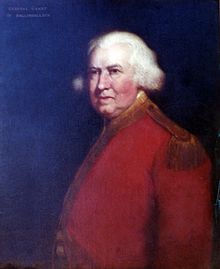
Late in the evening of 26 August, Gen. James Grant (1720–1806, shown above) sent a force of about 4,000 British and Hessian men forward against the Continentals. The first major skirmish was around the Red Lion Inn. The British captured the American commander, Maj. Edward Burd, and sent his forces fleeing.

Gen. Samuel Holden Parsons of Connecticut managed to gather Continental troops along the Gowanus Road and to send for reinforcements. Gen. Stirling arrived with about 1,500 men from Maryland and Delaware. Under his command, the Continentals moved back toward the Red Lion Inn.

Meanwhile, Gen. Grant’s Crown troops were also growing, up to 7,000. That force included the 2nd battalion of marines.

According to a letter written on 4 September by a British officer to a friend in Aberdeen, and published in the Scots Magazine, the marine battalion “was sent from our right to support Gen. Grant.”

In the fighting on 27 August, those marines came under “several fires” from a unit dressed in blue uniforms with red facings. Those were the colors of some Hessian regiments while most of the Continental Army had no uniforms at all, so the British officers assumed that was friendly fire.

Lt. Ragg and twenty men from his grenadier company were “sent out to speak to” those Hessians.

TOMORROW: They weren’t Hessians.