J. L. BELL is a Massachusetts writer who specializes in (among other things) the start of the American Revolution in and around Boston. He is particularly interested in the experiences of children in 1765-75. He has published scholarly papers and popular articles for both children and adults. He was consultant for an episode of History Detectives, and contributed to a display at Minute Man National Historic Park.

Subscribe thru Follow.it


•••••••••••••••••


Showing posts with label Christopher Monk. Show all posts

Tuesday, June 16, 2026

Act Worthy of Yourselves at King’s Chapel, 18–20 June

King’s Chapel has brought back Act Worthy of Yourselves, a sixty-minute drama set around the funeral of Dr. Joseph Warren in April 1776.

The teaser copy says:
The British army has finally left Boston. Now, nearly a year after his death, friends and family can finally hold a funeral for Dr. Joseph Warren.

Inside King’s Chapel, his brother, his fiancée, and his good friend Paul Revere gather to mourn Warren and to make sense of their loss. Outside the Chapel, two Black abolitionists wonder what this revolution will mean for them. A play about memory, legacy, and the potential and pitfalls of the American Revolution.
While anchored in April 1776, the play flashes back to episodes in the life of Dr. Warren earlier in the 1770s. In addition to the doctor’s brother John and his fiancée, Mercy Scollay, the characters include the black businessmen Lancaster Hill and Prince Hall, Paul and Rachel Revere, Abigail Adams, merchant and Freemason John Rowe, medical trainee William Eustis, rising young lawyer Perez Morton, and Christopher Monk, badly wounded at the Boston Massacre.

This play was written by Noah Good and Kaitlin Rose, and directed by Anjie Echemendia. With that large cast and many scenes set at different times and places, it’s a complex undertaking. Last year, as I recall, many of the performers came from the King’s Chapel interpretive staff rather than Boston’s professional theatrical scene.

The remaining performances for this year are on 18–20 June at 7:30 P.M. and on Saturday, 20 June, at 2:00 P.M. Tickets cost from $40 to $15 depending on the view, and are available through this website.

Monday, March 04, 2013

Charles Bahne on the Scene of the Massacre

As we approach the anniversary of the Boston Massacre on 5 March, Charles Bahne, author of The Complete Guide to Boston’s Freedom Trailkindly shared this essay analyzing what may be our earliest visual source on the question: What did the Boston Massacre look like?

Besides the depositions and testimony given by eyewitnesses to the Boston Massacre, we have two contemporary pictorial depictions of the incident. Better known of the two is the copperplate print of “The Bloody Massacre”, “Engrav’d Printed & Sold by Paul Revere, Boston.” As discussed here, Revere’s print of the Massacre was copied—some say plagiarized—from an almost identical image by Henry Pelham.

The Revere/Pelham print is an accurate portrayal of the setting for the Massacre — the buildings, the starry night with its crescent moon, the overall streetscape. But its depiction of the events is far less accurate; issued as part of the radicals’ propaganda efforts, it contains some deliberate distortions. And to compress the entire action into one image, the perspective was foreshortened, placing the victims in much closer proximity than they really were.

For a more accurate depiction, we look to the above image, also attributed to Paul Revere, but with less certainty, since it’s unsigned. (Mellen Chamberlain, who gave this document to the Boston Public Library, said that the handwriting matched Revere’s.) Unlike the more famous print, which was fairly widely distributed, this image existed only in manuscript and wasn’t circulated publicly until over a century later.

We’re looking at a plan or map of the action that evening, drawn from an overhead perspective. North is at right, west at top. In the upper center the Town House (Old State House) is prominently marked. Rows of buildings line either side of King Street (State Street), with other streets branching off to right and left.

But while this plan is a more accurate portrayal of the Massacre events, it also has its limitations. Four bodies lie in the street, some drawn in intricate detail, along with six circles, which apparently show the injured townsfolk. That makes a total of ten victims, but eleven people were actually shot—five dead and six wounded.

At extreme upper right is a seventh circle, unlabeled by the artist and unnoticed by any earlier commentator. Could this be the eleventh victim, or is it something else entirely, being so remote from the rest of the action?

All four bodies, and five of the circles for the wounded, are labeled with letters. Two letters clearly match the names of the slain: A for Attucks and G for Gray. But the other two bodies are marked C and G, only a partial match with the other martyrs, Caldwell, Carr, and Maverick. The circles are labeled with three Ps and two Ms; the six wounded citizens were Payne, Patterson, Parker, Monk, Clark, and Green.

Some discrepancy may have been caused by the belated deaths of Patrick Carr and Samuel Maverick. Was one of them considered wounded, rather than killed, when the plan was drawn?

Still, there are just nine letters in this plan. With eleven known victims, we’re missing two Cs; while a G and an M appear to have been switched between the injured (Green) and the deceased (Maverick).

At lower right, in front of the Custom House, stands a curved line of seven soldiers—not the eight who were actually there. Some historians have theorized, partly on the basis of this plan, that one of the regulars may have stood behind the others, not in line with his colleagues.

Unfortunately, the meaning of the letters, numbers, and circles must remain a matter of speculation. If a key to the plan was created, it’s been lost. Some say that a key was written on the back of the paper, which has since been glued to a board, permanently obscuring whatever it may once have said.

In their recent books about the Massacre, Neil York and Richard Archer both attempt to match the bodies and circles with the names of the fallen citizens—and they disagree. (Neil York consulted with me on this, and cites me in his book.)

The bottom line is that we know with some certainty where Crispus Attucks and Samuel Gray fell, next to the soldiers, and where Edward Payne was hit, standing on his doorstep at lower left. James Caldwell is one of the other bodies shown on the plan, probably the prominent one in the middle of the intersection. As for the other victims, we can only guess who fell where.

TOMORROW: How the scene looks today.

Sunday, January 20, 2013

The Non-Fatal Battle of Golden Hill

Yesterday was the anniversary of what New York historians later called “The Battle of Golden Hill.” That’s a mighty name for what was really the biggest of a series of brawls between British soldiers stationed in the city and local men over the first Liberty Pole.

Some accounts of the fighting 19 Jan 1770 say that it produced “the first blood of the Revolutionary War.” Others even say it included the first death. New York historians were pleased to find an event that predated the killing of Christopher Seider and the Boston Massacre (which also got a mighty name).

There was surely some bloodletting in the fight, but there had been blood shed earlier as well. The first violent death of the conflict might have been the killing of Lt. Henry Panton at sea in April 1769, or we might interpret that as part of sailors’ ongoing resistance to Royal Navy impressment, with no direct link to the Revolutionary argument.

As for fatalities, there were indeed early reports that a citizen was killed in the fighting on 19 Jan 1770. For example, a letter dated 22 January and published in the St. James Chronicle stated, “One sailor got run through the body who has since died, &c.”

However, no New York newspaper ever published the name of that dead man, and the local Whigs would surely have made a public martyr of him. We know from the Boston Massacre that activists publicized the names of all the dead and then some. Paul Revere’s print of the shooting says Christopher Monk and John Clark had been wounded “mortally,” but both apprentices lived for years. I think that sailor fell into the same category, dead enough to complain about but not really dead.

A special supplement to the New-York Journal on 1 Mar 1770 printed a long, detailed account of the fighting dated 31 January. Though signed “An Impartial Observer,” the writer clearly leaned toward the local side of the conflict. And that account stated there were no fatalities, though only by luck. Here’s a sample of that blow-by-blow between soldiers wielding bayonets, swords, and clubs and locals wielding, well, swords and clubs:
Those few that had the sticks maintained their ground in the narrow passage in which they stood, and defended their defenceless fellow citizens, for some time, against the furious and unmanly attacks of armed soldiers, until one of them missing his aim, in a stroke made at one of the assailants, lost his stick, which obliged the former to retreat, to look for some instrument of defence; the soldiers pursued him down to the main street; one of them made a stroke, with a cutlass at Mr. Francis Field, one of the people called Quakers, standing in an inoffensive posture in Mr. Field’s door, at the corner; and cut him on the right cheek, and if the corner had not broke the stroke, it would have probably killed him.

This party that came down to the main street cut a tea-water man driving his cart, and a fisherman’s finger; in short they madly attacked every person that they could reach: And their companions on Golden-Hill were more inhuman; for, besides cuting a sailor’s head and finger, that was defended himself against them, they stabbed another with a bayonet, going about his business, so badly, that his life was thought in danger.

Not satiated with all this cruelty, two of them followed a boy going for sugar, into Mr. Elsworth’s house, one of them cut him on the head with a cutlass, and the other made a lung[e] with a bayonet at the woman in the entry, that answered the child. Capt. Richardson was violently attacked by two of the soldiers, with swords, and expected to have been cut to pieces; but was so fortunate as to defend himself with a stick for a considerable time, ’till a halbert was put into his hands, with which he could have killed several of them; but he made no other use of it, than to defend himself, and his naked fellow-citizens.—

Mr. John Targe, hearing from his house, the cry of murder, went out unarmed, to see the occasion of it, and when he came in view of the soldiers, three of them pursued him to his house, with their arms drawn, from whence he took a halbert, with which he defended himself against their attacks (with sticks of wood, which they took from a heap that lay in the street, and threw at his legs, as they could not reach his body with their arms) and obliged them to retire to their companions; in which time their lives were in his power, had he been disposed to have taken them.
And so on. I suspect the man whose “life was thought in danger” was the sailor earlier rumored to have died.

Most modern accounts agree with me and say the “Battle of Golden Hill” produced no deaths, but every so often a chronicler repeats the claim that it was the first fatal confrontation of the Revolution.

(The image above is Charles Lefferts’s painting of “The Battle of Golden Hill,” completed about 1920 and now at the New-York Historical Society.)

Friday, May 02, 2008

The Last Victim of the Boston Massacre?

Three people died very quickly after the shooting on King Street that we’ve come to call the Boston Massacre: Crispus Attucks, Samuel Gray, and James Caldwell. The apprentice Samuel Maverick died before daylight.

Bostonians expected two more wounded teenagers to die soon afterwards. The Boston Gazette for 12 Mar 1770 listed them as:

A lad named Christopher Monk, about 17 years of age, an apprentice to Mr. [Thomas] Walker, Shipwright; wounded, a ball entered his back about 4 inches above the left kidney, near the spine, and was cut out of the breast on the same side; apprehended he will die.

A lad named John Clark, about 17 years of age, whose parents live at Medford, and an apprentice to Capt. Samuel Howard of this town; wounded, a ball entered just above his groin and came out at his hip, on the opposite side, apprehended he will die.
Of course, it is apprehended that we all will die, but the Boston Whigs were clearly not expecting to see these teens around for much longer.

Instead, the next person to die of his wounds was the breeches-maker Patrick Carr. That brought the number of deaths to five, which is the total that usually appears in history books.

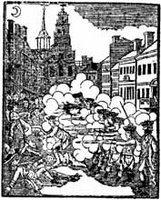
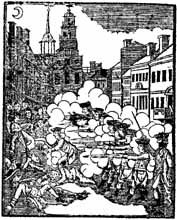
When Henry Pelham created his engraving of the Massacre (the model for Paul Revere’s more famous one, as well as the little version shown above), his caption named all five men who had died and added: “Six others were wounded; two of them, mortally.” The town was still waiting for Monk and Clark to die.

And the waiting went on. As I described earlier in the week, in early 1774 Monk’s master went to Boston and asked for public assistance because the boy was still alive, but still languishing—and shortly to turn twenty-one. The selectmen collected private contributions for Monk and doled them out over the following year.

And still Monk survived. Officials also collected donations for him after the Massacre orations of 1775 and 1777. (The 1776 oration took place outside Boston.) I assume there were collections in the next two years as well, and in 1780 newspapers once again reported that “A collection was made for the unhappy Monk, who still languishes under the cruel wounds he received.” The town records for that year report:
Mr. [John] Scollay Reported that he had distributed the whole of the Money Collected March 6. 1780 for Christopher Monk as p[er] Minute Book of that date—the Sum being three hundred thirty two pounds fourteen Shillings & 1d. Old Money—the particulars of which he exhibited to the Selectmen—
But on 20 Apr 1780 the Continental Journal ran this notice:
Died. Mr. CHRISTOPHER MONK, who has been long languishing under the wounds he receiv’d on the evening of the fifth of March, 1770, by a party of British mercenaries, under the command of Capt Thomas Preston. His funeral will be attended this afternoon.
Monk would have been about twenty-seven years old. His wound in 1770 appears to have been debilitating, and quite possibly led to his early death. By some standards, we should list Monk as the sixth fatal victim of the Boston Massacre. But we don’t.

(According to Ellen Chase’s The Beginnings of the American Revolution (1910), John Clark had died in 1778. I don’t know the source of that statement. It might be based on an incomplete peek at Medford’s vital records, which state that a John Clark died in that town on 26 May 1778—but he was sixty years old. Those same town records say that John Clark, Jr., was born there on 10 June 1752, so he was indeed seventeen years old when wounded.)

Tuesday, April 29, 2008

Passing the Hat for Christopher Monk

Yesterday I wrote about how shipwright Thomas Walker had asked the town of Boston for money to pay for the care of Christopher Monk, his apprentice wounded during the Boston Massacre of 1770. On 14 Mar 1774, the Boston town meeting turned down Walker’s request.

But that wasn’t because of lack of compassion. Rather, Bostonians had already provided a sizeable amount of cash for young Monk’s care through a voluntary collection after John Hancock’s oration about the Massacre on 5 Mar 1774 in the Old South Meeting-house (thumbnail shown here, courtesy of Prof. Jeffery Howe’s scrapbook of Georgian architecture).

The oration was also a legal town meeting, and Boston’s records say:

Upon a Motion made Voted, that there be a Collection made in this Meeting, for Mr. Christopher Monk, a young Man now languishing under a Wound receiv’d in his Lungs, by a Shot from [Capt. Thomas] Preston’s Bloody Party of Soldiers on 5th. March 1770.

A Collection for Mr. Monk was made accordingly, which amounted to the Sum of Three Hundred and Nineteen Pounds 13/3 old Tenor, & the same by Order of the Town, was lodged with the Select Men for the Use of the said Monk.
On 9 March this note appeared in the minutes of the selectmen’s meetings:
A Collection was made by the Town at their meeting on the 5 of March Instant for Christopher Monk of Forty two pounds twelve Shillings & 4d. which by Order of the Town was deposited with the Selectmen for the use of said Monk—The Selectmen having determined to deliver the same to him at twelve different times, the whole was lodged with Deacon [Timothy] Newell for that purpose, who has made him one of these Monthly payments.
How did the collection manage to shrink from £319 to £42 in four days? The first sum was calculated in “old Tenor,” or the devalued local currency, and the 9 March total was probably in real money. Wikipedia has a brief description of the fall of the Massachusetts pound over the 1700s. It says that after 1759 new money was worth ten times the “Old Tenor,” so the selectmen might actually have collected more for Monk since the night of Hancock’s speech.

It’s also interesting that the selectmen didn’t trust Monk—or, more likely, Walker—to handle the whole £42 at once, and doled it out over the full year.

Monday, April 28, 2008

Thomas Walker Seeks Help with Health Care Costs

On 25 Feb 1774, shipwright Thomas Walker (not to be confused with British army drummer Thomas Walker) delivered a petition to Boston’s selectmen, describing himself as “a very great Sufferer by the Barbarous Firing of the Soldiers of the 29th. Regiment upon the Inhabatents of this Town on the Memorable fifth of March 1770”—i.e., the Boston Massacre.

Walker doesn’t appear on the list of dead or wounded from that event. Instead, he really wrote on behalf of his teen-aged apprentice, for whom he had taken legal responsibility:

His Apprentice Christopher Monk then in the siventyth [i.e., seventeenth] Year of his Age, havng been at that time Dangerously wounded by a Bullett passing through his Lungs, Whereby you Petitioner besides loosing the most Valuiable Part of his Apprentices Time, was Obliged to surport him, and pay for his Nursing, which was a very Expence, and has also the Sergen’s Bill amountg. to One Hundred & Eighteen pounds five shillings, & four pence lawfull Money now laying against him, and altho the Surgeon has generously consented to give in his whole Charge for Dressing and Attendance, and to take only what the Medicenes amounts to charged at the Usal rate, yet this is more than yr. Petitioner us able to Pay without greatly Straitning himself and Family.

He Therefore Humbly Prays that you would take into Consideration, the Great share of that Public Calamity which has fallen to his Lott, that you would Commerate his Circumstances and grant him that Relief which your Wisdom and Generosity to a Distressed fellow Citizeon whose Missfortunes are not owing to any Crime or Indiscretion in him, or in his Aforesaid Apprentice shall point Out.
Walker signed this petition, but someone else had written it out for him. The matter appeared on the agenda for Boston’s 14 March town meeting.

That meeting came just after the anniversary of the Massacre, commemorated in 1774 by an oration from John Hancock (shown above). Unlike previous years’ orators, Hancock specifically mentioned Monk. Addressing the “bloody butchers” in the royal government who had supposedly instigated that shooting, Hancock declared:
surely even your obdurate hearts must shrink, and your guilty blood must chill within your rigid veins, when you behold the miserable Monk, the wretched victim of your savage cruelty. Observe his tottering knees, which scarce sustain his wasted body ; look on his haggard eyes; mark well the death-like paleness on his fallen cheek, and tell me, does not the sight plant daggers in your souls?

unhappy Monk! cut off in the gay morn of manhood, from all the joys which sweeten life, doomed to drag on a pitiful existence, without even a hope to taste the pleasures of returning health! yet Monk, thou livest not in vain; thou livest a warning to thy country, which sympathizes with thee in thy sufferings; thou livest an affecting, an alarming instance of the unbounded violence which lust of power, assisted by a standing army, can lead a traitor to commit.
Despite such ringing rhetoric, however, the town meeting responded to Walker’s petition like this: “it was moved that the Petition be dismissed, and it was accordingly dismissed.”

TOMORROW: What Boston did for Christopher Monk instead.

Wednesday, February 27, 2008

Misremembering the Massacre in 1823

In 1823, William Tudor, Jr., wrote The Life of James Otis, of Massachusetts, the first major biography of a figure from Boston’s pre-Revolutionary political turmoil. This is what that book had to say about the Boston Massacre:

The presence of the troops in Boston had now produced one of the effects, which had been foretold by those persons, who had deprecated their being sent to the country. The feelings of reserve and ill-will towards the army, which pervaded the whole community, often led to quarrels and fighting between the soldiers and some of the labouring classes.

The troops behaved well generally, though in many instances individuals were insulted by them, and some few cases of outrage and wounding unarmed persons occurred. Yet in looking at the chronicles of those days, where no event of this kind was either omitted or palliated, they seem to have been under good discipline, and to have demeaned themselves as well as could have been expected, when it is remembered, that they were quartered among a people who always met them with aversion.

At length a quarrel arose, from an insulting answer given by a black man to a soldier. A battle ensued, in which the soldier after beating the negro, was, for an insolent answer to the fellow’s master, beaten himself in turn. Afterwards, when several of his comrades engaged in the dispute, they were also worsted, and being bent on revenge, they reinforced their numbers to renew the struggle on another day, which was promptly followed by the people, till the whole town became agitated by the disturbance.

In this state of things, a dispute occurred between the guards stationed in State-street [then King Street], and some men and boys to the number of eighty or a hundred, who had assembled in the street. A sergeant’s guard, in passing to relieve a centinel at the custom house, pushed or struck some of the people with their muskets, and immediately they began to pelt them with snow balls, stones, or any missiles they could find. Captain Preston was in command of the guard, and he directed the soldiers to fire in self defence. About eighteen or twenty were killed and wounded.
It’s remarkable how inaccurate this account was, considering that some Bostonians alive in 1823 could still remember the event. Furthermore, Tudor had access to important sources. His father had been one of John Adams’s law clerks in 1770. Adams himself was urging the young man to write about Otis and sending him reminiscences. Those circumstances suggest that this was how Tudor and his circle wanted to remember the Massacre.

Among the inaccuracies:
  • The fight at John Gray’s ropewalk did not start because of “an insulting answer given by a black man to a soldier.” It started because of an insulting answer given by a white man to a solider. We even know that white man’s name: William Green. Tudor’s account shifted the blame for the ruckus to a black man with a “master,” absolving the free white population of causing any trouble.
  • Saying that “A sergeant’s guard [was] passing to relieve a centinel at the custom house” implies that those soldiers just happened by King Street in their regular march through the town when one sentry replaced another. Cpl. William Wemms and his squad of grenadier privates came to the Customs office because Pvt. Hugh White, the sentry there, had sent a man running for reinforcements. That squad didn’t make any friends by how they arrived, pushing and pricking people with their bayonets. But White thought the crowd was already violent.
  • Capt. Thomas Preston didn’t order the soldiers to fire in self-defense. His attorneys—Adams, Robert Auchmuty, and Josiah Quincy, Jr.—made the case that he had never given such orders. Indeed, one of the privates, Edward Montgomery, later told one of those lawyers (most likely Auchmuty) that he had been the man who yelled, “Fire!”
  • There were five Bostonians killed, six if we count Christopher Monk, who died years later after suffering a crippling injury. The first newspaper accounts listed five more as wounded. Eleven is a long way from “eighteen or twenty” victims.
For nearly twenty years after the Massacre, Boston commissioned a public oration each 5th of March to commemorate the event. That tradition faded after Massachusetts adopted the Constitution, to be replaced by an oration on the 4th of July. This passage from Tudor’s book shows how much Bostonians then forgot about the Massacre in the next thirty-five years.

Sunday, December 30, 2007

Another Cut at the Massacre

To show off and sell its useful but expensive Archive of Americana digital databases, the Readex company offers a few online samples, including this broadside about the Boston Massacre titled “Poem in memory of the (never to be forgotten) Fifth of March, 1770.” Click on the picture here to go to the appropriate page, and click on the picture there to download a PDF version.

I first saw this document reproduced on the wall of the Old State House Museum. The Readex version is a scan from a microfilm photograph of an imperfectly preserved printing, so it’s not pretty. In fact, I’m not sure it’s legible. Here’s my best guess at the second stanza:

Look into king-street: there with weeping eyes
Regard O Boston’s sons—there hear the cries!
There see the men lie in their wallow’d gore!
There see their bodies, which fierce bullets tore!
So as poetry it’s not readable, either.

Still, it’s possible to spot some interesting details.
  • At the top is a line of five coffins for the five people killed on King Street, whose names are also listed after the title. Like the dark borders, this was an obvious sign of morning.
  • Within the text another coffin appears, representing the death of Christopher Seider eleven days before the Massacre.
  • Seider’s coffin, like the one above marked “S.M.” for Samuel Maverick, has a scythe on it as well as a skull and crossbones. I believe that was supposed to symbolize that these boys had been cut down too soon: Seider at nearly age eleven, Maverick at seventeen.
  • The poem mentions another badly wounded boy, Christopher Monk, in the tenth stanza. He survived for several years, but people blamed his disability and early death on his wounds.
  • Stanza 8 calls for punishment of Ebenezer Richardson, who shot Seider. However, the poem doesn’t complain that he’s been convicted and not punished, which probably dates it to mid-1770.
Finally, this specimen of propaganda and the printing art was “Sold next to the Writing-School, in Queen-Street,” so Boston’s schoolboys probably got a good chance to cogitate upon it.

Wednesday, July 25, 2007

How to Play Tip-Cat

John Adams’s statement, whatever its source, that apprentice Christopher Monk carried a catstick to the Boston Massacre indicates that the town’s adolescents were familiar with the game of tip-cat.

Tip-cat was one of many games humans have invented that involve hitting a small object with a stick and then running around while other players try to catch the object and/or you. Nowadays we play baseball and softball and Wiffleball and cricket and oina. In centuries past people played stoolball and rounders and one-ol’-cat and tip-cat.

In fact, the eighteenth century seems to have been when baseball, under the name of “base,” started to surface in that collection of games. George Ewing’s journal of life at Valley Forge contains entries like this, from April 1778:

Attested to my Muster Rolls and delivered them to the Muster Master excercised in the afternoon in the intervals playd at base this evening some Rogueish chaps tied a sheaf of straw to the tail of Joseph Andersons B Quartermaster commonly called leg and a piece of five Pound tens horse tail and set it on fire and let him run which very much offended him and he set out to the Genl to enter a complaint
Good times.

The following explanation of tip-cat combines text from Joseph Strutt’s The Sports and Pastimes of the People of England (first published in 1801, revised and republished many times afterwards) and diagrams from Daniel Carter Beard’s Outdoor Games for All Seasons (1896), shown above.
The Cat [fig. 272] is about six inches in length, and an inch or an inch and a half in diameter, and diminished from the middle to each end in the manner of a double cone: by this curious contrivance the places of trap and ball are at once supplied; for when the cat is laid upon a stone, or the ground, the player with his cudgel or catstick [or bat, fig. 273] strikes it smartly, it matters not at which end, and it will rise with a rotatory motion [fig. 274], high enough for him to beat it away as it falls, in the same manner as he would do a ball.
You can also read Beard’s discussion of tip-cat from Inquiry.net.

What did Strutt mean by “trap and ball”? A trap was another mechanism for putting a ball into play. It was a lever, either with its own fulcrum or placed on the edge of a little hole. The batter stomped on one end of the trap to launch the ball on the other end up into the air, where he or she could hit it. These two pages contain images of children in the 1800s playing trap-ball. Fisher-Price and Little Tikes now sell machines that do the same thing as a trap for $40-60.

A catstick like Kit Monk’s could have been used with either a trap and ball, or a cat. Back in colonial times, not all children had wussy leather balls. No, some played with pieces of wood! And they liked it!

Sunday, July 22, 2007

Christopher Monk's Catstick

While attorneys at the trial of soldiers for the Boston Massacre questioned blockmaker James Brewer, as described over the past week, one lawyer for the defense, John Adams, was taking notes. He summarized some significant parts of Brewer’s testimony like this:

Kit. [Christopher] Monk was there. I turned round to speak to Kit. Monk, and they fired and K. faltered. [Pvt. Mathew] Kilroy struck me upon the Arm with his Bayonet as they came round before they were formed. The Firing began upon the Right. I thought it was the Man quite upon the right. Kilroy struck at me. Saw no blows, nothing thrown. Monk had a Catstick in his Hand. Heard no Names called, no Threats, no shouts, no Cheers, till the firing.
What’s a “catstick”? John Russell Bartlett’s Dictionary of Americanisms (published in 1849) defines that object this way:
Catstick. A bat or cudgel, used by New England boys in a game at ball. It is known by the same name in England, though used for a different play. I have never heard the word except here in Rhode Island.
A catstick was thus a small wooden bat, perhaps the size of those miniature bats sold as souvenirs. (The one pictured above, available from the Oddball Mall, features Nomar Garciaparra in a Red Sox uniform. I wonder why those haven’t sold out.)

Here’s the real mystery. The detail that “Monk had a Catstick in his Hand” does not appear in the published record of Brewer’s testimony. It first saw print when Adams’s notes were published in the third volume of Legal Papers of John Adams. What explains the discrepancy? I can imagine two scenarios.

First, the shorthand expert who privately transcribed the trial, John Hodgson, might have missed that part of Brewer’s testimony. Adams and merchant Richard Palmes both claimed Hodgson had made serious mistakes. Hodgson did not capture Robert Treat Paine’s summation for the Crown because the courtroom was so crowded and his hand so cramped. The Whigs already suspected Hodgson’s neutrality since he was a Scottish immigrant employed by a printer who supported and was supported by the Customs service.

But Brewer testified early in the trial, and Adams said Hodgson’s notes on the witnesses’ remarks were fine. (I suspect his notes on Adams’s summation were fine as well, and that speech simply wasn’t as brilliant as Adams wanted to remember.) Testimony that young Kit Monk had been carrying a stick, especially from a prosecution witness, would have helped the defense, so it seems unlikely that Hodgson would have missed it. Furthermore, that detail doesn’t fit with Brewer’s other testimony: he was busy denying that he’d seen any civilian on King Street with any stick.

My second scenario, therefore, is that Adams might have heard about Monk’s catstick from some other source. As he took notes on Brewer’s testimony, the attorney responded to the blockmaker’s denials by, perhaps indignantly, inserting a contradictory fact. But because no witness testified about the catstick, Adams and his colleagues never got to introduce that detail into the trial.

COMING UP: So what did New England boys use a catstick for? Besides possibly brawling with soldiers, of course.

Wednesday, July 18, 2007

James Brewer at the Boston Massacre, part 2

Yesterday I quoted the start of blockmaker James Brewer’s testimony about what he had seen on King Street on the night of Monday, 5 Mar 1770. Here’s more from his time in the witness-box as the prosecutors led him to fill in his account—particularly a detail he’d left out earlier, but which was probably crucial to the case they were trying to make.

Q: Was it the first gun that you thought wounded [Christopher] Monk?

B: No.

Q: Did you see any of these prisoners there?

B: I think I saw [Pvt. Mathew] Kilroy, and that he was the man who struck me with his bayonet, when they came down, before they formed.

Q: Did any body near you do any violence to him?

B: No, I saw none.

Q: Had you seen Monk that evening before?

B: No, nor the day before.

Q: How near were you to the soldiers when they fired?

B: I was about ten or fifteen feet from them, I stood in the street just above Royal-exchange-lane, about six or seven feet from the gutter.

Q: Could you see the whole party?

B: Yes, they stood in a circle, or half moon.

Q: Did you take notice of the distance betwixt the first and second gun?

B: No.

Q: Was your back to them, when that first gun was fired?

B: No, my face was to them.

Q: Where did the firing begin?

B: Towards the corner of Royal-exchange-lane. I think it was the man quite to the right.

Q: Did you know him?

B: No.

Q: Did the man that struck you do it on purpose, or accidentally, do you think?

B: I think he did it on purpose, I apprehended it so; I was standing by the gutter, and he was before me.

Q: Said he anything to you?

B: No, nor I to him: he came to form, and I was closer than I wished I was, and he struck me.
Pvt. Kilroy was key to the prosecutors’ hopes of convincing the jury that the British soldiers were out for blood when they arrived on King Street. He had been at the brawl between soldiers and ropemakers the previous Friday. He had a bad reputation in Boston, shoemaker George R. T. Hewes would recall. And according to Brewer, he had struck out at the crowd with his bayonet “on purpose” and been the first to fire his gun.

(Image of musket and bayonet above from the Black Watch Regimental Museum.)

COMING UP: James Brewer’s cross-examination.

Tuesday, July 17, 2007

James Brewer at the Boston Massacre, part 1

On Wednesday, 28 Nov 1770, the Crown called James Brewer, blockmaker, to the witness stand at the trial of soldiers for the shootings on King Street the previous March. The prosecutors were Solicitor General Samuel Quincy and an attorney specially hired by the town of Boston, Robert Treat Paine. Their questioning started like this:

Q: Please to look upon the prisoners, do you know any of them?

Brewer: I think I remember this man. [He pointed to Pvt. Mathew Kilroy.]

Q: Was you in King-street the fifth of March last?

B: Yes, in the evening.

Q: Please to inform the Court and Jury what you saw there?

B: I came up Royal-exchange-lane, and as I got to the head of it, I saw the Sentry [Pvt. Hugh White] on the steps of the Custom-house, with his bayonet breast high, with a number of boys round him: I called to him, and said, I did not think any body was going to do him harm. I saw Capt. [Thomas] Preston and some soldiers come down.

Q: Which of the prisoners was the Sentry?

B: I cannot tell, I was not so nigh him to know his face.

Q: How many boys were there round him?

B: I think about twenty.

Q: How old were those boys?

B: About fourteen or fifteen years old, perhaps some of them older, I saw no men there except one, who came up Royal-exchange-lane with me, thinking it [the alarm bell] was fire. He went back again.

Q: What did you take to be the reason that the Sentry charged his bayonet?

B: I could not tell what the reason was; there was no body troubling him. I was at the corner of Royal-exchange-lane, and a young man went up to the Sentry and spoke to him; what he said I do not know.

Q: Was you there at the time of the firing?

B: Yes, I went toward the Sentry-box, where I saw Capt. Preston. I said to him, Sir, I hope you are not going to fire, for everybody is going to their own homes. He said I hope they are. I saw no more of him. He immediately went in amongst the soldiers.

Q: What number of soldiers were there?

B: I think seven or eight, I did not count them. [There were eight enlisted men, including White.]

Q: Did Capt. Preston lead or follow them down?

B: I think he was upon the right of them. [Preston arrived a short time after his men, who were led by a corporal.] As they came down they had their guns charged breast high. I saw Christopher Monk [a sixteen-year-old shipwright’s apprentice], who was wounded that night, I turned to speak to him, and directly they fired, and he seemed to faulter. I said are you wounded, he said yes. I replied, I do not think it, for I then apprehended they fired only powder [i.e., the soldiers had fired blanks].
NEXT: Brewer’s testimony continues.

Thursday, March 08, 2007

The First Newspaper Reports on the Massacre

In colonial Boston, some newspapers published each Monday, and some each Thursday. Because the Boston Massacre occurred on a Monday evening, the first press reports appeared on Thursday the 8th—237 years ago today. The Massachusetts Gazette and Boston News-Letter listed the casualties this way:

Mr. Samuel Gray, Ropemaker, killed on the Spot, the Ball entred his Head broke the Skull.

A Mollatto Man, named Johnson, who was born in Framingham, but lately belonging to New-Providence, and was here in order to go for North-Carolina, killed on the Spot, two Balls entering his Breast.

Mr. James Caldwell, Mate of Capt. Morton’s Vessel, killed on the Spot, two balls entering his Breast.

Mr. Samuel Maverick, a promising Youth of 17 Years of Age, Son of the Widow Maverick, and an Apprentice to Mr. Greenwood, Joiner, mortally wounded, a Ball went through his Belly, and came out at his Back: He died the next Morning.

A Lad named Christopher Monk, about 17 Years of Age, an Apprentice to Mr. Walker, Shipwright; Mortally wounded, a Ball entered his Side and came out of his Back; apprehended he will die.

A Lad named John Clark, about 17 Years of Age, whose Parents live at Medford, and an Apprentice to Capt. Samuel Howard of this Town; Mortally wounded, a Ball entered just above his Groin and came out at his Hip, on the opposite side, apprehended he will die.

Mr. Edward Payne, of this Town, Merchant, standing at his Entry Door, received a Ball in his Arm, and shattered some of the Bones.

Mr. John Green, Taylor, coming up Leverett’s Lane, received a Ball just under his Hip, and lodged in the under Part of his Thigh, which was extracted.

Mr. Robert Patterson, a Seafaring Man, who was the Person that had his Trowsers shot thro’ in [Ebenezer] Richardson’s affair, wounded; a Ball went thro’ his right Arm.

Mr. Patrick Cole, about 30 Years of Age, who work’d with Mr. Field Leather- Breeches-maker in Queen-Street, wounded, a Ball entered near his Hip and went out at his Side.

A Lad named David Parker, an Apprentice to Mr. Eddy the Wheelwright, wounded, a Ball entered his Thigh.
What seems off about this list? Well, for one thing, though people expected apprentices Christopher Monk and John Clark to die shortly, neither did. Monk remained disabled by his wound for several years before dying, so he’s not memorialized among the standard five Massacre victims.

The Boston Gazette, published the same day, ran a similar list, emphasizing the three wounded apprentices ahead the working-men. The Gazette also gave different names for two men. The first was Patrick Carr, an Irish-born laborer I’ll have more to say about soon. While the two apprentices survived, Carr turned out to have been mortally wounded.

The Gazette also reported the one name people today are most likely to connect to the Boston Massacre: Crispus Attucks. Apparently he was living in Boston under the alias “Michael Johnson,” the name on the coroner’s report on his death (now in the collections of the Old State House Museum). Both the News-Letter and the Boston Chronicle reported the mulatto sailor’s name as Johnson. But the Boston Gazette had the name that appeared on all the subsequent legal proceedings, the name that’s come down in history.

Oddly enough, however, the News-Letter and Gazette had the same description of the man’s history: born in Framingham, working as a sailor out of the Bahamas, in Boston between voyages. Both identified him as mulatto, and therefore didn’t grant him the honorific title of “Mr.” In the 1850s historians found a newspaper ad that implied Attucks had escaped from slavery in Framingham twenty years before, which would explain why he used an alias while back in his home province. But how Bostonians discovered the history of that dead man, and how details reached one newspaper before the others, is still a gnawing mystery.