J. L. BELL is a Massachusetts writer who specializes in (among other things) the start of the American Revolution in and around Boston. He is particularly interested in the experiences of children in 1765-75. He has published scholarly papers and popular articles for both children and adults. He was consultant for an episode of History Detectives, and contributed to a display at Minute Man National Historic Park.

Subscribe thru Follow.it


•••••••••••••••••


Showing posts with label Charles James Fox. Show all posts

Thursday, October 05, 2023

The Real Life and Death of Mrs. Coghlan

Margaret Moncrieffe was born in Scotland in 1762. Her father was army officer Thomas Moncrieffe, who soon became one of Gen. Thomas Gage’s aides in North America. Her wealthy mother died young.

When the Revolutionary War broke out, Margaret was in the New York area while her father was serving as a brigade major inside besieged Boston.

In 1776 Maj. Moncrieffe came to New York with the British expeditionary force, and his teenage daughter became a suspected spy, potential hostage, and all-around headache.

Over the next ten years, Margaret Moncrieffe:
  • Fell in love with an American officer—most authors believe that man was Aaron Burr.
  • Was sent over to the British in Manhattan.
  • Was married to Lt. John Coghlan of the 23rd Regiment of Foot.
  • Ran away from her husband to London.
  • Became mistress of Lord Thomas Pelham-Clinton.
  • Was sent to a convent in Calais.
  • Fell in with Charles James Fox, Richard Brinsley Sheridan, and others in the British political opposition.
  • Became mistress to a “Mr. Fazakerley.”
  • Became mistress to Lord John Augustus Hervey.
  • Became mistress to Capt. Andrew Barnard.
  • Became mistress to a “Mr. Giffard.”
Then, in June 1787, the London newspapers reported that Margaret (Moncrieffe) Coghlan had died. The Daily Universal Register, which later became the Times of London, stated she passed away on 4 June “After two days illness…at three o’clock.”

The Gentleman’s Magazine included her in its section “Obituary of Considerable Persons,” with these details: “In Cavendish-street, Portland-squ. … Mrs. Margaret Coghlan, lady of John C. esq; and dau. of Colonel Moncrieffe.”

Seven years later, British readers were presented with Memoirs of Mrs. Coghlan, (Daughter of the late Major Moncrieffe.) Written by Herself and Dedicated to the British Nation; Being Interspersed with Anecdotes of the late American and Present French War, with Remarks Moral and Political.

That book described adventures and affairs extending past 1787 to the date of publication. Among her later lovers was retired general William Dalrymple, who makes most of his Boston 1775 appearances as the British army commander in Boston during the Massacre.

In Revolutionary Ladies (1977), Philip Young guessed that Margaret Coghlan had left some memoirs before she died, but someone—he guessed it was the political writer Charles Pigott—had expanded that document in unreliable ways and arranged for it to be published.

In Revolution Song (2017), Russell Shorto cited documents showing Margaret Coghlan was active after 1787. He concluded that she reported her death to newspapers in order to escape creditors and flee to France. Later she published her memoirs herself in another bid for money. That made Coghlan’s memoirs a more credible historical source—albeit coming from someone dishonest enough to fake her own death.

Last month the Journal of the American Revolution published Jane Strachan’s two-part profile of Margaret (Moncrieffe) Coghlan, from birth through fake death to her last recorded writings, documents begging for support from 1803 and 1805. It’s a thorough discussion of her life and the challenges of sorting out the facts about that life. It’s also quite a ride.

Saturday, March 04, 2023

John Sawbridge, M.P.

John Sawbridge (1732–1795) was of the radical Whigs who joined the Rev. John Horne in supporting John Wilkes during the 1760s, forming the Society of Gentlemen Supporters of the Bill of Rights, and then leaving that group to form the Constitutional Society instead, as discussed yesterday.

Sawbridge first tried to run for Parliament in 1763, but bowed out when a more prominent Kentish gentleman wanted the seat. Reportedly, Tories tried to keep him in the race in hopes he’d split the Whig vote—the first time he had to deal with the rough and tumble of genteel Georgian politics.

Five years later, Sawbridge entered Parliament as a member for the town of Hythe, succeeding Lord George Sackville (Germain). At first he appeared to be one of the Duke of Grafton’s men, but he started to push Wilkes’s cause. As a result, Lord Grafton dropped Sawbridge, but the city of London adopted him, making him a sheriff and an alderman.

Then came the split with Wilkes. In 1771 Sawbridge was up for the post of Lord Mayor of London, but Wilkes threw his weight behind the incumbent instead. That year, the ministry’s preferred candidate won the office—Wilkes and Sawbridge had split the Whig vote.

Wilkes became increasingly vituperative, saying that “in politics [Sawbridge], poor man,…[could] see no farther than his nose.” Sawbridge had a big nose, but the cross-eyed Wilkes was hardly the one to criticize someone else’s vision. When that didn’t work, Wilkes complained that Sawbridge was a “proud Colossus of pretended public virtue.”

In response, Sawbridge kept talking about the importance of remaining politically independent of parties and, more radically, serving the people by voting the way they wanted. Most politicians preferred the approach Edmund Burke argued for, voting the way that you knew was best for them.

In the spring of 1774 Sawbridge and Wilkes reconciled. Sawbridge bowed out of the race for Lord Mayor in favor of Wilkes, who promised support in the fall’s parliamentary election. Sawbridge lost his seat in Hythe but won one in London. The next year, he also succeeded Wilkes as Lord Mayor.

Both men opposed Lord North’s policy toward the American colonies, but they were part of a small minority in Parliament. Over the next few years, Sawbridge allied with the Marquess of Rockingham and the Earls of Shelburne and Chatham rather than the more radical opposition. As Charles James Fox rose to lead the Whigs in the House of Commons, Sawbridge deferred to him.

In 1780, Sawbridge supported the Roman Catholic Relief Act. That proved to be wildly unpopular; the Gordon Riots paralyzed the city. Sawbridge lost support among Londoners, apologized humbly for taking a position that they didn’t like, and still came in fifth in a race for four seats.

However, one of the four frontrunners, John Kirkman, died on the day the polls closed. There was a special by-election, and this time Sawbridge won with no contest.

Four years later, the new prime minister, William Pitt, spent £2,000 supporting his own candidate in London. His party called Sawbridge a “republican” and “an avowed enemy to the constitution, to monarchy.” It didn’t help that Sawbridge’s older sister was the celebrated republican historian (and now married widow) Catharine Macaulay Graham.

Sawbridge insisted he wanted only reform in the Commons and protection for “the Rights of the People.” He pulled out a win in 1784 by only nine votes. He promptly resumed pushing for parliamentary reforms, which still went nowhere.

In 1790, Sawbridge sought reelection mainly for old times’ sake, even asking for the privilege to die in political service to the city of London. Voters chose him overwhelmingly. But then he suffered a stroke, so while he remained an M.P. until his death he was at least partially paralyzed.

Though contemporaries and historians agree that John Sawbridge was an ambitious man, he also stuck to his principles, which were ahead of his time.

Thursday, November 03, 2022

“How would those advantages accrue to us, if America was conquered?”

The last major speech in the House of Commons on 31 Oct 1776 about the American War came from Charles James Fox, an opposition Whig (but one who didn’t get along well with some other Whigs).

Fox spoke at length about what had brought on the war, how badly the ministry had executed it, and, at the end, how it could not win:
What have been the advantages of America to this kingdom? Extent of trade, increase of commercial advantages, and a numerous people growing up in the same ideas and sentiments as ourselves.---

Now, Sir, how would those advantages accrue to us, if America was conquered? Not one of them. Such a possession of America must be secured by a standing army; and that, let me observe, must be a very considerable army.

Consider, Sir, that that army must be cut off from the intercourse of social liberty here, and accustomed, in every instance, to bow down and break the spirits of men, to trample on the rights, and to live on the spoils cruelly wrung from the sweat and labour of their fellow subjects;---such an army, employed for such purposes, and paid by such means, for supporting such principles, would be a very proper instrument to effect points of a greater, or at least more favourite importance nearer home; points, perhaps, very unfavourable to the liberties of this country.
Horace Walpole later wrote about this occasion:
Charles Fox answered Lord George [Germain] in one of his finest and most animated orations, and with severity to the answered person. He made Lord North’s conciliatory proposition be read, which, he said, his Lordship seemed to have forgotten, and he declared he thought it better to abandon America than attempt to conquer it.

Mr. [Edward] Gibbon, author of the “Roman History,” a very good judge, and, being on the Court side, an impartial one, told me he never heard a more masterly speech than Fox’s in his life; and he said he observed [Edward] Thurlow and [Alexander] Wedderburne, the Attorney and Solicitor Generals, complimenting which should answer it, and, at last, both declining it.
That left only one member interesting in speaking, the government opponent Gen. Henry Seymour Conway. He said he respected King George III but opposed the speech he had delivered on behalf the ministry.

The Commons then voted on whether to amend the response to that speech proposed by supporters of the government. The vote was 242 in favor of Lord North’s position, 87 against. (A second vote followed, close to midnight: 232 to 83. The House of Lords had a similar debate, which the government won 82 to 26.)

In sum, for all the speeches, answered and unanswered; for all the wit and telling points; for all the Parliamentary Register reports favoring the Whigs, Lord North’s government carried the day because it had an almost 3-to-1 advantage in Parliament. The opposition’s rhetoric and logic and being ultimately right about the American War were no match for the party that had the most votes in the room.

Something to remember as we proceed through our own election season.

[ADDENDUM: It turns out the Parliamentary Register left out a speaker that Walpole recorded. I added his remarks here.]

Tuesday, October 25, 2022

Who “stole the great seal of England”?

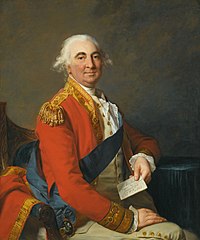
Edward Thurlow (1731–1806, shown here) entered Parliament in 1765 and quickly made a name for himself as a Tory by defending the government’s actions to keep John Wilkes from taking his seat.

When Lord North became prime minister, he appointed Thurlow the solicitor-general of Great Britain. A year later the man became attorney-general, and in that role was involved in the discussions about which individuals could be tried for the Boston Tea Party and other resistance.

In 1778, at the urging of of King George III, Thurlow was made a baron, a member of the Privy Council, and the Lord Chancellor. The last post had a variety of duties, one of which was to look after the Great Seal used to signal that laws and commissions had received government approval.

Thurlow remained Lord Chancellor after Lord North’s fall and through the Whiggish governments that negotiated the Treaty of Paris. When a coalition of Charles James Fox and Lord North made the Duke of Portland prime minister in April 1783, Thurlow was replaced by a committee, but at the end of the year William Pitt the Younger first came to power and reinstated him.

Thus, as of March 1784 the Great Seal of Britain was back in Thurlow’s keeping. It was a gold disk, about six inches across, engraved with images and symbols of the king and the words “GEORGIVS III DEI GRATIA MAGNÆ BRITANNIÆ FRANCIÆ ET HIBERNIÆ REX FIDEI DEFENSOR” (George III, by the grace of God, King of Great Britain, France, and Ireland, Defender of the Faith).

On 23 March, someone broke into Baron Thurlow’s mansion on Great Ormond Street in London and stole the gold seal, along with some money and two swords with silver hilts.

One might think that government ministers, especially those overseeing the judicial system, would be secure from such break-ins. But people of the time don’t show much surprise that crime could affect the Lord Chancellor. Indeed, back in the fall of 1774 Lord North himself had been the victim of a highway robbery while traveling from London to Oxfordshire.

Some folks speculated that there was a political reason for the theft. It was a remarkable coincidence that the seal disappeared on 23 March just as Parliament was clearly about to dissolve. Did some political actors take the seal to delay that action and the new parliamentary elections to follow? Or perhaps Thurlow didn’t notice the seal was missing until he checked for it on that date.

As it turned out, the loss of the seal had no official effect. The government just commissioned a new one with the year “1784” added in several places. That was in Thurlow’s hands by 25 March as the king officially dissolved Parliament. Another new seal, this one engraved with more care, was unveiled the next spring. By then Pitt had won a big majority and was firmly in power.

Still, lack of evidence didn’t stop prose and graphic satirists from accusing prominent Whigs like Fox of stealing the seal. If not to delay the election, then for its monetary value.

British reference books say the real seal thieves were never found. However, at All Things Georgian, Sarah Murden noted an item from the 21 April Morning Herald and Daily Advertiser:
William Vandeput was on Monday committed to New Gaol, Southwark, where he is now doubled ironed, on a charge of burglary in the house of the Lord Chancellor, and stealing there-out the Great Seal. A Jew in Petticoat Lane was yesterday apprehended, on an information against him for having purchased and melted the Great Seal into an ingot; but while he was conducting to the Rotation Office in Southwark, for examination, he was released from the Peace Officer by eight ruffians. The Jew melted the seal, while the robbers remained in his house.
The Lewis Walpole Library shares a broadside describing the execution of nine men on 1 Dec 1785. Those include Vandeput, identified as “by trade a jeweler, born of creditable parents.” He had been convicted with two other men of stealing silk from a warehouse. But the broadside added:
He was the person who broke open the Lord Chancellor’s house, and stole the great seal of England. For this fact he was tried, but for want of sufficient evidence, acquitted.
Thus, even if that theft officially remains unsolved, people blamed William Vandeput for it.

TOMORROW: Thurlow’s loan and Thurlow’s daughters.

Tuesday, April 05, 2022

Frith as “Madman” and “unfortunate stone-thrower”

Although John Frith expressed his grievance against the British government using the language of rights and social contracts, his cause was personal, not political.

That didn’t stop his case from being mixed into the factional politics of 1790, however.

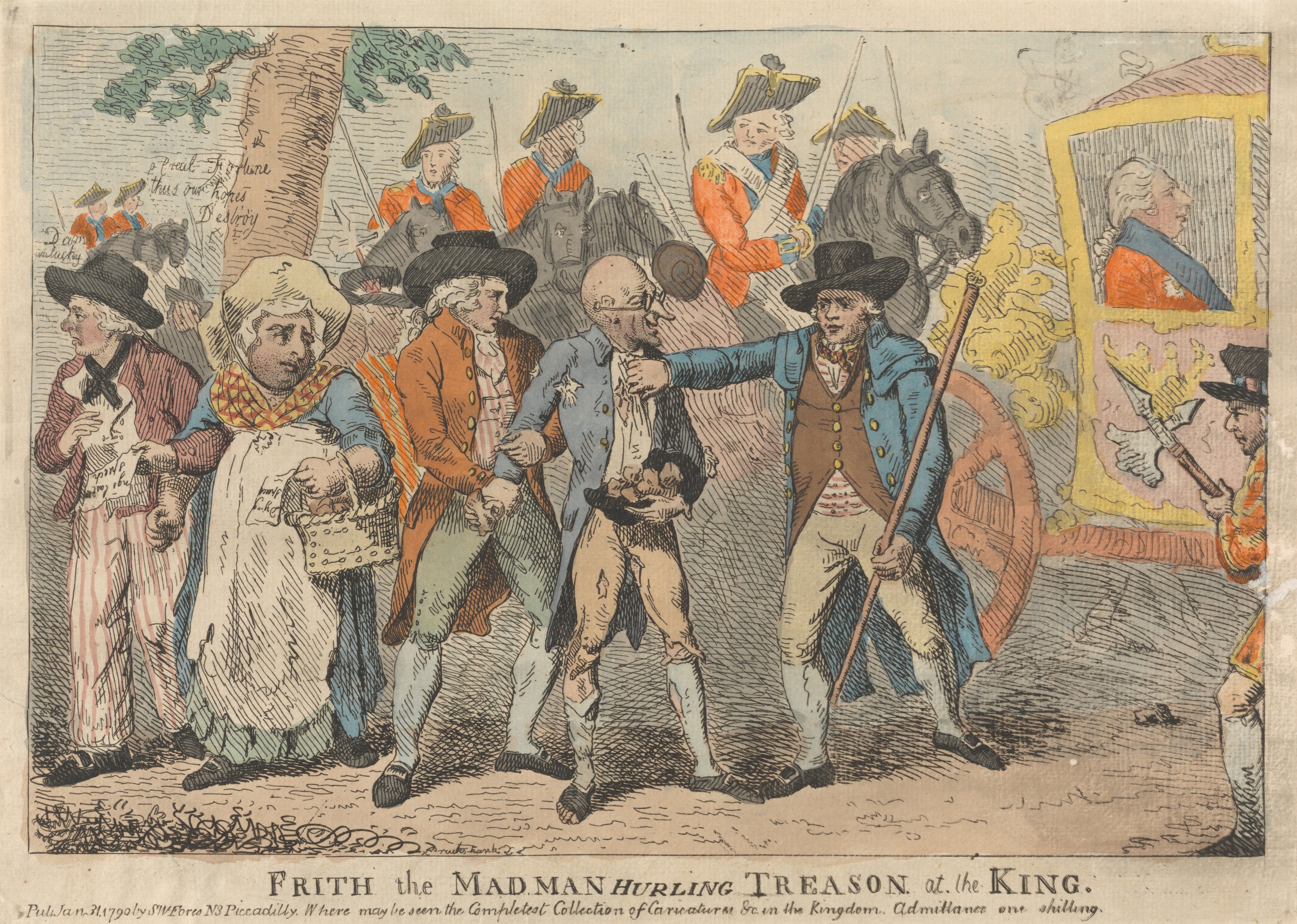
Ten days after Frith threw a stone at King George III’s gilded carriage, the caricaturist Isaac Cruikshank issued the print shown above, titled “Frith the Madman Hurling Treason at the King,” shown courtesy of the Yale Centre for British Art.

King George is at the right, riding by obliviously. A small fiddle-playing demon rides on his carriage and mounted guards follow.

In the middle of the picture, two men are seizing a third who holds a hatful of rocks. That central figure doesn’t look like Firth, however. Instead, it’s a caricature of the elderly Edmund Burke, bald, bespectacled, and ragged from being out of power. One of the men stopping him is dressed as a Bow Street Runner. The other looks like George, the Prince of Wales, as the British Museum expounds.

At the left are figures of a sailor and a woman carrying a basket, dismayed at the arrest. The woman’s five-o’clock shadow reveals her to be a lampoon of Charles James Fox, another opposition leader. The sailor looks like Fox’s ally Richard Brinsley Sheridan.

The message of this image is therefore that the opposition Whigs in Parliament metaphorically throwing rocks at the king.

Another, cruder image came from William Dent, shown here through the British Museum. It contrasted Frith “the unfortunate stone-thrower,” making “a follish throw for full pay” as an army officer, with the impeached India administrator Warren Hastings. As a “fortunate stone thrower,” Hastings is tossing diamonds as bribes “for a full P-rd-n.”

In this print Frith labeled is “Gulliver the little in Brob-dignag,” confronting the giants of the king and his bodyguards. In contrast, Hastings is “Gulliver the great in Lilliput,” lording over the grasping king and queen and Baron Thurlow, the former attorney general and lord high chancellor. George III and Thurlow were supporting Hastings in his ongoing impeachment trial.

The Member of Parliament who led the case against Hastings was Edmund Burke—the same man Cruikshank depicted as Frith in his print. Thus, artists on opposite sides of the political debate used Frith’s attack on the king’s carriage to convey contradictory messages.

Thursday, January 06, 2022

“Burke surely rolls over in his discreetly marked grave”

Back in December 2020, after the election and before the insurrection, the L.A. Review of Books published an op-ed essay by Jessica Riskin, a professor of history at Stanford University.

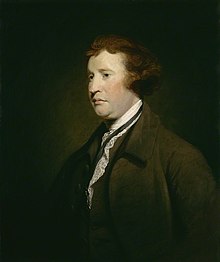
Riskin’s started with the way Edmund Burke (1729–1797) defined conservative politics in the 1790s.

Burke had been an ally of the American Whigs. In 1765 he was private secretary to the Marquess of Rockingham, who led one opposition Whig faction in Parliament. Toward the end of that year, the marquess became prime minister. His team found a pocket borough to send Burke to Parliament, where his oratory made a quick impression.

Rockingham was soon out of power, but Burke continued to be his faction’s most eloquent voice, in both speeches and print. In 1774 he won a seat from Bristol and promptly told his constituents that he would vote as he saw best, not as they told him; he didn’t win reelection from that district six years later.

When Rockingham returned to power after the British defeat at Yorktown, he made Burke Paymaster of the Forces. Rather than maintain the job as a lucrative sinecure, Burke introduced a law to reduce its financial latitude. He wrote other reform bills as well, though some stuck only after other people introduced them.

After Rockingham died, Burke allied with Charles James Fox. That worked out during the brief Fox-North coalition government, but then William Pitt the Younger became prime minister and stayed in the job for the rest of the century. Because of faction rather than strong ideological reasons, Burke was stuck in the opposition during his final years.

Those were also the years of the French Revolution, which inspired Burke’s statements on conservatism. In her op-ed, Prof. Riskin drew a hard line between that ideology and the political methods of Donald Trump and his followers:
Each time a commentator refers to Trumpism as “conservative” — probably hundreds of times a day — Edmund Burke surely rolls over in his discreetly marked grave in Buckinghamshire.

Burke, the Irish political philosopher and Whig MP who originated Anglo–American conservatism, supported the rebellion of the British colonies in North America but hated the revolutionaries in France, and there you have conservatism in a nutshell. The American rebellion, Burke judged, was not a revolution but a movement to conserve an ancient principle of the British constitution, the people’s power of “granting their own money” to the government. Also in keeping with Burke’s “principle of conservation” was the colonists’ preservation of other longstanding institutions such as slavery, which Burke favored eliminating, but only “gradually.”

In France, on the other hand, people went rushing around hurling kings from their thrones, abolishing feudalism, summarily eliminating aristocratic and clerical exemptions and privileges, and making a lot of vulgar noise about equality. That sort of revolution was anathema to Burke. The discreet marker on his grave was a compromise: he had asked that it be altogether unmarked, sure that the Jacobins would arrive in droves to desecrate his final resting place, if they could find it, as they had desecrated the institutions of the Old Regime.

His abhorrence of the French Revolution led Burke to define the political philosophy that would come to be known as conservatism. His central principle was that abstract political ideals, such as the ideal of absolute equality, were dangerous because they led people to destroy longstanding traditions in their name. A society could not rest upon airy abstractions, Burke argued, but only upon solid things: traditional institutions, such as the institutions of property and inheritance. Burke’s “principle of conservation” held that any reform must be undertaken gradually, keeping always in mind that traditions were the bedrock of society, and that to eliminate them was to invite mayhem. . . .

“Conservative” in reference to Trumpism is dangerously misleading. If you’re a conservative, you’ll think the word denotes wisdom and judiciousness, two things Trumpians don’t even pretend to embrace, but make a show of flouting. If you disagree with conservatism as a political philosophy, you might think it sounds stodgy, benighted, even oppressive, but in a static or at least a slow-moving way, not in a way that poses an immediate threat of civil war. No one associates an attempted coup, even an inept one such as we’ve been witnessing, with the word “conservative.”
Note that Riskin wrote thirteen months ago, before 6 Jan 2021.

On that day Trump told thousands of followers, “we’re going to walk down, and I’ll be there with you,…we’re going to walk down Pennsylvania Avenue. . . . And we’re going to the Capitol.” And then he went home to watch the resulting violence on television. That habitual deceit isn’t even “Trumpism”; it was just trumpery.

Thursday, December 02, 2021

How to Become the Member from Thirsk

Under the subject of “Eighteenth-century British aristocrats are not like us,” I’ve been looking into the life of Thomas Gascoigne (1745-1810).

Gascoigne was born not in Britain but in a convent at Cambrai in northern France. He was the third son of Sir Edward Gascoigne, baronet, and his wife. The Gascoignes were Catholic and had long ties to that convent, which was part of the English Benedictine Congregation.

Thomas grew up in France, educated by monks at Douai. In 1762, when he was sixteen years old, his older brother died, and he succeeded to the baronetcy. From then on he was Sir Thomas Gascoigne, baronet.

To prepare for his responsibilities as an estate owner, the teenager was sent to Paris for more schooling, visited Britain for the first time, and in 1764 embarked on a Grand Tour of southern Europe.

That travel ended abruptly in March 1765 when, it appears, a traveling companion killed a coachman in Rome and young Sir Thomas was peripherally involved. He had to hurry back to England, though his connections secured a papal pardon later in the year.

For the next decade Sir Thomas Gascoigne settled into life as a British gentleman. He developed his estates, including the usual improvements: scientific gardening, breeding race horses, funding coal mines, founding a spa. He had a romance with Barbara Montgomery (1757-1788), one of the three sisters Joshua Reynolds painted as “Three Ladies Adorning a Term of Hymen” in 1773.

By 1774 it was safe to visit Europe again, and Sir Thomas spent the rest of the decade outside Britain. He traveled with the author Henry Swinburne, paying most of the bills. During those years Britain declared war on France and Spain, but that doesn’t appear to have greatly affected Sir Thomas’s movements because he was traveling in Catholic circles. His faith kept him out of the British government, after all.

That all changed soon after Sir Thomas Gascoigne returned to his seat in the middle of 1779. He decided to get involved in politics. As a baronet, he had inherited a title but not a peerage, so he wasn’t in the House of Lords and could run for the House of Commons. However, the law barred him from Parliament as a Catholic.

On the king’s birthday in June 1780, therefore, Sir Thomas Gascoigne renounced his Catholicism before the Archbishop of Canterbury. (He never stopped supporting Catholic missions.) Three months later, he entered Parliament as the member from Thirsk, a seat recently purchased by the Marquess of Rockingham for his faction of Whigs. Later he represented Malton and Arundel.

As a Rockinghamite, Sir Thomas opposed continuing the war in America and supported some electoral reforms. Within the larger Whig faction he favored Charles James Fox over the younger William Pitt, which left him once again excluded from power after 1784.

TOMORROW: Sir Thomas Gascoigne’s mark on history.

Friday, October 15, 2021

From William Fitzmaurice to the Marquess of Lansdowne

William Fitzmaurice was born in Dublin in 1737 and grew up in rural southern Ireland. His parents were from aristocratic families, though neither had titles. William’s father John was a grandson of the Earl of Kerry through a younger son, and his mother Anne was daughter of a knight and brother of the first Earl of Shelburne.

Both those titles—Earl of Kerry and Earl of Shelburne—were in the Irish peerage. The men holding them were entitled to seats in the Irish House of Lords but not the British House of Lords, which covered England, Wales, and Scotland. Even though people in Great Britain addressed Irish peers by their noble titles, they were technically not British lords. I get the sense that British lords could look down on them a bit, but British commoners were supposed to look up.

In 1743, the year William turned six, his father John Fitzmaurice won a seat in the Irish House of Commons, which he held for the next eight years. At that point, in 1751, the status of the family began to change.

First, William’s uncle the Earl of Shelburne died, leaving his extensive property to John Fitzmaurice on the condition that he adopt his wife’s family name, Petty. John Fitzmaurice accepted the name John Petty Fitzmaurice, in later generations hyphenated as Petty-Fitzmaurice to make the alphabetization easier to remember.

Thus, in 1751 William Fitzmaurice, now in his teens, became William Petty Fitzmaurice.

Later in 1751, the Crown granted John Petty Fitzmaurice two noble titles: Viscount Fitzmaurice and Baron Dunkerton. It was very common for a peer to have subsidiary titles under his main one, moving down the ladder of peerages (duke, marquess, earl, viscount, and baron). Those titles for John Petty Fitzmaurice came in the Irish peerage, and the new viscount became a member of the Irish House of Lords.

Furthermore, in the British aristocratic system, the eldest son and heir of a peer is by courtesy addressed by his father’s second-highest noble title. Thus, in late 1751 William Petty Fitzmaurice became Lord Dunkerton.

In 1753 the Crown gave Viscount Fitzmaurice a promotion within the Irish peerage by recreating his late brother-in-law’s title of Earl of Shelburne for him. He was thenceforth addressed as Lord Shelburne.

That meant that in 1753 young Lord Dunkerton gained the courtesy title of Lord Fitzmaurice. That’s how he was addressed when he went off to Oxford University two years later.

As I said before, the Earl of Shelburne wasn’t entitled to a seat in Great Britain’s House of Lords because he was an Irish peer. Likewise, Lord Fitzmaurice, despite being able to use that courtesy title, wasn’t a British peer. As such, they could stand for seats in the British House of Commons. And that’s what Lord Shelburne did in 1754, winning a seat he held until 1760.

In that year, the Crown gave the Earl of Shelburne a title within the British peerage: Baron of (Chipping) Wycombe. That moved him out of the British House of Commons into the British House of Lords. People continued to call him Lord Shelburne because, even though the British peerage was more powerful than the Irish peerage, an earldom was more prestigious than a barony.

As for Lord Fitzmaurice, after his years at college he joined the British army and served under Gen. James Wolfe in the 20th Regiment of Foot. He saw action at Rochefort, Minden, and Kloster-Kampen. Good service and noble background allowed Fitzmaurice to become a military aide-de-camp to King George III in 1760, with the rank of colonel. Within the army he was thus Col. Fitzmaurice. (This rank was controversial since more senior officers were passed over, but it stuck. Furthermore, even though the man stopped being active in the army, he was by protocol promoted to major general in 1765, lieutenant general in 1772, and general in 1783.)

Also in 1760, Lord Fitzmaurice stood for his father’s seat in the British House of Commons and won. The next year he was elected to the Irish House of Commons representing County Kerry. But before he could take those seats, the situation changed again.

In 1761 the Earl of Shelburne died. Lord Fitzmaurice became the Earl of Shelburne within the Irish peerage and Baron Wycombe within the British peerage. He was no longer eligible to serve in either country’s House of Commons. (His successor in Britain was Col. Isaac Barré, a political protégé and fellow veteran of Gen. Wolfe’s regiment.)

It was as the Earl of Shelburne that the former Lord Fitzmaurice, former Lord Dunkerton, former William Petty Fitzmaurice, born William Fitzmaurice, became a player in British-American politics. Prime Minister George Grenville appointed him First Lord of Trade in 1763, but Shelburne decided to ally with William Pitt and resigned a few months later. When the Marquess of Rockingham and Pitt (now Earl of Chatham) formed a government in 1766, Shelburne became Southern Secretary, but was pushed out after two years.

After 1775, Shelburne sided with Chatham, Rockingham, Barré, and others in opposing Lord North’s war policies. (Lord North was in the House of Commons, not the House of Lords, because his courtesy title came from being son and heir of the Earl of Guilford.) When news of the defeat at Yorktown arrived, Lord North’s ministry fell and was replaced with a government led by the Marquess of Rockingham. Shelburne was named one of two Secretaries of State—the first Home Secretary, in fact.

Then Rockingham died after only a few months, and the Earl of Shelburne became Prime Minister in July 1782. He and his envoys handled most of the negotiations with France, Spain, and the U.S. of A. to create the Treaties of Paris. However, before those documents were signed, Shelburne’s coalition fell because of internal wrangling. Rockingham’s other Secretary of State, Charles James Fox, made an alliance of convenience with Lord North to oust Shelburne in April 1783.

The next year, young William Pitt the Younger took over the Prime Minister’s office. Rather than bring his father’s old ally Shelburne back into government, he arranged for the man to gain a British peerage higher than his Irish one: Marquess of Lansdowne. That was the former William Fitzmaurice’s main title from 1784 until his death in 1805.

The marquess stayed out of politics, but he did do something significant in American culture: he commissioned Gilbert Stuart to create a full-length portrait of George Washington. Stuart delivered that picture in 1796. The artist also produced copies of what became known as the “Lansdowne portrait,” including one hung in the White House since 1800. The marquess’s descendants sold the original to the U.S. National Portrait Gallery in 2001 for $20 million.

The seed for this posting was my realization that mentions of Lord Shelburne and Lord Lansdowne in the late 1700s referred to the same man. I started to wonder whether his name and status had changed at other times in his life. I had no idea how complicated the answer would be.


Wednesday, October 06, 2021

The Secret of Sir Barrington Beaumont

While reading about Count Axel von Fersen for yesterday’s posting, I saw some intriguing anecdotes in his Wikipedia entry, quoted from The Reminiscences of Sir Barrington Beaumont, Bart., published in 1902.

I followed those up, finding a text with a lot about Von Fersen and a little about Horace Walpole, Charles James Fox, Marie Antoinette, and other famous figures that was much too good to be true.

Indeed, the reviewers of 1902 quickly caught on to that book as a fictional memoir of the eighteenth century.

The Irish Monthly reviewer wrote:
It pretends to be a real diary, the writer of which arranged that it should not be read till seventy years after his death; but one perceives at once that it is in reality a novel, bringing in such real persons as George Selwyn, Horace Walpole, Count Fersen, Marie Antoinette, and others. The writer has evidently studied the period well, though we suspect that Macaulay or Abraham Hayward would detect sundry inaccuracies and anachronisms. There is plenty of incident, lively conversations, epigrams original and selected, and a clear and correct style that is never dull.
Other readers, however, were not so pleased with the book. The Spectator stated:
No one, we imagine, is likely to be deceived by Memoirs of Sir Barrington, which profess on the title-page to be “now, by permission of his great grandson, published for the first time.” In spite of a serious preface, some notes by an editor, and the information that the names of the writer and the two chief personages have been altered, the imposture (if it deserves such a grave title) is so crudely and clumsily carried out that one scarcely thinks the writer or his publisher can expected it to be taken seriously. . . . [These pages] tell us little which was not well known, and that which is not well known in them is of little interest. The truth is they do not bear even upon the surface the stamp of genuineness.
And the critic in The Academy and Literature groused:
If the public greedily swallowed bogus love letters, the author probably argued, why should it not revel in bogus reminiscences? And we can only echo, Why not? The taste would not be more remarkable than that which finds savour in the Shakespeare-Bacon controversy. But to be successful the literary practical joke requires to be played with a nice combination of dash and dexterity. The creator of Sir Barrington Beaumont is not wanting in audacity,…but his attempt to imitate the style and reproduce the atmosphere of his chosen period is almost ludicrous in its inadequacy. . . .

This biographical joke might have been amusing if it had been better played, but unfortunately the author had no qualifications for his self-imposed task beyond a superficial knowledge of his period, and he has neglected to use use such simple devices as might have given his work external resemblance to a genuine memoir. He should have clothed the volume in imitation calf, and provided an elaborate index, copious foot-notes, and an appendix.

If a conscientious attempt had been made to imitate the style of 1812, and if the wits had been made to discuss contemporary tittle-tattle instead of paraphrasing their printed witticisms, the work might have mystified a section of the public. As it is, the author will probably fall between two stools, for his book is not a sufficiently good imitation of a last-century memoir to appeal to lovers of biography, nor a sufficiently good imitation of a novelette to appeal to lovers of light fiction.
The British Library now credits the book as a novel by Michael J. Barrington, a name that doesn’t appear anywhere in the printed volume.

Of course, some copies of this book got into larger library collections. Google Books scanned them. The Hathi Trust and Internet Archive took up one of the imperfect Google scans. Automated publishers of “classic” (i.e., public-domain) literature have vacuumed up the files and offer the book through online retailers.

As a result, The Reminiscences of Sir Barrington Beaumont, Bart. is more widely available today than it’s ever been, and most forms of the text carry no warning that it’s fiction. It is not and has never been a historical source about the eighteenth century.

Friday, June 04, 2021

John Adams on Hutchinson’s Death

John Adams was caustic about a lot of people, including sometime political allies. But his longest and deepest hatred appears to have been for Thomas Hutchinson.

Adams’s early legal and political career coincided with Hutchinson’s rise to being chief justice and then governor of Massachusetts, on top of his long tenure as lieutenant governor.

He came to see Hutchinson as the province’s arch-villain, even worse than Francis Bernard and other officials sent from Britain because he was betraying his own society.

Adams’s enmity colored how he recalled events later in life, such as the “writs of assistance” case and his work defending sailors for the murder of Lt. Henry Panton. He even blamed Hutchinson for helping to break up his friendship with Jonathan Sewall.

As early as the day after Boston’s first anti-Stamp Act protest, Adams wrote that Hutchinson had a “very ambitious and avaricious Disposition.” In 1772 he accused the governor of playing on “the Passions and Prejudices, the Follies and Vices of great Men in order to obtain their Smiles, Esteem and Patronage.” After the war arrived, Adams blamed the “mazy Windings of Hutchinsons Heart, and the serpentine Wiles of his Head.”

That enmity lasted into Hutchinson’s life as a pensioned exile in London. On 24 Mar 1780 Adams, then an American diplomat in Paris, wrote with undisguised pleasure about the supposed signs of the former governor’s downfall:
from several late Paragraphs in the Papers, and from Mr. [Charles James] Fox’s severe Observations in the House of Commons upon Governor Hutchinson, calling him in Substance, “The Firebrand” that lighted up all the Fire between the two Countries, it seems pretty clear, that it is in Contemplation to take away all these Salaries and Pensions.
That didn’t happen.

Hutchinson passed away on 3 June, as I related yesterday. Two weeks later, Adams passed on the news to the Congress:
Governor Hutchinson is dead. Whether the late popular Insurrections [the Gordon Riots], or whether the Resolutions of Congress of the eighteenth of March respecting their Finances, by suddenly extinguishing the last Rays of his hopes, put a sudden End to his life, or whether it was owing to any other Cause, I know not. He was born to be the Cause and the Victim of popular Fury, Outrage and Conflagrations.
Adams didn’t list the likelihood that Hutchinson died because he was in his late sixties and in poor health. Indeed, on that same 17 June Adams expressed no doubt about the cause in a private letter to his wife: “Governor Hutchinson fell down dead at the first appearance of Mobs.”

In fact, Elisha Hutchinson’s account makes clear that his father “conversed well and freely upon the riot in London,” and wasn’t greatly concerned about it. But that wasn’t the story John Adams wanted to believe.

Friday, October 09, 2020

Copley’s Theatrical Nun at the Huntington

The Huntington Library in California just announced that it had acquired this “newly discovered painting by John Singleton Copley (1738–1815) depicting celebrated 18th-century British actress Mary Robinson.”

According to the institution:
Mrs. Mary Robinson in the Character of a Nun (ca. 1780) is a cabinet portrait, perhaps commissioned by an admirer, of one of Britain's most famous actresses of the late 18th century.

Lost for generations until it was sold in 1999 at auction as a French painting of an unknown sitter, the newly identified work portrays Robinson in her role as Oriana in George Farquhar’s comedy The Inconstant; or The Way to Win Him, which she performed on the London stage in the spring of 1780. In the course of the play, Robinson's character engages in a series of ruses—dressing as a nun, feigning madness, and finally disguising herself as a pageboy—to win the heart of her love interest.

The portrait was painted just a few years after Copley, who had already established himself as a leading portraitist in colonial America, moved from Boston to London to test his skills at the Royal Academy, and at the height of Robinson's career. 
In Boston, of course, Copley had never seen an actress or a nun. In 1768 Myles Cooper paid Copley for what he called “the little Piece which I so much admired, the Nun with the Candle before her,” but scholars think that referred to Copley’s first portrait of his little half-brother, Henry Pelham, reading a thick book by candlelight. [That sketch in oils hangs at the Museum of Fine Arts. I use it as my Twitter avatar.]

As for Mary Robinson, she went on to have relationships with the Prince of Wales, Banastre Tarleton, and Charles James Fox. So she didn’t make the nun’s role a habit.

Thursday, August 17, 2017

Mary Robinson, Fashion Icon

Earlier this month, Prof. Terry F. Robinson wrote on the 18th-Century Common website about the British actress Mary Robinson (1757?-1800) and how she was an early example of a celebrity who shaped clothing fashion:
Mary Robinson’s meteoric rise to fame began in 1776 with her dazzling performance on the London stage as Juliet, and in 1779 with her spirited rendering of Perdita in David Garrick’s adaptation of Shakespeare’s The Winter’s Tale. The latter representation captivated the Prince of Wales (the future George IV), and an infamous romance between the newly styled “Perdita” and “Florizel” ensued.

Like many starlets today, her love life became a source of scandal and intrigue. When the Prince’s affection waned, Robinson left the stage and travelled to France. She befriended Marie Antoinette and was courted by the wealthiest man in Europe, the Duke de Chartres. In 1782, after her return from the Continent, Robinson indulged in romances with the dashing young dragoon Colonel Banastre Tarleton, a leading commander of British troops in the war against the American colonies, and Charles James Fox, the charismatic leader of the Whig party.

Robinson’s stage career, though brief (she retired from the boards at the close of the 1779-1780 season), was a tour de force. Her performances—both as an actress and a mistress—earned her widespread acclaim and notoriety. . . . But while Robinson’s acting and amours sparked her popularity, it was her fashion sense and style that kept the flame ablaze. By decorating herself in stunning confections known as the “Perdita Hood,” the “Robinson hat for Ranelagh,” the “Perdita handkerchief,” and the “Robinson gown,” she transformed herself into one of the foremost fashion icons of her day and sent the stylish set into a frenzy.
TOMORROW: Tarleton and the Robinsons.

Elizabeth Armistead, Wife of Charles James Fox

Last month Geri Walton, author of Marie Antoinette’s Confidante, profiled Elizabeth Armistead (1750-1841).

A courtesan and actress in London, Armistead was mistress to the second Viscount Bolingbroke; Gen. Richard Smith, head of the East India Company; the third Duke of Dorset; the twelfth Earl of Derby; and Lord George Cavendish.

And then came Charles James Fox, the Whig politician who was Foreign Secretary at the end of the American war. Walton wrote:
Fox and Elizabeth did not start out as lovers. They had a decade long platonic friendship before they became lovers. After their love affair began, one person asked Fox why he was suddenly absent so much from the gentleman’s club he attended called Brooks’s. He supposedly replied:
“You know I have pledged myself to the public to keep a strict eye on Lord Shelburne’s motions; and that is my sole motive for being so much in Berkeley-square; and that, you may tell my friends, in the sole reason they have not seen me at Brookes’s [sic].”
Fox had always been considered a rake, a drinker, and a gambler. Moreover, he was a notorious womanizer. . . . If Elizabeth planned to have a temporary fling with Fox, it soon turned long-lasting and exclusive. The exclusivity soon caused her financial problems and when she attempted to end her relationship with Fox, Fox would not allow it as he was too smitten.
“I have examined myself and know that I can better abandon friends, country, everything than live without Liz.”
Fox’s gay and frivolous lifestyle ended when he married Elizabeth secretly on 28 September 1795. . . . because of Elizabeth’s past, news of the marriage would cause a scandal and so Fox felt that he could not introduce her into society (supposedly she also insisted that he not do so).

It took seven years before he formally introduced Elizabeth as his wife.
Can this marriage be saved? See Walton’s full article for the full story.

Saturday, January 07, 2017

John Barker Church: “the mere man of business”?

So was the marriage of Angelica Schuyler (shown here) and John Carter/John Barker Church happy? We don’t have a body of correspondence between them as we have for, say, John and Abigail Adams. But their marriage lasted until their deaths, and they certainly enjoyed good circumstances.

In 1780 Carter became partners with former Continental Army commissary general Jeremiah Wadsworth (1743-1804) of Connecticut as the main supplier for Gen. Rochambeau’s troops in North America. The French needed food and supplies for thousands of men.

Unlike the Continental Congress, whose paper money was rapidly losing value, France could pay in specie. Wadsworth and Carter got a cut of everything they supplied. They also gained excellent credit they could use for their other ventures, and money they could lend other businessmen. As a result, by the end of the war, Wadsworth and Carter were very rich.

In August 1782 James McHenry wrote to Alexander Hamilton from Baltimore:
Mr. Carter is the mere man of business, and I am informed has riches enough, with common management, to make the longest life very comfortable. Mrs. Carter is a fine woman. She charms in all companies. No one has seen her, of either sex, who has not been pleased with her, and she has pleased every one, chiefly by means of those qualities which make you the husband of her Sister.
The next July, the Carters and Wadsworth headed to France to collect their final payments. Sometime in 1783, Carter revealed his real name: John Barker Church. There’s no evidence of when he told his wife about that part of his past. By that fall, Benjamin Franklin and John Jay knew about it, though the couple still went by “Carter” for a few months longer.

Finally, the family headed to Britain, and at that point they came out permanently as the Churches. At the end of 1784, Abigail Adams wrote to a sister from London, “Mr. and Mrs. Church are here too, alias Cartar. Mrs. Church is a delicate little woman. As to him, his character is enough known in America.”

Back in Britain, Church quickly paid off the debts that he had left behind in 1774 and reestablished himself in business. He bought a house on Sackville Street in London. He bought a country house near Windsor. The couple entertained widely, not just among the American community—one of John Barker Church’s gambling friends was the Prince of Wales.

We might think that a rather boring, aristocratic life compared to the drama of nation-building that brother-in-law Hamilton threw himself into in America, but John Barker Church was also interested in politics. He was part of the radical Whig faction, causing George III to call his principles “avowedly enemical.” In 1787 he ran for Parliament and lost. The following year, Church took another approach: he bought a rural estate which came with a parliamentary seat, and put himself up for that seat in 1790.

By then the French Revolution was roiling Europe, and Church was decidedly on the side of reform. He opposed Britain’s war measures and hosted French exiles at the height of the Terror. In addition, he:
  • financed Charles James Fox, leader of the Whig left, with big loans he was never able to collect on.
  • bankrolled an attempt to break Lafayette out of a Prussian prison on 1792. (One of these days I’ll tell that story.)
  • helped Talleyrand sail to America in 1794 after Britain suddenly expelled him.
After six years in Parliament, Church gave up his seat, sold his estate, and headed back to the U.S. of A.

In 1797 Robert Morris went bankrupt. Church was one of his creditors, and to settle the debts he took over a great many of Morris’s western land claims. A few years later, the Churches’ oldest son Philip went to a tract in western New York and founded the town of Angelica, named after his mother. John Barker Church himself commissioned a mansion in Belmont called Belvidere.

Meanwhile, Church kept busy in the New York business world. He underwrote loans and was a director of the Manhattan Company and the Bank of North America. The Churches had eight children between 1778 and 1800, most of them living a long time. And still their life was full of drama. John Barker Church fought a duel with Aaron Burr five years before Hamilton did. In fact, Church was the family expert on affairs of honor, supplying the pair of pistols that his nephew Philip Hamilton and his brother-in-law used in their fatal confrontations.

Angelica Church died in 1814. John Barker Church returned to his native Britain and died four years later. He wasn’t a brilliant writer or political theorist, but he certainly wasn’t boring.

TOMORROW: A last word, and comma, from Hamilton.

Saturday, December 05, 2015

Removing Symbols of the Old Ways

On 18 July 1776, the Massachusetts Council oversaw the reading of the Declaration of Independence at the State House. Afterwards, the public pulled down the royal emblems of the lion and unicorn from that building and burned them in a big bonfire.

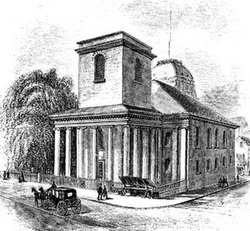
In the following years, the town of Boston renamed King Street and Queen Street to the more republican State Street and Court Street. King’s Chapel (shown here) was called the Stone Chapel for a while. The town’s main road, which had four names for different stretches in 1776, eventually became Washington Street to honor the new country’s new leader.

Hutchinson Street bore the name of the reviled Gov. Thomas Hutchinson, so it was renamed Pearl Street. In 1776 the town of Hutchinson petitioned the Massachusetts General Court to change its name as well; it became Barre, after Isaac Barré, a British Whig in Parliament who had advocated for American colonists for a decade. A few years later, the town of Foxborough was named for Charles James Fox, another sympathetic M.P.

Similar changes happened all across the new nation. New Yorkers pulled down the gilt statue of King George III on the Bowling Green. Tavern owners altered their signs, as Washington Irving’s story “Rip Van Winkle” later played on for comic effect.

This history is useful to recall when we consider current campaigns like those to change the name of the Woodrow Wilson School at Princeton, remove the statue of Thomas Jefferson at the University of Missouri, or create a new seal for Harvard Law School that doesn’t honor Isaac Royall.

Throughout history, societies have used names, public art, and other symbols to honor individuals they admire, and societies have removed or changed those symbols when they no longer reflect widespread values. That’s something societies do. It’s nothing new, so claiming that there’s an unprecedented wave of “political correctness” reveals historical blindness, not historical consciousness.

Furthermore, removing symbols of honor doesn’t erase the history behind them. The Bostonians who destroyed the lion and unicorn still knew full well that they had been part of the British Empire. They still acknowledged that Thomas Hutchinson had been the royal governor of Massachusetts from 1770 to 1774. They weren’t rewriting history. They just no longer felt those people and institutions deserved so much public respect.

Many people accuse those who now want to remove symbols they associate with slavery and racism of wishing to eradicate or hide troubling aspects of our history. That’s ridiculous. The people driving those campaigns will remain quick to highlight an institution’s historical connections to slavery and racism, and to argue that those connections remain significant. They’re really interested in preserving and broadening the memory of that history. They just disagree with previous generations about which historical figures deserve so much honor.

Accusing those campaigners of the opposite of their stated aims and usual behavior suggests their critics are parroting talking points they’ve never really examined. That seems to show a lack of knowledge and a disrespect. And I suspect there’s a significant overlap between people who say we should retain symbols despite their roots in slavery and racism and people who say they’re tired of hearing about the effects of slavery and racism.

People can respond to those symbol-changing campaigns in multiple ways, depending on circumstances and philosophy. We may support the goal but not the methods. We may differ on whether removing such symbols really helps efforts to eradicate the underlying wrongs, or might even hurt. I’m going to share some thoughts on those issues over the next couple of days. But mistaken claims that such behavior is new or that it’s an attempt to “erase history” add nothing to the discussion.

Friday, March 27, 2015

Hartley and Franklin, Reunited in Paris

I’ve been writing about the on-again, off-again correspondence of Benjamin Franklin and David Hartley, British scientist and Member of Parliament. Their relationship actually turned out to be a factor in the end of the war.

After London received news of the Battle of Yorktown, Lord North’s government fell. In March 1782 power shifted to the Marquess of Rockingham, longtime leader of the opposition, with a mandate to bring the American War to a close before it cost even more money. Rockingham filled the post of prime minister for all of four months before he died of the flu.

The Earl of Shelburne, one of Rockingham’s secretaries of state, took over. He was already steering negotiations with the U.S. of A.’s European diplomats through his envoy, the merchant Robert Oswald. By November 1782 Oswald worked out preliminary articles of peace with Franklin in France.

Meanwhile, Rockingham’s other secretary of state, Charles James Fox, refused to serve under Shelburne. He led other Rockingham Whigs, such as Edmund Burke, out of government. (That created openings for such rising politicians as William Pitt, who became Chancellor of the Exchequer at the age of twenty-three; they didn’t call him “the Younger” for nothing.)

David Hartley had opposed the American War all along, but he also disliked Shelburne and voted against the preliminary articles for peace. Hartley was a Fox ally, and he also maintained a personal friendship with Lord North, despite their political differences.

In April 1783 Fox and North, longtime opponents, made a surprising alliance to force Shelburne out of power. Shortly afterwards, George III appointed Hartley the new negotiator with the Americans. Fox and North both trusted Hartley, and they thought his friendly correspondence with Franklin would help to finish the negotiations on favorable terms.

Hartley walked into a very complex situation since France, Spain, and the U.S., though formally allied and bound to negotiate together, were all secretly angling for their own advantages and undercutting each other. Though there weren’t any more major campaigns on the North American continent, naval battles in the Caribbean and the siege of Gibraltar were still going on, tipping the balance of power and affecting different nations’ hunger for peace.

The Americans in Paris insisted on making very few changes to the terms they had reached with Oswald. If Hartley wasn’t going to sign over Canada, they weren’t about to concede anything else. France and Spain, meanwhile, thought the Shelburne ministry’s agreement to give the new American republic land all the way west to the Mississippi River was quite generous already.

In the end, the Treaty of Paris was basically what Oswald had negotiated eight months earlier. Hartley had voted against those terms, but his main contribution to the final treaty was the “Paris” part—he refused to leave the city for Versailles. On 3 Sept 1783, Hartley signed the final Treaty of Paris on behalf of Great Britain. Franklin, John Adams, and John Jay signed on behalf of the U.S.

(The picture above is Benjamin West’s famous unfinished canvas of the American diplomats involved in the negotiations in Paris. Hartley declined to pose.)

Friday, December 21, 2012

“Any other individual than Rigby would have been disconcerted”

Recently I ran across a lively passage in Nathaniel Wraxhall’s memoirs of the debate in Parliament on 4 Mar 1782, as opponents of Lord North’s government pressed for an end to the American War.

M.P. Richard Rigby rose to speak. Wraxhall recalled:
Never could he have appeared more opportunely on the Scene, or at a Moment when his Exertions were more necessary to re-invigorate the ministerial Ranks. His very Figure and Aspect, unblushing, fearless, confident, as if formed to stem the Torrent of Opposition even when most violent, powerfully aided the Effect of his Oratory.
Rigby spoke with what Wraxhall described as “blunt, not to say contemptuous, Levity.” However, he defended the government’s ministers without continuing to endorse their American policy.

Rigby made a slip as he acknowledged that he had been paymaster of the British army since 1768, meaning he supplied the specie used to pay the soldiers and accumulated a steady profit from doing so. Wraxhall wrote:
Rigby having, in the Progress of his Speech, said rather unadvisedly, that “he was tired of the American War, though as Paymaster of the Forces, he was by no Means tired of receiving Cash;” which singular Expression he however qualified by adding, that “he could nevertheless speak his Opinion honestly, uninfluenced by his Place;” Mr. [William] Pitt remarked with great Severity on the Words. He observed, that “if the Right Honorable Gentleman was not tired of receiving, the Nation was weary of paying, Cash to a Person, who profited more by the War than any four Members of that Assembly.”

Almost any other Individual than Rigby, would have been disconcerted by so invidious a Comment, coming too from such a Quarter. But, he, far from shrinking back, or exhibiting the slightest Mark of Discomposure, stood up; and directing his Looks, as well as his Reply, to Pitt and [Charles James] Fox, who sate very near each other on the Opposition Side of the House, almost under the Gallery, “I will just venture to remark,” said he, “that however lucrative my Office may be, it has been held by the Fathers of the two Honorable Members who spoke last; and I make little Doubt that whenever I may be compelled to quit it, those Gentlemen themselves may have an Eye to getting Hold of it. I repeat, I am not at all tired of receiving Money; but I am not to be told, because I receive the Emoluments of my Place, that I am therefore the Author of my Country’s Ruin.”

Neither Fox nor Pitt attempted any Retort.
Squelch.

Still, Lord North resigned before the month was out. Fox and Pitt would vie to be prime minister. Rigby’s successors as paymaster would be two other opposition politicians, Edmund Burke and Isaac Barré. Elections had consequences.

[The thumbnail above is a sketch of Rigby from “series of small, whole length caricature portraits of prominent members of the Whig Coalition and opponents of the American War,” offered by Michael Finney Antique Books & Prints.]