J. L. BELL is a Massachusetts writer who specializes in (among other things) the start of the American Revolution in and around Boston. He is particularly interested in the experiences of children in 1765-75. He has published scholarly papers and popular articles for both children and adults. He was consultant for an episode of History Detectives, and contributed to a display at Minute Man National Historic Park.

Subscribe thru Follow.it


•••••••••••••••••


Showing posts with label Dr. William Eustis. Show all posts

Tuesday, June 16, 2026

Act Worthy of Yourselves at King’s Chapel, 18–20 June

King’s Chapel has brought back Act Worthy of Yourselves, a sixty-minute drama set around the funeral of Dr. Joseph Warren in April 1776.

The teaser copy says:
The British army has finally left Boston. Now, nearly a year after his death, friends and family can finally hold a funeral for Dr. Joseph Warren.

Inside King’s Chapel, his brother, his fiancée, and his good friend Paul Revere gather to mourn Warren and to make sense of their loss. Outside the Chapel, two Black abolitionists wonder what this revolution will mean for them. A play about memory, legacy, and the potential and pitfalls of the American Revolution.
While anchored in April 1776, the play flashes back to episodes in the life of Dr. Warren earlier in the 1770s. In addition to the doctor’s brother John and his fiancée, Mercy Scollay, the characters include the black businessmen Lancaster Hill and Prince Hall, Paul and Rachel Revere, Abigail Adams, merchant and Freemason John Rowe, medical trainee William Eustis, rising young lawyer Perez Morton, and Christopher Monk, badly wounded at the Boston Massacre.

This play was written by Noah Good and Kaitlin Rose, and directed by Anjie Echemendia. With that large cast and many scenes set at different times and places, it’s a complex undertaking. Last year, as I recall, many of the performers came from the King’s Chapel interpretive staff rather than Boston’s professional theatrical scene.

The remaining performances for this year are on 18–20 June at 7:30 P.M. and on Saturday, 20 June, at 2:00 P.M. Tickets cost from $40 to $15 depending on the view, and are available through this website.

Thursday, May 16, 2024

“He fell lifeless on the ground!”

As I quoted yesterday, the Constitutional Telegraphe of 17 June 1801 was the only Boston newspaper to report on the duel between Edward Rand and Charles Miller, Jr., three days earlier.

I slyly broke off before the end of that passage: “…in which the latter was shot dead on the spot.”

Not that the duelists’ names necessarily appeared in the newspaper in the same order as the first paragraph of this posting.

So I’m still keeping the outcome of the duel from you.

The Federal Galaxy of Brattleboro, Vermont, went into more detail on 29 June:
Having agreed on seconds, they repaired to Dorchester Point early on Sunday morning last;—they then paced out the ground, and the lot was Rand’s to make the first fire; his fire, however, did no execution; Miller then discharged his pistol, the contents of which lodged in his antagonist’s heart, and he fell lifeless on the ground!
Decades later, in the 1859 edition of Notes on Duels and Duelling, Alphabetically Arranged (but not in the 1855 first edition), Lorenzo Sabine set down the story as he’d gathered it:
The late Governor [William] Eustis of Massachusetts (at that time a physician in practice) was on the ground as surgeon. Rand was accompanied by a brother; Miller, by Lieutenant [actually Midshipman] Lewis Warrington, who was subsequently a post-captain in the United States navy, and was distinguished in the war of 1812.

Rand was the challenger. Two shots were exchanged. Miller discharged his first pistol in the air, and then asked his antagonist “if he was satisfied.” The reply of Rand’s second was in the negative.

Miller—who had frequently amused himself with the pistol with the officers stationed at Fort Independence, and who had acquired a great reputation as a marksman—then said: “If I fire again, Mr. Rand will surely fall.”

The parties resumed their position, and at the word fired. Rand was shot through the right breast, and died upon the spot.
Under a 1784 Massachusetts law (follow the link here at HUB History), issuing or accepting a challenge to a duel was illegal, even if you never actually dueled. Anyone helping to arrange a duel was liable for up to £300 fine and six months in jail.

If you killed someone in a duel, you could be arrested and tried for murder. If you ended up convicted and hanged, your body could be dissected and/or buried without a coffin and with a stake through the heart. And the same went for the body of the person killed in the duel.

The picture above shows Dr. William Eustis, reportedly “on the ground as surgeon” during the exchange of shots. He would seem to have been at least arguably liable for abetting the duel. That’s especially striking for two reasons. First, in 1801 Eustis had just been elected to Congress. And second, his brother had died in a duel during the war.

TOMORROW: The aftermath.

Thursday, April 21, 2022

George on William Eustis in Roxbury, 23 Apr.

At the start of 1775, William Eustis was a twenty-one-year-old Harvard College graduate studying medicine with Dr. Joseph Warren.

The Rev. Dr. G. W. Porter’s 1887 profile of Eustis for the Lexington Historical Society relates his experiences at the start of the war:
On the 19th of April, 1775, while Mr. Eustis was a student with General Warren, an express arrived in Boston. The general mounted his horse, called Mr. Eustis, and said: “I am going to Lexington. You go round and take care of the patients.”

In making the visits, the youthful physician found everything in confusion. The patriots were continually coming to the house of Dr. Warren for news; and his own mind became so inspired with patriotic ardor that, having discharged his duties to the sick, he felt that his place was at the scene of conflict.

At mid-day… [Moses] Gill conveyed him to Lexington and Concord. The next day, Mr. Eustis returned to Cambridge. The American troops were fast assembling. The time of general and combined resistance to armed aggression had come. Regiments were formed. General Warren said to his youthful and patriotic pupil, “You must be surgeon of one of these regiments.”

His answer was: “I am too young. I expect that such men as you and Dr. [Benjamin] Church will be surgeons, and that we shall be mates [i.e., assistants].”

“We have more important affairs to attend to,” said the general; “and you have seen more practice than most of these gentlemen from the country.” Accordingly, Mr. Eustis was made surgeon.
William Eustis became the surgeon of Col. Richard Gridley’s artillery regiment, later Col. Henry Knox’s. He practiced medicine after the war but soon went into politics, serving in the U.S. House, in President James Madison’s cabinet, as minister to Holland, and for the last two years of his life as governor of Massachusetts.

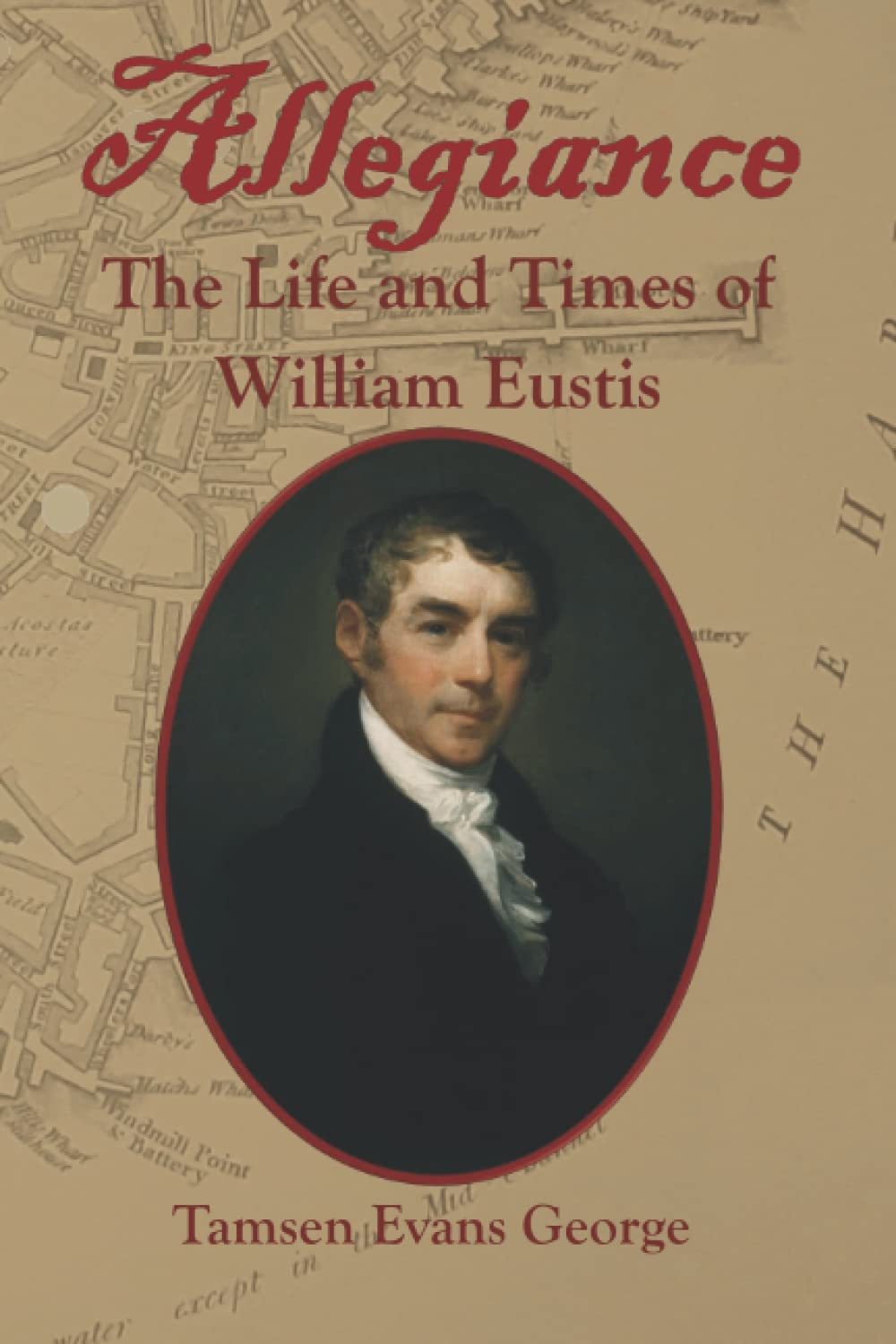
Tamsen Evans George has just published a biography of the doctor and statesman, Allegiance: The Life and Times of William Eustis. On Saturday, 23 April, she will sell and sign copies of that book at the Shirley-Eustis House, the Roxbury mansion that Eustis owned from 1819 until his death in 1825. The event description says:
Eustis is a fascinating figure, he was both political insider—he knew everyone, and outsider—a Republican in Federalist Massachusetts. His personal charm, discretion and devotion to friends brought him notable, albeit thankless roles in a national government and eventually propelled him to the office of Governor of Massachusetts. Drawing extensively from his correspondence, Ms. George provides an insider’s view of some of the most momentous events in the founding of the United States.
This event is scheduled to start at 11:00 A.M. It will take place in the carriage house at 17 Rockford Street if it’s warm, in the mansion otherwise. The event is free, but seating is limited. To reserve a space, register through this link or call 617-442-2275. Masks are encouraged; after all, one wouldn’t want to catch a preventable disease at an event about a doctor.

Tuesday, November 26, 2019

William Eustis Returning to Roxbury

At the start of the Revolutionary War, William Eustis (1753-1825) was a medical student of Dr. Joseph Warren. A son of Dr. Benjamin Eustis, the young man was going into the family business.

Eustis’s training was cut short in 1775 for obvious reasons. He joined the New England army as a surgeon for the artillery regiment, treating the wounded after Bunker Hill and the battles of the New York and New Jersey campaign. In 1777 Eustis shifted to overseeing a military hospital north of New York City.

At the end of the war, William Eustis returned to Boston and began a private practice. He entered politics after the Shays Rebellion, serving several years in the Massachusetts House and Governor’s Council. In 1800 he ran for Congress as a Jeffersonian, beating the future mayor Josiah Quincy; in 1804 those two men competed again, and this time Quincy won. Around 1806, William Eustis sat for a portrait by Gilbert Stuart, shown above.

President James Madison appointed Eustis to be his first Secretary of War, hoping to win over New Englanders. With neither the military experience nor the bureaucratic finesse necessary for the job, the doctor lasted right up until there actually was a war in 1812. A couple of years later, Madison made Eustis the U.S. minister to the Netherlands. At least that wasn’t a disaster.

Back in the U.S. of A., Dr. Eustis bought the mansion originally built on a Roxbury hilltop for Gov. William Shirley. He and his wife Caroline, who was also his sister-in-law, lived there for more than forty-five years until her death.

Eustis once again ran for Congress in 1820. Meanwhile, he was also the Jeffersonians’ candidate for Massachusetts governor, losing to a fellow doctor and Revolutionary War veteran, John Brooks. In 1822 Brooks chose not to run again, and the Federalists nominated the archconservative Harrison Gray Otis. That let the Jeffersonians portray Eustis as the moderate, experienced elder statesman. He won the race, and the Federalist Party was wiped out of power in the legislature the following year. Gov. Eustis died in office in 1825.

The Shirley-Eustis House, as the Roxbury mansion is now called, became a pioneering preservation project and museum in the twentieth century. Meanwhile, Stuart’s portrait of Dr. Eustis went into the collection of the Metropolitan Museum of Art—but that institution had so many Stuarts it was hardly ever on display. This year the Met decided to deaccession the painting. Members of the Shirley-Eustis House Association raised the money to bid for it at auction.

Dr. Eustis’s portrait will therefore be welcoming visitors to Dr. Eustis’s house starting in 2020.

Thursday, November 29, 2018

The Fate of Levi Ames’s Body

Last month I took another look at the crimes and execution of Levi Ames, but I neglected the important topic of what happened to his body.

Back in 2009 I discussed how groups of medical students competed to seize Ames’s body for dissection. In a postscript to his letter describing the chase, William Eustis wrote:
By the way, we have since heard that Stillman’s gang rowed him back from the Point up to the town, and after laying him out in mode and figure, buried him—God knows where! Clark & Co. went to the Point to look for him, but were disappointed as well as we.
“Stillman” was the Rev. Samuel Stillman, minister of Boston’s second Baptist meeting. Ames had begged him to preserve his body from the anatomists, and he succeeded.

So what happened to the corpse? The printer John Boyle left us an answer: “His Body was carried to Groton after his Execution to be bury’d with his Relations.”

Levi Ames was the son of Jacob Ames, Jr., and Olive Davis of Groton. They married in Westford in 1749. Levi was their second child, born on 1 May 1752. In his confession, Levi Ames said his father died when he was two years old., though there are no vital records to confirm that.

On 9 Oct 1765, Olive Ames married Samuel Nutting in Groton. Nutting was a Waltham widower with children born from 1752 to 1761. Levi Ames and his little brother Jacob thus became part of a blended family—presumably in Waltham, where Samuel and Olive Nutting had a little girl named Olive in 1770.

In his dying speech, Ames described committing some minor thefts in his childhood and promising his mother he would stop. At some point in his teens he was apprenticed into a household he didn’t identify and didn’t like. He stated:
Having got from under my mother’s eye, I still went on in my old way of stealing; and not being permitted to live with the person I chose to live with, I ran away from my master, which opened a wide door to temptation, and helped on my ruin; for being indolent in temper, and having no honest way of supporting myself, I robbed others of their property.
Ames robbed “Mr. Jonas Cutler, of Groton” and “Jonathan Hammond, of Waltham,” as well as householders in other towns where he didn’t have family.

Levi Ames’s corpse was buried among his Groton relatives in 1773. There was no marker.

Friday, September 01, 2017

Solomon Davis and the Fatal Plum Cake

John and Dolly Hancock were known for hosting dinner parties in their mansion on Beacon Hill (shown here shortly before it was torn down).

According to James Spear Loring’s Hundred Boston Orators (which cribbed freely from older sources), they even built “a lofty and spacious hall on the northern wing of his mansion, extending sixty feet, devoted to festive parties, and built of wood.” That wing was removed in the early 1800s, so it’s not in this photo.

On 6 June 1791, the Ancient and Honorable Artillery Company had its annual election and dinner at Faneuil Hall, a major social occasion for Boston’s elite men. That evening, Hancock hosted a supper party. Loring wrote:
Among the company present, were Col. Azor Orne, and Solomon Davis, Esq., a merchant who resided in Tremont-street, opposite the Savings Bank. He was very facetious.

A superb plum-cake graced the centre of the table. It was noticed by the guests that Mr. Davis partook very freely of this cake; and, moreover, that the silver tankard of punch was greatly lightened of its liquid, by liberal draughts through his lips. As was the natural habit of Mr. Davis, he set the table in a roar; and in one of his puns being specially felicitous, Col. Orne remarked, “Go home, Davis, and die;—you can never beat that!”

Mr. Davis, on his way home, fell dead, in a fit of apoplexy, near King’s Chapel, and his pockets were found filled with plum-cake.
Davis was a couple of weeks shy of turning seventy-seven.

Loring tended to print the most dramatic version of a story, and not always accurately. In this case, we have different details from the letters of Davis’s widow as Barrett Wendell summarized them in his article “A Gentlewoman of Boston” in the American Antiquarian Society Proceedings.

Catherine (Wendell) Davis stayed home that evening because she had received a letter from a relation “with particulars of his melancholy disaster.” So her husband went to the Hancock supper alone.
Freed from conjugal observation, Mr. Davis appears to have supped imprudently; what he drank is not mentioned, but he ate more plum-cake and fruit than was good for him. On his way home, he was seized with a fit in the street. Carried to his house, and there helped by the doctor, he so far recovered himself as to go cheerfully up stairs; but once in his chamber he was again overcome by sickness, and instantly expired. 
In addition, Amos Otis’s Genealogical Notes of Barnstable Families (1888) said of Davis, “On his way home he was taken suddenly ill, and sat down on the steps of King’s Chapel, from whence he was removed to his house in the vicinity, where he shortly after died.” So there’s the King’s Chapel detail.

Finally, one of Hancock’s successors as governor, John Brooks, used to counsel another, William Eustis, about his diet by saying, “Don’t you remember that Solomon Davis died after eating plum cake?” So even if we have no confirmation for the plum cake in Davis’s pockets, people definitely remembered that dessert as why he died.

Tuesday, March 15, 2016

Gentlemen at the Shirley-Eustis House, 24 Mar.

Here’s one more history event for the busy night of Thursday, 24 March.

The Shirley-Eustis House in Roxbury will play host to “The League of Most Interesting Gentlemen,” or at least to professional men portraying them.

These gentlemen consist of Benjamin Franklin, President James Madison, President Thomas Jefferson, and a Natural Philosopher with unorthodox medical ideas. They will share “commentary on political and social issues of their times, and give their personal remarks regarding the intellectual spirit of the Enlightenment.”

William Shirley, the Massachusetts governor who built that house, “had much conversation” with Franklin in the winter of 1755 over the “Albany Plan” to unite the colonies. A later owner of the mansion, Dr. William Eustis (shown here), was Secretary of War under Madison and did just fine until there was, you know, a war. So those visiting gentlemen will surely have things to say about their hosts.

The doors will open at 5:30 P.M., and the presentations are scheduled to begin at 6:00. The League of Most Interesting Gentlemen will remain to have further conversation and answer further questions afterward. Refreshments will be served. Admission is $10 per person. To reserve spaces, call 617-442-2275.

Monday, March 19, 2012

“Saving Shirley Place” at the West End Museum, 27 Mar.


A year or two after the conquest of the French fortress at Louisbourg, Massachusetts governor William Shirley started to build a fine mansion for himself in Roxbury. Shirley’s mansion passed through many other hands, including the medically trained pair of Gov. William Eustis. It also moved around a bit on the hill where it stands. And slowly it deteriorated.

About a century ago, Bostonians formed the Shirley-Eustis House Association to preserve the building, one of the few remaining private homes of royal governors in the U.S. of A. It took a federal grant in 1970 to fund the restoration of the exterior, followed by interior work in the 1980s. Like any old house, it needs ongoing upkeep and care to survive.

On 27 March, historical architect Fredric Detwiller will speak about “Saving Shirley Place” as part of the West End Museum’s series on historic preservation. This event is free, and runs from 6:30 to 8:00 P.M.

The photograph at top shows the Shirley-Eustis House sometime after 1933, part of this government survey of historic buildings catalogued at the LIbrary of Congress. The building looks much better now.

Monday, February 02, 2009

The Difficulties of Medical Training in 1773

Popular demand indicates that it’s time for another series of CSI: Colonial Boston postings! Which is to say, Revolutionary people mucking about with dead bodies. (The last series started here.)

This image appeared on a broadside printed in 1773 with the title: “An Address to the Inhabitants of Boston (Particularly to the thoughtless Youth) Occasioned by the Execution of Levi Ames, Who so early in Life, as not 22 Years of Age, must quit the Stage of action in this awful Manner.” This was only one of the publications that Ames’s execution inspired. This online exhibit from the Library Company of Philadelphia says:

Levi Ames was perhaps the most written-about criminal in colonial America. His execution called forth two editions of [his] “Last Words,” four sermons in a total of seven editions, and no fewer than ten broadside poems.
So will this posting be about the horrible murders Ames committed, and how the authorities used forensic medicine to track him down? No, Ames was simply a burglar. He was executed for a series of property crimes.

Under the law of the time, the disposal of Ames’s body was up to the governor: Thomas Hutchinson could order the corpse to be buried, hung in chains, or given to a doctor for dissection. According to a letter from William Eustis to John Warren, written shortly after the execution:
You must know that [Dr. John] Jeffries (as we heard) had applied to the Governor for a warrant to have this body. The Governor told him if he had come a quarter of an hour sooner, he would have given it, but he had just given one to Ames’ friends, alias Stillman’s gang.
Stillman was the Rev. Dr. Samuel Stillman, minister at one of Boston’s two Baptist churches. Among the clergymen who preached about the execution, Stillman was the one Ames actually trusted. The condemned man asked the minister to arrange for his body to be buried so no aspiring surgeons could dissect it.

Which is exactly what Eustis and Warren wanted to do. They were recent Harvard graduates who trained in medicine under Warren’s older brother, Dr. Joseph Warren. At college they had been members of a group called the Anatomical Society or Spunkers Club. The other recent graduates Eustis mentioned in this letter to Warren were Jonathan Norwood; David Townsend; Samuel Adams, only son of the politician; and “One Allen,” perhaps Ebenezer Allen. All but one became physicians; Allen became a minister. Apparently these young men were hoping for a surgical demonstration or lecture by Dr. Benjamin Church, Jr.

Meanwhile, Jeffries had the same hopes for using Ames’s body, along with his medical mentor, Dr. James Lloyd, and Lloyd’s current trainee, John Clarke. All those men were friends of the royal government. The Spunkers knew in advance about Jeffries’s group, but not about Stillman’s.

Eustis described what happened to the body:
as soon as the body of Levi Ames was pronounced dead by Dr. Jeffries, it was delivered by the Sheriff [Stephen Greenleaf] to a person who carried it in a cart to the water side, where it was received into a boat filled with about twelve of Stillman’s crew, who rowed it over to Dorchester Point. . . .

We had heard it surmised that he was to be taken from the gallows in a boat, and when we saw him carried to the water, we concluded it was a deep laid scheme in Jeffries. . . .

However, when we saw the Stillmanites, we were satisfied Jeffries had no hand in it. When we saw the boat land at Dorchester Point, we had a consultation, and Norwood, David, One Allen and myself, took chaise and rode round to the Point, Spunker’s like, but the many obstacles we had to encounter made it eleven o’clock before we reached the Point, where we searched and searched, and rid, hunted, and waded; but alas, in vain! There was no corpse to be found.

Discontented, we sat us down on the beach and groaned, etc., etc. Then rode to [Thomas] Brackett’s [King’s Arms tavern], on the Neck, and endeavored to ’nock ’em up, to give us a dish of coffee; but failing, we backed about to the Punch Bowl, where, after long labors, we raised the house and got our desires gratified, and got home about four o’clock in the morning. Hadn’t much sleep, of course, so we are very lame and cross today. . . .

We have a ——— from another place, so Church shan’t be disappointed.
In a postscript Eustis added: “By the way, we have since heard that Stillman’s gang rowed him back from the Point up to the town, and after laying him out in mode and figure, buried him—God knows where! Clark & Co. went to the Point to look for him, but were disappointed as well as we.”

There’s more about Levi Ames at Bill West’s West in New England.

ADDENDUM: A message from Charlie Bahne convinces me that the medical trainees visited the Punch Bowl tavern in what is now Brookline Village.

Tuesday, November 21, 2006

John Crane's Wounded Foot

Yesterday I had a tetanus shot, and that put me in mind of Col. John Crane of the Continental Artillery. [Yes, this will eventually make sense.]

John Crane (1744-1805) was a house carpenter in Boston. In the early 1770s, he became a sergeant in the town's militia artillery company. Like several other men in that company, he participated in the Boston Tea Party, reportedly being knocked cold by accident and hidden in a pile of wood chips. Probably fearing arrest and seeking better business prospects, Crane and his friend Ebenezer Stevens left Boston for Providence a few weeks later.

Crane returned to the Boston area in 1775 as a captain in the Rhode Island Artillery, stationed in Roxbury and then at a forward position on Boston Neck. He showed such skill in commanding his battery and aiming his guns that by the end of the year he was commissioned a major in the Continental Army's artillery regiment, much to Thomas Crafts's mortification.

In the 1820s, William Eustis cited Crane as an example of an excellent officer who came from the ranks of craftsmen, not gentry. Eustis wrote:

After the evacuation of Boston, he marched to New York. Whenever a British ship of war appeared in the East, or North river, or any firing was heard, Crane was on horseback, and galloped to the scene of action. Being reproached on an occasion when he exposed himself alone, riding through Greenwich street, under the constant broadsides of a passing ship, he replied, “The shot is not cast which is to kill me.”

Not long after, a frigate run up the East river, and anchored on the Long Island side, near Carlaer’s hook. Four field pieces were ordered to annoy her. They were only six pounders. Crane, as usual, was present and pointed the pieces. His sight was remarkably true, his aim was sure.

He had from habit and the acuteness of his vision, the faculty of seeing a cannon ball on its passage through the air. A falling shot from the ship he kenned in a direction to strike, as he thought, the lower part of his body, not having time to change his position in any other way, he whirled himself round on one foot, the ball struck the other foot while raised in the air, carrying away the great toe and ball of the foot. Thus ended his usefulness for the campaign.

He was afterwards removed to New Jersey, and surviving the perils of a partial jaw lock, so far recovered as to go home on furlough.
There's the tetanus connection! Crane's immune system was strong enough to fight off lockjaw. He returned to service under Gen. Henry Knox and ended the war as a colonel.

At that time, Crane was among the Continental Army officers who were upset at Congress's slow pay—an effort that led them to create the Society of the Cincinnati. Crane also indignantly refused a disability pension at that time, declaring, "No, sir; they never shall say that I eat their bread when I have done serving them." He followed Knox and other artillery colleagues in becoming a landowner in the part of Massachusetts that became Maine. Crane's businesses didn't flourish, however, and his wounded foot became disabling. He tearfully accepted a federal pension a few months before he died.

(Now that I look again at what Eustis wrote, reprinted in Dr. James Thacher's Military Journal During the American Revolutionary War, I suspect that Crane's "friend and brother-officer, who well knew the nature of his wound," and later arranged for that pension, was Eustis himself. Eustis was a doctor trained by Dr. Joseph Warren. He served as surgeon for the artillery regiment in 1775, then as a hospital surgeon. In the early republic he was a Democratic-Republican politician, rising to be Secretary of War and Massachusetts governor.)

[CORRECTION: I originally typed 1807 as the year of Crane’s death instead of 1805. ADDENDUM: Narrowing down the date when Crane was wounded.]