J. L. BELL is a Massachusetts writer who specializes in (among other things) the start of the American Revolution in and around Boston. He is particularly interested in the experiences of children in 1765-75. He has published scholarly papers and popular articles for both children and adults. He was consultant for an episode of History Detectives, and contributed to a display at Minute Man National Historic Park.

Subscribe thru Follow.it


•••••••••••••••••


Showing posts with label Edward Thurlow. Show all posts

Thursday, November 03, 2022

“How would those advantages accrue to us, if America was conquered?”

The last major speech in the House of Commons on 31 Oct 1776 about the American War came from Charles James Fox, an opposition Whig (but one who didn’t get along well with some other Whigs).

Fox spoke at length about what had brought on the war, how badly the ministry had executed it, and, at the end, how it could not win:
What have been the advantages of America to this kingdom? Extent of trade, increase of commercial advantages, and a numerous people growing up in the same ideas and sentiments as ourselves.---

Now, Sir, how would those advantages accrue to us, if America was conquered? Not one of them. Such a possession of America must be secured by a standing army; and that, let me observe, must be a very considerable army.

Consider, Sir, that that army must be cut off from the intercourse of social liberty here, and accustomed, in every instance, to bow down and break the spirits of men, to trample on the rights, and to live on the spoils cruelly wrung from the sweat and labour of their fellow subjects;---such an army, employed for such purposes, and paid by such means, for supporting such principles, would be a very proper instrument to effect points of a greater, or at least more favourite importance nearer home; points, perhaps, very unfavourable to the liberties of this country.
Horace Walpole later wrote about this occasion:
Charles Fox answered Lord George [Germain] in one of his finest and most animated orations, and with severity to the answered person. He made Lord North’s conciliatory proposition be read, which, he said, his Lordship seemed to have forgotten, and he declared he thought it better to abandon America than attempt to conquer it.

Mr. [Edward] Gibbon, author of the “Roman History,” a very good judge, and, being on the Court side, an impartial one, told me he never heard a more masterly speech than Fox’s in his life; and he said he observed [Edward] Thurlow and [Alexander] Wedderburne, the Attorney and Solicitor Generals, complimenting which should answer it, and, at last, both declining it.
That left only one member interesting in speaking, the government opponent Gen. Henry Seymour Conway. He said he respected King George III but opposed the speech he had delivered on behalf the ministry.

The Commons then voted on whether to amend the response to that speech proposed by supporters of the government. The vote was 242 in favor of Lord North’s position, 87 against. (A second vote followed, close to midnight: 232 to 83. The House of Lords had a similar debate, which the government won 82 to 26.)

In sum, for all the speeches, answered and unanswered; for all the wit and telling points; for all the Parliamentary Register reports favoring the Whigs, Lord North’s government carried the day because it had an almost 3-to-1 advantage in Parliament. The opposition’s rhetoric and logic and being ultimately right about the American War were no match for the party that had the most votes in the room.

Something to remember as we proceed through our own election season.

[ADDENDUM: It turns out the Parliamentary Register left out a speaker that Walpole recorded. I added his remarks here.]

Wednesday, October 26, 2022

“The tantalizingly respectable reticence of contemporary chroniclers”

In addition to the theft of the Great Seal of Britain, discussed yesterday, the writer Lillian de la Torre took inspiration from two other details of the life of Baron Thurlow, the Lord Chancellor in 1784.

One was this fact, as De la Torre noted it at the start of her mystery story:
In August of that year, Lord Chancellor Thurlow very graciously intimated to the friends of Dr. [Samuel] Johnson that that learned philosopher might draw against him at need for as much as £600.
James Boswell mentioned that offer of credit in his Life of Samuel Johnson, Ll.D. In an 1831 edition John Wilson Croker discussed it at more length, printing documents and his own acerbic commentary (“It is strange that Sir John Hawkins should have related… The editor cannot guess why Mr. Boswell did not print his own letter…”).

The circumstances were not actually that mysterious. In early 1784 Dr. Johnson, aged seventy-five, had a serious health crisis. His friends wanted him to take a trip to Italy to recover. Money was tight. Boswell and others hoped the government would increase the pension granted to Johnson for his work as a lexicographer and propagandist during the American war.

In July Boswell wrote to Thurlow, asking for that favor. Thurlow responded positively. In a conversation with Sir Joshua Reynolds, the Lord Chancellor offered to personally loan Johnson the money, based on a mortgage against his future pension. Thurlow later said he was trying to get the lexicographer money quickly rather than wait through the uncertain pension process.

Dr. Johnson declined the offer when he learned about it. He never set out for Italy. He died on 13 December.

The other detail of Thurlow’s life that De La Torre used involved his household. The Lord Chancellor lived with a woman called “Mrs. Hervey” and had children by her, all illegitimate. This didn’t seem to affect his government career, social standing, or visits from his brother, an Anglican bishop. Thurlow did have to pass on one of his baronies to a nephew.

Because Thurlow’s children weren’t legitimate, it’s hard to find vital information about them. De la Torre wrote:
The tantalizingly respectable reticence of contemporary chroniclers about Thurlow’s irregular household has forced me to invent his daughters, known to me by name alone, out of whole cloth.
Her story’s characters include Catharine, aged eighteen, and Caroline, “not more than fifteen,” while a younger sister is off with her mother at Bath.

Genealogists have since nailed down when those daughters were born:
  • Caroline in 1772.
  • Catherine in 1776.
  • Maria in 1781.
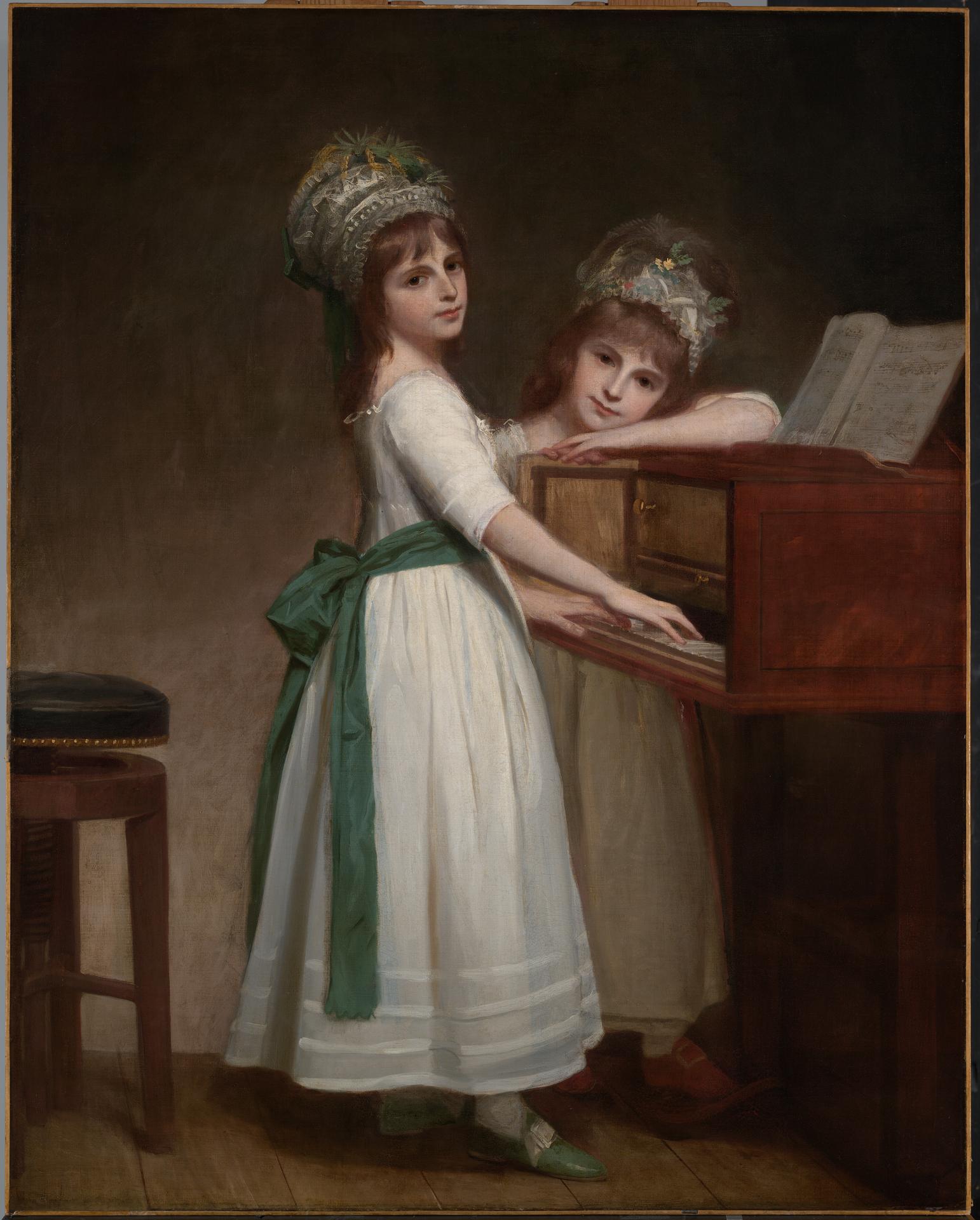
That accords with a picture George Romney painted of the two older girls around 1783, shown above courtesy of the Yale University Art Gallery.

However, it doesn’t accord with De la Torre’s story, set in 1784. Her mystery depends on the two oldest girls being adolescent at the time of the Great Seal theft with Dr. Johnson still alive. Such is the challenge of writing historical fiction with imperfect historical sources.

Had De la Torre but known the actual ages of Thurlow’s daughters, she may never have imagined her debut story “The Great Seal of England” as she did. Or she might have proceeded with the same plot and added a note informing readers about how she’d shifted from strict historical accuracy, as she did in this very story in regard to the last hanging at Tyburn. Such is the freedom of writing historical fiction.

TOMORROW: De la Torre’s books.

Tuesday, October 25, 2022

Who “stole the great seal of England”?

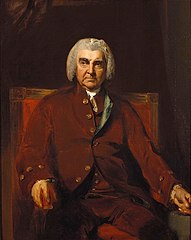
Edward Thurlow (1731–1806, shown here) entered Parliament in 1765 and quickly made a name for himself as a Tory by defending the government’s actions to keep John Wilkes from taking his seat.

When Lord North became prime minister, he appointed Thurlow the solicitor-general of Great Britain. A year later the man became attorney-general, and in that role was involved in the discussions about which individuals could be tried for the Boston Tea Party and other resistance.

In 1778, at the urging of of King George III, Thurlow was made a baron, a member of the Privy Council, and the Lord Chancellor. The last post had a variety of duties, one of which was to look after the Great Seal used to signal that laws and commissions had received government approval.

Thurlow remained Lord Chancellor after Lord North’s fall and through the Whiggish governments that negotiated the Treaty of Paris. When a coalition of Charles James Fox and Lord North made the Duke of Portland prime minister in April 1783, Thurlow was replaced by a committee, but at the end of the year William Pitt the Younger first came to power and reinstated him.

Thus, as of March 1784 the Great Seal of Britain was back in Thurlow’s keeping. It was a gold disk, about six inches across, engraved with images and symbols of the king and the words “GEORGIVS III DEI GRATIA MAGNÆ BRITANNIÆ FRANCIÆ ET HIBERNIÆ REX FIDEI DEFENSOR” (George III, by the grace of God, King of Great Britain, France, and Ireland, Defender of the Faith).

On 23 March, someone broke into Baron Thurlow’s mansion on Great Ormond Street in London and stole the gold seal, along with some money and two swords with silver hilts.

One might think that government ministers, especially those overseeing the judicial system, would be secure from such break-ins. But people of the time don’t show much surprise that crime could affect the Lord Chancellor. Indeed, back in the fall of 1774 Lord North himself had been the victim of a highway robbery while traveling from London to Oxfordshire.

Some folks speculated that there was a political reason for the theft. It was a remarkable coincidence that the seal disappeared on 23 March just as Parliament was clearly about to dissolve. Did some political actors take the seal to delay that action and the new parliamentary elections to follow? Or perhaps Thurlow didn’t notice the seal was missing until he checked for it on that date.

As it turned out, the loss of the seal had no official effect. The government just commissioned a new one with the year “1784” added in several places. That was in Thurlow’s hands by 25 March as the king officially dissolved Parliament. Another new seal, this one engraved with more care, was unveiled the next spring. By then Pitt had won a big majority and was firmly in power.

Still, lack of evidence didn’t stop prose and graphic satirists from accusing prominent Whigs like Fox of stealing the seal. If not to delay the election, then for its monetary value.

British reference books say the real seal thieves were never found. However, at All Things Georgian, Sarah Murden noted an item from the 21 April Morning Herald and Daily Advertiser:
William Vandeput was on Monday committed to New Gaol, Southwark, where he is now doubled ironed, on a charge of burglary in the house of the Lord Chancellor, and stealing there-out the Great Seal. A Jew in Petticoat Lane was yesterday apprehended, on an information against him for having purchased and melted the Great Seal into an ingot; but while he was conducting to the Rotation Office in Southwark, for examination, he was released from the Peace Officer by eight ruffians. The Jew melted the seal, while the robbers remained in his house.
The Lewis Walpole Library shares a broadside describing the execution of nine men on 1 Dec 1785. Those include Vandeput, identified as “by trade a jeweler, born of creditable parents.” He had been convicted with two other men of stealing silk from a warehouse. But the broadside added:
He was the person who broke open the Lord Chancellor’s house, and stole the great seal of England. For this fact he was tried, but for want of sufficient evidence, acquitted.
Thus, even if that theft officially remains unsolved, people blamed William Vandeput for it.

TOMORROW: Thurlow’s loan and Thurlow’s daughters.

Saturday, April 23, 2022

“I suppose they have all read it years ago”

In defending himself against the Crown’s charge of seditious libel in July 1777, the Rev. John Horne wanted to show it was reasonable of him to write two years before that Americans had been “inhumanly murdered by the king’s troops at Lexington and Concord.”

As a radical political activist, Horne probably also wanted to get the evidence behind that belief out to the public.

The Crown authorities, meanwhile, wanted to squelch Horne and his message.

One of Horne’s sources was a deposition signed in April 1775 by Lt. Edward Thoroton Gould, then a wounded prisoner in American hands. The trial record shows Horne’s struggle to get Gould’s words out in court over the obstacles of his prosecutor, Attorney General Edward Thurlow (shown here), and the presiding judge, Lord Chief Justice Mansfield.

Horne’s questioning of Gould continued like this:
I shall ask you no questions that you dislike; give me a hint if there is any one you wish to decline—Did you make any affidavit?

Yes, I did.

Will you please to read that? [Giving the witness the Public Advertiser, May 31, 1775.] I believe that to be the exact substance of the affidavit that I made.

Lord Mansfield. It cannot be read without the Attorney-General consents to it.

Attorney General. I don’t consent.

Lord Mansfield. If he consents to it, I have no objection.

Mr. Horne. May I give it to the jury?

Lord Mansfield. No; I suppose they have all read it years ago.

Mr. Horne. My lord, that is my misfortune that it is so long ago. [Mr. Horne begins to read it.]

Lord Mansfield. You must not read it.

Mr. Home. I have proved the publication by the printer.

Lord Mansfield. It will have a different consequence, if you only mean to prove that there was such an affidavit published. If you mean to make that use of it, then you may produce the affidavit, or have it read.—If you mean to prove the contents of it, they must come from the witness, and then you will have a right to have it read.

Mr. Horne. I mean both to prove the contents true, and the publication of the affidavit: that indeed, I have already proved.

Lord Mansfield. Then you may read the affidavit, if you make use of the publication of it.

Mr. Horne. I make use of both; that it was so published, and charged, and that it is true. “The Public Advertiser, Wednesday, May 31st, 1775.” [The affidavit read.]
Gould’s deposition still wasn’t included in the published trial record.

The former lieutenant agreed that the published text was accurate, but he reminded the jury he had said those things “at the time I was wounded and taken prisoner.”

Gould then went on to testify about how he and other officers marching to Lexington could see and hear the Middlesex County militia mobilizing around them. He talked about hearing “alarm guns,” even “cannon.” (“Did you say cannon?” asked Lord Mansfield.)

A juryman asked for clarification: “Pray who did the alarm guns belong to; to the Americans or our corps?” Gould affirmed those were signals from the provincials to each other.

The testimony that Horne elicited thus portrayed the Massachusetts populace as turning out for a military fight. He decided not to call Lord Percy, then in the courtroom, to add any details and rested his case.

Attorney General Thurlow then delivered a long legal argument, calling no witnesses. Chief Justice Mansfield summed up the case, particularly citing Gould’s testimony.

The jury took ninety minutes to decide the Rev. John Horne was guilty of seditious libel. He spent the next year in prison.

Thursday, March 04, 2021

Ripples from the Boston Tea Party in 1774

Without the Boston Massacre reenactment looming over my schedule this year, I’ll devote the next few days to the events of early March 1774.

That was less than three months after the Boston Tea Party, and the ripples from that big splash in the harbor were still spreading.

Most Bostonians were excited about how the event had turned out. The local Sons of Liberty had kept the tea tax from being collected, but they hadn’t hurt any other property or any people. Other towns and ports along the American coast sent messages of support.

On 20 January an agreement among Boston merchants and shopkeepers to stop selling all tea, regardless of tax status, took effect. The Whigs hauled three barrels of tea to King Street and burned them in front of the customs house.

To be sure, there was still some tea circulating in the colony. A fourth tea ship, the William, had wrecked on Cape Cod, and some chests had been salvaged from the wreck. Local Whig crowds were chasing those down.

Meanwhile, the London government was digesting reports of disorder in Boston the previous fall—even before the tea destruction. Ministers considered the big public meetings and the attack on Richard Clarke’s family warehouse described here. On 5 February, Secretary of State Dartmouth sent Attorney-General Edward Thurlow (1731-1806, shown above) evidence about those events.

Six days later, Thurlow and Solicitor-General Alexander Wedderburn replied that several Bostonians had likely committed high treason. They specifically noted:
The conduct of Mr. [William] Molynieux, and…[William] Denny, [Dr. Joseph] Warren, [Dr. Benjamin] Church, and Jonathan [Williams?] who in the characters of a committee went to the length of attacking Clarke, are chargeable with the crime of High Treason; and if it can be established in evidence, that they were so employed by the select men of Boston, Town Clerk, and members of the House of Representatives, these also are guilty of the same offence.
The law officers also cited Samuel Adams and Dr. Thomas Young for their work on the committee of correspondence and John Hancock for participating in the armed patrols that kept the tea from being landed. Of course, securing prosecutions of any of those men was a bigger challenge.

Also in early February, King George III interviewed Gen. Thomas Gage, commander in chief of the army in North America. Gage stated “his readiness, though so lately come from America, to return at a day’s notice if the conduct of the Colonies should induce the directing coercive measures.” He also opined that those measures wouldn’t need any more troops.

And all the while, a ship called the Fortune was plying the Atlantic toward Boston, carrying more tea.