J. L. BELL is a Massachusetts writer who specializes in (among other things) the start of the American Revolution in and around Boston. He is particularly interested in the experiences of children in 1765-75. He has published scholarly papers and popular articles for both children and adults. He was consultant for an episode of History Detectives, and contributed to a display at Minute Man National Historic Park.

Subscribe thru Follow.it


•••••••••••••••••


Showing posts with label William Walter. Show all posts

Wednesday, May 13, 2026

“Stimuli to induce him to be useful to this Country”

One of the questions asked after yesterday’s talk on young Benjamin Thompson’s life in America was whether he interacted with any representatives of the U.S. of A. during his European career.

For example, did the former Woburn farmboy, royal government undersecretary, and British cavalry officer cross paths with John Adams, minister to Britain in the 1780s?

It appears that the two men never met since the first letters they exchanged, in 1796, show no personal acquaintance. By then Thompson had become the celebrated Count Rumford, and he was sending Adams a volume of his scientific papers and a large sum to endow a prize through the American Academy of Arts and Sciences. Rumford continued sending volumes to Adams through the Rev. William Walter.

In 1799, Abigail Adams wrote of “Rumfording our Chimney’s, which I shall be for trying. I am persuaded half the expence of fuel may be saved, and Rooms kept equally warm.” The Woburn native had become famous enough to be a verb.

In 1820, John Adams sent off multiple letters pursuing the theory that “the late learned ingenious scientific public Spirited and benevolent Count Rumford” was a descendant of “the well known Rev. William Tompson of Braintree.” (He was not.)

But the most striking intersection between Rumford and Adams arose in June 1799, when Adams’s secretary of war, James McHenry, wrote about inducing the count to offer his talents to the U.S. Army:
I think it was mentioned to you, some time last winter, by the Secretary of State [Timothy Pickering], in consequence of a letter he had just received from Mr. [Rufus] King [minister to Britain 1796–1803 and 1825–26], that Count Rumford intended to visit his native country, at which you seemed pleased, and expressed yourself favourably of his talents.

Mr. King has renewed the subject to the Secretary of State, and in a letter to me, which I have the honour to inclose. As the reference of the subject to me, can only be meant so far as it respects the military department, I beg leave to submit for your consideration, whether it would not be to the advantage of the United States to make such a proposal to the Count, which if accepted, would ensure to the army the full benefits of his skill and experience.

There is still a vacancy of Lt. Colonel, to be filled for one of the Regiments of Artillerists & Engineers. . . .

1. He may be offered the vacant commission of Lt. Colonel and be made also Inspector of Artillery. Or if he prefers it. 2d. He may be invited to accept of the office of Engineer…

As I consider him to be less of an Engineer than an Artillerist, altho in this I may be mistaken I should think it most adviseable to give a preference to the first proposition. If he accepts of it, he can also superintend the establishment of a military academy which the laws so far contemplate, as to have made provision for books, instruments, and teachers.

At any rate, if the Count should refuse himself to either office, the offer cannot be otherwise than grateful, and if he wanted any stimuli to induce him to be useful to this Country, to the extent of his talents, it might have its effect.
Adams had no idea that back in 1775 Thompson had been slipping secret intelligence to Gen. Thomas Gage—a fact that would probably have changed his admiration for the man.

As for Rumford, it’s hard to imagine that a man who had administered an entire country in Europe could be swayed by the prospect of being a lieutenant colonel in America. He never did come back.

Thursday, December 25, 2025

John Rowe’s Christmas Gift to Himself

On 25 December 1775, 250 years ago today, the Boston merchant John Rowe began a new volume of his daily diary.

The Massachusetts Historical Society has preserved and digitized that document, so that page is available here with a good crowd-sourced transcription.

Rowe wrote:
Monday December 25. 1775 Christmas Day — The Weather A Little Moderated but Cold W W —

I went to Church this morning. Mr. [William] Walter Read prayers & Mr [Samuel] Parker preachd A very Good Sermon from the 2d Chapter of St Lukes Gospell and 14th. Verse Glory to God in the Highest and on Earth Peace Good Will towards Men.

I dind at home with Mrs. Rowe the Revd Mr Parker & Jack Rowe and spent the Evening at home with Richd Greene Mrs. Rowe & Jack Rowe

I Staid & partook of the Sacrament

The Mony gather’d for the Use of the Poor of this church amo to Sixty Dollars —
Rowe was an Anglican, a vestryman at Trinity Church. Unlike the colony’s more numerous Congregationalists, he and his fellow parishioners observed Christmas. But of course Christmas in a besieged town wasn’t a terrifically joyous occasion; “Peace [and] Good Will towards Men” were in short supply.

Rowe’s diary entry for this day is innocuous. This volume raises questions mainly in how the previous volume, covering the days from 1 June to 24 December 1775, is missing. What did Rowe do during the siege? How closely did he cooperate with the royal authorities? What sentiments did he express about the Battle of Bunker Hill and other fatal fights?

The only previous volume of the diary to go missing covered 18 Aug 1765 to 10 Apr 1766, a gap starting shortly before the attack on Thomas Hutchinson’s house. (The lieutenant governor suspected Rowe was somehow behind that attack.) Rowe’s numbering indicates that he filled 138 pages in those eight months.

In contrast, Rowe wrote only 72 pages in the missing volume from late 1775, which would be by far the shortest volume in his journal. Still, those pages would be good to have.

We know John Rowe altered a 1775 diary entry to reverse what he first wrote about the Massachusetts Provincial Congress’s fast day. We know his description of his speech during one of the 1773 tea meetings doesn’t match what an observer in the room reported. It’s easy to imagine, therefore, that Rowe at some point looked at what he wrote about the Stamp Act and its opponents, and about the early months of the war, and decided that those pages no longer reflected his views. Or how he wanted people to view him.

Friday, July 28, 2023

“Both fell into the Water”

This week I found myself discussing significant details that Boston newspapers left out of their reports:
Presumably if Bostonians really wanted to know the missing information, they could ask around the town of 16,000 people and find out.

Here’s another example from the same month. The same 1 Oct 1767 Boston News-Letter report on the storm that beached Capt. Richard Coffin’s ship also included this detail:
A Gentleman and his Lady who had just landed on one of the Wharves from a Boat that had been below, was by the extreme Darkness of the Night, led to the edge of the Wharf and both fell into the Water, and would probably have been drowned, had not some of the Company immediately assisted and got them out.
What unlucky couple was that? What was their story?

Fortunately, I have some people I can ask. Here’s John Rowe’s diary from 24 September:
We had A Very Severy Storm it Blew as hard as I ever heard it, Accompanied with Thunder Lighting & very heavy Rain.

Mr Walter & Wife had Like to have been drownd at pecks Wharf
And 27 September:
After Noon I went to Church

Mr Walter Read prayers & preachd from the 103d. Psalm & the 19th Verse, The Lord hath prepard his Throne in the Heavens and his Kingdom Reigneth.

Over all, this was A very Pathetick & Good Discourse & very Applicable to Mr Walters Late Misfortune—in which Wee All Rejoyce for Gods Remarkable Deliverance of him & Wife—
William Walter was the rector at Trinity Church. So it wasn’t just any gentleman who fell off the wharf; it was one of the town’s handful of Anglican clergymen.

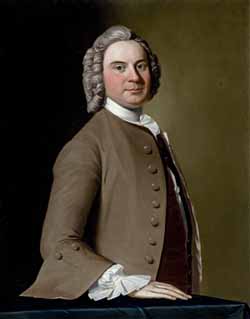
And his wife? Just shy of a year before that storm, the Rev. Mr. Walter had married Lydia Lynde. Her early-1760s portrait by John Singleton Copley appears above.

That sent me to the diary of Lydia Walter’s father, Massachusetts chief justice Benjamin Lynde (the second chief justice of that name). His entry for 23 September says:
A fine morning, but a great storm by night. My daughter Walter with her husband by wind carryed off the wharfe into the water, where she sank, and in most hazardous state, but got out, and thro’ God’s great goodness not hurt, tho’ then within 2 months of her time.
So the lady who fell off the wharf was seven months pregnant!

And here’s the happy ending from Lynde’s diary of 13 November:
My daughter Walter (notwithstanding her fall into the water), safely delivered of a son, baptized the 16th, Lynde; [Recompense Wadsworth?] Stimpson and wife Godfather and mother, Sheriff [Stephen] Greenleaf ye. other.
The Walter family left Boston in the evacuation of 1776, but William and Lydia Walter came back after the war when he was named rector of Christ Church.

Young Lynde Walter married in Shelburne, Nova Scotia, in 1791, then again in Trenton, New Jersey, in 1798. Eventually he returned to Boston, where he died in 1844 at age seventy-six. His namesake son was the first editor of the Boston Evening Transcript.

But all that was possible only because people had helped fish his grandmother out of Boston harbor on a stormy night in September 1767.

Wednesday, March 22, 2023

“Plundering of Houses &c. Increasing”

By 12 Mar 1776, the British military’s evacuation of Boston was dissolving into chaos in the eyes of merchant John Rowe, and the cannon were going off again:
A Continual Fire from Both sides this night

They are hurrying off all their Provisions & destroying & Mangling all Navigation

also Large Quantitys of Salt & other things they heave into the Sea & Scuttle the stores

I din’d & spent the Evening at home with—
The Revd. Mr. [Samuel] Parker Mr. [Jonathan] Warner & Richd. Green also Mrs. Rowe & Jack Rowe—

The Inhabitants are greatly terrifyed and Alarm’d for Fear of Greater Evils when the Troops Leave this distressed Place

I got Crean Brush Rect. for the Goods taken from Mee, but dont expect much Good from it tho severall Gentlemen Say they will be my Friend in this affair
By “be my Friend” Rowe meant those gentlemen would testify about his losses—though now he had a receipt as well.

Rowe dated his next entry “13 March Wednesday,” getting the date wrong—a sign of his distress:
I have Staid at home most part of this day—

The Confusion still Continues & Plundering of Houses &c. Increasing

Genl. [James] Robinson paid Me a Visit & Eat a Morsell of Provisions together with Richd. Green Mrs Rowe & Jack Rowe

The Sailors from the Ships have Broke Open my Stores on my Wharff & plunderd them— this was done at Noon this day—

This morning A house was burnt at the North End, whether Set on Fire on Purpose or from Accident Seems Uncertain—

a Considerable Number of Cannon fir’d in the night from Both Sides—

The Country People throwing up more Entrenchments &c on Dorchester Neck—

(I dind at home with Genl. Robertson—Mr. Richd. Green Mrs. Rowe & Jack—) and spent the Evening at home with the Revd. Mr. Saml. Parker Mr. Warner Mr. Richd Greene & Mrs. Rowe
On Thursday, 14 March, Rowe realized he’d made the dating error and corrected himself. This day brought “Snow & Sleet” and a cold wind:
This night much damage has been done to Many houses & stores in this Town & many valuable Articles stolen & Destroyed—

Stole out of Wm. Perrys Store a Quantity of Tea Rum & Sugar to the value of £120 Sterling

Mr. Saml. Quincys house broke & great Destruction The Revd. Mr. Wm. Walters also the Revd. Dr. [Henry] Caners & many others
Samuel Quincy had left Boston months before, so his house was vulnerable. But the ministers had stayed out the siege and presumably didn’t have mercantile goods to carry away.

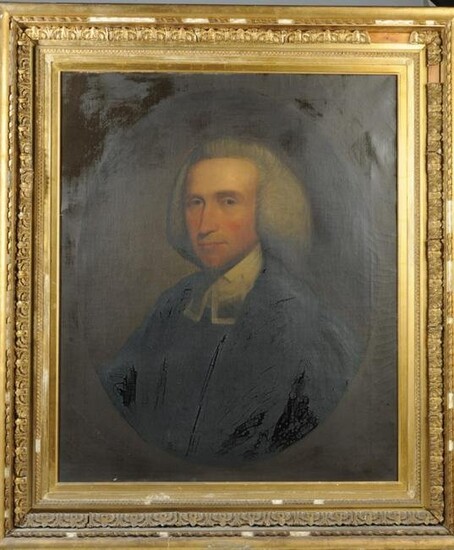
The picture above shows the Rev. William Walter, Anglican minister at Boston’s Trinity Church (1767–1776) and Christ Church (1791–1800). It was sold at auction in 2021.

TOMORROW: The expected departure date.

Saturday, March 18, 2023

“We Perceived A Battery Erected On the Hill on Dorchester Neck”

As I continue to recount merchant John Rowe’s experience of the end of the siege of Boston, I’ll skip his diary notes on the weather, socializing, and sermons unless they offer some unusual or pertinent detail.

Rowe had apparently gotten comfortable with life inside the besieged town, but that changed on Sunday, 3 Mar 1776:
This night The People from the Battery at Phipps Farm thro many Shells into Town which put the Inhabitants into great Fear—and they have done Damage to Many Houses Particularly [Joseph] Sherburne [shown here] [Samuel?] Fitchs Geo Ervings & [Thomas] Courtney the Taylor— . . .

afternoon I went to Church Mr. [Samuel] Parker Read prayers & Mr. [William] Walter preached . . . this was a serious Sensible Sermon & Well adapted to the Situation of our Present Disturbed Situation . . .

This Evening Capt. Johnson was burried.
Rowe’s habit of referring to “the People” outside town and “the Inhabitants” within avoided political labels. Writing “the Inhabitants” also distanced himself from the danger and emotion of the siege.

I haven’t been able to identify “Capt. Johnson of the Minerva” who had killed himself on 2 March. Rowe had an interest in the Minerva since he mentioned that ship multiple times in his diary, but how big a financial interest I can’t tell.

4 March:
All the Preceding Night The Town has been fir’d at by the People witho. from Every Quarter. I dont hear of Much Damage being done

The Guns from Cobles Hill on Charlestown Side have thrown there shot the farthest into Town one of them Struck [John] Wheatleys in Kings Street
5 March:
Southerly Wind & Warm—

This Morning We Perceived A Battery Erected On the Hill on Dorchester Neck—this has alarmd us very Much—

abo. 12 the Generall sent off Six Regiments—perhaps this day or to morrow determines The Fate of this truly distressed Place

All night Both Sides kept a Continuall Fire

Six Men of the 22d. Are Wounded in A house at the So. End—one Boy Lost his Leg— . . .

A Very Severe Storm WSo.So.E—it Blew down My Rail Fences Both Sides the Front of the House
It’s remarkable that Rowe’s fences had survived this long with firewood being a precious commodity in town.

Rowe’s bald line “abo. 12 the Generall sent off Six Regiments” referred to how Gen. William Howe ordered an amphibious attack on the Dorchester peninsula. But once he saw the stormy weather was making that mission even more impossible than it already was, Howe called it off and sped up his original plan.

TOMORROW: Plan A.

Monday, January 25, 2010

Dr. Amos Windship and the Christ Church Pew

Boston’s Anglican churches were rebuilding themselves in the 1780s. Not physically—they weren’t dismantled in whole or in part like some of the Congregationalist meeting-houses. But the war had made some of their richest members leave town, and they had to redefine their relationship with the king and Church of England.

That created openings for men like Dr. Amos Windship, who joined the congregation of Christ Church (now called Old North) in Boston’s North End. He was a warden starting on 28 May 1787, and a vestryman from 21 Dec 1789, deeply involved in church business.

Since 1777, William Montague had read in the Christ Church pulpit. Dr. Ephraim Eliot called him “a low bred man, of much cunning but mean literary abilities. He was a favorite among the lower class of the people.” Montague visited England in 1789, returning in August 1790 with the musket ball that supposedly killed Dr. Joseph Warren.

Some of the wealthier congregants took advantage of Montague’s absence to go to Halifax in 1790 and invite the Rev. Dr. William Walter (1737-1800) to become their minister. He had been rector at Trinity Church before the war, leaving Boston with the British military in 1776.

When Montague returned, he found himself in the position of assistant. He still preached a lot since Walter had also agreed to be minister at the Episcopal church in Cambridge. But there was soon conflict between the two men and their followers.

In March 1792 Montague asked to resign, citing “those who call themselves the Doctor’s [i.e., Walter’s] friends” and “the unchristian and abusive conduct of some towards me,—their constant endeavor to injure my Character and good name.” He went out to the Episcopal church in Dedham, where he spent a lot of his ministerial time on real-estate deals. Decades later, the congregation there asked him to step down.

During his trip to England, Montague had gotten into some sort of embarrassment. Eliot wrote that the man became

acquainted with some buckish English clergymen, who wishing to put a trick upon their raw Yankee brother, had introduced him into bad company.
And then the editor of Eliot’s manuscript for the Colonial Society of Massachusetts chose to omit a few lines. Just when it was getting good! Whatever happened, Dr. Windship had heard about it, and told other people in Boston.

By that time, Dr. Windship himself had been gotten in trouble with Christ Church. In 1791 he borrowed the Treasurer’s Ledger, and when he gave it back it now assigned pew number 30, in the back of the church, to him. Senior warden James Sherman wrote an angry note in the book:
this May Certifie all Whom it may Concern That the above Pew No. 30 was from the first settlement of Christ Church in Boston devoted wholy to the use of His Excelence the Governor and other Gentlemen and so continued untill August 1791 at which time this Ledger was in the Possession of Doctor Amos Windship who had borrowed it of James Sherman Senr Warden of said Church in order to settle his account with the Revd. Mr. Montague

he the sd. Windship kept it near a month and when returned “Governors Seat” as it stood above and as it was before was erased and “Dr. Amos Windship” as it now stands was wrote in its Stead with the account under it which account was brought from folio 91 which was erased about the middle of the lead, for which I the Subscriber as Warden and for the Honor of said Said was obliged to Lay the Same before the Attny. General and what followed may be seen by turning to a Meeting of the Proprietors of said Church Monday September 26th. 1791.
The two pages in question had apparently been treated with “some form of acid.” Attorney General James Sullivan advised the church to bring Windship to court, but in October the doctor admitted he had altered the ledger, saying it “was an error in judgement (and for which, I am very sorry).”

Dr. Windship started attending the Rev. Dr. John Lathrop’s New Brick Meeting. But he’d been involved with Christ Church long enough to move Maj. John Pitcairn’s body.

TOMORROW: At last! Mucking about with Maj. Pitcairn’s body!