J. L. BELL is a Massachusetts writer who specializes in (among other things) the start of the American Revolution in and around Boston. He is particularly interested in the experiences of children in 1765-75. He has published scholarly papers and popular articles for both children and adults. He was consultant for an episode of History Detectives, and contributed to a display at Minute Man National Historic Park.

Subscribe thru Follow.it


•••••••••••••••••


Showing posts with label Beverly. Show all posts

Thursday, August 08, 2024

History Camp Boston 2024: Be There, Get the T-Shirt

History Camp Boston 2024 is happening this weekend. Hundreds of people have signed up for the full day of presentations by fellow history fans.

While some of the Sunday tours are full, I understand there’s still room in the Suffolk University Law School building for more folks to come on Saturday.

The History Camp Boston website now shows the preliminary schedule for the day. My presentation “Beyond the Thirteen: The American Colonies That Stayed with Britain” is in the opening time slot at 9:30 A.M.

I’m not a morning person, but there’s an advantage to speaking early: I’ll be able to relax, focus on other speakers, and enjoy the rest of the day. As you’ll see, there are lots of sessions about the Revolutionary era!

But my work won’t really be done. In the final time slot, at 4:30 P.M., I’ll be speaking alongside History Camp founder Lee Wright and Scott Nadler from Santa Fe about upcoming Pursuit of History weekends, like the days we organized in April. The first will be in Santa Fe this October.

History Camp Boston’s Saturday session will once again take place at 120 Tremont Street, within sight of the Park Street T station. Doors will open at 8:00 A.M., and there’s a welcome session at 9:00. That gathering will end at 5:30 P.M., but folks can choose to attend Revolution’s Edge at the Old North Church an hour later.

As for the Sunday tours, a fourth was added, making:
  • Boston’s Innovation Trail 
  • Beacon Hill’s 19th Century African American Community 
  • Witches, Privateers, and Bankers: Five Centuries of North Shore History in Beverly
  • A Town Torn Apart: Patriots vs. Loyalists in the American Revolution in Hingham [full]
Can’t wait to see what History Camp Boston comes up with for next year!

Thursday, September 10, 2020

“When Washington Went to War at Sea” at Historic Beverly, 14 Sept.

On Monday, 14 September, I’ll deliver an online presentation through Historic Beverly on “When Washington Went to War at Sea: How Beverly Became the General’s Naval Base.”

Our teaser:
In the fall of 1775, Gen. George Washington adopted a new strategy to drive the British army out of Boston—attacking its supply ships at sea.

The semi-secluded cove of Beverly was the first base for those missions, and soldiers from Essex County sailed out on armed schooners to hunt British ships. This talk looks at the ups and downs of America’s first naval campaign, overseen by a general who never saw the ships he commissioned.
I’m drawing this talk from the National Park Service study I wrote about Washington’s work in Cambridge.

The online session is scheduled to start at 7:00 P.M. A Historic Beverly membership or $10 donation provides access to it. Sign up through this page before 5:00 on Monday the 14th.

This talk is moored to Historic Beverly’s exhibit of paintings of the Revolutionary War created for Henry Cabot Lodge’s 1898 book The Story of the Revolution. Lodge commissioned a select group of American illustrators to paint images of crucial moments in the war. Those pictures are all now owned by Historic Beverly.

Interestingly, while some of those artists worked in full color, others created their images in black and white, or what today we’d call “grayscale,” sometimes with splashes of red for the British army uniforms. That made those pictures easier to reproduce in Lodge’s book. Above, for example, is a detail of a picture of Gen. Washington reviewing his troops by Hugh W. Ditzler (1871-1949).

Historic Beverly is displaying at its 1781 John Cabot House two dozen of those paintings and additional period artifacts, including one of the first copies of the Declaration of Independence printed in Massachusetts, commissioned by the state government from Ezekiel Russell. Unfortunately, because of the pandemic, the society couldn’t welcome visitors to its sites for some months this year, but folks can visit this exhibit in its final weeks.

In addition, on Thursday, 24 September, at 4:00 P.M. curator Abby Battis will offer an online peek of the exhibit, walking through the display space, discussing the artists, and showing several paintings in the collection that didn’t make it into the main exhibit except for this final week. That online event will be live on Historic Beverly’s Facebook page, and it’s free to all.

Wednesday, October 23, 2019

William Burnet Brown, Skinny Legs and All

Like his first cousin William Browne, William Burnet Brown was a wealthy man and therefore rather well documented in eighteenth-century sources and nineteenth-century accounts.

However, almost none of those accounts connect him to the fight between John Robinson and James Otis, Jr., in the British Coffee-House in September 1769. That’s because he wasn’t even living in Massachusetts at the time.

In fact, the longest modern profile of Brown was written for Princetonians, the reference series on all men who went to Princeton College. It doesn’t mention the Otis incident at all, instead saying Brown “sank almost without trace” from prominence after 1767. So let’s start filling some gaps.

William Burnet Brown was born on 7 Oct 1738 in Salem. (Brown spelled his name both “Brown” and “Browne” in newspaper advertisements, and later sources spelled his middle name as “Burnett.” I’m using the simplest form.) At the time middle names were rare in New England, but little William’s parents gave him one for two reasons:
  • To distinguish him from his first cousin, the future Massachusetts Justice William Browne, born the previous year.
  • To remind people of his illustrious maternal line, including his great-grandfather, His Grace Gilbert Burnet (1643-1715), bishop of Salisbury; and his grandfather, the Hon. William Burnet (1688-1729), governor of both New York and New Jersey (1720-1728), and then both Massachusetts and New Hampshire (1728-1729).
William Burnet Brown’s father was Col. William Browne (1709-1763), a wealthy man and officeholder in Essex County. His mother was born Mary Burnet in 1723, married at the age of fourteen, and died of consumption at twenty-two, when her eldest son was about seven. Col. Browne later remarried.

After his cousin William went to Harvard College, William Burnet Brown headed south to join the class of 1760 at the College of New Jersey. The Princetonians profile speculates that this was because Col. Browne “was much given to theological speculation and controversy” and disliked the orthodox Congregationalists of New England.

I think it’s more notable that William B. was old for a college student. His cousin graduated from Harvard at the age of eighteen a few weeks before William B., a few weeks shy of seventeen, entered the New Jersey college’s grammar school for remedial lessons before becoming a freshman. So it’s possible the family chose that young college because it was the only one that would take him.

In 1763 William B. Brown’s father died, and he came into a big inheritance. The colonel’s will, quoted by Ezra Dodge Hines in Browne Hill and What Has Happened There, with Some Account of the Browne Family, states these bequests to his eldest son:
All my farm and lands at Royall Side with my land at Porter’s Neck [in Danvers], with the farm house and out houseing, stock and utensils, and the house on said farm, which I have built and named “Browne Hall” after the place in Lancashire, England, from whence my ancestors originally came, to William and the heirs male of his body lawfully begotten, and for want of such issue, the remainder to my son Samuel, and heirs male of his body lawfully begotten, and for want of such issue male, remainder to son Benjamin and heirs male, of his body lawfully begotten, and for want of such issue male, remainder to son Thomas, and heirs male of his body lawfully begotten, and for want of such issue in him to revert to my proper heirs. And to prevent any doubt whom I mean by heirs male in this devise, and in other parts of this my last will, I do hereby declare them to be, what by the laws of England they would be understood to be, and are not to be construed otherwise by any colour of any particular law or laws of any of the Colonys of America.

To William all pictures Tapestry, Library and medals, the same to be deemed heirlooms, and to pass with my said house called “Browne Hall,” to the heirs males, to whom my said house is limited as aforesaid. But my other sons and all their issue male, are to have the perusal of any of the books, in the said Library and liberty of borrowing them from time to time, as they have occasion for them, giving receipts for them in a receipt book, fixed to the Catalogue of the said Library, and useing them carefully and returning them safely, after a reasonable time allowed them for the reading thereof, when the receipts given are to be cancelled.

To William, one gilt cup, embossed with silver which was my said wife’s and formerly belonged to her grand-mother, Bishop Burnet’s Lady, which grand-mother was descended of the Duke of Buccleugh’s family. This is to be deemed an heir loom, and to pass with my said house of “Browne Hall” to the heirs males, to whom my said house is limited, that so it may remain as a memorial of their noble extraction. . . .

To William, two dutch knives, in a sheath of velvet, powdered with pearl; being a marriage covenant of Apollonius Scott, and Maria Vanderhoog, the father and mother of the said Bishop’s Lady.
The mansion that Col. Browne proudly called “Browne Hall” was known to locals at least as early as 1796 as “Brown’s Folly.” It stood on what’s still called Folly Hill in Beverly. Nathaniel Hawthorne wrote about the mansion in 1860, but someday I’ll discuss the real story behind it. For now, I’ll just say that in 1763 William Burnet Brown inherited a very valuable property.

The “pictures” that came with the estate included “a copy of Holbein’s portrait of Sir Anthony Browne, Viscount Montacute,” “a fine [painting] of the Bishop,” and portraits of his parents, perhaps by John Smibert. The “Tapestry” consisted of “Gobelin tapestry hangings, the gift to Bishop Burnet of William of Orange.” And there was “an inlaid box, in which the episcopal sermons were kept.”

In sum, William Burnet Brown was about as close to a British aristocrat as one could find in Salem, Massachusetts. Which was advantageous for him, because he had been sent home from Princeton after less than two years.

TOMORROW: A true American aristocrat.

Saturday, May 11, 2019

Pickering on the Beginning of the Siege

Earlier this week the Journal of the American Revolution made the first publication of a 21 Apr 1775 letter by Timothy Pickering, colonel of the Essex County militia. The letter now belongs to the Harlan Crow Library in Dallas.

The title of library curator Samuel Fore’s article emphasizes Pickering as an “Eyewitness to the British Retreat from Lexington.” However, the letter doesn’t say anything about the events of 19 April (including Pickering’s own actions, which were controversial for decades).

Rather, on 21 April Pickering wrote about how the siege of Boston was taking shape. Or at least about the situation on the northern wing of the siege; he didn’t mention what was going on in Roxbury at all. Instead, he told a colleague from Essex County:
The regulars were entrenching on the first hill beyond Charlestown neck; also on a point of ground (as well as I could learn) in Cambridge river, just as it opens to the Bay. For what purposes I cannot tell, but conjecture to prevent the provincials entering Boston by the way of Charlestown, or by boats going down Cambridge river. The provincials, perhaps three or four thousand men, were scattered about Cambridge common too much at random.
Lack of discipline by the common soldier was a fairly constant theme in Pickering’s military writings.

As a regimental commander, Pickering was invited to a council of war in Cambridge headed by Gen. Artemas Ward and Gen. William Heath, with Dr. Joseph Warren sitting in. Characteristically, Pickering voiced his opinions, including on whether the Massachusetts troops should attack the British positions:
I ventured to declare my opinion “That we ought to act only on the defensive; but some thought that now was the time to strike, & that now the day might be our own, & end the dispute. I could not think so: for besides the scanty portion of ammunition we at present could come at, our men were not sufficiently prepared for action; they were not disciplined even for an irregular engagement; few, very few, have had experience; & the officers in general have neither instructed themselves nor men how to act: The confusions of yesterday, testified by every officer I could talk with, fully justify these assertions. . . .

Another & what appeared to me an important reason for acting only on the defensive was this. The attack is universally said by our people to have been begun by the King’s troops: This may serve to justify a return of fire from us; and tho by pursuing them we seemed to act offensively, yet that was a natural consequence of the first attack, & might be excused: but to attack the troops, while they remained, as now, quiet in the trenches, would be deemed a much more atrocious act, & fatally prevent an accommodation, which notwithstanding yesterday’s skirmish, did not appear wholly impracticable.[”]
That reinforces Pickering’s reputation for wanting to find an “accommodation” with the royal government when other Massachusetts Patriots were ready to push harder. People groused that his attitude had kept the Essex County troops from engaging with the British column on 19 April.

Another question the Massachusetts commanders faced was whether to maintain maximum forces around Boston or send some militia units back home to defend their coastal towns from possible attack by the Royal Navy. Pickering didn’t want to leave Salem undefended:
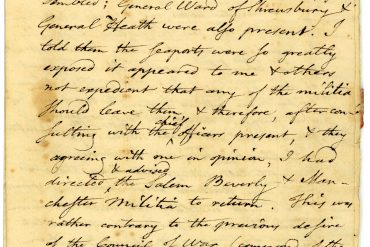
I told them the seaports were so greatly exposed it appeared to me & others not expedient that any of the militia should leave them, & therefore, after consulting with the chief officers present I had directed and advised the Salem, Beverly, and Manchester militia to return. This was rather contrary to the previous desire of the Council of War, (composed of the General & field officers above mentioned;) but afterwards it appeared that they also judged it expedient, by directing the Ipswich companies to return:
That shows us how loose Gen. Ward’s authority was. The previous day’s council of war had agreed to keep troops at the siege lines, but Pickering had already sent some of his men home.

Toward the end of his letter, Pickering wrote: “I have also just heard by a man from Boston, that Earl Percy is badly if not dangerously wounded.” That rumor was false. Lt. Col. Francis Smith had been wounded, though not badly, but Col. Percy was unhurt.

Tuesday, April 02, 2019

The American Enlightenment and the Transatlantic Cod Trade

On Thursday, 4 April, the Yale Center for British Art will host this year’s Lewis Walpole Library Lecture: “Was There an American Enlightenment?” by Caroline Winterer, Anthony P. Meier Family Professor in the Humanities and Director at the Stanford Humanities Center.

The event description:
The American Enlightenment is often viewed as a singular era bursting with new ideas as the U.S. sought to assert itself in a new republic free of the British monarchy. In this talk, Stanford historian Caroline Winterer shows how the myth and romanticization of an American Enlightenment was invented during the Cold War to calm fears of totalitarianism overseas. She’ll then look behind the 20th-century mythology, rescuing a “real” eighteenth-century American Enlightenment that is far different than the one we usually imagine.
Winterer is the author of American Enlightenments: Pursuing Happiness in the Age of Reason (Yale, 2016). Her previous books include The Mirror of Antiquity: American Women and the Classical Tradition, 1750-1900 and The Culture of Classicism: Ancient Greece and Rome in American Intellectual Life, 1780-1910. She received an American Ingenuity Award from the Smithsonian Institution for an article mapping the social network of Benjamin Franklin.

Winterer’s talk will began at 5:30 P.M. in the lecture hall of the Yale Center for British Art, 1080 Chapel Street in New Haven.

On Sunday, 7 April, the Salem Maritime National Historic Site’s visitor center will host a symposium on “Salt Cod for Silver: Yankees, Basques, and the North Shore’s Forgotten Trade.”

The program will explore the nearly two-hundred-year-long trading relationship between the New England ports of Salem, Marblehead, and Beverly and the Spanish Basque port of Bilbao.

As the event title suggests, in the years before the Revolution, shipping fish to Spain provided a major infusion of cash money for Salem and nearby ports. One of the mercantile firms handling that trade in Bilbao was Gardoqui & Sons, and during the war it turned to shipping arms back to the new U.S. of A.

The symposium participants will be:
  • Xabier Lamikiz, University of the Basque Country
  • David Hancock, University of Michigan–Ann Arbor
  • Karen Alexander, University of New Hampshire Gulf of Maine Cod Project
  • Donald C. Carleton, Jr., organizer and moderator
This symposium is presented in partnership with Historic Beverly, the Marblehead Museum, Salem State University Department of History, and Bilboko Itsasdarra Itsas Museoa (Bilbao Maritime Museum).

This free public event will be held in the Salem Visitor Center at 2 New Liberty Street from 2:00 to 4:00 P.M. Seating is limited to the first 200 people who arrive.

Tuesday, March 26, 2019

“There the people were much frightened”

Yesterday we left James Reed of the “Woburn Precinct” (Burlington) hosting about a dozen British soldiers in his house on the afternoon of 19 Apr 1775.

Some of those redcoats had given themselves up in Lexington in the morning while others had seen hard fighting on their way back from Concord. Testifying in 1825, Reed said, “Towards evening, it was thought best to remove them from my house.”

Reed’s house was probably prominent. It was located near a highway through Middlesex County. John Hancock and Samuel Adams had stopped there early that day, long enough to send back to Lexington for Lydia Hancock and Dolly Quincy before they all moved on to the parsonage where the widow Abigail Jones was ready to feed them.

But a prominent house wouldn’t have been an asset if the British military came looking for its lost men. The Massachusetts militia had defeated a force of over a thousand men with two cannon, but they knew there were thousands more soldiers, and scores more cannon, inside Boston.

Reed therefore gathered some other militiamen and moved the prisoners on:
I, with the assistance of some others, marched them to one Johnson’s in Woburn Precinct, and there kept a guard over them during the night.
There were simply too many Johnsons in Woburn to identify this one with certainty. I think the most prominent local man of that name was Josiah Johnson, a militia officer who would be elected to the Massachusetts Provincial Congress the following month. But some of his cousins might dispute that.

Reed evidently stayed at one Johnson’s house with the redcoats and his fellow guards because he stated:
The next morning, we marched them to Billerica; but the people were so alarmed, and not willing to have them left there, we then took them to Chelmsford, and there the people were much frightened; but the Committee of Safety consented to have them left, provided, that we would leave a guard. Accordingly, some of our men agreed to stay.
Having moved his charges further northwest into the Massachusetts countryside, Reed got to go home to his less-crowded house on 20 April.

The people of Billerica and Chelmsford and nearby towns probably worried about a British military attack just as much as people in Woburn. And that’s where my talk last Saturday about those P.O.W.’s intersects with that day’s other presentation, by Alexander Cain of Historical Nerdery and Untapped History.

Alex explored the “Great Ipswich Fright,” a panic on 21 April in towns along the North Shore from Beverly to Newburyport. Almost all the militiamen from those Essex County towns had gone down to the siege lines. That morning a British naval vessel appeared at the mouth of the Ipswich River. That set off a panic of people fearing that enraged redcoats would land, burn, and pillage—perhaps on their way to those prisoners that Patriot officials had insisted on holding in Chelmsford.

Wednesday, August 07, 2013

Farewell to Two Historical Gentlemen

The community of historical interpreters in Massachusetts is mourning two gentlemen who died this week.

Among other personas, Thomas Macy portrayed John Adams at many venues, often performing a two-person epistolary play with Patricia Bridgman as Abigail. For years Tom wanted to bring that Adams portrayal to Washington’s Headquarters, and as part of last month’s reenactment he was able to portray Adams’s meeting with Gen. George Washington.

Tom also wrote a short book called The Hannah and the Nautilus: The Beginning of the American Revolution at Sea, published by the Beverly Historical Society in 2002. It’s a detailed study of one of the first naval skirmishes of the Revolutionary War, which took place off Beverly’s coast in September 1775.

In Boston, Bob Jolly was one of the Freedom Trail Players for several years. He was a pioneer in portraying a little-known citizen of Revolutionary Boston rather than a celebrated name, an approach that allows visitors to consider events through the eyes of an ordinary person.

Bob’s character was Nathaniel Balch, a handsome hatter who was a close friend of Gov. John Hancock. Balch seems to have had the personality of a nightclub comic, making him a good match for Bob, who was also an actor and performer of Gilbert & Sullivan operettas.

Tom came from Nantucket, Bob from Louisiana, but both found new homes and new friends in the world of local historical interpretation.

Saturday, January 28, 2012

A House in Beverly and Its Revolutionary Owner

In Beverly, a developer has offered a 1715 house to anyone who will move it away from its present location, where the firm plans to build a drugstore. The Salem News reported that offer this month, describing the house like this:
Built in 1715, it is one of the last remaining First Period homes from Beverly’s earliest settlement. It was the home of Nathaniel Greenwood, a captain in the militia and a member of the Sons of Liberty, a group of patriots that included John Adams, John Hancock and Paul Revere.
An earlier article described the building’s history in more detail:
The wood-frame house was built by a shoemaker named Nehemiah Wood between 1715 and 1725 and was later owned by Nathaniel Greenwood, an officer in the Boston Regiment. The building was a grocery store in the early 1900s. It was bought by Johnny Appleseed’s in 1947 and became the clothing company’s headquarters.
It’s currently a real-estate office.

As for former owner Nathaniel Greenwood, the articles appear to be combining two men of that name, father and son. The son owned the house and kept an inn there for a while later in the eighteenth century. He was born in 1732, married Priscilla Snelling of Boston in 1766, and moved out of town during the war. Later he returned to Boston, established a sail-making business, and died in 1823.

The older Nathaniel Greenwood was born in 1693 and became a merchant, militia captain, town official, and Old South member. Everyone seemed to know who “Captain Greenwood” was. He died in 1780, having lived his last couple of years with his son in this Beverly house.

Much of the information about the family comes from The Greenwood Family of Norwich, England in America (1934), and I can’t confirm a lot of it. The genealogy says, “Nathaniel Greenwood belonged to the ‘North End Caucus’, the most important political club in the town at the time.” But I don’t see that name in the only surviving records of that group, published in Elbridge Goss’s Life of Col. Paul Revere.

The name of “Capt. Greenwood” is indeed on the long list of men who dined with the Sons of Liberty in August 1769. This was a large event that involved most of the prominent men in Boston. Some of those diners later became Loyalists, others Patriots.

The Greenwood family included men in both political camps. The captain’s son-in-law John Marston was a fairly prominent Whig. Yet the captain’s son Samuel Greenwood (1741-1826) joined the Sandemanian sect, which preached against rebellion, and became a Loyalist. (Interestingly, Samuel’s second wife was another Snelling. The captain had been business partner with their father.)

In the spring of 1774, Nathaniel Greenwood, Sr., signed a complimentary address to Gov. Thomas Hutchinson as he prepared to sail to England. He also signed a protest against actions of the Whig-dominated town meeting. That put the octogenarian captain into the Loyalist camp, at least that year. [ADDENDUM: In late 1773, during the tea crisis, Greenwood was one of the liaisons between the public meetings and the governor’s sons, who were tea importers.]

When the British military left Boston in 1776, Samuel Greenwood and his family sailed with them. But his brother Nathaniel stayed behind, and the old captain evidently stayed with him. They moved out of Boston, eventually settling in that house in Beverly. So saying that building was home to “a member of the Sons of Liberty” makes a complex picture too simple. But a muddle doesn’t sell buildings.

Thursday, April 21, 2011

“With two balls each time, and with well directed aim”

J. W. Hanson’s History of the Town of Danvers (1848) prints part of a speech that that veteran Gideon Foster delivered when laying the cornerstone of that town’s Revolutionary War monument (shown at right) in 1835. Foster described how his militia company had marched on 19 Apr 1775:

I was then 26 years of age. About ten days before, I had been chosen to command a company of minute-men, who were at all times to be in readiness at a moment’s warning. They were so ready. They all assembled on the very spot where we are this day assembled:—they all went; and in about four hours from the time of meeting, they travelled on foot (full half the way upon the run) sixteen miles, and saluted the enemy. This they did most effectually,—as the records of that day most clearly prove.

I discharged my musket at the enemy a number of times (I think eleven,) with two balls each time, and with well directed aim. My comrade (Mr. Cleaves of Beverly) who was then standing by my side, had his finger and ramrod cut away by a shot from the enemy.

Whether my shots took effect, I cannot say; but this I can say, if they did not, it was not for the want of determined purpose, in him who sent them.
I first took note of this passage as yet another example of someone shooting two balls at once, as likely happened at the Boston Massacre. Some folks have said it would be foolish to try to shoot two balls from a flintlock musket; all I can say is that men of the eighteenth century did it.

After the British evacuation, Dr. Edward Augustus Holyoke billed Massachusetts for treating:
Nathaniel Cleaves of Beverly
wounded in Lexington Battle
To Amputating his finger, sutures &c
To 5 dressings Do.
Holyoke’s treatment lasted from 20 April to 24 May, and cost 12 shillings.

While the Danvers men traveled on foot, Cleaves rode from Beverly. We know that because he asked to be reimbursed £12 for his lost horse, saddle, and bridle. He got £2.12s.

And speaking of Beverly, I’ll repeat the announcement that on Monday, 25 April, at 9:30 A.M., I’ll speak at that town’s library on “The Lost and Legendary Riders of April 19th.” I’m afraid that Cleaves doesn’t make the list.

Friday, April 08, 2011

“Lost & Legendary Riders” in Beverly, 25 April

We’ve entered the Patriots Day season in Massachusetts, with many events linked to the Battle of Lexington and Concord. Among them, I’m pleased to announce, will be:

The Lost and Legendary Riders of April 19th
Monday, 25 April, at 9:30 A.M.
Beverly Public Library
Beyond Paul Revere and his companions, Americans have passed along stories of other notable riders on April 19, 1775. In this illustrated lecture I’ll explore the facts and fiction behind Hezekiah Wyman, the dreaded “White Horseman”; Abel Benson and Abigail Smith, children said to have helped raise the alarm in Middlesex County; and Israel Bissell, the post rider credited with carrying news of the fight all the way to Philadelphia.

I delivered an earlier version of this talk at the Old South Meeting-House last fall. This will be my first public appearance on the North Shore. I plan to dress warmly.

For less important events, such as the annual battle reenactment involving hundreds of participants, see the Battle Road website and Boston National Historic Park’s events listing. Events at National Park Service sites could of course be affected by the House of Representatives’ government shutdown. [ADDENDUM: I hear that the Meriam's Corner Exercise scheduled for Saturday, 9 April, in Concord has been canceled due to uncertainty about the federal lands, but that the town’s Patriots Day Parade and Dawn Salute will go on.]

Since Patriots Day is the start of Massachusetts’s April school vacation, many historic sites and museums, such as the Paul Revere House, have extra programs for kids and families that week. Local sites would not be affected by problems in the federal government.

Wednesday, October 06, 2010

Birthplaces of the U.S. Navy

Last month I received a lecture announcement that begins:

What do Beverly and Marblehead, MA; Philadelphia, PA; Machias, ME; Providence, RI; and Whitehall, NY, have in common? They all claim to be the birthplace of the U.S. Navy.
Boston 1775 readers might recall that in February I gave a lecture proposing to add Cambridge, Massachusetts, to that list. While living in that town, Gen. George Washington ordered Col. John Glover to prepare armed schooners to attack British shipping. Apparently my proposal hasn’t yet come to the attention of the proper authorities.

This new lecture announcement continues:
To unravel the complicated history of the early years of the United States Navy - and perhaps at last determine who deserves this distinction - the National Archives and the USS Constitution Museum are hosting a public program on October 13, at 5:30 PM.

Using original documents from the holdings of the National Archives in Washington, DC, Archivist of the United States David S. Ferriero, a native of Beverly and a Navy veteran, and Trevor Plante, a senior archivist at the National Archives specializing in military records, will shed light on the various arguments made by each town staking the birthplace claim.

Can the controversy be settled once and for all? Come to the program and find out!
This program, “The Founding of the US Navy - Setting the Record Straight,” will be free and open to the public. It starts at 5:30 P.M. on Wednesday, 13 October, at the U.S.S. Constitution Museum in the Charlestown Navy Yard.

(Photo of Constitution above courtesy of the National Park Service.)

Saturday, February 20, 2010

“The spirit of equality which reigns through this Country”

In October 1775, muster master general Stephen Moylan went to Beverly to assist Col. John Glover in fitting out schooners with artillery and crews for the Continental Army. Back in Cambridge, the commander-in-chief’s military secretary, Joseph Reed, was impatiently waiting for word those schooners had sailed.

After Reed sent Glover a particularly harsh letter, suggesting that he was exploiting the contract, Moylan replied a week later with a list of the challenges involved:

You cannot conceive the difficulty, the trouble, and the delay there is in procuring the thousand things necessary for one of these vessels. I dare say one of them might be fitted in Philadelphia or New-York in three days, because you would know where to apply for the different articles; but here you must search all over Salem, Marblehead, Danvers, and Beverly, for every little thing that is wanting.

I must add to these, the jobbing of the carpenters, who are, to be sure, the idlest scoundrels in nature. If I could have procured others, I should have dismissed the whole gang of them last Friday—and such religious rascals are they, that we could not prevail on them to work on the Sabbath. I have stuck very close to them since, and what by scolding and crying shame for their tory-like disposition in retarding the work, I think they mend something.

There is one reason, and I think a substantial one, why a person born in the same Town or neighbourhood, should not be employed on publick affairs of this nature, in that Town or neighbourhood; it is, that the spirit of equality which reigns through this Country will make him afraid of exerting that authority necessary for the expediting his business.

He must shake every man by the hand, and desire, beg, and pray, do brother, do my friend, do such a thing; whereas a few hearty damns, from a person who did not care a damn for them, would have a much better effect, (this I know by experience,) for your future government. Indeed, I could give other reasons, but I think this sufficient.
In fact, Moylan, Glover, and their workers managed to launch four armed schooners by the end of that October. I think Reed was extraordinarily impatient because a committee of Continental Congress delegates had arrived in Cambridge, and he wanted to impress them by reporting that the schooners were already sailing.

This afternoon I’ll say more about this episode and others in my talk “Cambridge: Birthplace of the American Navy?”, at Longfellow National Historic Site.

Sunday, December 27, 2009

Revere Communion Vessels on Sale in January

The Boston Globe reports that on 21 January Christie’s will auction off a collection of silver vessels that the First Parish of Beverly decided to sell in order to pay for necessary building repairs.

The items include a ewer, a quart can, and two communion plates made by the workshop of Paul Revere around 1800.

According to the Globe:

Congregants originally used the collection for communion, but the church stopped holding regular communion services after it converted to Unitarianism in 1830. By the early 1900s, church leaders had moved the silver to a vault in a bank across the street for safekeeping. In recent years, according to Charles E. Wainwright, chairman of the church historical committee, only a few of the items were used regularly…
The congregation voted to keep a “baptismal bowl, a tankard, and a goblet”—and, of course, the church roof.

Friday, May 15, 2009

Mutiny Aboard the Tyrannicide, 17 May

Here’s an announcement from the Beverly, Massachusetts, library about a free talk scheduled for this Sunday, 17 May, at 2:00 P.M.:

In November of 1776, Captain John Fisk of the brigantine Tyrannicide set sail from Salem in search of British merchantmen. Crewed, in part, by local Beverly, Gloucester and Salem men, the events of this voyage were lost in the mists of time until speaker Dennis Ahern started reading the logbook of their voyage. This is the story of that voyage, the story of a mutiny on board one of America’s first commissioned warships.
The Tyrannicide was actually commissioned by Massachusetts, as part of the state’s own navy. There’s a little of this story in Paul A. Gilje’s article “The Meaning of Freedom for Waterfront Workers” in Devising Liberty: Preserving and Creating Freedom in the New American Republic.

Thursday, February 12, 2009

Nelson on Washington’s Navy in Boston, 18 Feb

Last year James L. Nelson of Maine published George Washington’s Secret Navy: How the American Revolution Went to Sea, which offers a detailed account of the first American navy, launched shortly before independence.

After overseeing the siege of Boston for a few months, Gen. George Washington realized that, although the provincial troops had trapped nearly the entire British army in North America inside Boston, they’d also left the back door open. The Royal Navy had the run of the seas to the east, so its ships were bringing in food, firewood, ordnance, and other necessary supplies.

The Continental Congress hadn’t authorized the creation of an American navy, which would be a big financial undertaking. Some New England states were licensing privateers—basically, privatized warships. Washington took a further step by authorizing Col. John Glover of Marblehead to take his soldiers, many of them experienced fishermen and sailors, and launch ships out of Beverly to hinder Britain’s supply effort. Only afterwards did Washington ask Congress to authorize this.

Nelson will speak about this story on Wednesday, 18 February, at 6:00 P.M. at the invitation of the Shirley-Eustis House Association, dedicated to preserving Gov. William Shirley’s mansion in Roxbury. The Massachusetts Society of the Cincinnati is supporting this event as well. It will take place at the William Hickling Prescott House at 55 Beacon Street in Boston, local headquarters of the National Society of The Colonial Dames of America. R.S.V.P. to the Shirley-Eustis House.

Friday, January 25, 2008

Capt. Moses Brown and the Beverly Company

Boston 1775 reader Tom Macy sent a link to his handy online edition of the orderly book of Capt. Moses Brown of Beverly from January to May 1776. Brown’s company was part of the 14th Continental Regiment, stationed in Beverly to guard the first American privateers’ wharfs, supplies, and captured vessels.

Here’s what the regiment’s commander, Col. John Glover (shown here), issued as general orders on this date in 1776:

It is Coll’s Orders that the Captains see that the Soldiers under their Command be disciplined [i.e., trained] twice a day at least, and that they keep their Arms clean and fit for Use, also to divide them into Messes of Six Men each, and to visit their Barracks three times a week & order them to be swept clean, and that the Soldiers keep themselves Neat & Clean, shave once a Week at least – as their Health & Reputation much depends on this, it’s expected this Order is punctually obeyed.

And it is further ordered and directed that the Non-Commissnd Officers & Soldiers attend divine Service at the house of publick Worship, and that no one will presume to go to the house of God in an indecent rude or disorderly manner, or behave so while their, on penalty of being punished therefore agreeable to the Nature of his Offence, and in order to encourage and stimulate the Soldiers, Commissioned Officers will set the Example by going themselves.
Macy’s annotations explain the location of the barracks, the nearest meeting-house, and the local ministers who were paid as chaplains. He also wisely writes, “There must be a good story behind the order that no one should behave ‘in an indecent rude or disorderly manner’ at church.” Almost every time someone writes a rule against certain behavior, we can assume that someone else has been behaving in just that way. Likewise, some officers had probably not been setting the example the colonel wanted.

The website also includes Brown’s breakdown of his company by age, height, home town, and whether they brought their own muskets. Almost all these soldiers came from Beverly, so they were serving in their home town. One, Esop Hales, was African-American, confirming that Glover’s regiment was integrated.

Capt. Brown’s orderly book is on display with his sword at the Beverly Historical Society.