J. L. BELL is a Massachusetts writer who specializes in (among other things) the start of the American Revolution in and around Boston. He is particularly interested in the experiences of children in 1765-75. He has published scholarly papers and popular articles for both children and adults. He was consultant for an episode of History Detectives, and contributed to a display at Minute Man National Historic Park.

Subscribe thru Follow.it


•••••••••••••••••


Showing posts with label Thomas Machin. Show all posts

Friday, April 12, 2024

Thomas Machin on the Firing at Lexington

On 9 August 1775, Jedediah Preble (1707–1784, shown here) was visiting Cambridge.

A veteran of the wars against the French, he had been the Massachusetts Provincial Congress’s first choice to command its forces back in October 1774, but turned down the job on account of his age and health.

During that visit Preble wrote in his diary: “This morning met with a man that deserted from the regulars this day fortnight, as sensible and intelligent a fellow as I ever met with.”

A fortnight, or fourteen days, before was 27 July. There was one man who deserted from Boston around that date, remained with the Continentals, and was praised for his intelligence by men on both sides: Thomas Machin, captain in the American artillery from 1776. So I believe Preble recorded the former private Machin’s observations on the start of the war.

Preble wrote:
He was at Lexington fight. He says he came out with Lord Percy, and that he asked a young fellow of his acquaintance who fired first.

The soldiers when they first came where the Provincials were, one of them flasht his piece, on which a regular officer fired and swung his gun over his head, and then there was a general fire. They had 75 killed and missing, 233 wounded.
Alas, the antecedent for “one of them” is ambiguous: “soldiers” or “Provincials”?

Machin’s informant certainly blamed some “regular officer” for aggravating the situation. On the other hand, this version of events doesn’t have Maj. John Pitcairn or other officers ordering the redcoats to fire, which became the official provincial line soon after the battle.

There are further considerations. Machin’s information was secondhand, and he may have felt pressure to tell Americans what he thought they wanted to hear. Nonetheless, these comments ring true as a British enlisted man’s perspective: What did officers expect their soldiers to do when one of them was firing his gun and waving it around?

Preble went on:
He was also at Bunker’s Hill, where there was killed and died of their wounds 700, and 357 wounded that recovered. He took the account from Gen’l Robinson [actually James Robertson]. He says before he came out there died eight men of a-day, one day with another, and that they could not muster more than 6000 men.
Again, we know from Gen. George Washington’s files that Machin had brought out those casualty figures, as well as drawings of the British fortifications. He must have planned his desertion carefully.

Friday, November 18, 2016

Thomas Machin “employed in ye. Colony service”

I left off yesterday with Gen. George Washington asking the Massachusetts government to release Lt. Thomas Machin from his project surveying a canal through Cape Cod and join the Continental Army around New York. Washington needed engineers to build fortifications.

On 10 June, Washington’s military secretary Robert Hanson Harrison told Gen. Artemas Ward:
I am commanded by his Excy to request you to send immediately to this place Lt Machin of the Train, provided, he does not belong to either of the Artilly Companies, in Boston—If he does not, he will come with all possible dispatch
A week later, Ward wrote back to the commander-in-chief: “Last evening I received Major Harrison’s Letter of the tenth Instant, and agreeable [to] your desire have directed Lieut. Machin to be ready as soon as possible to set out for New York.”

But “as soon as possible” appears to have meant different things to different people. Massachusetts still wanted that canal, which would make shipping from Boston to the southern states quicker and safer. Evidently Machin continued to work on the project. On 19 June the head of the Massachusetts Council, James Bowdoin (shown above), wrote to him at Nantasket, or Hull:
I informed the committee that you could go to Sandwich on the survey if it could be taken this week; in consequence of which, we agreed that you might set out as soon as is thought proper, and begin the survey, and that we would follow, and be there next Tuesday. I beg you would let me see you to-morrow evening, that the committee may hear what to depend on.
He also provided a pass: “Lieut. Machin, the bearer hereof, being employed in ye. Colony service, it is desired he may pass from hence to Sandwich and back without interruption.” That was dated “Boston, June 20, 1776.”

But Massachusetts couldn’t keep Machin much longer. A month later, on 21 July, he was in New York City, Gen. Washington sent him up the Hudson River, telling a secret committee of the state government:
Mr Machine a Lieut. in the Train, who has just returned from overseeing the Works at Boston, he is as proper a person as any I can send, being an ingenious faithfull hand, And One that has had considerable experience as an Engineer
Washington’s orders for Machin were:
You are without delay to proceed for Fort Montgomery, or Constitution in the High Lands on Hudsons River, and put yourself under command of Colo. George [actually James] Clinton or the Commanding Officer there, to Act as Engineer in compleating such Works as are already laid out, and such others as you, with the advice of Colo. Clinton may think Necessary—’tis expected and required of You—that you pay strict and close Attention to this Business—and drive on the Works with all possible Dispatch, In Case of an Attack from the Enemy, or in any Action with them you are to join and act with the Artillery on that Station, and to return to your Duty in the Regiment as soon as you can be spared from the Works
That was the beginning of Machin’s long service fortifying and protecting the upper Hudson against British ships, which included his most storied feat: building a chain of barriers across the river at West Point.

Machin had left something behind in Massachusetts, however. On 10 Aug 1778 Dr. Nathaniel Freeman wrote to Machin from Sandwich: “Your chest of books and instruments are safe here, and ready to be delivered to your order at any time…”

As for Massachusetts’s big engineering project, Freeman wrote, “Our report respecting the channel was seasonably made and in favor of it, but nothing done.” The Cape Cod Canal wasn’t completed until the early twentieth century.

Thursday, November 17, 2016

Lt. Machin and the Cape Cod Canal

On Saturday I’m going to Sandwich to speak to the Cape Cod Sons of the American Revolution about The Road to Concord. So I decided to look for something interesting about Revolutionary Sandwich.

That led me back to one of my favorite characters from the siege of Boston: Thomas Machin. As I’ve written, Machin came to the town in 1774 as a private in His Majesty’s 23rd Regiment of Foot.

Machin left town on the night of 26 July 1775, “when sentry on the fire boat in the river near the neck.” He took his fellow regular’s musket while he slept, got into a canoe, and headed for the American lines.

In Cambridge, Machin was debriefed by Gen. George Washington himself. He then helped John Trumbull sketch the British fortifications; when he defected, two British officers wrote in their diaries that he knew something about that topic. Machin then probably worked in quartermaster Thomas Mifflin’s department. In January 1776, he was commissioned a second lieutenant in the Continental Artillery—one of the American army’s few engineers.

After the siege, Washington ordered Machin to stay in the Boston area to help fortify the harbor against any new British attack. But in May the Massachusetts legislature got a new idea:
It is represented to this Court that a navigable canal may without much difficulty be cut through the isthmus which separates Buzzards Bay and Barnstable Bay, whereby the Hazardous Navigation round Cape Cod, both on account of the shoals and enemy, may be prevented, and a safe communication between this colony and the southern colonies be so far secured
The notion of a canal through Cape Cod had been around for decades. With the Royal Navy lurking out in the Atlantic, this seemed like an excellent time to push it through.

People understood that Machin had experience digging canals. According to family tradition set down in the mid-1800s, he had worked for the British canal engineer James Brindley. Indeed, Brindley was active in the part of central England where Machin reportedly hailed from. However, that family tradition is suspect, creating a fictional past for the man instead of identifying him as a deserter.

Whatever his background, Lt. Machin went to work surveying the canal route and making other plans. But on 10 June 1776, Gen. Washington wrote to James Bowdoin, senior member of the Massachusetts Council:
I am hopeful that you applied to General [Artemas] Ward, and have received all the Assistance that Mr Machin could give in determining upon the practacability of cutting a Canal, between Barnstable & Buzzards Bay ’ere this, as the great demand we have for Engineer’s in this Department [i.e., New York], Canada, &ca, has obliged me to order Mr Machin hither to assist in that branch of business.
Just as the canal construction might be starting that summer, the engineer was called back to the army.

TOMORROW: Can this project be saved?

Sunday, March 10, 2013

The Truth about Thomas Machin

I’ve been discussing the early life of Thomas Machin, commissioned a lieutenant in the Continental Army artillery on 18 Jan 1776. But what had he been doing before then?

His family left an account that had Machin born to a distinguished British scientist, working for a duke, coming to America in 1772, and quickly joining the movement that led to independence. But there’s no evidence for any of that, and strong evidence against it.

And then there’s this 27 July 1775 entry from the journal of Lt. Richard Williams of His Majesty’s 23rd Regiment of Foot:
Last night Thos. Machin, soldier in our Regt. deserted when sentry on the fire boat in the river near the neck. he went off in the Canoe go to this float, he took the other man’s firelock with him, as it was that man’s turn to lay down, this fellow will give them good intelligence of our Works, for he was a pretty good Mechenik & knew a little of fortification. he invented a new carriage for guns on a pivot &c. his books & instruments were sent for to the General’s.
Lt. Col. Stephen Kemble also noted the desertion that night of a man from the 23rd, “a sensible intelligent fellow, some knowledge of fortification and Gunnery.”

The 23rd Regiment’s muster rolls record that Thomas Machin had enlisted in Maj. Harry Blunt’s company on 17 Feb 1773 and sailed to New York that spring. The regiment arrived in Boston in August 1774. Machin was thus in the army during the Battle of Bunker Hill—but in the British army.

Several people on the American side noted Machin’s arrival, though most didn’t record his name. Col. William T. Miller of Rhode Island wrote on 29 July that “it is thought [he] will prove a very serviceable man to our army, as he is able to give a plan of all the works and fortifications in Boston, and knows all their plans.” The old veteran Jedidiah Preble said he was “as sensible intelligent a fellow as I ever met with.”

Most important, Gen. George Washington wrote down “An Acct. of the Killed & Wounded in the Ministerial Army” based on a conversation with a man he recorded as “John Machin.” The commander-in-chief assigned the deserter to work with his young aide-de-camp, John Trumbull, to draw plans of the British fortifications. (One product of their collaboration appears above.) Later Machin worked for quartermaster general Thomas Mifflin and was most likely a scout during an 8 Jan 1776 raid on British positions at Charlestown.

Machin’s entry in American National Biography says nothing about that activity, accepting the family story of a genteel life in England and a respectable arrival in America. But Machin was a British army private, a deserter, and part of “Washington’s First Spy Ring” during the siege of Boston. I’ll divulge more secrets of the general’s early intelligence efforts this afternoon in Lincoln at an event sponsored by the Friends of Minute Man National Park.

(Thanks to Bob Vogler for posting the quote from Lt. Williams’s diary above to the Revlist in 2002. That sent me hunting for the elusive Thomas Machin.)

Saturday, March 09, 2013

The Holes in Thomas Machin’s Biography

Yesterday I quoted the biography of Thomas Machin, military engineer for the Continental Army, as it was published in 1845. It linked the man by blood to one of England’s most prominent mathematicians, by employment to one of England’s finest engineers and a duke, and by history to a famous British military victory fought when Machin was just fifteen years old.

Despite such prominence, the details of that life are impossible to confirm. Sometimes the information is just too vague. For example, “He was born March 20th, 1744, O. S., four miles from Wolverhampton, Staffordshire, England.” I’ve looked at birth records from parishes that fit the description and haven’t found Machin’s name, but of course I might have missed the right register.

As for Machin’s father being “John Machin, a distinguished mathematician,” I can rule that out. John Machin (1686?-1751, shown above) was the most distinguished man in eighteenth-century England with that surname. He was secretary of the Royal Society from 1718 to 1748 and professor of astronomy at Gresham College.

Gresham College is in London. Prof. Machin had no connection to Wolverhampton, more than a hundred miles away. He never married, and the Oxford Dictionary of National Biography says that when he died “his only relative was a second cousin, Mary Tasker.”

The biography says Thomas Machin’s first military experience was in “a corps of English cadets,…or fencibles, as called,” in the Battle of Minden in 1759. “Fencibles” meant militia troops raised to defend the British homeland, so they didn’t fight in Germany.

Was Machin clerk to James Brindley (1716-1772), the canal engineer? In the mid-nineteenth century, legend had it that Brindley was “practically illiterate” and kept no records, which would have made it impossible to test that statement. Now we know that some of Brindley’s records did survive, but without specific dates it’s hard to know where to look.

The biography says Machin arrived in America in 1772 and was “one of the celebrated Boston tea party of 1773.” That was a secret, risky operation, and it’s extremely unlikely that the Boston radicals would have shared their plans with a new arrival from England. I haven’t spotted Machin’s name in any of the records of pre-Revolutionary Boston, particularly those of political activity.

The capsule biography goes on to say that Machin “was engaged and wounded (in one arm) in the conflict on Bunker’s hill, while acting as lieutenant of artillery.” But Thomas J. Abernathy’s study of Col. Richard Gridley’s artillery regiment in 1775 says that Machin’s name doesn’t appear on its records until his commission as a second lieutenant in January 1776.

TOMORROW: Which is not to say Machin wasn’t in the army during that battle.

Friday, March 08, 2013

The Early Life of Thomas Machin

After the Revolutionary War, Capt. Thomas Machin of the Continental artillery settled in upstate New York, built mills, and raised a family. In his 1845 History of Schoharie County, Jeptha R. Simms (shown here, courtesy of Three Rivers) devoted a great deal of space to Machin, based on documents surviving from the war and afterward and family recollections.

Here’s how Simms described Machin’s pre-war career:
He was born March 20th, 1744, O. S., four miles from Wolverhampton, Staffordshire, England. His father, John Machin, a distinguished mathematician, had two sons, John and Thomas. The former was killed at the siege of some town near the outlet of the Red Sea; and the later was one of a corps of English cadets, which, with the British infantry became so distinguished for their bravery in the battle of Minden, Germany. The cadets, or fencibles, as called, were almost annihilated in that battle, which took place between the allied army under Ferdinand and the French, in August, 1759.

The Duke of Bridgewater, who may justly be styled the father of the canal navigation of Great Britain, projected at his own expense a canal from the coal measures on his lands in the town of Worsley to Manchester, a distance of some ten miles; obtaining his first act for the same at the session of parliament for the winter of 1758 and 59. A few years after he obtained an act for carrying a branch of it to Liverpool, nearly thirty miles. . . .

Those great works which were looked upon at their commencement by the incredulous as wholly impracticable, were prosecuted to completion under the direction of the celebrated engineer and mechanical inventor, James Brindley. Soon after Brindley began those works, Thomas Machin entered his employ; and it is not surprising that under such a tutor, he, too, should have become a good practical engineer. He was engaged in taking the levels for the Duke’s canal; and as clerk paid off many of the laborers employed by Brindley.

After making a voyage to the East Indies, Machin sailed for America, and arriving in 1772, took up his residence in the city of New York. The principal object of his voyage was to examine a copper mine in New Jersey.

After a short stay in New York, he went to reside in Boston, and evidently intended a permanent residence; as he warmly espoused the cause of the Bostonians against his “father land.” He was one of the celebrated Boston tea party of 1773. He was engaged and wounded (in one arm) in the conflict on Bunker’s hill, while acting as lieutenant of artillery.
That biography is the basis for Machin’s inclusion in many lists of Tea Party participants and Bunker Hill veterans. It’s the source of the information about his background in American National Biography and other reference books.

In every point it’s either false, misleading, or unverifiable.

TOMORROW: What’s wrong with this biography.

Thursday, March 07, 2013

“Washington’s First Spy Ring” Talk in Lincoln, 10 Mar.

On Sunday, 10 March, I’ll speak to the Friends of Minute Man National Park on “Washington’s First Spy Ring”:

One of the biggest challenges that Gen. George Washington faced when he became Continental Army commander-in-chief was gathering intelligence on the British military in Boston. This talk reveals secrets and names the names.
I’m scheduled to start at 3:00 P.M. at Bemis Hall, 15 Bedford Road in Lincoln. Thanks to the Friends, this lecture is free and open to the public.

At left is a French map of the Hudson River near West Point, New York. The Continental Army fortified this narrow point in the river to keep the Royal Navy from sailing up the Hudson to reach Lake George and Lake Champlain, thus potentially cutting New England off from the rest of the U.S. of A.

In addition to the forts on either side of the Hudson, the Americans built a barrier across it, designated on the map by the line to the right of the “ou.”

That was the Great Hudson River Chain, actually a pair of booms floating on the water, one of sharpened logs roped together and one of rafts supporting and held together by giant iron links. Any British ship trying to sail upriver would have to turn at that spot and try to break through the barriers, all under fire from both sides. From 1778 to the end of the war, no ship ever tried.

What does the defense of the Hudson River have to do with my talk this weekend? The military engineer in charge of designing, manufacturing, assembling, and maintaining that chain was Capt. Thomas Machin. He was part of Washington’s first spy ring outside Boston in July 1775, but that fact has been kept secret until now.

TOMORROW: Thomas Machin’s background.

Friday, December 28, 2012

The Voices of British Soldiers

Folks might recognize Don Hagist’s name from the British Soldiers, American Revolution blog. He digs out details about the enlisted men who were part of the British government’s effort to hold onto those thirteen rebellious North American colonies. His research can turn some faceless redcoats into individual people.

Often that task involves paging through muster rolls, pension grants, court-martial records, and other British military documents now stored at the National Archives at Kew. Unfortunately, there’s no British equivalent to the American pension application system, which (in lieu of systematic record-keeping during the war) required veterans to provide detailed narratives of their service. That means most British soldiers are preserved as names on a few documents without a line connecting those dots.

A few redcoats left detailed personal narratives. One of Don’s earlier books was an edition of Sgt. Roger Lamb’s postwar writing that collected all his first-hand military experiences in one volume. Don’s new book, British Soldiers, American War: Voices of the American Revolution, reprints nine shorter narratives of service in the king’s army (as well as the samples of the work of two military poets, including John Hawthorn). The narratives include the information taken down by the pension office, a letter written during the war to a potential patron, a convict’s dying words, and several published memoirs.

In each case, Don has checked and filled out the soldier’s own account with contemporaneous documentation, where available. Thus, the book includes the autobiographical “Dying Speech” of Pvt. Valentine Duckett, executed for desertion on Boston Common in 1774, and the record of his court-martial. Another court-martial fills out the story of Pvt. Thomas Watson, who survived to settle in Bolton, Massachusetts.

In some chapters Don describes other British soldiers whose careers parallel the main subject. For example, chapter 9, “The Aspiring Soldier,” is about William Burke of the 45th Regiment, who deserted to the Americans for more social and economic opportunity. That chapter also mentions Pvt. Thomas Machin of the 23rd, who did the same in July 1775 and eventually became Capt. Thomas Machin of the Continental Artillery. (I also discuss Machin in the big Washington study.)

You’ve probably spotted a significant pattern in these narratives: most of the memoirists ended up becoming American. Of the nine men profiled in the book, only two retired from the British army in good standing. Six deserted to the Americans or, in the case of Ebenezer Fox of Roxbury, deserted back to the Americans. Their recollections got published because in America those men became honored relics of our War for Independence.

British society simply wasn’t that eager to read the experiences of enlisted men. That may have been due to how societies don’t like to be reminded of wars they lose. But I think it reflects the aristocratic values of Georgian Britain. We see the pattern already right after the Battle of Lexington and Concord. The Massachusetts authorities published broadsides naming all the local men killed and wounded, regardless of rank. Gen. Thomas Gage sent home reports listing the officers killed but not the enlisted men. (Granted, that would have been a much longer list.) American culture valued ordinary individuals more.

Given the social stratification in Britain, it’s no surprise that several of these redcoats saw more opportunity on the other side of the conflict. One chapter of British Soldiers, American War documents how the army encouraged soldiers to learn to read and write, valuable skills in any large organization. But even an educated enlisted man was very unlikely to rise above sergeant.

As memoirists and as defectors, most of the men who left behind recollections for British Soldiers, American War were atypical. But of course all memoirists are atypical (at least until this era of self-publishing). And these men offer a rare peek into the daily lives of British recruits. Alongside Don’s research on recruitment patterns, demographic data, &c., the book is a top-notch source on the king’s soldiers during the Revolutionary War, “ordinary” men caught up in historical change.

British Soldiers, American War is handsomely designed (though, reflecting what Georgian artists were commissioned to paint, the cover art shows British officers instead of enlisted men). The profiles include images of some of their documentary sources. Eric H. Schnitzer’s drawings and detailed captions discuss the soldiers’ likely garments, which should increase the value of the book for reenactors. Thorough notes and index round out a fine volume.

Sunday, January 29, 2012

My “Marital Infidelity and Espionage” at the M.H.S., 7 February

On Tuesday, 7 February, the Boston Area Early American History Seminar will meet at the Massachusetts Historical Society to discuss my paper “Marital Infidelity and Espionage in the Siege of Boston.”

The description:
This paper will examine patterns in the popular linkage between marital and political infidelities over a range of espionage cases from the start of the Revolutionary War. Drawing on new findings about such spies as Dr. Benjamin Church, Benjamin Thompson, and the Rev. John Carnes, it will address the topic from multiple perspectives, including actual cases, the use of marital disloyalty as a metaphor for political disloyalty, and how stories of family splits were hidden, preserved, or retold.

Each side of the political conflict tried to portray the other’s leaders, up to and including Thomas Gage and George Washington, as unfaithful husbands. Betrayal in the home, such reports suggested, led to betrayal of the public. Some men involved in espionage did indeed make a habit of extramarital affairs, but others appear to have undertaken their risky ventures to support their wives and children. Both at the time and in later generations, Americans have been selective about which family splits they recorded, and thus which side’s agents appeared most treacherous.
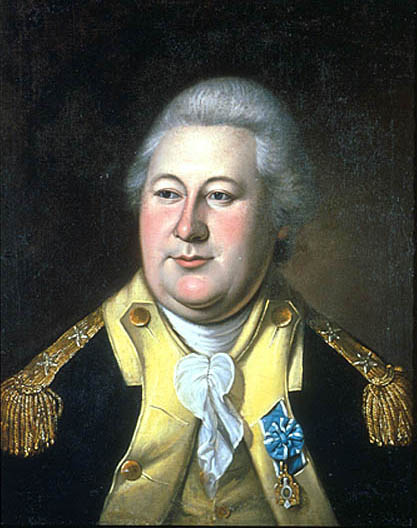
In addition to the names dropped above, the paper discusses Henry Knox (shown above) and his in-laws and the shadowy past of the American artillerist Thomas Machin. And in the final version I focused just on people secretly providing intelligence for the American side, so Benjamin Thompson, always a slippery fellow, escaped into a footnote.

As usual in this seminar series, the paper will be available at the M.H.S. for reading in advance. The seminar begins at 5:15 P.M. with Prof. Robert Allison of Suffolk University commenting on my draft. Then there will be a more general discussion with everyone invited to participate, followed by sandwiches. The society asks people to email if you plan to attend so they know approximately how many sandwich fixings to put out. I look forward to chatting with folks there!

Tuesday, May 12, 2009

Individuals to Follow through the Revolution?

Yesterday Ray Raphael described a challenge he set for himself: find a bunch of individuals to follow through the Revolution whose stories could also tell the story of the founding of the U.S. of A. He chose seven people. As a proud owner of a copy of the resulting book, Founders, I can’t fault those choices. But just for fun, I can second-guess them.

Ray wrote that George Washington is virtually a given. So naturally, to be perverse, I have to question that conclusion. Henry Knox (shown here, later in life) spent nearly the whole war at Washington’s side, so it would be possible to follow the Continental Army’s top command through his eyes rather than through the commander’s. And Knox would bring some further advantages:

  • He was present at the Boston Massacre and may have been a crucial informer for Paul Revere just before the war.
  • After Washington’s first farewell in 1783, Knox became Secretary of War for the Confederation while the commander went home to Mount Vernon.
  • Knox’s alarmist letter to Washington about Shays’ rebellion convinced the older man to throw his prestige behind a movement for a new constitution.
  • Knox served as Secretary of War again under President Washington.
  • Knox’s personal story from fatherless apprentice bookseller to general, large landowner in Maine, and founder of the Society of the Cincinnati exemplifies the social mobility possible in the Revolution.
Following Nathanael Greene offers some of the same possibilities: involvement in prewar conflicts (Greene was probably involved in the Gaspee incident of 1772) and social mobility. In addition, his handling of the Continental forces in the southern states was crucial to the end of the war. Greene’s support for black soldiers is interesting, as is his turn to being a southerner with his own slave-labor plantation.

Such a book would need to follow someone deeply involved in running the American government—i.e., the Continental Congress—during and shortly after the war. My perverse suggestion for that figure is James Lovell. Son and assistant of the Loyalist master of Boston’s South Latin School, he was a Whig politics newspaper essayist and orator. The British military arrested him as a spy in 1775 after officers found his letters on Dr. Joseph Warren’s body. He was reportedly taken to Halifax in chains.

After James Lovell was exchanged and returned to Massachusetts, the state elected him to the Congress. He supported Gen. Horatio Gates over Washington in 1777, and wound up virtually running American foreign policy and intelligence efforts since no one else wanted those responsibilities so badly. His father and siblings were in exile, and his illegitimate son was in the Continental Army. For added interest, in Philadelphia he reportedly roomed in a brothel while his wife and children were back home in Boston. On the down side, Lovell’s a hard man to understand—John Adams reportedly paced the floor in Holland, trying to figure out what his official instructions meant—and to sympathize with.

Another potentially exemplary character is Thomas Machin, a British veteran who ended up as a captain in the American engineering corps. He oversaw the effort to build a chain of obstacles across the Hudson River to prevent the Royal Navy from sailing too far north—a major industrial undertaking in a sparsely settled area. Later Machin was one of the artillery officers who accompanied Gen. John Sullivan on an expedition against the Crown’s Native American allies in upper New York. And, as a kicker, the standard story of Machin before joining the Continental Army in 1776 is a lie; this immigrant (or his descendants) reinvented his life in the New World.

For a southern perspective, I might consider John Laurens: son of a bigwig in Congress, young Continental Army officer, proponent of emancipation, prisoner of war, diplomat, and army officer again. Regardless of what far one concludes that Laurens went with Alexander Hamilton, the close relationship of those two young men shows how military service shaped them.

A book like this needs at least one female figure. Since most women, even those who became involved in political causes, stuck close to their homes, I’d look for candidates in the Middle and Southern states where most of the fighting was. Those women saw the most of, and suffered the most from, the war.

One possibility would be Esther Reed of Pennsylvania: wife of a Continental Congress delegate, military officer, and governor. In 1777 she had to flee from her home. Three years later she organized an effort to support the army, struggling against both wartime shortages and Washington’s expectations for women.

Another candidate is Annis Boudinot Stockton of New Jersey, who became a refugee in 1776. She wrote some political poetry, and had a close-up look at developments in the government through her brother, Elias Boudinot; son-in-law, Dr. Benjamin Rush; and husband, Richard Stockton. Unfortunately, little of her writing is very personal.

And of course a book like this needs to reflect the American enlisted man’s experience. One possibility would be to stitch together three or four people’s accounts of serving in the ranks, both to cover the waterfront and to emphasize how the army was composed of many men working together rather than individuals standing out on their own. (Yes, that goes against the very idea of focusing on individuals that Ray set out to try.)

Among the soldiers who left enough personal material to follow might be fifer and private John Greenwood, privateer sailor and prisoner of war Ebenezer Fox, and soldier’s wife and camp helper Sarah Osborn. Adding dragoon Boyrereau Brinch to that mix would mean bringing in the rarely documented African-American soldier’s experience.

Folks might notice that a lot of my choices lean toward people from greater Boston, simply because I know that region best. In addition, my list leaves out some really obvious candidates. I didn’t pick any of the people Ray Raphael followed in Founders, even if they’d be my first choices as well—which is a good clue to the names he actually picked.