J. L. BELL is a Massachusetts writer who specializes in (among other things) the start of the American Revolution in and around Boston. He is particularly interested in the experiences of children in 1765-75. He has published scholarly papers and popular articles for both children and adults. He was consultant for an episode of History Detectives, and contributed to a display at Minute Man National Historic Park.

Subscribe thru Follow.it


•••••••••••••••••


Showing posts with label Onesimus Mather. Show all posts

Saturday, May 16, 2026

“To Vax or Not to Vax” walking tour in Boston, 17 May

On Sunday, 17 May, the Partnership of Historic Bostons is offering a walking tour titled “To Vax or Not to Vax: Smallpox in Early Boston.”
The organization says:
The subject of our newly revised walking tour is smallpox, one of the great killers of the 17th century. This European disease found fertile ground in the growing colonies in New England, with the most devastating effects suffered by Native Americans who had no immunity. Up to 90% of the Massachusett Tribe, whose land included Boston and Charlestown, perished, their villages lying empty and providing English colonists with unoccupied land for reasons that Puritans saw as providential.

English colonists had some immunity but, even so, successive generations suffered wave after wave of deadly smallpox outbreaks. . . .

During the tour, we will investigate how the colonists saw smallpox and tried to contain it, and how smallpox roiled their society in a number of ways. Had God handed the Shawmut peninsula over to them by clearing out the Native population, or was he punishing them with the same pestilence for not sufficiently following His word? Could smallpox be successfully treated by medical methods practiced since the time of the Romans, or would new, more radical methods (some employed by Africans, including Cotton Mather’s enslaved African Onesimus, and Turks) prove more effective?
This tour is led by Michael Prochilo. It will start outside of Park Street Station at 2:30 P.M. and is scheduled to last 90 ninety minutes. Because of construction projects, the route is not wheelchair-friendly. Participants are reminded to bring water [Sunday might bring our first 80°F. days this year] and wear comfortable shoes.

Friday, September 15, 2023

“Argumentive dialogue concerning inoculation”

The Telltale essays by Harvard College students in Ebenezer Turell’s notebook come to a stop on 1 Nov 1721.

In the preceding month, 411 people in Boston had died of smallpox. The epidemic had been spreading and killing since April.

People at Harvard were contracting the disease, including the maid of undergraduate Samuel Mather (1706–1785).

Samuel’s father, the Rev. Cotton Mather, had heard about inoculation against smallpox from his enslaved servant Onesimus and then from reading accounts of the procedure in Turkey. He urged Dr. Zabdiel Boylston to try this approach infecting people with a mild case of the disease in hopes of immunizing them for life.

In June 1721, Boylston inoculated his young son, an enslaved man, and that man’s son. When they didn’t die, he and Mather went public. Boston’s selectmen told him to stop. Boylston didn’t, inoculating young Samuel Mather among others.

Dr. William Douglass opposed inoculation with his pen and his authority as a Scottish-educated physician. The Rev. Benjamin Colman (shown above) supported Boylston and Mather with his Narrative of the Method and Success of Inoculating the Small-pox in New England. Other doctors and ministers divided on the question.

In that atmosphere, around the start of November Ebenezer Turell opened his Telltale notebook from the other end and wrote out a fourteen-page “Argumentive dialogue concerning inoculation between Dr. Hurry and Mr. Waitfort.” Dr. Hurry was, of course, eager for the new procedure, and Mr. Waitfort was still hanging back.

The dialogue consisted of exchanges like this one:
W[aitfort:…] He that bring sickness upon himself Voluntarily Breaks one of the divine Commandment (the 6th)…

H[urry:] I never heard yt the Bringing Sickness upon our selves was a Breach of ye Divine Law Absolutly for by vomitting Purging letting of Blood &c We make our selves sick and that voluntarily too
In the end Dr. Hurry prevailed. The essay concluded with this verse:
Theres none but Cowards fear ye Launce,
Heroes receive ye Wound
With rapturous joy they Skip & Dance,
While others hugg ye Ground.
According to Dr. Boylston’s published account, on 23 November he “inoculated Mr. Ebenezer Pemberton, and Mr. John Lowel, each about 18.” Both those young men were in Turell’s college class and in his circle. (Indeed, I suspect this John Lowell was the student he started the Telltale with.)

The next day, he administered the procedure to a Harvard professor, a tutor, and seven students, including “Mr. Ebenezer Turil.”

Turell went back into his notebook and added that his “Argumentive dialogue” was “Compos’d about three weeks before I was inoculated.”

TOMORROW: Ebenezer Turell’s Society.

Tuesday, September 27, 2022

Revere House‘s Fall Lowell Lecture Series

The Paul Revere House’s annual Fall Lowell Lecture Series starts tonight, with the talks available for free both in-person and online.

The theme for this year’s series is “Beyond the 13: The American Revolutionary Era Outside the Emerging United States,” and the speakers will focus on “areas that have not traditionally received much attention in explorations of the American Revolutionary period.” Here’s the lineup:

Tuesday, 27 September, 6:30–7:45 P.M.
“‘To Begin the World over Again’: Revolutionary Rights”
Janet Polasky, Presidential Professor of History at the University of New Hampshire, explores how American claims to Revolutionary rights have reverberated throughout the Atlantic world and influenced our understanding of liberty and equality from the eighteenth century to the present.

Tuesday, 11 October, 6:30–7:45 P.M.
“The Other Fourth of July: The American War of Independence in the Southern Caribbean”
Tessa Murphy, Associate Professor of History at Syracuse University, considers what the American Revolution meant to British colonial subjects in some lesser-studied parts of the Americas. Indigenous, enslaved, and free people all seized the opportunity to ally with Great Britain’s chief rival, France, and many used this moment of disruption to seek freedom, sovereignty, or autonomy.

Tuesday, 25 October, 6:30–7:45 P.M.
“Slavery and Smallpox Inoculation”
Elise A. Mitchell, Presidential Postdoctoral Research Fellow at Princeton University, looks at the rich African Atlantic history of smallpox inoculation. Her lecture contextualizes the more familiar history of Onesimus and Cotton Mather in early eighteenth-century Boston within the broader history of Africans performing inoculations in West Africa, Jamaica, and Saint Domingue (Haiti) in the Revolutionary Era.

All these talks will be held in the Commons of Sargent Hall, Suffolk University, at 120 Tremont Street. They will also be streamed and recorded for later viewing via GBH’s Forum Network.

The Paul Revere House also has special offerings each Saturday—music, crafts demonstrations, first-person interpreters, and so on. Check its website for details.

Sunday, October 18, 2020

Conversations to Watch and Texts to Read

At the start of the month I participated in a couple of online conversations recorded for history.

First was the “Onesimus and Rev. Cotton Mather: Race, Religion, and the Press in Colonial America” organized by the Freedom Forum. This was part of a series titled “Religious Resolve,” and it focused on the response to smallpox in Boston in 1721. Here’s the recording.

Here are some of the texts and studies we mentioned in this discussion: 
  • John Adams’s account of being inoculated against smallpox in 1764.
  • Abigail Adams’s account of having her household inoculated in 1776.
  • Benjamin Franklin’s remarks on his son not being inoculated, in 1736 and decades later.
  • Kathryn Koo’s article “Strangers in the House of God: Cotton Mather, Onesimus, and an Experiment in Christian Slaveholding” (P.D.F. download).
  • Lorenzo J. Greene, The Negro in Colonial New England, 1620-1776 (1942).
  • William D. Pierson, Black Yankees: The Development of an Afro-American Subculture in Eighteenth-Century New England (1988).
  • Daniel R. Mandell, Behind the Frontier: Indians in Eighteenth-Century Eastern Massachusetts (1996).
  • Elizabeth A. Fenn, Pox Americana: The Great Smallpox Epidemic of 1775-82 (2002).
  • Alex Goldfeld, The North End, A Brief History of Boston's Oldest Neighborhood (2009).
  • C. S. Manegold, Ten Hills Farm: The Forgotten History of Slavery in the North (2009).
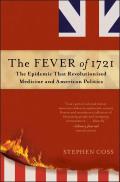
  • Stephen Coss, The Fever of 1721: The Epidemic That Revolutionized Medicine and American Politics (2009).
  • Jared Hardesty, Unfreedom: Slavery and Dependence in Eighteenth-Century Boston (2016).

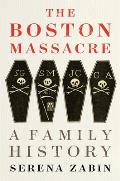
The second recording comes from the Dr. Joseph Warren Historical Society, founded by Christian DiSpigna and Randy Flood. They’ve been posting a series of video interviews with authors and invited me to be a guest host for a conversation with Serena Zabin about her new book The Boston Massacre: A Family History. That recording is here.

In addition to Zabin’s new book, we talked about some older texts, and here’s what I remember:
  • Hiller B. Zobel, The Boston Massacre (1970).
  • The Legal Papers of John Adams, edited by L. Kinvin Wroth and Zobel (1965), readable here.
  • A Short Narrative of the Horrid Massacre, Boston’s official report on the event, readable here.
  • My articles on Pvt. John Moies of the 14th Regiment, starting here.

Monday, September 28, 2020

“Onesimus and Rev. Cotton Mather” Program, 1 Oct.

On Thursday, 1 October, I’ll be part of an online discussion through the Freedom Forum on “Onesimus and Rev. Cotton Mather: Race, Religion, and the Press in Colonial America.”

The Freedom Forum’s description says:
The third program in the Freedom Forum’s series, Religious Resolve: Stories from Our Past, for Our Future, explores a story that received cursory attention when the COVID-19 pandemic first emerged in the United States. That is the story of the enslaved man, Onesimus, who was inoculated for smallpox in Africa and who taught the Rev. Cotton Mather the technique just as a deadly smallpox epidemic hit Boston in 1721.

While this historical fact is known, the program will explore less familiar but interesting aspects of the story. How did other Boston religious and medical leaders react to Rev. Mather’s promotion of African medical techniques? How did Benjamin Franklin get involved? How did the ensuing confusion lead to the development of Boston’s first independent newspaper? And what happened to Onesimus after Rev. Mather finally gave up on converting him to Christianity?
Besides myself, the panelists will be Tom Meenan, citizen researcher and educator for the Freedom Forum, and Debra L. Mason, Ph.D., Fellow at Harvard’s Religion Literacy Project and Professor Emerita at the Missouri School of Journalism, University of Missouri.

This free event will start at 1:00 P.M. Eastern time. Register through this link.

Among the other discussions in this Freedom Forum series is one covering the African-American ministers Richard Allen and Absalom Jones during the yellow fever epidemic in Philadelphia, as well as conversations about more recent American history.

Tuesday, April 28, 2020

“Impowred to order and require so many days’ work yearly”

Yesterday I mentioned how colonial Boston selectmen’s records periodically include lists of the free black men in the town in connection with, of all things, highway repairs. Here’s more about that.

Massachusetts militia laws excluded black and Native American men from drilling with the white men required to serve, presumably to avoid giving those men of color so much military training they could start an uprising. It’s possible that the social-gathering side of militia musters also played a role in this exclusion.

Since militia duty made free white men give up four days a year for the good of society, that society felt it was only fair to require free black men to give up four days as well. Therefore, in 1707 the Massachusetts General Court passed a law that said:
Whereas, in the several towns and precincts within this province, there are several free negro’s and molatto’s able of body and fit for labour, who are not charged with training, watchings and other services required of her majesty’s subjects, whereof they have share in the benefit,—Be it enacted…

That the selectmen of each town or precinct be and hereby are impowred to order and require so many days’ work yearly, of each free male negro or molatto, able of body, dwelling within such town or precinct, in the repairing of the highways, cleansing the streets, or other service, for the common benefit of the place, as, at the discretion of the selectmen, may be judged an equivalent to the services performed by others, as aforesaid.
The result was a form of tax levied only on free black men and extracted in the form of labor. Or it was a way to continue coercing labor, at least a little, from black men even after they became free.

In fact, this custom may have already been in place before that law made it official. On 26 Sept 1704 the Boston selectmen “Ordered that Mr. Timo. Wadsworth be desired to take Care of doing what is necessary in repaireing the High way on ye neck & that as many of the free negros & poor of ye Town may be imployed therein as Shall be convenient.” Perhaps that was free labor, perhaps the town expected those workers to be paid and specified “the free negros & poor” to ensure their asking price would be as low as possible.

On 16 June 1707, the selectmen moved to take advantage of unpaid labor under the new law. They ordered “each Free negro & mollatto man of this Town, forthwith to attend and perform four dayes Labour, abt. repaireing the Streets or Highwayes.” The town announced it could call on those men for more work if needed, “reserving their remayning Service untill further order.” A constable was empowered to summon the men, putting the force of law behind this requisition.

For the next couple of decades, lists of black and Native men and their work assignments, ranging from two days to twelve, periodically appeared in the selectmen’s records. It looks like men who got out of their obligation in one year were assigned more days the next. I found lists for 1708, 1710, 1711, 1712, 1714, 1715, 1716, 1718, 1719, and 1723.

At various towns the selectmen empowered any one of them to summon free black men and appointed “Capt. Hab. Savage,” Richard Hubburt, Eneas Salter, and others to oversee those workers. Specific assignments included “clearing the valt of ye. House of Easment [i.e., outhouse] belonging to the Free Lattin School in School Street.” But most of the work was repairing the main roads.

The 1725 list, the first to include a man named Onesimus, was unusual in giving only first names for the men being drafted. Usually there was more identifying information. Sometimes those names came with other notations like “dead“ or ”gon,” or remarks about how many days men had already worked or had left to do.

There was no list of laborers in 1736 or 1737, so on 30 Aug 1738 the selectmen directed ”Thomas Cowdrey…to take a List of the Free Negro’s, Indians, and Molatto’s in the Town that are capable of Service, and to lay it before the Select men, in order to their being Employ’d in the Service of the Town, according to law.” The list entered on 13 September contained twenty-one names, including Titus Rumney Marsh, John Woodby, and Onesimus Mather.

The town drafted free black workers again in 1743 and 1744, but the practice became less common over time. On 14 June 1759 the selectmen resolved:
Whereas there is Considerable Work to be done this year on Boston Neck, & the Free Negroes of the Town have been for Several Years exempted from any duty, therefore it was Some time past Voted that they be Orderd to attend the Selectmen, & on this day the following Negroes Attended
  • Bristol Jeffries who will do what Work he is orderd to do—
  • Pompey Blackman who agrees to pay half a dollar p. day for so many days as he shall be orderd—
  • Liecester Black ditto—
  • Dick Tynge to pay half a dollar as above—
  • David Primus ditto—
  • Homer Blackadore Sickly.
Some of the town’s free black men now had enough money to buy their way out of service in the same way white men could pay fines so as not to attend militia drill. (Though I’m not sure how often those fines were really collected.)

TOMORROW: How a custom died in Revolutionary Boston.

Monday, April 27, 2020

Onesimus Mather in Freedom

It’s hard to find traces of the Rev. Dr. Cotton Mather’s enslaved servant Onesimus after the minister grudgingly manumitted him in late 1716 or early 1717.

In some respects that’s good because it means the man didn’t have to return to his former owner for support and thus get mentioned in his diary. (Because the minister would have been all over that.) Nor was Onesimus ever recorded entering the almshouse.

According to Mather, Onesimus had a wife and children while still enslaved. There’s no official record of this marriage, however. We don’t know the name of the wife or of any surviving children.

The vital records of Boston show two black men named Onesimus marrying and having children in Boston in the 1720s, the decade after Mather’s manumission. One of those men could have been the minister’s former servant marrying again—or perhaps neither were. Puritans knew the name of Onesimus from a slave mentioned in the New Testament, so they reused it.

The Rev. Joseph Sewall married one Onesimus to a black woman named Jane at the Old South Meeting-House on 3 June 1725. That couple baptized a son named William in that church on 23 Apr 1728. It’s not stated if they were enslaved or free.

The other Onesimus is more likely to have been the man who worked for Cotton Mather because he went to the Mathers’ meetinghouse in the North End to marry. This man was described as a free Negro when the Rev. Joshua Gee married him to a woman named Hagar on 15 Feb 1727. Gee was then Mather’s colleague at the church. Cotton Mather died a year later.

[Assuming, that is, that the marriage did indeed happen in what we now call 1727. The published Boston town records suggest that was a New Style date. But if the marriage actually took place on 15 Feb 1728, that was two days after the Rev. Dr. Mather died—too close to be a coincidence.]

The Old North Meeting’s records show Onesimus and Hagar having three children baptized:
  • Onesimus on 22 Mar 1730.
  • John on 10 Oct 1731.
  • another Onesimus on 5 May 1734, and time Hagar is not on the record.
That indicates the first Onesimus died young, and Hagar might have died as well. As the minister’s diary shows, Onesimus had already lost one namesake son and perhaps another son before becoming free. Eighteenth-century parenting was full of sadness.

Twenty years later, in 1754, a “free negro” named Onesimus married a woman named Phillis, enslaved to Rachel Fessenden. Again, this could be the baby baptized in 1734 or it could be a completely unrelated man.

A more certain appearance of the Rev. Cotton Mather’s former servant appears in the Boston selectmen’s records of highway repairs. I’ll explore why that source exists in future postings. For this one, it’s necessary only to say that in some years the Boston selectmen made a list of all the free black men in town. As Eric Hanson Plass noted in his study of Boston’s early African-American community, this is as close as we have to a census of those men.

On 11 Nov 1725, the selectmen’s list included twenty-six Negro men, including one named “Onesimas." They were drafted for “Eight Days...in Clensing or Repairing the High wayes or other services for the Comon benefit.” Again, this could be either Onesimus who got married that decade.

Thirteen years later, on 13 Sept 1738, the selectmen drafted five men for one day’s work and sixteen men for two days. In the second group was “Onesimus Mather.”

This confirms that more than thirty years after being given to Cotton Mather, and more than twenty years after becoming free again, that man was still living freely in Boston. It’s also notable that he was using his old master’s surname, which of course carried great cachet in those parts. That’s why, even while I caution against assuming that ex-slaves adopted their former owners’ surnames, I feel comfortable referring to this free man as Onesimus Mather.

Sunday, April 26, 2020

The Freeing of Onesimus Mather

As recounted yesterday, in July 1716 the Rev. Dr. Cotton Mather determined that he needed to “dispose of” his enslaved servant Onesimus in the same month that he wrote to London describing that man as “intelligent” and passing on his knowledge of smallpox inoculation in Africa.

“Disposing of” Onesimus didn’t mean selling him to another local slaveholder or shipping him to the Caribbean. Mather didn’t seek to maximize his profit. Instead, frustrated after years of trying to produce a religious conversion and probably faced with frequent requests, the minister agreed to set Onesimus free—but on what terms?

The American Antiquarian Society holds an undated memorandum in Mather’s handwriting detailing his decision. The document is undated but was probably written within a few months after that July 1716 diary entry. Mather stated:
My servant Onesimus, having advanced a Summ, towards the purchase of a Negro-Lad, who may serve many occasions of my Family in his Room, I do by this Instrument, Release him so far from my Service and from the claims that any under or after me might make unto him, that he may Enjoy and Employ his whole Time for his own purposes, and as he pleases. But upon these conditions.

First, that he do every Evening visit my Family, and prepare and bring in, the Fuel for the day following, so Long as the Incapacity of my present Servant, shall oblige us to Judge it necessary: As also, in great snows, appear seasonably with the help of the Shovel, as there shall be occasion.

Secondly, that when the Family shall have any Domestic Business more than the Daily affairs, he shall be ready, upon being told of it so far to Lend an helping Hand, as will give no Large nor Long Interruption to the Business, of his own, to which I have dismissed him; As particularly, to carry corn unto the mill, and help in the fetching of water for the washing, if we happen to be destitute. And in the piling of our wood, at the season of its coming in.

Whereas also, the said Onesimus has gott the money which he has advanced as above mention’d, from the Liberties he took, while in my Service, and for some other Considerations, I do expect, that he do within six months pay me the sum of Five Pounds, wherein he acknowledged himself Endebted unto me.
In her article “Strangers in the House of God” (P.D.F. download), Kathryn S. Koo points out that the manuscript of this manumission includes several more lines in which Mather acknowledged himself “obliged to provide for [Onesimus] in case of Sickness or Lameness”—but then crossed them out. New England slaveholders and slaves shared an understanding that masters shouldn’t abandon people when they could no longer work, that working as a slave came with support in old age (if one should live so long). But Mather decided that no longer applied to him.

Instead, the minister laid out the obligations that flowed the other way. For leaving the Mather household short-handed, Onesimus had to return to chop firewood, shovel snow, help at dinner parties, and do other chores when needed. Four years before, Mather had written in his diary about granting Onesimus “great Opportunities to get money for himself.” Now he wanted the man to pay him £5 “from the Liberties he took.”

Finally, the first condition for Onesimus’s freedom was that he had “advanced a Summ, towards the purchase of a Negro-Lad, who may serve…in his Room.” Again, Mather viewed Onesimus as leaving the household in the lurch and thus sharing the responsibility to fill that hole. The minister could have written the memo simply stating that Onesimus was paying a certain amount of money for his freedom. Instead, he insisted that the man was compensating for the labor he was taking away.

Onesimus, for his part, was willing to leave another person enslaved in his place—though it’s notable that the plan was to buy a “Lad.” Child-servants and apprentices regularly worked for no pay, just having their basic needs met. Perhaps Onesimus believed that the minister would grant his young replacement the same opportunities he had gained himself, including education, marriage, and eventual freedom.

It doesn’t appear that Mather and Onesimus had a particular enslaved boy in mind when the minister wrote that memo. Mather was surprised when he found Onesimus’s replacement on 1 Oct 1717, writing:
A strange Providence of GOD, has brought into my Family a new Servant; A Negro Boy of promising Circumstances. Oh! Let me use all possible Projections and Endeavours, to make him a Servant of the Lord. That this may be kept in Mind, I call him, Obadiah.
That name literally meant “servant of the Lord.”

Mather left no evidence of how often Onesimus returned to the household to fulfill the obligations laid upon him or for other reasons. We don’t know if he completed the payment of £5. The last time the minister mentioned his first slave in his diary was an entry on 2 April 1717:
I fear I have not been so frequent and fervent and particular, as I should have been, in my Prayers for the converting Influences of Heaven, on the Soul of my Servant Onesimus. Who can tell what may be done for him, and what a new Creature he may become, if more prayers were employ’d for him!
But, as I noted yesterday, seven years later Mather wrote again about what Onesimus had told him of smallpox inoculation. By then Boston had gone through an epidemic, and inoculation had proved an effective way of minimizing the spread and harm of the disease. Clearly Cotton Mather never forgot his first, frustrating, enlightening African servant.

TOMORROW: Glimpses of Onesimus as a free man in Boston.

Saturday, April 25, 2020

“First instructed in it, by a Guramantee-Servant”

As described yesterday, the Rev. Dr. Cotton Mather tried to convert Onesimus, an enslaved young man he received in 1706, to his form of Christianity. But the man was more interested in marrying, having children, and earning his own money.

On 31 July 1716, the minister was reaching the end of his patience. He wrote in his diary:
My Servant Onesimus, proves wicked, and grows useless, Froward, Immorigerous. My Disposing of him, and my Supplying of my Family with a better Servant in his Room, requires much Caution, much Prayer, much Humiliation before the Lord. Repenting of what may have offended Him, in, the Case of my Servants, I would wait on Him, for his Mercy.
“Froward” meant “contrary.” “Immorigerous” meant “rude.” As for “Disposing of him,” the minister hadn’t yet made up his mind about what to do.

Remarkably, that same month Mather wrote to a correspondent in the Royal Society of London, describing Onesimus’s intelligence and knowledge of the seemingly radical practice of smallpox inoculation. That 12 July 1716 letter said:
Enquiring of my Negro-man Onesimus, who is a pretty Intelligent Fellow, Whether he ever had ye Small-Pox; he answered, both, Yes, and No; and then told me, that he had undergone an Operation, which had given him something of ye Small-Pox, and would forever praeserve him from it; adding, That it was often used among ye Guramantese, & whoever had ye Courage to use it, was forever free from ye Fear of ye Contagion. He described ye Operation to me, and shew’d me in his Arm ye Scar, which it had left upon him…
In 1713 and 1716 the Royal Society published two accounts of smallpox inoculation from European physicians who had traveled and worked in Turkey. Soon afterward, Lady Mary Wortley Montagu and her diplomat husband returned from Constantinople, and in London she also talked up this way of obtaining immunity from the virus.

In 1721, a smallpox epidemic broke out in Boston. Mather allied with a local physician named Zabdiel Boylston to try using inoculation locally. Since that treatment meant giving people the disease, though hopefully a mild case, it prompted a lot of opposition from people who thought the point of medicine was to produce fewer sick people, not more. Opponents included the European-educated Dr. William Douglass and the printer of the newspaper Douglass helped to fund, James Franklin.

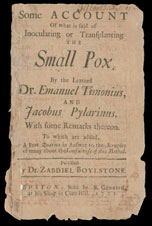
Boylston published a pamphlet drawing on the Royal Society publications and adding more arguments, some from Mather. The minister cited what he had learned from Africans. Of course, opponents of inoculation used that source to ridicule the idea.

The argument became so heated that someone threw an incendiary bomb at Mather’s house. But eventually Boylston was able to inoculate enough people to make a scientific case that the new treatment saved lives. It became a standard regimen for the rest of the century, though communities still worried about careless doctors not keeping their infectious patients isolated from the public.

Mather wrote about the controversy in his 1724 manuscript “The Angel of Bethesda,” which echoed that earlier pamphlet in how he described learning about inoculation:
There has been a Wonderful Practice lately used in Several Parts of the World, which indeed is not yett become common in o’r Nation.

I was first instructed in it, by a Guramantee-Servant of my own, long before I knew, that any Europaeans or Asiaticks had the least Acquaintance with it; and some years before I was enriched with the Communications of the learned Foreigners, whose Accounts I found agreeing with what I received of my Servant, when he shewed me the Scar of the Wound made for the Operation; and said, That no Person ever died of the Small-pox in their Countrey that had the Courage to use it.

I have since mett with a considerable Number of these Africans, who all agree in One Story; That in their Countrey grandy-many dy of the Small-Pox: But now they learn This Way: People take Juice of Small-Pox, and Cutty-skin, and Putt in a Drop; then by’nd by a little Sicky, Sicky: then very few little things like Small-Pox, and no body dy of it; and no body have Small-Pox any more. Thus in Africa, where the Poor Creatures dy of the Small-Pox like Rotten Sheep, a Merciful GOD has taught them an Infallible Praeservative. Tis a common Practice, and is attended with a Constant Success.
This passage has been analyzed for Mather’s presentation of an African dialect and for the way he portrayed Africans as backward while also drawing on their medical knowledge.

Indeed, the whole 1720s argument over smallpox inoculation in Boston has attracted a lot of scholarship, and I haven’t tried to recount it all here. Among the most recent studies are Stephen Coss’s The Fever of 1721, Amalie M. Kass’s “Boston's Historic Smallpox Epidemic” in the Massachusetts Historical Review, and Margot Minardi’s “The Boston Inoculation Controversy of 1721-1722” in the William and Mary Quarterly.

By the time that controversy raged, the Rev. Cotton Mather had already disposed of his frustrating servant, and source of medical knowledge, Onesimus.

TOMORROW: What happened to Onesimus?

Friday, April 24, 2020

Onesimus Mather Unchristianized

In 1706 the Rev. Cotton Mather published a pamphlet titled The Negro Christianized: An Essay to Excite and Assist that Good Work, the Instruction of Negro-Servants in Christianity.

Thirteen years before, Mather had published Rules for the Society of Negroes, encouraging the small but growing population of Africans in Boston to worship as Christians. He also gave money for reading lessons. At the same time, his pamphlets assured slaveholders that their human property could be baptized and still remain human property.

Mather’s wealthy parishioners, those most likely to own slaves, evidently thought he was just the man to become a slaveholder himself. In December 1706, the minister wrote in his diary:
This Day, a surprising Thing befel me. Some Gentlemen of our Church, understanding (without any Application of mine to them for such a Thing,) that I wanted a good Servant at the expence of between forty and fifty Pounds, purchased for me, a very likely Slave; a young Man, who is a Negro of a promising Aspect and Temper, and this Day they presented him unto me. It seems to be a mighty Smile of Heaven upon my Family; and it arrives at an observable Time unto me. I putt upon him the Name of Onesimus; and I resolved with the Help of the Lord, that I would use the best Endeavours to make him a Servant of Christ, and also be more serviceable than ever to a Flock, which laies me under such Obligations.
I can’t help but think that day contained even more surprises for the young men thereafter known as Onesimus. That name, meaning “useful,” been assigned to many enslaved men in the Roman Empire. Mather knew it best from the epistle to Philemon, in which Paul sent an escaped slave named Onesimus back to his master with an admonition for them both to do better.

Onesimus had been born in Africa, and Mather later described his people as “Guramantese,” most likely Coromantee from what is modern Ghana. What the young man’s original name was, how he came to Boston, what he thought of his new home—we know none of that.

Christianizing Onesimus proved to be harder than Mather expected. For one thing, the minister—all the while exploiting the man’s labor for his own family—believed he stole things. On 2 Dec 1711 Mather wrote:
I must keep a strict Eye on my Servant Onesimus; especially with regard unto his Company. But I must particularly endeavour to bring him unto Repentance for some Actions of a thievish Aspect. Herein I must endeavour that there be no old Theft of his unrepented of, and left without Restitution.
Yet Mather was also acceding to the man’s pressure for more autonomy. In 1712 he wrote:
Having allowed unto my Servant Onesimus, the conveniences of the Married State, and great Opportunities to get money for himself, I would from hence take occasion mightily to inculcate on him, his obligations to keep the Rules of Piety, and Honesty; and Particularly Charge him, to devote Part of his gains to Pious Uses.
The big surprise to Mather seems to have been that Onesimus was, well, smart. The only way the minister found he could affect his servant’s behavior (which suggests he tried other methods) was persuasion, as he wrote on 2 Aug 1713:
My Negro Servant is one more Easily govern’d and managed, by the Principles of Reason, agreeably offered unto him, than by any other methods. I would oftener call him aside, and assay to reason him into a good Behaviour.
Mather laid out a course of education on 2 Dec 1713:
There are several Points, relating to the Instruction and Management of my Servant Onesimus, which I would now more than ever prosecute. He shall be sure to read every Day. From thence I will have him go on to Writing. He shall be frequently Catechised. I would also invent some advantageous Way, wherein he may spend his Liesure-hours.
The minister enlisted other family members in this effort as well, writing in 1712 that after catechizing his children, “I also made one of them, to hear the Negro-Servant Say his Catechism.”

Mather treated any misfortune as an opportunity for theological education—any misfortune of Onesimus’s, that is:
  • 2 Jan 1714: “My Servant burying of his Son, it gives me an Opportunity, to inculcate agreeable Admonitions of Piety upon him.”
  • 20 Mar 1716: “My Servant has newly buried his Son; (Onesimus his Onesimulus). Lett me make this an Occasion of inculcating the Admonitions of Piety upon him.”
  • 28 May 1717: “Onesimus’s Recovery from a dangerous Fitt of Sickness, must be improv’d for his Awakening to Piety.”
“Onesimulus” was a coinage meaning “Little Onesimus” in Latin. I presume Mather insisted on that name.

Despite all that effort, Onesimus never declared himself to be saved, asked to be baptized, or joined a congregation. In Mather’s eyes he remained unchristianized.

I should note that most of the times the Rev. Dr. Mather wrote of Onesimus’s faults he also chided himself for not having corrected those faults already. He was using his diary entries to prod himself into improving. And he was, after all, supposed to be an expert.

TOMORROW: Fighting the epidemic.

(For more on how the Rev. Cotton Mather wrestled with his servant Onesimus’s religious life, see Kathryn S. Koo’s “Strangers in the House of God” [P.D.F. download].)

Saturday, October 01, 2011

“Several of the founding fathers were champions of inoculation”

In The Nation, Lindsay Beyerstein took on Rep. Michele Bachmann’s recent incendiary comments about vaccinations from a historical perspective:
As a Tea Party conservative, Bachmann styles herself as defender of original vision of the founding fathers for America. Ironically, several of the founding fathers were champions of inoculation against infectious disease. Some even played key roles in ushering in the vaccine age.

If it hadn’t been for mandatory smallpox inoculation, the Republic might never have survived. General George Washington ordered the Continental Army inoculated against smallpox in 1777, the first large scale inoculation of an army in history. Washington was supported in this effort by Dr. Benjamin Rush, a signatory to the Declaration of Independence and the chair of the Continental Congress’ Medical Department.

Inoculation was a precursor to vaccination which induced a milder case of smallpox by scratching the skin and rubbing in pus from a smallpox lesion. Cleric and amateur scientist Cotton Mather provided a dramatic proof of concept for inoculation when he inoculated 287 people during a smallpox epidemic in Boston in 1721. Only six of the inoculated individuals died, a much lower death rate than for natural smallpox. Mather gets credit for introducing smallpox inoculation to North America, but he learned about it from Onesimus, a slave who had undergone inoculation in Africa.

Despite the success of his experiment, Mather was widely vilified for mocking the will of God. At the time, many believed that smallpox was a divine punishment for sins and that trying to evade the consequences of sinning by getting inoculated was a sin in itself. That argument sounds ridiculous to modern ears, but that same logic still prevails in some quarters when discussing sexually transmitted diseases.

Someone threw a small bomb through Mather’s window with a note that said, roughly, “Inoculate this, Mather.”
The article goes on to name-check Alexander Hamilton, Thomas Jefferson, and Harvard professor Dr. Benjamin Waterhouse.

Not mentioned in the article is how in 1721 James Franklin published essays criticizing Mather (shown above) and Dr. Zabdiel Boylston for their inoculation campaign in his New England Courant newspaper and in pamphlets. Among the apprentices who helped to create those publications was the printer’s little brother Benjamin.

Eventually, however, Benjamin Franklin accepted the scientific evidence for the value of smallpox inoculation, particularly after his young son died of the disease in 1736. Two decades later, Franklin and Dr. William Heberden of London published a pamphlet on inoculation in England and America. Franklin had a very important quality for a political leader, or anyone else: the willingness to change one’s mind after seeing solid evidence that undermines one’s initial beliefs.