J. L. BELL is a Massachusetts writer who specializes in (among other things) the start of the American Revolution in and around Boston. He is particularly interested in the experiences of children in 1765-75. He has published scholarly papers and popular articles for both children and adults. He was consultant for an episode of History Detectives, and contributed to a display at Minute Man National Historic Park.

Subscribe thru Follow.it


•••••••••••••••••


Showing posts with label Daniel Fowle. Show all posts

Saturday, August 15, 2026

Spreading the News of the Spread of a Fire

We can see the spread of news in the spring of 1775 through articles on the fire in Boston on the night of 17–18 May 1775.

The first printed report appeared in Samuel Hall’s Cambridge-based New-England Chronicle on 18 May, in the middle of other local news:
A terrible Fire broke out in Boston about 9 o’Clock last Evening, and raged a long Time. We hear it began just above the Draw Bridge, and burnt along the Town-Dock. A great Number of Buildings are doubtless consumed; but it is not possible to collect the Particulars for this Paper.
That same dire but vague paragraph was reprinted in Hartford on 22 May, Portsmouth on 26 May, and Philadelphia on 29 May.

Ebenezer Watson’s Connecticut Courant of Hartford confirmed that report in the 22 May issue by also quoting “a Letter from a Gentlemen in Cambridge…dated May 18”:
They had a great Fire in Boston last Night---it appeared to be between King-Street and the Market---it continued all night, and is not yet extinguished. What has really happened, is to us uncertain, as yet.
James Rivington chose to run the latter item in his 25 May New-York Gazetteer.

Meanwhile, on 22 May Solomon Southwick’s Newport Mercury offered an extract from “a manuscript account of the fire which happened in Boston last Wednesday night”:
The fire began in the barracks, under the arch formerly improved by Benjamin Davis, about half after eight o’clock, 17th May.—The soldiers were receiving some cartridges, by which means one took fire, and communicated to many more, which immediately set fire to the room.
That account then listed many property owners starting with John Hancock and including “a cooper’s shop, owned by Eliakim Hutchinson, adjoining the town dock, improved for barracks.” It concluded:
Instead of ringing the bells as usual, the soldiers beat to arms, by which means the people were in great confusion, not being used to such signals in time of fire.

N.B. The inhabitants took particular care to save the goods in Mr. Hancock’s store.
Curiously, in his 26 May New-Hampshire Gazette Daniel Fowle printed a version of that same detailed report on page 1 even as on page 3 he ran the New-England Chronicle’s first story saying it was “not possible to collect the Particulars for this Paper.”

John Holt put the “manuscript account” in his New-York Journal on 1 June with the dateline “CAMBRIDGE, May 12”—an obvious error since the fire hadn’t yet occurred then. Presumably Holt’s shop should have printed 19, 21, or 22 May, getting one digit wrong or transposing them.

No newspaper was published in Cambridge on those dates, suggesting Holt indeed took that text from a manuscript, not from a preceding newspaper. In addition, that text never appeared in the New-England Chronicle, the only newspaper then published out of Cambridge.

That strongly suggests that the Patriot authorities in Cambridge, perhaps Boston town officials in exile, sent their own quasi-official report on the fire out to newspapers in other colonies.

TOMORROW: A more pointed description.

Thursday, January 11, 2024

Who wrote, “we can make every Tory tremble”?

Earlier this year, I saw a tweet crediting Samuel Adams with the line: “With ladies on our side, we can make every Tory tremble.”

Adams wasn’t usually that pithy, and the statement doesn’t appear in the four volumes of The Writings of Samuel Adams.

The line first appeared in a letter to Daniel Fowle’s New-Hampshire Gazette published on 22 July 1774. Here’s more context:
The Consumption of TEA I think is in a fair Way of being totally laid aside in this Town, as there are but very few indeed, that will refuse to sign or solemnly ingage not to suffer it used in their Families;

and what adds a great Pleasure to us all, is, that the Fair Sex universally consent to give up, this detested superfluous Article; and under the Auspices of the worthy Doctor Clement Jackson, we hope soon to see a glorious List of Female Worthies, whose Virtue can withstand every daring Insult when put to the Test; and we all desire their Names may be recorded in the Town Books, to perpetuate their Memories:---

Then let us see who will sell that obnoxious Herb, for with the Ladies on our side, we can make every Tory tremble; as it is generally agreed upon, not to frequent those Shops were TEA is sold.
The signature, under a Latin quotation, was “AMICUS.”

A few weeks later, on 26 August, the New-Hampshire Gazette published another letter, addressed to the people of New Hampshire and signed “AMICUS PATRIAE.” It urged people in that colony to support Boston, suffering under Parliament’s Coercive Acts, with donations for the poor.

Both letters show a pattern of short italicized phrases and occasional all-capitalized nouns. Both end with Latin quotations. The signatures overlap. I therefore think it’s likely the two letters came from the same pen.

In his History of New-Hampshire (1792), the Rev. Jeremy Belknap printed a letter from New Hampshire governor John Winthrop to the Earl of Dartmouth dated 29 August, which said:
The town-clerk of Boston [William Cooper], who is said to be a zealous leader of the popular opposition, has been in this town about a week; immediately appears a publication in the New-Hampshire Gazette, recommending donations for Boston…
Belknap added a footnote to that sentence:
The publication here referred to was written by a person whom the Governor did not suspect, and the town-clerk knew nothing of it.
But Belknap obviously did know the author. In fact, his granddaughter Jane Belknap Marcou wrote in her 1847 biography that she had found “the imperfect manuscript [i.e., draft] remaining among Mr. Belknap’s papers.” In other words, he’d written it himself.

Back in 1774, Jeremy Belknap was the minister in Dover, New Hampshire. Ministers weren’t supposed to get directly involved in politics, but as “AMICUS PATRIAE” he had things to tell his fellow citizens. And Belknap also appears to have been the most likely author of the line “With ladies on our side, we can make every Tory tremble.” (I wonder if a draft of that essay might be in his papers at the Massachusetts Historical Society.)

The line resurfaced in John C. Miller’s Origins of the American Revolution (1943) as an example of American Whig sentiment before the war. Philip Foner picked it up in his History of the Labor Movement in the United States (1947), crediting the sentiment to “Sons of Liberty.” Charles O. F. Thompson included the line in A History of the Declaration of Independence: A Story of the American Patriots who Brought about the Birth of Our Nation (1947), curiously tossing in the word “blessed” ahead of “Tory.” Other books followed.

From there it appears that an author or authors decided that “Sons of Liberty” meant Samuel Adams. In the current century several books and authoritative websites attribute the statement to Adams, usually saying “often quoted” or “reported to have said” as a signal that the writers can’t find the words in those four volumes of Writings. In several places the quotation has also lost the article “the” before “Ladies.”

In conclusion, while it’s definitely possible to quote the line “with the Ladies on our side, we can make every Tory tremble” from the Revolutionary era, it should be tentatively attributed to Jeremy Belknap, not Samuel Adams.

Sunday, February 07, 2021

London Imprints on Boston Bibles?


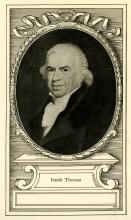
In 1756 the Boston Overseers of the Poor indentured Isaiah Thomas as an apprentice to the printer Zechariah Fowle (1724-1776). He was seven years old and didn’t yet know how to read.

Isaiah’s father had died, and his mother apparently felt she couldn’t support him by herself. The Overseers were used to finding masters for children in that situation.

As he grew up, Isaiah listened to stories from Fowle, from other printers, and from a former printer named Gamaliel Rogers (1685-1775) who ran a nearby bookshop. About Rogers he later wrote:
I went frequently to his shop, when a minor. He knew that I lived with a printer, and for this, or some other reason, was very kind to me; he gave me some books of his printing; and, what was of more value to me, good advice.
Isaiah developed less respect for Fowle, whom he came to see as lazy, not “enterprising” like some earlier printers. Thomas himself was quite enterprising—releasing himself early from his apprenticeship, cajoling his former master into co-publishing the Massachusetts Spy, and finally building a lucrative publishing network in the new republic.

Among the stories young Isaiah heard were tales of the surreptitious printing of a New Testament and of a Bible in Boston just a few years before he entered the profession. In his 1810 History of Printing in America, Thomas wrote:
[Samuel] Kneeland [1696-1769] and [Timothy] Green [1703-1763] printed, principally for Daniel Henchman [1689-1761, bookseller], an edition of the Bible in small 4to. This was the first Bible printed, in the English language, in America.

It was carried through the press as privately as possible, and had the London imprint of the copy from which it was reprinted, viz. “London: Printed by Mark Baskett, Printer to the King’s Most Excellent Majesty,” in order to prevent a prosecution from those, in England and Scotland, who published the Bible by a patent from the crown; or, Cum privilegio, as did the English universities of Oxford and Cambridge.

When I was an apprentice, I often heard those who had assisted at the case and press in printing this Bible, make mention of the fact. The late governor [John] Hancock was related to Henchman, and knew the particulars of the transaction. He possessed a copy of this impression.

As it has a London imprint, at this day it can be distinguished from an English edition, of the same date, only by those who are acquainted with the niceties of typography. This Bible issued from the press about the time that the partnership of Kneeland and Green expired [which was in 1752]. The edition was not large; I have been informed that it did not exceed seven or eight hundred copies.

Not long after the time that this impression of the Bible came from the press, an edition of the New Testament, in duodecimo, was printed by [Gamaliel] Rogers and [Daniel] Fowle [1715-1787], for those at whose expense it was issued. Both the Bible and the Testament were well executed. These were heavy undertakings for that day, but Henchman was a man of property; and, it is said, that several other principal booksellers, in Boston, were concerned with him in this business.

The credit of this edition of the Testament was, for the reason I have mentioned, transferred to the king’s printer, in London, by the insertion of his imprint. . . .

Zechariah Fowle [brother of Daniel], with whom I served my apprenticeship, as well as several others, repeatedly mentioned to me this edition of the Testament. He was, at the time, a journeyman with Rogers and Fowle, and worked at the press. He informed, that on account of the weakness of his constitution, he greatly injured his health by the performance. Privacy in the business was necessary; and as few hands were intrusted with the secret, the press work was, as he thought, very laborious. I mention these minute circumstances in proof that an edition of the Testament did issue from the office of Rogers and Fowle, because I have heard that the fact has been disputed.
Elsewhere in the same edition Thomas said Rogers and Fowle printed “about two thousand copies” of their New Testament before Kneeland and Green printed their Bible. In the 1874 edition of Thomas’s history, incorporating his notes, the passage above was amended to state that chronology.

Among his papers at the American Antiquarian Society, Thomas also left multiple lists of books published in Boston before the Revolutionary War. Under the date 1749 one of those lists include a “Bible containing the Old and New Testament (this had a London imprint about 1749 or 1750).”

When in 1770 some Boston printers wanted to sell copies of the Short Narrative of the Horrid Massacre despite the town ordering them not to, they had undoubtedly heard the same stories as Isaiah Thomas. They knew the trick of putting a fake London title page on a book to make it appear aboveboard.

The Bibles that Thomas described being printed in Boston around 1750 went completely undetected. In fact, those books might never have existed.

TOMORROW: The hunt for Boston’s phantom Bibles.

Wednesday, July 22, 2020

“In drinking of outlandish TEA”

On 22 July 1774, more than half a year after the Boston Tea Party, this item appeared in Daniel Fowle’s New-Hampshire Gazette:
Mr. FOWLE,
If you think the following Lines upon the Use of Tea worthy a Place in your valuable Collection, by inserting them in your next, you will oblige a Customer.

I.
ROUSE ev’ry generous thoughtful Mind,
The rising Danger flee;
If you would lasting Freedom find,
Now then abandon TEA.
II.
Scorn to be bound with golden Chains,
Though they allure the Sight;
Bid them Defiance if they claim
Our Freedom and Birth-Right.
III.
Shall we our Freedom give away,
And all our Comfort Place,
In drinking of outlandish TEA,
Only to please our Taste.
IV.
Forbid it Heaven, let us be wise,
And seek our Country’s Good;
Nor ever let a Thought arise,
That Tea should be our Food.
V.
Since we so great a Plenty have,
Of all that’s for our Health;
Shall we that blasted Herb receive,
Impoverishing our Wealth,
VI.
When we survey the breathless Corpse,
With putrid Matter fill’d;
For crawling Worms a sweet Resort,
By us reputed ill.
VII.
Noxious Effluvia sending out,
From it’s pernicious Store,
Not only from the foaming Mouth,
But ev’ry lifeless Pore.
VIII.
To view the same enrol’d in TEA,
Besmeared with such Perfumes,
And then the Herb sent o’er the Sea,
To us it tainted comes.
IX.
Some of it tinctur’d with a Filth
Of Carcases embalm’d;
Taste of this Herb then if thou wilt,
Sure me it cannot charm.
X.
Adieu, away O TEA be gone,
Salute our Taste no more;
Though thou art coveted by some,
Who’re destin’d to be poor.
This newspaper contributor urged readers not to drink any tea, harnessing various rumors about how it was tainted with “Perfumes” and “a Filth of Carcases embalm’d,” not to mention politically and economically unhealthy. These particular verses seem designed to be sung to familiar New England hymn tunes, making the reminder of “the breathless Corpse” fit right in.

Ezekiel Russell reprinted these lines in his Salem Gazette a week later under the title “On the Use of Tea,” but I don’t see a lot of other newspapers picking up the item.

In 1855 Evert A. and George L. Duyckinck printed the lyrics, with updated spelling and punctuation, in their Cyclopædia of American Literature. The following year, George Moore included them in his Songs and Ballads of the American Revolution, appending the titles “The Blasted Herb” and “India Tea.” That book said the song was also issued as a broadside (though I haven’t found a listing for one).

Moore also wrote of the song that “It has been attributed to Meshech Weare” (1713-1786), a leading New Hampshire Patriot. He shared no evidence for that attribution and didn’t appear fully convinced of it himself. I haven’t found other mentions of Weare writing verse. Nonetheless, later collections have confidently stated that Weare is the author.

Monday, June 13, 2016

Isaiah Thomas’s Travels and Togs

When Isaiah Thomas reached Halifax in early 1765, he didn’t have much. That’s what happens when you leave your apprenticeship early. Having worked for printer Zechariah Fowle for nine years, the sixteen-year-old knew he was taking a risk.

According to his grandson Benjamin Franklin Thomas, “He used to say, not without satisfaction in the contrast with his affluent condition in later life, that his linen was reduced to one check shirt, and that the only coat he had he sent to a tailor to turn, and the tailor ran away with it.”

But we know that Thomas built up his wardrobe quickly. In 1846 the Portsmouth Journal and Boston Courier reported that builders had discovered a document inside an “old building belonging to Mr. Supply Ham.” It was “a marble covered memorandum book” with the inscription “Isaiah Thomas His Book 1766,” and its text recorded the young printer’s travels and compensation:

Left Mr. Fowle the 19th of September 1765, and sat sail the next Day about 10 o’clock for Halifax, and arrived there on the 24th Day about 10 o’clock, which was just four Days from the Time I left Boston.

Went to Mr. [Anthony] Henry’s and engaged work with him for 3 Dollars per month and he to find me Boarding, Washing, &c. Work extremely scarce.

Received of Mr. Anthony Henry the following Articles, viz.
1 Pair of Broadcloth Breeches 0 15 0
Two pair of Stockings 7 0
1 pair of Shoes 8 0
Two Check Shirts 16 0
1 Pistereen 1 0
1 Bottle of [torn] 1 0
Two Dollars in Cash 10 0
To 1 yard of Black Shallon 4 0
To 1 yard of Blue Ditto 3 9
______________________
Halifax Currency 3 5 9

Work’d with Mr. Henry 5 months, 3 Weeks and 3 Days. Sailed from Halifax the 19th day of March, 1766, and arrived at Old York [Maine] the 27th (at Dark) of said Month.

Work with Mr. [Daniel] Fowle of Portsmouth [New Hampshire] 13 Days.

Friday, April 10, 1766. Came to work with Messrs. [Thomas] Furber & [Ezekiel] Russell for eight Dollars per month and my Board.

Received of Messrs. Furber & Russell 5 yards & half of Black Serge at 9 Shillings Lawful money per yard 2 9 6.
Thomas later said that friends in Boston recognized his work in Furber and Russell’s newspaper. He suggested that was the quality of his typesetting, but it may have been his woodcuts. Or Daniel Fowle may simply have written to his brother Zechariah that his wayward apprentice had reappeared, hungry for work. In any event, the Boston printer invited young Isaiah to return.

Thomas’s grandson wrote, “On his arrival at Portsmouth the people were celebrating with great enthusiasm the repeal of the Stamp Act.” But 27 March was too early for that. The young printer might have stayed in Portsmouth through that town’s celebration in May, but it’s also possible that he returned to Boston just in time for its big celebration on 19 May, and the memory got garbled.

According to Benjamin Franklin Thomas, back in his old master’s shop the teenager “gets along quietly for a few weeks. In July 1766, on the day of the funeral of Jonathan Mayhew [11 July], whom the whole town followed to his grave, he has fresh trouble, but the difficulty is compromised and he lives with him once more. He remains but a few weeks and then, with the full consent of his master, leaves his service finally.”

Isaiah Thomas’s next stop: Wilmington, North Carolina.