J. L. BELL is a Massachusetts writer who specializes in (among other things) the start of the American Revolution in and around Boston. He is particularly interested in the experiences of children in 1765-75. He has published scholarly papers and popular articles for both children and adults. He was consultant for an episode of History Detectives, and contributed to a display at Minute Man National Historic Park.

Subscribe thru Follow.it


•••••••••••••••••


Showing posts with label Cadwallader Colden. Show all posts

Saturday, January 13, 2024

“Let him take care of His House, Person & Effects”

Next week Christie’s in New York plans to auction off a handwritten document it describes as “the earliest known documentary evidence of popular revolt against Great Britain in the American colonies.”

It’s a piece of paper with this message written on it:
Pro Patria

The first Man that either
distributes or makes use of Stampt
Paper, let him take care of His
House, Person & Effects,

Vox Populi;
We dare
Lt. Gov. Cadwallader Colden, soon to be the target of anti-Stamp Act rioters, sent a similar document over to London on 26 Oct 1765, reporting that it had just been posted around New York City.

John Romeyn Brodhead made a facsimile of that paper in the British government archive in 1843. That image was published in the Documents Relating to the Colonial History of the State of New York series in 1856.

Last November, historian Michael Hattem shared a photo of the British National Archives’s copy on his Twitter feed (see below). He also wrote a thorough essay on the background of the Christie’s document, published on the auction house’s website.

The Brodhead facsimile and the document now offered for sale look very similar, down to the triangular tear at the bottom. They are not identical, though; the first capital T is different, and the word “His” shifts a line. Aside from the capital T and the ampersand, the handwritings are nearly identical; curiously, neither message was written with the long s.

Christie’s says:
The present example was found by the antiquarian, Joshua Brookes, who added a note on the recto: “I have reason to believe that this is an original paper stuck up in New York as mentioned in [William] Gordon’s History of War, page 131 Vol. 1. in 1765”
Brookes died in 1859, so he could very well have seen the image published three years earlier, but he didn’t cite that authority.

I’m still wondering how the triangular tear got into both copies.

Christie’s estimate for the copy in New York is $4–6,000,000. Bidding starts in four days.

Friday, August 31, 2018

“After the Destruction of Captn. Chambers’s Tea”

Everyone agreed that during the New York Tea Party of 22 Apr 1774 and associated demonstrations, the rest of the city was peaceful. Lt. Gov. Cadwallader Colden told the absent governor, William Tryon, “the Quarter where I reside, and the greatest Part of the Town were perfectly Quiet.”

For the Whigs, that showed how the New York community was normally peaceful and under control; right-thinking locals destroyed the eighteen chests of offensive tea and did no other damage. For their opponents, the fact that only a small fraction of New Yorkers got involved showed how the movement wasn’t really popular.

That split reflected the ongoing battle for public opinion. The Whig committee that orchestrated the tea destruction was playing to several audiences. They wanted to show the government and mercantile community in London, and the East India Company, that their city was adamantly opposed to paying the new tea tax. They wanted to warn merchants and sea captains like James Chambers against trying to evade that boycott.

They also wanted to show the Whigs of Boston and Philadelphia and other North American ports, who had already dealt with tea shipments, that they were just as strongly opposed. As Hugh Gaine’s New-York Gazette concluded its 25 April report:
Thus, to the great Mortification of the Secret and open enemies of America, and the joy of all the friends of liberty and human nature, the union of these Colonies is maintained in a contest of the utmost importance to their safety and felicity.
In addition, the Whigs wanted to assure the city’s riled-up populace, who actually started destroying the tea before the self-appointed leaders wanted, that their committee was looking out for the public interest.

Of course, not everyone supported the tea destruction. The first newspaper attack on the action appeared in James Rivington’s New-York Gazetteer on 28 April. In highly emphasized language a correspondent demanded:
What is the Committee of Observation? By whom were they appointed? and what authority had they to order Capt. Chambers, or any body else, to attend them at Mr. [Samuel] Francis’s, or any other place whatsoever? Who says, and upon what authority does he say, that the sense of the city was asked, relatively, either to the sending away Capt. [Benjamin] Lockyer, or the destruction of the tea on board the London? Has not every London Captain brought tea, under the same circumstances? And, if so, what were the Apostates that informed against the unfortunate man, who was threatened with DEATH for obeying the laws of his country? . . .

I wish the printers of public chronicles would be cautious of disgracing their papers, by publishing party relations. While they adhere to matters of fact, ’tis all well; but when they expand their columns to either patriot or ministerial minions, without any known evidence,— nay, contrary to the truth of fact,—they must not, they cannot, they shall not hope to escape the animadversions of a lover of Constitutional Liberty; but a sworn foe to Coblers and Taylors, so long as they take upon their everlasting and unmeasurable shoulders, the power of directing the loyal and sensible inhabitants of the CITY and PROVINCE of NEW-YORK.
According to Lt. Gov. Colden, the radical Whigs actually lost the ensuing political struggle. On 7 Sept 1774, he wrote to the governor:
After the Destruction of Captn. Chambers’s Tea, and some other violent Proceedings of the pretended Patriots, the principal Inhabitants began to be apprehensive and resolved to attend the Meetings of the Inhabitants when called together by Hand Bills.

The Consequence has been that [John Morin] Scott, [Alexander] McDougall, [Isaac] Sears & [John] Lamb are all in disgrace, and the People are now directed by more moderate Men. I hope that the giving [of] any new offence to Parliament will be guarded against.
New York City remained in a delicate balance between factions. In the summer of 1775 it simultaneously welcomed both Gov. Tryon and Gen. George Washington. In 1776 New Yorkers celebrated the Declaration of Independence by tearing down George III’s statue, and then half a year later the city, retaken by the British military, became the center of Loyalism for the rest of the war.

TOMORROW: What happened to Capt. James Chambers?

Thursday, August 30, 2018

“Through the Multitude, to the End of Murray’s Wharf”

On the night of 22 Apr 1774, New Yorkers emptied eighteen chests of tea belonging to Capt. James Chambers into the harbor while hundreds of people watched. This eventually became known as the New York Tea Party.

According to diarist William Smith, the crowd then carried the empty wooden chests to the Merchants Coffee House (shown here) and built a bonfire in the street. This blaze both celebrated the merchants’ unity and warned those gentlemen not to break the boycott as Chambers had.

The city’s activists had already summoned the public to the waterfront on Saturday morning to see off Benjamin Lockyer, captain of a ship carrying 698 chests of tea waiting outside the harbor near Sandy Hook. Again, that demonstration was supposed to both thank Lockyer for agreeing to sail that tea back to London and to make sure he understood how unwelcome it was.

On Saturday morning, the 25 April New-York Gazette reported, all the ships in the harbor flew the British flag, and “a large flag was hoisted on the Liberty Pole.” At 8:00 all the church bells rang. Then:
About 9, the greatest Number of People were collected at and near the Coffee-House, that was ever known in this City. At a Quarter past Nine the Committee came out of the Coffee-House with Captain Lockyer, upon which the Band of Musick attending, played, God save the King.

Immediately there was a Call for Captain Chambers,—where is he? where is he? Capt. Lockyer must not go till we find Capt. Chambers to send him with the Tea Ship.

This produced Marks of Fear in Capt. Lockyer, who imagining some Mischief was intended him; but upon Assurances being given him to the contrary, he appeared composed.

The Committee, with the Musick, conducted him through the Multitude, to the End of Murray’s Wharf, where he was put on board the Pilot Boat, and wished a safe Passage; upon which the Multitude gave loud Huzza’s, and many Guns were fired, expressive of their Joy at his Departure.
Lt. Gov. Cadwallader Colden added in a letter that Chambers “thought it was best to go off himself next Day with Captain Lockyer.”

For a while, some of Lockyer’s crew didn’t want to make that voyage. The Whigs’ committee of observation reported:
that the sailors of the Tea Ship, being unwilling to proceed with her to London, made a raft of spars and boards, in order to quit the ship with the tide of flood, but were observed by the Captain, and being aided by the Committee, who offered their assistance to him, they desisted from their project.
The merchants’ committee didn’t want ordinary sailors to get too independent, after all.

At 10:00 A.M. on Sunday the Nancy finally weighed anchor and headed back out to sea, still carrying the 698 chests of East India Company tea loaded the preceding fall. The committee’s sloop followed the ship for three leagues to be sure it was leaving and then turned back to New York.

TOMORROW: Fallout from the New York Tea Party.

Wednesday, August 29, 2018

“The Mohawks were prepared to do their Duty”

On the afternoon of 22 Apr 1774, Capt. James Chambers admitted to the committee enforcing New York City’s tea boycott that he had brought in eighteen chests of tea on his ship London.

The 25 April New-York Gazette reported, “The Owners [of the ship?] and the Committee immediately met at Mr. Francis’s.” That was Samuel Fraunces’s tavern in southern Manhattan, now the Fraunces Tavern Museum, shown above. Which makes it only logical for the museum’s new exhibit “Fear & Force: New York City’s Sons of Liberty” to highlight this confrontation from 1774.

Despite having been alerted by two informants, the committee must have been a little surprised by Chambers’s action. As Lt. Gov. Cadwallader Colden wrote on 4 May, “Last Voyage he claim’d applause here, for being the first who refused to take the India Company’s Tea on Board his Ship; and received Public thanks from the People of this place for it.” For that reason, his arrival with tea “drew the particular Resentment of the People upon himself by the duplicity of his Conduct.”

Chambers might have argued that he hadn’t broken his promise because he hadn’t imported tea that still belonged to the East India Company and was designated for its American sales agents. As he told the committee, “he was sole Owner of it.” Did Chambers just not realize that the tea boycott had been extended to include all tea from Britain?

It’s worth noting that Chambers had done something similar back in the Stamp Act crisis. He had carried stamped paper into New York harbor, reportedly designated for Connecticut agent Jared Ingersoll, in early January 1766. In that case the captain had left London on 22 October, meaning he had probably heard about the early anti-Stamp Act demonstrations in Boston and elsewhere before setting out, but he was still willing to risk carrying politically incorrect cargo.

Chambers couldn’t plead ignorance of the broader tea boycott since he had repeatedly lied to committee members about having any tea on board. It wasn’t hard for those men to deduce what the captain was up to: he hoped to make a nice profit for himself by reselling his eighteen chests of tea into a market deprived of fresh caffeine.

In 1766, Chambers had received “public censure” for carrying stamped paper. This time, the crowd wasn’t in a mood to be so lenient. In fact, it looks like the committee saw themselves as standing between Chambers and the mob. Fortunately, the Boston Tea Party (and second Boston Tea Party) provided a model for what Whig activists should do in this situation.

The New-York Gazette reported what happened next:
After the most mature Deliberation, it was determined to communicate the whole State of the Matter to the People, who were convened near the Ship; which was accordingly done.

The Mohawks were prepared to do their Duty at a proper Hour, but the Body of the People were so impatient that before it arrived a Number of them entered the Ship, about 8 P. M. took out the Tea, which was at Hand, broke the Cases and started their Contents in the River, without doing any Damage to the Ship or Cargo.

Several Persons of Reputation were placed below to keep Talley, and about the Companion to prevent ill disposed Persons from going below the Deck.

At 10 the People all dispersed in good Order, but in great Wrath against the Captain; and it was not without some Risque of his Life that he escaped.
As quoted back here, New Yorkers had been referring to “Mohawks” destroying tea since the preceding fall. (It took another century before that term became regularly linked to the Boston Tea Party.)

TOMORROW: A send-off for the captains.

Friday, January 01, 2016

“Happy Years to the Sons of LIBERTY”

Since there’s no better time to quote carrier verses about the Stamp Act than now, the sestercentennial of the period when that law remained a hot topic in North American politics, here’s another example.

This one comes from New York and is credited to a well known newspaper seller there—Lawrence Sweeny, not a young apprentice but a grown man from Ireland.
New Year’s
ODE
For the YEAR 1766,
Being actually dictated,
BY
LAWRENCE SWINNEY,
Carrier of News, Enemy to Stamps, a Friend to the Constitution, and an Englishman every Inch.

I AM against the Stamp Act;
If it takes Place, I’m ruined for ever.
C———’s Coach and J———’s House!
Lord Colvil, General Murray!
I’m in Debt to the Doctors,
And never a Farthing to pay.
The Weather is severely cold.
I have the Rheumatism in my Leg,
And but little Hay for my little Horse,
And if Famine should stamp him to Death,
More than half my Fortune in gone!
What shall I say for the Boys of New-York?
Happy Years to the Sons of LIBERTY.

Ding Dong.
Ding Dong.
Long live the KING,
The KING live long.
But the DEVIL may Shoot,
Wicked G————l and B——.
Well, that certainly has the sound of something someone might dictate, especially late at night in a tavern. But what’s it all about?

At the bottom “G————l and B———” are clearly George Grenville and Lord Bute, the prime minister who proposed the Stamp Act and his predecessor who didn’t but still got blamed for it all over North America.

“C———’s Coach” refers to Lt. Gov. Cadwallader Colden’s coach, fed to a bonfire during New York’s anti-Stamp Act protest on 1 Nov 1765. “J———’s House” refers to the house rented by Maj. Thomas James and torn apart by rioters that night.

“Lord Colvil” must be Adm. Lord Colville, the man in charge of the Royal Navy in North America at that time. He was based in Halifax, not New York, but as the new year began he was threatening to have the navy seize any ship trying to leave harbor without the correct papers.

“General Murray” was Gen. James Murray, governor of Quebec. He doesn’t seem to have had anything to do with the Stamp Act in New York. But his accommodation of the French Canadians—the vast majority of the people he governed—was making him unpopular with the English settlers up in Canada.

The names of Colville and Murray would have been especially resonant for Sweeny since they were both commanders during the recent Seven Years’ War. According to an article in the Magazine of American History in 1877, the news carrier became known as “Bloody News” Sweeny for his habit of shouting out that phrase to sell newspapers during the war.

Finally, Sweeny is studied today as an early example of Irish-American humor and pride. For example, the American Antiquarian Society has featured the New Year’s verse he distributed in 1769, which is proudly and loudly Irish. That makes the 1766 handbill’s phrase “an Englishman every Inch” somewhat problematic. I take that as Sweeny’s claim to all the rights of Englishmen, including not having a Stamp Tax foisted upon you (even though by that year Englishmen had been paying a Stamp Tax for decades).

TOMORROW: Sweeny against the Stamp Act.

Monday, November 23, 2015

“We have now the Stamped Papers in our own Hands”

As related yesterday, on the evening of 5 Nov 1765, Lt. Gov. Cadwallader Colden handed New York’s supply of Stamp Act paper over to the city government.

Colden reported:
They were carried to the City Hall, and remained safe with a very triffling Guard indeed upon them. The Mob dispersed immeadiately and remain quiet. Can anything give a stronger suspicion who they were that composed the Mob, and under whose direction they acted?
That was the same building (shown here) where the Stamp Act Congress had met the previous month.

Colden’s remark about the crowd was a typical assumption of friends of the royal government, seeing “the Mob” as raised and directed by local politicians rather than the people having wills of their own.

In fact, the city’s political activists were hustling to make sure the populace accepted the compromise they had made with Colden and kept the peace. The next morning, this note was posted at the city’s main coffee house:
To the Freeholders & Inhabitants of the City of New York

Gentlemen

We have now the Stamped Papers in our own Hands, so that there is a Prospect of our enjoying Peace once more; all then that we have to do is to promote this Peace; to do which we are under many Obligations; of which what follows will be a Proof;

1st We have entirely accomplish’d all we wanted in rescuing the Stamps from the Hands of our inveterate Enemy; to proceed any farther then would only hurt the good Cause in which we are engaged.

2dly As we have promised, both for ourselves & by our Representatives whom we ourselves have chosen, that if the Stamps were lodged in the Hands of these our Representatives (as they now are) we would be quiet & no Harm should be done, the Honour & Credit of the City lie at Stake, & shall we ruin our own Credit? I am persuaded no one would be so infatuated as to attempt it.

Let us then as we have joined Hand in Hand in effecting the Peace that now subsists also join in preserving it. This will shew that we have Conduct as well as Courage, prove that we have acted, not as a Mob, but as Friends to Liberties & be as strong an Argument as we can use to obtain a Repeal of the Stamp Act.
At the end of the day, that paper was taken down and delivered to Colden, who then sent it with his report to London. But it had done its work.

One week later, on 13 November, Sir Henry Moore, the long-expected new royal governor, arrived in New York from Britain. Colden “had the pleasure of delivering up the Administration,” and the attending headaches, to Moore “in as much quietness as could be expected in the present situation of the public affairs.”

There were, however, two new complications. Moore’s ship had also brought:
  • nine more big boxes of stamped paper for New York and Connecticut.
  • Colden’s grandson Peter De Lancey, Jr., with the proud news that the royal government had appointed him stamp inspector for Quebec, Nova Scotia, and New Hampshire.
So I expect we’ll be coming back to New York for more sestercentennial updates.

Sunday, November 22, 2015

How the New Yorkers Came to a Deal

On 5 Nov 1765, Lt. Gov. Cadwallader Colden of New York sent a report to London about how an angry crowd was besieging him inside Fort George with the province’s stamped paper.

In his letter to the Marquess of Granby, Colden wrote, “I expect the Fort will be stormed this night—everything is done in my power to give them a warm reception.”

Capt. John Montresor of the Royal Artillery, who had been busy strengthening the fort, wrote in his journal that 5th of November:
Advertisements and many papers placarded throughout this city declaring the storming of the Fort this Night under cover of burning the Pope and pretender unless the Stamps were delivered.
But in fact there was a compromise in the works. The next day Colden updated his messenger on the developments:
In the forenoon yesterday the Common Council of the City presented an Address to me Requesting that in order to restore Peace to the City & to prevent the effusion of Blood, I would deliver the Stamp’d Paper into the care of the Corporation, who in that case undertook to protect them. I was surprised at the Proposition, but upon their adding a Clause whereby the Mayor & Corporation became engaged for the full amount of the Paper &c and Duty, in case they were lost, destroyed or carried out of the Province, I consented to take the advice of his Majesty’s council upon it.
Colden was worried about the slippery slope: “The delivering the stamp’d Papers on the threats of a Mob, who may still make further demands greatly affects the dignity of his Majesty’s Government; & may have a tendency to encourage perpetual mobish proceedings hereafter.”

New York’s provincial Council advised that “the City appeared to be in perfect annarchy, and the power of Government either Military or Civil insufficient—that the defense of the Fort would involve the destruction of the City.” Those gentlemen recommended taking the deal. Colden then asked Gen. Thomas Gage for his advice as commander of the king’s army in North America, and he concurred. Colden had thus covered himself bureaucratically as much as he could.

Therefore, on the evening of 5 November the lieutenant governor turned the stamped paper in Fort George over to a committee led by Mayor John Cruger (shown above), who had participated in the Stamp Act Congress the previous month.

Cruger signed this receipt:
Received of the Honble. Cadwallader Colden, Esq. his Majesty’s Lt. Govr. and Commander in Chief of the Province of New York, Seven Packages containing Stamp’d Paper & Parchment all marked No. 1, J. McE., New York which I promise in behalf of the Corporation of the City of New York to take charge & care of, and to be accountable in case they shall be destroyed, or carried out of the Province as particularly set forth and declared in the Minutes of the Common Council of the said Corporation of this Day. Witness my hand in the City of New York this fifth day of November 1765.
TOMORROW: Was that enough to calm the populace?

Saturday, November 21, 2015

Lt. Gov. Colden’s Unsafe Situation

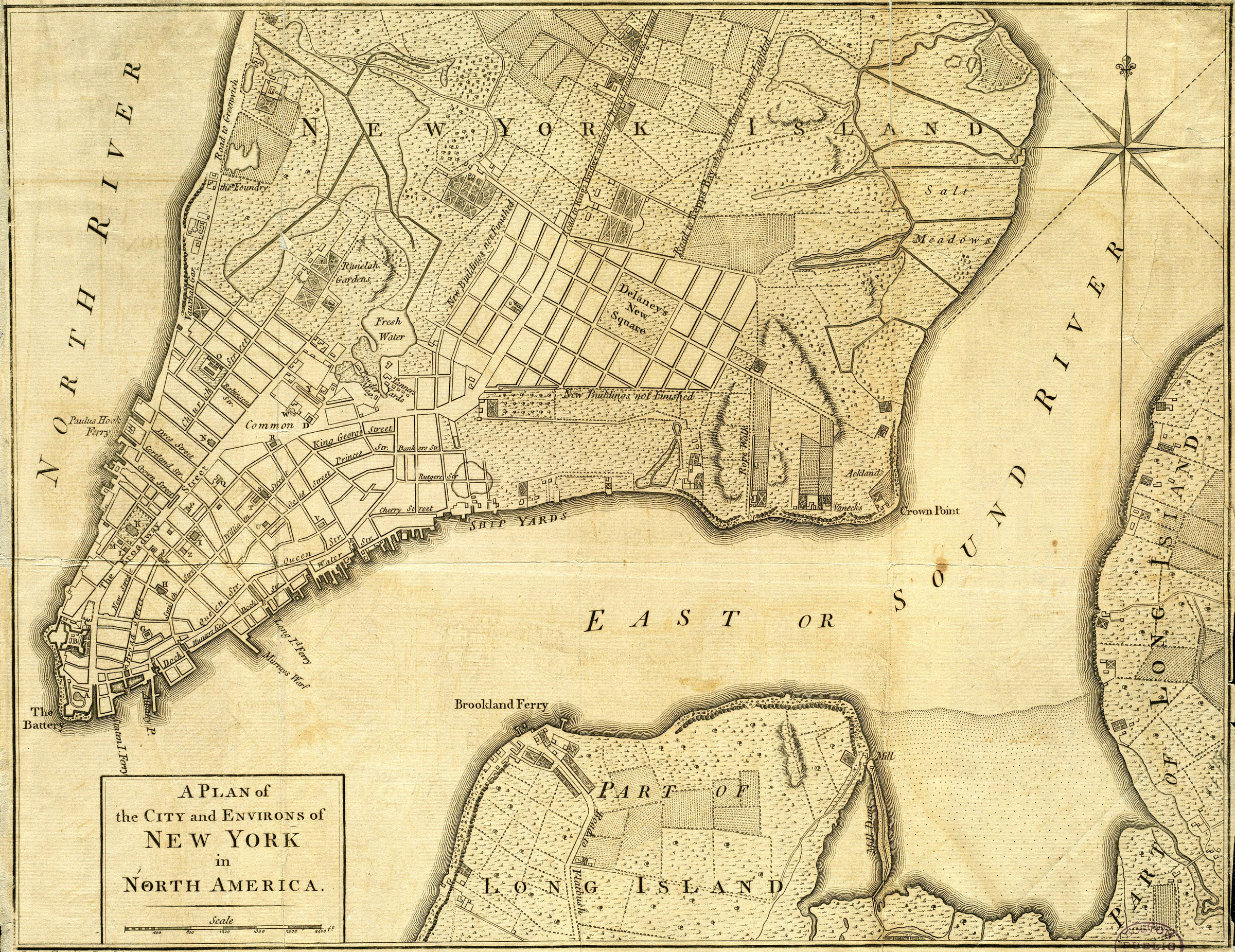
As November 1765 began, New York acting governor Cadwallader Colden was holed up in Manhattan’s Fort George (on the far left of the map above) with a contingent of the king’s military forces and the stamped paper for three colonies. Outside was a crowd of thousands of men convinced that the Stamp Act was tyrannical and determined to keep it from taking effect.

Maj. Thomas James commanded some men from the Royal Artillery inside the fort. That, and his contemptuous remarks, had caused the crowd to tear apart the mansion he was renting in town on the night of 1 November. 

Capt. Archibald Kennedy had sent “Lieutenant Owen & twenty four Marines” to the fort to support Colden. However, he added, “by doing this I leave the Ships without Marines, & as most of our men are imprest there is a great risque of their deserting.” But he declined to take charge of the stamps, lest the crown attack his home and property.

Colden asked the military engineers how they would strengthen Fort George. On 2 November, Capts. Harry Gordon (d. 1787), Thomas Sowers, and John Montresor delivered their report:
The most necessary & Expeditious way of putting this Fort in an immediate posture of defence.

A Number of Barrells Boxes or such Instruments as will contain a sufficient quantity of earth to make them Musquet proof to be put on the Salient Angles of the Bastions to form a Lodgement for 12 Men each, filld with earth 4 ft. 6 in. high. The Earth for filling them to be taken from the inside of the parapet leaving only a Banquet inside of the Barrells Boxes &c. A piece of artillery behind those lodgements towards the shoulders of the Bastions.

Two Pieces of light artillery covered with their mantelets &c. to be mounted on each Flank & the shoulders rais’d to cover them.

A Howitzer to be mounted on each Curtin towards the Town

The Crows feet to be scetterd to the Gate, Sorties and other practicable Avenues to the Fort.

All the Remainder of the Chevaux des frises to be fix’d and ready to plant along the places where the parapet remains en harbet and to be steadied by some Earth thrown against them

A Lodgment of Mattresses or Bedding or any thing proper to make a Covering a top of the large House for a Serjeant & 12 good men who have been practised to firing.

One hundred hand Grenades to be lodg’d at each Curtin & forty near each small lodgment on the Points of the Bastions to be loaded & ready to be lighted & thrown.

The Gate to be Barricaded within at Night as fast as possible & two pieces of large artillery to be planted against it, & two light pieces at some distance behind the Chevaux des frises.

The several Fronts of the Fort to be disencumbered from the Buildings &c

’Twould be necessary for the defence of the Fort if Capt. Kennedy’s House was taken possession of as it commands two Fronts the most accessible of the Fort.

Proper Instruments & Workmen for the defence should be immediately provided and a sufficient number of Men at least three hundred.

Notwithstanding the above Improvements for the defence of the place, its still under great inconveniences arising principally from the want of proper cover within, & being commanded by the Circumjacent Buildings.
In other words, even with at least 300 men, plenty of weapons, Kennedy’s full cooperation, and a lot of hard work, Fort George would still be vulnerable. It had been built to protect the city from attack by sea, not to withstand a siege by land. And was there time to do all those things anyway?

The next morning, a paper was found inside an oyster shell at the gate of Fort George, addressed to Colden himself:
Sir

As one who is an enemy to Mischief of all kinds, & a Well wisher to you & your Family, I give you this Notice that Evil is determined against you & your Adherents & will in all human Probability take Effect, unless Speedily prevented by your public Declaration upon Oath, That you will never, in any Manner, countenance, or assist, in the Execution of the Stamp Act, or anything belonging to it; and also, that you will, to the utmost of your Power, endeavour to get it repealed in England, and meanwhile prevent its taking Effect here. Your Life may depend upon the Notice you take of this Advice.

Benevolus

P.S. I well know the Guides of the People would only shew you that they may dare also; but don't incense them, for God’s Sake, by an unpolitical Contempt! You are not safe at Flushing.
Flushing was where Colden had his country estate. He was probably wishing he were there.

TOMORROW: Reaching a compromise. 

Friday, November 20, 2015

Capt. Kennedy and the Stamped Paper

On the night of 1 Nov 1765, after the Stamp Act was supposed to take effect, a New York mob signaled its disapproval of that development by burning the coach and other vehicles of Lt. Gov. Cadwallader Colden. Then some of that crowd destroyed the estate being rented by Maj. Thomas James, the commander of the fort protecting Colden and the stamped paper.

The acting governor responded with a public announcement early on the morning of 2 November that he was suspending enforcement of the new law until the new royal governor arrived. That calmed the immediate situation.

Colden also sent a letter to Capt. Archibald Kennedy (c. 1723-1794, shown here), the highest-ranking officer in the Royal Navy at New York, aboard his ship Coventry. The acting governor asked the captain if he was willing to take over the protection of the stamps:
The Gentlemen of the Council are desirous that the Stamp’d papers now in the Fort, should be put on board one of the Men of War—and I desire to know as soon as possible from you whether or not you will order them to be received on board—
Capt. Kennedy quickly wrote back to Colden:
I have this Instant received yours of this date informing me it is the desire of the Council that the Stamp’d paper should be sent on board one of the Kings Ships,

as they are already lodged in Fort George which is a place of security sufficient to protect them from any attempt the Mob can possibly make to destroy them. cannot see any plausable reason for moving them, and indeed the very attempting to move them must be attended with much greater risque than they can possibly be exposed to while there,

I shall ever be ready when necessity requires to give you all the assistance in my power
Though it seems clear Kennedy wasn’t assisting at all at that moment.

Aboard his warship, Kennedy was safe from any angry crowds, but his property wasn’t. The captain’s father had been a major businessman in New York, he had earned a lot of money from naval prizes in the wars against France, and he had married a Schuyler sister. Through inheritance, investments, and marriage, Kennedy owned a whole lot of New York real estate, including his own mansion at 1 Broadway.

The lieutenant governor explained that to British officials the next month:
Kennedy absolutely refused to receive them [the stamps], & with good reason, for he was aware of their design to force Him to deliver them by Threatning to destroy the Houses he was possesst of in the City, of which he had in his own & his wife’s Right more than perhaps any one Man in it.
I sense that Colden might have been more exasperated at his Council for suggesting this unrealistic solution than at Kennedy for resisting it. But Parliament didn’t like Kennedy’s action, or inaction, and recalled him to Britain over it. Of course, Kennedy didn’t need the navy’s salary, so he retired.

TOMORROW: Lt. Gov. Colden assesses his defenses.

Wednesday, November 18, 2015

“The effigy of a man who had been honoured by his country”

On 1 Nov 1765, New York had its first classic Stamp Act protest. This was the day the law was supposed to take place, and many other North American colonies had already seen such political disturbances.

James McEvers’s preemptive resignation as a stamp master meant that New Yorkers hadn’t had a good target for their demonstrations. Until, that is, Lt. Gov. Cadwallader Colden made it clear that as the highest royal authority in the colony he would try to enforce the new law.

As reported in the Boston Post-Boy, reprinting news from New York, the anti-Stamp demonstration on 1 November followed the usual lines:
About 7 o’clock in the evening two companies appeared, one of them in the fields, where a moveable gallows was erected, on which was (suspended the effigy of a man who had been honoured by his country with an elevated station, but whose public conduct supposed to aim at the introduction of arbitrary power, and especially in his officiously endeavouring to enforce the Stamp Act, universally held by his Majesty’s faithful and loyal subjects in America, to be unconstitutional and oppressive) has unhappily drawn upon himself the general resentment of his country.

The figure was made much to resemble the person it was intended to represent. In his hand was a stamped paper, which he seem’d to court the people to receive;—at his back hung a drum, on his breast a label, supposed to allude to some former circumstances of his life. By his side hung, with a boot in his hand, the grand deceiver of mankind, seeming to urge him to perseverance in the cause of slavery.
According to other sources, the label identified the effigy as “The Rebell Drummer of 1715,” suggesting that Lt. Gov. Colden had supported the Stuart Pretender’s uprising that year. Colden had in fact been back in Britain as a young physician in 1715; he had even gotten married there. According to him, however, he had “carried above 70 Volunteers into Kelso” to support the Hanoverian forces under Lord Jedburgh. It appears men of Scottish descent like Colden remained vulnerable to accusations of Jacobite disloyalty, even fifty years later.

Back to the New York protest:
While the multitude gathered round these figures, the other party with another figure representing the same person, seated in a chair, and carried by men, preceeded and attended by a great number of lights, paraded through most of the public streets in the city, increasing as they went, but without doing the least Injury to any house or person. They proceeded in this order to the coach-house at the fort, from whence they took the Lieut. Governor’s coach, and fixing the effigy upon the top of it, they proceeded with great rapidity towards the fields.

About the same time the other party was preparing to move to the fort, with the gallows as it stood erect on its frame, and lanthorns fix’d on various parts of it. When the two parties met, and every thing was in order, a general silence ensued, and proclamation was made that no stones should be thrown, no windows broken, and no injury offered to any one,—and all this was punctually observed.

The whole multitude then returned to the fort, and though they knew the guns were charged, and saw the ramparts lined with soldiers, they intripidly marched with the gallows, coach, &c. up to the very gate, where they knocked, and demanded admittance, & if they had not been restrained by some humane persons, who had influence over them, would doubtless have taken the fort, as I hear there were 4 or 500 seamen, and many others equally intrepid, and acquainted with military affairs.

But as it seems no such extremities were intended, after they had shewn many insults to the effigy, they retired from the fort gate to the bowling green, the pallisades of which they instantly tore away, marched with the gallows, &c. into the middle of the green, (still under the muzzles of the fort guns) where with the pallisades and planks of the fort fence, and a chaise and 2 sleys, taken from the governor’s coach house, they soon reared a large pile of wood round the whole, to which setting fire, it soon kindled to a great flame, and reduced the coach, gallows, man, devil, and all to ashes.
All classic anti-Stamp demonstrations involved burning an effigy like that. By adding four of Colden’s vehicles to the fire, the crowd got more fuel. But they hadn’t destroyed anyone’s house.

TOMORROW: Yet.

Tuesday, November 17, 2015

Protesting the Stamped Papers inside Fort George

As I noted back here, the designated Stamp Tax collector for New York, James McEvers, resigned that post on 26 Aug 1765, after hearing about how Bostonians had smashed up Andrew Oliver’s house.

Acting governor Cadwallader Colden insisted on enforcing the law nonetheless. Because the British military had made New York its base at the end of the Seven Years’ War, there was a sizable contingent of soldiers in the city, as well as Royal Navy ships and marines. Colden thus didn’t have the problem that stymied Gov. Francis Bernard in Massachusetts—that he could not rely on the militia to stop a mob when the mob was made up of the militiamen.

Colden asked the navy, under the command of Capt. Archibald Kennedy, to intercept the ships carrying stamped paper and carry that precious cargo to Fort George, there to be protected by the Royal Artillery under Maj. Thomas James.

That didn’t sit well with the city’s inhabitants, as reported in the New-York Gazette of 7 Nov 1765 and reprinted eleven days later in the Boston Post-Boy:
On the 23d of October, by Capt. Davis, arrived a parcel of the stamps, which immediately raised a spirit of general uneasiness in the town;—they were put under convoy of a man of war, landed and deposited in the fort. The Governor had very injudiciously, some time before the arrival of the stamps, made a great shew of fortifying the fort, providing it with mortars, guns, ammunition, and all the necessaries for the regular attack of an enemy—and it was given out that he threatened to fire on the town if the stamps were molested (which greatly exasperated the people). Representations against these measures were made to him; and they were, I believe, discontinued, but resumed again upon the arrival of the stamps.

From this time several papers appear’d stuck up in public places about the town, threatening every person that should deliver or receive a stamp. The preparations at the fort were continued with greater vigour, and the people grew more uneasy and enflamed. On the 31st of October, the merchants had a meeting, where they enter’d into an obligation that none of them should order any goods from England till the stamp act was repeal’d, that the orders already sent (and not executed) should be countermanded, (except grindstones, &c. for such ships as were there belonging to this place) and that they should accept no goods on commissions, or assist in the sale of any sent here. This was subscribed by upwards of two hundred merchants.

The shopkeepers also obliged themselves to purchase no goods sent here contrary to the above articles, till the stamp act was repealed. That evening a large company suddenly assembled and marched to the walls of Fort George, and from thence thro’ several streets in the city. The magistrates appeared, and endeavoured to disperse them, but in vain. After a short time they suddenly dispersed of themselves without doing any mischief. It was rumour’d about town a much larger concourse would assemble the next night, and their visit was by some expected, while others thought they would meet no more.
The map above shows Fort George, courtesy of the Library of Congress. The big round spot at the bottom is the Bowling Green with a statue of King George III in the center. (ADDENDUM: The statue was installed in 1770.) It’s currently the site of the Alexander Hamilton U.S. Custom House.

TOMORROW: The day the Stamp Act was supposed to take effect.

Monday, November 16, 2015

Two Gentlemen Who Couldn’t Possibly Take Charge of Connecticut’s Stamped Paper

When the British government instituted the Stamp Act for North America, one of the first steps was to buy a lot of paper. With the tax added, that paper was budgeted to bring in over £100,000 from the thirteen colonies that became the U.S. of A. alone. The untaxed cost of that paper was less, but it was still a substantial investment for the government.

The paper was also a substantial chunk of government property to take care of. Naturally, most colonial officials didn’t want to take any more responsibility for that than they had to.

On 9 Sept 1765, as the anti-Stamp protests heated up in Connecticut, designated stamp master Jared Ingersoll asked a favor of Cadwallader Colden (1688-1776, shown here), the acting governor of New York:
the Stampt papers intended for this Colony are Expected to arrive Soon at N. York & were to have been forwarded to me who am appointed the Distributer here, but the unaccountable rage & fury of the Mob is at present So high against Stamp Officers & papers that I do not think it Safe to have the later Sent here as yet

I have therefore to desire of you to protect the Same when they Shall arrive by placing them in the Fort, or otherwise as you shall be Able, until Some further Steps may be taken . . .

my Duty to the King obliges me to give You this trouble

I am Sr
Yr Most Obedt & Most Humbl. Servt.…
On 14 September, Colden responded:
I have yours of the 9th desiring me to take care of the stamp Paper for your Colony when they arrive. In my opinion they may be put more safely & with greater ease on board one of the Men of War at this Place, & more easily conveyed from thence to your Colony, than by placeing them in this Fort, where it is too probable there will be a necessity of placeing those designed for this Colony. This Fort at present is crowded with Men & military Stores. It may be proper for you or some Person for you to be in this place to take care of your Stamp’d Papers, as my hands are too full with the affairs peculiar to this Province. . . .

I am with great Regard, Sir,…
Ingersoll publicly resigned his post as stamp master on 19 September, as described starting here. He therefore told Colden that the papers were really no longer his charge:
by the time that your favour of the 14th reached my house, I had been Compelled in a most Extraordinary manner to declare I would not directly or indirectly intermeddle with the Stampt papers intended for this Colony—at present therefore when all the Springs of Government are broken I can do no more than recommend to you to take the best Care you Can of those Stampt papers for the Crown until you shall have further directions concerning them from the Commissioners of Stamps, or from me

I am
Yr. Most Obedt. Humb Servt.…
When the stamps for Connecticut actually arrived, Gov. Colden silently disregarded that request and had his son David (1733-1784) take up the correspondence on 28 October:
The Gover. Orders me to inform you that Captn. Davis has brought over three Packages of Stamp’d Papers Marked for Connecticut, which are now lodged in the Governor’s House in the Fort. The Gaspey Cutter is now here & is a very fitt vessell for carrying the Papers to you if you can prevail upon Captn. [Archibald] Kennedy to order her to do it. We hear more Stamped Paper is on board three Ships daily expected here.

I am with great Regard, Sir,…
Ingersoll replied directly to the acting governor on 31 October:
Yesterday I received your favour of the 28th advising me of the Safe arrival of part of the Stamp papers intended for this Colony. I immediately advised with the Governour [Thomas Fitch] on the Subject & for Answer have to Say, that as the people of this Colony have with impunity offered the most high handed violence to my person on account of my having undertaken to be Distributor of Stamps And still Continue their threats to me in case I shall intermeddle with the Stamp papers, as also the destruction of the papers themselves, and as the house of Representatives of this Colony have lately voted the Act of Parliament itself unprecedented & unconstitutional whereby the peoples Spirits are kept up, and as we have no Strong hold wherein to place the papers, I Cannot think it Safe for me or the papers or prudent to bring them into the Colony & have therefore only to thank you for your past goodness & to repeat to you my request that you will be So good as to keep & protect the papers that have or shall arrive at N.York until you Shall receive further directions about the Same.

I am Sr
Yr. Most Obedt. Humble Servt.…
I like how the complimentary closes to those letters give an “Alphonse and Gaston” tone to this exchange.

By the time Colden received Ingersoll’s last letter, the situation in New York had become dire. Connecticut’s paper was the least of his troubles.