J. L. BELL is a Massachusetts writer who specializes in (among other things) the start of the American Revolution in and around Boston. He is particularly interested in the experiences of children in 1765-75. He has published scholarly papers and popular articles for both children and adults. He was consultant for an episode of History Detectives, and contributed to a display at Minute Man National Historic Park.

Subscribe thru Follow.it


•••••••••••••••••


Showing posts with label deathways. Show all posts

Saturday, September 19, 2026

Sequencing Thomas Jefferson’s D.N.A. Confirms Historical Evidence

The New York Times is reporting on a Smithsonian study to be published in book form this week that:
  • completely sequenced Thomas Jefferson’s D.N.A.
  • found that it matched fifth-generation descendants of both Martha Jefferson and Sally Hemings in the percentage to be expected of descendants of Thomas Jefferson.
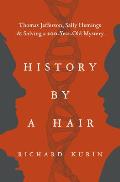
The book is History by a Hair: Thomas Jefferson, Sally Hemings & Solving a 200-Year-Old Mystery, by Richard Kurin.

When Kurin launched this study fifteen years ago, the sort of genetic testing it ended up using wasn’t yet available. Extracting a complete genome from hair was thought to require follicles, not a snipped lock, plus a lot of luck that the molecules hadn’t degraded.

Another bump in the road was when strands of hair found in Jefferson’s edited Bible turned out not to be his, based on their mitochondrial D.N.A.

But Monticello was able to provide another hair sample, said to be clipped from Jefferson’s head during his last illness in 1826. That produced a match with the descendants who had provided D.N.A. samples.

Back in 1998 Nature published a study led by Eugene A. Foster which found a Y-chromosome match between patrilineal descendants of one of Jefferson’s paternal uncles and a patrilineal descendant of Eston Hemings. The same test found that chromosome was different for patrilineal descendants of Jefferson’s nephews Patrick and Samuel Carr and of Thomas Woodson, believed by some relatives to be a Jefferson child.

Already there was strong historical evidence for Jefferson’s paternity of Eston Hemings, his brother Madison Hemings, and the other siblings Madison named. The Y-chromosome findings were entirely consistent with Madison’s description of the family in 1873. Most historians considered the question settled.

Some Jefferson “defenders,” however, responded to the Foster study by proposing Thomas Jefferson’s brother Randolph or his sons as a possible source for that patrilineal D.N.A. Those men had never been publicly linked to Sally Hemings before.

This new analysis looked at Thomas Jefferson’s D.N.A. distinct from Randolph’s, removing that brother and his sons from consideration. 

This study also involved more descendants, not just those with a patrilineal connection. In fact, the descendant in the study sharing the most D.N.A. with the third President (5%) is a descendant of Sally Hemings, not of Martha Jefferson.

Monday, September 07, 2026

“Ever afterwards, he was known as Dr. Bush”

David Bushnell’s pioneering submarine didn’t do much damage to the Royal Navy in 1776, but the next year he came back with another invention.

As Christian McBurney relates in this article, in August 1777 Bushnell oversaw an attack on H.M.S. Cerberus with explosive mines. They didn’t hit the warship, but they did destroy a schooner and kill three British sailors.

In August 1779 Bushnell became an officer in a new Continental corps of “Sappers and Miners.” Two years later, Capt. Bushnell led his specialized unit in the siege of Yorktown.

In 1787 Bushnell moved from Connecticut to France. There’s not much evidence of what he did there. Some people speculate that he crossed paths with Robert Fulton, who would design his own submarine as well as a steamboat. However, it looks to me like Fulton didn’t go to France until 1797, and by then Bushnell was back in the U.S. of A.

Not in Connecticut, however. Instead, Bushnell settled in Georgia “in 1795 or 96,” according to the Rev. George White’s Historical Collections of Georgia (1854). At first he was “a teacher in the County of Columbia.”
He was eminently distinguished for his classical and scientific learning. His chief enjoyments were found in the instruction of his classes, and an occasional visit to a few men of congenial spirit. . . .

His old fellow soldier, the Hon. Abraham Baldwin, received him into his family, under whose auspices he had no difficulty in placing himself at the head of one of the most respectable schools in Georgia. In this vocation he spent several years, and under his guidance and tuition many of our most useful citizens received valuable instructions in learning and morals.
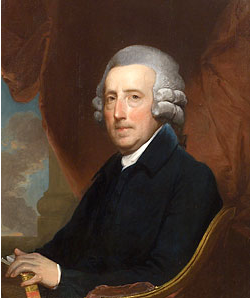
Bushnell and Baldwin (1754–1807, shown above) had met at Yale in the early 1770s. Baldwin was barely a “fellow soldier,” though; he had been a chaplain for Connecticut troops but spent most of the war preparing for the Congregationalist pulpit. Then in 1783 he suddenly changed direction, became a lawyer, and moved to Georgia.

Within a few years Baldwin was representing the state in the Confederation Congress, the Constitutional Convention, and the first federal House of Representatives. He also served as president of the nascent University of Georgia while it was organized.

As for the “family” that Baldwin welcomed Bushnell into, both men were lifelong bachelors. It looks like Bushnell shared Baldwin’s house for several years before the younger man died suddenly in 1807 while serving in the U.S. Senate.

The Historical Collections of Georgia profile of Bushnell continued:
Late in life, he settled in Warrenton as a practitioner of physic. Then, and ever afterwards, he was known as Dr. Bush. For reasons which have never been disclosed, he had some time before he settled in Georgia, dropped the last syllable of his name; and until the publication of his last will and testament, no person in this country, except his old friend Baldwin, was apprised of the fact that his family name was Bushnell.
The name of “David Bush, Phicion [physician]” does appear on Georgia tax records for 1805, owning “Stock in trade & House adjoining Warrenton.” Three years later, he bought more real estate. In 1810 David Bush was one of the commissioners to incorporate the town of Warrenton, named for Dr. Joseph Warren.

At least one other local did know Dr. Bush’s real name, however. In 1814 George Hargraves, a notary in Warren County, wrote a letter to Thomas Jefferson enclosing a “description and drawing of a Torpedo” that might be useful to the U.S. in the current war. He said the inventor was “a man of science” mentioned in David Ramsay’s history of the Revolution, hinting: “you will readily conjecture who the Inventor is.” Bushnell must therefore have entrusted Hargraves with his secret, just as he trusted the man to be an executor of his will.

Dr. Bush probably died in early 1826. Hargraves started advertising for his debtors to come pay what they owed the estate on 15 March of that year.

On 9 August an item appeared in the Middlesex Gazette of Middletown, Connecticut, reminding readers about Bushnell and his “destructive machine.” It reported:
About 30 years since, Mr. Bushnell left his native town, and from that period no information was received respecting him, until very recently, when a gentleman arrived in Saybrook from Georgia, with the intelligence that Mr. Bushnell had lately died in that State, leaving about 9,000 dollars in cash; accumulated principally by the practice of Medicine; which Mr. B. had given to him, he being a particular friend, provided that if he should, upon inquiry, discover that Mr. B’s connexions in Saybrook, were from their character, worthy of the property, such connexions were to receive the whole amount.

The gentleman with whom it was entrusted, ascertained, on reaching Saybrook, that Mr. Bushnell’s nearest relatives were four nephews, and those all men of worth and integrity, and faithfully divided the property among them.
Those were the sons of David Bushnell’s brother Ezra. In addition to the money, this article said, he bequeathed them an “unfinished a piece of mechanism, upon which he had bestowed much pains”—but what it was, the newspaper didn’t, or couldn’t, say.

The Middlesex Gazette stated: “Mr. Bushnell…bore a very high reputation as a mechanical genius, and was esteemed an exemplary member of society, although possessing many eccentricities of character.” Again, the paper didn’t say what those eccentricities were.

Wednesday, August 26, 2026

Identifying a Revolutionary Unknown Soldier at Camden

Last month the Independent newspaper reported on the identification of remains from the Revolutionary War using a relatively new method.

The story started on the battlefield at Camden, where on 16 Aug 1780 Gen. Cornwallis’s redcoats decisively defeated a Continental force under Gen. Horatio Gates.

The article says:
Archaeologists surveying the area in 2020 came across human bones protruding from the ground. Eventually, 14 sets of remains were identified — 12 of them Continental soldiers. The others were determined to be connected to the British side and were reburied at the battlefield.

The Richland County Coroner’s Office had worked with Texas-based FHD Forensics on modern-day cases and asked for their help.
The head of that organization is Allison Peacock. She and her associates use the immense databases of genetic code that have built up in recent decades to find unknown biological relatives for a range of reasons.

One of the American corpses was labeled “Camden 9B” as the second body retrieved from the ninth excavated burial.
The 12 Continentals were later reinterred [in 2023] with full military honors. Camden 9B’s headstone read: “UNKNOWN. REV WAR. BATTLE OF CAMDEN. AUG 16 1780.”

Meanwhile, samples from two of the soldiers were sent to Astrea Forensics in California for DNA extraction and sequencing. . . .

From a petrous portion of the temporal bone, a delicate structure behind the ear at the base of the skull, they successfully extracted DNA that generated [Camden 9B]’s entire genome. Peacock’s team then uploaded the data to FamilyTreeDNA and GEDmatch to trace three types of DNA matches: autosomal, X chromosome and Y chromosome.

“We got 20,000 matches to work with,” she said. “So, it was a lot to kind of comb through.”
Another clue was that when Camden 9B died, “the growth plates around his knees had not yet fully closed,” meaning he was still young.

The genetic markers found a match on the maternal line with Russ Hudson, a “retired federal agent in Gettysburg, Pennsylvania.” He offered to join the search in archival sources.

Ultimately, the team found records of a Continental Army private from Anne Arundel County, Maryland, named John Pumphrey. He was in the right age range and had a family connection to Hudson.

Pumphrey’s exact birthdate is unknown, but those growth plates suggest he was between thirteen and fifteen years old when he enlisted in the 7th Maryland Regiment on 6 Jan 1777. He could sign his name only with an X.

As Historic Camden relates, Pumphrey’s regiment served at Brandywine, Germantown, Valley Forge, and Monmouth. He reenlisted on 28 Feb 1779, as shown in the paperwork above. The regiment spent the brutally cold winter of 1780 at Morristown.

In April 1780, the Maryland Line was sent south. The last part of their travels was a brutal trek from Cox’s Mill, North Carolina, to Camden, South Carolina—a difficult route with little food available along the way. Then came the battle for one of the British army’s main inland garrisons.

The skeleton doesn’t preserve clues to how Pvt. Pumphrey died. However, his brigade was part of an especially brutal fight with the 71st Highlanders, and the bodies were found in that part of the field.

Research continues on another of the bodies from the Camden field that had surviving D.N.A.,  now known only as 11A.

Sunday, August 23, 2026

The Return of Benjamin Davis

In late 1783, Benjamin Davis, Sr., and Benjamin Davis, Jr., sailed out of New York harbor, their second evacuation to Canada in the course of the American Revolution.

Father and son bought a land grant in Nova Scotia from Samuel Barnard and helped to establish the new town of Shelburne, continuing to work as merchants. Benjamin, Jr., went to London the next year, presumably to make contacts.

In the fall of 1786, Benjamin, Sr., was appointed a judge of the court of oyer and terminer in Nova Scotia. During the British Empire’s wars with Napoleonic France, Davis administered prize money from privateers; the signature above comes from one of those documents.

I’ve been frustrated in my efforts to learn more about the enslaved man captured and held with the Davises in 1776–77. Canadian records show Benjamin Davis continued to be a slave owner. In October 1789, he sold the Rev. John Agnew claim to “four negroes named Prince, and Bella his wife, and two children named Peter and William.”

At some point the Davises quietly moved back to Boston, where their family roots were, even though in 1778 Massachusetts had banished the older man by name and prepared to confiscate his property.

Boston newspapers reported that Benjamin Davis, Sr., died on 14 Sept 1805. Probate judge Thomas Dawes, Jr., appointed an administrator for his estate, which was found to consist entirely of household furniture worth just $101.

Benjamin, Jr., sold the Shelburne land in 1809. On 31 Dec 1836, the Boston Courier and Columbian Centinel reported the death three days before of “Benjamin Davis, Esq., aged 81.” The newspapers stated:
he was the last male descendant (of the name) in Boston of Capt. William Davis, an early settler, and well known character in the colony history.
I hadn’t planned to spend two weeks on Benjamin Davis, but the remarks from 1776 about him and gingerbread piqued my curiosity, and then there were more threads to pull.

Friday, July 17, 2026

A Boston Stone

This month the city of Boston announced a new finding about a stone in the Granary Burying Ground that reads:
HERE LYES Ye.
BODY OF BOSTON
AGED 70 YEARS
DECd. FEBy. Ye. 28
1 7 2 8
Kelly Thomas, director of the Historic Burying Grounds Initiative for the Boston Parks and Recreation Department, told WBZ: “I was reviewing the photos of headstones, and then I noticed that the stone only had one name.” A geographic name, at that. That hinted the person buried there had been an enslaved man.

Some documentary research turned up records of such a man. Indeed, Gloria McCahon Whiting discussed Sebastian’s marriage to Jane Lake at length in her 2024 book, Belonging: An Intimate History of Slavery and Family in Early New England. Judge Samuel Sewall helped to negotiate the terms of that union at the same time he was writing The Selling of Joseph, his pioneering but self-suppressed anti-slavery pamphlet.

On 13 Feb 1701, after protracted discussions between the couple’s two owners, the judge married the couple. Sebastian’s owner, John Waite, died the next year. Six years after that, when the Boston selectmen listed free black men in town they put to work mending roads (since those men were free/barred from militia training), one of those men was identified as “Bastion Waite.”

Interestingly, Sebastian’s wife came to be known as Jane Basteen and then Jane Boston, taking (or being assigned) her husband’s name while he was assigned his late owner’s surname. As Whiting pointed out, Sabastian would name his second son Joseph, echoing Sewall’s pamphlet. Meanwhile, Sebastian’s name evolved into “Boston.”

The issue of the New-England Weekly Journal dated 24 Feb 1729 included this death notice:
On the 14th. Instant [i.e., of this month] died here a Negro Freeman named Boston, in an advanced Age, and on the 17th, was very decently Buried. A long Train follow’d him to the Grave; it’s said about 150 Blacks, and about 50 Whites, several Magistrates, Ministers, Gentlemen, &c.——

He having borne the Character of a sober Virtuous Liver, and of a very trusty honest and faithful Servant to all that employ’d him, and having acquir’d to himself the general Love and Esteem of his Neighbours by a Readiness to do any good Offices in his power for every one; his Funeral was attended with uncommon Respects, and his Death much lamented.
The carved gravestone, whether paid for by Boston’s estate or by his friends, was another sign of his standing in the community. It is, Mayor Michelle Wu now notes, “one of the oldest gravestones of a free Black person in America.”

At first I was confused by the different death dates stated in the newspaper and on the gravestone. But then I realized the stone was written in the Old Style, Julian date system while the newspaper followed New Style, Gregorian dating decades before the British Empire adopted it officially.

Tuesday, June 16, 2026

Act Worthy of Yourselves at King’s Chapel, 18–20 June

King’s Chapel has brought back Act Worthy of Yourselves, a sixty-minute drama set around the funeral of Dr. Joseph Warren in April 1776.

The teaser copy says:
The British army has finally left Boston. Now, nearly a year after his death, friends and family can finally hold a funeral for Dr. Joseph Warren.

Inside King’s Chapel, his brother, his fiancée, and his good friend Paul Revere gather to mourn Warren and to make sense of their loss. Outside the Chapel, two Black abolitionists wonder what this revolution will mean for them. A play about memory, legacy, and the potential and pitfalls of the American Revolution.
While anchored in April 1776, the play flashes back to episodes in the life of Dr. Warren earlier in the 1770s. In addition to the doctor’s brother John and his fiancée, Mercy Scollay, the characters include the black businessmen Lancaster Hill and Prince Hall, Paul and Rachel Revere, Abigail Adams, merchant and Freemason John Rowe, medical trainee William Eustis, rising young lawyer Perez Morton, and Christopher Monk, badly wounded at the Boston Massacre.

This play was written by Noah Good and Kaitlin Rose, and directed by Anjie Echemendia. With that large cast and many scenes set at different times and places, it’s a complex undertaking. Last year, as I recall, many of the performers came from the King’s Chapel interpretive staff rather than Boston’s professional theatrical scene.

The remaining performances for this year are on 18–20 June at 7:30 P.M. and on Saturday, 20 June, at 2:00 P.M. Tickets cost from $40 to $15 depending on the view, and are available through this website.

Wednesday, June 03, 2026

Archeological Investigation on Breed’s Hill This Month

For the next couple of weeks, the Boston City Archaeology Department will be conducting a dig on Breed’s Hill in Charlestown. The public can watch the investigation proceed while visiting the battle monument.

The program’s website explains:
There have been multiple archaeological surveys surrounding the Bunker Hill Monument, the site of the redoubt on Breed’s Hill and currently a National Park. These surveys have revealed the likelihood that the 1775 redoubt structure may still be identifiable under the current surface of the grassy hill.

Ground penetrating radar (GPR) and other non-invasive remote sensing techniques have been useful for finding earthworks, and a previous GPR survey on the monument hill in the 1990s had promising results suggesting an oval-shaped trench present on the hill.

Technology has significantly improved since this original survey and the City Archaeology Program is actively working with the National Park Service and other partners on a plan to re-survey the top of the hill to provide an even better underground snapshot of the location and condition of the 1775 redoubt.

A goal of the project is to accurately document the presence and location of the 1775 redoubt, including the potential for an archaeological trench across the original redoubt to reveal a section of the surviving fortification as part of the 250th celebrations in the summer of 2025.

In addition to the redoubt, the team is also actively working to use remote sensing techniques to identify areas of potential burials for the more than 300 individuals who lost their lives during the battle, including both colonial and British forces. The colonial forces included people of color and Native individuals from multiple Native nations. No burials will be disturbed as part of this work, but radar and documentary surveys may help to better protect these locations.
The department is working working with the National Park Service and American Veterans Archaeological Recovery with support from the Friends of Boston Archaeology.

The department shares lots of information from previous archival and geographical investigations of Revolutionary Charlestown on its webpage.

Monday, May 25, 2026

“The services of their father in repairing certain cannon”

Preserved Clap was born in Hadley, lived in the part of that town which became Amherst, and ultimately died at age eighty up the Connecticut River in Claremont, New Hampshire.

His headstone appears here courtesy of Find a Grave. His wife Eunice’s stone is nearby.

Clapp probably had earlier ties to that region. The Preserved Clap listed as serving in 1775 in a provincial company recruited largely from Bolton was said to come from Charlestown, New Hampshire, next to Claremont.

There’s also this curious anecdote related by Jaazaniah Crosby in his History of Charlestown in New Hampshire (1833):
On the 18th of June, 1756, while Lieut. Moses Willard was endeavoring to extinguish the fire, which had been kindled in his fence, he was attacked by the Indians, and killed behind the barn of the late Capt. John Willard, and near the academy. At the same time, his son Moses was wounded in the hip by a spear, which is said to have remained in the wound till after his retreat into the fort. It is further said that a Mr. Preserved Clap carried the same spear into the revolutionary war.
Preserved and Eunice Clap’s son Roswell was living in Claremont by 1790, per the first U.S. Census.

Dr. Clap’s children followed in his footsteps in at least one way: asking to be paid for his inventions during the Revolutionary War.

In 1837, the U.S. Senate took up “the petition of Roswell Clapp and Charlotte Reed, children and heirs of Preserved Clapp, praying compensation for the services of their father in repairing certain cannon belonging to the United States.” That referred to work sixty-one years before, just after the siege of Boston.

And the Clap family kept up that plea until 1841, thirty years after the doctor had died.

Sunday, February 15, 2026

“The Villain that murdered Colo: Parsons Brother is here”

Back here I described the family of the Rev. Jonathan Parsons of Newburyport, including his fourth son, Thomas Parsons, who disappeared in 1772.

The third son, Samuel Holden Parsons, became an attorney in Lyme, Connecticut. He prospered, getting elected to the colonial assembly, and then moved to New London. At the start of the Revolutionary War Parsons raised a regiment and marched north.

Parsons served through the siege of Boston and in the spring of 1776 led his troops south through Connecticut to defend New York.

Soon after Continental officers detained Basile Boudrot (alias Dugan) on suspicion of murdering Thomas Parsons and his crew, someone sent the news to Col. Parsons.

The next trace of Boudrot that we have is therefore Gen. Philip Schuyler’s 12 June letter from Albany to Gen. George Washington:
The Villain that murdered Colo: Parsons Brother is here. The Colo: desired Me to send him to New York I wait Your Excellency’s Directions.
Washington replied on 24 June:
As Colonel Parsons has requested you to send the Person who is supposed to have murdered his Brother, I have no objection to your doing it, if you judge it necessary. He, from what I have been told, designs to apply to Congress, for instituting some Mode of Trial for the Offence.
Schuyler (shown here) proceeded on that course. On 11 July, John Holt’s New-York Journal reported:
Last Sunday [7 July] one Bazel Bonderot, a native of Nova-Scotia, was brought to this city from Canada, charged with being a principal in the murder of Captain Thomas Parsons, and eight other persons, in Nova-Scotia, in February 1772.

Soon after this murder was perpetrated, he fled his country, and has been wandering from place to place ever since, till last April, when he was providentially detected by Captain Hector McNeil, properly secured, and sent forward to receive the just reward of his crimes.

He was yesterday sent on from this city to Newbury Port, the place where Captain Parsons last lived, for examination and trial.
That article was reprinted in several newspapers, and eventually in the 19 July Essex Journal of Newburyport.

That same issue of the Essex Journal reported:
This Morning, between 6 and 7 o’clock, departed this life after a long tedious illness, the Rev. JONATHAN PARSONS, in the 71st year of his age, and in the 31st of his MINISTRY in the PRESBYTERIAN Church, in this Town—His remains to be interred on Tuesday next, at three o’clock in the afternoon.
It’s not clear whether the minister heard about the capture of his son’s alleged killer before he died.

TOMORROW: Deliberations in the Congress.

Sunday, February 01, 2026

Getting Warmer on the Origin of a Warming Pan

At Historic New England, Erica Lome, curator of collections, shared a behind-the-scenes essay about a warming pan with a Revolutionary heritage of sorts:
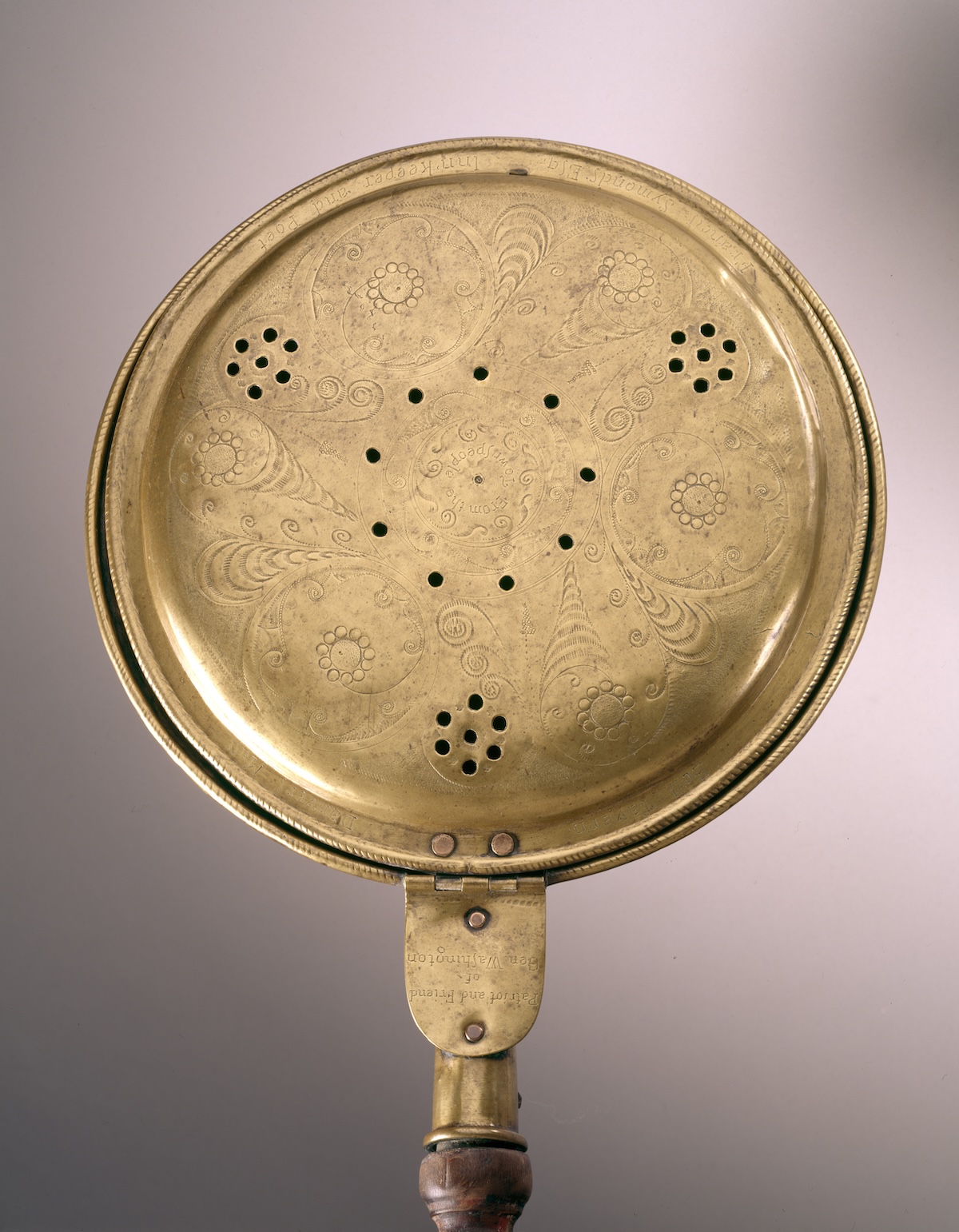
Tucked away in the parlor at Historic New England’s Cogswell’s Grant in Essex, Massachusetts, is a warming pan with a turned wooden handle and a brass container pierced with holes and engraved with scrolling vines and flowerheads. Also referred to as bed warmers, warming pans were a common household tool in colonial and post-revolutionary America, filled with embers and placed under the sheets of a bed to warm it before use.

This particular warming pan had more than just decorative motifs adorning its metallic surface. Engraved on its lid are the words:
From the Townspeople / Patriot and Friend of Gen. Washington / Bell Tavern, Danvers, Massachusetts / Francis Symonds Esq. Innkeeper and Poet.
On the pan’s sides, inside the incised outline of a bell:
I’ll toll you / if you have need / and feed you well / and bid you speed.
On the other side:
Francis Symonds / makes and sells / the best of chocolate / also shells.
John Warner Barber’s Historical Collections (1839) recorded that those verses hung on signs outside the Bell Tavern. In 1841 the Boston Cultivator stated that innkeeper Symonds’s “poetic genius caused [those lines] to be inscribed”; as Lome notes, he was known for adding bits of rhyme to his advertisements. (The Cultivator changed “also shells” to “and shells,” which scans better if you put three syllables into “chocolate.”)

The essay continues:
By its history, as recorded by Nina Fletcher Little, the warming pan was presented to Symonds around 1785: “After the war’s close, the citizens of Danvers evidently wished to present Symonds with a token of their esteem and decided on a warming pan as a practical gift.” The engraved inscription inside the bell matched the Bell Tavern’s signpost. The additional inscription praised Symonds as a patriot, friend of George Washington, and a poet, truly a prominent citizen and worthy of appreciation.

When researching this object for [the upcoming exhibit] Myth and Memory, one major detail of Symonds’s life challenged its story: Francis Symonds died on September 22, 1775. According to the Essex Gazette:
“On the 22nd Instant died at Danvers and on the 24th was very decently interred, Mr. Francis Symonds, Innholder, in the 5th Year of his Age. He was very just in his Dealings, and compassionate to the Poor as far as lay in his Power. In his last Sickness, especially towards the Close of Life, his Calmness and Resignation were very remarkable. He has left a sorrowful Widow and 6 Children, for whom we wish that the fame Compassion that he has shown to others may be shown to them.” . . .
Francis Symonds mustered for two days with Colonel [Timothy] Pickering’s regiment during the Battle of Lexington and Concord, and again on April 24, 1775, serving for a little over three months, until August 1, 1775. He was at home when he died of illness.

So, what about the warming pan? It seems very unlikely that the town of Danvers presented it to him on his deathbed, nor to his family immediately after, given the ongoing Siege of Boston. What is its true history?
Lome doesn’t offer a definite conclusion, but I like her hypothesis that the words were inscribed during a commemoration of the Revolution, such as Danvers’s dedication of a memorial obelisk near the Bell Tavern in 1835. Or later, when warming pans themselves were becoming relics of a quaint past. 

Sunday, December 21, 2025

The Burdicks after the Boston Massacre

In the year after the Boston Massacre, Benjamin Burdick became the proprietor of the Freemason’s Arms tavern—better known as the Green Dragon Tavern, owned by the St. Andrew’s lodge.

I imagine his wife Jane did a lot of the hosting since Benjamin remained Constable of the Town House Watch through 1774.

As the London government cracked down and war approached, the Burdicks moved out to Marblehead. Benjamin opened a “large, genteel, and commodious” inn opposite Jeremiah Lee’s mansion. Soon he was watching over auctions of captured goods and vessels. Later the inn hosted auctions of estates confiscated from absent Loyalists.

By 1786 Burdick had relocated to Danvers, at the Sign of the Flag, but that property was sold the next year. Jane was back in Boston when she died in 1791. I haven’t found a record of Benjamin’s death. (It doesn’t help that genealogists have intertwined him with a man of the same name from Westerly, Rhode Island.)

In 1778, the Boston merchant Samuel Phillips funded the opening of a new academy in Andover with Eliphalet Pearson as preceptor. The inaugural class of that school included Malcolm McNeil Burdick, born in Boston 1764—the Burdicks’ oldest son. (His first and middle name appeared with different spellings.) Malcolm was in his teens but for some reason listed as age ten in school records.

Later Malcolm M. Burdick went to sea, appearing in advertisements as master of the Minerva sailing from Baltimore to Liverpool in 1801 and of the John out of New York in 1807. By 1812 he had settled in Windham, Maine, where he advertised that someone else’s livestock had gotten onto his land.

Another of Benjamin and Jane Burdick’s sons, William, born in 1774, went into printing. In July 1795 he and Benjamin Sweetser cofounded a newspaper in Boston called the Courier. Soon that became The Courier, Boston Evening Gazette and Universal Advertiser. Burdick signed over his portion of the business to Sweetser in December, and it ceased publishing in March 1796 after a fire.

[ADDENDUM: From 1798 to 1800 William Burdick was the junior partner in publishing the Oriental Trumpet newspaper in Portland, Maine. He then returned to Boston.]

In 1809 William Burdick married Lucretia Sprague (1788–1849), daughter of Continental artillery veteran Samuel Sprague (1753–1844). According to her brother, the banker and poet Charles Sprague (1791–1895), their father was also part of the Boston Tea Party.

William Burdick reused the Boston Evening Gazette name for a new periodical in 1813. His printing office at Congress and State Streets was next to the Exchange Coffee House, and he bought stock in that jittery enterprise. The printer’s older brother Malcolm sold subscriptions up in Maine.

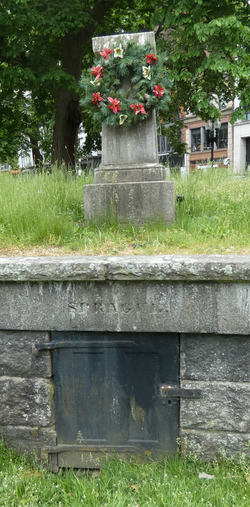
That Boston Evening Gazette evolved into the the Boston Intelligencer in August 1816. Burdick sold the business the following January and died on 30 May 1817, under Dr. John Collins Warren’s care. He was intestate but solvent, so his widow Lucretia could settle the estate and live for three more decades. She was interred in the Sprague family tomb in Boston’s Central Burying-Ground, shown above.

Friday, November 21, 2025

The End of the Jacob Osgood House

In 2012 and again in 2023 I reported on the deterioration of the Jacob Osgood House in Andover.

Parts of that building may have dated to 1699, but its historic significance arose from being where James Otis, Jr., died in 1783.

This month the Andover News website reported that the town had demolished the Osgood house as a safety hazard.

The owner of the building died last year. She had never lived there but used the property to store more than 100 tons of stuff she’d accumulated at other places and couldn’t bear to part with. By 2023 the house was flagged with a sign warning emergency personnel that it was too dangerous to enter.

Andover was able to preserve one artifact from the house: the granite back step where Otis was standing when lightning hit the building, traveled down a beam, and went through his body. It appears here in a photo by Brian C. Mooney.

According to the Andover News, “Before demolition, the stone was removed to a temporary location near the arch at West Parish Garden Cemetery, awaiting relocation to a permanent home in the cemetery.” (Otis’s body was interred in the Old Granary Burying Ground in Boston.)

For more on why James Otis went to Andover while dealing with mental illness, read Lucy Pollock’s article for Revolutionary Spaces. Otis first moved to the town in 1778 to be under the care of Dr. Daniel How, and How’s house still stands in the same neighborhood as the late Osgood house.

Thursday, November 20, 2025

The Samuel Maverick Inquest

Three of the people shot in the Boston Massacre died almost immediately: Crispus Attucks, James Caldwell, and Samuel Gray.

The soldiers’ guns also wounded several men and boys, and by the next morning one of those had died: seventeen-year-old Samuel Maverick.

On 6 Mar 1770, Thomas Crafts convened his second coroner’s inquest in two days to consider Maverick’s case. While the jury that had looked into Caldwell’s death included some prominent Bostonians and the victim’s employer, this men on this second jury appear more typical: ordinary citizens from the neighborhood.

The foreman was Benjamin Harrod. The town had two men by that name, father and son. The father owned the building where Henry Knox rented space for his bookstore in 1775. After the war they moved to Haverhill and Newburyport, respectively.

Harrod and his thirteen fellow jurors determined that Maverick had died after a “Musket Bullet entered into his Belly and lodged between his Ribs.” Later Crafts produced that musket ball in court, according to the notes of John Adams.

Samuel Maverick had worked for and lived with Isaac Greenwood, an ivory turner in the North End. The teen-aged apprentice shared a bed with Greenwood’s nine-year-old son John, a notable voice in this week’s American Revolution documentary on P.B.S.

Two years after the Massacre, Gov. Thomas Hutchinson appointed Isaac Greenwood to be another coroner in Suffolk County.

Tuesday, November 18, 2025

Considering Thomas Crafts the Coroner

As recounted yesterday, two documents at the Boston Public Library establish that one of the coroners holding inquiries after the Boston Massacre was Thomas Crafts.

Does that evidence restore that milestone in my mental narrative of Thomas Crafts, Jr.’s rise from a member of the Loyall Nine to artillery colonel and judge in the new republic?

Unfortunately not. Because, as the name implies, Thomas Crafts, Jr., wasn’t the only Thomas Crafts in Boston in 1770.

Thomas Crafts, Sr. (1706–1789), was a housewright of standing. He had moved into Boston from Roxbury and joined the First Baptist Meeting. He and his wife Anne had seven children between 1729 and 1752. Starting in 1745 he held town offices like surveyor of boards, fence viewer, and warden. In 1766 he got the contract to frame the new town jail.

In contrast to his father, Thomas Crafts, Jr. (1740–1799), was a decorative painter. At the time of the Massacre, he was still only twenty-nine years old. He married Frances Pinkney Gore in 1763, and they had two children by 1770. Thomas, Jr., was a member of the St. Andrew’s Lodge of Freemasons and an officer in the militia artillery company. He was on his way up. But he wasn’t yet a respected elder.

Back here I noted that The Massachusetts Civil List for the Colonial and Provincial Periods, 1630-1774 didn’t list any Thomas Crafts among the Boston coroners in the third quarter of the eighteenth century. But that book did list Thomas Crofts, who could be our man. (The Crafts family genealogy notes Craft and Crofts as alternate spellings used in the 1600s.)

If Gov. Francis Bernard appointed Thomas Crofts/Crafts as a coroner in 1761, that definitely wasn’t Thomas, Jr., since he was barely legal at the time. But Thomas, Sr., was then fifty-five years old, the sort of weighty neighbor whom people would trust as a coroner.

Did Crafts the coroner fill out the verdict forms himself? If so, then we could compare his handwriting and the signature on the fifth line to other documents by the two Craftses.

Until such additional evidence arises, I’ll make my best guess based on the social evidence and say that Thomas Crafts the coroner of 1770 was the housewright father, in his mid-sixties with experience in several town offices. He was an example to his sons, but Thomas, Jr., hadn’t yet achieved the same political stature.

TOMORROW: Examining the coroners’ examinations.

Monday, November 17, 2025

The Coroners Who Oversaw Inquests after the Boston Massacre

The most famous piece of coroners’ paperwork from the Boston Massacre is a verdict from the inquest into the death of Michael Johnson—or Crispus Attucks, as he was soon to be identified.

That document is in the collection of Revolutionary Spaces and has been on display in the Old State House. It’s been reproduced and transcribed in several places. Here’s an article about its conservation.

The coroner for that proceeding was Robert Pierpont, a Whig who lived at the far southern end of town.

I knew that the Boston Public Library’s Special Collections Department holds several more inquest documents. Mellen Chamberlain collected those papers for the library in the late 1800s, for both their historical value and their autographs.

Last last month, therefore, I made an appointment to look at the Chamberlain Manuscripts. I’ve done research at the B.P.L. for years, but the Special Collections Department upgraded its facilities and tightened its procedures since my last visit, so this required making an appointment and learning some new procedures.

I’m pleased to report that I found the verdicts of two inquests overseen by coroner Thomas Crafts. One examined the body of James Caldwell on 5 Mar 1770, and the second examined Samuel Maverick the next day.

In addition, Chamberlain acquired verdicts from two inquests headed by Thomas Dawes (shown above). He handled the cases of Samuel Gray (6 March) and Patrick Carr (15 March).

The collection also includes testimony for the Gray inquest from Richard Palmes, Robert Goddard, Joseph Petty, and Richard Ward, plus a deposition about aggressive soldiers from John Leach, Jr., that Dawes took in on 6 March. All but one of those witnesses also testified for Boston’s Short Narrative of the Horrid Massacre report or the trials or both. (Frankly, they couldn’t shut Palmes up.)

Thus, we should list Thomas Dawes among the coroners who did the first investigations of the Boston Massacre. In fact, he did more than Pierpont, and more evidence from his inquiries survive.

TOMORROW: So am I satisfied that Thomas Crafts, Jr., was a coroner in 1770?

Saturday, November 15, 2025

The Coroners of Suffolk County, 1747–1774

Early this month I started to discuss the office of coroner in pre-Revolutionary Boston. Then came Pope Night, followed by postings about the espionage of Dr. Benjamin Church, Jr. Now I’m going back to pick up the coroners’ thread.

Coroners were royal appointees: chosen by the governor, who was chosen by the ministry in London, who was chosen with the approval and authority of the king.

As such, their commissions lapsed six months after the death of the king in whose name they were appointed. The new monarch could remove them before that date or authorize new appointments.

The same rule applied to many other legal documents issued in the king’s name, such as the writs of assistance that granted Customs officials the power to search buildings for smuggled goods.

The death of King George II on 25 October 1760 started that clock ticking. In January 1761 sixty-three Boston merchants with James Otis, Jr., as their attorney sued to challenge the validity of new writs of assistance under Massachusetts law. Customs official Charles Paxton responded with his own filing, and the case was argued before Massachusetts judges in February and November 1761.

The merchants lost. But John Adams’s memory of the case (and his wish to put Massachusetts ahead of Virginia in challenging Crown policies) made the Writs of Assistance Case a milestone on the way to independence and eventually the Fourth Amendment.

When it came to the coroners, there was much less trouble. With the advice and consent of the Council, Gov. Francis Bernard simply issued new appointments in the name of King George III for what appear to have been all the existing coroners, and perhaps some new ones, on 5 Nov 1761.

In 1870, William H. Whitmore went through government records, compiled a list of every man elected or appointed to Massachusetts offices before independence, and published The Massachusetts Civil List for the Colonial and Provincial Periods, 1630-1774. You can read it here, though it’s not that sort of book.

Here are scraps of The Massachusetts Civil List’s section on Suffolk County coroners. Recall that Suffolk County then included all of today’s Norfolk County, so this list includes men who examined unexpected deaths in rural towns well outside Boston.

That list doesn’t say when a coroner left office, usually by becoming a potential subject for a coroner’s inquiry. But it should include the names of the Boston coroners in 1770, the year of the Massacre, and 1774, the year of William Molineux’s death.

That’s why I started to worry I’d tripped into a Boston 1775 emergency.

TOMORROW: A chill of doubt.

Tuesday, November 04, 2025

“So soon as any coroner shall be certified of the dead body”

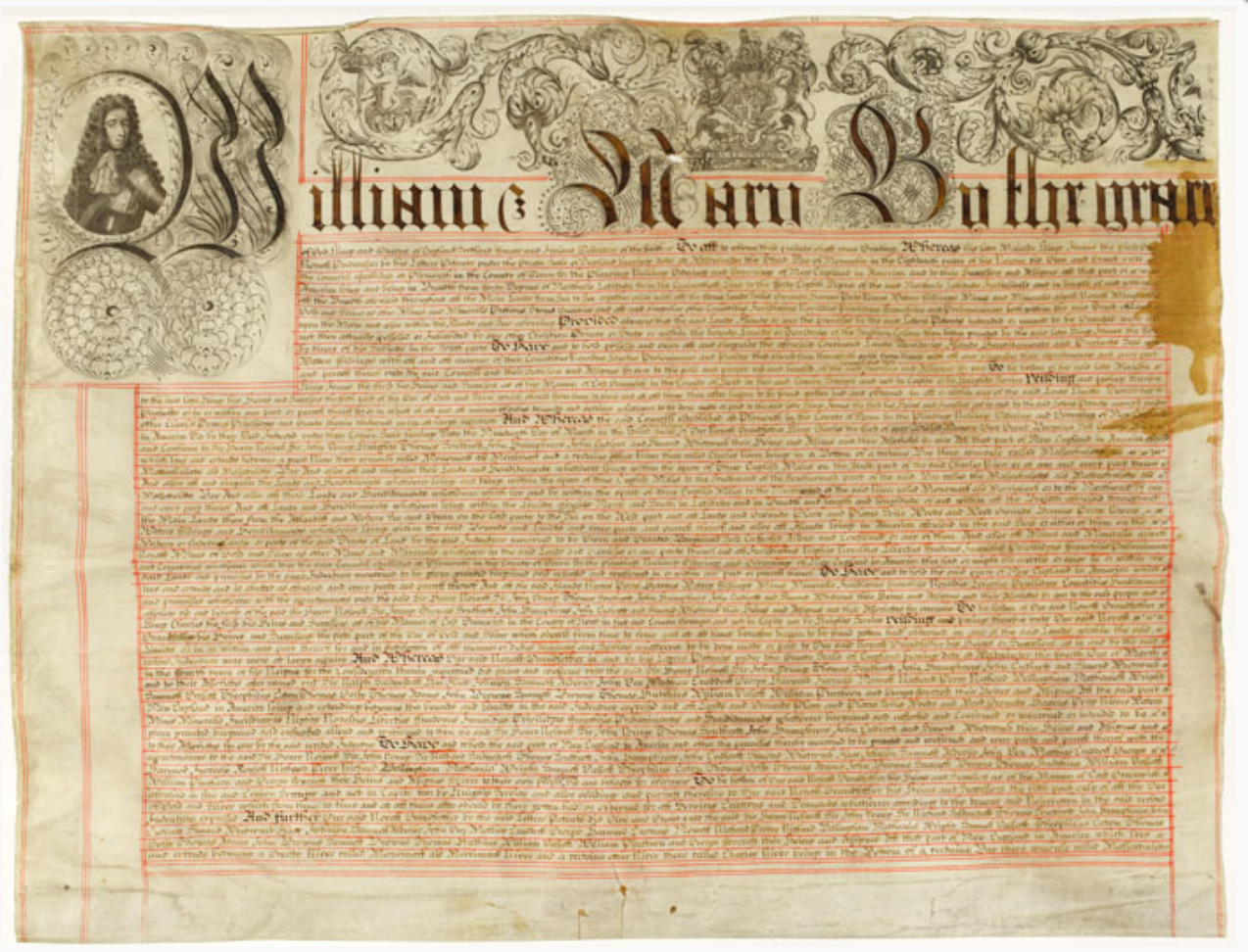
The Pilgrims of the Plymouth Colony established coroners as an elected office in 1636. By the end of the century, however, that colony had been absorbed into the province of Massachusetts Bay, and the monarchs William and Mary had issued a new charter for the province (shown above).

That 1691 charter stipulated:
it shall and may be lawfull for the said Governour with the advice and consent of the Councill or Assistants from time to time to nominate and appoint Judges Commissioners of Oyer and Terminer Sheriffs Provosts Marshalls Justices of the Peace and other Officers to Our Councill and Courts of Justice belonging…
The charter didn’t mention coroners, but everyone probably assumed they fell within the “other Officers” category. Such officials had presided over inquests in England for centuries, and in Massachusetts for decades. The big difference was that now the royal governor of Massachusetts, appointed by the ministry in London, would name coroners in every county, subject to the consent of the Council.

In 1700 the Massachusetts General Court got around to passing an act on “the office and duty of a coroner.” It stated:
every coroner, within the county for which he is appointed, shall be, and hereby is empowered to take inquests of felonies, and other violent and casual deaths committed, or happening within his precinct.
The law then devoted many more words to spelling out the oath that coroners would swear.

The next section said:
when and so soon as any coroner shall be certified of the dead body of any person supposed to have come to a violent and untimely death, found or lying within his county or precinct, he shall make out his warrant directed unto the constables of the same town where such dead body lies, or of three or four of the next adjacent towns, if need be, requiring them forthwith to summon a jury of good and lawful men of the same town, or such number as shall be sufficient, with those sent for from the neighbouring towns to make up eighteen in all, to appear before him at the time and place in the said warrant expressed
Then the law specified the language of the summons, the oath for the jury foreman chosen by the coroner, the oath for those jurors, and the fines to be levied if the constables or prospective jurors didn’t do their duties. I’m pleased to report that the law let the coroner swear in jurors “by three or four at once,” or else we’d still be waiting.

Out of the pool of eighteen men called, the coroner would choose “fourteen or more” for a jury and give them this charge:
You shall diligently inquire, and true presentment make, on the behalf of our sovereign lord the king, how and in what manner A. B. here lying dead, came to his death; and you shall deliver up to me, his majesty’s coroner, a true verdict thereof, according to such evidence as shall be given to you, and according to your knowledge. . . .

to declare of the death of the person, whether he died of felony, or by mischance and accident? and if of felony, whether of his own or of another’s? and if by mischance or misfortune, whether by the act of God or of man? and if he died of another’s felony, who were principals and who accessaries? who threatened him of his life or members? with what instrument he was struck or wounded? and so of all prevailing circumstances that can come by presumption.

And if by mischance or accident, by the act of God or man, whether by hurt, fall, stroke, drowning, or otherwise, to inquire of the persons that were present, the finders of the body, his relations or neighbours, whether he was killed in the same place, or elsewhere? and if elsewhere, by whom and how he was thence brought? and of all other circumstances.

And if he died of his own felony, then to inquire of the manner, means or instrument, and circumstances concurring.
Coroners could also summon witnesses, and of course they had their own oaths to swear.

The jury findings were specified in such detail that coroners came to use printed forms, filling in the blanks with information about the dead person, the date, the jurors, and so on.

The 1700 law said coroners could collect 10s. per day for travel and expenses, plus 2s. per day for each juror, to be collected from the dead person’s estate (or a dead child’s parents). If not enough money was available, the county treasurer would pay out what was needed.

In 1726 a new law allowed coroners to appoint deputies. In 1739 the legislature decided “some of the coroners within this province have of late greatly multiplied their deputies, and under colour of such deputation persons have pretended to be exempted from duties,” so it made such deputies a temporary appointment.

In contrast, coroners, like justices of the peace, kept their jobs for life—but that meant either their own lifespan, or the lifespan of the monarch under whom they were appointed.

COMING UP: Up for renewal.

Monday, November 03, 2025

“The Disease was rapid and poignant”?

Last month I faced a Boston 1775 emergency.

Which was, of course, not really an emergency. No one was in the least danger. I just felt an urgent need to confirm a statement I’d been repeating for years and suddenly had reason to question.

This dire situation arose because I asked myself how the coroners of Suffolk County responded to the death of William Molineux on Saturday, 22 Oct 1774.

John Rowe wrote in his diary that Molineux died “suddenly,” though Dr. Joseph Warren had visited the man the day before. Thomas Newell recorded death came “after three days’ illness,” Molineux’s political work having “produced an inflammation of the bowels.” John Andrews said Molineux died “After surviving a fit of apoplexy two days.”

By the time the Monday newspapers appeared, the Patriots had their story down. Edes and Gill’s Boston Gazette declared:
His Watchfulness, Labours, Distresses and Exertions to promote the general Interest, produced an Inflammation in his Bowels: The Disease was rapid and poignant; but in the severest Pangs, he rose superior to Complaint; he felt no Distresses but for the Public.
As for the Boston Post-Boy and Boston News-Letter, friendly to the royal government, they didn’t report Molineux’s death at all.

Some diarists and the Boston Gazette said that Molineux’s last words were “O SAVE MY COUNTRY HEAVEN!” That may even have been true, but I must note that “Oh, save my country, heav’n!” is a line from Alexander Pope’s Moral Essays. And that Molineux was notorious in his time for being a deist.

By March, Loyalists were publicly hinting that Molineux had committed suicide: through “the Laudanum of Doctor Warren, he quitted this Planet.” But there were also rumors, recalled by George Robert Twelves Hewes, that British army officers had poisoned the man.

That muddled situation led me to wonder if there was any official verdict on Molineux’s death. Massachusetts had inherited the English system of county coroners convening juries and holding inquests on suspicious deaths.

Unfortunately, not much paperwork seems to survive from inquests in pre-Revolutionary Massachusetts. There’s a small cache of documents relating to the Boston Massacre, probably saved those for their historic significance. Otherwise, collectors preserved a few determinations of coroners’ juries because they contained notable signatures.

Furthermore, in late 1774 the Massachusetts judicial system was being brought to a standstill by Patriot protests over judicial salaries and the Massachusetts Government Act. Some men, most prominently Molineux, refused to serve on juries. Outside Boston, crowds were blockading courthouses. Did that shutdown extend to coroners’ inquests as well?

Those questions led me to look more deeply into the coroners. How many were there? How long did they serve? How did they operate?

TOMORROW: Reading the law.

Wednesday, October 01, 2025

Bell-Ringing on Special Occasions

Yesterday I looked at the daily schedule for ringing the bells of Boston’s meeting-houses in the 1740s.

I presume those bells also rang for their primary purpose, summoning congregants for services on Sunday.

Beyond that weekly routine, church sextons rang (or arranged for someone else to ring) the bells on various special occasions.

Bells were supposed to signal town meetings, for example. In September 1747 many North Enders complained that no bell had sounded in their neighborhood that morning, so the citizens agreed to postpone that day’s meeting until 3 P.M. The selectmen gave orders “that the Bells be rung throughout the Town.”

The selectmen also ordered sextons to ring their bells for celebrations: on imperial holidays, in response to news of military victories against the French, and when a high-ranking dignitary came to town.

Church bells rang in mourning, as when Boston received word that George II had died. And each meetinghouse’s bell was rung for a funeral, though on 12 May 1747 the town government moved to regulate that practice:
That for the Burial of any Person within the Town of Boston there shall not be more than the Bells of two Churches toll’d and that but twice at each Church on Penalty of Twenty shillings for each Bell more that shall be Toled at one and the same Funeral to be paid by him that shall order Procure or Tole the same.——

The second or Passing Bell not to exceed one hour and half after the first on Penalty aforesaid.——

That any Person demanding or Receiving any more than the Selectmen shall allow for twice Tolling said Bell at one Funeral shall forfeit the Sum of Twenty shillings.
Boston’s Whigs made a sonorous point on the second anniversary of the Boston Massacre, as the Boston Gazette reported: “the Bells muffled toll’d ’till Ten.”

Of course, church bells had also played a role in that 1770 event. After Pvt. Hugh White clubbed barber’s apprentice Edward Garrick, some of the boy’s friends got into the Old Brick Meeting-House to ring its bell. An unscheduled ringing was a fire alarm, but could also be useful in bringing out a crowd for a riot.

You can find more sources on public bells in eighteenth-century Boston in this article from the Colonial Society of Massachusetts.

TOMORROW: A new sound in Boston.

Saturday, September 27, 2025

Thomas Williston, Doorkeeper

Yesterday I introduced Thomas Williston, sexton of Boston’s Old Brick (First) Meeting-House starting in the 1740s.

Williston also took on jobs for the town of Boston. Some of those were tied to his work as a church sexton, such as winding his meetinghouse’s clock and burying the dead. Others were civic tasks, as in managing the weekly traffic of farm wagons at the marketplace.

In June 1754 the town government offered another job: “Mr. Thomas Williston is appointed to attend the Select men in the room of Mr. John Savel who by reason of Age and Infirmities cannot attend the business.” Williston was also given “the care and Oversight of all the Watches in the Town.” And he was still the sexton at the Old Brick.

Thomas Williston’s official title was doorkeeper at Faneuil Hall. As such, he continued to patrol the marketplace, arranged to illuminate the building after the capture of Montreal in 1760, and the next year took down “the Potts & other Iron Ware” from the walls and hung “the Town Ladders” there instead.

But being doorkeeper also involved a lot of running around Boston. In 1758 the selectmen empowered Williston to enforce the town’s newly revised by-laws, including speed limits on vehicles. They sent him out on the water to warn ship captains against unloading “French neutrals” or possible smallpox patients. Along with Deacon William Larrabee, Williston was assigned to warn newcomers out of town—though he did that for only a few months, Robert Love’s Warnings reports. At different times Williston summoned new officeholders, tax collectors, and heads of fire companies to meet with the selectmen at Faneuil Hall.

For the annual inspection of the schools, Williston contacted the many respected gentlemen chosen for that committee. He also visited the two grammar-school masters to obtain the names of the graduating scholars so the selectmen could invite their parents to a dinner at Faneuil Hall. (Students leaving the three writing schools didn’t get a party.)

Some of Williston’s assignments overlapped with his roles as gravedigger, bellringer, and watchman. For example, in March 1761 he informed tomb owners they were responsible for paying to repair a wall of the burying ground. But he could also be told to deliver the seals to the newly elected sealers of leather, inspect leaning chimneys, and warn property owners about dangerous drains.

Williston’s busiest months on record were during the smallpox epidemic of 1764. He appears over and over in the selectmen’s minutes: tracking down reported patients, moving some to the hospital at New Boston in the town sedan chair, installing flags and guards (including his brother Ichabod) outside quarantined homes, hiring and dismissing nurses, smoking homes and clothing, and burying the dead under special arrangements to contain the disease. Thomas, his brother John, his other brother Ichabod, and Ichabod’s wife Elizabeth all got extra pay during those months.

After army regiments arrived in Boston in October 1768, Thomas Williston had the task of telling British officers that the selectmen wanted to speak to them—a potentially volatile clash of authorities. In November he summoned two officers accused of having “insulted & interrupted” the Dock Watch; those officers apologized for being drunk. In July 1770 “Mr. Williston, Door-keeper to the Select-men,” carried a letter from a town committee to Capt. Thomas Preston in the town jail. In September, some sick soldiers came back from Castle Island to enter “the Hospital in the Common”; the selectmen had Williston summon regimental surgeon Charles Hall for consultation.

In sum, Thomas Williston was well known in Boston, the liaison between the town’s highest elected officials and citizens of all sorts. He was based at Faneuil Hall and the Old Brick Meeting-House, but he could show up anywhere in the course of his duties.

On 18 Feb 1773, Isaiah Thomas’s Massachusetts Spy reported the death of Thomas Williston, “sexton of the Old-Brick, and doorkeeper of Faneuil hall.” He was buried in the Granary Burying Ground with his wife Sarah, who had died on Christmas Day in 1771.

Four days later the selectmen met in Faneuil Hall. Those men, “taking into consideration who was a proper Person to fill up the place of Mr. Thomas Williston, who for a number of years had attended them on the Towns Business; Agreed to give the Offer of the office to Mr. William Barrett Sexton of Dr. [Samuel] Coopers Church” on Brattle Street.

Williston’s successor as sexton of the First Meeting-house and, as of 31 March, as a town-approved gravedigger was Josiah Carter. As I discussed here, he had also been a town watchman. However, Carter lasted in that sexton’s job less than two years after Williston’s demise.