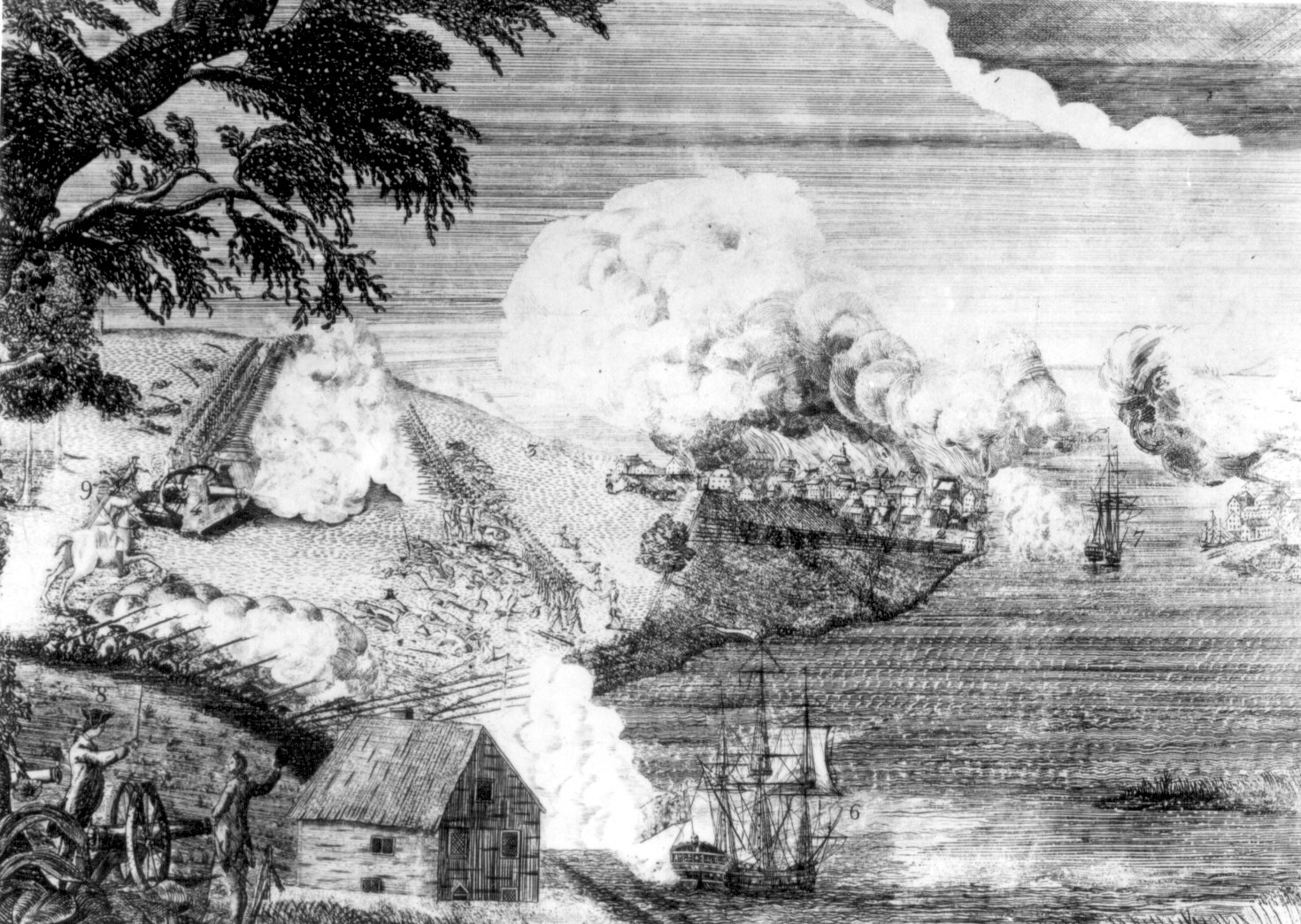
Capt. Ebenezer Bancroft and the Embrasures

The first comes from Ebenezer Bancroft (1738-1827) of Dunstable, Massachusetts, who was a captain in the provincial army. It was reportedly “written from dictation in 1826” by Bancroft’s grandson John B. Hill of Mason, New Hampshire, and printed for the first time in The Granite Monthly in 1878.
That magazine said it had taken the text from proofs of Hill’s Sketches of Old Dunstable, which was never published as a stand-alone book. Instead, Hill’s material was appended to a much shorter address that nevertheless gets top bibliographic billing: Bi-Centennial of Old Dunstable, by S. T. Worcester.
Here’s the start of Bancroft’s account:
On the night of the 16th of June, 1775, my company was ordered out with the detachment to take possession of the heights of Charlestown. This detachment consisted of three regiments commanded by Col’s [William] Prescott, [Ebenezer] Bridge and [James] Frye, and amounted in all to between 1000 and 1200 men. These regiments were principally from Middlesex county, Col. Prescott from Pepperell, Col. Bridge from Chelmsford, Col. Frye from Andover. I was that evening on a court-martial and could not get liberty to go with my company, but in the morning of the 17th General [Artemas] Ward granted me permission to join my company, though the court-martial was not through.The first time I read a retelling of that anecdote, it sounded like the provincials fired point-blank into the earthen wall to create the embrasures, and I recall at least one author expressing doubt that anyone would ever do that. Bancroft’s (or Hill’s) words suggest that the men started the excavate the openings by hand, and he fired the cannon through the narrow hole they opened in order to make it easier for them to widen. As to whether those shots reached all the way into central Boston, that still seems dubious.
Soon after I reached the hill our men left work and piled their intrenching tools in our rear, and waited in expectation of reinforcements and refreshments, but neither reached us, if any were sent. The reinforcements halted at Charlestown Neck. Whilst I was standing by the redoubt before the action began, a ball from the Somerset passed within a few inches of my head, which seriously affected my left eye so that it finally became totally blind.
When the works were planned no calculation was made for the use of cannon, and of course no embrasures were left for them. But on the morning of the 17th two ship cannon were sent up and a platform with them. About ten o’clock the British troops began to make their appearance at the wharves in Boston.
General [Israel] Putnam, who had been incessant in his exertions through the morning to bring reinforcements, now rode up to us at the fort and says: “My lads, these tools must be carried back,” and turned and rode away. An order was never obeyed with more readiness. From every part of the line volunteers ran and some picked up one, some two shovels, mattocks, etc., and hurried over the hill.
When the pile of tools was thus removed I went through the lines to form an estimate of the number of men in the redoubt, at the same time stating that those who had gone with the tools would come back, though I was by no means confident that they would. I estimated the number then left in the redoubt at 150, but was afterward informed by one of the captains of Col. Frye’s regiment that he counted them, and the whole number, including officers, was 163. I was not certain that any reinforcements after this time came into the redoubt; thus the number of our effective force was very materially reduced. General Putnam had given his orders and gone, and nobody seemed to think it belonged to him to stop the men and execute the order in a proper way.
The artillery-men had all gone with the tools, and Col. Prescott came to me and said, “If you can do anything with the cannon I wish you would. I give you the charge of them.” I directed the men to dig down the bank in order to form an embrasure, which they were forced to do with their hands, for the party that had carried off the intrenching tools had not left us a single shovel or mattock. Men never worked with more zeal. Many of them dug till their fingers bled. To loosen the earth I loaded the cannon and fired into the gap, and they dug again, and I fired a second time. Both these balls fell in Boston, one near the meeting-house in Brattle square, the other on Cornhill, as I was afterward informed by Boston gentlemen.
TOMORROW: What effect did those cannon have on the battle?