


J. L. BELL is a Massachusetts writer who specializes in (among other things) the start of the American Revolution in and around Boston. He is particularly interested in the experiences of children in 1765-75. He has published scholarly papers and popular articles for both children and adults. He was consultant for an episode of History Detectives, and contributed to a display at Minute Man National Historic Park.

Subscribe thru Follow.it


•••••••••••••••••


Showing posts with label Isaac Cazneau. Show all posts

Thursday, September 25, 2025

Boston’s “Sedan for Removing the Sick”
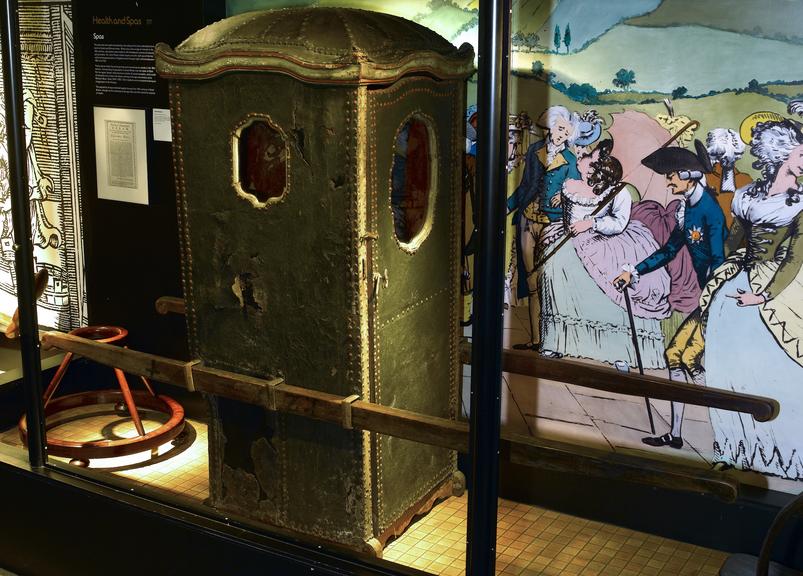
Lining up the sparse mentions of sedan chairs in colonial Boston reveals a clear pattern: they were used to transport sick people.

In 1674 the Rev. John Oxenbridge of the First Meetinghouse suffered a stroke while preaching the Thursday Lecture and “was carried home in a Cedan.”

Thirteen years later, Judge Samuel Sewall wrote in his diary: “Capt. Gerrish is carried in a Sedan to the Wharf and so takes Boat for Salem, to see if there he may find amendment of his Distemper.”

In May 1715, the newly reappointed governor Joseph Dudley was bed-ridden with gout. At the end of the month, Sewall wrote, he came to Boston and “was carried from Mr. Dudley’s to the Town-House in Cous. [William? Jeremiah?] Dummer’s Sedan: but twas too tall for the Stairs, so was fain to be taken out near the top of them.”

Yesterday I listed five times sedan chairs were advertised for sale in eighteenth-century Boston newspapers. I don’t think it was coincidence that four of those ads were estate sales, and the fifth seller died within two years. Those men might have acquired sedans as they or their wives became too ill to walk around.

Boston also had a public sedan chair, operated by the town itself. In March 1739, the Boston selectmen took note of “A Sedan, or Chair belonging to the Hon. Edward Hutchinson Esqr. which the Town has had the loan of for a considerable time.” One of those local elected officials was Thomas Hutchinson, and the sedan owner was his uncle. The selectmen decided that the chair “be effectually Repaired, and made fit for Use, in the best and frugal manner.”

That sedan chair became part of Boston’s public-health infrastructure. On 4 Jan 1757 the selectmen voted “that the Sedan for Removing the Sick be broke to Peices” and “Mr. [Isaac] Cazneau make a good Serviceable Sedan at the Charge of the Town.” Cazneau was a saddler.

In 1760 the Massachusetts General Court bought land in the sparsely populated western point of the Boston peninsula called “New Boston” for a new hospital. Four years later, the town suffered a serious smallpox epidemic. That appears in the selectmen’s records with an uptick in orders for the sedan chair to carry people to that hospital.
  • 16 Jan 1764: “Information was given the Select men by Dr. [Phillip] Cast, that One Hallet who came from Newfoundland a Month past, and Boards at Mrs. Nicholsons in Fitches Alley, has the Symptoms of the Small Pox upon him whereupon the Select men endeavour’d to perswade him to consent to his being removed, and having obtain’d such consent, he was accordingly removed in the Sedan to the Province Hospital at New Boston.”
  • 20 Jan 1764: “The Select men having prevailed with Mr. Adams to consent that his Child should be removed from his House to the Hospital at New Boston, they at about 12. OClock that Night took Mr. Williston and a number of hands with the Sedan to said House, when they received the Wet Nurse and Child and carried them to said Hospital”.
Similar entries appeared through August of that year.

TOMORROW: “Mr. Williston.”

(The picture above shows a sedan chair used to carry medical patients in La Paz, Bolivia, now in the Wellcome Collection in London.)

Sunday, February 16, 2020

“The Effects of Junius’ Letter”?

Throughout 1769, British politics was roiled by a series of public letters signed “Junius,” attacking the ministry of the Duke of Grafton and promoting William Pitt, by then the Earl of Chatham.

The letters combined erudite arguments, apparently inside knowledge of British politics, and personal attacks. The author’s identity has never been confirmed, but most evidence points to the Irish bureaucrat and politician Philip Francis, shown here.

The “Junius” letters made their way across the Atlantic to Boston, where the Whigs were already fans of Pitt and trying to form alliances with reformers in London.

In May 1769, Boston newspapers started to reprint letters from the “Junius” debate. Curiously, the first and, for a long time, only newspapers to do so were those closest to the royal authorities: Richard Draper’s Boston News-Letter and John Mein and John Fleeming’s Boston Chronicle. Other newspapers reported on the debate in London, passing on the occasional speculation about who “Junius” was.

On 16 October, the Boston Gazette joined in the fun by reprinting a letter from “Junius Americanus,” a pseudonym of the Virginia-born Arthur Lee. He wrote about issues that affected North American colonists directly.

In the 16 December London Evening-Post, “Junius” published a letter addressing George III. Such a direct public message to the king was a breach of traditional etiquette, arguably even illegal. The author presented this letter as a hypothetical letter written if the monarch had asked for frank and honest advice—and who could complain about that?

“Junius” expressed what the British Whigs saw as wrong with current London politics. There were several slaps at Scotsmen for supposedly being less loyal than Englishmen. There was a long defense of John Wilkes for attacking Scotsmen. There was support for the printers then taking the radical action of making the proceedings of Parliament available to the public. (Later in 1770 the first printer of the “Junius” letters was himself prosecuted, but the government lost that and similar cases.)

Toward the end of his letter to the king, “Junius” wrote: “The same pretended Power which robs an English Subject of his Birthright, may rob an English K[ing] of his C[rown].” That was as obvious a warning of justified rebellion as the British press could handle in those days.

Customs Collector Joseph Harrison’s anonymous informant reported that on 7 Feb 1770 “Capt. [Isaac] Cazneau arrived from London and brought with him Junius Letter to the K--g, which was published the next day in Drapers paper,” the Boston News-Letter. Draper also printed a much shorter reply from a “Junius” opponent signing himself “Modestus.”

Edes and Gill then reprinted the “Junius” and “Modestus” essays as a two-page supplement to their 12 February issue of the Boston Gazette, the same that included the expanded list of importers that I showed yesterday.

Three days later, the anonymous informant wrote: “Between the 8th & this date, most of the Importers had their Windows broke their Signs defaced, and many other marks of Resentment—in short the Effects of Junius’ Letter was Visible which way so ever you turned yourself.”

This was a top-down view of politics, all too typical of upper-class Loyalists. According to this perspective, a verbose, educated, well connected but unaccountably radical gentleman in London wrote a provocative letter. Once reprinted in Boston, it provoked common subjects who would otherwise be peaceful and content into violent attacks on supporters of Parliament’s new taxes.

Of course, Boston’s non-importation movement was over a year old by the time the “Letter to the King” came to town. The “Body of the Trade” meetings and the decision to call importers public enemies took place in January, before that letter arrived. Is it really believable that a long essay published in the News-Letter on 8 February prompted the “Importer” sign that went up at William Jackson’s shop that morning (possibly even before the newspaper came out)?

Both the Boston Whigs and the Boston Loyalists saw their cause as parallel, or even part of, the political conflicts in Britain. They were eager to draw connections between their struggles and the imperial capital. But in this case the cause-and-effect is more than tenuous.

It’s conceivable that the “Junius” letter and its reprint in the 11 February Boston Gazette, the town’s most popular Whig newspaper, fueled the larger demonstration four days later. But I think the energy was really coming from the bottom up.

TOMORROW: The shrill voices of the voiceless.