J. L. BELL is a Massachusetts writer who specializes in (among other things) the start of the American Revolution in and around Boston. He is particularly interested in the experiences of children in 1765-75. He has published scholarly papers and popular articles for both children and adults. He was consultant for an episode of History Detectives, and contributed to a display at Minute Man National Historic Park.

Subscribe thru Follow.it


•••••••••••••••••


Showing posts with label medicine. Show all posts

Tuesday, May 26, 2026

“Environmental History & the War of Independence” in Boston, 27 May

David Hsiung is the Dr. Charles R. and Shirley A. Knox Professor of History at Juniata College in Pennsylvania.

For several years he’s been working on the problem of how the enviroment affected the American Revolution, how the Revolution affected the environment, and how it’s possible to study those interactions with the data we have.

That is, of course, a huge topic, so part of the historiographical challenge is, I’m sure, to narrow down and define the questions in a manageable way. In the meantime, I’ve been enjoying his articles and lectures, which always open my eyes to new ways of seeing this history.

On Wednesday, 27 May, David Hsiung will be at the Massachusetts Historical Society for a conversation with Joyce A. Chaplin of Harvard, author most recently of The Franklin Stove: An Unintended American Revolution.

The description of “Curious & Complex Connections: Environmental History & the War of Independence” says:
Many of us give only a moment’s thought about the environment when considering the War of Independence: the slope of Breed’s Hill, the ice-choked Delaware River, and diseases such as smallpox. But what might we gain by connecting biology, ecology, and geology to the thinking and actions of soldiers and civilians? Rebels and British soldiers acquired and used energy in the form of food, fuel, and work animals, which shaped people’s lives, the course of the war, and the direction of environmental change.
This is a hybrid event starting at 6 P.M., with a reception in the preceding half-hour for people attending in person. Attendance costs $10, but is free to M.H.S. members and Card to Culture participants. Listening in online is free. Register for either form of access through this page.

Folks can also take in these talks from Prof. Hsiung:

Friday, May 22, 2026

A Long Line of Preserved Claps

Dr. Preserved Clap, the man who stepped forward to render Boston’s broken cannon useful again in the spring of 1776, came from a long line of Preserved Claps.

According to The Clapp Memorial (1876), the doctor’s ancestors Roger Clapp and Joanna Ford arrived in Massachusetts in 1630, settling in Dorchester.

(This genealogy preferred the spelling “Clapp,” even changing how the name appeared in the period sources it quoted.)

Those Clapps named their first children Samuel, William, and Elizabeth, but then went full Puritan for most of the rest: Experience, Waitstill, Preserved, Hopestill, Thanks, Desire, Thomas, Unite, and Supply.

Preserved Clapp (1643–1720) moved to Northampton and had a son named Preserved Clapp (1675–1757), who likewise had a son named Preserved Clapp (1705–1758). That last man moved to Hadley. He married Sarah West in August 1730, and they had their first son the following May: Preserved Clap (1731–1811).

Histories of Northfield and Deerfield say that in the fall of 1754 our Preserved Clap was in charge of a small force—nine or ten men—guarding the settlement of Huntstown, now Ashfield.

The genealogy above didn’t have this information, but more recent researchers have found that in 1756 this Preserved Clapp married Eunice Atherton of Lancaster, and they started having children by 1760. His name appears a couple of times in the Amherst town records in the following decade.

On 1 Jan 1770 the Connecticut Courant of Hartford ran this notice:
CLOCKS and Watches made in the best Manner, by
PRESERVED CLAP
of Amherst.

Likewise all Kinds of Instruments in Surgery.
That’s the first surviving sign that the latest Preserved Clap had ambitions to be more than a country farmer.

The Colonial Society of Massachusetts published the image of a clockface above in an article about the engraver Thomas Johnston (1708–1767). At the top it says: “Preserved Clapp / New England.”

Did Clap order this plate from Johnston for a clock he planned to build, or for one he planned to own? And did he pay for it? Johnston kept that sheet of copper and used the other side to engrave a musical score for his publication of Daniel Bayley’s A New and Compleat Introduction to the Grounds and Rules of Musick (Boston, 1766).

Massachusetts Soldiers and Sailors of the Revolutionary War records that in 1775 a man named Preserved Clap served a few months as a private in the company of Capt. Benjamin Hastings of Bolton. I haven’t found anyone else named Preserved Clap of military age at the time. But it seems unusual for a forty-three-year-old man with military experience, social ambition, and some connection to medicine to serve in the ranks. In any event, Hastings’s company saw action at Bunker Hill.

The next time Preserved Clap surfaces in the records I’ve found is the Rev. Dr. Samuel Cooper’s 29 Apr 1776 letter to Samuel Adams, which refers to him as “a Country Surgeon in our Army.” By this time he was evidently using those “Instruments in Surgery,” not just making them. However, I haven’t found any record of Clap being surgeon for a Continental regiment. Perhaps he had taken that role in one of the militia regiments that Massachusetts raised in early 1776.

TOMORROW: Claiming credit.

Saturday, May 16, 2026

“To Vax or Not to Vax” walking tour in Boston, 17 May

On Sunday, 17 May, the Partnership of Historic Bostons is offering a walking tour titled “To Vax or Not to Vax: Smallpox in Early Boston.”
The organization says:
The subject of our newly revised walking tour is smallpox, one of the great killers of the 17th century. This European disease found fertile ground in the growing colonies in New England, with the most devastating effects suffered by Native Americans who had no immunity. Up to 90% of the Massachusett Tribe, whose land included Boston and Charlestown, perished, their villages lying empty and providing English colonists with unoccupied land for reasons that Puritans saw as providential.

English colonists had some immunity but, even so, successive generations suffered wave after wave of deadly smallpox outbreaks. . . .

During the tour, we will investigate how the colonists saw smallpox and tried to contain it, and how smallpox roiled their society in a number of ways. Had God handed the Shawmut peninsula over to them by clearing out the Native population, or was he punishing them with the same pestilence for not sufficiently following His word? Could smallpox be successfully treated by medical methods practiced since the time of the Romans, or would new, more radical methods (some employed by Africans, including Cotton Mather’s enslaved African Onesimus, and Turks) prove more effective?
This tour is led by Michael Prochilo. It will start outside of Park Street Station at 2:30 P.M. and is scheduled to last 90 ninety minutes. Because of construction projects, the route is not wheelchair-friendly. Participants are reminded to bring water [Sunday might bring our first 80°F. days this year] and wear comfortable shoes.

Thursday, May 14, 2026

Twenty Years of Boston 1775

Twenty years ago today, on 14 May 2006, I posted my first item on this blog.

That post was a link to an article I’d written for the magazine then called New England Ancestors, now American Ancestors, published by the New England Historical and Genealogical Society.

The original link broke. A subsequent link from 2012 broke. But Boston 1775 is still here.

That article described how a message from Dr. John Homans to his mentor, Dr. Joseph Gardner, in the first days of the Revolutionary War was detoured by the duplicitous Dr. Benjamin Church, Jr.

Last August I revealed other messages that Dr. Church diverted into the files of Gen. Thomas Gage, from Boston magistrate Edmund Quincy to his daughter Dorothy and her fiancé, John Hancock.

Tonight I’m speaking in Stoneham about how Dr. Church managed to infiltrate Gen. George Washington’s network for sneaking intelligence out of besieged Boston before the Continentals realized their surgeon-general as a spy.

One way to look at this situation is that after twenty years of daily blogging I’m still working the same ground.

Another is that Dr. Benjamin Church’s treachery is an endless source of revelations and fun.

Saturday, May 02, 2026

“Inspector of all Boats, Letters, Goods and Passes”

In the fall of 1777, as recounted yesterday, John Hill and his family were released from captivity in Boston as part of a prisoner exchange.

I haven’t been able to find more about that deal—who arranged it, what prisoners of the Crown went free, and so on. To the Hills, those details probably didn’t matter.

Soon John and Elizabeth Hill and John’s daughter were inside British-held New York City. Before the war, they had run an inn there. Had that building survived the fire of 1776? Was it awaiting their return?

Later, in describing his services to the Crown, Hill simply said that he joined a volunteer militia company commanded by David Mathews, the city mayor.

But his major service began, he said, in July 1779 when he “was appointed Inspector of the Ferry, at Brooklyne; near New York, a place of great Trust, and received 10 shillings New York Currency, per Day.”

The Royal Gazette announced that appointment on 14 August:
JAMES PATTISON, Esq; Commandant of the city of New-York and Major General of his Majesty’s Forces in North-America, has been pleased to appoint JOHN HILL, Inspector of all Boats, Letters, Goods and Passes, at Brooklyn-Ferry.
John’s brother Richard, another evacuee from Boston, held the same post, perhaps earlier. In May 1780, Richard broke his thigh bone and had to use crutches, but he appears to have continued in the job.

On 10 Nov 1779, John Hill’s daughter (unnamed) married “Lieut. Cunningham, of the Legion,” at Brooklyn. As I wrote before, this officer might have been Ralph Cunningham, killed the next year in South Carolina.

As ferry inspector, John Hill ran periodic notices in the newspapers announcing lost property. For example, on 11 Dec 1779 he put a notice in the Royal Gazette that he was holding “a Vellice with a Marque, marked Capt. Knight, 43d regiment, with some small articles.” That was presumably Henry Knight, by then major in the 45th.

Hill also sold Richard Speaight’s “Royal Bitter Tincture, for the Fever and Gue,” that franchise being arranged “For the conveniency of the Inhabitants of Long-Island.”

But Hill’s main job was to keep watch for deserters and spies.

TOMORROW: Counterespionage.

Tuesday, February 24, 2026

“As ever the two Armies met”

Yesterday we left schoolteacher Jonathan Hastings, Jr., and the rest of Col. Thomas Gardner’s Cambridge militia contingent caught near the Lexington meetinghouse on 19 Apr 1775.

Lt. Col. Francis Smith’s expedition to Concord (which Hastings called “the Detachment”) was headed back their way from the west, harried by other militia companies.

Col. Hugh Percy’s reinforcement column (“the Brigade”) was approaching from the east. Percy had more soldiers. And he had cannon.

We return to Hastings’s 11 June letter, now in the Thomas Gage Papers:
We were commanded to retreat into a thick Grove of Oaks over a Meadow, up to our Knees in water, wch. saved us. The Brigade turned their Artillery immediately upon us.—Their Cannon Balls cut down the Branches of the Trees merrily but none of us were killed.

As ever the two Armies met, it being about 3 Quarters after one OClock, they begun a precepitate Retreat for Bunkers Hill in Charlestown under the Protection of the navy. There were not above 400 that attacked them, being 1850 at once that day. Lord Peircy put the Cannon in Front, himself in the Centre, & the Marines were formed in the Rear. The Grenadiers & Marines were nobly peppered. Peircy had a Ball shot thro’ the Bosom of his shirt.

Two Officers were treppaned in the Red House leading to Charlestown. Quarters were offered them, they refused, replying their Orders were neither to give nor take any Favour. They met Death bravely.—

It is easier for you to imagine, than for me to describe the Horrid Barbarity & savage Cruelty of the British Troops in their Retreat. Houses plundered & burnt, wounded Men begging for mercy, had Bayonets struck into their Heads, & the Piece discharged, Women in Child Bed commanded into the Streets with a Gun at their Breasts, Old Men unarmed thrust thro’ their Bodies. Harmless young Fellows shot dead, such was the horrid Scene.

But on our side no such Vestiges of Cruelty were seen or exercised on any who chose to live: the wounded taken the utmost Care of, & when exchanged for our Men who were taken Prisoners, & have been treated most inhumanly: they cryed like Children to tarry among us.—
Of course, the redcoats had their own tales of atrocities by the enemy, starting with the “scalping” at Concord’s North Bridge.

I can think of one example of a woman who had recently given birth ordered out of her house (Hannah Adams of Menotomy) and one of a young teenager shot when he peeked out a window (Edward Barber of Charlestown). But Hastings’s letter rendered those examples as plural. And I’m not sure what he referred to with the bayonets.

Likewise, Hastings’s numbers of the troops engaged—400 militiamen chasing off 1,850 regulars—are skewed to make his side look good. Many groups of 400 provincials attacked the British column in turn. The Massachusetts force had a clear advantage in numbers.

Hastings wrote of emergency surgeries in “the Red House leading to Charlestown” as if his correspondent knew that location. Indeed, there appears to have been a brick house fitting that description. I haven’t been able to identify who owned or lived there, but sources do refer to its appearance and location.

On 12 May the Massachusetts committee of safety mentioned “the red house at the head of the creek near the road from Cambridge to Charlestown.” Soon provincials built the “Red House Fort,” more commonly called Fort No. 3, to guard a nearby crossroads, as shown in the detail of Henry Pelham’s map above. Today the site is just south of Union Square in Somerville.

TOMORROW: Finishing the letter.

Tuesday, January 13, 2026

Online Lecture Series from Historic Deerfield

Here’s another series of online lectures exploring the Revolution during the Sestercentennial, this time from Historic Deerfield.

Sunday, 25 January, 2 P.M.
Mighty Microbes: The Deadly 1775 Massachusetts Dysentery Epidemic and the Other Diseases That Shaped the American Revolution
Woody Holton, Professor of History at the University of South Carolina, author of Liberty Is Sweet

Sunday, 22 February, 2 P.M.
Spain, Native Nations, and the American Revolution
Kathleen DuVal, Carl W. Ernst Distinguished Professor of History the University of North Carolina, author of Native Nations

Sunday, 29 March, 2 P.M.
Picturing the American Revolution
Paul Staiti, Professor of Fine Arts on the Alum Foundation at Mount Holyoke College, author of Of Arms and Artists

Historic Deerfield says this series will “explore the American Revolution not just as a political conflict, but as a broad and complex global event that profoundly shaped the lives of everyone in the colonies. The war’s impact extended far beyond political fervor, crucially affecting Native nations seeking autonomy, free and enslaved Black people across the continent, and every sphere of social, cultural, and economic life—from material culture and daily labor to political ideology.”

All three lectures will be free of charge and presented virtually via Zoom webinar. Register for the links through this page.

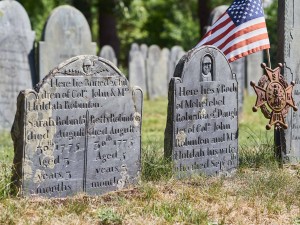
(The picture above shows the gravestones of young sisters Betty, Huldah, and Mehetebel Robinson, dead of dysentery in late 1775, courtesy of the Westford Museum.)

Sunday, January 11, 2026

The Reality of “Dr. Cutts”

Back here, I quoted Edmund Quincy’s story of his father, little Josiah Quincy, starting to study Latin at the Phillips Academy in Andover in 1778 alongside a man more than twenty years older—a former Continental Army surgeon named Cutts.

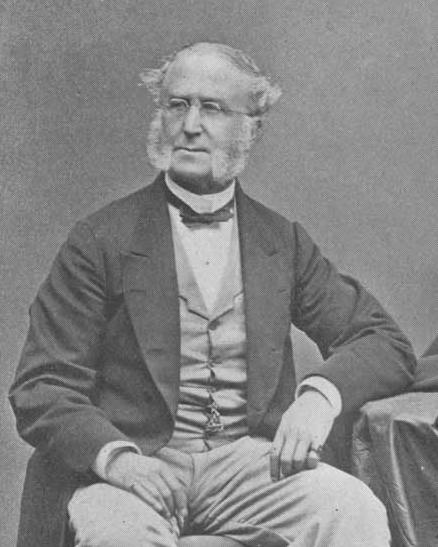
It’s significant that that story appeared in Edmund Quincy’s biography of his father not in Mayor Quincy’s own words but in those of the author (shown here), remembering what he’d heard from his father decades before.

As I stumbled across gathered evidence, it became clear that the younger Quincy amalgamated multiple figures from his father’s school days into a composite “Dr. Cutts.”

The first figure was James Anderson of Londonderry, New Hampshire, admitted to the same inaugural class at the academy alongside six-year-old Josiah even though he was twenty-nine. As beginning students, they may indeed have been seated together, as Edmund Quincy described.

Next were a pair of young brothers named Cutts, who joined the school in 1782. Josiah Quincy and Richard Cutts (1771–1845) went on to be Harvard classmates who both represented Massachusetts in the U.S. Congress in the first decades of the nineteenth century, albeit in different parties. Edmund Quincy remembered that surname.

Finally there was John Brown Cutting, whose last name was easily confused with “Cutts” and equally appropriate for a surgeon. He entered the Phillips Academy in 1781, when Josiah Quincy was nine. According to academy records, Cutting was then 23 years old. (According to the age reported when he died, Cutting was a little older, born about 1755.)

John Brown Cutting came to the school from the Continental Army medical department. But he wasn’t a surgeon or surgeon’s mate; rather, starting in 1775 he served as an assistant apothecary. In this period, apothecaries were routinely addressed as “Doctor,” and Cutting definitely used that title.

Other details of John Brown Cutting’s life also connect with what Edmund Quincy described about “Dr. Cutts.” He did spend many years after the Revolutionary War in Europe. In 1806 he did marry a gentlewoman in Virginia: Sally (Carter) Carter (1767–1814), widow of George Carter.

Later Cutting worked for the U.S. government and started spelling his middle name with a terminal E. He died in Alexandria in 1831. Laudatory obituaries appeared in national newspapers and in the Boston Palladium, which likely prompted Josiah Quincy to tell his son stories of his old schoolmate.

Mayor Quincy probably remembered John Brown Cutting vividly not just because he was an unusual older student at Andover but because the man was a world-class networker, schmoozer, and unabashed gossip. Cutting served John Adams as a fill-in secretary in 1787. He aided American sailors as a self-appointed diplomat. He corresponded with both John and Abigail Adams, Washington, Jefferson, Hamilton, Madison, Knox, Jackson, Pickering, and more. Gouverneur Morris once described him entering the room with “a World of News.”

I plan to explore stories from the life of John Brown(e) Cutting. For now, though, I simply wish to establish that Edmund Quincy’s tale of a “Dr. Cutts” turns out to have some basis in reality, but not exactly as printed.

Friday, January 09, 2026

“This mature schoolfellow, Cutts by name”

Edmund Quincy wrote The Life of Josiah Quincy of Massachusetts (1867) by drawing on his father’s writings and his own memories.

The father, namesake son of the Patriot Josiah Quincy, Jr., wrote a detailed reminiscence about his years as a student at what became the Phillips Andover Academy. I quoted some here.

To that first-hand account Edmund added information he recalled hearing, such as this anecdote about one of his father’s classmates:
The Phillips Academy at Andover had just been founded [in 1778], mainly by the contributions of his grandfather [William Phillips] and other members of the Phillips family; and it was thought expedient that the founders should show their confidence in the school by sending their children and grandchildren to it. . . .

And at six years old he took his seat on the lowest form by the side of a man nearly thirty years of age, and they began their Cheever’s Accidence [the standard Latin textbook] together.

This mature schoolfellow, Cutts by name, had been a surgeon in the Continental army, who, having scrambled into as much surgical skill as was then thought sufficient for that position without any early advantages of education, was made so sensible of his deficiencies, through associating with the cultivated men he was thrown among in the army, that he resolved to supply them as soon as he had an opportunity.

Resigning his commission, he came to Andover Academy, and went regularly to school for two years, to make up in some degree his classical shortcomings. Out of school, of course, he associated on equal terms with the Preceptor and the other gentlemen of the town. He was a man of wit and talent, and the two ill-mated form-fellows were friends in later years.

Various romantic stories are told of him, of which this is one. During his military service he had won the heart of the daughter of a rich Virginia planter, who would not consent that her hand should go with it to the penniless young surgeon. His scholastic training as well as his military career being ended, Dr. Cutts, after various adventures, went to Europe, where he lived for many years, nobody knew how.

After long years a letter from the lady of his youthful love found him out, which told him that her father, and I think her husband, and whatever other obstacles had hindered the course of their true love from running smooth, were now out of the way, and that, if he retained his old affection for her, and chose to claim her early promise, she was ready to fulfil it. On this hint he hastened home, married his early love, and spent the rest of his life at ease. . . .

All this I remember my father telling us at breakfast, many years ago, on reading in the newspaper the death of his old schoolfellow, somewhere near Alexandria, at a good old age.
Now that’s a fine anecdote of a marriage being saved. Unfortunately, it’s tough to find any evidence to support it, and easy to find contradictory records.

TOMORROW: Little Josiah’s big classmate.

Wednesday, December 17, 2025

Eight Runaway Men in a Boat from Boston

Capt. Richard Dodge was a Continental Army officer stationed in Chelsea during the second half of 1775. Like his regimental commander, Lt. Col. Loammi Baldwin, he sent periodic reports to Gen. George Washington’s headquarters about what he saw in Boston harbor.

On 16 December, Dodge reported some exciting news: “Last Eveing Eight men Runaway in a bote from Boston to our guard at the farry.”

Following recently enacted protocol, Dodge sent those men to a local health committee who “Clensed them by Smooking them” against the smallpox.

Six (or seven, according to the 25 December Boston Gazette) of those eight men were “masters of Vassels” captured by the Royal Navy and brought into Boston over the preceding months.

One, Capt. James Warden, had sailed for the Philadelphia merchant Thomas Mifflin and was anxious to renew their acquaintance now that Mifflin was the army’s quartermaster general. Naval Documents of the American Revolution reports that Warden was commanding the schooner Tryal on 22 August when it surrendered to H.M.S. Nautilus under Capt. John Collins.

The Essex Journal of Newburyport identified another of those ship’s captains as named Nowell, possibly Silas Nowell (who wouldn’t have been held that long). He came out with a copy of the Boston News-Letter, the only newspaper still being published in the town, and the news that Gen. John Burgoyne had sailed for England.

On 17 December, 250 years ago today, Dodge wrote out a précis of what those men told him about life inside Boston. The prices for food were high. One escapee reported that “he Dined with a man that Dined with Lord parsey a feu Day ago upon horse beaff.”

Firewood was even scarcer with winter coming on. Gen. William Howe had ordered the Old North Meeting-House and empty houses torn down for fuel. We also know Howe told London that he might have to order wharves torn up next.

Citing Capt. Nowell, the newspapers added that “all the drugs and medicines in the town have been seized for the use of the army.”

TOMORROW: Tales of the searcher.

Sunday, September 28, 2025

A Last Word on Boston’s Sedan Chairs

Originally I flagged Alun Withey’s blog post about sedan chairs in Britain just because I thought it had interesting details about daily life in the eighteenth century.

But then I got interested in the question of whether those details also applied in Boston.

Looking for sedan chairs locally led me into the smallpox epidemic of 1764, and thus to the name “Williston” appearing over and over in the selectmen’s records. So I had to figure out who Thomas Williston was.

So, having spent nearly a week on what I’d thought was a one-day topic, I’m coming back around to complete this sedan chair trip with some familiar names.

In 1769 the smallpox virus flared up again in Boston, though not nearly as badly as five years before. On 21 June the selectmen’s minutes reported:
Mr. Thomas Cunningham living near Dr. [Jonathan] Mountforts gives information to the Selectmen, that one Joseph Hading who came to his House on Satturday last, from a Vessel which then arrived here from Philadelphia is suspected of having the Small Pox broke out upon him.

Dr. [Joseph] Warren was in consequence of the above information sent to the said Cunninghams house to examine into the same, who having done it, makes Report that the Person has got the Small Pox.

Whereupon the Sedan was sent to carry him to the Hospital at New Boston.
“Mountforts Corner” was the site of a well-known apothecary shop in the North End. The Jonathan Mountfort running it in 1769 was a son of the man with the same name who’d set it up. When he died in 1781, the business passed to his own son, also named Jonathan (born in 1746 and painted as a kid by the young John Singleton Copley, as shown above courtesy of the Detroit Institute of Arts). That third Jonathan Mountfort died only four years later, but the name survived for at least another decade.

In late July 1769 the selectmen sent the town sedan chair to carry more smallpox victims to the province hospital: “Mr. Jabez Searl,” “a Child a Daughter of Abijah Lewis,” and “Capt. Timothy Parker…between the Hours of Two & Three OClock in the morning.” (Others, such as “a Negro Woman Servant to Mr. William Wingfield,” were simply ordered to be removed to the hospital, and it’s not clear how that happened.)

These people were surprised to be catching smallpox. They must not have volunteered to be inoculated with what doctors believed was a mild strain. Health statistics stretching back decades showed that contracting the disease “in the natural way” was more deadly than being inoculated. And indeed, by 9 August, Searl and Parker had both died.

A few months later, the army drummer Thomas Walker was carried to the hospital in what he called “the Machine for the Conveniency of Removing the Sick.” He didn’t have the smallpox; instead, he’d been injured in the fight between soldiers and ropemakers on 2 Mar 1770. I wonder if that “Machine” was the town sedan chair or if the army had its own equipment.

My next milestone in the story of sedan chairs in Boston comes in 1799. In that year the town established its first board of health. Paul Revere was board president, the silversmith’s highest civic office. On 8 Apr 1800, the selectmen’s records say: “On application from the Board of Health, order’d that the Sedan Chairs belonging to the Town be delivered to them for their use”.

Thus, in eighteenth-century Boston, sedan chairs were ambulances. We can find a few individual sedan owners in the records, but they appear to have been in poor health. The appearance of a sedan chair on your street signified not luxury but illness.

Thursday, September 25, 2025

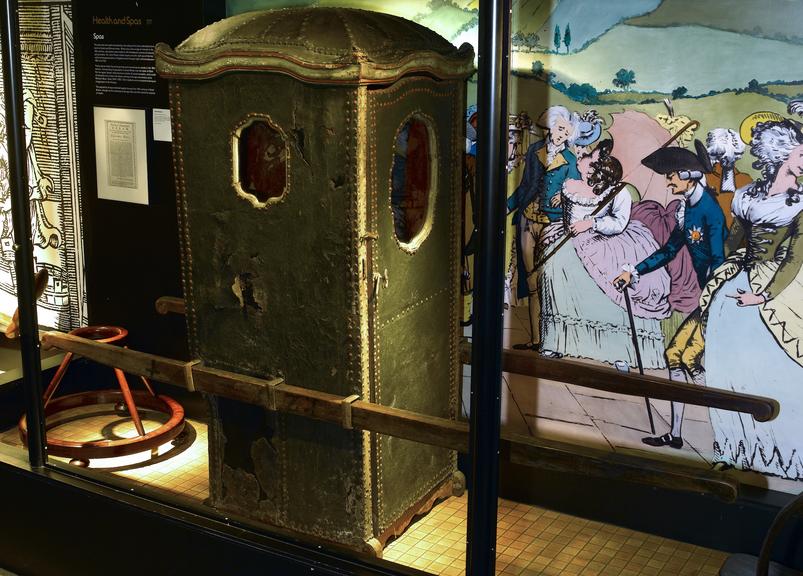
Boston’s “Sedan for Removing the Sick”

Lining up the sparse mentions of sedan chairs in colonial Boston reveals a clear pattern: they were used to transport sick people.

In 1674 the Rev. John Oxenbridge of the First Meetinghouse suffered a stroke while preaching the Thursday Lecture and “was carried home in a Cedan.”

Thirteen years later, Judge Samuel Sewall wrote in his diary: “Capt. Gerrish is carried in a Sedan to the Wharf and so takes Boat for Salem, to see if there he may find amendment of his Distemper.”

In May 1715, the newly reappointed governor Joseph Dudley was bed-ridden with gout. At the end of the month, Sewall wrote, he came to Boston and “was carried from Mr. Dudley’s to the Town-House in Cous. [William? Jeremiah?] Dummer’s Sedan: but twas too tall for the Stairs, so was fain to be taken out near the top of them.”

Yesterday I listed five times sedan chairs were advertised for sale in eighteenth-century Boston newspapers. I don’t think it was coincidence that four of those ads were estate sales, and the fifth seller died within two years. Those men might have acquired sedans as they or their wives became too ill to walk around.

Boston also had a public sedan chair, operated by the town itself. In March 1739, the Boston selectmen took note of “A Sedan, or Chair belonging to the Hon. Edward Hutchinson Esqr. which the Town has had the loan of for a considerable time.” One of those local elected officials was Thomas Hutchinson, and the sedan owner was his uncle. The selectmen decided that the chair “be effectually Repaired, and made fit for Use, in the best and frugal manner.”

That sedan chair became part of Boston’s public-health infrastructure. On 4 Jan 1757 the selectmen voted “that the Sedan for Removing the Sick be broke to Peices” and “Mr. [Isaac] Cazneau make a good Serviceable Sedan at the Charge of the Town.” Cazneau was a saddler.

In 1760 the Massachusetts General Court bought land in the sparsely populated western point of the Boston peninsula called “New Boston” for a new hospital. Four years later, the town suffered a serious smallpox epidemic. That appears in the selectmen’s records with an uptick in orders for the sedan chair to carry people to that hospital.
  • 16 Jan 1764: “Information was given the Select men by Dr. [Phillip] Cast, that One Hallet who came from Newfoundland a Month past, and Boards at Mrs. Nicholsons in Fitches Alley, has the Symptoms of the Small Pox upon him whereupon the Select men endeavour’d to perswade him to consent to his being removed, and having obtain’d such consent, he was accordingly removed in the Sedan to the Province Hospital at New Boston.”
  • 20 Jan 1764: “The Select men having prevailed with Mr. Adams to consent that his Child should be removed from his House to the Hospital at New Boston, they at about 12. OClock that Night took Mr. Williston and a number of hands with the Sedan to said House, when they received the Wet Nurse and Child and carried them to said Hospital”.
Similar entries appeared through August of that year.

TOMORROW: “Mr. Williston.”

(The picture above shows a sedan chair used to carry medical patients in La Paz, Bolivia, now in the Wellcome Collection in London.)

Tuesday, September 09, 2025

“Swelled to three times his size, black as bacon”

Here’s another account of anti-epidemic measures from the Adams family papers, this one a 17 Apr 1764 letter from John Adams to his fiancée, Abigail Smith.

John had gone into Boston to be inoculated with smallpox under the care of Dr. Nathaniel Perkins, and he reported:
Messrs. Quincy’s Samuel and Josiah, have the Distemper very lightly. I asked Dr. Perkins how they had it. The Dr. answerd in the style of the Faculty “Oh Lord sir; infinitely light!” It is extreamly pleasing, says he, wherever we go We see every Body passing thro this tremendous Distemper, in the lightest, easiest manner, conceivable.

The Dr. meaned, those who have the Distemper by Inoculation in the new Method, for those who have it in the natural Way, are Objects of as much Horror, as ever.

There is a poor Man, in this Neighbourhood, one Bass, now labouring with it, in the natural Way. He is in a good Way of Recovery, but is the most shocking sight, that can be seen. They say he is no more like a Man than he is like an Hog or an Horse—swelled to three times his size, black as bacon, blind as a stone. I had when I was first inoculated a great Curiosity to go and see him; but the Dr. said I had better not go out, and my Friends thought it would give me a disagreable Turn.

My Unkle [Dr. Zabdiel Boylston?] brought up one [John] Vinal who has just recoverd of it in the natural Way to see Us, and show Us. His face is torn all to Pieces, and is as rugged as Braintree Commons.

This Contrast is forever before the Eyes of the whole Town, Yet it is said there are 500 Persons, who continue to stand it out, in spight of Experience, the Expostulations of the Clergy, both in private and from the Desk, the unwearied Persuasions of the select Men, and the perpetual Clamour and astonishment of the People, and to expose themselves to this Distemper in the natural Way!—

Is Man a rational Creature think You?—Conscience, forsooth and scruples are the Cause.—I should think my self, a deliberate self Murderer, I mean that I incurred all the Guilt of deliberate self Murther, if I should only stay in this Town and run the Chance of having it in the natural Way.
Smallpox continued to spread well into the age of photography, so there’s graphic documentation of how victims look when the blisters break out. I don’t recommend it.

Monday, September 08, 2025

“Our House is an hospital in every part”

On 8 Sept 1775, 250 years ago today, Abigail Adams had serious news for her husband John, who was heading back to the Continental Congress:
Since you left me I have passed thro great distress both of Body and mind; and whether greater is to be my portion Heaven only knows. You may remember [hired boy] Isaac [Copeland] was unwell when you went from home. His Disorder increasd till a voilent Dysentery was the consequence of his complaints, there was no resting place in the House for his terible Groans. He continued in this state near a week when his Disorder abated, and we have now hopes of his recovery.

Two days after he was sick, I was seaz’d with the same disorder in a voilent manner. Had I known you was at Watertown I should have sent Bracket [a farm hand] for you. I sufferd greatly betwen my inclination to have you return, and my fear of sending least you should be a partaker of the common calamity. After 3 day[s] an abatement of my disease relieved me from that anxiety.

The next person in the same week was [servant girl] Susy. She we carried home, hope she will not be very bad.

Our Little Tommy [Thomas Boylston Adams] was the next, and he lies very ill now—there is no abatement at present of his disorder. I hope he is not dangerous.

Yesterday [servant girl] Patty was seazd and took a puke. Our House is an hospital in every part, and what with my own weakness and distress of mind for my family I have been unhappy enough.
The Adams Papers editors noted: “Patty, who was probably a relative of JA or AA and had lived four years in the Adams household, died after a protracted and grisly illness early in October.”

The letter went on to list other neighbors who were ill. Abigail and John also both knew that his brother Elihu had died of the same disease in early August.

Two days later, Abigail resumed her letter:
As to my own Health I mend but very slowly—have been fearful of a return of my disorder to day but feel rather better now. Hope it is only oweing to my having been fatigued with looking after Tommy as he is unwilling any body but Mamma should do for him, and if he was I could not find any body that is worth having but what are taken up already with the sick. Tommy I hope is mending, his fever has abated, his Bowels are better, but was you to look in upon him you would not know him, from a hearty hale corn fed Boy, he is become pale lean and wan.

Isaac is getting better, but very slowly. Patty is very bad. We cannot keep any thing down that she takes, her situation is very dangerous. Mr. Trot and one of his children are taken with the disorder.
As discussed back here, George Trott was a politically active jeweler from Boston, and Abigail had taken in the Trott family as refugees.

The epidemic that Abigail’s letter described was “camp fever,” a bacterial dysentery. It spread among provincial soldiers and then to their families and neighbors because, basically, people didn’t yet realize they had to wash their hands and clothing thoroughly to avoid spreading germs. Women and servants caring for the sick thus became vectors for the disease to themselves or others.

All this time, Abigail was also worrying about smallpox, a viral disease that spread more slowly but was more deadly. She wrote:
The small pox in the natural way was never more mortal than this Distemper has proved in this and many neighbouring Towns. 18 have been buried since you left us in Mr. [Ezra] Welds parish [of Braintree]. 4, 3 and 2 funerals in a day for many days. Heitherto our family has been greatly favourd.
Looking ahead, Abigail asked John to send her medical supplies:
By the first safe conveyance be kind eno to send me 1 oz. of turkey Rhubub, the root, and to procure me 1 quarter lb. of nutmegs for which here I used to give 2.8 Lawful, 1 oz. cloves, 2 of cinnamon. You may send me only a few of the nutmegs till Bass [another family servant] returns. I should be glad of 1 oz. of Indian root. So much sickness has occasiond a scarcity of Medicine.
Many modern American parents can easily sympathize with Abigail having to care for a child like Tommy. But the number of sick people in the household and the neighborhood, and the specters of serious illness and death, are worries we’ve usually been spared. This sort of document is a reminder of the danger of rolling back proven health measures.

Saturday, September 06, 2025

“He Lieut. Thos. Hawkshaw did affirm this to be the Fact & Truth”

On 23 Apr 1775, Lt. Thomas Hawkshaw of the 5th Regiment was lying near death.

He’d been shot through the throat during the Battle of Lexington and Concord. He’d lost a lot of blood, not only from that wound but from supposedly therapeutic bleeding. He was suffering spasms of pain. He had trouble swallowing pain relief, much less solid foods.

And his commander-in-chief, Gen. Thomas Gage, had just intercepted a letter from justice Edmund Quincy to the Patriot leader John Hancock saying Hawkshaw had been heard saying that British troops had fired first and started the war.

Hawkshaw’s regimental commander, Lt. Col. William Walcott, and other officers came to speak to him. They went away with this document, now in Gage’s papers. It said:
Boston, 23d. April 1775

Lieut. Thos. Hawkshaw of the 5th: Regt. of Foot, declares in the most solemn Manner to Lt. Col. Walcott, in the Presence of Capt. Smith & Lieut. Ben. Baker All of the same Regimt.,

That, he, Lieut. Thos. Harkshaw, never did say to any Person whatsoever, that, the King’s Troops gave the first Fire upon the People of this Country in the Affair which happened between the said Troops & the said Country People on Wednesday last the 19th. April;

that, so far from knowing or believing that the Troops were the first who fired, he, Lieut. Thos. Harkshaw, knows & believes that the Country People did fire first upon His Majesty’s Troops, & that he Lieut. Thos. Hawkshaw did affirm this to be the Fact & Truth to Lt: Col. [Francis] Smith of the 10th: Regt. of Foot who commanded the Grenadiers & Light Companies, upon the Spot, and that he, Lt. Thos. Harkshaw, did again upon his being brought into Boston, make the same Declaration to Capt. [John] Gore of the 5th. Regt. of Foot, That, to the best of his Knowledge & Belief, the Country People fired first upon His Majesty’s Troops.

Thomas Hawkshaw
Lieut 5th Regt. Foot

Wm: Walcott, Lt: Col. 5th. Foot.
John Smith Capt: 5th. Foot
Ben Baker, Lt. & Adjt. 5th. Foot
The regiment contained lieutenants named Benjamin Baker and Thomas Baker, so they used first names to sort out those men. The handwriting of the document looks like Walcott’s.

The detail about Hawkshaw telling Lt. Col. Smith (shown above) that the provincials in Lexington had fired first suggests the lieutenant was on or near the common during that shooting while Smith was still back with the grenadiers.

However, the document doesn’t add any detail about what Hawkshaw actually heard or saw there, and Gage was collecting such detail from other officers at this time. That makes me think Hawkshaw had passed on what he’d heard from other officers. (If Hawkshaw turns out to have been a light-infantry officer, then that’s off.)

In any event, from his sickbed Lt. Hawkshaw was insisting that he’d consistently blamed the provincials for shooting first.

TOMORROW: Corroborating witnesses.

Friday, September 05, 2025

“Lt. Hawkshaw yesterday near expiring thro. his bad wounds”

During the British army withdrawal on 19 Apr 1775, Lt. Thomas Hawkshaw of the 5th Regiment was shot in the side of his face.

As recorded by his regiment’s surgeon, blood gushed from his nose and mouth as well as his wound. Some of the affected tissue became inflamed. He had trouble swallowing.

People thought Lt. Hawkshaw was lying on his deathbed. And according to legal and popular understandings of the time, that meant he couldn’t lie in another way. After all, a person wouldn’t utter a falsehood just before meeting his maker, right?

Or, as a legal maxim quoted in 1700s reference books said: Nemo moriturus præsumitur mentiri. A dying person is not presumed to lie.

Usually that “dying declaration” doctrine allowed testimony from a dead victim that would otherwise be ruled out as hearsay. Thus, Patrick Carr’s doctors could report his remarks about the soldiers holding back before the Boston Massacre in 1770. To discredit such strong evidence, Samuel Adams had to resort to sneering that Carr “in all probability died in the faith of a roman catholick.”

The same thinking made “deathbed confessions” convincing. In the case of Lt. Hawkshaw, word went around that as his life slipped away he blamed the army for starting the war. Justice of the peace Edmund Quincy wrote to John Hancock on 22 April:
Here they say & swear to it all round, in excuse of ye Regulars, proceeding at Lexinton—that they were attack’d first & I doubt not many oaths of Officers & men are taken before J. G—ley [Justice Benjamin Gridley], to confirm it—but among others who contradict ’em—Lt. Hawkshaw yesterday near expiring thro. his bad wounds——Call’d Several Credible persons to him & told ’em as a dying man—that he was obliged in Conscience to confess—that the first Action of ye Whole at L. was done by the Kings troops—wr. they killd & wounded eight men—but doubtless you have sufficient proof of ye Fact & every Circumstance attending near at hand— . . .

Capt. [John] Erving, at his house yesterday Gave me ye Account of Hawkshaws Confesso.-proved to him at ye No: End yesterday to be real
As discussed here, Quincy gave that letter to Dr. Benjamin Church, Jr., who slipped it to Gen. Thomas Gage. Which meant Lt. Hawkshaw’s commander read that he was contradicting the official army line.

TOMORROW: A quick response.

Thursday, September 04, 2025

“The blood continued to dribble, for two days after”

In 1805, Henry St. John Neale published the second edition of his Chirurgical Institutes, Drawn from Practice, on the Knowledge and Treatment of Gun-shot Wounds.

In another book Neale identified himself as “formerly surgeon to the Duke of Northumberland’s regiment, of fifth battalion of infantry, and the Royal Hospital at Chatham.”

The Duke of Northumberland was previously Earl Percy, colonel of the 5th Regiment. The 1781 Army List names Neale (rendered as “St. John Neill”) as surgeon of that regiment, appointed November 1780. He may have previously been a surgeon’s mate, or he may have drawn from his predecessors’ accounts of what they did earlier in the war.

Chirurgical Institutes contains a description of Lt. Thomas Hawkshaw’s condition and treatment by the 5th’s medical staff after he was wounded on 19 Apr 1775.

Neale’s section labeled “History of the wound of the gallant Captain Hawkshaw.” reported:
The most remarkable wound in the neck, which happened during the American war, was that of Captain Hawkshaw, of his Majesty’s 5th regiment of infantry, This gallant officer was wounded in the neck, by a musquet ball, which entered the coraco hyoideus muscle, on the right side, passing through and through behind the gullet, which it grazed in its passage.

The sufferings of that brave soldier, in the course of his cure, is far above my abilities to express, which he bore with the greatest fortitude. The instant after he received his wound, the blood gushed out in torrents from his mouth and nostrils, and the wound also bled profusely. At first it was feared that the large blood vessels had suffered, but they fortunately escaped from the blow: although the ball had passed within a hair’s breadth of the COROTID ARTERIES.

An external dilatation [stretching] was soon made, as much as the situation of the parts would admit, a soft dressing applied, and as soon as was possible, his neck covered with an emollient poultice. Soon after he was bled copiously, although he had lost a large quantity from the wound, and the blood continued to dribble, for two days after, from his mouth and nostrils.

In the evening he had a clyster [enema], and towards bed time, a few drops of laudanum, which was got down with great difficulty. He spent a restless night, and as we were fearful of a hæmorrhage, a surgeon was constantly with him. The next day all his powers of deglutition [swallowing] were impeded, so that he could scarcely get down fluids into his stomach, which was contrived to be conveyed through a small tube by suction: and the same method was used for his anodyne [painkiller] at night. The second and third night was something better than the first, but attended with considerable spasms at intervals.

On the third morning the dressings were removed, which came off with ease, from the suppuration which had taken place, and the wound dressed with warm balsamic digestives. The inflammation of the surrounding parts, was very considerable, which had communicated to both the larynx and pharynx.

From the third to the twentieth day, matters went on (all circumstances attending this extraordinary wound being considered) as well as could be expected. He was supported solely by fluids, which he sucked down through the small tube above mentioned, for the space of thirty days, sometimes cows milk, at other times panada [bread soup], with now and then a spoonful of wine.

About the end of this period, he was enabled to swallow spoon meat, but was reduced to great weakness. The peruvian bark [quinine] was now administered copiously, and in three weeks more he was enabled to get down solid food.

In another fortnight his wound was perfectly healed, and in every respect he was restored to his pristine health, to the great joy of all who were acquainted with the great merit of this brave officer.
Thomas Hawkshaw was a lieutenant when he was wounded, but he was promoted to be a captain-lieutenant in the 5th Regiment in November 1777 and then captain in November 1778. Neale probably knew him by that rank. There was certainly no other officer named Hawkshaw in the regiment.

It’s striking how these eighteenth-century military surgeons decided that a patient who just had blood gushing from his mouth, his nostrils, and a wound in his neck really needed to be “bled copiously.” And it’s a testament to Lt. Hawkshaw’s constitution that he survived.

TOMORROW: A deathbed admission?

Wednesday, September 03, 2025

“Wounded in the cheek, and it is tho’t will not recover”

Lt. Thomas Hawkshaw went out of Boston with his soldiers in the 5th Regiment of Foot on 19 Apr 1775.

He came back wounded. The always helpful Lt. Frederick Mackenzie recorded that Hawkshaw was wounded on the cheek.

Almost half a century later, provincial militiaman Joseph Thaxter recalled this rumor:
Lieutenant Hawkstone, said to be the greatest beauty of the British army, had his cheeks so badly wounded that it disfigured him much, of which he bitterly complained.
That looks like a memory of Lt. Hawkshaw. But I can’t find any British source inside Boston that includes a handsome lieutenant’s lament. That’s the sort of thing fellow officers would be likely to mention or remember.

If Hawkshaw was indeed handsome, that might be why Bostonians remembered him being at disputes and couldn’t identify the other officers with him. That might also make it more appealing for Patriots to imagine him grieving his lost beauty.

I don’t think Thaxter is a reliable source here. Not only did he recall the lieutenant’s name imperfectly, but he described the man being wounded at Concord’s North Bridge, and he wasn’t. Hawkshaw was probably hit between Lexington and Charlestown.

Ezekiel Russell’s “A Bloody Butchery, by the King’s Troops” broadside offered readers outside Boston another significant detail:
Lieutenant Hawkshaw was wounded in the cheek, and it is tho’t will not recover.
For at least the first week, many people expected the lieutenant to die.

By 6 May, that medical prognosis had improved. David Greene wrote from Boston of “Hawkshaw, of the 5th, badly wounded, but like to recover.”

TOMORROW: How bad was Lt. Hawkshaw’s wound?

Sunday, August 31, 2025

“He died with the Effects of the Measles”

Henry Marchant (1741–1796, shown here) was a rising young lawyer in Rhode Island.

Born on Martha’s Vineyard, Marchant grew up in Newport and attended the College of Philadelphia (one of the schools that became the University of Pennsylvania in 1791).

In 1771 Marchant was appointed to be Rhode Island’s attorney general. He set sail for London to observe judicial practices there. His notes on James Somerset’s freedom case are an important document of that episode.

Marchant headed home in November 1772. On arriving in Boston, he received a boatload of bad news, as he told Benjamin Franklin in a letter. One loss was particularly close:
Mr. [Tuthill] Hubbart next informed me of the Death of my Third and only Son a Child of Three years old. He died with the Effects of the Measles, the Day after I left London. My two Daughters had been very ill with the same Disorder but are since happily recovered.
Measles was a common disease in colonial America. Martha Washington and other people at Mount Vernon caught it in 1760, and some of her enslaved workers in 1773. Benjamin Franklin’s grandson Benny caught measles in 1772, like little William Marchant. In 1788 Henry Knox reported that he had five children going through the disease.

In 1783 Abigail Adams reported that her son Charles had came down with the measles, adding: “it has proved very mortal in Boston. Tis said 300 children have been buried since last March.” Abigail’s sister Mary Cranch included a cousin’s descriptions of his symptoms in a letter in 1790:
I know you Will rejoice to hear that cousin Tom has got comfortable through the Measles. He caught them at Cambridge the day he arriv’d from new york— He came here the Monday after & told me he thought he had them but return’d the next day—promising to return as soon as he felt the Symtoms The Monday following his cousin William brought him home in a close carriage but he did not break out till Wednesday.

he was pretty sick but not very bad till they came out. He had Several faint turns before & sometimes felt as if he did not weigh a pound after they broke out— The rash came first but the measles soon follow’d thick enough, his cough was troublesome & his Fever pretty high but upon the whole I think he has had them light to what people in general have or to what you & I had. There are many People Who have them now extreamly bad & many have died with them—
Measles was overshadowed by smallpox, another disease that produced fever and spots, because smallpox was much deadlier. On the other hand, measles is much more contagious—spreading far more quickly and easily than Covid-19, H.I.V., and other viruses we’ve faced in recent decades.

We don’t have to worry about measles as much as past generations did because in 1954 medical scientists developed a vaccine. Cases in the U.S. of A. dropped precipitously after the government approved regular immunizations in 1963.

Unfortunately, the Trump administration’s Secretary of Health and Human Services, Robert Kennedy, Jr., has cockamamie ideas about vaccines. In fact, Kennedy was chosen for his cockamamie ideas—he has no other connection to health services. In particular, experts blame Kennedy for promoting a measles epidemic in American Samoa in 2019.

During his confirmation hearings Kennedy made noises about believing in vaccines, pointing out that all his children have been immunized. But as soon as he was in office and a media outlet gives him free rein to talk, Kennedy returned to spouting all sorts of lies about the nature of the vaccine, its effectiveness, and its side effects.

This past month, Kennedy demanded that the Centers for Disease Control adapt to his anti-vaccine beliefs, cancel highly promising research, and curtail the availability of Covid-19 boosters for Americans. When the head of the C.D.C. refused to go along, Kennedy and Trump forced her out, prompting the next level of managers to resign in protest.

There are many ways the Trump administration is harming people and causing deaths around the globe. The effects of Kennedy’s anti-vaccine crusade, if not stopped, will be among the most damaging. Parents will once again be feeling the same grief as Henry Marchant for no good reason.

Wednesday, August 27, 2025

“Are you serious, Dr. Church?”

In a letter to the Rev. Dr. Jeremy Belknap, Paul Revere recalled a dramatic moment on 21 Apr 1775:
The Friday evening after [the Battle of Lexington and Concord], about sun set, I was sitting with some, or near all that Committee [of safety], in their room, which was at Mr. [Jonathan] Hastings’s House at Cambridge. Dr. [Benjamin] Church, all at once, started up—

Dr. Warren, said He, I am determined to go into Boston tomorrow—

(it set them all a stairing)—

Dr. [Joseph] Warren replyed, Are you serious, Dr. Church? they will Hang you if they catch you in Boston.

He replyed, I am serious, and am determined to go at all adventures.

After a considerable conversation, Dr. Warren said, If you are determined, let us make some business for you. They agreed that he should go to git medicine for their & our Wounded officers.

He went the next morning; & I think he came back on Sunday evening.
As part of his medical mission, Dr. Church carried in a note from Dr. John Homans of Brookline to his mentor Dr. Joseph Gardner, asking for surgical knives.

Revere recalled speaking to Church after his return:
After He had told the Committee how things were, I took him a side, & inquired particularly how they treated him? he said, that as soon as he got to their lines on the Boston Neck, they made him a prisoner, & carried him to General [Thomas] Gage, where He was examined, & then He was sent to Gould’s Barracks, & was not suffered to go home but once.
In Igniting the American Revolution, Derek W. Beck guessed that the Gould of “Gould’s Barracks” was Lt. Edward Thoroton Gould, who on that day was a wounded prisoner of war outside of Boston. But I think the answer appears in a letter of merchant John Andrews on 11 January:
This morning the soldiers in the barrack opposite our house, left it, and took quarters with the royal Irish in Gould’s auction room or store—in the street leading to Charlestown ferry.
Bostonians often referred to barracks by the name of the local landlord who had rented those buildings to the army, making “Gould’s barracks” a big building on Back Street in the North End.

Robert Gould was a merchant who in August 1773 announced that the Boston selectmen had authorized him to set up as an auctioneer. He advertised heavily over the next several months (usually signing those notices “R. Gould”) before the Boston Port Bill hit. Renting his store to the army might have seemed like the best possible deal.

Robert Gould had also invested in Maine land along with Francis Shaw, Sr., a settlement that became Gouldsboro. He had trained Francis Shaw, Jr., in business, and newspaper ads in 1770 show that the younger man was selling ceramics out of “the store lately improved by Mr. Robert Gould.” In June 1776, Francis, Jr., and his wife Hannah had a boy they named Robert Gould Shaw. That man would pass the name on to his grandson, the Civil War hero.

Robert Gould remained in Boston after the British evacuation, but the Patriot authorities were suspicious of his dealings with the king’s army. The selectmen recommended detaining him for questioning, but the Massachusetts General Court decided to drop him from the list. Gould went back to advertising as a regular merchant in late 1776. But then he died unexpectedly, intestate and in debt, in January 1777, aged 57.

TOMORROW: The doctor’s documents.