J. L. BELL is a Massachusetts writer who specializes in (among other things) the start of the American Revolution in and around Boston. He is particularly interested in the experiences of children in 1765-75. He has published scholarly papers and popular articles for both children and adults. He was consultant for an episode of History Detectives, and contributed to a display at Minute Man National Historic Park.

Subscribe thru Follow.it


•••••••••••••••••


Showing posts with label Thomas Morton. Show all posts

Wednesday, November 19, 2025

The Jury for the James Caldwell Inquest

As I wrote yesterday, I now lean toward housewright Thomas Crafts, Sr., being one of the Suffolk County coroners who responded to the Boston Massacre rather than his namesake son.

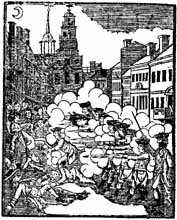
In fact, Thomas Crafts was apparently the first coroner to act. His date on the inquest into the death of James Caldwell is “the Fifth Day of March” in 1770. In other words, his jury convened, examined the evidence, and issued their determination in the immediate hours after the shooting.

Decades later, Benjamin Bussey Thacher interviewed the shoemaker George Robert Twelves Hewes about how the crowd on King Street had carried away Caldwell’s body:
Caldwell, who was shot in the back, was standing by the side of Hewes at that moment, and the latter caught him in his arms as he fell, and was one of those who bore him up to Mr. [Alexander] Young’s, the Jail-House in Prison Lane. He…was at this time second mate of a vessel commanded by Capt. Morton. This man lived in Cold Lane, and Hewes ran down directly to his house, from Young’s, and told him what had happened. The corpse soon followed him. . . . Morton…looked upon the dreadful object, and shouted like a madman for a gun, to run out “and kill a regular”…
The 12 March Boston Gazette reported that Caldwell was buried out of Faneuil Hall alongside Crispus Attucks as a “stranger,” a detail later histories repeat. But the 19 March issue said: “In the account of the funeral procession in our last, it should have been said, James Caldwell was borne from the House of Capt. Morton in Cold-Lane, instead of Faneuil Hall.”

Way back in 2006, the first year of this blog, I identified that sea captain as Thomas Morton. (Over a decade later came the Boston Massacre Sestercentennial commemoration in the Old South Meeting House. That was a weird event, on the lip of the pandemic shutdown when we were all wondering whether we should gather at all. But the weirdest moment for me was hearing a speaker identify Caldwell as Capt. Thomas Morton’s mate and flashing back to when I’d drilled down to find that name.)

I was therefore struck by seeing Thomas Morton’s signature among the members of the coroner’s jury examining James Caldwell’s body. Clearly he was emotionally involved in that death. Nonetheless, coroner Crafts made him part of the inquest. Maybe that was a way to calm Morton down, letting him respond to the young man’s killing in a productive way.

Other members of this jury were prominent Bostonians. The foreman was town treasurer David Jeffries. His son, Dr. John Jeffries, was a juror, months before he testified as a defense witness for the soldiers. William Dorrington, keeper of the smallpox hospital, was another.

Other members of this coroner’s jury included:
  • Samuel Gridley. In his testimony for the Short Narrative report, the apothecary Richard Palmes said he “followed Mr. Gridley with several other persons with the body of Capt. Morton's apprentice, up to the prison house.” Did that “Mr. Gridley” stay around to serve on the inquest jury?
  • Nathan Spear, whose younger brother Pool Spear was in the crowd on King Street and offered testimony against the soldiers.
  • Samuel Franklin (1721–1775), cutler. On 8 June, his first cousin once removed Benjamin Franklin wrote from London: “I received your kind letter of the 23d of March. I was happy to find that neither you, nor any of your family, were in the way of those murderers.” 
The verdict those fourteen men delivered to coroner Crafts: Caldwell was “murdered by a Musquet Ball shot thro’ his Body, & another Ball lodged in his Shoulder.” At first the men said the culprit was unknown, but then they revised the form to read “the Murderer a Soldier to us unknown.”

Wednesday, February 27, 2013

Richard Palmes’s Inquest Testimony

Richard Palmes had a front-row view of the Boston Massacre. He was close enough to Capt. Thomas Preston that, as he later said, “my left hand was on his right shoulder.” At Preston’s trial Palmes said, “The Gun which went off first had scorched the nap of my Surtout at the elbow.” He then laid about him with a “heavy [walking] stick,” knocking one soldier’s hand off his gun, before realizing it would be wise to run away.

The next day, Palmes provided a deposition for coroner Thomas Dawes’s inquest on the death of Samuel Gray. I’ve added paragraph breaks and included all interpolated text to make it easier to read, but there’s only so much I can do:

I Richd. Palmes of Boston Apoth’y [?] of Lawfull Age Testafieth & Sayeth, that about 9 oClock Last evening I heard one of the Bells Ring, which I Suppos’d was for fier, upon which I Went towards ware I supposed it was, I ask what the matter was, I was told that the Soldgers was abusing the Inhabetents, I ask ware the Soldgers was, and was told in King Street & that there was a Rumpus at the Custom-house Door,

assoon [sic] as I got their, I saw one Capt. Preson at the head of Six or Eight Soldgers, the Soldgers had their Guns Brest high, I went ameadiatly to the Sd. Capt Preson, I ask him if the Soldgers guns were Loaded his Reply was that they ware Loaded with Powder & Ball I then ask him if he intended they should fire his Answer was by no Means, but I Did not here him tell the men not to fire

I saw apice [sic] of Ice fall among the Soldgers Ameadiatly upon this the Soldger at his right hand fired his Gun that Instant I herd the word fire, but who said it I know Not; the Soldgers at his Left fired Next, and the others as fast as they Could one after the other, I turned my Self as Soon as I could & Saw one Lay Dead at my Left, upon wich I struck at the Soldger that fird the first Gun I hit his Left hand which maid his Gun fall, at which I made a Stroke at the offiser, & Struck him on the Arm at him, and thought I hitt his head, but sd. officer Preson Says I hitt his Arm, on my makg. the Strook I fell on my Right knee, the I then saw the Soldger that first fird, agoing to push his Bayanett at me, upon which I threw my Stick at his head, so he gave Back—and Gave me an Opportunity to Jump frome him, or I must Ben Run threw my Bodey,

Directly I past threw Exchange Lane, and so up the Next Lane by Mr. Kents office, & Saw the Bodey of three persons Laying on the Ground I followd the [body] of Capt. Mortons apprentice Carrg By [?] I followd it up to the parson house, and Saw he had a Ball, shot threw his Breast &c and further Sayeth not.
“Capt. Mortons apprentice” was victim James Caldwell; there’s a discussion of his body’s travels here. I tried to nail down Morton’s identity here. “Mr. Kent” was the Whig lawyer Benjamin Kent.

Palmes’s inquest testimony is preserved in the Boston Public Library’s Mellen Chamberlain collection.

TOMORROW: Richard Palmes gets the last word.

Friday, September 08, 2006

Who Was Caldwell's Capt. Morton?

Earlier this week, BCaldwell wrote:

As a Caldwell, I've always been interested in Boston Massacre victim James Caldwell (aka "a mate on Capt. Morton's vessel"). Accounts of the event (including the famous Gazette account) refer to "Capt. Morton" as if he were a well known figure to Bostonians of the day. Does anyone know who Capt. Morton was, what the name of his vessel was, or how I can find out more about him?
I don't usually take requests because they so often involve work. But by happy coincidence, I wrote about James Caldwell (or, rather, about his body) and about Capt. Morton's response to his killing in one of my earliest entries, titled "The shoemaker's memory." So I already had an idea about who "Capt. Morton" was. How simple and impressive it would be simply to drop that information, I thought.

And this is why I don't take requests.

The Capt. Morton I had in mind was Capt. Dimond Morton, who died in Littleton, Massachusetts, on 2 Feb 1792 at the age of forty-nine. He was a witness in the trial of Capt. Thomas Preston. However, a little more research showed me that in 1770 Dimond Morton was running a tavern and stable with his father Joseph, not working as a sea captain and living on Cold Lane like Caldwell's master. Morton didn't acquire the title of captain until late 1775, when he was in Henry Knox's artillery regiment. (His younger brother Perez Morton was an attorney who delivered the oration over Dr Joseph Warren's body and then got into a sex scandal with his wife and sister-in-law. But that's gossip for another day.)

So I was back to the beginning with "Capt. Morton." Newspapers referred to lots of sea captains and militia captains only by their title. Since Boston had only about 16,000 people, over half of them children, most readers knew the major authority figures in town. And indeed, looking through the colonial newspaper database shows a great many references to Capt. Morton from Boston, sailing back and forth to Britain's Caribbean islands and mainland colonial ports. But was there one captain with that name or more? And what was his first name?

I started trawling in those newspapers for items with both "captain" and "Morton" as keywords. In 1765, a man named Morton captained the brig Hawk. So I looked for combinations of "hawk" and "Morton." On 9 April 1770, the Pennsylvania Chronicle reported that "T. Morton" was the captain of the Young Hawk from Boston. He had arrived in Boston from Hispaniola in early February, according to the 8 Feb Boston Chronicle. (That seemed to put him in Boston during the Massacre, a good sign.) From Philadelphia T. Morton and the "Young Hawke" headed to Newfoundland, per the 23 April Pennsylvania Chronicle.

Since eighteenth-century Bostonians didn't value a lot of variation in given names, I guessed Capt. Morton might be named "Thomas." Indeed, the 20 June 1768 New-York Gazette identifies the master of the Hawk from Boston as Thomas Morton. So does the 11 Jan 1762 Boston Post-Boy. The 12 Dec 1768 Boston Gazette describes a brig sailing from the West Indies home to Boston, "Thomas Morton, Master," being driven ashore "on the Rocks near the Light-House" in Boston Harbor. So that could explain why Morton was sailing the Young Hawk a year and a half later.

So, with more work than I expected behind me and no claim to a definite answer, I suggest that the ship's captain James Caldwell served in early 1770 might have been Thomas Morton of the Young Hawk. Was he also the Thomas Morton who joined the Charitable Irish Society of Boston in 1761? The Thomas Morton who owned a house near the Town House in 1798? Hey, do I have to do this all myself?