J. L. BELL is a Massachusetts writer who specializes in (among other things) the start of the American Revolution in and around Boston. He is particularly interested in the experiences of children in 1765-75. He has published scholarly papers and popular articles for both children and adults. He was consultant for an episode of History Detectives, and contributed to a display at Minute Man National Historic Park.

Subscribe thru Follow.it


•••••••••••••••••


Showing posts with label food. Show all posts

Thursday, September 03, 2026

“Environmental Histories of New England” in Boston, 18 Sept.

On Friday, 18 September, the Massachusetts Historical Society will host the New England Quarterly Symposium on Environmental Histories of New England, 1600-2026.

Papers relevant to our period include:
  • “Preserving the Catch: Curing Practices, Environmental Agency, and the Eighteenth-Century New England Commercial Cod Fishery” by Morgan S. Hardy, University of Tennessee
  • “Beyond ‘Hot Girl Summer’: Rural Life and Gendered Experiences of Seasonal Variability in Eighteenth-Century Northern New England” by Emma C. Moesswilde, Elon University
  • “Many Are These Awfully Sudden Deaths: Mapping the Environmental History of Boston’s 1721 Epidemic” by Christopher Parsons, Northeastern University, and Molly Nebiolo, Butler University
  • “Environmental history with/for Indigenous communities: Examples from Acadia” by Catherine Schmitt, Schoodic Institute at Acadia National Park
  • “‘A Fishay Noyse’: Taunton’s Herring Crisis and New England Energy Futures” by Zachary Bennett, Norwich University
The keynote address at the end of the day will be “Tom Paine’s Sunshine Soldiers” by Joyce Chaplin, the James Duncan Phillips Professor of Early American History at Harvard University.

Registration, which includes food, costs $20. The event is free for graduate students, teachers, and adjunct faculty.

On the afternoon before the symposium, the Norman B. Leventhal Map & Education Center, a co-sponsor of the event, will host an open house in its facilities at the Boston Public Library central building.

For the full program and registration information, start at this page.

Sunday, August 30, 2026

Long Island Has Fallen

On the morning of 30 Aug 1776, 250 years ago today, Gen. William Heath was stationed at Kingsbridge, New York, on the Hudson River just north of Manhattan Island.

Heath wrote urgently to his commander-in-chief:
A very Extraordinary Report has Just Spread here, that whether True or false we are as yet uncertain That Long-Island is Evacuated by Our Troops. . . .

I am in Anxiety Untill I hear from you
This letter is transcribed at Founders Online, and the Massachusetts Historical Society has digitized Heath’s copy.

Likewise, Abraham Yates, Jr., head of the New York committee of safety, wrote to the commander from the same place:
In our way to Fishkill agreable to an adjournment of the Convention, we are informed that the Army is removed from Long Island to the City of New York—

an anxiety to know the fact, as well as to be informed wether you think any measures necessary for us to take—Induces us to trouble your Excellency at this time for an answer hereto—

We have ordered last Night all the Militia of the Counties of Ulster, Dutchess, Orange and Westchester to be ready at a Minutes warning, with five days provisions.
Gen. George Washington wrote back to Yates:
Circumstanced as this Army was in respect to Situation Strength &c., it was the unanimous advice of a Council of General Officers to give up Long-Island, and not by divideing our Force be unable to resist the Enemy in any one point of Attack, this reason added to some others, particularly the fear of haveing our Communication cut of from the Main (of which there seemed to be no Small probability) and the extreame fatigue our Troops were laid under in guarding such extensive Lines, without proper Shelter from the weather, induced the above Resolution.

It is the most intricate thing in the World Sir to know in what manner to conduct ones self with Respect to the Militia, if you do not begin many days before they are wanted to raise them, you cannot have them in time, if you do they get tired and return, besides being under very little Order or Government whilst in Service—

However if the Enemy have a design of serveing of Us at this place as we apprehended they meant to do on Long-Island—it might not be improper to have a body in readiness to prevent or retard a Landing of them on the East of Harlem River, if need be—

In haste & not a little fatigued, I remain with great Respect & Esteem Sir Yr Most Obedt Hume sert…
Washington let the adjutant general, Joseph Reed, reply to Heath:
The Report of the Evacuation of Long Island last night is true—it was a Measure founded in the fullest Necessity after the Surprize of our Troops last Tuesday [the Battle of Brooklyn], by which the Flower of our Army & some of our best Officers were lost.

add to this that the constant Rains upon Troops without Cover has so spoil’d the Ammunition & enfeebled the Men that had the Enemy attempted to force our Lines they must have done it with great Ease. The Ships have also been trying to get up the whole Week, which if they could effect our Communication would have been cut off and the whole Army must have surrendered at Discretion.

Under these Circumstances the remaining General Officers were unanimously of Opinion that it was absolutely necessary to retreat which was done so as to bring off all our Ammunition & Artillery except the heavy Pieces & most of our Provisions

Our Situation is in all Respects critical Ld. Stirling & Gen. [John] Sullivan are both Prisoners—the latter was permitted to come out this Morning on his Parole with a Message from Ld. Howe. This is the Substance of what has passed in this important Week.

Saturday, August 22, 2026

Benjamin Davis, Baker?

The record of Benjamin Davis, Sr.’s appearance before the Loyalists Commission in Canada states of his time in New York:
He was then a Baker in Govert. Service.
That detail has gone into every profile of Davis written from that source. Articles have discussed Davis as an example of the baking profession.

That puzzles me because nothing in Davis’s past shows any connection to baking. (Gingerbread, yes. Running a bakery, no.)

In Boston, Davis was a general import merchant, usually dealing in dry goods. He also invested in distilling, whaling, and other enterprises. Whigs denigrated him as a “Huckster,” not a baker. The goods he lost at Boston included “Iron, Tea, Liquor, Stockings, Haberdashery…”

Later the same Loyalists Commission document quoted Davis as saying that when he was captured on his voyage to New York in 1776 “He was then going into Trade on advice of Sir W. How.” The term “Trade” meant general mercantile trading. The cargo Davis was bringing to the city? Wine, not flour or bread.

An advertisement in the 13 Dec 1777 Royal Gazette shows that Benjamin Davis had opened a store in New York “in Queen-Street, the corner of King-Street.” He offered Madeira wine, tea, candles, sugar, cloth, clothing, blankets, and “An assortment of childrens toys.”

On 23 May 1778 “Benjamin Davis, & Son,” advertised in the Royal Gazette from “their Store, No. 229, Queen-Street, the Corner of King-Street.“ They sold cloth, garments, notions, and wine.

In 1779 the father and son offered “A neat and elegant assortment of BOOKS.” In 1781 they had “Four hundred gallons choice fresh South Carolina ORANGE JUICE.” In 1782 they advertised “Garden SEEDS” shipped from London. Several of their newspaper ads offered the cloth and trimmings for military uniforms. But never bread.

That firm’s advertisements disappeared after August 1783 as the British military left New York. That’s why I’m confident these merchants were Benjamin Davis, Sr. and Jr., from Boston. (Because of course there were a bunch of men with that name in Revolutionary America.)

It’s conceivable that Benjamin Davis, Sr., provided some capital for a bakery that supplied the British military in New York, but there’s no sign he was involved in running that operation. And I wonder if the word “Baker” was correctly transcribed.

TOMORROW: Benjamin Davis, to the end.

Sunday, August 16, 2026

“May God preserve this second Sodom”

On 25 May 1775, one week after the New-England Chronicle’s initial, hazy report on the fire that started in the 65th Regiment’s barracks, printers Samuel and Ebenezer Hall returned to the subject with a longer dispatch.

This article started by summarizing the account of how the fire started and listing a few damaged buildings. It continued:
The following Letter contains an Account of the Transactions of the Military at the Fire; and will give the Public some Idea of the present wretched Police of that once well governed Town.

Extract of a Letter from Boston.

“I propose to give you a circumstantial Account of the late Fire, previous to which please to observe, that for ten Days past, a Report has been propagated, that the Liberty Party intended to set Fire to the Town in different Places as soon as the greater Part of them had got out.

The General [Thomas Gage] took the Alarm, and took the Engines under Guard, and appointed new Captains; the late Engine Men took umbrage at it; but to the Point.---

I being informed that Barrack was on Fire, ran through the Street crying Fire, (as no Bells rang) but was stopped by a Man who told me it was the Officer’s Order not to cry Fire, one having threatened to beat the Man’s Brains out that did. The Drums all this Time beating to Arms.

When I came to the Fire I found no engine there. Applying to one of the late Engine Men to know the Reason, was informed that he had applied for the Engine, but the Bayonet was pointed at him, and he was told that he must apply to some Officer for an Order before he could have it.

After this fatal Delay the Engines appeared with the new appointed Captains and military Firewards, and a miserable figure they cut, the former not knowing how to obey if the latter had known how to command.---

Upon the whole, it appears to me as plain as the meridian Sun, had the Engines been on the old Footing, the Fire would have been put out, and *twenty thousand Pounds Sterling Loss prevented. Let that be as it may, I will venture to say, had the Fire broke out in the Center of the Town it would have laid it in Ashes, in the Direction it took to the Water. May God preserve this second Sodom from the Fate of the First.”

* The whole Loss is thought to be £40,000 Sterling.
After that Hall printed the complete list of property losses that had already appeared in the Newport Mercury and other papers. That list included: “50 Barrels of Flour, belonging to the Donation Stock, destroyed.” That stock was food donated to feed the poor of Boston since the previous year’s Port Bill.

That contemporaneous account was rewritten for the Saturday Morning Transcript of 15 Mar 1834 under the headline “Fire Reminiscences: No XVI.” The best new line put into the original voice was: “I asked the reason of such extraordinary delay, and was told by an Engineman that he had been to his Engine, but the bayonets were too thick.”

That text in turn was printed with small changes in Arthur Wellington Brayley’s A Complete History of the Boston Fire Department in 1889.

As a first-person account, it was more dramatic than the list of burned buildings alone. At the same time, the writer and printers had a political message about how military occupation was damaging the community.

TOMORROW: Back to Benjamin Davis.

Tuesday, August 11, 2026

“We went to see Mr. Davis in Jail”

As I wrote back here, the lore in Benjamin Davis’s family was that his third wife, Alice, left him soon after their marriage in 1768 because she couldn’t stand how he worshipped with the Sandemanians.

Reportedly the men of the sect agreed that Davis could remarry if he chose. In a profile of Davis written for the Colonial Society of Massachusetts, Henry H. Edes said:
If Mr. Davis married a fourth wife, it is probable that she was Katharine Overlick, whose Intention of Marriage with Benjamin Davis was entered 24 April, 1773, but as we find no record of a marriage, and do find that Catharine Overlick,—presumably the same woman—entered her Intention of Marriage with John Clows 10 November, 1774, it is doubtful if Mr. Davis made another matrimonial alliance.
Alice (Whipple) Davis died in Cranston, Rhode Island, in 1795.

When captured on the Peggy sailing from Halifax to New York in July 1776, Benjamin Davis was accompanied only by his son and an enslaved man. In contrast, a couple of other merchants on the same ship were traveling with their wives, most notably Robert and Mary Semple, formerly Mary Wheat of Lincoln.

In her journal, published by the Essex Institute in 1868, Mary Holyoke (1737–1802, shown above) of Salem wrote:
July 28. Mr. Ben. Davis taken and put into Jail at Boston, and on the 31st Mrs. Davis spent the day with us at Mrs. Minott’s; we went to see Mr. Davis in Jail.
It appears that this “Mrs. Davis” wasn’t Benjamin Davis’s wife but a friend and/or relative of Mary Holyoke whom she mentioned many other times. But this Mrs. Davis could also have been related to Benjamin, giving him a courtesy call.

Life in the Boston jail wasn’t easy. The mates on the British transport ship Anne, James Young and John M’Kurdy, escaped from custody in Massachusetts and provided this intelligence on 24 August:
That Mr. Benjamin Davis, and several others were passengers, and that they treated Mr. Davis very ill. That they do not give the prisoners sufficient provisions, but offer them good wages to enter on board their privateers, and that many do enter.
The captain of the Peggy, James Kennedy, even petitioned the Massachusetts Council on 13 August for release on the grounds that he didn’t deserve to be associated with his passenger:
As your Petitioner had a Man on Board by the Name of Davis whose Character he did not know till he was brought into this Place, he beleives is the Occasion of his receiving different punishment from other Masters of Vessells.
Kennedy was indeed let out of the jail. According to the Naval Documents of the American Revolution editors, four other men gained release through “similar petitions.”

TOMORROW: Junior.

Sunday, August 09, 2026

“The Women from the Windows asking Davis whether he wanted any Gingerbread”

Massachusetts ships captured the Peggy on its voyage from Halifax to New York on 22 July 1776, as described yesterday.

The civilians aboard that ship were taken to Marblehead, then to Boston under guard. Word spread quickly that one of them was Benjamin Davis, a merchant who had left town months before.

On 28 July, Joseph Ward wrote to John Adams from Boston about the ship: “There are many Tories on board, among whom is the noted Benjamin Davis.”

The next day, Ezekiel Price put in his diary: “Brought to town Benjamin Davis and a number of other Tories, who were committed to jail.”

Why was Davis being singled out? He’d made himself notorious in some way, and we have a couple of hints about how.

David Cobb wrote to Robert Treat Paine on 29 July:
Just now the Tories were Landed at the Long Wharf from Marblehead & were attended from thence to the Prison by 2 thousand people; the Women from the Windows asking Davis whether he wanted any Gingerbread, refering to his treatment of the little Chreldren when they were going out of Town last Year. I wish the Devil had ’em.
Abigail Adams alluded to the same scuttlebut in her letter to John the same day:
we have taken a vessel from Halifax bound to New York, which we should call a prize but that it containd about 14 Tories among whom is that infamous Wretch of a Ben Davis the Ginger Bread Robber. How many little ones can say I was an Hungry and you gave me no Bread, but inhumanely took what little I had from me. I wish the Sea or any other Element had them rather than we should be tormented with them.
The editors of the Adams and Paine Papers weren’t sure what to make of those remarks about gingerbread.

I can’t find any sources providing a definite answer, but here’s my guess. At the start of the war, many families sought to leave Boston. Gen. Thomas Gage didn’t want refugees to take out food, which his army needed, or weapons, which the provincial army needed. So the governor set up a system of passes and inspections using both military and civilian administrators.

In the 5 June 1775 Boston Gazette, Benjamin Edes published an open letter addressed “To the perfidious, the truce breaking THOMAS GAGE” and signed “Massachusettensis.” (This was not, presumably, the Loyalist political writer.) Among its complaints about Gage was:
Nay, have not you, and your associates by your orders, been mean enough to steal rum and sugar from a poor teamster, half a cake of gingerbread, a nutmeg, and half a bisket from a poor woman who was flying half famished out of Boston from your low lived tyranny and oppression?
That item was reprinted in several other Massachusetts and Connecticut newspapers over the next couple of weeks. It’s the one gingerbread-related complaint I could find from the period.

That complaint shows that people working for the royal government were confiscating food from folks trying to leave Boston, even mundane food like gingerbread, even from “a poor woman.”

I suspect that Benjamin Davis had agreed to work for Gage’s royal government as some sort of inspector or administrator. At some point that spring, he took gingerbread from a family or two trying to leave town. Children may have cried. That incident didn’t get into the newspapers, but it made him notorious enough that citizens yelled at “Ben Davis the Ginger Bread Robber” more than a year later.

And, unlike Hopestill Capen, few people in Boston minded seeing Davis locked up.

(The picture above shows the Pennsylvania politician Joseph Galloway, not mentioned anywhere in this posting. In September 1774 John Adams wrote in his diary that he was “introduced to Mr. Galloway, the Speaker of the House in Pensylvania. He looks like Ben. Davis the Sandimanian.”)

Saturday, August 08, 2026

“Fell in with two Arm’d Schooners”

Yesterday I wrote about Benjamin and Edward Davis, two brothers who were mercantile partners in Boston until religion and Revolutionary politics split them apart.

Benjamin became a Sandemanian, devoutly guided not to oppose British Crown policies by, for instance, signing on to the non-importation boycotts.

Edward remained an Anglican, attending Trinity Church. By late 1774 the Whigs coopted him into helping to enforce their strongest boycott, the Continental Association.

Both brothers remained in Boston during the siege. But when the British military evacuated, Edward stayed while Benjamin sailed away to Halifax, Nova Scotia. In April 1776 the Patriot authorities ordered magistrates to question Edward about his loyalty, but evidently he passed muster.

Around the start of July, Benjamin Davis boarded the ship Peggy, headed for New York. Along with him came his son Benjamin, Jr., who turned twenty that year; an enslaved man; half a dozen other Loyalist men; and a few Loyalist women.

Evidently those refugees saw business opportunities supplying the huge British and Hessian army assembling at New York. The Peggy was loaded with provisions, including 2,648 “mutton hams,” 311 “tierces salted beef,” fish, flour, snuff, cloth, stockings, and a large quantity of alcohol in various forms.

The Peggy also carried six 3-pounder and two 2-pounder cannon. It sailed in convoy with dozens of other merchant ships and troop transports, all escorted by two Royal Navy warships. The sea voyage probably seemed safe.

We have the ship captain’s account of what happened next:
I James Kennedy, Master of the Ship Peggy, in the Merchant Service, declare that I left Hallifax about the first Inst. [i.e., of this month] under Convoy of the Renown of Fifty Guns, with a Fleet of sixteen [torn] Transports containing the 42nd & 71 Scotch Regiments & Fraziers new rais’d Regiment, about 3000 in all, & three Large Ships with Hessian Troops on board, about 600 in all, & one Ship with 5 companys of English foot Guards, & four Victualling Ships, the whole Fleet bound for New York.

Off Nantucket Shoals we fell in with the Flora Frigate of Thirty Guns & four Transports with Highland Troops, these had been in Boston Bay, where they got information from a Fisherman that the Town was Evacuated, on which they Stood for Hallifax untill they met with us, they then joyn’d our Fleet for New York.

The Scotch Troops were all to be of Coll [Archibald] Campbells division (of the Grand Army in America, the whole of which Army I was informd, would by the last of July, amount, to 50,000.) the Hessian Troops left England about the 12th of May, some of the Officers informd me they came out with 304 Sail under the Command of Commodore Hawtham [William Hotham], on board of whom were 10,000 Foreign Troops & some English Troops (number unknown).

last Fryday sennight [19 July] in a gale of wind & thick weather I lost the Fleet & on monday [22 July] I fell in with two [American] Arm’d Schooners, Capts. [John] Skimmer & [Samuel] Tucker, to whom I surrendered after a short engagement, in which I had only one man Wounded.

The day after the Fleet left Hallifax, I saw from my Deck forty Sail of Ships standing in for that Harbour, & which I suppose to be part of the Fleet under Commodore Hawtham.
Skimmer commanded the Franklin and Tucker the Hancock, schooners originally launched under the authority of the Continental Army commander. They were now sailing for Massachusetts.

The Patriot authorities who took Capt. Kennedy’s deposition were evidently pumping him for intelliegence on what other British ships and troops were out there rather than details of his engagement with the schooners.

For Benjamin Davis, all that mattered now was that he was a prisoner of the state he’d left four months before.

TOMORROW: The gingerbread man.

Wednesday, June 10, 2026

Three Podcast Episodes

Producing a podcast strikes me as a lot of work, but speaking about Boston history on other folks’ podcasts is always fun.

Here are three episodes I’ve recorded in the last few months. Enjoy all you can.

“The Spark: How Boston Ignited the American Revolution” on The Object of History from the Massachusetts Historical Society

We ask several historians for their thoughts on why Boston helped light the spark of the American Revolution. Was there something unique about Boston's community or geography that made it prone to a rebellious spirit? We sit down with J. L. Bell, Historian of the Revolutionary Era in Massachusetts, Garrett Dash Nelson, President & Head Curator at the Leventhal Map & Education Center at the Boston Public Library, and Kathryn Lasdow, Assistant Professor of History and Director of Public History at Suffolk University, to answer this question.
I’d already been mulling about “Why did the Revolutionary conflict flare up in Boston?” when the invitation to explore that question arrived. Hear my threefold answer and more.

“Boston” on History’s Greatest Cities from History Extra
As one of the oldest cities in the United States, Boston played a pivotal role in the outbreak of the American Revolutionary War, as well as the signing of the Declaration of Independence that followed. In this episode of History’s Greatest Cities, Paul Bloomfield is joined by writer John Bell to explore the storied history of the capital of Massachusetts. Together, they wander through Boston’s oldest neighbourhoods, tracing the story of this harbour city from its pre-colonial roots, through Puritan settlement, to its rise as a major port and administrative centre of the British Atlantic world.
This podcast asks its guests to answer a series of questions, from major events to foods a visitor mustn’t miss.

“Not What You Hurd” on Antiques Roadshow Detours from GBH
In the world of rare silver, American Colonial silver is the stuff collectors dream of. So, when a pair of drinking vessels or “canns,” complete with intricate engraving by a master Boston craftsman, were discovered during ROADSHOW’s visit to Akron in 2023, expert Nick Dawes examined the cups’ clues to reveal both the silver’s early-American history and extraordinary value. But does Nick’s tale of the tankards hold water? Join host Adam Monahan as he searches for the untarnished truth, picking through the many stories, half-truths, and wishful legends in a quest for what may or may not have been lost to history forever.
My voice pops up occasionally on this episode, leaving more time for the fine local historians Joel Bohy and Caitlin DeAngelis.

Thursday, May 28, 2026

“Specimens of Indian Insult”

I’ve quoted a couple of accounts of mock battles on Boston Common during militia musters, as reported proudly in the local newspapers. On those occasions, half the local unit provided an enemy by portraying the French.

Here’s a report from the 12 May 1774 Norwich Packet, describing a different scenario in Woodstock, Connecticut, a town on the border with Massachusetts:
NORWICH, May, 12.

A Correspondent from Woodstock informs us, that on Monday the 2d. Inst. the Three Military Companies of that Town met upon the Parade, in the First Society, where they performed the Manual Exercise with a Spirit and Activity that did Honour to their Officers and themselves.

At Eleven o’Clock a Troop of Horse, under the Command of Capt. Samuel McClellan, came upon the Parade; which, for elegance of Dress, goodness of the Horses, and suitable Furniture, were judged, by the numerous Spectators present, to be inferior to no Troop in America.

At Three o’Clock the Foot and Troop feigned a Skirmish with each other, which they conducted with Propriety and Order: Suddenly a Company of Aborigines appeared, who made Captives of some of the Children present, and gave other Specimens of Indian Insult to the Foot and Horse: Their Depredations roused the New-England Spirit in the Troop, who, with seem Fury, attacked and drove them yelling off the Field, to the great Joy of the Spectators.

The good Order that was observed, not only by the Troop and Foot Companies, but also by the Spectators, was remarkable.----No Injury was sustained by any One present. The Day and Evening Entertainments, were concluded with strict Sobriety and Decency.

The Captain of the Troop gave an elegant Dinner to his Company and a Number of Gentlemen, as also did Capt. [Benjamin?] Lyon, and the Colonel of the Regiment honoured the Day with his Presence.
I’ve found this event mentioned in a local history but not quoted in full. It offers an example of what Philip J. Deloria called “playing Indian” in American culture. This moment was a few months after the Boston Tea Party, a few months before the Patriot press began to share fearful speculations that the Crown government might recruit Natives and French Canadians to attack resistant colonies.

Ironically, the town of Woodstock contains the site of Wabaquasset, a Native American “praying town” from the mid-1600s. That community was split and depopulated by the King Philip’s War. Englishmen from Roxbury then settled the land. The town’s seal now depicts Native and English men standing on either side of a heraldic shield.

Tuesday, May 26, 2026

“Environmental History & the War of Independence” in Boston, 27 May

David Hsiung is the Dr. Charles R. and Shirley A. Knox Professor of History at Juniata College in Pennsylvania.

For several years he’s been working on the problem of how the enviroment affected the American Revolution, how the Revolution affected the environment, and how it’s possible to study those interactions with the data we have.

That is, of course, a huge topic, so part of the historiographical challenge is, I’m sure, to narrow down and define the questions in a manageable way. In the meantime, I’ve been enjoying his articles and lectures, which always open my eyes to new ways of seeing this history.

On Wednesday, 27 May, David Hsiung will be at the Massachusetts Historical Society for a conversation with Joyce A. Chaplin of Harvard, author most recently of The Franklin Stove: An Unintended American Revolution.

The description of “Curious & Complex Connections: Environmental History & the War of Independence” says:
Many of us give only a moment’s thought about the environment when considering the War of Independence: the slope of Breed’s Hill, the ice-choked Delaware River, and diseases such as smallpox. But what might we gain by connecting biology, ecology, and geology to the thinking and actions of soldiers and civilians? Rebels and British soldiers acquired and used energy in the form of food, fuel, and work animals, which shaped people’s lives, the course of the war, and the direction of environmental change.
This is a hybrid event starting at 6 P.M., with a reception in the preceding half-hour for people attending in person. Attendance costs $10, but is free to M.H.S. members and Card to Culture participants. Listening in online is free. Register for either form of access through this page.

Folks can also take in these talks from Prof. Hsiung:

Friday, May 01, 2026

”No other Crime, but retaining their Allegiance to the King”

We left John Hill, his wife Elizabeth (?), and his daughter in the Boston jail in February 1777, suspected of “being Enemical to the States” and “attempting to Carry Intillegence to the Enemy.”

The next trace of Hill that I’ve found is from John Noble’s article “Some Massachusetts Tories” for the Colonial Society of Massachusetts in 1900:
At the July [court] Term, 1777, John Hill of Boston recovers judgment in a plea of the case against Crean Brush for £2.8s.10d lawful money, and costs.
Did Hill sue Brush, his employer during the evacuation from Boston, for some loss? Or was this another John Hill?

There’s firmer information from John Howe’s Newport Gazette, published in the British-occupied city on 20 Nov 1777:
By Mr. JOHN HILL, who left Boston the 15th of October, we learn, that Dr. [Benjamin] Church, Mr. John Dean Whitworth, of the Queen’s Rangers, and a Number of others, are yet confined in Boston; Dr. [Mather] Byles is confined in his own House; and upwards of 70 Persons, who can be charged with no other Crime, but retaining their Allegiance to the King, and Attachment to that happy Constitution under which they were born, and from which they have enjoyed the most solid and inestimable Blessings, are now confined on board a Prison Ship in that Harbour.—

He also adds, that almost every Goal in New England is filled with these unhappy People.

Mr. Hill has also favoured us with the current Prices, in Lawful Money, of the following Articles, at the Time he left it:
Beef, — — 0.1.3
Mutton, — — 0.1.6
Butter, — — 0.4.0
And so on through a list of other meats and foods, alcohols, sugars, teas, and cordwood to shoes for men (£2.2/pair) and women (£1.10/pair).

Presumably Howe was making the point about price inflation in Continental-governed areas, but we’d have to find pre-war costs for comparison.

Years later John Hill told the Loyalists Commission, as recorded by Todd Braisted:
That on the 17th of March 1776, he left Boston, with the Royal Army; but was taken at Sea, by the Rebels, . . . himself, his Wife, & Daughter was carried back to Boston, and he confined in Prison 19 months; they were all tried For their lives, but not Condemned.

In November 1777, they were Exchanged, went to Halifax, and afterwards to New York
Hill’s memory was off by just a few weeks. It’s possible he didn’t remember the port his family came through, or that the Hills went from Newport to Halifax. Adding to the confusion on that point, on 16 Oct 1777 the Independent Chronicle reported that “a Cartel” ship “with upwards 130 Prisoners on board” had sailed the previous day from Boston for Halifax. 

By whatever route they left New England, John Hill, his wife, and his daughter eventually returned to New York, the city he’d been chased out of in the spring of 1775. But now it was held by the British military.

TOMORROW: Inspector Hill.

Friday, April 10, 2026

“With an Irony which inflamed their resentments”

As Crean Brush was seizing linen and woolens for the British military in March 1776, some of the wealthy merchants who owned that cloth complained to Gen. William Howe’s headquarters.

Brush responded with a memo to Gen. James Robertson, who was overseeing the evacuation:
if any Articles were removed which did not answer the description [in Howe’s order] the Parties are only to blame they being repeatedly called on to declare the Contents of each which they obstinately refused—

These People your Memorialist are irritated against him but your Memorialist begs leave to assure your Honor he is fully able to prove that his Conduct toward them was governed with politeness coolness & moderation

true it is that when attempts were made to engage his attention in tedious dissertations on Magna Charta & the rights of British Subjects with intent to retard him in the execution of his Office he did interrupt such Harangues & with an Irony which inflamed their resentments complimented them on their Eloquence which had in Town Meetings been so successful as to throw all America into confusion but that I was upon Business which I was determined to execute without interruption—

The Goods I received from the Stores were taken on board & stowed away with all the care & attention my peculiar Situation would possibly admit and I solemnly aver that from the 5th to the 13th March my own Assiduity was so great that I did not in any one Night allow Myself more than two Hours Sleep…
With the help of his assistants plus “two boys and a man” on board the Elizabeth, Brush managed to pack that brig. Some of Cyrus Baldwin’s goods went onto the Minerva.

At some point Brush’s assistants—Charles Blasquet, Richard and John Hill, and David Cunningham—appear to have asked what arrangements he’d made to get them and their families out of Boston. To his credit, he didn’t just ask what arrangements they’d made for themselves. Instead, Brush recognized that they’d “neglected their own Concerns to serve Government at my request.”

Crean Brush hustled those men and their families onto the Elizabeth into “a small space between Decks.” He later told Gen. Howe they had all brought their own provisions so they “cannot be the least convenience to any Person on board.” Basically, he asked for forgiveness instead of permission.

Brush’s memos to Robertson and Howe, published in the Naval Documents of the American Revolution, document the hurry and disorder of the evacuation. He was managing goods that merchants had asked him to store, goods that he’d seized from Patriots who had left Boston, the cloth that he’d been commissioned to keep out of rebel hands, and his own property. And he was trying, at least on paper, to keep these all separate and safely stored.

Conflict continued even on the Elizabeth. Brush had loaded nineteen barrels of flour on board, on “Major Hutchinsons orders”—I think this was Maj. Frances Hutcheson of the 60th Regiment, the army paymaster. Brush told Robertson:
the second Barrell which was opened I sent for some [flour] which when discovered by Mr [Caleb] Wheaten he imperiously flourished [his sword] over me while in Bed & told me he was surprized at the assurance I dared to shew in giving directions to have any,

Upon which I told him he was an insignificant inpertinent Puppy.

Captain [Peter] Ramsey at that instant came in declared he would not hear one word of the occasion which provoked me to use the words I have mentioned but that if I uttered three words more he would send me Prisoner on board the Commodore—
While dealing with such quarrels, Capt. Ramsey got the Elizabeth out of Boston harbor with the rest of the evacuation fleet by the end of March.

And on 2 April three American schooners captured the ship.

TOMORROW: In custody.

Wednesday, December 17, 2025

Eight Runaway Men in a Boat from Boston

Capt. Richard Dodge was a Continental Army officer stationed in Chelsea during the second half of 1775. Like his regimental commander, Lt. Col. Loammi Baldwin, he sent periodic reports to Gen. George Washington’s headquarters about what he saw in Boston harbor.

On 16 December, Dodge reported some exciting news: “Last Eveing Eight men Runaway in a bote from Boston to our guard at the farry.”

Following recently enacted protocol, Dodge sent those men to a local health committee who “Clensed them by Smooking them” against the smallpox.

Six (or seven, according to the 25 December Boston Gazette) of those eight men were “masters of Vassels” captured by the Royal Navy and brought into Boston over the preceding months.

One, Capt. James Warden, had sailed for the Philadelphia merchant Thomas Mifflin and was anxious to renew their acquaintance now that Mifflin was the army’s quartermaster general. Naval Documents of the American Revolution reports that Warden was commanding the schooner Tryal on 22 August when it surrendered to H.M.S. Nautilus under Capt. John Collins.

The Essex Journal of Newburyport identified another of those ship’s captains as named Nowell, possibly Silas Nowell (who wouldn’t have been held that long). He came out with a copy of the Boston News-Letter, the only newspaper still being published in the town, and the news that Gen. John Burgoyne had sailed for England.

On 17 December, 250 years ago today, Dodge wrote out a précis of what those men told him about life inside Boston. The prices for food were high. One escapee reported that “he Dined with a man that Dined with Lord parsey a feu Day ago upon horse beaff.”

Firewood was even scarcer with winter coming on. Gen. William Howe had ordered the Old North Meeting-House and empty houses torn down for fuel. We also know Howe told London that he might have to order wharves torn up next.

Citing Capt. Nowell, the newspapers added that “all the drugs and medicines in the town have been seized for the use of the army.”

TOMORROW: Tales of the searcher.

Sunday, December 14, 2025

“I Enquired for the waggon master”

On 16 May 1776, Gen. John Sullivan was at Albany, New York, trying to organize the remnants of the Continental Army’s invasion of Canada.

He sent a letter to Gen. George Washington complaining of the Northern Department’s wagon master, among other things:

Early on the 15 Inst. to my Surprize I found three hundred Barrels (which I had Sent forward) Lying on the Beach without any teams to Carry them to Still water about twelve miles further

I Enquired for the waggon master & was Informed he was at his own House About Six miles off

I Immediately wrote him of the Necessity of his Exerting himself at this time
Two days later Sullivan sent off another complaint about the wagon drivers:
I found at Still water a Number of Barrells of Pork that the Waggoners had Tap[p]ed & Drawn off the pickle to Lighten their Teams. This pork must Enevetably be Ruin’d before it can reach Canada,

as Genl [Philip] Schuyler was Absent I Order’d the Commissary not to Receive any Such from the Waggoners & the Commissary at half moon not to receive out of the Boats any or Deliver out such to the Waggoners.

I order’d the Waggoners not to Receive any such as it would Eventually be thrown on their hands I then Directed the Commissary here not to Send any Barrels forwards that had lost the Pickle which would be only taking up Batteaus & Waggons to Cary Provisions which when brought to Canada Could not be Eaten.

By this Step I hope to prevent any further fraud in the Waggoners who (it is said) Learnt this piece of Skill in the Last War, for which Some of them were well flogged, and I hope Some of them may Share the Same fate—again.
Washington passed on word of those complaints to Schuyler, who responded a month later:
As to the Waggon master he is an Industrious Active and I believe an honest Man, But It is not in his Power, nor any Mans whatsoever to procure Waggons at all Times & at that Time It was peculiarly difficult both on Account of the Scarcity of Forrage the Badness of the Roads and the extravagant Abuses the Waggoners had met with from some of the Troops that preceded General Sullivan’s Brigade.
Neither general named the wagon master, which might reflect how he wielded authority over the teamsters but wasn’t at the level of a gentlemen. Their letters do offer some clues about the man: He had his own house about six miles from where Sullivan was in Albany. He was literate. He was independent.

Now that man in May 1776 wasn’t necessarily the same official whom Schuyler oversaw in December 1775. Nonetheless, he was clearly not one of Schuyler’s slaves.

TOMORROW: Names at last.

Sunday, November 23, 2025

Back to the Scene of the Crime

A significant portion of The Road to Concord focuses on one spot in Boston: the corner of West Street and Tremont Street. There, across from the Common, stood the South Writing School and the newer gunhouse of the militia train of artillery.

(Now that space is occupied by a Suffolk University dormitory, a Sal’s Pizza, and a Blue Bikes rack.)

In September 1774, as I wrote in the book, the artillery company dissolved amid political recriminations. Soon their four small brass cannon disappeared, two from that corner.

In April 1775, war broke out, in some immediate sense because of those cannon, and all of Boston’s public schools shut down.

The following March, the British military left Boston. Patriot authorities gained control. After tending to the most dire problems, the selectmen looked ahead to a new school year, which would ordinarily begin in July.

In June the selectmen ordered the South Writing School to reopen. However, Master Samuel Holbrook was still out of town. So were a lot of families—Boston’s population was only a fraction of what it had been.

The selectmen therefore said that James Carter, the master of the Queen Street Writing School, would fill in for Master Holbrook. In effect, I think, that was consolidating the two schools for at least a few months until enough pupils returned to justify reopening both schoolhouses.

In October 1777 the town looked into repairing the South Writing School, possibly from damage during the siege. Two months later, Master Holbrook asked for an assistant, to be paid £34 plus £16 “on Accot. of the rise of Provisions”—i.e., the price of food had inflated. 

Ordinarily a schoolmaster had an adult assistant called an “usher,” paid about half of the master’s salary. Holbrook asking for an “assistant” with a smaller salary suggests that he was seeking to hire a teenager, as he had employed Andrew Cunningham in 1774–75. Perhaps he had in mind his own son Abiah, then fourteen years old.

We can see the effects of inflation in how the town meeting voted to pay Holbrook over the next few years:
  • March 1778: £100 salary plus £100 “on Account of the present high Price of Provisions &c.” in the next six months.
  • November 1778: £140 more to cover the remaining six months of the year.
  • March 1779: a town committee recommended £600 for Holbrook himself plus £100 for his usher and £30 house rent. The meeting approved even more: £640 for the master, £300 for the usher.
  • November 1779: and another supplemental grant, £1,500 for September through March.
Master Holbrook’s usher arriving in October 1778 was named Abiah Holbrook. The master’s son would still have been too young to command that title and salary. But Holbrook also had a nephew named Abiah Holbrook. A man of that name advertised a school in Portsmouth, New Hampshire, from 1775 to 1777. So perhaps that man moved to Boston to work for his uncle, taking the place of his young cousin. Running writing schools was a family business; Master Holbrook had started out working as usher under his own brother—named, of course, Abiah.

Thus, as the 1770s ended, the South Writing School was back in operation under Master Samuel Holbrook, just as it had been at the start of the decade. But it was costing a lot more to operate, at least in inflated wartime currency.

TOMORROW: Changes at the gunhouse.

Thursday, September 04, 2025

“The blood continued to dribble, for two days after”

In 1805, Henry St. John Neale published the second edition of his Chirurgical Institutes, Drawn from Practice, on the Knowledge and Treatment of Gun-shot Wounds.

In another book Neale identified himself as “formerly surgeon to the Duke of Northumberland’s regiment, of fifth battalion of infantry, and the Royal Hospital at Chatham.”

The Duke of Northumberland was previously Earl Percy, colonel of the 5th Regiment. The 1781 Army List names Neale (rendered as “St. John Neill”) as surgeon of that regiment, appointed November 1780. He may have previously been a surgeon’s mate, or he may have drawn from his predecessors’ accounts of what they did earlier in the war.

Chirurgical Institutes contains a description of Lt. Thomas Hawkshaw’s condition and treatment by the 5th’s medical staff after he was wounded on 19 Apr 1775.

Neale’s section labeled “History of the wound of the gallant Captain Hawkshaw.” reported:
The most remarkable wound in the neck, which happened during the American war, was that of Captain Hawkshaw, of his Majesty’s 5th regiment of infantry, This gallant officer was wounded in the neck, by a musquet ball, which entered the coraco hyoideus muscle, on the right side, passing through and through behind the gullet, which it grazed in its passage.

The sufferings of that brave soldier, in the course of his cure, is far above my abilities to express, which he bore with the greatest fortitude. The instant after he received his wound, the blood gushed out in torrents from his mouth and nostrils, and the wound also bled profusely. At first it was feared that the large blood vessels had suffered, but they fortunately escaped from the blow: although the ball had passed within a hair’s breadth of the COROTID ARTERIES.

An external dilatation [stretching] was soon made, as much as the situation of the parts would admit, a soft dressing applied, and as soon as was possible, his neck covered with an emollient poultice. Soon after he was bled copiously, although he had lost a large quantity from the wound, and the blood continued to dribble, for two days after, from his mouth and nostrils.

In the evening he had a clyster [enema], and towards bed time, a few drops of laudanum, which was got down with great difficulty. He spent a restless night, and as we were fearful of a hæmorrhage, a surgeon was constantly with him. The next day all his powers of deglutition [swallowing] were impeded, so that he could scarcely get down fluids into his stomach, which was contrived to be conveyed through a small tube by suction: and the same method was used for his anodyne [painkiller] at night. The second and third night was something better than the first, but attended with considerable spasms at intervals.

On the third morning the dressings were removed, which came off with ease, from the suppuration which had taken place, and the wound dressed with warm balsamic digestives. The inflammation of the surrounding parts, was very considerable, which had communicated to both the larynx and pharynx.

From the third to the twentieth day, matters went on (all circumstances attending this extraordinary wound being considered) as well as could be expected. He was supported solely by fluids, which he sucked down through the small tube above mentioned, for the space of thirty days, sometimes cows milk, at other times panada [bread soup], with now and then a spoonful of wine.

About the end of this period, he was enabled to swallow spoon meat, but was reduced to great weakness. The peruvian bark [quinine] was now administered copiously, and in three weeks more he was enabled to get down solid food.

In another fortnight his wound was perfectly healed, and in every respect he was restored to his pristine health, to the great joy of all who were acquainted with the great merit of this brave officer.
Thomas Hawkshaw was a lieutenant when he was wounded, but he was promoted to be a captain-lieutenant in the 5th Regiment in November 1777 and then captain in November 1778. Neale probably knew him by that rank. There was certainly no other officer named Hawkshaw in the regiment.

It’s striking how these eighteenth-century military surgeons decided that a patient who just had blood gushing from his mouth, his nostrils, and a wound in his neck really needed to be “bled copiously.” And it’s a testament to Lt. Hawkshaw’s constitution that he survived.

TOMORROW: A deathbed admission?

Sunday, July 27, 2025

“We march’d into the camp & told the army what we had done”

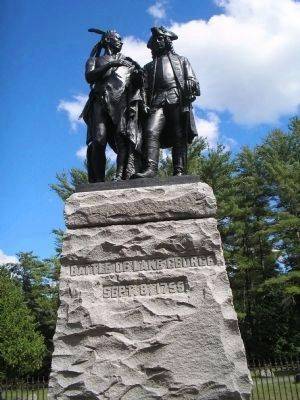
I’ve been quoting Capt. Nathaniel Folsom’s account of his New Hampshire troops’ fight against a French and Indian force south of Lake George in the late afternoon of 8 Aug 1755.

He continued with lively detail:
After being closely engaged for about three quarters of an hour, they kill’d two of our men & wounded several more on our left wing, where they had gain’d a great advantage of us.

Which, with our being very much tired and fatigued, ocсаsioned us to retreat a little way back; but finding by our retreat we were likely to give the enemy a greater advantage we rallied again in order to recover the ground we had lost, and thinking that if we quitted the ground we should loose our greatest advantage, about fifteen or twenty of us ran up the hill at all hazard. Which we had no sooner done but the enemy fired upon us vigorously; & then, seeing us coming upon them (we being charg’d & they discharg’d) they run & gave us the ground.

Whereupon we all shouted with one voice and were not a little encouraged. In this skirmish Ensign Jonathan Folsom [the writer’s brother] was shot through the shoulder & several others wounded. At every second or third discharge during the engagement we made huzzas as loud as we could but not to be compar’d to the yells of our enemies, which seem’d to be rather the yellings of devils than of men.

A little before sunsetting I was told that a party of the Yorkers were going to leave us, which surpris’d me. I look’d & saw them in the waggon road with packs on their backs. I went to them & asked where they were going. They said to Fort Edward. I told them they would sacrifice their own lives & ours too. They answer’d they would not stay there to be kill’d by the damn’d Indians after dark but would go off by daylight.

Capt. [John] Moore and Lieut. [Nathaniel] Abbott & myself try’d to perswade them to tarry, but to no purpose till I told them that the minit they attempted to march from us I would order our New Hampe. men to discharge upon them. Soon after which they throw’d off their packs & we went to our posts again.

Upon my return to my tree, where I had fought before, I found a neat’s tongue (as I tho’t) and a French loaf, which, happening in so good a season, I gave myself time to eat of; & seeing my lieut. at a little distance, much tired & beat out, I told him if he would venture to come to me, I would give him something to comfort him. He came to me & told me I was eating a horse’s tongue. I told him it was so good I tho’t he had never eat anything better in his life.

I presently saw some Yorkers handing about a cagg of brandy, which I took part of & distributed amongst the men. Which reviv’d us all to that degree that I imagin’d we fought better than ever we did before.

Between sunsett and the shutting in of daylight we call’d to our enemies: told them we had a thousand come to our assistance; that we should now have them imediately in our hands; and thereupon made a great shouting & beat our drums. Upon which they drew off upon the left wing, but stood it on the front & right wing till daylight was in & then retreated & run off.

Then we begun to get things ready to march to the lake, when Providence sent us three waggon horses upon which we carry’d in six wounded men; made a bier & carried one on, lead some & carry’d some on our backs. We found six of our men kill’d & mortally wounded so that they dyed in a few days, and fourteen others wounded & shot through their cloaths, hatts, &c. With much difficulty we persuaded the Yorkers to go with us to the lake.

In about an hour after the battle was over we march’d & sent two men forward to discover who were inhabitants at the lake. Who met us and told us all was well. Whereupon we march’d into the camp & told the army what we had done. As soon as they understood by us that we had drove the enemy off & made a clear passage for the English between forts, the whole army shouted for joy, like the shouting of a great host.
That was the third part of the Battle of Lake George. The French forces had won the first stage with their ambush of the British column heading south to Fort Lyman (Edward). But pressing that attack brought out the larger British force camped at Lake George, and the Crown won the second stage. Then Capt. Folsom, Capt. William Maginnis of New York, and other provincials came up behind the French fighters who had fallen back and started this third and smallest stage.

TOMORROW: Who won?

Friday, July 18, 2025

“Altho’ he made his living by crying, he was always in a most jovial mood”

Last week History.com published Elizabeth Yuko’s article “Town Criers Were the Original Social Media.”

The scope of this survey ranges from medieval period to the early nineteenth century, in Europe and various parts of America. Yuko quoted my observations on the town criers of Boston.

The 1796 Boston directory listed only John Weare as a crier, a post that Laurie Halse Anderson found he’d held since 1782. But Weare died in 1800. The 1809 Boston directory listed James Wilson as the town crier, living “over 23 Cornhill” near the center of town.

In Old Boston Town: Early in This Century (1883), James Hale wrote:
The steps of the Exchange Coffee House were much used by James Wilson, the town crier, to announce the auction sales of Whitwell & Bond, Thomas K. Jones & Co., David Hale (afterwards of N. Y. Journal Commerce), and other auctioneers, who did chiefly congregate in Kilby street, near State.

Jimmy was a great humorist, and altho’ he made his living by crying, he was always in a most jovial mood. He generally closed the formal announcement of an auction by some quizzical remark to a bystander, for he knew everybody, and was on familiar terms with all sorts and conditions of men.

Jimmy Wilson was often at his post about nine o’clock in the evening, ringing his bell loudly for several minutes to collect a large crowd, and then announcing a lost child, or a lost pocket-book. His account of the agony of bereaved parents would be heart-rending, when he would suddenly explode a joke which would start the crowd off, roaring.
In Rambles in Old Boston (1886), Edward Griffin Porter added:
James Wilson…for nearly half a century was better known probably among men, women, and children than any other person in the town. He was a short, thick-set, red-faced man, with keen eyes and a powerful voice. Although commonly known as the crier, he was a brush-maker by trade, and a good one too. The writer has seen a pair of clothes-brushes made by him, which have been in constant use in Boston for over seventy years, and are as good apparently as ever.

Wilson’s shop was in the basement of the Exchange Coffee-House, fronting upon what is now Congress Square. At one period he sold ale, after the English fashion, in pewter mugs, and had a foaming “toby” painted on his door to indicate it; but his chief sign was this bell in hand, said to be a correct copy of the bell he carried so many years.
Wilson’s retailing establishment eventually developed into today’s Bell in Hand tavern.

Saturday, July 05, 2025

“Siege and Liberation of Boston,” 7–8 Aug.

Registration is open for the third Pursuit of History Weekend that I’ve helped to program, this one on “The Siege and Liberation of Boston” on 7–8 August.

Organized with the folks who manage History Camp, these sessions are designed to offer in-depth looks at developments 250 years ago through expert speakers and visits to the actual sites where the history happened.

We’ll start on the slope of Breed’s Hill in Charlestown, exploring what turned out to be the decisive battle of the first campaign of the Revolutionary War. Sam Forman and Mary Adams will introduce two of the leaders of the American forces, Dr. Joseph Warren and John Stark. We’ll walk the battlefield and hear about ongoing investigations of the landscape from Boston City Archaeologist Joe Bagley. Then we’ll take a road trip to other places that the Continental Army fortified, which few visitors see. That day we plan to have meals at two restaurants that go back to the eighteenth century.

On the following day, we’ll move into the North End, collaborating with the Paul Revere House, the Old North Church, and veteran tour guide Charles Bahne to offer an in-depth look at the experience of living inside besieged Boston. Finally, I’ll speak about George Washington as a new commander-in-chief, what he thought his job was, and what he really learned.

The Pursuit of History webpage for this event has a video of me explaining more. Sam Forman and I are also scheduled to talk about the siege and this event in the History Camp discussion series on Thursday, 10 July, at 8:00 P.M.

This Pursuit of History Weekend is not, in fact, on a weekend but on a Thursday and Friday. That’s to allow people to also attend History Camp Boston on Saturday, 9 August, and even the related tours the next day if their history interests are still unsated.

And speaking of History Camp Boston 2025, I’ll be speaking there, too. My topic is related to the end of the Boston siege. That talk is called “Henry Knox, Loyalist?” It offers a new interpretation of that American general’s rise to prominence.

Saturday, June 14, 2025

“The said Inventory (A Very few Articles excepted)”

By 1787, Henry Howell Williams had been reestablished on Noddle’s Island for about three years.

Having stayed in Massachusetts throughout the war, Williams had also established his loyalty to the republic, which might have been in doubt back in 1774 and 1775.

Williams then decided to revive his effort to be compensated for the loss of his animals and the destruction of his farm and house back in May and June 1775.

Williams assembled a long list of the property he had lost twelve years before, including furniture, clothing, and food. A sampling of the items:
  • “24 very Eloquent Gilt Pictures, 1 small Carpet”
  • “1 Coat of Arms work'd on Satting with Silver & Gold thread”
  • “40 lb. of flax 2 Barrls Hops & 3 Quntal salt fish”
  • “3 Large Jarr’s Sweet meats never opened”
  • “1 Mahogy. Clock cost in England 25 £ Sterl. New”
  • “1 Silver Nipple & Bottle”
  • “60 bullets 30 lb. Lead. 6 Powdr horns. 2 Powdr flasks”
  • “1 Barrl. best hard Bread a large Quanty of Loaf Sugar”
  • “1 Large Bible & Several Other Books”
  • “3 Hogsheads New Rum Just got home from the W. Indies Quanty. 234 Gallons a 3/4–”
  • “6 Chissells 3 dung forks. Squares &c.”
  • “1 large Boat £32– 1 Moses do £14. 1 yall £10–”
  • “A New Black-Smiths Shop”
  • “333 Young Locust tree’s Cut down which were Set out by Mr. Williams & were to have been paid for by the Owners of the Island at 3/ Each”
As to livestock, Williams stated he had lost:
43 Elegant Horses...@ 30£ Each put into the Publick Stables … £1290:11:—
3 Cattle taken & used as Provisions for the Army … 30:11:—
220 Sheep used as Provisions as above @12/- … 132:11:—
4 fine Swine … 12:11:—
5 Dozn Fowls Turkys & Ducks … 6:11:—
The bottom line was £3645:6:2. That might or might not have been in debased local currency, but pound for pound that total was more than a third of what the East India Company had calculated as its loss in Boston harbor back in 1773.

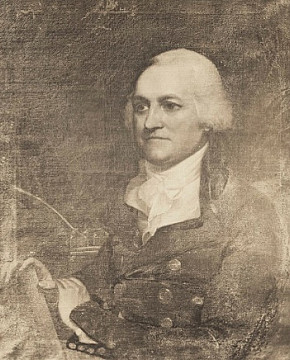
On 10 Mar 1787, Williams and his wife Elizabeth went before magistrate William Tudor (shown above) and swore
That the said Inventory (A Very few Articles excepted) was taken in the month of July following [the raids] & that according to my best Judgment and Recollection the Same is just and true
The whole document can be studied on the Massachusetts Historical Society’s website.

In addition, Williams had collected some evidence supporting his claim, or perhaps answering critics who had said back in 1775 and 1776 that he didn’t deserve financial support.

TOMORROW: Supporting documents.