


J. L. BELL is a Massachusetts writer who specializes in (among other things) the start of the American Revolution in and around Boston. He is particularly interested in the experiences of children in 1765-75. He has published scholarly papers and popular articles for both children and adults. He was consultant for an episode of History Detectives, and contributed to a display at Minute Man National Historic Park.

Subscribe thru Follow.it


•••••••••••••••••


Showing posts with label John Barrett. Show all posts

Thursday, April 09, 2026

“This Party behaved very Insolently & with Great Rapacity”
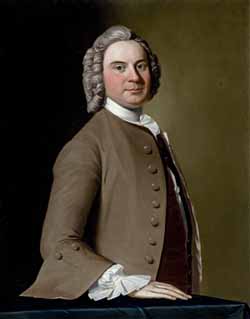
Samuel Austin, quoted yesterday, wasn’t the only Boston merchant to complain about how Crean Brush had confiscated cloth in March 1776.

Capt. Samuel Dashwood also groused about Brush. As cited by Eric Wiser, the captain described how Brush pushed through the back door of his house, strode past the family, and opened their front door for his assistants. At the end of the day, Dashwood determined he was missing nine trunks and two chests of silks and cloth.

Dashwood made a point that Brush had been wearing a sword (as many gentlemen did). “If any person should presume to interrupt,” Dashwood quoted his unwanted visitor saying, “[soldiers] would thrust their bayonets into such a person.”

Capt. Dashwood wasn’t above violence himself, though. Back in 1769, he was among the merchants who challenged printers John Mein and John Fleeming on King Street. And the next year, during an anti-import protest, Theophilis Lillie described Dashwood as “in a great rage, challenging me to come out of my house and he would break my neck, my bones, and the like.”

While Dashwood was a virulent Patriot, John Rowe (shown above) was a trimmer, trying to stay neutral. He lamented the outbreak of war, lived in Boston through the siege, and then chose to remain as the king’s military left. But he also objected to Brush’s actions.

I quoted Rowe’s complaints about how Crean Brush seized property on 11 March back here. At that time I assigned “Mr. Hill” the first name William, but now I think it was more likely either Robert or John.

The next day Rowe collected a receipt for his goods from Brush but wrote, “[I] dont expect—much Good from it.”He told his diary, “This Party behaved very Insolently & with Great Rapacity & I am very well Convinc’d exceeding their orders.”

The next few days were even worse, however. Rowe found other men breaking into his warehouses and stealing more goods, not just the cloth that Gen. William Howe had authorized Brush to take. And of course those men left no receipts at all.

Between Rowe’s diary, documents that Brush signed, and postwar legal filings, we can identify a few more people besides those I’ve already discussed who lost property to Crean Brush’s team: selectman John Scollay, Capt. Samuel Partridge, “Widow [Mary?] Newman,” “John Barret & Sons,” and Dr. Thomas Bulfinch.

TOMORROW: Brush’s response.

Sunday, March 22, 2020

The Town Meeting and the “Carrier of the Dispatches”

On Thursday, 22 Mar 1770, 250 years ago today, Boston began a new town meeting.

It had been only three days since the end of the last meeting, which had spread over several days as inhabitants chose men for town offices and discussed how to respond to the Boston Massacre. In fact, legally that meeting was still going on, in adjournment until Monday.

One of the decisions at that meeting, as described here, was for the town to hire a ship “as a Packet to carry home their Dispatches” about the shooting. Those “Dispatches” included the town’s report on the shooting, which James Bowdoin, Dr. Joseph Warren, and Samuel Pemberton were busy revising.

The town had appointed a committee—John Bradford, William Molineux, and John Barrett—and they had “hired a Schooner of Capt. [Andrew] Gardner for One hundred Pounds and twenty Pounds Sterling.” So suddenly Boston was about to spend real money.

But the idea of renting a ship to sail to London hadn’t been listed as an agenda item for that previous meeting. Opponents could therefore object that that vote wasn’t legal. And I suspect that some men in the town leadership were also worried about the practical outcome of the previous session’s decisions.

The selectmen therefore issued a call for this new town meeting to address the same proposals. The town quickly “Voted unanimously, that—John Barrett Esq. Mr. William Mollineux Capt. John Bradford be and hereby are appointed a Committee to take up for the Town a suitable Vessel as a Packet.” That was the same committee as before, just listed in a different order.

Then Gardner, the captain those men had already hired, came into Faneuil Hall to report on how he was preparing the Betsy to sail:
he had got a Mate for his Schooner, upon whom he could depend, also a Hand extraordinary; and that if it be the mind of the Town; he would endeavor to secure a Landing upon the first English Ground he might make, and then immediately proceed to London in order to deliver with his own hand the Packets he may be intrusted with, to the Gentlemen to whom they shall be directed.
So far, just like before. But then the town voted not to “employ any Person beside the Captain of the Packet to be the Carrier of the Dispatches.”

Earlier in the week, a merchant captain named Samuel Dashwood had offered to take the report to London as long as the town paid his expenses, and the Monday meeting had agreed. Dashwood was a strong supporter of non-importation. In fact, he had led the merchants’ violent confrontation with printer John Mein in October 1769. He had threatened to break importer Theophilus Lillie’s neck in January.

The Thursday town meeting decided it was best not to send Capt. Dashwood to London. Perhaps the voters didn’t want the extra expense since Capt. Gardner was offering to do the same job. Perhaps they didn’t trust Dashwood to represent Boston at its best. But their thinking didn’t go into the official record. The town just voted thanks to Dashwood for his “generous offer” and moved on.

The last item for that 22 March meeting was to empower town treasurer David Jeffries “to borrow upon Interest the Sum of One hundred and fifty Pounds Sterling” to pay for Gardner’s ship and expenses.

The committee had earlier reported that the Betsy “would be ready for sayling by to Morrow.” But it didn’t embark that quickly. Because suddenly the Short Narrative report had to be revised and expanded.

TOMORROW: Back to the French boy.

Monday, October 28, 2019

John Mein and the “Well Disposed”

Since 17 Aug 1769, John Mein had been publishing manifests of vessels arriving in the port of Boston in his Boston Chronicle newspaper.

I’ve called those leaks from the Customs service, but it’s possible all Mein had to do was go to the office on King Street and copy down what incoming captains had officially declared.

Such information may seem politically innocuous, but publishing it caused a lot of trouble. Those manifests suggested that many Boston merchants, including some at the forefront of the non-importation movement against the Townshend duties, were actually importing goods. That raised resentment in Boston and suspicion in other ports.

The Whig press responded by increasing its attacks on Mein. Eventually Edes and Gill’s Boston Gazette listed him on the top left of the front page among “those who have AUDACIOUSLY counteracted the UNITED SENTIMENTS of the BODY of Merchants throughout NORTH-AMERICA; by importing British Goods contrary to the Agreement.”

Mein retaliated by using the corresponding corner of the Chronicle to list the six Boston gentlemen on the committee to enforce the boycott, and by directing a series of pointed questions to them. “Do the ‘well disposed’ think the public is ignorant, that one of their number, and a Committee-man too, has been a great transgressor, though the signs of grace, which he shewed on a late occasion, entituled him to some mercy”? “Well disposed” was a label the merchants’ committee had adopted early on, and Mein proceeded to overuse it sarcastically.

On Thursday, 26 October, Mein went further, filling the front page of the Boston Chronicle with “Outlines of the Characters of some who are thought to be ‘WELL DISPOSED.’” This item took the form of a series of descriptions of books he was supposedly going to publish, hinting at the men’s embarrassing or criminal deeds.

Here are the nicknames Mein printed and the names of the men being lampooned, taken from a manuscript Mein himself wrote which is now at Harvard. The first six were the boycott committee, the rest their supporters.
On 28 October, 250 years ago today, Mein reprinted all his shipping reports since August plus the pointed questions and an edited version of these character sketches in a pamphlet titled A State of the Importations from Great-Britain into the Port of Boston. You can read the text here.

As Mein must have expected, that ticked off some of the merchants involved. Especially the merchant captains, who were used to being masters of their little worlds. John Rowe wrote in his diary (giving no sign that he himself had nearly been named and shamed), “Mr. M—— Publication that appeared to Day has Given Great uneasiness & this evening he was spoke to by Capt. Dashwood.”

That conversation quickly turned violent.

TOMORROW: More gunshots.