J. L. BELL is a Massachusetts writer who specializes in (among other things) the start of the American Revolution in and around Boston. He is particularly interested in the experiences of children in 1765-75. He has published scholarly papers and popular articles for both children and adults. He was consultant for an episode of History Detectives, and contributed to a display at Minute Man National Historic Park.

Subscribe thru Follow.it


•••••••••••••••••


Showing posts with label Lemuel Robinson. Show all posts

Monday, May 05, 2025

“Opposite to the house occupied by the committee”

On 18 Apr 1775, the Massachusetts Provincial Congress’s committee of safety met “at Mr. [Ethan] Wetherby’s, at the Black Horse” tavern in west Cambridge.

Among other business that day, the committee promised “the two brass two pounders, and two brass three pounders” that had been stolen out of Boston to Lemuel Robinson’s Suffolk County artillery company. Robinson had hidden those cannon at his tavern in Dorchester earlier in the year, before they were moved out to Concord.

The committee decided to continue meeting in the same tavern at 10 A.M. the next morning. Three important members from MarbleheadElbridge Gerry, Jeremiah Lee, and Azor Orne—chose to stay overnight since they were far from their own beds. Other members went home to Charlestown, Newton, and elsewhere. 

On the afternoon of the 18th people spotted Maj. Edward Mitchell and other army officers riding by that tavern on horseback. Gerry sent a warning note to John Hancock in Lexington, and Hancock replied. There was a widespread worry that troops might arrest leaders of the resistance. Of course, neither man’s message indicated that he was worried for himself, certainly not.

In 1828 James T. Austin published a two-volume Life of Elbridge Gerry, his father-in-law, which offered this story about what happened in the night that followed:
Mr. Gerry and colonel Orne retired to rest without taking the least precaution against personal exposure, and they remained quietly in their beds until the British advance were within view of the dwelling house. It was a fine moonlight night, and they quietly marked the glittering of its beams on the polished arms of the soldiers as the troops moved with the silence and regularity of accomplished discipline. The front passed on.

When the centre were opposite to the house occupied by the committee, an officer and file of men were detached by signal, and marched towards it. It was not until this moment they entertained any apprehension of danger.

While the officer was posting his files the gentlemen found means by their better knowledge of the premises to escape, half dressed as they were, into an adjoining corn-field, where they remained concealed for more than an hour, until the troops were withdrawn. Every apartment of the house was searched “for the members of the rebel congress”; even the beds in which they had lain were examined.

But their property, and among other things a valuable watch of Mr. Gerry’s, which was under his pillow, was not disturbed.
I can’t identify the source of the phrase in quotation marks, either in earlier books, period newspapers, or Gen. Thomas Gage’s orders. 

TOMORROW: Another family source.

Wednesday, February 05, 2025

History Camp Discussion about the Outbreak of War, 6 Feb.

This Thursday, 6 February, at 8:00 P.M. Samuel A. Forman and I will appear live on the History Camp Author Discussion feed, talking about the Battle of Lexington and Concord with Lee Wright and Mary Adams and taking audience questions.

Sam is the author of Dr. Joseph Warren: The Boston Tea Party, Bunker Hill, and the Birth of American Liberty. He shared a great deal of his research for that book on his Joseph Warren website.

Sam and I are both members of the board of The Pursuit of History, Inc., the non-profit organization that organizes History Camp, these online author discussions, and the Pursuit of History Weekends, including the upcoming look at “The Outbreak of War” on 3–6 April. So we’ll talk about those things, too. 

One of the overlaps between my book and Sam’s is Dr. Joseph Warren’s 10 Feb 1775 letter to Samuel Adams, kept at the New York Public Library. It gives a vivid picture of the tension inside redcoat-occupied Boston 250 years ago:
We were this Morning alarmed with A Report that A Party of Soldiers was sent to Cambridge with Design to disperse the [Massachusetts Provincial] Congress many here believed it was in Consequence of what was Yesterday published by their Order, I confess I paid so much Regard to it as to be sorry I was not with my Friends and Altho, my Affairs would not allow of it I went down to the Ferry in a Chaise with Dr. [Benjamin] Church both determined to share with our Brethren in any Dangers that they might be engaged in but we there heard that the Party had quietly passed the Bridge on their Way to Roxbury up[on]. which we returned Home.

I have spent an Hour this Morning with Deacon [William] Phillips and am concerned that our Existence as a free People absolutely depends in acting with Spirit & Vigor, the Ministry declare our Resolution to preserve our Liberty and the common People there are made to believe we are a Nation of noisy Cowards, the Ministry are supported in their Plan of answering us by Assurances that we have not Courage enough to fight for our Freedom, even they who wish us well dare not openly declare for us lest we should meanly desert ourselves and leave them alone to content with Administrations, who they know will be politically speaking, omnipotent if America should submit to them,

Deacon Phillips Dr. Church and myself are all fully of Opinion that it would be a very proper Step should the Congress order A Schooner to [?] be sent Home with an accurate State of Facts, or it is certain that Letters to and from our Friends in England are intercepted, and every Method taken to prevent the People of Gt. Britain from gaining a Knowledge of the true State of this Country— I intended to have consulted with you had I been at Cambridge to Day on the Propriety of A Motion for that Purpose—but must defer it untill to Morrow—

One thing however I have upon my Mind which I think ought to be immediately attended to—the Resolution of the Congress published Yesterday greatly affects one [Obadiah] Whiston who has hitherto been thought firm in our Cause but is now making Carriages for the Army—He assisted in getting the four Field Pieces to Colo. [Lemuel] Robinson’s at Dorchester, where they are now, He says the Discovery of this will make him,—and He threatens to make the Discovery, perhaps Resentment and the Hope of gain may together prevail with him to act the Traitor—

Dr. Church and I are clear that it ought not to be one Minute in his Power to point out [to] the General [Thomas Gage] the Place in which they are kept but that they ought to be removed without pray do not omit to obtain proper Orders concern’g them
Whiston the blacksmith was cut out of the Patriot organization; eventually he left Boston as a Loyalist in March 1776. The committee of safety convinced Robinson to turn over those “four Field Pieces” so they could be moved further from Boston—out to Concord, in fact. However, since Dr. Church was or would soon be in Gage’s pay, the general tracked them out to that town. 

After war did break out, one of Dr. Warren’s first actions as head of the Massachusetts Provincial Congress was to assemble an account of the first battle from the Patriot perspective and send it by specially hired ship to London, just as this letter proposed.

This letter is one of many documents that show the Massachusetts Patriots making plans to respond to a British army action. Of course, every bit of military preparation convinced Gov. Gage that those men were planning an armed rebellion.

Back when Sam and I were writing our books, we had to go to New York to see that letter. Now it’s been digitized for anybody to read (though searching for it is still a challenge).

Sunday, September 03, 2023

Where Have You Gone, Colonel Robinson?

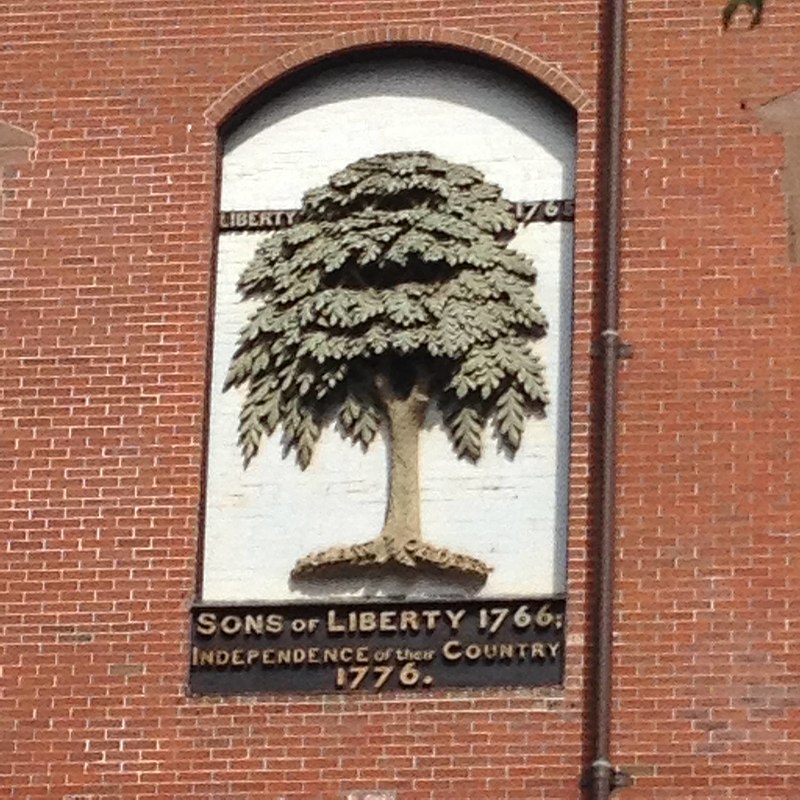
After Boston’s first anti-Stamp Act protest in 1765, Lemuel Robinson changed the sign outside the tavern he owned in Dorchester (shown above) to show Liberty Tree.

The Sign of the Liberty Tree hosted the big banquet of the Boston Sons of Liberty in August 1769.

Robinson was captain of a Suffolk County artillery company under Gov. Thomas Hutchinson, then a colonel after the Massachusetts Provincial Congress called on Patriots to reorganize their militia structure.

By January 1775 Robinson was hiding two of the Boston train’s small cannon on his property under dung heaps. Two more cannon, plus two mortars, were moved out there soon after. Committee of safety records hint that it took some prodding before Robinson turned those weapons over to provincial agents to be moved further out to Concord.

During the Battle of Lexington and Concord, Robinson made his tavern a center for feeding militiamen arriving outside Boston from the southwest. He became an officer in the New England army, but also stepped on other officers’ toes with his aggressive recruiting tactics.

Robinson then shifted to representing Dorchester in the Massachusetts General Court.

The British military wasn’t the only danger that year. Smallpox was spreading as well. After the king’s troops sailed away, there was a major effort to inoculate people.

On 3 Aug 1776 Elbridge Gerry wrote to his colleagues in Philadelphia about how a number of people they knew had come through that treatment:
Generals [James] Warren, [Benjamin] Lincoln Mrs. [Elizabeth] Bodwoin and a Number of our other Friends are recovered. Mrs. [Mercy] Warren in a good Way, poor Colo. Lem. Robinson dyed by imprudently pumping Cold Water on his Arm after getting well of the Distemper.
So how should we classify Lemuel Robinson’s death? As a result of smallpox? During the smallpox epidemic? Or that more obscure cause, “imprudently pumping Cold Water on his Arm”?

Wednesday, August 18, 2021

Joseph Akley as an Adult

Being sued for tarring and feathering a Customs officer wasn’t the only big event in Joseph Akley’s life in the spring of 1771.

On 16 May, still aged only nineteen, Joseph wed Margaret Durant, according to Boston’s list of intentions to marry.

I can’t find a record of what church the couple married in or anything more about Margaret Durant. But there’s no record of a child coming quickly.

Instead, the couple’s first recorded children were baptized at King’s Chapel:

  • Joseph on 5 May 1773.
  • Margaret, 12 Mar 1775. [Transcribed “Skeley” in some publications.]
Later there was Sarah, baptized 25 Oct 1778 at Trinity Church, when that was the only functioning Anglican church in town.

Massachusetts Soldiers and Sailors of the Revolutionary War lists only one “Joseph Akeley.” He did twenty-one days active service in Capt. Hopestill Hall’s company of Col. Lemuel Robinson’s Massachusetts militia regiment. That was in February 1776, when Gen. George Washington was desperate for any men to shore up the siege lines.

That “Akeley” was recorded as enlisting in Roxbury. But that would be consistent with the Akely family having left Boston after the war started. It’s also understandable that Joseph Akley, father of young children, didn’t go into the Continental Army full-time.
By the 1790s we see Joseph Akley listed as a hairdresser in the Boston directories. He owned real estate, having overcome the poverty of his early years.

Indeed, the Akley family seems to have gained a little stature. When Joseph’s mother, Tabitha Akley, died in 1790 at the age of seventy, her death was noted in newspapers across the state. Only twenty years earlier she had been in the Boston almshouse.

On 13 Nov 1794 the American Apollo reported this death:
At Point-a-Petre, Guadaloupet Mr. Joseph Akely, jun. of this town—a worthy young man, whose death is much lamented by his most cursory acquaintance, Æt. 22.
Presumably the Akleys’ oldest child was on some sort of mercantile voyage when he died.

On 1 Nov 1808, the New-England Palladium reported that the barber Joseph Akley had died the previous day at the age of fifty-six. His widow Margaret was appointed executrix.

The 1810 U.S. Census lists Margaret Akely living alone on Hanover Street in Boston. That could be the widow or her eldest daughter, unmarried.

TOMORROW: The Akely brothers at war.

Saturday, August 17, 2019

”A Procession that extended near a Mile and a half”

On rereading the Boston Gazette’s description of the Sons of Liberty 14 Aug 1769 dinner this year, I was struck by the detail that three times the men punctuated their toasts with “A Discharge of Cannon.” Perhaps only one cannon, but still.

By the early 1770s, the innkeeper who hosted that celebration, Lemuel Robinson of Dorchester, was captain of a militia artillery company protecting Suffolk County outside of Boston.

His Liberty Tree tavern—shown above, in a sketch from the Dorchester Historical Society—was where the Massachusetts Committee of Safety hid the Boston train’s four missing cannon in early 1775. (And the committee’s records suggests there was some effort required to get Robinson to let them out of his hands to be hidden in Concord.) But Robinson had cannon on his property, at least for this special occasion, as early as 1769.

The Sons of Liberty dinner also included music. John Adams wrote in his diary:
We had also the Liberty Song—that by the Farmer, and that by Dr. Ch[urc]h, and the whole Company joined in the Chorus.
“The Farmer” was John Dickinson. As I detailed here, he cowrote the original “Liberty Song” the previous year. Adams’s mention of Dr. Benjamin Church is the reason scholars attribute the version of the song that begins “Come swallow your Bumpers, ye Tories! and roar,” to that poetic physician.

Adams then wrote:
Between 4 and 5 O clock, the Carriages were all got ready and the Company rode off in Procession, Mr. [John] Hancock first in his Charriot and another Charriot bringing up the Rear.
Adams had to head out of town, but the Boston Gazette reported on the gentlemen’s return to Boston:
About Five o’Clock the Company left Mr. Robinson’s in a Procession that extended near a Mile and a half, and before Dark entered the City, went round the State-House, and retired each to his own House.
Merchant John Rowe, who wasn’t at the dinner, added in his diary that the procession contained “139 Carriages” and “Mr. [James] Otis brought up the rear.”

That circle around the seat of government was a victory lap over Gov. Francis Bernard, and a warning to remaining royal officials that the Whigs dominated the landscape. To rub that in, the Gazette added:
Should this Account overtake the Baronet of Nettleham on this Side T–b—n, he and Ld. H——h are at Liberty to write seventy-seven Volumes of their High Dutch and low Diabolical Commentaries, “about it, and about it.”
The baronet was Bernard. “Lord H——h” was the Earl of Hillsborough, secretary of state overseeing the colonies. “T–b—n” was Tyburn, where criminals and traitors were hanged. “About it, and about it” was a common way to say “and on and on.” And the whole sentence crowed over how Bernard’s letters complaining about the Whigs had leaked and destroyed his standing in the province.

Friday, August 16, 2019

Memories of “Mr. Balch’s Mimickry”

As I detailed yesterday, Nathaniel Balch (shown here, courtesy of Balchipedia) was a hatter. But at heart he was an entertainer, known across Boston for his humor and charm.

When Josiah Quincy, Jr., was traveling in the southern colonies on 6 Mar 1773, he wrote in his diary: “In walking with ——— occurred a singular event, of which Balch could make a humorous story.” Unfortunately, Quincy didn’t record that event and we don’t know what Balch made of it.

Most of our descriptions of Balch come from after independence, when he became known as a bosom friend of Gov. John Hancock. The French political reformer Jacques Pierre Brissot (1754-1793) wrote of an encounter in 1788: “Governor Hancock…has the virtues and the address of popularism; that is to say, that without effort he shews himself the equal and the friend of all. I supped at his house with a hatter, who appeared to be in great familiarity with him.”

The most lively pictures of Balch appear in the memoirs of men writing in the mid-1800s who had been boys growing up in Hancock’s Boston. E. S. Thomas wrote about Gov. Hancock in 1840:
He was very fond of joke and repartee, so much so, that a worthy citizen of Boston, Nathaniel Balch, Esq., a hatter, who never failed to appear among the invited guests at his hospitable board, obtained the unenvied appellation of “the Governor’s Jester.
Sidney Willard wrote in 1855:
For his three-cornered hat, his cocked hat, my father resorted to Nathan Balch, a very worthy and respectable man, sometimes irreverently called Nat. Balch; a frequent guest of Governor Hancock, and entertainer of his other guests, adding zest to the viands and the vina at the dinner-board by anecdotes and stories, mimetric [sic] art, humor, witticism, and song, drawn from his inexhaustible storehouse.
And Samuel Breck’s posthumously published memoir said:
We had a medley of eccentric tradesmen in Boston in 1788, who were a compound of flat simplicity in manners and acute cleverness in conversation, shrewd, perhaps somewhat cunning; often witty; always smart and intelligent.

…above all, Balch, the hatter. His shop was the principal lounge even of the first people in the town. Governor Hancock, when the gout permitted, resorted to this grand rendezvous, and there exchanged jokes with Balch and his company, or, as sometimes happened, discussed grave political subjects, and, tout en badinant, settled leading principles of his administration.
So what material did Balch pull out for the Sons of Liberty dinner in August 1769, with more than three hundred of Boston’s leading gentlemen present?

According to John Adams:
After Dinner was over and the Toasts drank we were diverted with Mr. Balch’s Mimickry. He gave Us, the Lawyers Head, and the Hunting of a Bitch fox.
Hmm. I guess you had to be there.

TOMORROW: The party’s over.

Wednesday, August 14, 2019

Dinner at the Sign of Liberty Tree

On 14 Aug 1769, 250 years ago today, Boston’s Sons of Liberty gathered to celebrate the anniversary of the first public protest against the Stamp Act, four years earlier.

Of course, they were also celebrating what they saw as their triumph over Gov. Francis Bernard, who had sailed away from Massachusetts at the start of the month, never to return.

The celebration actually began with fourteen toasts at Liberty Tree at eleven o’clock. Those started with “The KING” and “The QUEEN and Royal Family,” moved through John Wilkes, the “Glorious Ninety-Two,” Paschal Paoli and his Corsicans, “American Manufactures,” and finally “May the 14th of August be the annual Jubilee of Americans, till Time shall be no more.”

Then the company left town. The Sons had organized dinner for more than 300 at Lemuel Robinson’s tavern in Dorchester, the Sign of Liberty Tree. [In the winter of 1775, that tavern was a crucial spot in the story of The Road to Concord.] By dining outside of Boston, the upper-class politicians guaranteed that they could control their setting and the level of festivity.

This dinner was in honor of “the Farmer”—John Dickinson, author of The Farmer’s Letters and coauthor of “The Liberty Song.” He wasn’t there. But two of his friends from Philadelphia were: his brother, Philemon Dickinson, and Joseph Reed, then secretary of the colony of New Jersey.

John Hancock’s business protĂ©gĂ© William Palfrey made a list of 355 gentlemen at the dinner. That list included far more than Boston's political activists. The most important elected officials were all there, including some who would later be Loyalists. The town’s schoolmasters had taken the day off, as had many merchants, doctors, lawyers, and militia officers. John Adams wrote in his diary about feeling pressure to attend: “many might suspect, that I was not hearty in the Cause, if I had been absent whereas none of them are more sincere, and stedfast than I am."

Adams described the banquet setting this way:
We had two Tables laid in the open Field by the Barn, with between 300 and 400 Plates, and an Arning of Sail Cloth overhead, and should have spent a most agreable Day had not the Rain made some Abatement in our Pleasures.
There’s that New England non-rhotic R in how Adams spelled “awning.”

Because the fourteen toasts before noon weren’t enough, after dinner the party drank forty-five more. This series started with the “King, Queen and Royal Family,” followed by “A Discharge of Cannon, and three Cheers.” The toasters named fourteen British politicians considered friendly to America and the historian Catharine Macaulay. They honored “The Cantons of Switzerland,” “The States General of the seven United Provinces” of Holland, and “The King of Prussia.”

Some of the after-dinner toasts delineated the Whigs’ political ideals: “Annual Parliaments,” “A perpetual Constitutional Union and Harmony between Great Britain and the Colonies,” and “Liberty without Licentiousness.” Others identified enemies: “May the detested Names of the very few Importers every where, be transmitted to Posterity with Infamy” (more cannon). And finally “Strong Halters, Firm Blocks, and Sharp Axes, to all such as deserve either.”

Evidently the diners didn’t imbibe deeply at each and every toast because Adams declared, “To the Honour of the Sons, I did not see one Person intoxicated.”

As for the subsequent entertainment, the Sons of Liberty had provided…a hatter.

TOMORROW: But not just any hatter.

Wednesday, December 14, 2016

“You all perhaps have heard the tale of the search”

Yesterday I quoted a Robinson family tradition printed in A Family Story in the late 1800s. It described how Lemuel Robinson smuggled two brass cannon out of Boston past British army sentries and hid them in his Dorchester barn, even foiling a search by British officers.

In assessing whether that story is reliable, I’ll start by saying that there’s no doubt Lemuel Robinson hid brass cannon from Boston at his “Liberty Tree” tavern estate (shown here, courtesy of the Dorchester Atheneum website). In all, there were four brass cannon from Boston’s militia train and two brass mortars, probably brought out by James Brewer. Those weapons were in Robinson’s custody from before 5 January 1775 to shortly after 10 February, when they were quickly moved on to Concord. All that is shown by contemporaneous documents.

But the Robinson family seems to have lost some of those details and filled them in with others. For example, A Family Story speaks only of two brass cannon—meaning the two that were enshrined in the Bunker Hill Monument from 1842 to the 1970s. There’s no mention of the other ordnance, lost during the war.

The book also dates the removal of cannon to after the outbreak of war, when Robinson had sent his wife and children to safety in Stoughton. (Yet it also says “women and children” were in Robinson’s house to see the British officers’ frustrated search.) Sources closer to that time say that Col. Robinson was consumed with army business soon after the war broke out; in 1788 the Rev. William Gordon wrote of him, “For nine days and nights the colonel never shifted his clothes, nor lay down to sleep.”

The story says that Robinson drove a load of vegetables into Boston as part of the smuggling scheme, but that would have been impossible once the war began. The whole point of the siege was that the Continentals were blocking food to the British garrison. Could Robinson have driven in those vegetables instead in December 1774 or January 1775, when the guns came to his farm, and his family misremembered the timing? That’s possible, but the middle of New England’s winter is not the right time for “fresh garden truck.”

Then there’s the question of the British army search. I’ve seen no contemporaneous evidence for such a search in Gen. Thomas Gage’s orders or in the memoirs and letters of British army officers. Late in the winter Gage occasionally sent troops marching out of Boston into the countryside for exercise, and to accustom the population to seeing soldiers, but no officer appears to have mentioned orders to search for artillery along the way.

Locals later recalled a couple of those marches, to Watertown and Jamaica Plain, as unsuccessful searches for cannon. However, in 1775 even Patriots quick to complain about military activity didn’t mention officers intruding on the Robinsons. To be sure, it’s conceivable that resistance leaders decided not to complain too loudly about cannon searches because they didn’t want to draw attention to the fact that they actually had cannon.

Then there’s the anecdote about the search itself. According to the family tradition, Robinson moved the cannon into his barn through a back door. Then British officers came and threw open the big front doors, saw that opening covered with spiderwebs, and concluded that no one had entered the barn for a long time. That story fits into the long national tradition of sly Yankees fooling the British. But surely a group of British gentlemen would have known that it was unlikely for a farm family to simply stop using their barn, and that barns can have more than one entrance.

Stories of Patriots bringing those cannon out of Boston date from 1823, or more than sixty years before A Family Story appeared. Many of those stories, like the Robinsons’, involved hiding the cannon under manure. In The Road to Concord, I found a family link that lends credence to the oldest of those stories, cited another as a possibility, and dismissed a third.

Having considered the Robinson tradition after the alert from Earl Taylor, I’m not convinced by it. So many of its details seem unreliable, probably added as people in the family passed the tale down to children. After all, in A Family Story a Robinson great-grandchild tells younger relatives, “You all perhaps have heard the tale of the search by the exasperated British officers…” It’s possible that there’s a kernel of truth at the core of this legend, that Lemuel Robinson truly was involved in moving two cannon out of Boston. But all I can say for sure is that he and his family guarded four cannon and two mortars for the Patriot cause during the winter of 1775, and that deserves to be remembered.

Tuesday, December 13, 2016

The Legend of Lemuel Robinson and Two Brass Cannon

After The Road to Concord was published, Earl Taylor of the Dorchester Historical Society sent me some pages from a book that preserves another family tradition about the Boston train’s stolen cannon.

The book is titled A Family Story, and the author was a great-grandchild of Lemuel Robinson of Dorchester. Which great-grandchild is unclear—there’s no author name on or inside the book. It ends with an 1888 letter, so the University of California cataloguer guessed the book was published around 1889.

The opening page quotes from an 1870 Robinson genealogy by the author’s brother Edward. That quotation matches a passage in William and Anne Robinson of Dorchester, Mass., by Edward Doubleday Harris (1839-1919, possibly shown here—see Leigh McKinnon’s Flickr page for the mystery). That genealogy was published in 1890, so either the author of A Family Story alluded to an earlier edition or that 1870 date is a misprint.

Edward’s book lists his siblings still living in 1890. Given the reticence, I suspect the Family Story author was one of his sisters—which narrows our search down to a mere five candidates.

The oldest Harris sibling, William Thaddeus Harris, had been librarian of the New England Historic Genealogical Society. Several other relatives wrote antiquarian and historical books, so the family standards for historical evidence were above average. At the same time, the audience for this book was clearly other members of the extended family, unlikely to be skeptical about tales of ancestral heroism.

So here’s what A Family Story says:
We have found mention in the Provincial Records of the field pieces which Col: Robinson succeeded in taking out of Boston under the very eyes of the sentries. . . . The patriot army needed much these field pieces, the property of the province, but no fire arms nor ammunition were allowed to be taken out of Boston; strict watch was kept that none should be removed.

Col. Robinson donned a carter’s frock and mien, and drove into Boston with a large load of fresh garden truck which the inhabitants would gladly welcome;—later why should he not drive innocently out again, past all the keen-eyed, vigilant sentries[,] his large wagon heaped with a huge load of manure which the town desired to be rid of? (When I look at the portrait of the Colonel, I wonder that his eyes had not betrayed him!) Before many hours passed[,] the field pieces—two brass cannon—from beneath their malodorous cover, were snugly hidden in Colonel Robinson’s barn, northeast of his dwelling house.

You all perhaps have heard the tale of the search by the exasperated British soldiers sent out by the orders of Gen: [Thomas] Gage, when it became known that the field pieces were gone, and suspicion turned upon Col: Robinson; how they came to our ancestor’s house and found only women and children to answer their angry questioning, who could give them no information concerning the missing treasure. After searching the premises, they turned to the barn and swinging open the great [front] doors, were confronted by such a mass of cobwebs across the entrance, that a laugh burst from them all, and they turned horse and rode away—leaving the field pieces for the use of the Continental Army.
The first line about “Provincial Records” produces some skepticism for me. Our unnamed author has clearly done some research about the brass cannon taken from Boston, two of which at that point had been on display in the Bunker Hill Monument for decades. As a result, we’re not getting the unvarnished Robinson family tradition. We’re getting that tradition polished and perhaps trimmed to fit around the enshrined cannon and the author’s other sources.

TOMORROW: Assessing the details.

Sunday, October 16, 2016

“How the Cambridge Alarm Led to the Concord Fight,” in Cambridge, 20 Oct.

Last March I spoke at Longfellow House–Washington’s Headquarters National Historic Site about “The End of Tory Row.” That talk was about that Cambridge neighborhood in the early 1770s, defined by one extended family of wealthy Anglican sugar-plantation owners. Their comfortable community came to an abrupt end on 2 Sept 1774.

On Thursday, 20 October, I’m returning to the Longfellow–Washington site to tell the next chapter of that story: “How the Cambridge Alarm Led to the Concord Fight.” Like the story of the “Tory Row” neighborhood, that narrative also involves extended family networks. The Road to Concord includes a dive into the family of young Samuel Gore, including his brothers-in-law Thomas Crafts and Moses Grant, to see why they became ready to rebel. But there are other families I could have traced out the same way.

Let’s take George Trott (1741-1780), a jeweler and goldsmith in Boston. Trott and Crafts were both members of the “Loyall Nine” who organized the public protests against the Stamp Act in 1765. Trott became the second-in-command of the train, Boston’s militia artillery company, while Crafts was the third-ranking officer.

Trott married Ann Boylston Cunningham (1745-1810), daughter of James and Elizabeth Cunningham. Her youngest sibling, Andrew (1760-1829), was the teen-aged assistant to South Writing School master Samuel Holbrook in September 1774. That’s when the train’s four small brass cannon disappeared, two of them from a building right next to the school. Coincidence? I doubt it. (I’ll describe who removed those cannon and how in my talk.)

By early 1775 those four brass cannon had been smuggled out of Boston to Lemuel Robinson’s tavern in Dorchester. Robinson (1736-1776) was an obvious choice to hide those guns. He was the captain of the militia artillery company for Suffolk County outside Boston, and he was active in the Whig movement. He put Liberty Tree on his tavern sign and hosted Boston’s Sons of Liberty at a big dinner in 1769.

Was there a family connection between Trott and Robinson? Robinson was raised in Dorchester by his maternal grandfather, Thomas Trott (1685-1762). George Trott’s father was also named Thomas Trott (1705-), a blacksmith of Boston. Genealogists have had trouble sorting out or connecting those families, though.

Robinson’s wife was born Jerusha Minot in 1734. Her brother named John (1730-1805) had a son he named George—i.e., Lemuel and Jerusha’s nephew—in 1755. A tradition in Roxbury published as early as 1835 credits a George Minot, son of John, with helping to smuggle two of the train’s four cannon out of Boston. Coincidence? Well, I’m not so convinced by the Minot stories, but if he was involved I’m sure the Robinson-Minot family network played a role. (A Dawes-Williams family network was definitely involved in moving cannon, as I’ll explain.)

My talk at the Longfellow–Washington site, 105 Brattle Street in Cambridge, starts at 6:30 P.M. (Stretches of Brattle Street open up for free parking at 6:00.) We’ll have copies of The Road to Concord for sale and signing afterward. To reserve seats in the carriage house, please call (617) 876-4491 or email reservationsat105@gmail.com.

Sunday, September 25, 2016

“All the Province Stores Sent to Col James Barretts”

Sometime in the early spring of 1775, James Barrett of Concord, a Massachusetts Provincial Congress delegate and militia colonel, wrote down “An account of all the Province Stores Sent to Col James Barretts of Concord Partly in His Own Costody & Partly Elsewhere all under his Care.” That undated document is now at the American Antiquarian Society.

The top of the list begins with the most valuable, dangerous, and risky-to-be-caught-with items:
Two peices of Cannon Brought From Watertown to ye Town
Eight Peices of Cannon Brought to ye Town by Mr Harrington
Four Peices of Brass Cannon & Two Mortar from Col Robertsons
That last name should be Lemuel Robinson, proprietor of the Liberty Tree Tavern in Dorchester. Massachusetts Committee of Safety records confirm that Robinson had those four brass cannon and two mortars in his custody early in 1775.

Barrett was thus in possession of sixteen pieces of artillery, on top of the handful of cannon that Concord itself had bought and mounted. Such weaponry had no use other than warfare, and there was no other foe on the horizon but the royal government.

Barrett’s account also listed a great many other military supplies, including musket cartridges, musket balls, flints, gunpowder, entrenching tools, medical chests, tents and tent poles, dishes and spoons, and “Four Barrels of Oatmeal containing 20 Bushels.” He was helping to equip an army.

Barrett clearly didn’t expect this account to fall into the hands of royal agents since he listed the names of men who had sent him those illegal supplies, including:
  • Jeremiah Lee of Marblehead (“thirtyfive half barrels of powder,” tents).
  • Moses Gill of Princeton (tents, “axes & pick axes & hatchetts”).
  • David Cheever of Charlestown (“Two Barrels of Musquit ball containing 2100 weight,” another “2900 of ball,” another “2000,” &c.).
All those gentlemen were members of the congress’s Committee on Supplies.

Barrett also kept notes of where he was storing different supplies: at the homes of his son James, Ethan Jones, Joshua Bonds, Willoughby Prescott, Abijah Brown, Thomas Hubbard, Ephraim Potter, James Chandler, Joseph Hosmer, Jonas Heywood, and so on. Again, Barrett seems to have felt that information was secure, almost twenty miles from Boston.

But Crown agents found out about those military supplies in March 1775. They gave Gen. Thomas Gage detailed information about where things were in Concord, including those four brass cannon. And on 19 April three companies of the king’s soldiers arrived at Barrett’s farm.

How all that came about, what happened next, and what mysteries remain will be the topics of my talk this Thursday, 29 September, at Minute Man National Historical Park: “Cannons in Concord, and Why the Regulars Came Looking.” That event will start at the park’s Lexington/Lincoln visitor center at 7:00 P.M., and I’ll be happy to sign copies of The Road to Concord afterward.

Thursday, June 02, 2016

“He assisted in getting the four Field Pieces”

Have I mentioned that the book launch for The Road to Concord: How Four Stolen Cannon Ignited the Revolutionary War is tonight?

Here’s a bit from another document that informed the book, a letter from Dr. Joseph Warren to Samuel Adams dated 10 Jan 1775:
One thing however I have upon my Mind which I think ought to be immediately attended to—the Resolution of the Congress published Yesterday greatly affects one [Obadiah] Whiston who has hitherto been thought firm in our Cause but is now making Carriages for the Army

He assisted in getting the four Field Pieces to Colo. [Lemuel] Robinson’s at Dorchester, where they are now, He says the Discovery of this will make him,—and He threatens to make the Discovery, perhaps Resentment and the Hope of gain may together prevail with him to act the Traitor—

Dr. [Benjamin] Church and I are clear that it ought not to be one Minute in his Power to point out [to] the General [Thomas Gage] the Place in which they are kept but that they ought to be removed without

pray do not omit to obtain proper Orders concern’g them
Alerting Samuel Adams to have those cannon moved before the royal authorities could seize them? That was smart. Talking it over with Dr. Church first? In retrospect, not such a good idea.

Tuesday, December 09, 2014

Whom Do We Mean by “Sons of Liberty”?

One for the perennial questions about America’s Revolution is how we should understand the “Sons of Liberty,” as American activists called themselves. With a television show of that name on the way, I suspect the question will come up even more.

In recent weeks Rebecca Brooks’s History of Massachusetts blog and Bob Ruppert’s article for the Journal of the American Revolution have tackled that question, rounding up the sources on the Sons of Liberty in Boston.

One one side of the spectrum of possible answers is the one implied by the “Sons of Liberty medal” I discussed yesterday: it was such a formalized group that it gave each member a medal engraved with his initials to wear on public occasions and (at least according to Johnny Tremain) flash as a sign of membership. That idea holds appeal for spy fiction writers, but the evidence for it is very thin.

On the other side is the idea that “Sons of Liberty” was a generic label for any men in the colonies who opposed the Crown’s new revenue measures and enforcement between the Stamp Act and the outbreak of war. That suggests it was no more of a formal group than, say, “all true Americans.”

Ben Carp’s article on the term for Colonial Williamsburg, which I missed when it was published on the web three years ago, offers some valuable information on how the phrase resonated in the Georgian British Empire:
The term “sons of liberty” or “sons of freedom” was a generic term of national pride in the eighteenth century, usable on both sides of the Atlantic for anyone who felt that English, and later British, liberty was his birthright. An English writer in 1753 knew that his readers, as “sons of liberty,” would recoil at tales of despotism in India and elsewhere. An Irish Protestant might rally his compatriots with the phrase. Essentially, a British son of liberty was the same thing as a patriot, or a “friend of his country.” In the 1760s, when Americans took pride in their identity as British subjects, they thought of empire and liberty as one and the same.

But in 1765, the relationship between Great Britain and the colonies changed, and so did the meaning behind the phrase “Sons of Liberty.” The phrase caught fire in America when Colonel Isaac BarrĂ© spoke against the Stamp Bill introduced in Parliament in February 1765.
A group of Whigs in Albany led by Dr. Thomas Young adopted the name “Sons of Liberty” when they wrote themselves a “constitution,” now known only through a photostat copy.

Most other groups didn’t that far, and local newspapers used the term in a more general way, as in “a great Number of Gentlemen, Sons of Liberty” (New York Mercury, 13 Jan 1766), or “some young gentlemen, Sons of Liberty” (Newport Mercury, 14 Apr 1766). There were also references to “Daughters of Liberty” and “Friends of Liberty,” all united in the same cause.

And in Boston? On 15 Jan 1766, John Adams wrote in his diary that he “Spent the Evening with the Sons of Liberty, at their own Apartment in Hanover Square, near the Tree of Liberty.” He named nine men who were there, without suggesting they were the only members of the group, and compared them to the sort of gentlemen’s club he was used to. A month later, one of those men, Thomas Crafts, Jr., told Adams that “the Sons of Liberty Desired your Company at Boston Next Wensday.”

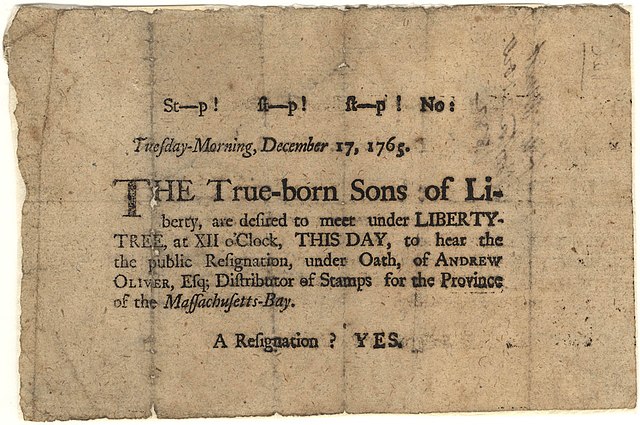
So in early 1766 the term “Sons of Liberty” seems to have meant a particular group in Boston. Yet as of the end of the previous year that same group was calling itself “the Loyall Nine” while issuing the invitation shown above to “all True-born Sons of Liberty”—which implies they saw themselves as just part of a larger movement. And within a couple of years men not part of the Loyall Nine, such as Dr. Young from Albany, were taking the lead in organizing political actions in Boston.

By the anniversary of the first Stamp Act protests in 1769, over three hundred “Sons of Liberty” dined at Lemuel Robinson’s Liberty Tree tavern in Dorchester. Those men included some who became Loyalists as war arrived. That’s obviously too large and diverse a group to be secretly organizing radical political actions as the Loyall Nine had done back in 1765.

On the other hand, those political actions could bring out thousands of people, as at the funerals of early 1770 or the tea meetings of 1773. So there were probably many more than three hundred men in Boston who considered themselves “Sons of Liberty.” (Indeed, by making their celebration a sit-down dinner out in Dorchester, whoever organized that banquet made sure it was just for gentlemen.)

I think it’s best to think of the label “Sons of Liberty” as similar to “Tea Party,” “Women’s Lib,” or other mass movements from recent decades. There are small formal groups that use “Tea Party” in their names, but many people support the movement or attend events without joining such groups. No single organization decided everything said and done in the cause of “Women’s Liberation.” And those movements developed recognizable iconography, but they didn’t have membership badges.

Sunday, June 17, 2007

Timothy Newell Reports on Bunker Hill

Just back from this year’s Dublin Seminar for New England Folklife, and in time to post Boston selectman Timothy Newell’s account of the Battle of Bunker Hill, which occurred 232 years ago today.

Newell probably wrote this diary entry on 18 June or later, given its comment on “the night following.” There are a lot of other problematic details in this diary entry as well, showing his limited perspective inside the besieged town and his political preferences.

The Provincials last night began an Entrenchment upon Charlestown (say Bunker’s Hill) before sunrise.

The Tartar Man of War and the battery from Corps hill began a cannonade about 2 oClock AM.

Genl. [William] Howe with [blank] pieces of Cannon and three thousand Men landed on Charlestown point and marched up to the Redoubt after a great slaughter of Thirteen-hundred and twenty five of the Regulars killed and wounded—one hundred and twelve officers included—and of Provincials fifty killed and one hundred and eighty wounded and missing—among whom were Dr. [Joseph] Warren and Colonel Robinson killed—the Garrison gave way—a constant fire from the Men of War &c. all the night following—only three from one company and fourteen from another of the Regulars brought off.

18th. Skirmishes most of the day—divers killed and wounded.
From Newell’s Boston perspective, the provincials fortified Bunker’s Hill. He didn’t see Breed’s Hill as different.

At first I thought “Tartar Man of War” might refer to the name of a British naval ship. But I checked the names of the ships firing on Charlestown: the Lively, Somerset, Symetry, and Falcon. I then realized that Newell was communicating not a fact but his political opinion: that the royal forces were behaving like the proverbially tyrannical Tartars—not that actual Tatars are any more tyrannical than any other ethnic group.

“Corps hill” is usually called “Copp’s Hill.” Gotta love that Boston accent.

The Massachusetts Historical Society’s published transcription of Newell’s diary says the cannonade began at “2 oClock AM.” Most accounts agree it began at daybreak, when the British military spotted the redoubt. So that might be a transcription error for “7 oClock AM,” or perhaps the two o’clock time should be applied to the start of Howe’s attack in the next sentence.

As for deaths, Newell was correct that Dr. Joseph Warren was killed in the provincial lines. But no “Col. Robinson” was. Perhaps Newell heard that Lt. Col. John Robinson of Westford was killed (he wasn’t even wounded), or that Col. Lemuel Robinson of Dorchester was (he wasn’t even in the battle). And the one Massachusetts colonel who was fatally shot, Thomas Gardner of Cambridge, lingered until July.

Newell wrote that there were 3,000 British soldiers in the battle; the standard estimate is 2,600, so close enough. In the casualty figures Newell’s biases come through more clearly. The British suffered 226 dead and 828 wounded, so Newell’s report of those casualties was too high by 25%. The provincial losses are estimated as 140 dead, 271 wounded, 30 captured, or nearly twice as bad as Newell’s figures. His accounting of casualties was wishful writing.