


J. L. BELL is a Massachusetts writer who specializes in (among other things) the start of the American Revolution in and around Boston. He is particularly interested in the experiences of children in 1765-75. He has published scholarly papers and popular articles for both children and adults. He was consultant for an episode of History Detectives, and contributed to a display at Minute Man National Historic Park.

Subscribe thru Follow.it


•••••••••••••••••


Showing posts with label Joseph Guild. Show all posts

Friday, August 20, 2021

Thomas Akley and “a military Road over the Green Mountains”
The third Akley boy was Thomas, baptized at King’s Chapel on 25 May 1755. When he was nine years old, the Boston Overseers of the Poor sent him to live with the Rev. Jason Haven in Dedham.

In 1832 Thomas Akley applied for a Revolutionary War pension. He was then living in Brattleboro, Vermont. He said he was 77 years old and had been “born in Boston, Mass. in the year 1755,” confirming the match.

Thomas Akley testified that he marched in Dedham’s minuteman company on 19 Apr 1775, and:
A few days after Lexington Battle I inlisted for eight months under Capt. [Joseph] Gild and Col. [John] Greaton. . . . Served that term of eight months, at Roxbury, Dorchester and Cambridge, and was dismissed at Cambridge at the end of the term, without any written discharge.

also served one month more in the same company after the said eight months had expired, to supply the place of some recruits who did not arrive in camp as expected.
When asked about officers he recalled serving under, Akley said that from that year he “remembers Col. [John] Patterson’s regment, remembers General [Artemas] Ward.”

Akley moved to Vermont in 1776, and in the middle of that year he joined another unit alongside Phinehas Mather:
we enlisted into a company to go & open a military Road over the Green Mountains from Charlestown (N.H.) or No. 4. to the Lake, so that the New Hampshire & other eastern militia could march over to Fort Independence & the Lake

I enlisted at Guilford, Vt. on or about the first day of June AD 1776 and marched thro’ Brattleboro’, Dummerston, Putney, Westmoreland & Walpole, to said Charlestown, under Capt. [Samuel] Warriner & Maj. John Shepardson.

From Charlestown, I went to Springfield (Vt.) to Col [John] Barrets, who provided for us. Thence to Cavendish, where we were encamped awhile & employed on said Road, the bridges &c.

We repaired or opened the Road over the Green Mountains & when we got to Rutland, were billetted out some time, working upon the said Road & bridges. We made a Bridge at Rutland, over Otter Creek River.

While there there was an Alarm or Two by the movements of the Enemy on the Lake, and we marched thro’ Castleton & Hubbardston to Mount Independence. Genl [Benedict] Arnold was on the Lake about this time, and being compelled to retreat & leave the lake, is said to have burnt his ship before he gave up.

As near as I can recollect, our time expired the first of December 1776 & we returned thro’ Cavendish, Springfield, & so down the River as we went, to our homes. We were then under New York State, & probably called New York troops. . . . We were armed with Guns & tomahawks.
Several documents in Akley’s pension file are arguments that this road-building was an army project, not a civilian effort, and thus should count toward his military service.

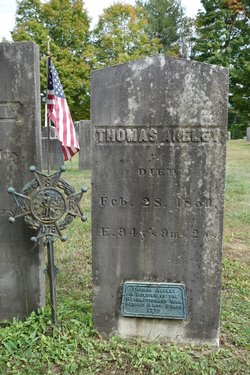
Thomas Akley settled in Brattleboro and married Abigail Wilder in 1783. They had fourteen children between 1783 and 1808. Abigail died in 1840. Thomas survived until 28 Feb 1850, dying at ninety-four. Shown above, courtesy of Find a Grave, is Thomas Akley’s gravestone in the West Brattleboro Cemetery.

TOMORROW: More Akleys.

Friday, July 13, 2018

Watching the Native Northeast Portal Grow

The Native Northeast Portal is still in early development but offers great promise. It addresses the challenge of how many primary-source documents about New England Native communities are unpublished, scattered, and difficult to access. As the website explains:
The Portal represents a scholarly critical edition of New England Native American primary source materials gathered presently from the partner institutions into one robust virtual collection, where the items are digitized, transcribed, annotated, and edited to the highest academic standards and then made freely available over the Internet, using open-source software. By providing annotated transcriptions, the Project’s editors provide the Series users with useful information within a well-researched and balanced context necessary to understand the complexities of the historical record.
As an example of this portal's resources, here's a petition from Jonathan Capen seeking the release of Isaac Williams from the Suffolk County jail in December 1776. Crisp images of the document with the Council's response written on it are accompanied by a transcription and a map showing the pertinent location.

Other sources fill out the story. Williams was "a Molatto" from Dedham who enlisted in Capt. Joseph Guild's company in May 1775 and served until the end of the year. Early that November Williams married Elizabeth Will, a member of the Punkapoag community in Stoughton.

Williams must have reenlisted in the Continental Army or was drafted for it in some way because on 14 Aug 1776 he was listed as a deserter from Guild's company. He was then said to be twenty-three years old and 5'10" tall. The army still listed him as coming from Dedham.

Apparently Williams had gone to his wife in Stoughton because the selectmen of that town had him arrested as a deserter and put in the Suffolk County jail. (That didn't mean the jail in Boston since Suffolk County then included all of modern Norfolk County.)

Capen was the agent for the Punkapoag community in its dealings with the government, so he petitioned on behalf of Elizabeth Williams. Capen wrote that her young husband was "in a very poor State of Health," which might well be why he had left the army. The Massachusetts Council approved that petition and ordered the selectmen to release Williams.

As for the end of Williams's story, I'm pleased to report that he recovered. According to genealogists David Allen Lambert and Jennifer Pustz, he lived until 1831. The Stoughton Historical Society owns the pieces of his gravestone. Elizabeth Williams lived until 1848, long enough to apply for a pension as a Continental Army widow. (Her application doesn't mention any service or arrest in 1776.) Among the people supporting the Williams pension claim with a shaky signature was Jonathan Capen, evidently the elderly son of the man who filed the 1776 petition.