Being a widow with young children didn’t make Mary Lobb unusual in eighteenth-century Boston. Even living apart from her second husband probably wasn’t that odd, especially after the disruption of the war. What makes Mary Lobb notable is that she became a stalwart Catholic.
It’s quite possible that Mary Lobb had long thought of herself as a Catholic. The 1944 History of the Archdiocese of Boston says Mary Lobb was “Born in 1734, the daughter probably of Patrick Connell, mariner and sea-captain,” but it’s also possible she came from Ireland. Though she was married and saw her children baptized in Boston’s Anglican churches, those might simply have been her best choice before the 1780s. Up until the Revolution, after all, Boston was a site of violent annual anti-Catholic parades.
In November 1788 a priest named Abbé Claude F. B. de la Poterie, who had arrived in Boston as chaplain to the French fleet, celebrated the Roman mass in what had been the Huguenot Church on School Street. He was soon joined by another priest named Louis Rousselet. This was the beginning of a formal Catholic presence in the town. It wasn’t a smooth start—both men had scandals in their past, and the new bishop for the U.S. of A., headquartered in Baltimore, dismissed each after a short time.
The Rev. John Thayer took up duties as Boston’s priest in June 1790. He was a native of the town, born in 1755 and raised Protestant. In 1781 he had traveled to France to learn the language, then did more study in Europe. In May 1783 Thayer was in Rome, where he chose to convert to Catholicism, as he described in a memoir published five years later.
Samuel Breck, who had met Thayer in Europe during a brief period of being a Catholic himself, described the reopening of the church:
We fitted up a dilapidated and deserted meeting-house in School-street that was built in 1716 by some French Huguenots, and it was now converted into a popish church, principally for the use of French Romanists. A subscription put the sacristy or vestry-room in order, erected a pulpit, and purchased a few benches. A little additional furniture and plate was borrowed.
Thomas H. O’Connor’s
Boston Catholics says:
One of the first and most active members of Father Thayer’s little congregation was Mrs. Mary Lobb (née Mary Connell), widow of a sea captain…
Thayer was a bit of a loose cannon; in 1790 the bishop in Baltimore wrote that he had “proved turbulent, ambitious, interested,” and combined “much ignorance with consummate assurance.” The bishop sent him to do missionary work in Kentucky. Thayer then had the better idea of starting a Catholic school for American girls, and went to Europe to raise funds. He died in Limerick in 1815.
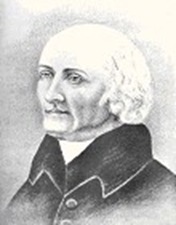
The Rev. Dr. Francis Matignon (1753-1818) arrived in 1792, first serving as an assistant to Thayer and then taking over. He had been driven out of France by the Revolution. Abbé Jean-Louis Lefèbvre de Cheverus (1768-1836), Matignon’s former student, arrived in October 1796 to assist him. And their landlady was Mary Lobb.
That 1944 history of the archdiocese says, “Father Matignon lived at the house of Mrs. Mary Lobb, in Leverett’s or Quaker Lane (now Congress Street), in what was a small Catholic section.” Lobb donated money to help build the new Church of the Holy Cross, which stood from 1803 to about 1862 (shown above late in its existence). As late as 1810, Mary Lobb was a subscriber to a book by John Milner answering an anti-Catholic tract.
TOMORROW:
Mary Lobb and her family get involved in a landmark lawsuit.