


J. L. BELL is a Massachusetts writer who specializes in (among other things) the start of the American Revolution in and around Boston. He is particularly interested in the experiences of children in 1765-75. He has published scholarly papers and popular articles for both children and adults. He was consultant for an episode of History Detectives, and contributed to a display at Minute Man National Historic Park.

Subscribe thru Follow.it


•••••••••••••••••


Showing posts with label Elkanah Watson. Show all posts

Friday, December 07, 2018

John Brown’s Gunpowder for Sale
Yesterday I quoted a story from Elkanah Watson describing a trip to Medford with gunpowder for the Continental Army during the siege of Boston.

Watson’s memoir didn’t specify a date for that mission. We know from contemporaneous sources that Gen. George Washington was confident about his army’s gunpowder supply until 3 Aug 1775. Then suddenly Massachusetts officials told him that their reports showed what gunpowder they had collected without subtracting the powder that the army had used.

Immediately after that bad news, Washington wrote to the Continental Congress and regional governments asking for more powder. He issued sharp orders that Continental soldiers should not to fire their guns unnecessarily. (He did not, however, spread rumors to British informants of having 1,800 barrels of gunpowder on hand, as biographer James T. Flexner claimed.) More powder started to arrive, enough so that by September the commander was ready to propose an attack on the British Boston.

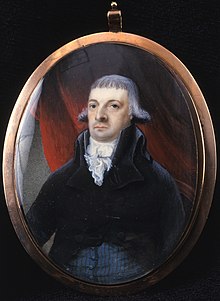
Elkanah Watson’s employer, the Rhode Island merchant John Brown (shown here), entered this story with a letter dated 3 November:
I having a Vessel arrived at Norwich [Connecticut] from Suranam which having brought a Small Quantity of Powder Viz. Forty four Cask Containing a Half hundred Each, I thought it proper to acquaint you thereof, but I am at a loss to determin which may be best for the General Cause for it to go to the Camp or to be Sold out here, so that People in General may be better quallified to Defend the Sea Coast…
With a postscript written the next day:
Since the above, Our General Assembly has applyed for the Refusel of the Powder. and if they Give the price which will make it as Good to me as tho the money had bin Layd out in mello. Viz. 6/ per ¶ Ct, must Give them the prefference.
The response came from Stephen Moylan, the Continental mustermaster general just elevated into the role of Washington’s acting military secretary. He wrote on 8 November: “As the powder you mention to have Imported, is disposed of, I have nothing to say thereon.”

More than two weeks later, on 21 November, Brown wrote again to say he hadn’t heard back from the general. Either Moylan’s letter never arrived or Brown decided to pretend it hadn’t since he still had powder to sell after all: “This is to Offer you One Ton of good Pistol Powder at Six shillings per pound here.” That was 50% more than Washington had paid for powder from another supplier in late October.

Moylan responded:
in your Letter of the 21st you make an offer of one ton of good Pistol powder at 6/per pound The General Will take it tho it is a most exorbitant price, he is willing to encourage the importation of that necessy article.

P.S. There are two Companys orderd from your quarter to this place, Governor [Nicholas] Cooke will inform you when they march you will please to Send the powder under their Guard in a Coverd Waggon shoud they have Set out before this reaches you must get a few of the minute or militia men of your Colony to guard it to this place
Brown presumably sent that gunpowder in December. It’s conceivable that he entrusted the shipment to his teen-aged apprentice Watson, who recalled having made such a journey with “six or eight recruits.“ Indeed, an escort of militiamen, if they were indeed men, might have made Brown more comfortable sending young Watson.

However, even if this was the mission Watson described, it’s clear that he exaggerated the details in his memoir. The army’s gunpowder supply never dropped to “four rounds to a man,” even at the crisis point in August, and that crisis was well past by December. Brown offered a ton of gunpowder, not “a ton and a half.” And the merchant didn’t “immediately forward” the powder to Cambridge once his ship arrived; he played two potential customers off against each other for a couple of weeks in order to get his high asking price.

Elkanah Watson may well have delivered gunpowder to the American lines for his master. But as to whether he supervised the shipment, met the commander-in-chief at his headquarters, or learned anything about barrels of black sand in the powderhouse, I suspect some of those details were embellishments to make the memory more interesting.

TOMORROW: A myth built on top of a myth.

Thursday, December 06, 2018

Elkanah Watson’s Story Built on Sand

This week The Atlantic published Amy Zegart’s article “George Washington Was a Master of Deception.”

Most of the examples are from the Revolutionary War when Washington was trying to fool the British commanders about his military capacities and plans. That was, of course, normal behavior for eighteenth-century generals, not to mention generals today. Even people who want to believe Mason Weems’s “cannot tell a lie” myth don’t begrudge Washington those untruths.

One particular example caught my eye:
After a summer of skirmishes around Boston, rebel gunpowder was nearly gone; Washington’s soldiers had enough only for nine bullets per man. To hide this potentially fatal weakness from the British while he scrambled to get supplies, Washington ordered that fake gunpowder casks be filled with sand and shipped to depots where they would be spotted by British spies.
The citation for this claim points to Elkanah Watson’s memoir Men and Times of the Revolution, published posthumously in 1856. This anecdote comes a passage in which Watson (shown above) discusses his apprenticeship to the Providence merchant John Brown:
On the 3d of July, 1775, Gen. Washington assumed the command of the forces then besieging Boston. He found an army animated with zeal and patriotism, but nearly destitute of every munition of war, and of powder in particular. Mr. Brown, anticipating the war, had instructed the captains of his vessels to freight on their return voyages with that article. At this crisis, when the army before Boston had not four rounds to a man, most fortunately one of Mr. Brown’s ships brought in a ton and a half of powder. It was immediately forwarded, under my charge, to headquarters at Cambridge. I took with me six or eight recruits to guard it.

I delivered my letter to Gen. Washington in person, and was deeply impressed with an emotion I cannot describe, in contemplating that great man, his august person, his majestic mien, his dignified and commanding deportment, the more conspicuous, perhaps, at that moment, from the fact that he was in the act of admonishing a militia colonial with some animation.

He directed a young officer to accompany me, and superintend the delivery of the powder at Mystic [Medford], two miles distant. Whilst delivering it at the powder-house, I observed to the officer, “Sir, I am happy to see so many barrels of powder here.”

He whispered a secret in my ear, with an indiscretion that marked the novice in military affairs, “These barrels are filled with sand.”

“And wherefore?” I inquired.

“To deceive the enemy,” he replied, “should any spy by chance look in.” Such was the wretched appointment of that army upon which rested the hopes of American liberty.
Like a lot of stories in Watson’s memoir, this one makes him look important. He was entrusted with ferrying a ton and a half of desperately needed gunpowder to the Continental lines. He had an audience with Gen. Washington himself (and weathered it better than that “militia colonel”). He was privy to the vital secret of the fake powder, but also wise enough to realize that telling the secret was “an indiscretion that marked the novice.” And all when he was only seventeen years old!

Then Zegart paints Washington as even more tricky than Watson did. The memoir said the powderhouse was kept full “should any spy by chance look in.” The Atlantic article says the commander knew the barrels of sand “would be spotted by British spies.”

The result is a great little story, but I haven’t found any support for Watson’s claim. Filling many barrels with sand and transporting them to powderhouses would have required a lot of people. The army would have needed a way to tell the barrels of sand apart from the barrels of genuine powder. And none of the people involved in this operation would have had any reason to keep that secret after the end of the war. Yet no one mentioned it until Watson wrote fifty years later.

TOMORROW: The contemporaneous record.

Monday, February 06, 2017

Dinner with the Old Colony Club in 1769

The Old Colony Club started as a group of seven young gentlemen from Plymouth. They formed their club in January 1769, and on 22 December of that year had a dinner to commemorate the landing of the first British settlers in what was then the Plymouth Colony but was subsumed into Massachusetts.

The dinner took place at the inn of Thomas Southworth Howland, another descendant of the first settlers, starting at 2:30 P.M. According to club records, the food consisted of:

1. A large baked Indian whortleberry pudding.

2. A dish of sauquetash.

3. A dish of clams.

4. A dish of oysters and a dish of codfish.

5. A haunch of venison roasted by the first jack brought to the Colony.

6. A dish of sea-fowl.

7. A ditto of frost-fish and eels.

8. An apple pie.

9. A course of cranberry tarts, and cheese made in the Old Colony; dressed in the plainest manner (all appearances of luxury and extravagance being avoided, in imitation of our worthy ancestors whose memory we shall ever respect).
At 4:00 the club walked solemnly back to “Old Colony Hall,” the procession “headed by the steward carrying a folio volume of the laws of the Old Colony” of Plymouth. Other descendants gathered as a military company and “discharged a volley of small arms, succeeded by three cheers.”

Peleg Wadsworth brought out the boys from his “Private Grammar School opposite the Hall,” who sang “a song very applicable to the day.” Young Elkanah Watson might have been among those boys; his namesake father, his teacher Wadsworth, and the school’s other teacher, Alexander Scammell, were among the men who joined the club members for toasts that afternoon.

The public part of the ceremony ended at sunset with a cannon being fired and the club taking down their “elegant silk flag” inscribed “Old Colony 1620.”

Friday, April 22, 2016

John Howland and the Lexington Alarm in Providence

Yesterday I quoted Elkanah Watson’s description of how Providence, Rhode Island, responded to the Battle of Lexington and Concord.

According to Watson, the news arrived on the afternoon of 19 Apr 1775, his militia unit spent the whole night equipping themselves, and they marched off on the morning of 20 April, defying the governor’s proclamation that they not cross the border into Massachusetts.

Watson’s contemporary John Howland, born in October 1757, left his own memoir of that day. He was from a lower class than Watson, apprenticed to a barber instead of a merchant and attached to an ordinary militia unit instead of the Cadets. But Howland grew up to be president of the Rhode Island Historical Society and seems to have been more accurate about important points:
On the afternoon of the 19th of April, 1775, news arrived here that a battle was then going on, as the regulars had marched from Boston into the country. There were four or five boys of us on Mr. Thompson’s wharf, where some hands were unloading a scow load of salt. Mr. Thompson came down and said, “war, war, boys, there is war. The regulars have marched out of Boston; a great many men killed; war, war, boys.” He turned quickly and went up to the street. We all followed, and saw the officers of the companies and many others on the parade before Gov. Bowen’s, seeking intelligence.
Jabez Bowen was never governor of Rhode Island; in 1778 he became deputy governor, and served for several years. But Bowen was a leader of the Providence militia, so it makes sense that people gathered near his house for news.
The drums of the four independent companies beat, and the men paraded as soon as possible. It was sundown, and the officers of the company repaired to Lieut. Gov. [Darius] Sessions, requesting him to give them orders to march towards Boston, as without his orders their authority would cease when they should have passed Pawtucket bridge. He declined doing any thing in the case, having no power out of the colony, or in it, as the Governor [Joseph Wanton] who lived in Newport was above him in authority.

It was then concluded to send an express towards Boston, to know whether the enemy had returned or were yet in the field, and to act or march on further intelligence, orders or no orders. Mr. Charles Dabney, a member of the Cadet company, offered to be the express. A horse was procured and he set off. It was toward noon the next day before he returned, but an express from near the scene of action arrived, stating that the regulars were safe cooped up in Boston.

Before this intelligence arrived here, early in the morning Col. [James] Varnum, with his Greenwich company arrived, but would not stay. They continued their march some miles beyond Pawtucket, when receiving the intelligence they returned here. I viewed the company as they marched up the street, and observed Nathaniel Greene with his musket on his shoulder, in the ranks as a private. I distinguished Mr. Greene, whom I had frequently seen, by the motion of his shoulders in the march, as one of his legs was shorter than the other.
According to Howland, therefore, Varnum’s Kentish Guards were the only Rhode Island company that marched across the colony line on 20 Apr 1775. Watson’s unit, the Independent Company of Cadets, waited for word from their member Dabney about what the situation was. Before noon, Providence received news “that the regulars were safe cooped up in Boston,” so those Cadets probably never marched. Elkanah Watson just wished they had.

Thursday, April 21, 2016

Elkanah Watson and the Lexington Alarm in Providence

I previously quoted the part of Elkanah Watson’s Men and Times of the Revolution in which he described his military training as a schoolboy in Rhode Island.

Watson, born in 1758, was still a teenager when the Battle of Lexington and Concord occurred. He was a clerk working for John Brown in Providence. Here’s how Watson described the colony’s response to that news:
The intelligence of the march upon Lexington reached Providence in the afternoon of the 19th of April, 1775. Our five companies flew to arms. The whole population was convulsed by the most vehement excitement. We were unprovided with cartridges, and were compelled to defer our march till morning. I spent the most of that night with many of our company [Independent Company of Cadets under Col. Joseph Nightingale], in running bullets and preparing ammunition.

We mustered early the next morning, and marched for the scene of action. The royal governor, [Joseph] Wanton, issued a proclamation, which was little regarded, interdicting our passing the colony line, under the penalty of open rebellion. Capt. [Nathanael] Green, afterwards the celebrated Gen. Green, with his company of Warwick Greens, and Capt. [James] Varnam, afterwards a revolutionary general, with his Greenwich Volunteers, marched with us at the same time towards Lexington.

We had advanced six miles amid the cries and tears of women, every road we passed enveloped in a cloud of dust from the march of armed men, hastening onward, when an express met us, with the information that the regulars had been driven back into Boston.
Watson misremembered some facts. Greene wasn’t a captain in charge of a company but a private in the company Varnum commanded, the Kentish Guards. The “Warwick Greens” and “Greenwich Volunteers” may just have been bunches of guys in that independent militia company.

Gov. Wanton didn’t issue a proclamation forbidding Rhode Island troops from entering Massachusetts, though Rhode Islanders clearly believed they were taking a risk to do so.

Furthermore, there’s reason to doubt that Watson’s company marched into Massachusetts as he described.

TOMORROW: Another Rhode Islander’s recollections.

Tuesday, May 20, 2014

Priscilla Watson “being left a rich widow”

Yesterday I started quoting from Benjamin Marston Watson’s story in the New England Historical and Genealogical Register for 1873, describing how in the late 1720s Priscilla Thomas of Duxbury was courted by two men: Noah Hobart, the local schoolteacher whom she loved but who was still struggling to pay off college loans; and John Watson, a wealthy widower from Plymouth.

Not wishing to stand in the way of Priscilla’s good fortune, Hobart told her not to feel bound to him since he wasn’t sure when he would be in a position to marry. This is what happened next:
She then concluded to accept Mr Watson’s offer; and in a few weeks he married her [in 1729], & carried her to his home in Plymouth. In due time she bore him two sons, ye eldest, my great uncle William Watson; & ye youngest my grandfather Elkanah Watson; & soon after, in Septr. 1731, her husband died of a fever, and left his wife a handsome young widow, of about 25 years of age.
The gravestone of John Watson (1678-1731) appears above, courtesy of Sandra Lennox and Find-a-Grave. His death seems to leave the way clear for young Hobart, doesn’t it?
About ye same time that M’r Watson’s death occurred, the wife of Thomas [actually Isaac] Lothrop Esqr., one of their neighbours, died, leaving a young infant, w’h was frequently sent to Mr’s Watson to be nursed, she having also a nursing infant.

In ye meantime, Noah Hobart probably not having yet paid his college debts, did not now manifest any particular sentiments, or intentions in relation to her, perhaps also being influenced by ye contrast in their condition, she being left a rich widow.

The intercourse created between M’r Lothrop & Mr’s Watson by their mutual interest in his nursing infant, brought about a reciprocal interest in each other, & in due time he offer’d, & was accepted by her as her second husband. She lived with him happily for some years, & bore him three children, two sons & a daughter; viz. D’r Nathaniel Lothrop & Isaac Lothrop Esqr., of Plymouth, and Priscilla, married to Gershom Burr Esqr., of Connecticut; when M’r Lothrop died, & Priscilla became a widow for ye second time.
And here’s the gravestone of Isaac Lothrop (1707-1750). Priscilla actually bore him six children. And what had happened to her first suitor?
Noah Hobart, while ye incidents related in ye former chapter were occurring to Priscilla, having been settled in ye (Congregational) ministry at Fairfield, Connecticut, had married & his wife had died previously to the death of Mr. Lothrop. At a suitable interval, subsequent to these events, he concluded to make a visit to his first sweetheart & went to Plymouth, & again proposed himself for her husband.

She was very glad to see him, & received him very graciously; and much regretted that she could not accept his proposals, without breaking a promise that she had made to M’r Lothrop on his deathbed, not to marry while his mother lived.
Oh, come on!

TOMORROW: No, really—can this marriage be saved?

Thursday, February 16, 2012

“About the Time the prophetic Egg was laid in the Town of Plymouth”

After reading the nineteenth-century reports of a pro-William Howe message appearing mysteriously on an egg in Plymouth during the Revolution, I went looking for contemporaneous sources. I found only one reference in the America’s Historical Newspapers database.

That calls into question Dr. James Thacher’s statement in 1832 that “the story of the egg was the subject of newspaper speculation in various parts of the country.” Of course, there might be other articles not picked up by that system, or I may not have searched for the right terms. (Additional mentions welcome!)

The lone response to the egg appeared in The Freeman’s Journal, or New-Hampshire Gazette, published in Portsmouth, New Hampshire, on 28 Jan 1777. That date supports Elkanah Watson’s memory of this event occurring at the same time that Plymouth received word of the American victory at Trenton in late December 1776.

The item started by dismissing superstition—but then it went on to both parody and exploit that credulity:
To the PRINTER.

SIR,

As the Superstition and Weakness of human Nature is such, that sometimes the most trivial Circumstance or grossest Absurdity, is attended with serious Consequences; you are desired to acquaint the Timid & Credulous, that Characters inscribed on Adamant are much more durable than when wrote only on an Egg-Shell. And also to inform the Public, that about the Time the prophetic Egg was laid in the Town of Plymouth, with this wonderful Prediction wrote on its Shell, “Oh, oh, America Howe shall be thy Conqueror,” a Hermit resembling the Genius of America, who had resided in a certain Forest from the first Settlement of the Country, found the following Lines inscribed on a Fragment of Marble near his Cave, visited by the Curious from all Parts of Europe, for the remarkable Eccho which oft reverberated in loud Peals, heard beyond the Atlantic,
TOMORROW: The following lines.

Wednesday, February 15, 2012

Dr. James Thacher’s Story of the Egg

In 1832, Revolutionary War veteran Dr. James Thacher (1754-1844) published a History of the Town of Plymouth that included this anecdote:
An innocent trick was devised by some persons in this town, which occasioned at that time a general surprise and agitation. An egg was produced with the following words imprinted on the shell by the artifice of some tories. ‘O America, America, Howe shall be thy conqueror.’

The egg being taken from the hen roost of Mr. H. on Sunday morning, and exhibited to a concourse of people assembled for public worship excited the greatest agitation, and the meeting was for some time suspended. The tories affected to believe that the phenomenon was supernatural, and a revelation from heaven favoring their cause and predictions; and some whigs were ready to fall into the delusion, when one less credulous, observed that it was absurd to suppose that the Almighty would reveal his decrees to man through the medium of an old hen.

Thus ended the farce; but the story of the egg was the subject of newspaper speculation in various parts of the country, and the alarm which it occasioned in the minds of some people here was truly astonishing.
This story appears to be independent of the first-hand account I quoted yesterday from Elkanah Watson. Thacher inserted the story among anecdotes from before the war while Watson linked it to a Sunday in late 1776 or early 1777 when word of the Battle of Trenton reached Plymouth. Watson misspelled the name of the town’s Whig minister, which appears several times in Thacher’s book: Chandler Robbins.

The two writers also show different attitudes toward the event. Watson had to be convinced by “an ingenious painter” that the message could have been put onto the egg artificially. Thacher, on the other hand, suggested the notion of divine messages by that channel was prima facie “absurd” and a “farce.” Watson and his friends thought the egg was a Tory’s dirty trick. Thacher called it “an innocent trick.”

Both authors independently agreed on one detail: that the egg came from a hen owned by a family with the initial H.

TOMORROW: Tracking back to 1777.

Tuesday, February 14, 2012

Elkanah Watson’s Magic Egg

This anecdote is from Men and Times of the Revolution, the posthumously assembled memoirs of Elkanah Watson (1758-1842). It starts in December 1776 just after young Watson and some friends were inoculated against smallpox:
About the time we left the hospital, Major Thomas, of the army, arrived at Plymouth, from head-quarters. He had left Washington retreating through New-Jersey. I spent the evening with him, in company with many devoted Whigs. We looked upon the contest as near its close, and considered ourselves a vanquished people. The young men present determined to emigrate, and seek some spot where liberty dwelt, and where the arm of British tyranny could not reach us. Major Thomas animated our desponding spirits by the assurance that Washington was not dismayed, but evinced the same serenity and confidence as ever. Upon him rested all our hopes.

On the ensuing Sunday morning, as the people were on their way to church, I suddenly witnessed a great commotion in the street, and a general rush to the back door of Mrs. H—’s dwelling. Supposing the house to be on fire, I darted into the crowd, and on entering the house, heard the good woman’s voice above the rest, exclaiming, with an egg in her hand—“There, there, see for yourselves.” I seized the magic egg, and to my utter astonishment read upon it, in legible characters formed by the shell itself, “Oh, America, America, Howe shall be thy conqueror!”

The agitation and despondency produced, will hardly be appreciated by those unacquainted with the deep excitability of the public mind at that period. We were soon relieved from our gloom and apprehension, by ascertaining from an ingenious painter, who happily came in, that the supernatural intimation was the effect of a simple chemical process. We were convinced it was a device of some Tory to operate on the public feeling.

In the afternoon, an express arrived from Boston; a hand-bill was sent into the pulpit, and at the close of the service our venerable Whig Parson [Chandler] Robins, read from his desk the heart-thrilling news of the capture of the Hessians at Trenton—a happy retort upon the Tories.
Watson’s memoir was published in 1856, or nearly eighty years after this reported event.

TOMORROW: An earlier version of the same anecdote.

(Click on the portrait above or here for the Princeton University Art Museum’s exploration of John Singleton Copley’s 1782 portrait of Elkanah Watson.)