


J. L. BELL is a Massachusetts writer who specializes in (among other things) the start of the American Revolution in and around Boston. He is particularly interested in the experiences of children in 1765-75. He has published scholarly papers and popular articles for both children and adults. He was consultant for an episode of History Detectives, and contributed to a display at Minute Man National Historic Park.

Subscribe thru Follow.it


•••••••••••••••••


Showing posts with label Warren Hastings. Show all posts

Tuesday, April 05, 2022

Frith as “Madman” and “unfortunate stone-thrower”
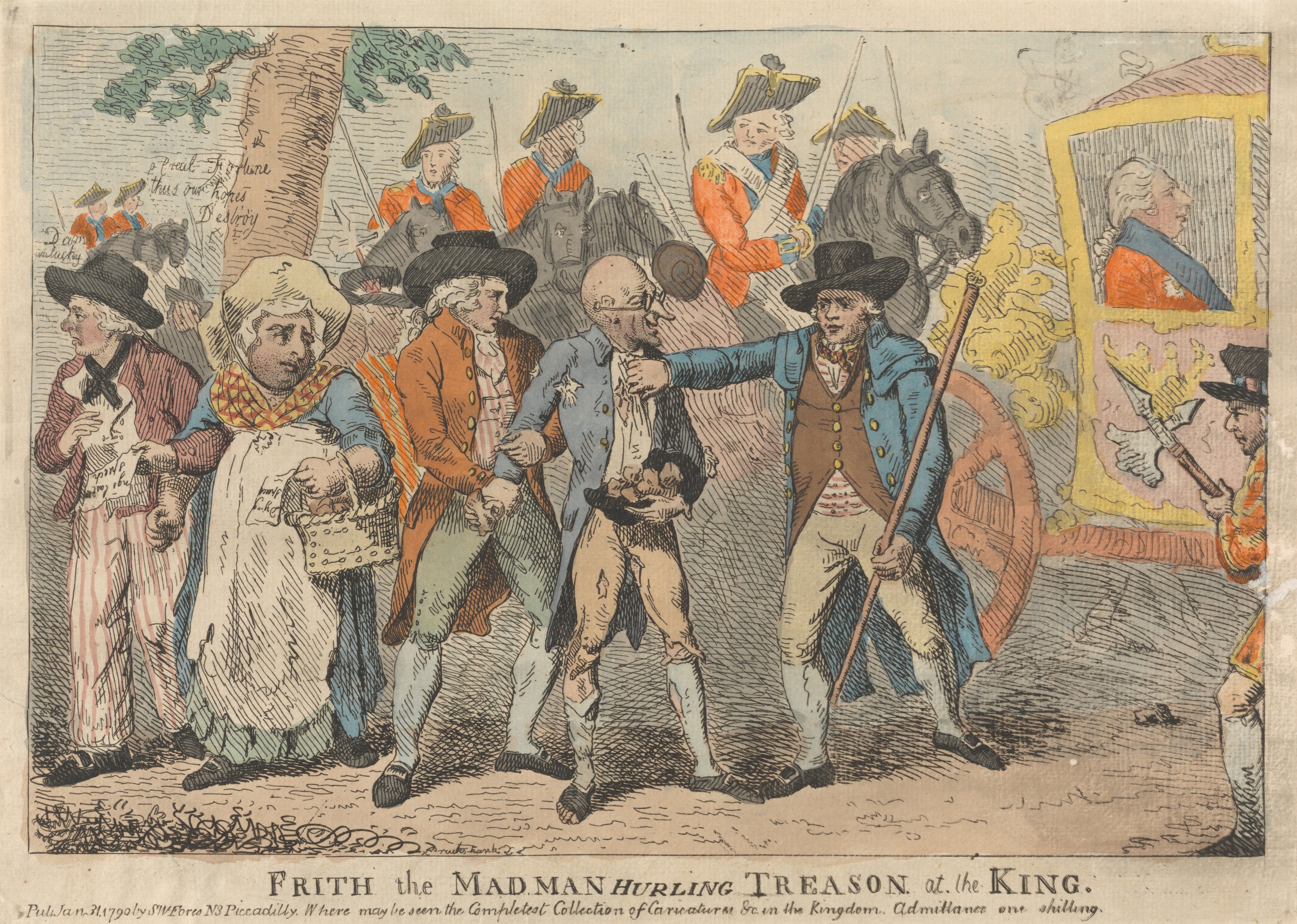
Although John Frith expressed his grievance against the British government using the language of rights and social contracts, his cause was personal, not political.

That didn’t stop his case from being mixed into the factional politics of 1790, however.

Ten days after Frith threw a stone at King George III’s gilded carriage, the caricaturist Isaac Cruikshank issued the print shown above, titled “Frith the Madman Hurling Treason at the King,” shown courtesy of the Yale Centre for British Art.

King George is at the right, riding by obliviously. A small fiddle-playing demon rides on his carriage and mounted guards follow.

In the middle of the picture, two men are seizing a third who holds a hatful of rocks. That central figure doesn’t look like Firth, however. Instead, it’s a caricature of the elderly Edmund Burke, bald, bespectacled, and ragged from being out of power. One of the men stopping him is dressed as a Bow Street Runner. The other looks like George, the Prince of Wales, as the British Museum expounds.

At the left are figures of a sailor and a woman carrying a basket, dismayed at the arrest. The woman’s five-o’clock shadow reveals her to be a lampoon of Charles James Fox, another opposition leader. The sailor looks like Fox’s ally Richard Brinsley Sheridan.

The message of this image is therefore that the opposition Whigs in Parliament metaphorically throwing rocks at the king.

Another, cruder image came from William Dent, shown here through the British Museum. It contrasted Frith “the unfortunate stone-thrower,” making “a follish throw for full pay” as an army officer, with the impeached India administrator Warren Hastings. As a “fortunate stone thrower,” Hastings is tossing diamonds as bribes “for a full P-rd-n.”

In this print Frith labeled is “Gulliver the little in Brob-dignag,” confronting the giants of the king and his bodyguards. In contrast, Hastings is “Gulliver the great in Lilliput,” lording over the grasping king and queen and Baron Thurlow, the former attorney general and lord high chancellor. George III and Thurlow were supporting Hastings in his ongoing impeachment trial.

The Member of Parliament who led the case against Hastings was Edmund Burke—the same man Cruikshank depicted as Frith in his print. Thus, artists on opposite sides of the political debate used Frith’s attack on the king’s carriage to convey contradictory messages.

Tuesday, August 22, 2017

A Trial and Execution in India

What was happening in India while the siege of Boston got under way on the far side of the world? The Executed Today blog describes a controversial court case:
On [5 Aug] 1775, inconvenient Indian official Nandakumar (or Nand Kumar, or Nuncomar) was hanged on a forgery charge — all too conveniently inflicted at the very time he was accusing British Governor-General Warren Hastings [shown here] of corruption.

Nandakumar and Hastings decidedly did not get along; the Indian believed he had been unfairly denied a plum career assignment. He leveled in response an accusation that Hastings was taking payola in exchange for his appointments.

English pols involved in the administration of India, such as Philip Francis, John Clavering and George Monson, had their own rivalries with Hastings and wanted to pursue these charges. Instead, within weeks, Nandakumar was facing years-old forgery charges, and two months after his trial, he was at the end of a rope. . . .

(He forged part of a will to recover a bad loan. All concerned appear to agree that this charge is factually accurate, which is, of course, a long way from explaining why the matter required immediate adjudication at this juncture. Incidentally, while forgery could get you hanged in England, it was a much less serious offense under Hindu law.) . . .

Parliamentarian heavyweight Edmund Burke would eventually weigh in on the hanged man’s side, charging that Hastings had “murdered this man, by the hands of [Chief Justice] Sir Elijah Impey.” In a report to the select committee established by the Amending Act (cited in this tome), Burke noted
that this Trial and Execution was looked upon by many of the Natives as political; nor does the Committee conceive it possible, that, combining all the Circumstances together, they should look upon it in the Light of a common judicial Proceeding; but must regard it as a political Measure, the Tendency of which is, to make the Natives feel the extreme Hazard of accusing, or even giving Evidence of corrupt Practices against any British Subject in Station, even though supported by other British Subjects of equal Rank and Authority. It will be rather a Mockery, than a Relief to the Natives, to see Channels of Justice opened to them, at their great Charge, both in the Institution and in the Use, and then Appeals, still more expensive, carefully provided for them, when, at the same Time, Practices are countenanced, which render the Resort to those Remedies far more dangerous than a patient Endurance of Oppression, under which they may labour.
Hastings was impeached for corruption in 1787 — it took Burke, who served as one of the prosecutors, two full days to read the 20-count indictment against him, though Burke’s own attempt to add judicial murder to the bill of particulars was jettisoned.
The House of Lords finally acquitted Hastings in 1795. Britain continued to enjoy the new empire he had assembled in India, even richer than the colonies lost in North America.

Executed Today points to three sources on this case: Henry Beveridge’s The Trial of Maharaja Nanda Kumar (1886); J. Duncan M. Derrett’s article “Nandakumar’s Forgery” in The English Historical Review (April 1960); and Nicholas B. Dirks’s The Scandal of Empire (2008).