J. L. BELL is a Massachusetts writer who specializes in (among other things) the start of the American Revolution in and around Boston. He is particularly interested in the experiences of children in 1765-75. He has published scholarly papers and popular articles for both children and adults. He was consultant for an episode of History Detectives, and contributed to a display at Minute Man National Historic Park.

Subscribe thru Follow.it


•••••••••••••••••


Showing posts with label John Pulling. Show all posts

Saturday, August 02, 2025

William Jasper and the Resistance

First in Boston 1775 postings and then in this article for the Journal of the American Revolution (also printed in this volume), I posited that Dr. Joseph Warren’s crucial informant on the night of 18 Apr 1775 was a British-born cutler named William Jasper.

I also laid out that argument in this talk for the Colonial Society of Massachusetts in April.

In collecting information about William Jasper, I looked for ties between him and the Boston activists. Of course, he couldn’t appear too close to Dr. Warren’s network in 1774–75 or else he wouldn’t have made a good spy. But I kept hoping for some documented link between Jasper and Boston’s resistance movement.

This summer I stumbled back into this page of signatures on a non-importation agreement from October 1767, protesting the new Townshend duties. It’s at Harvard’s Houghton Library.

And there’s William Jasper’s signature. He pledged to join this boycott several months before his June 1768 marriage to Ann Newman, previously the earliest sign I’ve found that he’d moved from New York to Boston.

What’s more, William Jasper’s signature appears right after John Pulling’s, and on the same sheet as Paul Revere. Those men were probably all in the same neighborhood, or even at the same neighborhood meeting. This sheet thus includes the signatures of three men involved in spreading the alarm on the night of 18 Apr 1775.

Sunday, June 09, 2024

Revolution’s Edge Returns to Old North

Old North Illuminated has brought back Revolution’s Edge, its thought-provoking play set inside the church on 18 Apr 1775.

Patrick Gabridge wrote this drama to be performed in Christ Church, Boston, about actual people in that congregation in 1775, using the historical record and some dramatic imagination. It’s directed by Alexandra Smith and produced by Jess Meyer for Plays in Place.

It looks like there’s a new cast this summer. The Rev. Mather Byles, Jr., a Loyalist at odds with most of his flock, is being played by Eric McGowan and Tim Hoover. Cato, the African man enslaved by Byles and the play’s narrative voice, is played by Stetson Marshall and Joshua Lee Robinson. Captain John Pulling, Jr., a church vestryman and Patriot activist, is played by Dustin Teuber and Kevin Paquette.

I wrote about the play last summer. The approaching Sestercentennial anniversary of the day it depicts makes it even more resonant.

Revolution’s Edge lasts about forty-five minutes. It will be performed four nights a week through 10 August. For more information, a video preview, and tickets, visit Old North Illuminated.

Saturday, July 08, 2023

Peeking in on “Revolution’s Edge”

A month ago I noted the upcoming premiere of “Revolution’s Edge,” a play dramatizing the stresses affecting three men associated with Christ Church in the North End on 18 Apr 1775.

The three characters are the Rev. Dr. Mather Byles, Jr., planning to leave that church; his enslaved servant, Cato, worried about being removed from his family; and John Pulling, a merchant captain and vestryman who’s also interested in the movement of British soldiers. Byles is a Loyalist, Pulling a Patriot, and for Cato the lack of liberty cuts most deeply.

I attended that first performance at Old North and can recommend the show as a thoughtful exploration of how the Revolution’s big issues intersected with individual desires and needs. Performances run through 19 September.

WBUR’s report on the play included this passage:
Nathan Johnson, the actor who plays Cato, says it is one of the most important projects in which he’s been involved.

Johnson, who is Black, promised himself early in his acting career that he would never play an enslaved person. But the depiction of Cato, and the importance of the play’s message, made the role too compelling to pass up.

“I want everyone to see that we have all something to contribute to our history,” Johnson said. “I want everyone to see that it is not a matter of white and Black. It is a matter of America. It is a matter of progress. It is a matter of stakes, it is a matter of tension. And not just for Pulling and Byles, but for Cato as well.”
Cato is the least documented of the three characters. Playwright Patrick Gabridge had to gather vital records from Boston, Roxbury, and Nova Scotia, and then make an educated assumption that all those mentions of a man named Cato related to the same person.

To compound the challenge of building Cato’s character when none of his words survive, an enslaved man in a room with his owner wouldn’t have been able to speak his mind.

Gabridge turned that vacuum into an advantage by making Cato the character who addresses the audience, introducing the historic situation, the other characters, and his own unvoiced thoughts.

For folks who want to hear more, WBUR also ran an audio report.

The photo above of Johnson performing as Cato was taken by Evan Turissini, who plays Pulling, as he waited to enter.

Saturday, June 10, 2023

“Revolution’s Edge” Premieres at Old North, 15 June

Old North Illuminated has commissioned a new play depicting the tensions within its Anglican congregation on the eve of the Revolutionary War.

The playwright and producer is Patrick Gabridge. Through Plays in Place, he has previously written site-specific dramas about the Boston Massacre and the John Hancock household for Revolutionary Spaces.

“Revolution’s Edge” portrays three men connected with Christ Church, Boston, in early 1775:
  • the Rev. Dr. Mather Byles, Jr., the minister and a firm Loyalist, though descended from the Puritan Mathers. 
  • John Pulling, a vestryman on the committee who hired Byles, a merchant captain, and an active Whig (member of the North End Caucus, for example). 
  • Cato, a domestic servant enslaved to Byles, married to a woman enslaved to Byles’s in-laws out in Roxbury. 
All three men have young children. All three face the prospects of separating from their families or communities. Byles has just resigned to take a pulpit in New Hampshire while Pulling is wondering if it’s safe for him to remain in army-occupied Boston.

And it’s also the morning of 18 April.

To hear more about this production and the historical facts behind it, listen to Gabridge and Nikki Stewart, execuctive director of Old North Illuminated, chatting with Jacob Sconyers for the HUB History podcast. (Disclosure: Stewart and Sconyers are married. Double disclosure: I’m referenced in this discussion.)

“Revolution’s Edge” will premiere on Thursday, 15 June. After that, there will be performances every Tuesday, Thursday, and Saturday evening until 19 September. Seating starts at 5:00 P.M., with the performance running from about 5:20 to a little after 6:00. Tickets are $20 for adults, $10 for people under age eighteen, though the show isn’t really recommended for kids under twelve.

Friday, April 21, 2023

The Real Third Rider on the 18th of April

Dr. Samuel Prescott is usually described as the third alarm rider to carry Dr. Joseph Warren’s alert on 18–19 Apr 1775, but that label should really apply to another man. There was an earlier alarm rider completely lost to history.

The first rider was William Dawes, Jr., adjutant of the Boston militia regiment. Following Dr. Warren's instructions, he rode out through the town gates in the early evening of 18 April.

Warren then turned to his Plan B. He passed the same alert to Paul Revere, who put into motion an arrangement he had made with Richard Devens and other Patriots in Charlestown.

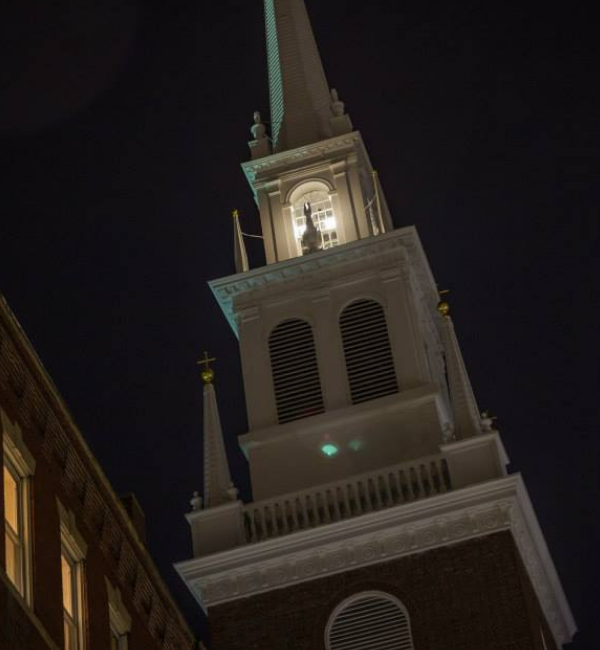
Revere in turn informed John Pulling, a vestryman of Christ Church in the North End, now better known as the Old North Church. Pulling summoned Robert Newman, sexton of that church. Around 10:00 P.M. those men hung two lanterns in the church’s tall steeple, a signal that the British army was starting their expedition by boat across the Charles River.

That launch for the British march hinted at where they were headed: west-northwest toward Cambridge, Lexington, and Concord rather than west-southwest toward Worcester. The committee of safety had just met in west Cambridge, with some delegates staying overnight, and top officials John Hancock and Samuel Adams were in Lexington. Both Concord and Worcester were storing multiple cannon and other military supplies.

The Patriots seem to have had good intelligence about the British government’s priorities. Lord Dartmouth, the secretary of state, had told Gen. Thomas Gage to start arresting leaders of the Massachusetts rebellion. Dr. Warren’s mission for Dawes, therefore, was to warn Hancock and Adams that troops were moving toward them. The Patriots didn’t know that Gage’s real focus was Concord, where his spies had located cannon spirited out of Boston armories back in September.

Old North’s two lanterns shone across the Charles River. Those lights were in the steeple only a short time. Newman and Pulling didn’t wait to be caught in the tower. Still, the signal lasted long enough for the Charlestown Patriots to spot it and take the next step in Plan B. On their side of the river, a man mounted a horse and started riding west toward Lexington.

And then that guy disappeared.

Not only do we not know what happened to that second rider, none of the people involved in sending him out preserved his name in their papers or reminiscences. I suspect that if British patrols had detained the man, or if he had betrayed the cause, the Patriots would have told the story in some way. Instead, there’s complete silence about the man’s identity in the record. That strikes me as likely a result of profound disappointment in the man rather than worry or anger.

Paul Revere made himself Plan C, a backup courier of Dr. Warren’s message to Hancock and Adams. He arranged for colleagues to row him across the Charles River to Charlestown. Arriving after 10:30, Revere consulted with Devens and other locals, got another horse, and started riding west, following the same route as the second rider.

After crossing the Charlestown neck into the west part of town, Revere almost fell into the hands of British army patrols. He had to wheel his horse and ride north, coming back onto the main road to Lexington after a few miles. Nevertheless, with a shorter route and a faster steed, Revere arrived in Lexington about half an hour before Dawes.

Presumably those same mounted British officers in west Charlestown stopped the second rider. Perhaps they detained him, as other officers would later detain Revere in Lincoln. Perhaps they simply scared him into abandoning his ride.

Either way, the third alarm rider that night was Paul Revere. And the second rider, the one who apparently never made it out of Charlestown, is completely forgotten.

Tuesday, November 23, 2021

Meeting the Clerks of the Market

Last week at dinner, the conversation turned to the question of what colonial Boston’s clerks of the market did. This is the kind of the dinner I like.

The post of clerk of the market was established in English law well before the kingdom colonized America, and it came to the colonies in different ways. In Philadelphia, the city charter of 1701 gave the mayor the power to appoint those officials. In contrast, the Boston town meeting elected clerks of the market, starting with two men in 1649. By the mid-1700s, there were twelve, one for each ward.

Clerks of the market were among the town’s lowest-ranking elected offices. But the post was a stepping-stone for young gentlemen seeking higher positions in politics or society. Many prominent men once served as clerks of the market for a year.

In March 1769, for example, the new clerks of the market included John Singleton Copley, Elisha Hutchinson, John Bernard, and John Gore, Jr. In 1770 the nod went to John Pulling, John Andrews, Nathaniel Wheatley, and Henry Jackson, among others.

The main stated duty of the clerks of the market was to ensure that the loaves of bread and the butter sold at the town market conformed to the selectmen’s stipulations. Each year, those officials announced what would be a fair weight for a loaf of bread of a standard price and quality. The price stayed the same, but the weight varied depending on the cost of grain, with a fair profit for the bakers mixed in.

For instance, in February 1773 the selectmen
Ordered that the Assize of Bread be set at Wheat at 7/ [seven shillings] p. bushel, and that 6d. [sixpence, or about 7%] p. bushel be allowed to the Bakers for their Charges Pains and Livelihood, which is computed as follows Vizt.
  • A Loaf of Brown Bread 3/4 Wheat 1/4 Rye meal must weigh 2 [lbs.] 8 [oz.]
  • a 4d. Ditto not above 1/2 Indian Meal must weigh 3 [lbs.] 8 [oz.]
  • Bisket of a Copper price 4 [oz.] 2 [drachms]
This was a long-established form of price-fixing, designed to avoid food riots like those in the 1710s. The selectmen tried to balance the needs of the populace against those of the bakers, as we can see in this extract from the town records in 1789:
On the application of Majr. [Edward] Tuckerman & Mr. [William] Breed two of the Town Bakers — It was agreed by the Selectmen that there should be 4 ounces instead of 2 ounces difference in the weight between 4d. white Loaf Bread & 4d. Superfine Brick Bread — and the Clerks of the Market were accordingly acquainted with this alteration, for their government in the weighing the same —
As that entry shows, the clerks of the market were supposed to enforce the bread rules. The law empowered them to seize loaves that were underweight, and even to go into any bakery or house where they knew bread was being baked for sale and check on how heavy the loaves were.

But did the elected clerks of the market really do that work? Usually a few of the men selected on the first round excused themselves by pleading inability and/or paying a fine, necessitating a second round. That suggests that many of those gentlemen weren’t actually that keen on the honor of serving their town that way.

Boston already had a full-time clerk of Faneuil Hall Market administering the rent on stalls, maintaining the infrastructure, and overseeing the maintenance staff of one. So were the gentlemen chosen to be clerks of the market actually out inspecting the bakers’ stalls every week? 

TOMORROW: Reading a clerk of the market’s diary.

[The image above comes from Food and Streets’ posting about making and tasting bread from an eighteenth-century recipe.]

Thursday, May 30, 2019

The Rediscovery and Remembrance of Robert Newman

For half a century after Robert Newman the Old North sexton killed himself in 1804, nobody much outside of his family remembered him.

He wasn’t named in public accounts of Revolutionary Boston. He had no monument in the Copp’s Hill Burying Ground, near the church he had tended.

(In contrast, his namesake Capt. Robert Newman did have a gravestone, which Thomas Bridgman described in detail in Epitaphs from Copp’s Hill Burial Ground, Boston: With Notes in 1851.)

Then at the start of 1861 Henry W. Longfellow published his poem “Paul Revere’s Ride.” That made Paul Revere and the lanterns hung in the Old North steeple famous. People started asking who hung those lanterns. Newman’s son and other descendants came forward to say that he had done it.

That led to a protracted dispute with the descendants of John Pulling, who grew up understanding that he deserved the credit. I already rehashed that unnecessary dispute; it seems quite clear that both men were involved.

More important to this week’s discussion, the rediscovery of the lantern story led to new interest in Robert Newman. Suddenly he was remembered. Meanwhile, the fact that another man of the same name had lived in the North End at the same time was forgotten.

As a result, starting in the late 1800s people gathered information about both Robert Newmans and wrote about them as a single person. By 1927 the Sons of the American Revolution had installed “an iron memorial” on Copp’s Hill that reportedly read:
CAPT. ROBERT NEWMAN
PRIVATEER ADVENTURE
SEXTON
OLD NORTH CHURCH
APRIL 19th, 1775
Historians of Freemasonry who were themselves Masons were particularly pleased by how this composite individual offered another link between Freemasonry and a famous Revolutionary moment. For example, this Masonic Genealogy website conflates the sea captain’s gravestone and Masonic career with the sexton’s activity on 18 Apr 1775. As I wrote yesterday, I’m skeptical that Newman the sexton was ever a Freemason.

Edward MacDonald’s Old Copp’s Hill and Burial Ground: With Historical Sketches, published in 1894, mentioned the sexton’s recently demolished house but said nothing about a gravestone for him. Within ten years, however, a stone had been installed for that Robert Newman at Copp’s Hill, as shown by the 1904 photo shown above.

The sexton’s stone reads:
HERE RESTS
ROBERT NEWMAN
BORN IN BOSTON, MCH. 20, 1752,
DIED IN BOSTON, MAY 26, 1804
(And then a Freemasons’ emblem—whether or not appropriate.)
THE PATRIOT WHO HVNG THE SIGNAL LANTERNS
IN THE CHVRCH TOWER, APRIL 18, 1775
The typography is, in a word, weird. It looks like a Colonial Revival attempt to replicate real eighteenth-century stones that’s at once too regular in its spacing and too irregular in its spelling. To me the type also looks similar to the monument in the Old Granary Burying Ground to Christopher Seider and the Boston Massacre victims, erected by “Boston Chapter S.A.R. 1906.”

I don’t mind Robert Newman the sexton having a monument, of course. I just wish we did a better job keeping him and his life distinct from that of Robert Newman the captain.

Thursday, April 18, 2019

Capt. Thomas Barnard and the Signal from Old North

Last spring I wrote a bunch of postings about the debate over who hung the signal lanterns from Old North Church on 18 Apr 1775, John Pulling or Robert Newman.

My conclusion: They were both involved, and in fact the earliest stories told by their descendants each mention another man, who was probably the other claimant. There’s no need for a debate.

However, a third name comes up in those accounts: sea captain Thomas Barnard. This posting is an attempt to sort out his place in the historiography of the event.

A 30 Dec 1873 Boston Traveler article (quoted here) credited sexton Robert Newman with hanging the lanterns and mentioned his “friend, a sea captain, who was watching the movement of the regulars.” That same article said (following the Longfellow poem) that Paul Revere was on the opposite shore of the Charles, which elevated Newman’s role but was wrong.

When the Rev. John Lee Watson first complained that Newman was being honored for the work he’d grown up hearing credited to his relative John Pulling, he wrote to the rector at the church. The Rev. Henry Burroughs wrote back noting how multiple people supported the Newman family account, including (as Watson put it in his letter in the 20 July 1876 Boston Daily Advertiser):
William Green, who lives at the North End, is the grandson of Captain Thomas Barnard. His sister, eighty-four years old, remembers Robert Newman.
The Barnard name thus came up first as someone whose grandchild remembered Newman. There was no claim to the man’s own role in signaling the Patriots of Charlestown.

Two years later, in his History of Paul Revere’s Signal Lanterns, April 18, 1775, William Willder Wheildon expanded on that story:
Miss Maria Green, living in Weston, born in 1793, is a daughter of William Green, who lived in Boston, near the North Church, where also her grand parents resided. She heard many times from her mother the story of the lanterns, and says, “I distinctly remember that she said her father, Capt. Thomas Barnard, was engaged on that night in watching the movements of the troops in order to obtain for Robert Newman the necessary information concerning their departure. Our family were familiar with the story of hanging out the lanterns owing to the connection of Capt. Barnard with it, and we never heard the act ascribed to any other person than Robert Newman, or to any other place than Christ Church.”

Mr. Green, a brother of the lady above mentioned, who died recently in Boston, is known to have made a similar statement.
Thomas Barnard’s grandchildren thus claimed that he was part of the story of 18-19 April, but only in watching the British troops (as many Bostonians had). They also suggested that Newman himself gathered information on the troops’ movements rather than taking direction from Dr. Joseph Warren through Revere.

Thomas Barnard was a ship’s captain who lived at one point on Middle Street. He was active in Boston maritime life and business until his death at age sixty-two in 1803. He may have been the Capt. Thomas Barnard who commanded the New York packet, often mentioned in the Rev. Dr. Jeremy Belknap’s letters because he was always sending things to friends there. (This Barnard is distinct from the Rev. Thomas Barnard of Salem who played a big role in “Leslie’s Retreat”; to confuse matters further, that minister’s meetinghouse has also been called “the old North Church.”)

In the twentieth century Thomas Barnard’s role in the lantern-hanging shifted—without, as far as I can see, any new evidence coming to light. In Paul Revere and the World He Lived In (1942), Esther Forbes wrote of the lantern-hanging:
One of the vestrymen at Christ’s, John Pulling, went with Newman, as probably did Revere’s neighbor, Thomas Barnard.
In a note Forbes added, “What Revere’s next-door neighbor, Barnard, was doing is even vaguer [than details about Pulling and Newman], but tradition says he did something.”

Fifty years later, in Paul Revere’s Ride (1994), David Hackett Fischer described this scene in detail:
On the afternoon of April 18, Revere alerted Newman and Pulling, and also another friend and neighbor, Thomas Bernard [sic], and asked them to help with the lanterns.

It was about 10 o’clock in the evening when Paul Revere left Dr. Warren’s surgery. He went quickly to the Newman house at the corner of Salem and Sheafe streets. As he approached the building, he peered through the windows and was startled to see a party of British officers who boarded with Mrs. Newman playing cards at a parlor table and laughing boisterously among themselves. Revere hesitated for a moment, then went round to the back of the house, and slipped through an iron gate into a dark garden, wondering what to do next.

Suddenly, Newman stepped out of the shadows. The young man explained that when the officers sat down to their cards, he pretended to go to bed early. The agile young sexton retired upstairs to his chamber, opened a window, climbed outside, and dropped as silently as a cat to the garden below. There he met Pulling and Bernard, and waited for Revere to arrive.

Revere told his friends to go into the church and hang two lanterns in the steeple window on the north side facing Charlestown. He did not stay with them, but hurried away toward his own home. The men left him and walked across the street to the Old North Church. Robert Newman tugged his great sexton’s key out of his pocket and unlocked the heavy door. He and Captain Pulling slipped inside, while Thomas Bernard stood guard.
This seems to be an attempt to reconcile the claims of both Pulling’s and Newman’s descendants that their ancestor actually hung the lanterns while keeping someone at watch down below. In turn, Fischer’s authoritative telling shaped the story in several books published in this century.

But, as I said, I’ve found no claim that Barnard actually was at Old North that night.

Thursday, April 19, 2018

Shedding Light on the Lanterns Debate

There are two big reasons I think the late-1870s debate over whether sexton Robert Newman or vestryman John Pulling hung the lanterns in the Old North Church steeple on 18 Apr 1775 didn’t amount to much.

The first is that the two family traditions which finally saw print in that decade weren’t really contradictory. Of course each set of children born after the Revolution grew up hearing about how their own daddy or granddaddy had done something very important in the war, paying little attention to other people in the story. But two traditions actually fit together.

Here’s the Newman lore, as expressed in 1873:
That evening the sexton of Christ Church, Robert Newman, sat quietly in his house on Salem street, opposite Bennett street, assuming an unconcerned look and manner to avert the suspicion of the English officers who were quartered upon him, but impatiently expecting the arrival of a friend, a sea captain, who was watching the movement of the regulars. 
Newman’s son recalled him awaiting “a sea captain,” and Pulling was a mariner whom everyone called “Captain.” Significantly, the Newmans didn’t recall the sexton hearing news directly from Paul Revere.

Meanwhile, Pulling’s relatives were clear that the first thing he did after learning about the British plans from Revere was to go to Newman:
As soon as he received his notice, he left his house, and, watching his time, went over to the sexton’s, in the same street, and asked for the keys of the church, which, as he was a vestryman, the sexton could not refuse to give him.
In sum, the two accounts are complementary. The only contradiction between these stories is that each family felt that their relative alone took two lanterns to Christ Church.

But it makes more sense if both men went to the church. That way one could keep watch and run interference. Pulling may well have seen himself as supervising while Newman recalled doing most of the physical work.

Both family traditions also hold that the royal authorities seized Robert Newman on 19 April or soon afterward. That leads us to the next big disagreement between the accounts. The Newman family said the sexton was released because the army didn’t have enough evidence to hold him. The Pulling relatives believed that Newman was released because he snitched on the captain—but they offered no evidence for the words they put in Newman’s mouth. The sexton remained in the North End for years after the war, and no one else accused him of being an informer.

These days, almost all historians say Robert Newman and John Pulling put up the signal lanterns together. The Pulling relatives’ suspicion about Newman gets swept aside. So as of now both sides of the debate won, and both sides lost.

But that’s only the first reason I say the debate over who hung the lanterns doesn’t matter much. The other reason is that hanging those lanterns probably had zero effect on history.

The lantern signal told William Conant, David Cheever, and other Patriots in Charlestown that the British troops were going to cross the Charles River. They dispatched a messenger on horseback to carry that news to Committee of Safety and Supplies members Elbridge Gerry, Azor Orne, and Jeremiah Lee in west Cambridge and to John Hancock and Samuel Adams in Lexington.

That messenger never made it. He was probably stopped on the west side of the Charlestown neck by British officers on horseback. Revere later ran into such officers and had to gallop off to a northern road. We don’t know who the original Charlestown rider was or what happened to him, but we know he didn’t get through.

That means the signal from the Old North tower played no role in alerting Provincial Congress leaders or countryside militia officers about the British march. Thus, if the two lanterns had never shone, the events of 19 April would have played out the same way. (Mind you, I’ve even questioned whether Revere’s ride mattered.)

So why did people care so much about the lanterns in the 1870s? Why do we care today, reenacting that event and idolizing the lanterns supposedly involved? The answer goes back to Henry W. Longfellow. He recognized the poetic power of that moment when the twin lanterns were lit—it’s focused, dramatic, visual. He made it a vital part of “Paul Revere’s Ride,” distorting history to depict it as crucial to Revere’s actual ride. And we’ve had it embedded in our national consciousness ever since.

Wednesday, April 18, 2018

The Debate Over Newman and Pulling

The Rev. John Lee Watson was pretty relentless in arguing his claim that John Pulling, not Robert Newman, had hung the lanterns in Old North Church on 18 Apr 1775.

On 20 July 1876, Watson published his letter in the Boston Daily Advertiser. In November he sent an updated and corrected version of that letter to Charles Deane, corresponding secretary of the Massachusetts Historical Society, who endorsed his conclusion and entered the letter into the society’s Proceedings.

The following year, a pamphlet titled Paul Revere’s Signal: The True Story of the Signal Lanterns in Christ Church, Boston appeared. That reprinted Watson’s letter and the M.H.S. discussion of it. Watson published an expanded edition in 1880. (In addition to arguing for Pulling’s participation, he also disputed the mistaken belief that the signal had been sent from the Old North Meeting-House instead of what had become known as the Old North Church.)

Most of the evidence to support Pulling’s participation was indirect, based on his documented role in other Patriot activism. Pulling was a member of the North End Caucus. He was elected to town offices: clerk of the market, warden, fireward, committee to supply the poor, committee to enforce the Continental Congress’s Association. After the siege, he served on the town’s wartime “Committee of Correspondence, Safety & Inspection” alongside Paul Revere.

In 1777 Pulling was a captain and conductor or commissary of ordnance in Col. Thomas Crafts’s Massachusetts artillery regiment. Basically that regiment was how middle-aged Sons of Liberty from Boston’s mechanics class helped to fight the war. (Revere was second-in-command.) In addition, starting in 1761, Pulling intermittently attended events of the St. Andrew’s Lodge of Freemasons.

Pulling’s Whiggish work was somewhat unusual in that he was an Anglican, even at times a warden and vestryman of Christ Church. But of course his access to that church’s tall steeple would have made him valuable on 18 Apr 1775.

In 1878, a defender of the Newman family claim hit back at the pro-Pulling argument. William W. Wheildon published his History of Paul Revere’s Signal Lanterns, April 18, 1775, in the Steeple of the North Church from his press in Concord. He listed more than a dozen people who had lived in the North End before and after the war and testified that it was common knowledge that Newman had hung the signal lanterns. (Like Watson, Wheildon also spoke up for Old North Church, not Old North Meeting-House, as the source of the signals.)

There’s clear evidence that Newman was indeed the sexton at Christ Church in 1775 and for years afterward (until he was criticized for charging visitors money to see the body of Maj. John Pitcairn in the crypt). And who besides the sexton would have the church keys and knowledge of the stairs to the steeple?

In this historical debate, Newman was the inside candidate. His family had remained in the North End and first got the attention of the Christ Church rector. Though Pulling had returned to the North End after the siege, by the 1870s his descendants were more scattered.

On the other hand, the Pulling faction had the advantage of class. The Newmans didn’t publish their own accounts. Pulling’s relatives did, the most vocal being clergymen. Pulling had been a respected merchant. In contrast, church sextons like Newman were seen as poor, menial, and dependent. “Are sextons, as a class, so intelligent and so reliable as to have been chosen for and intrusted with such an important affair?” Mary Orne Jenks sniffed. In this period the M.H.S. was at its most Brahmin, and it’s no surprise that institution lined up on the Pulling side.

Both parties in the debate claimed that their man was the “friend” that Revere asked to send the signal. Neither was actually able to provide evidence for friendship aside from all three men living in the North End in the same years. But Pulling was in his late thirties, closer to Revere’s age, while Newman was only twenty-three.

Both sides had dramatic stories to tell of their man carefully hanging the lanterns on 18 April, evading the royal authorities that night, and then being hunted down. But there’s no documentary evidence from 1775 to support either of those traditions.

And in the end, this whole debate was over very little.

TOMORROW: Why the Newman-Pulling dispute really doesn’t matter.

Tuesday, April 17, 2018

Another Version of the Story of John Pulling

I’ve been quoting the letter published in the 20 July 1876 Boston Daily Advertiser that first publicly credited John Pulling with having hung the signal lanterns in Old North Church at the start of the Revolutionary War.

It’s striking evidence of the speed of communications possible then that an evening reprint of that newspaper item reached Malone, New York, by 22 July, and a man there was able to have his reply published back in the Boston Journal on 24 July.

Henry F. Lane (1825-1897) was the pastor of the First Baptist Church of Malone. He wrote:

“WHO SIGNALED PAUL REVERE. . . .

Under this caption in your evening edition of Friday I learn that a correspondent of the Advertiser from Orange, N.J., answers the question by giving the name of John Pulling.

John Pulling was the grandfather of my mother, the late Mrs. Charles Lane, Jr., of Boston. The wife of John Pulling, my mother’s grandmother, died in Abington, Mass., about thirty years ago in her ninety-ninth year.
That elderly widow was Sarah (Thaxter McBean Pulling) Reed (1746-1843). Her daughter Sarah (1773-1817) married Isaac Reed of Abington in 1793, and their daughter Sarah (1797-1871) married Charles Lane in 1815. (The first Sarah's third husband was the father of the second Sarah’s only husband.)

Henry F. Lane told the family lore this way:
When I was a lad I remember distinctly hearing from her that her husband hung the lights in the steeple of the Old North Church to give the alarm to the country people. His residence at the time was on the corner of what was then called Ann and Cross Streets. The British at the time made diligent search for him, and I have heard my great-grandmother give a very vivid description of their searching the house to find him, and how he avoided capture by her concealing him under an empty wine-butt in the cellar.

He escaped with her from Boston in a small skiff while the British had possession, by disguising himself as a fisherman, was challenged while passing under the hawser of a British man-of-war, and landed on Nantasket beach. He was in concealment for a while in an old cooper shop near the beach, and in that lowly place my mother’s mother was born. At the time John Pulling was a shipping merchant. All his vessels and goods were confiscated and his house was occupied by British ofiicers. . . .

I will also add that John Pulling was one of the number that destroyed the tea in Boston Harbor. He was not disguised as an Indian, but was in his usual garb, even to the three-cornered hat. My great-grandmother, upon his return, took from the rim of his hat a small quantity of the tea that had been lodged there, and preserved it in a glass vial. Many of her descendants besides myself who are yet living will recall how vividly the old lady used to describe the event as she brought forth the precious memento. During the last year of her life that vial mysteriously disappeared.
In broad outline this is the same story passed down by the sisters and daughter of Pulling’s first wife to the Rev. John Lee Watson—sought by the royal authorities, Pulling snuck out of Boston by boat to Nantasket and lived there with his family during the siege of Boston, enduring privations. Many of the details differ, however, from the location of the Pullings’ North End home to the boat they escaped on.

In one important respect, Henry Lane’s understanding of his family history was wrong. He believed his grandmother was born at Nantasket during the siege. In fact, she was born on 19 Oct 1773, according to Boston records, and baptized at Christ Church five days later. It’s notable that Henry Lane didn’t know his grandmother, who died before he was born, but clearly did know his long-lived great-grandmother and her vivid stories of the Revolution.

In the end, the existence of two versions of the tale of John Pulling hanging lanterns from two branches of the family who clearly weren’t in touch shows that story goes back well before those lanterns became a celebrated part of American lore. But where does that leave Robert Newman?

TOMORROW: The debate over Newman and Pulling.

Monday, April 16, 2018

Pulling on the Run

Yesterday we left merchant captain John Pulling (1737-1787) in Boston’s North End with the royal authorities seeking to question him about the signal lanterns hung in the Old North Church steeple on 18 Apr 1775.

At least, that’s the way the Rev. John Lee Watson told the story in a letter published in the Boston Daily Advertiser on 20 July 1876. Watson went on:
In the meantime, a Mrs. Malcolm, a Scotchwoman, and wife of a near neighbor of Mr. Pulling,—who was under obligations to him for some service he had rendered him,—came to him with a message from her husband, “that he had better leave the town as soon as possible, with his family.”

And this he did, disguised as a laborer, on board of a small craft loaded with beer for the man-of-war lying in the harbor. In some way, one of the sailors belonging to the craft had known Mr. Pulling, and to him he confided his wish to escape from Boston with his family. The sailor said “if the skipper of the craft should be on board, he would not allow of any delay; but if the mate, who was a good-natured fellow, should have the command, he would be willing to put him ashore on his return.” This proved to be the case, and Mr. Pulling and his family were landed at Nantasket.

How long he remained there is not known, probably not long; but his wife and family continued to live there for some time, suffering from want of all the necessaries of life; for they had carried nothing with them,—every thing had been left behind.

And when Mr. Pulling returned to Boston,—after the siege was raised,—he found his dwelling-house, and stores, and abundant means, all so injured or destroyed that, at the end of the war, all his property was gone. He died soon after, and the family at once removed to Hingham, Massachusetts.
Boston newspapers show John Pulling holding offices in the militia and town government during and after the war, and advertising imported cloth and other goods for sale before his death in January 1787. But his family passed down a perception of him as impoverished.

Watson said the story he told was “derived principally from the letters of my kinswoman, the grand-daughter of John Pulling.” When the minister expanded his newspaper letter into a pamphlet, he named his correspondent as Mary Orne Jenks (1800-1886) of Salem.

Jenks had told her cousin: “The story of the lanterns I heard from my earliest childhood, from my mother, and from my step-grandmother.” John and Annis (Lee) Pulling (1743-1771) had only one daughter, also named Annis. In 1773 John remarried Sarah (Thaxter) McBean of Hingham, who helped to raise Annis and her brother from the first marriage. Thus, the mother and step-grandmother whom Jenks referred to must have been Annis (Pulling) Jenks (1769-1837) of Salem and Sarah (Thaxter McBean Pulling) Reed (1746-1843) of Abington.

In addition, Watson stated he heard the same story from “my mother and my aunt—both of them sisters of Mrs. Annis Pulling.” The minister’s mother was Lucy (Lee) Watson (1759-1840), Annis (Lee) Pulling’s youngest sister. There are multiple candidates for the aunt, but this is clearly an example of the women of the family maintaining the family lore and passing it on to the next generations.

TOMORROW: Another branch of the family heard from.

Sunday, April 15, 2018

John Pulling and the Lanterns in the Old North Steeple

In 1875 Old North Church celebrated the centennial of the start of the Revolutionary War and the role that its steeple had played in that event.

The rector, the Rev. Henry Burroughs, credited Robert Newman, the church’s sexton, with hanging the two lanterns that H. W. Longfellow’s poem had made famous.

That prompted a response from the Rev. John Lee Watson (1797-1884), who had four years before moved from Massachusetts to Orange, New Jersey:
Knowing that this statement could not be correct and having my attention called to the matter by a kinswoman of mine, who furnished me with additional reasons for believing that the honor of aiding Paul Revere on that “night much to be remembered,” belonged rightfully to a member of our own family, I addressed a letter to the reverend rector, asking for the authority on which he had made such a statement.
The rector pointed to the informants named yesterday, all descendants of Newman or people who had known him and/or Revere in Boston’s North End earlier in the century.

Watson, however, had grown up hearing a different story. In a long letter to the Boston Daily Advertiser published on 20 July 1876, he wrote, “I claim ‘the honor of raising the signal-lanterns’ for Captain John Pulling.”

Watson quoted Revere’s own account of the events of 18-19 Apr 1775, declaring that the “friend” the silversmith referred to was Pulling—indeed, that Pulling “had been, from boyhood, his most intimate friend.”

Like the Newman family, Watson shared dramatic details of that night:
Major [John] Pitcairn’s regiment was drawn up nearly in front of the church, and not only was there a risk of the light being observed in that quarter, but also, as Pulling said, “he was afraid that some old woman would see the light and scream fire.”
(When Watson republished this letter as a pamphlet, he silently replaced the clause about “Pitcairn’s regiment…nearly in front of the church” with the more vague and defensible “The soldiers were in the streets, at no great distance from the Church.”)

Here’s what Watson understood Pulling to have done:
As soon as he received his notice, he left his house [footnote: in Salem Street], and, watching his time, went over to the sexton’s, in the same street, and asked for the keys of the church, which, as he was a vestryman, the sexton could not refuse to give him. He then went into the church, locking himself in; and, “climbing to the upper window of the belfry,” he there waited patiently, until—
And here Watson inserted five lines of Longfellow’s poem.
…and then he hung out the signal of “two lanterns,” by which those on the opposite side would understand that the British “were going by water.”
Watson wrote that Paul Revere saw that signal from Charlestown (he didn’t) and quoted two more lines of Longfellow. We can see that poet’s cultural dominance in how people were trying to align their family stories with his verses rather than the historical record.
When it was discovered by the British authorities that the signals had been made from Christ Church, “a search was immediately set a-foot for the rebel who made them.” The sexton of the church was suspected and arrested. He protested his innocence; and, when questioned, declared that “the keys of the church were demanded of him, at a late hour of the night, by Mr. Pulling, who, being a vestryman, he thought had a right to them; and, after he had given them up he had gone to bed again, and that was all he knew about it.”

This answer was sufficient to procure his release, and turn the search towards Mr. Pulling.
Watson thus declared that not only had Robert Newman not hung the lanterns as his descendants and neighbors believed, but that he had actually pointed the royal authorities to the man who deserved the credit.

TOMORROW: Pulling on the run.

Thursday, September 23, 2010

Old North As You’ve Never Seen It

Last night I went to Bob Damon’s talk at the Old South Meeting House, part of the Paul Revere Memorial Association’s lectures on the legacy of Paul Revere’s ride and “Paul Revere’s Ride,” the poem.

He showed half of this stereograph from the New York Public Library’s picture collection. (Click on the double-thumbnail above for a webpage that will let you enlarge and pan around the image.) It shows Old North Church, where he works, as it was decorated for the centennial of 1875, with a big painting of a man about to hang two lanterns in the spire, and an only slightly smaller painting of Revere on his horse. Those Victorians had such subdued taste, didn’t they?

The last lecture in this series is next Wednesday at 6:30 P.M.: Prof. Jill Lepore of Harvard and the New Yorker, discussing the various political and cultural ways that Americans have used our Revolutionary heritage.

In other Old North news, I hear that Alex Goldfeld will be signing copies of his book The North End: A Brief History of Boston’s Oldest Neighborhood at the Old North Gift Shop on Saturday, 25 September, 1:00 to 4:00 P.M.

Thursday, September 02, 2010

Facts, Fables, and Fiction about “Paul Revere’s Ride”

On the remaining Wednesdays in September, the Paul Revere Memorial Association [i.e., the Paul Revere House, getting fancy] is presenting a series of lectures on the theme “One Hundred and Fifty Years of ‘Paul Revere’s Ride’: Facts, Fables and Fiction.”

These lectures will start at 6:30 P.M. each Wednesday at the Old South Meeting House on Washington Street in Boston. The series is free to the public, thanks to a grant from the Lowell Institute. Here are the topics.

Wednesday, 8 September
Listen, My Children: Paul Revere’s Ride in Poetry and Legend
Using new research, historian and author Charles Bahne [a Boston 1775 guest blogger] will examine how Henry W. Longfellow created one of America’s most enduring legends—a tale which, like all legends, often strays from the truth. What did Longfellow know when he wrote the poem? Why did he include some details, and ignore or omit others? What about William Dawes and Samuel Prescott? Included in the program will be a world-premiere: the first-ever public reading of Longfellow’s complete first draft, including an entire stanza which was later deleted, and has never been published.

Wednesday, 15 September
The Lost and Legendary Riders of April 19th
Beyond Paul Revere and his companions, Americans have passed along stories of other notable riders on April 19, 1775. Historian J. L. Bell [that’s me!] investigates the facts and fiction behind such figures as Hezekiah Wyman, the dreaded “White Horseman”; Abel Benson and Abigail Smith, children said to have helped raise the alarm in Middlesex County [and never explored on Boston 1775]; and Israel Bissell, the post rider credited with carrying news of the fight all the way to Philadelphia.

Wednesday, 22 September
“A Friend” of Paul Revere: The Role of Family Histories in the Ongoing Mystery of Who Hung the Lanterns in Old North Steeple, April 18, 1775
On April 18, 1875, in front of a packed house at Boston’s Old North Church, Samuel Haskell Newman presented his family’s account of the night of April 18, 1775. Specifically, he identified his father, Robert Newman, as the man who hung the lanterns in Old North steeple on that historic night. One year later, in July, 1876, Reverend John Lee Watson of Orange, New Jersey, argued in a letter to the Boston Daily Advertiser that it was his relative, Captain John Pulling, who hung the signal lanterns. Old North Foundation historian and educator Bob Damon will evaluate these competing narratives and explore the important role that family histories play in our understanding of history.

Wednesday, 29 September
Revering America: The Politics of Remembering the Revolution
Henry Wadsworth Longfellow was not the first, nor by any means the last, to make use of Revolutionary War history for other purposes. Just this past spring, George Pataki launched an anti-health care petition drive called RevereAmerica, from Boston’s Paul Revere Mall. Americans have always put the past to political ends. Jill Lepore, Kemper Professor of History at Harvard University and New Yorker staff writer, will discuss the fraught relationship between reverence and revolution.