J. L. BELL is a Massachusetts writer who specializes in (among other things) the start of the American Revolution in and around Boston. He is particularly interested in the experiences of children in 1765-75. He has published scholarly papers and popular articles for both children and adults. He was consultant for an episode of History Detectives, and contributed to a display at Minute Man National Historic Park.

Subscribe thru Follow.it


•••••••••••••••••


Showing posts with label Dr. John Jeffries. Show all posts

Wednesday, November 19, 2025

The Jury for the James Caldwell Inquest

As I wrote yesterday, I now lean toward housewright Thomas Crafts, Sr., being one of the Suffolk County coroners who responded to the Boston Massacre rather than his namesake son.

In fact, Thomas Crafts was apparently the first coroner to act. His date on the inquest into the death of James Caldwell is “the Fifth Day of March” in 1770. In other words, his jury convened, examined the evidence, and issued their determination in the immediate hours after the shooting.

Decades later, Benjamin Bussey Thacher interviewed the shoemaker George Robert Twelves Hewes about how the crowd on King Street had carried away Caldwell’s body:
Caldwell, who was shot in the back, was standing by the side of Hewes at that moment, and the latter caught him in his arms as he fell, and was one of those who bore him up to Mr. [Alexander] Young’s, the Jail-House in Prison Lane. He…was at this time second mate of a vessel commanded by Capt. Morton. This man lived in Cold Lane, and Hewes ran down directly to his house, from Young’s, and told him what had happened. The corpse soon followed him. . . . Morton…looked upon the dreadful object, and shouted like a madman for a gun, to run out “and kill a regular”…
The 12 March Boston Gazette reported that Caldwell was buried out of Faneuil Hall alongside Crispus Attucks as a “stranger,” a detail later histories repeat. But the 19 March issue said: “In the account of the funeral procession in our last, it should have been said, James Caldwell was borne from the House of Capt. Morton in Cold-Lane, instead of Faneuil Hall.”

Way back in 2006, the first year of this blog, I identified that sea captain as Thomas Morton. (Over a decade later came the Boston Massacre Sestercentennial commemoration in the Old South Meeting House. That was a weird event, on the lip of the pandemic shutdown when we were all wondering whether we should gather at all. But the weirdest moment for me was hearing a speaker identify Caldwell as Capt. Thomas Morton’s mate and flashing back to when I’d drilled down to find that name.)

I was therefore struck by seeing Thomas Morton’s signature among the members of the coroner’s jury examining James Caldwell’s body. Clearly he was emotionally involved in that death. Nonetheless, coroner Crafts made him part of the inquest. Maybe that was a way to calm Morton down, letting him respond to the young man’s killing in a productive way.

Other members of this jury were prominent Bostonians. The foreman was town treasurer David Jeffries. His son, Dr. John Jeffries, was a juror, months before he testified as a defense witness for the soldiers. William Dorrington, keeper of the smallpox hospital, was another.

Other members of this coroner’s jury included:
  • Samuel Gridley. In his testimony for the Short Narrative report, the apothecary Richard Palmes said he “followed Mr. Gridley with several other persons with the body of Capt. Morton's apprentice, up to the prison house.” Did that “Mr. Gridley” stay around to serve on the inquest jury?
  • Nathan Spear, whose younger brother Pool Spear was in the crowd on King Street and offered testimony against the soldiers.
  • Samuel Franklin (1721–1775), cutler. On 8 June, his first cousin once removed Benjamin Franklin wrote from London: “I received your kind letter of the 23d of March. I was happy to find that neither you, nor any of your family, were in the way of those murderers.” 
The verdict those fourteen men delivered to coroner Crafts: Caldwell was “murdered by a Musquet Ball shot thro’ his Body, & another Ball lodged in his Shoulder.” At first the men said the culprit was unknown, but then they revised the form to read “the Murderer a Soldier to us unknown.”

Friday, April 14, 2023

“More of a spectacle than a science”

Lily Ford’s Public Domain Review article “‘For the Sake of the Prospect’: Experiencing the World from Above in the Late 18th Century” drifted across my vision a while back.

She made an interesting observation about different national experiences of ballooning:

The first successful manned balloon flights were conducted in France with state support. The ascents themselves became known as “experiments”, and were concerned with an exploration of the upper air. In Britain, the Royal Society withheld support from such endeavours, so the first British ascents were underwritten, in the words of one early balloonist, by “a tax on the curiosity of the public”. This affected the cultural profile of ballooning in England: it was always more of a spectacle than a science.
British balloonists, including the Boston-born Dr. John Jeffries, nonetheless tried to do science in the air. Ford’s focus was one such man, the first to try to convey the experience of human flight through graphic design:
Thomas Baldwin, an early balloonist who hired [Vincent] Lunardi’s balloon for an ascent over Chester in 1785, inscribed a long book about his one day in the air to "the principal inhabitants of Chester" who had covered his costs. Uniquely in this period, Baldwin attempted to describe his experience not only verbally, but using images: three expensively produced plates depicting the view from the balloon, the balloon in the view, and the charted passage of the balloon over the landscape.
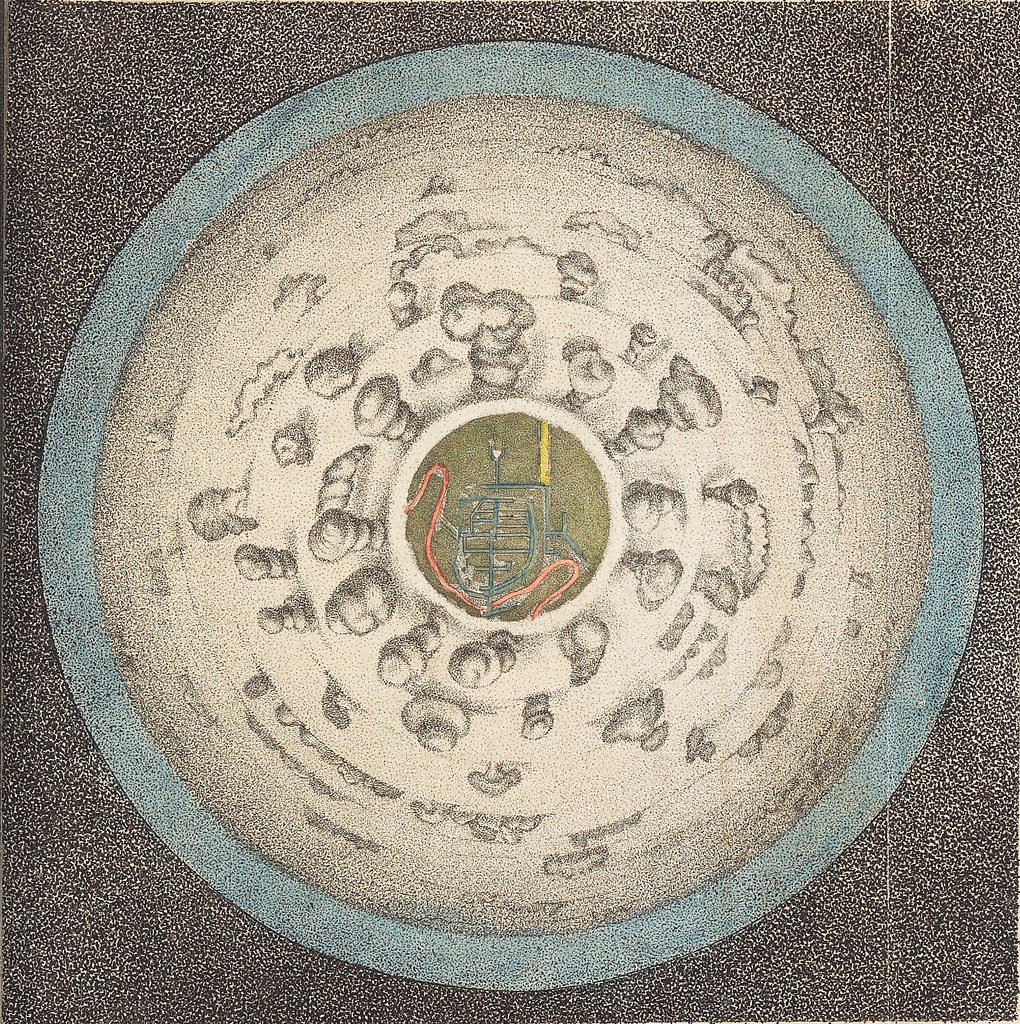
The first image in his Airopaidia, “A Circular View from the Balloon at its greatest Elevation”, departs from established conventions of landscape representation. At a quick glance it resembles an eyeball in its spherical regularity. . . . “The Spectator is supposed to be in the Car of the Balloon, suspended above the Center of the View” (Baldwin:iv). The ground is visible in the “iris”, a central roundel which contains, upon inspection, the plan view of a town and its river. This is Chester, fondly placed at the centre of this entirely new kind of view. The town is framed by a thick “Amphitheatre, or white Floor of Clouds” (Baldwin:iv). Drawing clouds was clearly not one of Baldwin’s strengths.
Baldwin even recommended laying the book on the floor or ground and looking straight down on this picture to understand it.

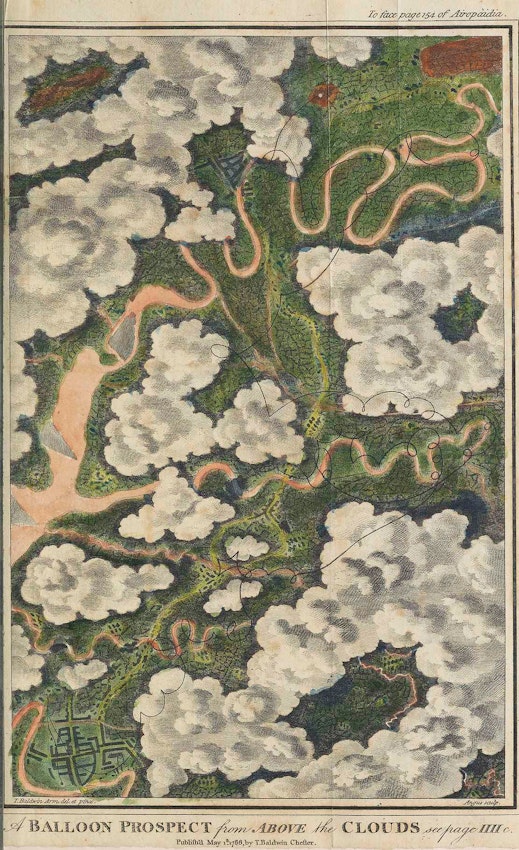
A later image is closer to the aerial views that have become entirely familiar in an age of airplanes and satellites.
The main point of this picture was the path of the balloon over the landscape, as shown by the looping black thread across the landscape.

Indeed, I suspect Baldwin created this image using a map of the area around Chester rather than sketching what he actually saw from the air. Cartographers had actually produced aerial views simply through mental effort.

Wednesday, January 20, 2021

Probing the Tale of Warren and Jeffries

I’ve just shared the two versions of the story of Dr. Joseph Warren sneaking across the siege lines in early June 1775 to try to talk Dr. John Jeffries into heading the provincial medical corps.

Both versions present Dr. Jeffries as a badass: so skilled that Warren was eager to recruit him, so proud that he refused to work under anyone else, so good a friend that he didn’t tell the royal authorities about Warren’s mission until he was dead.

Of course, one of those stories came from Dr. Jeffries’s family, and the other probably did. There’s no version of the tale from Warren’s side, nor any contemporaneous documentation.

Dr. Jeffries’s notes on young smallpox patients on Rainsford Island, now digitized from Harvard’s Countway Library, offer a little more information about this period in his life. I wondered what journal might say about when Jeffries was available to meet Warren on a dock in the North End and/or to treat Bunker Hill casualties on the morning after the battle.

Neither of those possibilities can be ruled out. Jeffries’s first journal entries are dated 6 June, 7 June, 10 June, 11 or 12 June, 14 June, 16 June, and 20 June. (It’s quite possible he missed recording the date of 15 June; his entry for patients after 14 June went through the whole cycle of patients twice before he wrote another date.) Jeffries was probably not on the island on the missing dates, and therefore could have been in the North End one of those nights, and on the Charlestown peninsula on 18 June.

At the same time, the notebook shows us that Jeffries was on Rainsford Island many times in the week before the battle. Rainsford is in the bottom right corner of the map above, well out in the harbor. That distance is why the town put the smallpox hospital there.

If Warren wanted to talk with Jeffries privately, with minimal chance of being taken prisoner, wouldn’t it have been wiser to take a boat from Dorchester out to Rainsford Island?

According to the Jeffries story, they met at the Charleston ferry landing, a place where the British army was patrolling, which Warren could reach only by crossing a river where the Royal Navy had stationed warships. That would be a very risky rendezvous.

Then there’s the question of Dr. Warren making this trip himself. With John Hancock off in Philadelphia, Warren became the presiding officer of the Massachusetts Provincial Congress. He was still on the important Committee of Safety. And as of the afternoon of 14 June, he was being made a major general of the Massachusetts army. Basically, in the late spring of 1775 Dr. Warren was the single most important leader of the New England resistance.

To believe the Jeffries story, then, we have to believe that Dr. Warren decided to risk being captured or killed rather than ask someone else to carry a message into Boston. Which we know people were doing at this point in the siege.

What’s more, Dr. Jeffries wasn’t just an ordinary medical colleague. He had taken an appointment as a Royal Navy surgeon in 1771. So Warren was supposedly putting his life and the cause in the hands of a man who had already pledged loyalty to the enemy military.

Another detail that makes me go “hmmm” appears in the first version of the story. Allegedly on 18 June Dr. Jeffries told Gen. William Howe about how Warren had “ventured over to Boston in a canoe to get information” a few days earlier. Why didn’t the general ask why Jeffries hadn’t mentioned that before? The Crown made a wave of arrests in the days after Bunker Hill, including Samuel Gore, Peter Edes, James Lovell, and John Leach—the latter two on suspicion of being in contact with Warren. Yet Dr. Jeffries supposedly set up a secret meeting with the local leader of the rebellion, kept quiet about it, and wasn’t detained.

To be sure, none of those questions makes Warren’s trip to talk with Jeffries impossible. But the tale seems increasingly unlikely. Much less likely than that Dr. Jeffries, back in Boston after 1790, made up a story for his American-born son about how he’d been friends with the heroic Dr. Warren, who had really wanted him to join the team.

Tuesday, January 19, 2021

“The connection of my father and General Joseph Warren, M.D.”

In 1875, Bostonians were very excited about the Centennial of the start of the Revolutionary War. Naturally, that included the editorial staff of the Boston Medical and Surgical Journal.

People at that magazine asked Dr. John Jeffries (1796-1876), whose father of the same name had grown up in Boston and lived through that war (albeit while supporting the Crown), what stories he’d heard. Those tales were of course secondhand since this man wasn’t born until more than a decade after the war. (He was in fact his father’s third son named John.)

In its 17 June 1875 issue, the Boston Medical and Surgical Journal published the elderly doctor’s reply:
In compliance with your request that I should state what I know of the connection of my father and General Joseph Warren, M.D., with the battle of Bunker Hill, I have penned the following reminiscences derived from statements of my father, who, like Drs. Warren, [Isaac] Rand, and others of that time, had been a pupil of Dr. James Lloyd. . . .

Dr. Warren had sent to my father a message to meet him secretly at midnight at the end of the wharf of the Charlestown ferry. He accordingly met him shortly before the battle of Bunker Hill. Dr. Warren came over in a small boat, with muffled oars. His object was to induce my father to unite with the Continental army as a surgeon. This he urged upon him, offering him great inducements to accept.

The reply was, “I thought, Warren, that you knew me better. I would not take office under anybody. My motto is ‘Aut Cæsar aut nullus [Either Caesar or no one].’”

Warren then said, ”Don’t be so quick, Jeffries, I have a general’s commission in my pocket. We want you to be at the head of the medical service.” The offer, however, was declined.
Yesterday I quoted the much briefer version of the same story that had appeared half a century earlier in Samuel Swett’s history of Bunker Hill. That telling was an adjunct to the story of how Dr. Jeffries had helped to identify Dr. Warren’s body, a topic that the 1875 letter didn’t mention at all.

There are other small differences between the two versions of the story. Did Warren visit Boston to gather information or to recruit Dr. Jeffries? Did he come by “canoe” or in a rowboat with “muffled oars”? Was he expecting to become a major general soon or did he already have “a general’s commission in my pocket”? (Indeed, other sources indicate that Warren never received the official commission that the Massachusetts Provincial Congress voted to give him on 14 June.)

However, those discrepancies seem like the typical signs of a story getting a little more dramatic as it’s retold over the decades.

I think what strains credibility about this tale, in either version, is Dr. Jeffries’s basic claim.

TOMORROW: Crossing the line.

Monday, January 18, 2021

Dr. Jeffries and Dr. Warren

When I started looking at Dr. John Jeffries’s records of caring for young smallpox inoculatees in June 1775, I hoped to find clues to his whereabouts during that month.

For almost two hundred years at least, a story has circulated about Jeffries and Dr. Joseph Warren meeting that June, and it’s always struck me as dubious.

To review, Dr. Jeffries (1745-1819) was son of Boston’s treasurer, David Jeffries, and protégé of Dr. James Lloyd. He thus had strong links to both the town’s Whig establishment and to friends of the royal government. Dr. Jeffries dined with the Sons of Liberty in August 1769, but in November 1770 Lloyd and Jeffries testified for the defense in the Boston Massacre trial. The two doctors described the victim Patrick Carr’s dying words, which helped to absolve the soldiers.

That testimony appears to have put Jeffries in the Loyalist camp. The next year, he accepted a sinecure appointment as a Royal Navy surgeon. He evacuated Boston with the British military in 1776, became a military surgeon, and spent the war either with the Crown forces or in London seeking higher positions.

In peacetime, Dr. Jeffries used his money to become a pioneering balloonist, or at least balloon passenger. But eventually the cost of living in the imperial capital and the lure of an inheritance in Massachusetts sent him back home. He reestablished his family and elite practice in Boston.

In 1825, six years after Dr. Jeffries died, Samuel Swett published his pioneering study of the Battle of Bunker Hill. He wrote this about the identification of Dr. Warren’s body on the morning after the battle, 18 June 1775:
Dr. Jeffries was on the field dressing the British wounded, and the wounded American prisoners, with his usual humanity and skill. [Gen. William] Howe inquired of him if he could identify Warren; he recollected that he had lost a finger nail and wore a false tooth, and informed the general that Warren had five days before ventured over to Boston in a canoe to get information, invited Jeffries to join the Americans as surgeon, and informed him that he was himself to receive a commission in the army.
Swett probably heard that story from Jeffries’s family. It’s certainly complimentary to the late physician, with its superfluous mention of “his usual humanity and skill.” And of course the idea that the heroic Warren had thought enough of Jeffries’s skills to try to recruit him was a ringing endorsement.

TOMORROW: A longer version of the story.

Sunday, January 17, 2021

How Aged Was William Northage?

This evening I came across an example of the importance of checking original documents where possible to confirm transcriptions.

In a 1993 article in the Bulletin of the History of Medicine titled “John Jeffries and the Struggle Against Smallpox in Boston (1775-1776) and Nova Scotia (1776-1779),” Philip Cash and Carol Pine referred to Dr. Jeffries’s 1775 patients on Rainsford Island this way:

These patients range in age from Nancy Hawes who was four weeks old to William Northage who is simply listed as “aged.”
Jeffries’s medical records at Harvard’s Countway Library are currently being transcribed, so we can see his actual handwriting. Note what he wrote next to the name of William Northage in this image’s last entry.
Jeffries didn’t described this patient as simply “aged.” He left space to record an age, as he had for previous names, but never got back to it.

All the other patients Jeffries listed on these opening pages were children, aged from four weeks to ten years. Later in this document, on the dates of 10, 14, 16, and 20 June, Jeffries referred to William Northage by the name Billy. In that time he used pus from Billy Northage’s legs to inoculate his own infant son John. To me all that suggests William Northage was another child rather than an old man.

Billy Northage appears alongside Benjamin Northage, aged six in 1775 and thus identifiable as the Benjamin Nottage baptized in the Brattle Street Meetinghouse in 1769. I suspect Benjamin and William were brothers.

Benjamin’s father, Josiah Nottage (sometimes spelled Nuttage), was a house carpenter who after the war became known for constructing bridges across the Charles and Passaic Rivers. In 1796 Josiah and Benjamin Nottage bought house lots on Phillips Street that eventually became the site of Vilna Shul.

Friday, May 01, 2020

Hutchinson and Adams, Together at Last

Both men would hate that I’m making a combined announcement, but new volumes of the Papers of Thomas Hutchinson and the Papers of John Adams have just been published.

The Colonial Society of Massachusetts is publishing the Thomas Hutchinson Papers, edited by John S. Tyler and Elizabeth Dubrulle.

The latest volume covers the years 1767-1769, including the imposition of the Townshend duties, the arrival of the new Customs Commissioners, the Circular Letter stand-off, the Liberty riot, the arrival of troops, the leak and publication of Gov. Francis Bernard’s letters, the Michael Corbet trial (barely mentioned), and Bernard’s departure. During this period Hutchinson was both lieutenant governor and chief justice of Massachusetts.

I received a printed volume as a member of the society. At some point soon, the text will be available in digital, searchable form on the Colonial Society’s website.

The Massachusetts Historical Society is publishing the Adams family’s papers in several series. On behalf of the editorial team, Sara Georgini just announced volume 18 of John Adams’s correspondence, which covers the months from December 1785 to January 1787.

Adams was then in London as the U.S. of A.’s first minister to the Court of St. James, feeling increasingly frustrated as Britain waved aside the young nation’s interests. A couple of men from pre-war Boston came back into Adams’s life in this period: Dr. John Jeffries and John Singleton Copley, who painted the picture shown above.

I looked at what these volumes said about the relationship between Hutchinson and Adams. The chief justice must have met the young Braintree lawyer in the early and mid-1760s, but Hutchinson left no comment about Adams until after he’d moved into Boston.

The new volume appears to contain Hutchinson’s first surviving remark on Adams, in a 5 Aug 1768 letter to a fellow judge (either John Cushing, Benjamin Lynde, or Peter Oliver):
For news I refer you to Edes and Gill. I am grown callous and all they say about me makes no impression. [James] Otis and the two Adams, [William] Cooper & [Benjamin] Church go regularly every Saturday in the afternoon to set the Press. They all profess a great friendship for me. I wish the whole Court were Pensioners that they might share part of the Obloquy.
The Boston Gazette had recently published an essay criticizing Hutchinson as “the Pensioner” for accepting a salary from the Crown.

Though the lieutenant governor included both Samuel and John Adams among the Whigs who “set the Press” in 1768, going to the print shop appeared to be a curious new experience for John when he wrote about it thirteen months later.

The new John Adams Papers volume takes up five years after Hutchinson’s death, but the American diplomat hadn’t forgotten the late governor. On 27 Jan 1787 he wrote to Benjamin Hichborn about the danger posed by the Shays Rebellion:
I begin to suspect that some Gentlemen who had more Zeal than Knowledge in the year 1770. will soon discover that I had good Policy as well as sound Law on my side when I ventured to lay open before our People the Laws against Riots, Routs & unlawful assemblies—

mobs will never do—to govern states or command armies—I was as sensible of it in 70. as I am in 87—to talk of Liberty in such a state of things–

Is not a [Job] Shattuck & a Chase [Daniel Shays] as great a Tyrant, when he would pluck up Law & Justice by the roots, as a Bernard or a Hutchinson when he would overturn them partially?
Over the nearly two decades in between those letters, Adams had become a lot more like Hutchinson than he’d acknowledge. In both of these collections the writer sighs about all the people criticizing him and warns against mobs.

TOMORROW: A new job for John Adams?

Saturday, July 13, 2019

Harvard Digital Collections from the Colonial Period

Last month the Harvard Gazette featured some treasures from the university’s Colonial North America collection, “approximately 650,000 digitized pages of handmade materials from the 17th and 18th centuries.”

Most of that material consists of manuscripts, but highlighted in this article are:
As I type, the collection’s front page features documents created by Dr. John Jeffries and the Rev. Thaddeus Mason Harris, two men from Revolutionary Massachusetts I don’t fully trust. But I can’t hold that against the university.

This week the university announced the launch of the larger Harvard Digital Collections, which contains the material from Colonial North America. That “provides free, public access to over 6 million objects digitized from our collections—from ancient art to modern manuscripts and audio visual materials.”

What’s more, this is the policy on copyright governing this material:
In order to foster creative reuse of digitized content, Harvard Library allows free use of openly available digital reproductions of items from its collections that are not under copyright, except where other rights or restrictions apply.

Harvard Library asserts no copyright over digital reproductions of works in its collections which are in the public domain, where those digital reproductions are made openly available on Harvard Library websites.
So if a person wanted an image of a certificate of initiation into the African Lodge of Freemasons, signed by Prince Hall, George Middleton, and other officers, one has merely to click.

Saturday, November 12, 2016

A “(Mostly) True” Picture Book Landing Now

On Publishers Weekly’s new list of the best picture books of the year is A Voyage in the Clouds: The (Mostly) True Story of the First International Flight by Balloon in 1785, written by Matthew Olshan and illustrated by Sophie Blackall.

The journal’s review of the book said:
The team behind the The Mighty Lalouche (2013) recounts the first international balloon journey, an expedition across the English Channel undertaken by a British doctor named Jeffries and a French balloonist named Blanchard in 1785. Tension arises even before the balloon leaves the ground as Jeffries discovers that Blanchard is plotting to exclude him from the trip. The two men cold-shoulder each other as the journey gets underway, but when the balloon starts to lose altitude, Blanchard’s heroism turns them into friends and allies. (They’re in their bloomers at the time, and Olshan keeps their rapprochement from getting too sentimental with a hilarious peeing scene.)

The baroque ornamentation and carefully lettered speech balloons of Blackall’s spreads recall the work of George Cruikshank; like him, she has a gift for revealing that people dressed in petticoats and tricorne hats are just as human as the rest of us. With humor that’s never snarky, Olshan reminds readers that, sometimes, the challenge adventurers must overcome is not the elements; it’s their own vanity. Ages 4–8.
Dr. John Jeffries was indeed British at the time of this flight, but he was born and raised in Boston. He had become a Loyalist, serving as a British military physician during the war. In 1789, after tensions had dissipated a bit (and he saw an inheritance in Massachusetts while running out of money in Britain), Jeffries returned to his native town for the latter part of his career.

Deborah Kalb interviewed Olshan about the book, asking in particular about that parenthetical word in the subtitle:
Q: The subtitle describes it as a “(mostly) true story.” What did you see as the right blend of the historical facts and your own imagination?

A: The phrase you singled out from the subtitle—“(mostly) true”—is a source of lively conversation about the book. Roger Sutton of The Horn Book wrote an editorial on this very subject in his blog,…in which he describes the challenge for a reviewer in properly categorizing A Voyage in the Clouds; i.e., can a book that characterizes itself as “mostly true” be considered “non-fiction?”

My story was certainly inspired by the flight of Jeffries and Blanchard; most of the events in the story actually happened as they’re described, as I explain in the Author’s Note. But I did take a few liberties in the interest of keeping young readers engaged.

If a book is to be presented as “non-fiction” or taught in classrooms as “history,” I think an author has a responsibility to volunteer the fact that he has departed from the historical record.

But even a story that hews as closely as possible to historical facts as they’ve been received and strives mightily to represent the “factual” is going to wind up being fiction, to a certain degree, if only by depicting the modern author’s impossible intimacy with his protagonists.

The author can’t have known them, but it’s essential to his “authority” that he seem to have.
For Boston 1775’s intimate retelling of Dr. Jeffries’s voyage with Jean Pierre Blanchard, from all the way back in 2006, start here.

Sunday, January 10, 2016

Dr. Jeffries’s Hat

Last week the anniversary of the first balloon crossing of the English Channel by Jean-Pierre Blanchard and Dr. John Jeffries, a Boston native, got a lot of attention on the web.

There was an article about making a similar journey by Dr. Tom Crouch of the Smithsonian Air & Space Museum, who’s working on a book about Jeffries. His past books include The Eagle Aloft: Two Centuries of the Balloon in America.

And the Houghton Library at Harvard pulled out the hat that Jeffries wore on his first balloon trip and when he had his portrait made. It turns out to be cut from a jaguar pelt.

My father looked at the Houghton material decades back, and he told me it included a fabric sample from the balloon. I didn’t see that when I looked at the documents in the last fifteen years, but I see that’s now a separate collection. Glad it didn’t float away.

My version of the Channel-crossing story from 2006 starts here.

Monday, December 28, 2015

Hannah Adams, Comic Book Heroine

The Massachusetts historian and author Hannah Adams (1755-1831) made an appearance in Wonder Woman, #28, published in 1946. She was the focus of a backup feature called “The Wonder Women of History,” and here it is.

Furthermore, it looks like the same story features a cameo by an (unrecognizable and anachronistically dressed) Dr. John Jeffries. His balloon trip across the English Channel might deserve a comics treatment of its own.

Tuesday, February 09, 2010

Twitter Feed, 30 Jan-8 Feb 2010

  • Brian Donahue to speak Wed, 10 Feb, about farming in Minute Man National Park: www.friendsofminuteman.org/blog/?p=643 #
  • New resource from NEHGS on African-American genealogy: bit.ly/cRpZao #
  • Most New Hampshire state senators are female—but state constitution from 1783 speaks only of "all men." Amendment time? bit.ly/cPxhif #
  • RT @LooknBackward: Newer approaches to writing history by Drake Bennett in BOSTON GLOBE: shar.es/aNNjn #
  • NPR interview about BIRTHRIGHT, history of James Annesley, young heir kidnapped to America in 1700s: bit.ly/9Uyn1l #
  • Profile of Revolutionary Concord tour guide & author Joseph L. Andrews from BOSTON GLOBE: bit.ly/94HrCO #
  • DAR to rededicate recovered plaque on Lexington common on Patriots Day, marking site of Old Belfry in 1775. #
  • RT @BorowitzReport: People talk about an "unruly mob," but is a mob ever ruly? // See 1774 court closings & Powder Alarm in Massachusetts? #
  • RT @lucyinglis: bit.ly/aXiReQ // Did Britain's pioneering obstetricians also murder pregnant women to study their anatomy? #
  • Review of Boston exhibit of Luis Melendez, 18th-c Spanish still life painter: bit.ly/9ga46y #
  • RT @Harvard_Press: Abigail Adams teaches you about e-mailing: bit.ly/9XP8Dc #
  • RT @DedhamHistory: 1733: Eleven prominent men purchase a plot of land to build an Episcopal Church. It won't be constructed until 1758. #
  • RT @bencarp: Video of "Teapot in a Tempest: The Boston Tea Party of 1773 (Part 1)" from Old South on Forum Network [link] #
  • RT @bencarp: "Teapot in a Tempest: The Boston Tea Party of 1773 (Part 2)" on Forum Network forum-network.org/node/23536 #
  • RT @PaulRevere1734: Feb 1764 my family among those visited with Small-Pox, reported to selectmen but would not remove my child to Pesthouse. #
  • New online exhibit about Silence Dogood (aka young Benjamin Franklin) from the Massachusetts Historical Socy: bit.ly/c99bwz #
  • Got to hear C. S. Manegold speak on TEN HILLS FARM at 6:30, but couldn't get to Concord to hear Bill Fowler speak on Newburgh at 8:00. #
  • A redcoat private who escaped from Continental captivity and made it back to the British army for life: bit.ly/9NnH0C #
  • Plan for Boston history museum on Rose Kennedy Greenway loses state support: bit.ly/cYy9PV Tough fundraising time already. #
  • RT @HistoryNet: AmH: America's Worst Winter Ever: Forget Valley Forge. The Morristown winter of 1779-80 bit.ly/bdvYcZ #
  • Beverly church raises $200K for roof by selling Paul Revere ewer: bit.ly/azxssn More detail: bit.ly/5ss13a #
  • David Waldstreicher reviews Michael Kranish's FLIGHT FROM MONTICELLO in BOSTON GLOBE: bit.ly/a9f6HP #
  • .@JBD1: perfect LT profile pic for John Jeffries - is.gd/7Drg1 // For more on Jeffries's adventures: bit.ly/a7B4IV #
  • RT @FakeAPStylebook: When composing the church newsletter, be careful not to confuse 'sexton' with 'sexting.' #
  • Boston Area Early American History Seminar invites paper proposals for upcoming year: bit.ly/b78SqA #
  • RT @magpie: "In The 18th Century" - twlol.com/tw/?v3-30327 #lol // It's hard out there for a baron. #
  • New British literary prize for historical fiction: bit.ly/aqS139 #
  • NEHGS's NEW ENGLAND ANCESTORS magazine to become AMERICAN ANCESTORS. Cuz, like, we rule. #
  • Researching African-Americans in Pre-Civil War New England, lecture at NEHGS, Boston, 24 Feb: bit.ly/99ugl2 #
  • A quick history of Boston's State House dome from Looking Backward: bit.ly/dgKJh7 #
  • Researching early American crime through the Readex newspaper database: bit.ly/bLqi66 #
  • RT @PaulRevereHouse: We've just linked our flickr photostream to our facebook page. bit.ly/d1tt6p #
  • RT @teachinghistory: In a new lesson plan, EdSITEment looks at the founding fathers' views on slavery: bit.ly/bKmCKc #
  • RT @Jurretta: How do today's students do research? Some interesting--and sobering--data: bit.ly/8XjDBK #
  • RT @HistoryNet: America's Disastrous Invasion of Quebec: Washington's plan to invade Canada in 1775 ended in disaster. bit.ly/aDMKAu #
  • RT @wcaleb: UPenn Press announces SHEAR Prize awarded yearly (w/contract) to book manuscript on N. America 1776-1861 bit.ly/ceYPSm #
  • RT @lucyinglis: Princess Serafina: London's First Recorded Drag Artist post.ly/Lfdi #georgianlondon #
  • The word "southpaw" predates organized baseball by about three decades: bit.ly/98cPj8 #
  • RT @history_geek: Me: "I need get these old slides digitized." Undergrad: "Wow, I've never seen one of these before." #
  • Patriots Day pageant in Lancaster, Mass., 1912: bit.ly/9jFiDl #
  • Slowly growing collection of online historical resources about Massachusetts: bit.ly/cuzc0P #
  • Hardcore History podcast considers if violent child-rearing methods contributed to brutal societies: bit.ly/9SqN4q #
  • RT @TJMonticello: Pictures from today's snowstorm at Monticello: bit.ly/cb2iH5 Current temperature in Charlottesville: 17F. #

Monday, February 02, 2009

The Difficulties of Medical Training in 1773

Popular demand indicates that it’s time for another series of CSI: Colonial Boston postings! Which is to say, Revolutionary people mucking about with dead bodies. (The last series started here.)

This image appeared on a broadside printed in 1773 with the title: “An Address to the Inhabitants of Boston (Particularly to the thoughtless Youth) Occasioned by the Execution of Levi Ames, Who so early in Life, as not 22 Years of Age, must quit the Stage of action in this awful Manner.” This was only one of the publications that Ames’s execution inspired. This online exhibit from the Library Company of Philadelphia says:

Levi Ames was perhaps the most written-about criminal in colonial America. His execution called forth two editions of [his] “Last Words,” four sermons in a total of seven editions, and no fewer than ten broadside poems.
So will this posting be about the horrible murders Ames committed, and how the authorities used forensic medicine to track him down? No, Ames was simply a burglar. He was executed for a series of property crimes.

Under the law of the time, the disposal of Ames’s body was up to the governor: Thomas Hutchinson could order the corpse to be buried, hung in chains, or given to a doctor for dissection. According to a letter from William Eustis to John Warren, written shortly after the execution:
You must know that [Dr. John] Jeffries (as we heard) had applied to the Governor for a warrant to have this body. The Governor told him if he had come a quarter of an hour sooner, he would have given it, but he had just given one to Ames’ friends, alias Stillman’s gang.
Stillman was the Rev. Dr. Samuel Stillman, minister at one of Boston’s two Baptist churches. Among the clergymen who preached about the execution, Stillman was the one Ames actually trusted. The condemned man asked the minister to arrange for his body to be buried so no aspiring surgeons could dissect it.

Which is exactly what Eustis and Warren wanted to do. They were recent Harvard graduates who trained in medicine under Warren’s older brother, Dr. Joseph Warren. At college they had been members of a group called the Anatomical Society or Spunkers Club. The other recent graduates Eustis mentioned in this letter to Warren were Jonathan Norwood; David Townsend; Samuel Adams, only son of the politician; and “One Allen,” perhaps Ebenezer Allen. All but one became physicians; Allen became a minister. Apparently these young men were hoping for a surgical demonstration or lecture by Dr. Benjamin Church, Jr.

Meanwhile, Jeffries had the same hopes for using Ames’s body, along with his medical mentor, Dr. James Lloyd, and Lloyd’s current trainee, John Clarke. All those men were friends of the royal government. The Spunkers knew in advance about Jeffries’s group, but not about Stillman’s.

Eustis described what happened to the body:
as soon as the body of Levi Ames was pronounced dead by Dr. Jeffries, it was delivered by the Sheriff [Stephen Greenleaf] to a person who carried it in a cart to the water side, where it was received into a boat filled with about twelve of Stillman’s crew, who rowed it over to Dorchester Point. . . .

We had heard it surmised that he was to be taken from the gallows in a boat, and when we saw him carried to the water, we concluded it was a deep laid scheme in Jeffries. . . .

However, when we saw the Stillmanites, we were satisfied Jeffries had no hand in it. When we saw the boat land at Dorchester Point, we had a consultation, and Norwood, David, One Allen and myself, took chaise and rode round to the Point, Spunker’s like, but the many obstacles we had to encounter made it eleven o’clock before we reached the Point, where we searched and searched, and rid, hunted, and waded; but alas, in vain! There was no corpse to be found.

Discontented, we sat us down on the beach and groaned, etc., etc. Then rode to [Thomas] Brackett’s [King’s Arms tavern], on the Neck, and endeavored to ’nock ’em up, to give us a dish of coffee; but failing, we backed about to the Punch Bowl, where, after long labors, we raised the house and got our desires gratified, and got home about four o’clock in the morning. Hadn’t much sleep, of course, so we are very lame and cross today. . . .

We have a ——— from another place, so Church shan’t be disappointed.
In a postscript Eustis added: “By the way, we have since heard that Stillman’s gang rowed him back from the Point up to the town, and after laying him out in mode and figure, buried him—God knows where! Clark & Co. went to the Point to look for him, but were disappointed as well as we.”

There’s more about Levi Ames at Bill West’s West in New England.

ADDENDUM: A message from Charlie Bahne convinces me that the medical trainees visited the Punch Bowl tavern in what is now Brookline Village.

Thursday, October 18, 2007

Dr. Joseph Warren's Body: the first identification

Today CSI: Colonial Boston enters a three-episode story arc involving the most famous case of forensic medicine during the American Revolution: the identification of Dr. Joseph Warren’s body after the Battle of Bunker Hill. It turns out that, because the doctor kept being buried and dug up again, there were actually multiple identifications.

The first occurred on 18 June 1775, the day after the battle. According to Samuel Swett’s 1818 study, “In the morning young Winslow of Boston, recognised the body of Warren, and announced the fact.” This young man was John Winslow (1753-1819), a clerk in the hardware store of his uncle, selectman Jonathan Mason. It’s not clear to me what he was doing on the battlefield.

Swett continued:

[Gen. William] Howe would scarcely credit the account; it was so improbable that the president of [Massachusetts Provincial] Congress was in the battle.

Dr. [John] Jeffries was on the field dressing the British wounded, and the wounded American prisoners, with his usual humanity and skill. Howe inquired of him if he could identify Warren; he recollected that he had lost a finger nail and wore a false tooth, and informed the general that Warren had five days before ventured over to Boston in a canoe to get information, invited Jeffries to join the Americans as surgeon, and informed him that he was himself to receive a commission in the army.

Warren was instantly recognised, and the enemy declared this victim alone was worth five hundred of their men.
I don’t actually believe all of this. Dr. Jeffries was a Loyalist and army surgeon during the war, and settled in Britain afterward. Having spent a lot of his money on ballooning, he decided to return to his home town of Boston and rebuild his practice there. Jeffries succeeded and became very popular by the end of his life, as Swett’s praise of his “usual humanity and skill” indicates. But I think he’s a slippery character.

In particular, that anecdote about Dr. Warren crossing the Charles River on a canoe on 13 June 1775 seems dubious. Jeffries is apparently the only source for it. And with Warren dead, who could contradict him?

Did Warren really risk being captured by the Crown when he had thousands of men ready to spy for him and Boston was leaking information like a sieve? Would he really have tried to recruit Jeffries, who had been aligned with the Crown for years? Did Jeffries really tell Gen. Howe right after the horrible battle that, oh, by the way, he’d had a secret meeting with the head of the rebellion, but hadn’t bothered to mention it to any royal authorities at the time?

I’m happy to accept that Dr. Jeffries helped to identify Dr. Warren’s body for the British army. As for the other details, who benefited most in the 1800s from a tale that the great Warren had thought so highly of Jeffries’s medical skills as to recruit him for the American army?

TOMORROW: Identifying Dr. Warren’s body again.

Saturday, August 05, 2006

Dr. John Jeffries: physician, Loyalist, aeronaut, part 7

This series of postings, starting with Part 1, has brought Dr. John Jeffries from his early medical practice in Boston to floating across the English Channel on a balloon in January 1785. Jeffries then returned to London, apparently hoping for adulation as a man of science and adventure.

And to some extent his feat was recognized. Jeffries was made a "Baron of the Cinq Ports," a minor honorary title. His position as a fashionable doctor seemed assured. But he didn't receive the financial reward and pension that the French king had given his companion, Jean Pierre Blanchard.

In 1787, at the age of forty-two, Jeffries remarried, to a twenty-two-year-old Englishwoman named Hannah Hunt. They had several children together, though two died sadly young, according to family records: Harriet Maria “smothered" before her first birthday, and Robinson Ardesoif “burnt to death" at the age of five. Some of their other children lived considerably longer, including a John Jr. who also became a doctor and practiced for 57 years until his death in 1876.

In 1789, Jeffries received letters from family in Massachusetts "urging the necessity of his immediately repairing to Boston, to secure some property which had devolved to him by the death of a near relative.” He returned to his native town with his new wife and children. His father, town treasurer David Jeffries, had never left. Even his medical mentor and fellow Loyalist, Dr. James Lloyd, had ridden out the war in Boston. In April 1790, Jeffries decided to stay and become an American citizen.

Within a few years Dr. Jeffries was a popular local physician, respected despite his service with the British military. Local writers accepted his stories of identifying Dr. Joseph Warren's body on Bunker Hill and finding new ways to treat smallpox, though they were often self-serving. The 1801 Massachusetts Register listed Jeffries as practicing on "Franklin-Street, near the Tontine."

As for the small French aeronaut Blanchard, his republican beliefs made his home country somewhat unwelcoming in the 1780s, so he traveled Europe, making the first or early balloon ascents from Frankfurt-am-Main, Hamburg, Nuremberg, Leipzig, Berlin, Breslau, Warsaw, and Vienna. After the French Revolution, the new government in Paris continued the pension that the king had granted the traveler.

On 9 Dec 1792, Blanchard arrived in Philadelphia on a ship from Hamburg, bringing "4200 weight of vitriolic acid." That was, he announced in the newspapers, "the quantity necessary to effect my own ascension, once." He no longer cared for aerial companions. On 9 Jan 1793, Blanchard made the first balloon flight in America, taking off from the grounds of the Walnut Street Prison, as shown in the engraving above.

Samuel Breck, a Boston native who became a businessman in Philadelphia, met both Jeffries and Blanchard. He wrote of their voyage over the Channel:

I have heard the account of this trip from Blanchard given with feelings of asperity that were not reciprocated in my hearing by the doctor. The Frenchman was from some cause or other displeased, and being intent upon revenge took a very public manner of insulting his companion. He employed Fielding, the best coachmaker of Philadelphia, to build him a vehicle that was to go without horses. The machinery that moved it was worked by a man standing on the footboard behind, who by the alternate pressure of his feet set the wheels going and expanded the wings of an eagle, that by constantly flapping them seemed to draw the carriage along by its flight. On the panels of this carriage, which was exhibited in all the large towns in the United States, he caused the doctor to be painted in the balloon, with a bottle of brandy to his mouth, intimating by the motto beneath that without the aid of this Dutch courage his fortitude would have wholly forsaken him.
Jeffries apparently kept his notes and his cool throughout the flight, so this seems to be Blanchard's jealousy about having to share any glory with his patron and passenger.

Blanchard died in 1809 after suffering a heart attack during a balloon ascent. His widow, Madeléine-Sophie Blanchard, became a famous aeronaut in her own right; she died on 7 July 1819 when her hydrogen balloon caught fire and she fell to the Paris street below.

Two months later, on 16 Sept 1819, Dr. John Jeffries died in Boston of, a medical colleague wrote, “an inflammation in his bowels, originating in a hernia, occasioned by great exertions in his first aërial voyage."

Friday, August 04, 2006

Dr. John Jeffries: physician, Loyalist, aeronaut, part 6

Part 5 of this series of postings left Jean Pierre Blanchard and Dr. John Jeffries dangling in their balloon a few yards above the English Channel. They had tossed out all their ballast, their pamphlets, parts of their balloon's car, and their overcoats. But still the balloon descended. The two men put on their cork life jackets and awaited impact.

Then the weather conditions suddenly changed. "Four or five miles from the shore" of France, the balloon started to rise. Soon, Jeffries judged, "We now ascended to a much greater height than at any former period of our Voyage, and exactly at three o’clock we passed over the high grounds between Cape Blanez and Blackness.” The balloon had completed the first aerial crossing of the English Channel, 7 January 1785.

Blanchard tossed out a packet of letters, and the men enjoyed watching it descend below them, "appearing, in its progress, to pass along over inclosures, houses, roads, &c. as if running after us.” In other words, the papers were traveling at the same speed as the balloon when Blanchard dropped them, and their momentum meant they kept traveling horizontally even as they fell vertically. Isn't Newtonian physics wonderful?

Jeffries and Blanchard then discovered a new problem: “from the height which we were now at, and from the loss of our cloaths, we were almost benumbed with cold.” It was January, after all. But that worry didn't last. The balloon began to descend again, and a large forest appeared below. Since it would be too dangerous to come down there, the aeronauts once again looked for things to throw out so the balloon stay up.

Jeffries and Blanchard “cast away one cork-jacket, and soon after it the other,” those "being the only things we had then left, excepting the Barometer." The doctor refused to discard his instrument—not only did it represent his desire to put aeronautics on a more scientific footing, but it was expensive. (He holds it in his portrait in ballooning gear.) Jeffries reported:

I felt the necessity of casting away something, to alter our course; happily (it almost instantly occurred to me, that probably we might be able to supply it from within ourselves), from the recollection that we had drank much at breakfast, and not having had any evacuation; and from the severe cold, little or no perspiration had taken place, that probably an extra quantity had been secreted by the kidneys, which we might now avail ourselves of by discharging. I instantly proposed my idea to M. Blanchard, and the event fully justified my expectation; and taking down from the circle over our Car two of the bladders, for reservoirs, we were enabled to obtain, I verily believe, between five and six pounds of urine; which circumstance, however trivial or ludicrous it may seem, I have reason to believe, was of real utility to us, in our then function; for by casting it away, as we were approaching some trees of the forest higher than the rest, it so altered our course, that, instead of being forced hard against, or into them (as at that instant appeared probable that we should be), we passed along near them in such a manner, as enabled me to catch hold of the topmost branches of one of them, and thereby arrest the farther progress of the Balloon

While Jeffries held the tree branches, Blanchard opened the balloon's valve, slowly letting out hydrogen. Pushing from one branch or tree to another, the men were able "to descend tranquilly to the surface of the ground" in half an hour. They had arrived in "the Forest of Guines, not far from Andres, and near the spot celebrated for the famous interview between Henry the Eighth, King of England, and Francis the First, King of France.” (This meeting was called the Field of the Cloth of Gold. The engraving above depicts Blanchard and Jeffries's balloon over the French countryside.)

In a short time locals arrived, including the Viscount Desandrouin. They provided the aeronauts with enough clothing to keep them warm and invited them to Calais. After recovering, the two men went on to Paris, where French society lavished most of its attention on Blanchard. He had an audience in Versailles with "the King, the Royal Family, the Minister, and other great Officers of State; and received, by Royal Order, a present of 12,000 livres, with a pension annexed of 1,200 livres a year; and as a perpetual memorial of this event, the place where we descended, to be called in future the Canton of Blanchard.”

Jeffries returned to England and published his account of the trip, which I've been quoting. He closed by noting he had been made "a founder and perpetual Member" of the new museum in Paris and an honorary citizen of Dover. Then he assured his readers that the “approbation…of his countrymen” will be “full compensation for those honours and rewards the French Court have partially bestowed on their Countryman." Hint, hint, hint.

Did Dr. Jeffries get the honor and rewards he was hoping for? See Part 7.

Wednesday, August 02, 2006

Dr. John Jeffries: physician, Loyalist, aeronaut, part 5

After their first flight together, in November 1784, Boston-born Loyalist Dr. John Jeffries and French balloonist Jean Pierre Blanchard set their sights on an aerial voyage more spectacular than any yet attempted: crossing the Channel from England to France.

Such a long voyage, largely over water, would be the most daring feat in the young science of aeronautics. With Britain and France at war until the beginning of 1783, showing that it was possible to cross silently from one country to the other carried military implications. And whoever survived such a flight would gain tremendous international glory—not a small consideration for men like Jeffries and Blanchard.

In Dec 1784, Jeffries returned to London to write an account of their first balloon trip, and no doubt to the plaudits of British society. He had agreed to pay Blanchard's expenses in assembling a new balloon and filling it with hydrogen gas in Dover. The two aeronauts traveled to that southern English town on the 17th. Almost immediately, cracks began to appear in the partnership. Jeffries suspected Blanchard of trying

to prejudice the minds of some of the principal Gentlemen of the County of Kent, and of the City of Dover, insinuating, that from the incapacity of the Balloon it was madness to attempt the experiment with two persons, unless the Balloon could carry an hundred pound weight of ballast. The pretended friends of M. Blanchard, his Countrymen, publicly circulated such reports of my having declined the enterprize...
At a weigh-in to determine how much the balloon would have to carry, Blanchard wore "a concealed heavy girdle" to increase his weight, trying to leave no room for the doctor.

The Governor of Dover Castle sat down with both men to clarify their (written) agreement. It became clear that Jeffries, who was paying the bills, was willing to travel without Blanchard if only one man could go. From then on, the little Frenchman stopped talking about the balloon being too small for two men.

The morning of 7 January 1785 "was remarkably fine, clear, and serene, but with intense frost"—the first day that seemed right for the launching. The team watched the clouds, smoke from Dover Castle, a kite, “a paper Montgolfier, and a small gaz balloon”—all of which indicated wind blowing across the Channel. After noon, the balloon was filled, dragged to the cliffs of Dover, and attached to the car and Blanchard's useless wings and oars. The two men climbed in, and the balloon took off at 1:00. There were crowds not only on land, but also salutes from ships in the sea below.

The balloon soon rose high enough for Blanchard and Jeffries to be able to see both England and France as the car twirled. However, it was also traveling slowly eastward—not the best direction. Gradually the wind shifted to carry the balloon toward France, and the two men turned their attention to attaching their flotation devices—inflated animal bladders—to the hoop between the car and balloon. But at 1:50, Jeffries realized, “having, I judge, been too inattentive to the state of the tubes...we were descending fast.” They were about a third of the way across the Channel.

The men tossed out a sack and a half of ballast, and the balloon rose again—for a while. Soon they had to toss out “the remaining sack and a half of ballast, sacks and all," followed by all the pamphlets Blanchard had brought to toss out over his native land. Jeffries recalled
We had not now any thing left to cast away as ballast in future, excepting the wings, apparatus, and ornaments of the Car, with our cloaths, and a few little articles; but as a counterpart to such a situation, we here had a most enchanting and alluring view of the French coast, from Blackness and Cape Blanez to Calais, and on to Gravelines, &c.
At 2:30—
the Balloon did not appear to be three-fourths filled with gaz. We immediately threw out all the little things we had with us, such as biscuits, apples, &c. and after that one of our oars or wings; but still descending, we cast away the other wing. . . . I now succeeded in attempting to reach without [i.e. outside] the Car, and unscrewing the moulinet, with all its apparatus; I likewise cast that into the sea.——Notwithstanding all which, the Balloon not rising, we cut away all the lining and ornaments, both within, and on the outside of the Car, and in like manner threw them into the sea; after which, we cast away the only bottle we had taken with us, which in its descent appeared to force out a considerably steam like smoke, with a hissing or rushing noise; and when it struck the water, we very sensibly (the instant before we heard the sound) felt the force of the shock on our Car; it appearing to have fallen directly perpendicular to us, although we had passed a considerable way during its descent.
Despite thinking of himself as a gentleman of science, Jeffries was apparently surprised by seeing Newton's laws of motion in action.

But still the balloon kept falling. It was only three-quarters across the Channel, and below the level of the French cliffs.
We were obliged, though very unwillingly, to throw away our anchors and cords; but still approaching the sea, we began to strip ourselves, and cast away our cloathing, M. Blanchard first throwing away his extra coat, with his surtout; after which I cast away my only coat...
The emphases are Jeffries's, making a point that Blanchard brought more heavy clothing than he did. Meanwhile, the water was getting closer.
...and then M. Blanchard [tossed away] his other coat and trowsers: We then put on and adjusted our cork-jackets [i.e., life jackets], and prepared for the event.
That event comes in Part 6.

Tuesday, August 01, 2006

Dr. John Jeffries: physician, Loyalist, aeronaut, part 4

The first of this series of postings described how Dr. John Jeffries is sometimes called the first American to fly, even though he didn't see himself as an American at the time, but rather as a loyal British subject. It was 30 Nov 1784, and Jeffries and the French balloonist Jean Pierre Blanchard had just taken off from the Rhedarium Garden in London, as described in yesterday's posting.

Dr. Jeffries thought that the early reports of aerial voyages lacked scientific rigor, with balloonists describing their feats and their sensations rather than measuring the atmosphere objectively. Therefore, he had equipped Blanchard's hydrogen balloon with some of the most advanced instruments available:

  • thermometer, for measuring temperature
  • barometer, for measuring air pressure (which, of course, varies with altitude as well as weather)
  • hydrometer, for measuring humidity
  • electrometer, for measuring electrical activity
  • timepiece
  • compass
  • telescope
  • thin ribbon, with scissors and knife for cutting it, to throw out and see whether the balloon was going up or down
  • several small glass bottles filled with distilled water and sealed
  • a "little dog"
  • a notebook and silver pencil, which he judged to be less likely to be affected by the thin air than either a pen or an ordinary pencil.

One of the aeronauts' first experiments, however, was to try Blanchard's invention of oars, wings, and rudder to steer the course of the balloon. (This apparatus appears in the illustration above.) Blanchard had a good idea, in theory: being to direct the course of a balloon would make it much more useful for transportation and warfare. However, the force of wind on a large balloon was far stronger than anything two men could counteract with artificial wings. Jeffries still insisted the experiment was a success:
M. Blanchard applied himself to the oars, which he had made some experiment of on our first ascent, and which (though inadequate to the government of the Balloon) appeared to me very materially to influence the course, ascent, and progress of the Balloon; and with which we could, by acting with but one oar or wing, always turn round the Car and Balloon.
In other words, the men found they couldn't steer their balloon, but could twist in the wind.

Jeffries noted down many measurements of the thermometer, barometer, and hyrdrometer. As to the electrometer, he wrote that its indicator "Though frequently attended to, I never observed to be any ways affected" by the altitude. By pulling the stoppers of the little glass bottles, he filled them with air from the various altitudes, then sealed them up again. He also tried to track the path of the balloon. For instance, at 2:59 PM:
we passed over what appeared to me to be a pavement; but which, upon examining with my prospect-glass, I was surprized to find, were the tops of a forest or wood. . . . Mr. Blanchard threw out a few more of his pamphlets; and I, at this time, amused myself in writing four cards, addressed to some friends; each of which I attached to an handkerchief, and at different periods afterwards cast out of the Car; and have since had the pleasure to know, that three of them were taken up at different places, and kindly forwarded, and received by those to whom they were addressed. . . . The extensive grounds of a Callico-Printer, covered with cloths of various colours, at my first observing it, appeared like a bed of tulips, which, when I remarked to M. Blanchard, he was struck with the same idea.

At about 3:20, the balloonists began to suffer from the cold, as did the dog. The men prepared to descend: "we untwisted both tubes of the Balloon, (through which it had been filled with gaz) and put them without-side of the Car, and opened the valve, to ease the Balloon, and to favour our descent.” But after five minutes, the temperature rose back into a comfortable range, and they decided to continue their journey. “We now refreshed ourselves with cold chicken, and drank a few glasses of wine to the health of our friends below us.” The balloon passed over Dartford and Crayford. Blanchard and Jeffries then decided that they had let out too much gas and might land in the river below. The doctor wrote, "We then threw out every thing except my instruments and our cloaths; and though this visibly checked our descent, yet it had no effect on our motion, in a right line for the River.” I must note that his account never mentions the little dog after this point.

The landing was rough:
At about 50 minutes past three, we cast out one of the anchors, or grapnels, and in two minutes after, the second, which as soon as it touched the surface of the earth (the cords by which they were attached to the net over the Balloon being 50 yards in length) checked us so far, that we struck the ground lightly, but rebounded; and ascending again, we opened the valve; but passing between the tops of some trees, they forced off, and carried away from the Car, our moulinet, with one of the oars or wings; indeed we met with such resistance, as to break off many of the twigs and berries, and to force some of them into my cloaths, pockets, &c. I caught hold of the limb of one of the trees, in hopes of stopping our motion, but was unable to do it; and was forced, after exerting my utmost efforts, to let it go. . . . As soon as we had passed the trees, the wind blowing fresh, our anchors were every minute taking the ground, so as to check us, and then giving away, so that we alternately fell and rose; when a man, by hard running, got hold of one of the cords of our anchors, but could not stop us: On which we opened the valve as far as it was possible, and kept it open until several persons coming up with us, and seizing hold of both the anchor cords, stopped our progress; and we alighted exactly at 59 minutes after three, in a marshy piece of ground, within a few yards of the River.

Legend says that a couple of years before some French farmers had attacked and destroyed a balloon that landed in their neighborhood, thinking it was a demon, but by this point ballooning had apparently been publicized enough that the English farmers knew what they had witnessed. The locals who had helped bring down the balloon were very excited, "asking thousands of questions." Jeffries found "a few bits of chicken, and morsels of bread" in the car; "I, at their urgent requests, divided it almost into atoms among them; every one being eager to get some of that food, which they had seen literally descend from the clouds.” Jeffries himself needed “a bowl of warm tea” to recover his equanimity, though his arms remained sore “for a day or two afterward.”

Blanchard and Jeffries soon began planning for a second, even more impressive voyage: the first aerial crossing of the English Channel. (Take off to Part 5.)

Monday, July 31, 2006

Dr. John Jeffries: physician, Loyalist, aeronaut, part 3

Part 1 of this series of postings introduced Dr. John Jeffries, who, despite his family ties to Boston's establishment, became a Loyalist. Part 2 described his frustrated attempts to lobby for a higher post in London. In Feb 1783, George III officially declared his war with the new U.S. of A. over, leaving Jeffries in London as a Loyalist exile, a doctor with, apparently, a steady practice but no way to fulfill his ambitions for something greater.

Then, in June, the Montgolfier brothers launched their first large balloon in Paris. A series of technological advances quickly followed: a flight with animal passengers in September, a flight with human passengers in November, the first human flight with a hydrogen balloon in December. A small, energetic, and egocentric Frenchman named Jean Pierre Blanchard (shown above) started to imagine ways that such balloons could be steered in flight. Already republican in his politics, Blanchard thought he would find more patrons outside France, so he went to England.

The first balloon flight in Britain was performed by Vincent Lunardi in September 1784. The 18th-Century Reading Room blog offers his own account. Dr. Jeffries was intrigued. Seeing himself as a man of science, he saw a flaw in all the previous aerial voyages. Jeffries felt that ballooning could “lead…to a full investigation of the nature and properties of the atmosphere," but that published accounts of aerial voyages so far showed that the balloonists'

principal attention was turned to the facility and safety of an ascent; to the prospects below them, in their elevated situation; to the effects which so sudden a change of situation and air, might have on them personally; and to the power of ascending at pleasure, and with safety.
He wanted to put aeronautics on a more scientific, less subjective footing.

Jeffries therefore approached Blanchard with a proposition: that two men should go up together, one attending to the balloon and the other to scientific instruments and observations. Blanchard, it became clear, hated to share any glory, but he needed a patron. He was a hydrogen balloonist, as opposed to a hot-air balloonist. With modern chemistry still in its infancy in the 1780s, scientists weren't sure what exactly distinguished these two forms of buoyancy. But it was clear that hydrogen balloons went higher and stayed up longer than the Montgolfiers' early hot-air balloons. It was also clear that launching a hydrogen balloon was terribly expensive: one needed large amount of sulphuric acid and iron filings to mix and release enough hydrogen gas. And the more men and equipment the balloon had to lift, the more hydrogen was necessary.

Blanchard therefore suggested a deal. As Jeffries later wrote:
I accordingly made application to M. Blanchard to indulge me with a feat with him in his next intended voyage; which indulgence I could not obtain of him, but in consideration of one hundred guineas presented him for that purpose.
The hundred guineas was a large sum, but not the full cost of the voyage. For more money, Blanchard planned to sell tickets to the launching.

The need for a large audience, however, produced another obstacle—crowds had torn up the spectator areas when other balloons didn't take off for reasons of bad weather, not enough gas, rips in the fabric, &c. As Jeffries described it:
The disorder and mischief occasioned by two unsuccessful attempts, and the damage thereby done to individuals in their property, had made every one who had grounds of their own, or at their disposal, suitable for such an exhibition, in or near the metropolis, resolve against granting the use of them, on almost any consideration; and more than four weeks were lost in fruitless solicitations for a proper place to ascend from. . . . these disappointments were heightened by reflections on the season of the year; the small portion of day-light, which could at best be afforded us; the variableness of the weather...
Time was running out for Blanchard and Jeffries.

Finally, the pair found a location at the Rhedarium Garden in London. They scheduled their ascent for Monday, 29 November, but that day proved “uncommonly tempestuous.” The next morning they tried again. “The operation of filling the Balloon was not begun until after eleven o’clock," which was the time Jeffries hoped the balloon would be full; "it was not until after two o’clock that we began to fasten the Car to the Balloon.” The men sent up a small balloon to gauge the direction of the wind—east southeast. At 2:34 PM, the balloon lifted the car over the railing of the inflation apparatus; men pulled it down to the launch area, and Blanchard and Jeffries climbed in.

Having loaded his equipment, Jeffries reported:
we attempted again to rise; but still with cords in the hands of people on the ground: But finding that we had too much ballast in proportion to the gaz in our Balloon, after alighting for a moment, on the pent-house of the stables, on the north side of the Rhedarium, and falling off towards the west end so near, as almost to touch the buildings, M. Blanchard threw out the remaining part of our sand ballast, on which we again rose; when, after striking against the top of a chimney with so much force, as to beat off the earthen tunnels on it, (which accident, I imagine was occasioned by the wind suddenly acting on the Balloon as it first arose above the Buildings, and before it had acquired a situation to be acted on equally as to its course, or its full velocity of ascent)—at 38 minutes after two, we rose above the reach of any further terrestrial obstructions.
At last Dr. John Jeffries was flying. (See Part 4 for whether he came down.)