J. L. BELL is a Massachusetts writer who specializes in (among other things) the start of the American Revolution in and around Boston. He is particularly interested in the experiences of children in 1765-75. He has published scholarly papers and popular articles for both children and adults. He was consultant for an episode of History Detectives, and contributed to a display at Minute Man National Historic Park.

Subscribe thru Follow.it


•••••••••••••••••


Showing posts with label Jacob Bates. Show all posts

Tuesday, February 20, 2024

“The Art of Horsemanship in all its different branches”

As I wrote yesterday, by 1781 a man named Jacob Bates was living north of Philadelphia and breeding horses.

Was this the same Jacob Bates who had visited Philadelphia, New York, Boston, and Newport in 1772 and 1773, exhibiting feats of horsemanship for paying audiences?

Starting in mid-1785, a man named Pool advertised similar equestrian exhibitions in Maryland, Pennsylvania, New York, Massachusetts, and Connecticut. I’m looking into Pool, and what I’ve found so far is surprising enough that I have to pause to catch my breath. I hope to tell you soon.

What’s important to this story is that in August 1785 Pool came to Philadelphia and erected “a MENAGE, as a very considerable expence.” It stood “near the Centre-House,” a prominent tavern. Back in 1772, folks could buy tickets for Bates’s shows at the same Centre-House.

Bates had used the same term for where he showed his horses, spelling it “Manage.” Strictly speaking, it meant a riding school rather than a theater, but of course he wanted to elevate his craft.

Pool moved on from Philadelphia. It looks like he was in New York at the end of September 1785, and in 1786 in Boston and New York again.

On 28 Apr 1787, a year and a half after Pool’s departure from Philadelphia, Jacob Bates announced that he was starting a riding school:
The MENAGE
At the Center-House will be Opened on the 7th day of May, by the subscriber, for the instruction of Ladies and Gentlemen in that manly, useful and healthy exercise, the Art of Horsemanship in all its different branches: as he had the honour of instructing several Gentlemen 6 years ago, and likewise last summer, he hopes the pupils that may in future come under his care, will not find the least reason to complain, either of his abilities or attention.

The days of exercise will be on Monday, Wednesday and Friday, for the Gentlemen; and in order that business may not be interrupted, nor Gentlemen incommoded with the heat of the day, he proposes to begin each morning at 4 o’clock and close at 8 o’clock.

JACOB BATES.

N.B. Ladies will be attended to on the other three days.
I don’t think there’s any way to know if Pool’s “MENAGE” had stayed up until Bates started to use it, or if Bates had to rebuild from scratch. But the fact that the two men referred to the same spot is probably why some authors say Bates took over or even rented Pool’s establishment.

Back in 1772, Jacob Bates didn’t sell horseback riding lessons, however much he hinted that his equestrian displays were instructive. But perhaps he was getting too old for those tricks, and genteel riding lessons looked like an easier way to make money.

It looks like the riding school didn’t last more than a season, however, and Bates went back to his property in the Northern Liberties.

In September 1788 Bates advertised the auction of the Richard Hopkins estate in the Independent Gazetteer. However, on 26 Nov 1789 the sheriff advertised the same estate for sale, apparently having seized it under a prior writ.

Nonetheless, Bates was still out at Point-no-Point in July 1792 when he offered an “Eight Dollars Reward” for the finding “a Negro boy named RICHMOND, about eighteen years of age.” Bates stated: “he may pretend to know something of breaking, riding, and taking care of horses as he has seen something of it.” Presumably young Richmond’s experience working with horses for Bates was precisely why Bates wanted him back.

Finally, on 18 Mar 1793 Johoshaphat Polk and Philip Redman advertised the settlement of “the Estate of Jacob Bates, late of Point-no-Point, deceased.” If this Pennsylvanian was indeed the man who had toured colonial ports showing of his riding skills in 1772–73, he had returned to the continent and died as an American.

Monday, February 19, 2024

The Return of Jacob Bates?

You thought I was done with Jacob Bates when we saw him off to London four days before the Boston Tea Party.

However, in The Circus: Its Origin and Growth Prior to 1835, Isaac J. Greenwood wrote:
…he is said to have been conducting a riding-school in Philadelphia after 1786.
Incidentally, Greenwood also published on his ancestor John Greenwood and early American naval hero John Manley.

S. L. Kotar and J. E. Gessler echoed that report in The Rise of the American Circus, 1716–1899, stating:
Bates returned to Philadelphia in 1787 and rented an equestrian building from Thomas Pool and established a riding school.
I’m not completely convinced this man in Pennsylvania was the same Jacob Bates who billed himself as an equestrian before the war. He did display horses, but as a breeder rather than a performer. He did offer riding lessons, but didn’t promise any special tricks. But maybe he was getting too old for that stuff.

The name of Jacob Bates appears in the city of Philadelphia’s roll for the “effective supply tax” in 1781 and 1782, even before the formal end of the war. This Bates’s property in the “Northern Liberties,” north of the city, was valued at somewhat over £900. In 1781 the entry just below Bates was “for Thomas Hopkins’s,” and in 1782 it was “Robert Hopkins.”

The next sign of Jacob Bates that I’ve found is an advertisement in the Pennsylvania Packet on 30 Apr 1782:
ECLIPSE,
A beautiful high-blooded bright-bat STALION, will COVER this season, at Point-no-Point, on the Farm late the property of Robert Hopkins, deceased.

HE is full 15 hands high, entirely free from blemish and well marked, bread from Fearnought and Herod, and out of a Juniper Mare; for beauty, carriage and speed ’tis supposed that no horse on the continent excels him, now rising five years old, and in fine order. His Pedigree will be given to those who send their Mares.

The Price is FIVE POUNDS for each Mare and a Crown to the Groom.

Good Grass and careful Attendance given to the Mares on the Farm. The Money to be paid before they are taken away.

JACOB BATES.
April 6.

He will be shewn on Market-days (if the weather proves fair) at the Coffee-house.
Bates advertised Eclipse at much greater length on 12 Apr 1785. Later that month he offered to sell a mare named the Ulster Lass. In 1789 he offered the stud services of Atlass, the Ulster Lass’s colt.

Point-no-Point was a spot on the Delaware River north of Philadelphia. John Adams rode out there in 1777 and wrote home:
The Road to Point No Point lies along the River Delaware, in fair Sight of it, and its opposite shore. For near four Miles the Road is as strait as the Streets of Philadelphia. On each Side, are beautifull Rowes of Trees, Buttonwoods, Oaks, Walnutts, Cherries and Willows, especially down towards the Banks of the River. The Meadows, Pastures, and Grass Plotts, are as Green as Leeks. There are many Fruit Trees and fine orchards, set with the nicest Regularity. But the Fields of Grain, the Rye, and Wheat, exceed all Description. These Fields are all sown in Ridges; and the Furrough between each Couple of Ridges, is as plainly to be seen, as if a swarth had been mown along.
That was prime farmland, near the country’s largest city. The area is now the part of Philadelphia known as Bridesburg.

TOMORROW: Menage à deux?

Tuesday, December 12, 2023

The Departure of Jacob Bates

On 12 Dec 1773, two and a half centuries ago today, the equestrian Jacob Bates left America.

We know this from a couple of newspaper items published the next day.

The Boston Evening-Post:
Yesterday Morning sailed for London the Brig Dolphin, Capt. Scott, in whom went Passengers, Mr. Nathan Frazier, Merchant; Capt McKenzie, of Newbury; Mr. Bates, who lately performed the Feats of Horsemanship here) and Doctor John Sprague, jun.
The Boston Post-Boy:
Yesterday Morning sailed for London, the Brig Dolphin, Capt. James Scott, with whom went Passengers, Mr. Nathan Frazier, Merchant, Doctor John Sprague, jun. and Mr. Jacob Bates, the famous Horseman.
That second report is the only time that American newspapers mentioned Bates’s first name, as far as I found. That’s how we can link this Bates to the Jacob Bates who performed in Europe, shown above.

Capt. Scott regularly sailed from Boston to London for John Hancock. Back in November he had arrived with news of four tea ships on their way, and he was leaving just before the resulting crisis was resolved.

Bates’s departure was notable enough to be reported in the Connecticut Gazette. And months later another performer invoked his name in the 16 July 1774 Providence Gazette:
HORSEMANSHIP,
By Christopher H. Gardner,
The original American Rider, who will perform, on one or two Horses, on Tuesday the 26th Instant, all the Parts which were exhibited in America by the celebrated Mr. Bates, in several of which Parts it is allowed by good Judges he fully equals, or rather exceeds, any thing of the Kind ever performed on this Continent.

N.B. Notice will be hereafter given of the particular Place and Hour of riding.

Providence, July 16, 1774.
Clearly Bates, having performed in Philadelphia, New York, Boston, and Newport, had left his mark on the continent.

Tuesday, November 14, 2023

“The famous Jacob Bates hath lately exhibited here”

We last left the equestrian Jacob Bates as he arrived in Newport, having already exhibited his skills in Philadelphia, New York, and Boston.

As I noted then, Bates didn’t advertise in Rhode Island newspapers the way he’d done in those other cities. Thus, we don’t have that sort of evidence about his shows.

But we do have a description written on 14 Nov 1773, 250 years ago today, in a letter by the lawyer William Ellery (1727–1820, shown here):
But I cannot bid you adieu in this solemn manner. Totus mundus agit histrionem. [The whole world’s a stage.] The famous Jacob Bates hath lately exhibited here his most surprising feats of horsemanship, in a circus or enclosure of about one hundred and twenty feet in diameter, erected at the east end of Mr. Honyman’s field. The number of spectators was from three to seven hundred. He exhibited four times, and took half a dollar for a ticket.

A mountebank doctor, who lately came into America from some part of Europe, (Great Britain, I believe,) and who is expected here, is now haranguing daily, from a wagon, to the good gaping people of Connecticut, and, while they are gaping, he is picking their pockets. Strolling players we have had among us. I expect that, in a few years, Drury Lane and Sadler’s Wells, &c., will be translated into America.

I wish, while we are encouraging the importation of the amusements, follies, and vices of Great Britain, America would encourage the introduction of her virtues, if she have any; for I am sure, by thus countenancing her follies and vices, we shall lose the little stock of virtue that is left among us. This I am very clear in, that exhibitions of players, rope-dancers, and mountebanks, (I must confess, indeed, there is something manly and generous in the exhibitions of Mr. Bates; for a well-formed man, and a well-shaped, well-limbed, well-sized horse, are fine figures, and in his manage are displayed amazing strength, resolution, and activity,) have a more effectual tendency, by disembowelling the purse, and enfeebling the mind, to sap the foundations of patriotism and public virtue, than any of the yet practised efforts of a despotic ministry. But it will be in vain to talk against these things, while there are a hundred fools to one wise man.
Like the person who wrote to the Boston Evening-Post quoted here, Ellery saw Bates as the sort of London showman that good New Englanders should beware of. Yet he also viewed that particular equestrian act as better than other theatricals. Indeed, he appears to have enjoyed the spectacle.

The “Mr. Honyman” who provided land for Bates’s display was probably James Honeyman, Esq. (1710–1778), a prominent lawyer and broker of marine insurance. His namesake father had been rector of Newport’s Trinity Church. In the early part of his career Honeyman was elected to various offices, including Rhode Island attorney general. By this time, however, he held royal appointments instead since he leaned toward the Crown in politics. During the war Honeyman resigned his remaining government posts and tried to sit out disputes.

William Ellery himself went on to represent Rhode Island in the Second Continental Congress, arriving just in time to vote for and sign the Declaration of Independence and remaining until 1785.

Wednesday, October 25, 2023

Jacob Bates Finds New Pastures in Newport

On 25 Oct 1773, two and half centuries ago, the Newport Mercury reported:
Last week Mr. Bates, the famous horseman, arrived in town, from Boston, and ’tis supposed he will perform this week.
Jacob Bates may have planted this item with printer Solomon Southwick, but it’s more tentative than his usual style.

When Bates arrived in New York and then Boston, he took out long advertisements proclaiming his skills, his triumphs in Europe, and exactly when locals would have the fortunate opportunity to see him perform.

But no such advertisements appeared in the Newport newspapers, not even little ones. Was he out of money? Or did he not need to advertise in Rhode Island because there was already plenty of interest in horsemanship—as reflected in this newspaper item?

Southern New England was known for producing horses. Since the late 1600s, Rhode Island’s governors usually listed horses first on their lists of the colony’s exports. The principal market was the sugar islands in the Caribbean, where the animals provided power for planting and refining as well as transportation.

In 1715 the governor of Barbados complained about how French and Dutch colonies had come to rival his island in producing sugar “owing to the great Supplies of Horses they receive from New England.” In 1729 a British merchant claimed that New England captains had told him they didn’t have to pay fees on French islands as long as they arrived with sixty horses. Two years later, British Caribbean planters asked Parliament to forbid the sale of horses outside the empire, but the mainland traders managed to head off that legislation.

Rhode Island was also a center of horse racing. The Rev. James MacSparran wrote in America Dissected (1753) that Rhode Island’s “fine horses…are exported to all parts of English America. They are remarkable for their fleetness and swift pacing, and I have seen some of them pace a mile in little more than two minutes, a good deal less than three.” Eventually these horses would be recognized as Narragansett pacers.

Thus, in moving his equestrian exhibitions from Boston to Newport, Jacob Bates was shifting to a smaller town but perhaps finding more appreciative audiences.

Wednesday, October 18, 2023

“This Day Published…Mr. Bates and his Horses”?

Two hundred fifty years ago today, on 18 Oct 1773, the Boston Post-Boy published this advertisement:
THIS DAY PUBLISHED,
And to be SOLD at the New Printing-Office
in Hanover-street, Boston,
A Pamphlet, entitled,
Mr. Bates and his Horses,
Weighed in the Balance.

In which is shewn, with great Brevity, that his Exhibitions in Boston, are impoverishing, disgraceful to human Nature, and downright Breaches of the Sixth Commandment.

OH BE A MAN! Young.
This was very similar to the advertisements that had appeared back on 27 September, as previously quoted. The big difference is that the first ad had started, “In a few Days will be published…”

The 17 October was even more similar to an ad in the Post-Boy on 4 October, and again on 11 October. In fact, those three notices were all identical. And they all said that “Mr. Bates and his Horses” was published that day. The text never shifted over to say “Now available” or any other phrasing to indicate the pamphlet was already off the press.

Combined with how no printed copy of “Bates and His Horses Weighed in the Balance” has survived, nor any mention of it in writings of the time, that repeated advertisement raises the question of whether that screed was actually ever printed.

Nathaniel Mills and John Hicks, printers of the Boston Post-Boy since April, could have sold ad space for a certain number of weeks and kept the type in place for each new issue of the paper until that time ran out. If they didn’t hear from their client about updating the wording, they had no strong motive to quibble with it.

On the other hand, Joseph Greenleaf, proprietor of the printing office on Hanover Street, would probably have wanted some payment before investing time and paper in the pamphlet. With Jacob Bates heading out of town in early October, public interest in his moral standing probably dried up.

But we can’t be sure. Perhaps some author really had a lot to say about Bates’s equestrian exhibition and did pay to have it printed, only for no one else to care enough to preserve the result. People could always find a use for scraps of rag linen paper.

Wednesday, October 11, 2023

“For the further amusement of the Town”

On 11 Oct 1773, 250 years ago today, Jacob Bates ran his last advertisement in the Boston newspapers.

It appeared in the Boston Post-Boy, repeating his announcement in the 7 October Boston News-Letter that his performance at 2:00 P.M. on the 12th would be his last in town. Unless it rained. In which case, he’d perform “the first fair Day after.” But that would be “Positively the last Time here.”

That same day, Thomas and John Fleet at the Boston Evening-Post ran this item sent in by a reader (and set in small type to fit it all in):
Messi’rs FLEETS,

AS the extraordinary feats of Horsemanship now performing here by Mr. Bates, has much engrossed the attention of the Town; please to insert, for the further amusement of the Town, the substance of an Advertisement to be seen in the London Ledger of last July, relative to the more astonishing Performances of the famous Mr. Wildman,

“who lets any Person in company cut off the Head of a living Cock, Hen, or other Fowl, and he will immediately join the Head to the Body again in the presence of the company, and the Fowl shall be alive and perfectly well as before the operation—

He will likewise exhibit many astonishing Performances with his Oriental Caskets, and several Pieces of new invented Machinery—

He tells the Ladies and Gentlemen Thoughts by several methods never attempted by any other Person—

He puts a Piece of Money into a Lady or Gentleman’s hand, and takes it away without their knowledge, let them hold it ever so fast—

And fifty other different astonishing Deceptions with Cards, Money & Watches, that cannot possibly be inserted in his Bill.—

He concludes with his much admired exhibition of Bees, when he will command them the leave the Hive, and settle on any Gentleman’s Handkerchief, Sword, Cane, or any other part the Company shall request; from thence he will order them to settle on his naked arm, representing a swarm of Bees on the Boughs of a Tree; he will then remove them from his Arm to his naked Head and Face in a most extraordinary manner; and afterwards makes them march over the Table at the word of Command:—

He likewise offers to give One Hundred Guineas if his Performances can be equalled by any Person in the Kingdom.”——
The Connecticut Journal of New Haven had run a similar item from the London press back on 20 August. Similar but not identical—that announcement about the feats of “Mr. Wildman” included cutting off the head of a cock and card tricks, but it said nothing about bees.

The Connecticut newspaper didn’t add any editorial comment. The Boston Evening-Post’s correspondent tied the material to public interest in Jacob Bates. But what point was he (or she) trying to make?

Was this correspondent criticizing the Boston public for its fascination with a showman? The apparently admonitory “Bates and his Horses” pamphlet would be advertised in the Post-Boy another week, though since no copies survive it’s not certain it was ever printed.

But perhaps this Evening-Post reader simply wanted to share another curious glimpse of London-based entertainment. If you think Bates’s horsemanship is impressive, you ain’t seen nothin’!

If we lived in that society, the implications of reprinting the description of Wildman’s act for the Boston public might be clearer. Or perhaps people had just as much trouble discerning tone and irony in print then as now.

TOMORROW: Wildman and his horses.

(The playing card above comes from this set, courtesy of Harvard, showing people caught up in the South Sea Bubble early in the 1700s.)

Saturday, September 30, 2023

“Went to See Bates Performance on Horsemanship”

On 8 Sept 1773, as described back here, Jacob Bates debuted his equestrian exhibition in Boston.

The merchant John Rowe wrote in his diary that day:
This Afternoon Mr. Bates performd for the first Time horsemanship. A Great many People attended him—
It doesn’t look like Rowe himself was there, but he certainly heard about the event.

Nonetheless, it looks like Bates didn’t attract the same size of audiences in Boston as he had in the American cities to the south. His shows spanned three months in Philadelphia, almost two in New York. But after less than a month in Boston, he was preparing to move on.

The equestrian’s 27 September ad told the public: “As Mr. BATES’s Stay in Town will be but short, he will go thro’ all his Performances at the above Time.”

And also, using a rare spelling of a rare term for a riding school, the ad stated: “The Manage, where he Rides, to be Sold.” As at New York, Bates wanted to sell off the lumber he had used to define and shield his riding area.

The 4 October Boston Post-Boy carried this notice:
Positively the last Time here.
Mr. BATES
Will perform To-Morrow,
if suitable Weather, if not the first fair Day after:

As the Evenings are Cold, the Doors will be opened at Two o’Clock, and he mounts precisely at Three.

He is extremely obliged to the Gentlemen of Boston, who have countenanced him in his Performances.

TICKETS to be had at the usual Places.
With that news, John Rowe finally set out to see the show. On 5 October the merchant wrote in his diary:
Afternoon Mr. Parker Mrs. Rowe & My Self went to See Bates Performance on Horsemanship

hes A smart Active & Strong Man & does every thing to General Acceptance
That mention of “General Acceptance” is significant because the “Mr. Parker” who accompanied the Rowes to the exhibition space at the bottom of the Mall was Samuel Parker, then under consideration to be a minister at Trinity Church, where Rowe was a warden. Parker eventually did become rector at Trinity, later Episcopal bishop of Boston.

To be sure, Anglicans like Rowe and Parker didn’t have the same distrust of theatricals as their Puritan neighbors in New England. Nonetheless, Rowe’s praise for Bates shows that not everyone shared the hostility of the anonymous author of the “Bates & his Horses Weighed in the Balance” pamphlet.

COMING UP: One more stop for Bates and his horses.

Friday, September 29, 2023

“BATES and his HORSES Weighed in the Balance”

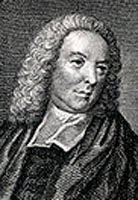
engraved portrait of the poet Edward Young in a clerical robe, wig, and bands
The same 27 Sept 1773 newspapers that ran Jacob Bates’s latest advertisements about his equestrian show at the foot of the Mall in Boston, as quoted yesterday, also ran advertisements for a new publication:
In a few Days will be published, and sold at the Printing-Office in Hanover-street, Boston,
A Pamphlet, entitled,
BATES and his HORSES
Weighed in the Balance.

In which is shewn, with great Brevity, that his Exhibitions in Boston, are impoverishing, disgraceful to human Nature, and downright Breaches of the Sixth Commandment.

OH BE A MAN! Young.
The Sixth Commandment, in Hebrew and Protestant numbering, is the one that forbids murder.

The words “Oh be a man!” came from Edward Young’s The Complaint, or Night Thoughts on Life, Death and Immortality (1742), where they appear twice:
Oh, be a man! and thou shalt be a god!
And half self-made!—Ambition how divine!
. . .
Oh! be a man;—and strive to be a god.
“For what? (thou say’st)—to damp the joys of life?”
No; to give heart and substance to thy joys.
Or that phrase might just have been an allusion to Bates’s self-vaunted “Horsemanship” and “Variety of manly Exercises.”

Exactly what the poetic tag meant, and how performing tricks on horses was tantamount to murder, was presumably clearer in the published pamphlet. Except that no copy of that pamphlet has survived.

As Carl Robert Keyes’s Adverts 250 points out, the print shop on Hanover Street belonged to Joseph Greenleaf, an active Whig. That doesn’t mean the pamphlet reflected his own views, however; Greenleaf may well have taken on the job at the customer’s expense.

It’s also possible this pamphlet was never actually published. The advertisement for it ran in two newspapers, but only on that one Monday and never again. It appears to have reflected many New Englanders’ distrust of theatrics of all kinds—and yet Jacob Bates continued to perform.

TOMORROW: A clergyman at the exhibition.

Thursday, September 28, 2023

Jacob Bates “With a Burlesque on Horsemanship”

On Tuesday, 28 Sept 1773—two and a half centuries ago today—Jacob Bates once again performed his feats of horsemanship at the bottom of the Mall on Boston Common.

Having already cut his top prices, Bates was trying to improve his act and show people more. When he first advertised in Boston, he promised to “perform on ONE, TWO, and THREE HORSES.”

In the notices he ran in multiple newspapers on 27 September, Bates now promised:
He will perform on One, Two, Three, & Four HORSES.
A Variety of Manly Exercises never seen here,
With a Burlesque on Horsemanship, or the
Taylor riding to Brentford.
“Billy Buttons, or the Tailor Riding to Brentford” was a skit developed only a few years earlier by an English performer named Philip Astley. Circus historians consider it the first documented clown act.

The skit may have been inspired by a satirical print issued by painter John Collett and engraver T. Stayner in 1768, as shown here. The idea was that an upstart tailor was setting out for the polls to vote, but was so not a gentleman that he couldn’t ride his horse properly.

In performance, this act was an excuse for various comical acrobatics with a horse: having trouble getting on, falling off, chasing the horse, being chased, riding backwards, hanging off one side or the other, and so on.

The act gained lasting popularity in Britain, inspiring more comical prints and picture books. Charles Dickens mentioned “the highly novel and laughable hippo-comedietta” by name in Hard Times.

The “Billy Buttons” skit eventually evolved into a circus act with a man coming out of the audience, foolish or drunk, and insisting on being able to ride one of the horses. That version makes an appearance in The Adventures of Huckleberry Finn, in which Huck doesn’t get the whole joke.

Jacob Bates was clearly trying to please the paying customers in Boston, but the town’s resistance to theatrics may have been too much of a challenge.

TOMORROW: The wrong kind of attention?

Saturday, September 09, 2023

“So much disturbed by a Number of unruly People”

Two hundred fifty years ago today, on 9 Sept 1773, Jacob Bates ran this advertisement in the Boston News-Letter:
Mr. BATES
Is extremely sorry that the Ladies and Gentlemen were so much disturbed by a Number of unruly People on Wednesday last when he performed, and so much Mischief done to the Fence: —
He is determined for the future, to prosecute to the full Extent of the Law, any Person that shall attempt any thing of the Kind.

He performs again on SATURDAY next, the 11th Instant. The Doors open at 3 o’Clock.

*** TICKETS to be had at Col. Ingersoll’s, in King-Street, Mr. Bracket’s, in School-Street, and at the Place of Performance.

As Mr. BATES is willing to do every thing in his Power to oblige the Ladies and Gentlemen, he has lower’d the Price to Three Shillings each.

Mr. BATES is allowed by the greatest Judges in the Manly Art he professes, to excell any HORSEMAN that ever attempted any Thing of the Kind.
Apparently there had been some sort of disturbance at Bates’s first performance.

Or had there? Back in Philadelphia in September 1772, Bates had likewise posted how he was “extremely sorry that the Ladies and Gentlemen were disturbed by the MOB.” Such apologies might just have been a way to spread the word that his show was extremely popular, like restaurants taking out ads to apologize for running out of food last night.

As for Bates’s new lower price, three shillings was already his minimum price for tickets. He was discounting only the premium admission, perhaps admitting that he wasn’t selling a lot at the higher price.

(I’d like to provide a solid explanation for Bates’s distinction between “Tickets for the First Place” and “for the Second” beyond the obvious that the first were more expensive and therefore presumably better in some way. However, he was the only person to use that phrase in American newspapers in the quarter-century before the war.)

And speaking of those tickets, in addition to Bates’s enclosure at the bottom of the Mall, Bostonians could buy them at two long established taverns:
Taverns with enclosed courtyards were a common venue for traveling performers like Bates. Obviously he needed more space, but those publicans were probably comfortable with handling ticket sales for entertainers.

Friday, September 08, 2023

Bates “at the Bottom of the Mall in Boston”

When we last checked in with equestrian Jacob Bates, on 27 Aug 1773 the Boston selectmen denied his request “to erect a Fence in the Common which will inclose about 160 feet of Ground in order to show his feats in Horsmanship.”

Nonetheless, on 6 September, the Boston Gazette ran this notice:

Mr. BATES, (allowed by the greatest Judges in the Manly Art he professes, to excel any HORSEMAN that ever attempted any Thing of the Kind) on Wednesday next, if good Weather, if not the Friday following, will perform on one, two, and three Horses, at the Bottom of the Mall in Boston.

TICKETS for the first Place at one Dollar each, and for the second Three Shillings, to be had at Col. Ingersol’s, Mr. Bracket’s, and at the Place of Performance.
An even larger advertisement appeared the same day in the Boston Post-Boy:
HORSEMANSHIP,
By Mr. BATES,
The Original PERFORMER;
Who has had the Honour of performing before
THE Emperor of Germany, the Empress of Russia, and King of Great-Britain, the French King, the Kings of Prussia, Portugal, Sweden, Denmark, and Poland, and the Prince of Orange; Also, at the Courts of Saxony, Bavaria, Brunswick, Mecklenburgh, Saxe-Gotha, Hilbourghausen, Anspach, and every other Court in Germany; at all which he received the greatest APPLAUSE, as can be made manifest by the Certificates from the several Courts, now in his Possession, and is allowed, by the greatest judges in the MANLY ART he professes, to excel any Horseman that ever attempted any Thing of the Kind.

On WEDNESDAY,
the 8th September Instant,
If good Weather, if not, the Friday following,
He will perform on ONE, TWO, and THREE HORSES, at the Bottom of the MALL, in BOSTON.

The Doors will be opened at Three o’Clock, and he will mount precisely at Four.

The Seats are made proper for LADIES and GENTLEMEN.

He will take it as a particular Favour, if Gentlement will not suffer any Dogs to come with them.

TICKETS for the First Place at One Dollar each, and for the Second, Three Shillings Lawful Money, to be had at Colonel INGERSOL’s, in King-street, Mr. BRACKETT’s in School-street, and at the Place of Performance.

No Money will be taken at the Doors, nor Admittance without Tickets.
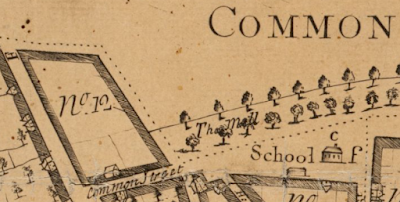
Obviously Bates had found a place to erect his fence anyway. The Mall was part of the Common, defined since the early 1700s by two rows of trees planted by the selectmen’s order along Tremont Street (then also called Common Street). The “Bottom of the Mall” was most likely privately owned land at the southern end of those trees in an area of town still not densely populated.
On Wednesday, 8 September, two and a half centuries ago today, the weather in Boston was good. Bates and his horses performed their show.

TOMORROW: Mr. Bates apologizes.

Sunday, August 27, 2023

Jacob Bates and the Boston Selectmen

On 27 Aug 1773, 250 years ago today, Jacob Bates met with the Boston selectmen.

As I discussed back here, Bates had become celebrated on continental Europe for feats of horsemanship. There was even a German print devoted to him and his horses.

In late 1772 Bates arrived in Philadelphia. He placed notices in newspapers from 2 September to 2 November.

Then the performer moved on to New York from June through early August 1773.

Unlike some traveling performers who could roll into town, find a tavern to host them, and quickly start shows in a courtyard, Bates had to set up a large space to ride in, plus an enclosure around that space to prevent people who hadn’t paid from seeing. That’s what he wanted to talk to the selectmen about on that Friday.

In that discussion were John Scollay, Timothy Newell, Thomas Marshall, Samuel Austin, and John Pitts. (John Hancock and Oliver Wendell were absent.)

The town’s official records say:
Mr. Jacob Bates a famous Horsman, attended & craves leave of the Selectmen to erect a Fence in the Common which will inclose about 160 feet of Ground in order to show his feats in Horsmanship—
Boston was notoriously hostile to theater and suspicious of anything that smacked of it. Traveling performers did come through, such as the rope-flyer John Childs and the musician James Joan. However, they had to navigate local rules and not disrupt life for too long.

Did the selectmen find Bates’s request to fence off part of the fifty-acre Common for a show of horsemanship reasonable?
his request was not granted.
COMING UP: Getting back on his horse.

Thursday, August 10, 2023

“The public may be assured that this will be his last exhibition”

Yesterday I quoted Jacob Bates announcing that his last display of horsemanship in Philadelphia would be on 23 Sept 1772, and he was pulling out some new tricks for the occasion.

It’s possible Bates left the city and visited some nearby towns, putting on more shows that didn’t make the newspapers.

But that definitely wasn’t his last show in Philadelphia because the 2 November Pennsylvania Packet announced:
To the PUBLIC.

MR. BATES intending in a short Time to leave the Province, and being desirous of manifesting his Gratitude to this City,—proposes to exhibit on Thursday next, (if the weather is good,—otherwise on the succeeding Saturday) at the upper End of MARKET-STREET,—All his various Feats in HORSEMANSHIP,—having Confidence in the generous Attendance of the Citizens; as the Sum which may be then collected, shall be deposited in the Hands of three Gentlemen of Reputation, who will apply it in the advancing inclement Season, to the Relief of such modest Poor, as have experienced better Days.

• The Doors to be opened at Three o’Clock, and to mount precisely at Four.
There’s no sign of where Bates spent the winter and spring. He surfaced next in the second largest British city in North America, New York.

On 17 June 1773, an advertisement in the New-York Journal announced:
HORSEMANSHIP,
By Mr. BATES,
The Original PERFORMER;
Who has had the honour of performing before the Emperor of Germany, the Empress of Russia, the King of Great-Britain, the French King, the Kings of Prussia, Portugal, Sweden, Denmark, and Poland, and the Prince of Orange; also, at the courts of Saxony, Bavaria, Brunswick, Mecklenbergh, Saxe-Gotha, Hilbourghausen, Anspach, and every other court in Germany; at all which he received the greatest applause, as can be made manifest by the CERTIFICATES from the several courts, now in his possession, and is allowed, by the greatest judges in the MANLY ART he professes, to excel any Horseman that ever attempted any thing of the kind.

THIS AFTERNOON, at Five o’clock, he will perform at the Bull’s-Head, in the Bowery Lane.

The doors will be opened at four o’clock, and he will mount precisely at five.

The seats are made proper for Ladies and Gentlemen.

He will take it as a particular favour, if Gentlemen will not suffer any dogs to come with them.

TICKETS for the first place, at One Dollar each; and for the second, Four Shillings; to be had at the bar of the Coffee-House, at Mr. Rivington’s, and at the place of performance. No money will be taken at the doors, nor admittance without tickets.
Bates advertised several more performances in the New York papers over the following weeks, usually stating that he planned only one or two more shows.

Earlier this month Carl Robert Keyes, who studies advertising in the colonial press, posted an essay on one of those ads, dated 5 August. That one stated it “was intirely the Printer’s mistake in advertising last week that Mr. BATES would perform only once more.” Was it really? Prof. Keyes asks.

One detail to add to that consideration: The printer whom Bates was throwing under a wagon for supposedly misreporting his schedule was James Rivington, who’d sold tickets to his first performances in June. (Later Bates also sold through another printer, Hugh Gaine.)

Another wrinkle: Bates announced he had “changed his tickets,” and none “of the old tickets should be taken at the door.” Does that suggest a falling-out with his printer? Or had he just ordered another batch of tickets printed?

On 9 August the New-York Gazette repeated:
Mr. BATES,
WILL perform on Tuesday next, if the weather should permit,—if not, he will ride on the Friday following. The public may be assured that this will be his last exhibition, and that he will leave the town on his way to Boston, the day after his finishing performance.
COMING: A warm Boston welcome.

Wednesday, August 09, 2023

The Celebrated Mr. Bates

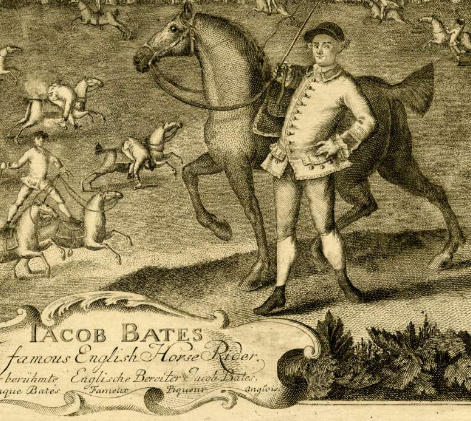
This picture is a detail from a print produced in Nuremburg in 1766, showing “IACOB BATES, The famous English Horse Rider.” Click on it to go to the full image on the British Museum website.

In the 1760s Bates entertained crowds across Europe with his trained horses and equestrian skills. He performed in St. Petersburg in 1763 or 1764. The year after this print appeared, he became the first man to exhibit a large outdoor horse show in Paris.

An 1820 profile stated, “It does not appear he ever publicly exhibited in England.” That seems odd, but I haven’t found any more recent study of Bates that contradicts that statement by citing a British show.

In 1772 Bates decided to take his act to the New World. An advertisement in the 2 September Pennsylvania Journal announced:
Mr. BATES,
Who has finished a tour of Europe, is arrived at Philadelphia, and intends to perform his surprising feats in
HORSEMANSHIP,
At the upper end of Market-street, on Monday, the 7th of September. The doors to be opened at four o’clock, and he mounts precisely at five.

SEATS are made proper for Ladies and Gentlemen, that they will not be in danger of receiving any damage from the horses. Mr. Bates will take it as a particular favour if Gentlemen will not suffer any Dogs to come with them. No money to be taken at the doors, nor admittance without a ticket.

• TICKETS to be had at the Bar of the London Coffee-House, the Indian King, the place of performance, and at the Center House: For the first place five shillings, and the second two shillings and six-pence.
In another ad a week later, Bates clarified the nature of his performance:
different feats in
HORSEMANSHIP,
On One, Two, and Three HORSES
He also found a way to note how popular his first appearance was:
• Mr. BATES is extremely sorry that the Ladies and Gentlemen were disturbed by the MOB; but for the future, there will be such methods taken that they will not be incommoded.
On 23 September, Bates announced that on that afternoon “(Weather permitting)” he would perform in the city “for the LAST TIME.” For that occasion he added “Several NEW PERFORMANCES.” 

TOMORROW: But that wasn’t Bates’s farewell to Philadelphia.