J. L. BELL is a Massachusetts writer who specializes in (among other things) the start of the American Revolution in and around Boston. He is particularly interested in the experiences of children in 1765-75. He has published scholarly papers and popular articles for both children and adults. He was consultant for an episode of History Detectives, and contributed to a display at Minute Man National Historic Park.

Subscribe thru Follow.it


•••••••••••••••••


Showing posts with label Thomas Melvill. Show all posts

Sunday, December 01, 2024

Going to Work for the Feds

In exploring the Creating a Federal Government website, I saw a fair number of familiar names.

Then as now, government officials appointed military veterans to civilian posts. Thus, I see significant appointments in the U.S. Customs department going to:
Likewise, a lot of men who were active in Boston’s Whig movement before the war got posts in the state government during and after it.

I also saw some familiar names which turned out to be men with appointments a generation or more after the Revolution. I wonder if they’re descendants of the Patriots, named after a Revolutionary ancestor and perhaps leveraging the family name and connections.

On interesting example is Francis C. Whiston (1798–1878), a Customs employee from 1824 to 1828. He later related how the Marquis de Lafayette handed him a masonic apron after laying the cornerstone of the Bunker Hill Monument in 1825.

Francis C. Whiston’s grandfather Obadiah Whiston was a blacksmith in pre-war Boston, ready to tussle with British soldiers during the 1768–1770 occupation. In late 1774 he helped to hide two of the militia cannon I wrote about in The Road to Concord. But in January 1775 the Patriot leaders heard rumors he was talking about switching sides and divulging where those guns had been taken, so they cut him out of the network. The blacksmith had to leave town with the British military in March 1776.

I don’t know if Obadiah Whiston’s wife and sons stayed behind or sailed away with him and returned, but his grandson was working for the federal government fifty years later.

TOMORROW: Sorting out Lovells.

Wednesday, January 17, 2024

“We know nearly a dozen of the ‘party’ alluded to…”

On 16 Aug 1826, the Columbian Centinel newspaper of Boston published this item on the upper left corner of its front page:

Tea Destroyers.—“One of the famous Boston “Tea Party” is still alive in Newburyport. His name is NICHOLAS CAMPBELL, aged 94 years.” New York Advocate.

“Why is it, that the names of the persons who destroyed the Tea in Boston in 1773 have been so pertinaciously concealed from the public? They ought not to be ashamed of the exploit.” Providence paper.

REMARK.—We know nearly a dozen of the “party” alluded to, all now alive and well, and among our most wealthy and enterprizing citizens. To our knowledge they have never concealed their agency in the “exploit;” but they are not boasters.—To hundreds of Bostonians their names have been as familiar as those of Adams, Hancock, Otis, &c.

We have recently seen a phial filled with the tea which two of the party found in their shoes after their return home, and have preserved as a memorial. It may be recollected that the shoes worn in those days did not fit to the ancle so snug as those of our modern dandies, and that boots were then only worn by fishermen.
I read this as the flagship of Boston’s Federalist press claiming full authority on the “Tea Destroyers.” Of course we in Boston know who these heroes are, the writer says; we just don’t want to tell you.

I particularly like the couple of backhand, scare-quoted allusions to the new term spreading in the national press: “Tea Party.” That phrase seems to have surfaced at the start of the year in an interview with Joshua Wyeth.

In 1826 the Columbian Centinel was still owned by its founding editor, Benjamin Russell (shown above). Years ago I hypothesized that about a decade later he was the “aged Bostonian” who supplied the list of tea destroyers published in Traits of the Tea Party.

The “phial” of tea this article described was probably Thomas Melvill’s, already mentioned in the Boston Daily Advertiser in 1821. That first item said Melvill had collected it from “himself and companions.” This one says “two of the party.” By 1856 that tea was said to have come from Melvill’s clothing alone.

Sunday, December 04, 2022

“The little bottle of tea came from David Kennison’s pockets”

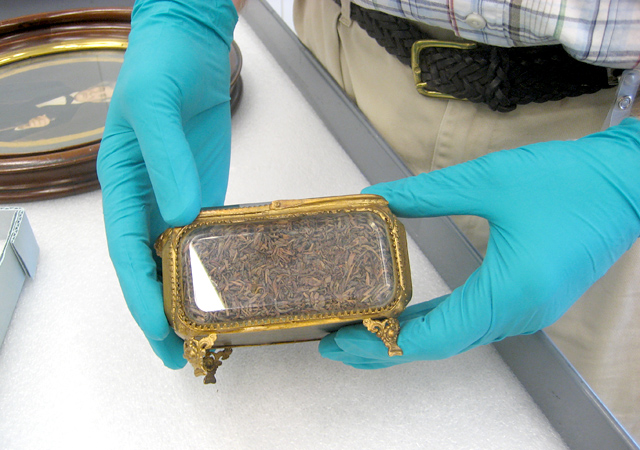
Moving further west, I arrive at another set of tea leaves linked to the Boston Tea Party, these in the collection of the Chicago History Museum.

They reportedly came from an old New Englander named David Kennison or Kinnison. He arrived in Chicago in the mid-1800s and recounted participating the Tea Party and other celebrated events of the Revolution. For a young but growing western city, he was a link back to America’s beginning.

The problem with that lore is that it’s quite clear David Kennison was a fraud. He exaggerated his age. He claimed people from New Hampshire had traveled all the way to Boston to destroy the tea. He told false and contradictory stories about military service during the Revolutionary War.

Furthermore, authors have debunked Kennison’s claims for over a century now. Every few decades through the 1900s, people rediscovered the same weak points and genuine records. But the artifacts, the original credulous accounts, and the wish for a link to the Boston Tea Party survive. Kennison’s stories therefore keep creeping back into view.

A very thorough examination of the tea leaves linked to Kennison appears at the “Hidden Truths” website. I particularly appreciate the rundown of all public mentions of this tea in Chicago:
1894: forty-two years after David Kennison's death, news of the existence of tea leaves in the possession of Fernando Jones is published in a Chicago newspaper. Jones mentions the affadavit, and explains the little bottle of tea came from David Kennison’s pockets. The leaves were purportedly left in the possession of Kennison's mother, who kept them in her cupboard until Kennison retreived them years later.

1901: Fernando Jones has two vials of tea.

1903: Jones's tea leaves came from David Kennison's boot, where they had accidentally fallen during the Boston affair.

1908: Chicago Historical Society acquires photo reproduction of a daguerreotype of Kennison.

1911: Fernando Jones dies.

1912: Chicago Historical Society acquires vial of tea and affadavit declaring its authenticity.

1939: CHS is acknowledged to have a daguerreotype of David Kennison.

1975: CHS has "2 ounce vial of tea sealed with red wax," accompanying affadavit, CHS also has a painting, and pictures of Kennison.

1982: CHS has vial of tea

1987: CHS has golden chest of tea
The artifact appears above in a photograph made by the Chicago Historical Society for that website.

The page concludes with the leaves’ most recent public appearance:
Chicago History Museum, June 2007, the exhibition, “Is It Real?”

For this exhibition, curated by Peter Alter, objects from within the museum’s collection were presented with thoughtful text panels questioning the objects’ claimed significance. . . .

When I inquired about the vial of tea sealed in red wax, he said he had never seen such an item. He showed me the tea leaves. They were contained within the same chest that was pictured in the 1987 “We the People” catalogue. Some time between 1982 and 1987, the vial of tea had become a chest of tea.

But what looks like a full container of tea leaves, is actually a falsely fashioned front containing a very small quantity of tea. In this last Hidden Truth mystery regarding David Kennison, the newer container for the tea leaves, is actually an item from from the 1893 Columbian Exposition. It is a replica of the golden chest that held the ashes of Christopher Columbus.

Peter Alter does not know how the tea ended up in this container.
I think the references to vials of tea sealed with red wax reflects the strength of the meme established by the Thomas Melvill tea starting in 1821. Relics of the Tea Party packaged or created after that became famous tended to fit the same mold, like the vial the Massachusetts Historical Society gave to Gov. William Seward in 1841. When sealing wax became less common, people resorted to sealing those vials with wooden corks.

I wouldn’t be surprised if the tea at the Chicago Historical Society was always packaged in that souvenir glass chest and people chose to refer to it as a bottle or vial since those seemed like proper terms for a relic of the Boston Tea Party. After all, those same people had also convinced themselves that David Kennison was a reliable storyteller.

Saturday, November 26, 2022

“Tea which fell into the shoes”

The 10 Nov 1821 issue of the Boston Daily Advertiser contained the fifth of a series of short essays headlined “Reminiscences.”

It told readers about the destruction of the East India Company tea in Boston harbor in December 1773, an event not yet dubbed the “Boston Tea Party.” The author wrote:
The destruction was effected by the disguised persons, and some young men who volunteered; one of the latter collected the tea which fell into the shoes of himself and companions, and put it in a phial and sealed it up;—which phial is now in his possession,—containing the same tea.
In 1835 an Independence Day orator identified the man who “preserved a vial full” of tea as Thomas Melvill, who had died three years before.

Twenty-one years later a literary chronicler stated that tea was “found in his shoes on returning from the vessel it was sealed up in a vial, although it was intended that not a particle should escape destruction!”

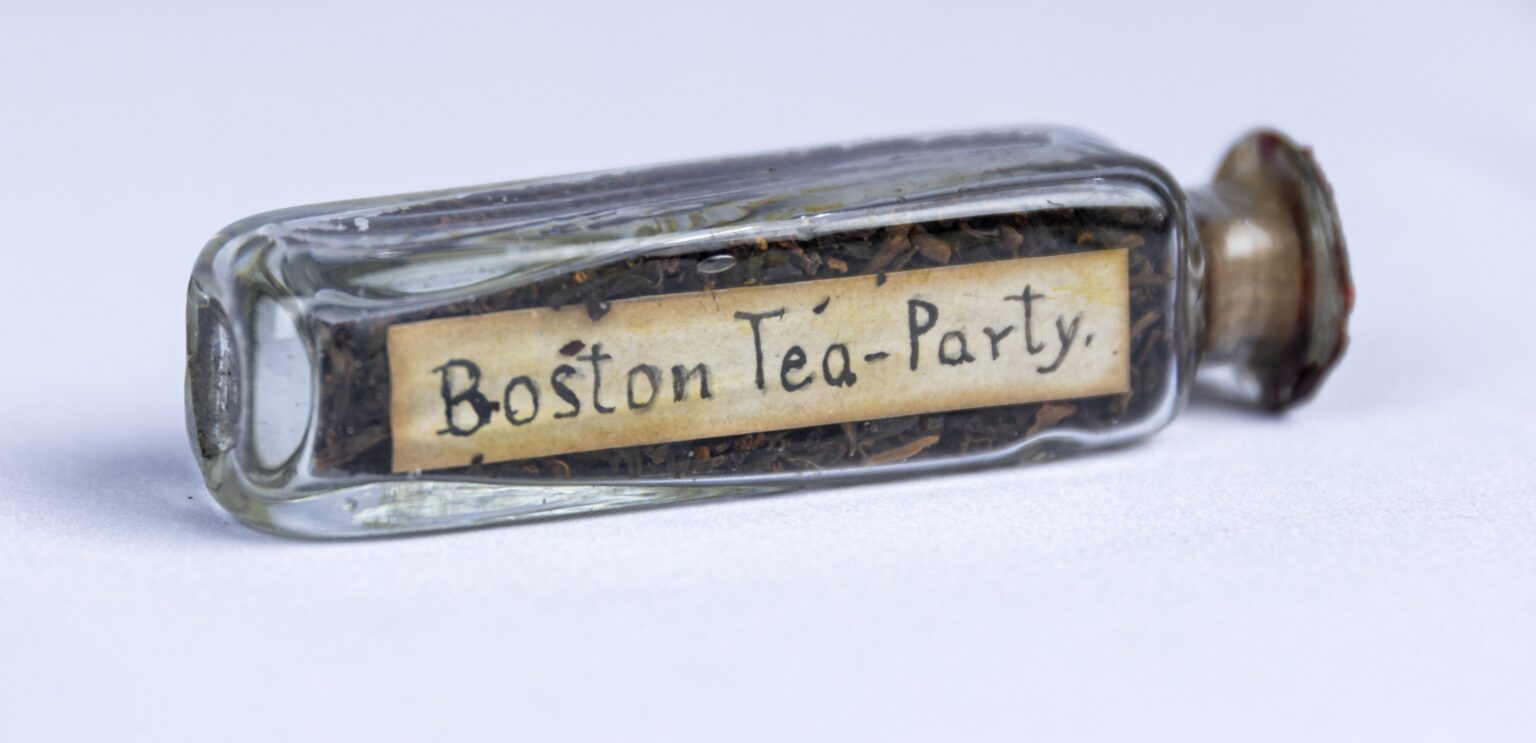
Back in 2018, I tracked that storied sample of tea to its present repository in Revolutionary Spaces’ Old State House museum.

As a historical artifact, that vial had some advantages over the tea reportedly collected on the Dorchester shore and being distributed to historical organizations by the Rev. Dr. Thaddeus Mason Harris before he died in 1842.

First of all, the Melvill leaves had an unbroken provenance leading back to the tea ships. Harris didn’t record who collected the tea in Dorchester or who gave it to him, but Melvill and his descendants presented a complete chain of custody.

Furthermore, Melvill’s tea came from a participant in the destruction of the cargo, not just someone who woke up the next morning and found wet tea leaves on a beach.

Of course, there was the matter of Melvill preserving tea that he was supposed to destroy. But he’d explained that—he “and companions” had brought home this tea inadvertently. That touch of irony made the story even more savory.

Now either lots of other men brought home tea in their shoes the same way, to be secretly preserved by their families until the late 1800s, or this story became an archetype that several other families duplicated.

For example, there’s a strong tradition that John Crane was part of the Tea Party, and he was certainly part of the right crowd. By 1893 the Bostonian Society was in possession of a:
Tea-caddy, with tea found in the pocket and boots of John Crane, one of the Boston Tea Party, when taken injured to his home, Dec. 16, 1773.
An old photograph of that tea-caddy appears above.

By that same year of 1893, the Essex Institute in Salem had received what a young St. Nicholas correspondent named Peggy described as:
two bottles of the tea that was thrown over board at the Boston tea-party,—it was found in the shoes of Lot Cheever after removing his disguise
The name of Lot Cheever is not otherwise linked to the Tea Party. Indeed, the only Lot Cheever I can find was born in Danvers in 1837. (Ezekiel Cheever was captain of the militia patrol that Bostonians appointed to keep the cargo from being landed on November 30.) Maybe Lot Cheever was the donor of this artifact, not the original creator.

The story of tea leaves coming home with a Tea Partier also appears in Robert Lawson’s novel Mr. Revere & I, in which Paul Revere’s mother shakes out his clothing to increase her supply of caffeine. That shows the appeal of this anecdote.

TOMORROW: Competing traditions.

Sunday, May 01, 2022

Spilling the Tea on an Artifact

The American Independence Museum in Exeter, New Hampshire, will open for the season on Wednesday, 4 May.

Its first “Tavern Talk” of the year will be one week later, on 11 May. Alan R. Hoffman will speak on “Lafayette and Human Rights” at 6:30 P.M.

While visiting the museum website, I was intrigued by this webpage on a reported sample of “Boston Tea Party Tea,” part of a series called “30 Stories for 30 Years.” About the vial shown above, it says:
This tea is believed to have originated from Patriot Thomas Melvill (1751-1832), who participated in the Boston Tea Party. . . . It is believed that this vial contains the tea saved from Melvill’s shoe and was passed through the generations until it was eventually acquired by William Lithgow Willey [1857–1949] and donated to the Society of the Cincinnati.
However, that’s followed by a “Contemporary Interpretation” that says:
A document found in the Society’s archives pertaining to Willey’s estate following his death states that the vial is “labeled in W.L.W’s printing,” suggesting that the vial may not be the same one labeled by Melvill’s wife. The label has been dated to the nineteenth century, creating further doubt. . . . To date, no documentation has been found to determine how and where Willey acquired this vial, and its origins remain a mystery.
What’s more, the Old State House Museum in Boston holds a vial of tea from the Melvill family that was described as early as 1821, pictured in 1884, and donated to that collection in 1900, as I tracked here. That vial is featured on the Old State House’s website.

The two artifacts do look similar, which might have made them easy to confuse. Or was one created in imitation of the other?

Friday, November 22, 2019

Capt. David Bradlee, Wine-Merchant

If there’s not enough evidence to say David Bradlee participated in the Boston Tea Party of 1773, I don’t know what he did between the collapse of George Gailer’s lawsuit in late 1771 and the start of the war.

When Bradlee resurfaces in my notes, however, he was still deep inside Boston’s Revolutionary resistance. In early 1776, he was quartermaster of the Continental artillery regiment. (He may have had this job earlier as well.)

Once the war moved south to New York, Bradlee declined to move with the regiment, recently assigned to young Col. Henry Knox. So did the second-in-command, Lt. Col. William Burbeck, and a significant number of the men.

Bradlee instead became an officer in Massachusetts’s artillery regiment under Col. Thomas Crafts, who had helped to organize Boston’s resistance since the first anti-Stamp Act protest in 1765; Crafts was bitterly disappointed not to receive a colonelcy from the Continental Congress. The second-ranking officer in that regiment was Lt. Col. Paul Revere. The regiment’s major was Thomas Melvill, a veteran of the Tea Party. The regimental surgeon was Dr. Joseph Gardner, who had helped Bradlee carry Crispus Attucks away from the Boston Massacre.

Again, Bradlee was right in the middle of the socially rising mechanics who drove the Revolution in Boston’s streets and public meetings. He now had a military rank, and people referred to him as “Captain Bradlee” for the rest of his life. He joined the St. Andrew’s Lodge of Freemasons in 1777.

Bradlee’s connections helped him start building his fortune. On 10 Apr 1778 he joined Melvill and John Hinkley as majority investors in the privateer Speedwell. The ship left Boston harbor in July. After only three days, it captured a British sloop “laden with Sugar, Coffee, Cocoa, Limes, etc.” David Bradlee’s ship had come in.

In Boston’s 1780 tax roll, Bradlee was listed as a tavern-keeper, no longer a tailor. That same year, his younger sister Elizabeth Bradlee (1757-1832) married Gershom Spear (1755-1816), a nephew of Pool Spear, thus uniting the families of two of the people that Gailer had sued ten years earlier.

By the mid-1780s, David Bradlee was recognized as a “wine-merchant,” importing a commodity of upper-class life. He started to rent the basement of the State House to store his inventory, a sign of his continuing connections with the local government. The rent was £17, and the selectmen didn’t collect for two years until he’d finished renovating the space.

In 1794, after nine years, the State House rent was raised to £45, and Bradlee moved out. He bought a large wood and brick shop on the “w[est] side of the…Corn Market,” erected a set of scales outside the front door, and continued selling wine.

Bradlee had carried his family into genteel society. His daughter Sarah married a U.S. Navy captain, Patrick Fletcher. His son Samuel married Catherine Crafts, a daughter of Col. Crafts. His son David W. Bradlee became a member of the Ancient and Honorable Artillery Company and of the Boston Board of Health.

Capt. David Bradlee died on March 6, 1811—“very sudden,” according to one citizen’s diary. He was mourned as a respected member of Boston’s business community and laid to rest in the family’s own tomb, purchased in 1800.

The American Revolution allowed this tailor to become an officer and a merchant. Still, Capt. Bradlee may never have escaped hearing words like those the Rev. Jeremy Belknap attributed to a blacksmith chafing at the demands of a newly-rich tailor: “Come, come, citizen pricklouse, do not give yourself such airs as this! It was but t’other day that you was glad to measure my arse for a pair of breeches.”

Thursday, December 20, 2018

The Tracks of Thomas Melvill’s Tea

The earliest printed mention of Thomas Melvill’s sample of tea from the Boston Tea Party appears to be the 10 Nov 1821 issue of the Boston Daily Advertiser. That newspaper was running a series of short essays headlined “Reminiscences.”

The fifth installment addressed the destruction of the tea. Memory of that event had gotten so foggy that the anonymous writer first discussed whether there were two tea ships or three, and what wharf they were docked at. Turning to the event itself, the writer said:
The destruction was effected by the disguised persons, and some young men who volunteered; one of the latter collected the tea which fell into the shoes of himself and companions, and put it in a phial and sealed it up;—which phial is now in his possession,—containing the same tea.
In keeping with the local ethic, the article named no names.

Thomas Melvill was then known as a survivor of the Revolution who had worked for the federal government and promoted firefighting in Boston. In 1830 the young poet Oliver Wendell Holmes was inspired by the sight of the old man in old-fashioned clothing to write “The Last Leaf.” Melvill died in 1832 after falling ill while providing support for fire companies working on his block.

Melvill’s death coincided with rising public interest in the newly-christened Tea Party. In 1835, in notes to an Independence Day oration in New Orleans, O. P. Jackson named Melvill as not only a participant in destroying the tea but also the man who had saved some: “The late Colonel Thomas Melville, reputed to have been one of the number, preserved a vial full, which has finally become a curiosity.” But where was that curiosity?

In their 1856 Cyclopædia of American Literature, the Duyckincks wrote in their entry on the novelist Herman Melville about his grandfather, Thomas Melvill:
There is still preserved a small parcel of the veritable tea in the attack upon which he took an active part. Being found in his shoes on returning from the vessel it was sealed up in a vial, although it was intended that not a particle should escape destruction! The vial and contents are now in possession of Chief-Justice [Lemuel] Shaw of Massachusetts.
Shaw (1781-1861) had been engaged to Thomas Melvill’s daughter Nancy, but she died before they married. Years later, his own daughter Elizabeth married Herman Melville. So the vial of tea was still somewhat within the family.

However, two years after that, in his monthly magazine for August 1858, Maturin M. Ballou wrote that the tea had moved on:
A phial of the Boston Harbor tea is now preserved in the cabinet of Harvard University as a precious relic of Revolutionary times. The portion thus preserved was taken from his shoes by Thomas Melville, of Boston, one of that celebrated tea party, and treasured by him as a memento of the daring exploit until the period of his death. His heirs placed it in the cabinet at Cambridge for future preservation. The action of time has reduced the tea to a fine powder, and destroyed its flavor; but there is an odor of patriotism about it, that grows stronger and stronger as time rolls on, and the magnificent destiny of our country unfolds itself.
In 1874, when he quoted John Russell’s 1850 letter about Thomas Melvill in the Essex Institute Historical Collections, James Kimball said the tea was still “believed to be in the Cabinet of Harvard University.” (He also silently changed Russell’s phrase that Melvill “obtained [the tea] at the time” to “found [the tea] in his clothing on his arrival home”—which was, of course, not quite the same thing, but was in accord with the 1850s statements.) But Kimball may have been mistaken.

By the time Francis S. Drake prepared his book Tea Leaves, the vial of tea was back with the Melvill family, and in fact with a branch that had moved far away from Boston. Drake wrote that it was “now in the possession of Mrs. Thomas Melvill of Galena, Illinois.” That was Mary Anna Augusta (Hobart) Melvill, second wife and widow of Thomas Melvill’s namesake son born in 1776. She allowed a picture of the vial and its label to be engraved for Drake’s book, as shown above. Mary Melvill died in 1884, the same year Tea Leaves was published.

Three years earlier, the Bostonian Society was founded, and the organization began to gather artifacts for a museum of local history in the Old State House. Nancy Melville D’Wolf Downer (1814-1901), a Melvill descendant living in Dorchester, donated several items, including two pictures of Melvill’s house and his 1832 obituary. The society’s 1895 catalogue also listed a copy of the engraving of Melvill that had appeared in Tea Leaves, courtesy of the publisher.

In 1899 Thomas Melvill’s grandson George R. Melvill died in Galena. It appears that his daughter Mary May Melvill (1855-1918) then sent the vial of tea to the Bostonian Society; the society’s 1900 Proceedings volume acknowledges “Miss Mary Melville” as a donor. Other members of the extended family gave two oil paintings of their ancestor, in youth and old age, and the cocked hat he was known for wearing well after it was out of fashion.

The Bostonian Society thus has a fine collection of Thomas Melvill artifacts, with the tea probably the most celebrated. Here it is featured on the museum’s website. And here it is featured on the Customs and Border Protection website, for reasons I can’t really understand.

Wednesday, December 19, 2018

Thomas Melvill and “a small parcel of the veritable Tea”

On 2 Mar 1850 the Boston Evening Transcript published a letter over the signature “Native Bostonian.” The editors described the writer as “a venerable citizen of a neighboring city, now a member of the House of Representatives, but a native of this city, whose father was an active partizan with Paul Revere, Melville, Sprague, and others, Sons of ’76.”

They then added more detail:
In a private note, the writer speaks of the new building on the corner of Essex and Washington streets, describing it with all the familiarity of his boyhood, as “near by where Ezekiel Russell’s Printing Office and Book Shop, sign of the Bible and Heart, near Liberty Pole, once was to be found.”
I think the mention of the Russell name was supposed to be a clue to the identity of the “Native Bostonian.”

Almost a quarter-century later, in 1874, an article in the Essex Institute Historical Collections named the letter writer as John Russell of Salem, son of William Russell (1748-1784) of Boston. (For more about William, see Francis Cogliano’s American Maritime Prisoners in the Revolutionary War.)

John Russell was born in 1779 and therefore had few direct memories of his father or Revolutionary events. That’s why he remembered “Liberty Pole” but not Liberty Tree, which came down in 1775. Russell used the stories and documents in his family to speak and write about that local history. One of his claims, first published in the Transcript article, concerned a medal carried by Sons of Liberty to identify themselves, which the Russells had lost and no one else in greater Boston ever claimed to have seen; I’m quite skeptical about that.

But today I’m looking at another artifact Russell wrote about in 1850:
Having ever felt an interest in the transactions of that eventful period, and knowing the late Major [Thomas] Melville had preserved a small quantity of the prohibited article, he having been, in common with my father and others, engaged in its destruction, he gratified me, a short time before his death [in 1832], with the sight of a small parcel of the veritable Tea, which he obtained at the time, although it was intended that not a particle of it should have been preserved;—he had it securely sealed up in a small phial;—it was of a coarse twist, and appeared to be in perfect order.
Russell added, “It is to be hoped that this interesting relic is now in safe hands, and that it will eventually, if not so already, be in the possession of the Historical Society.” But it never would be.

TOMORROW: The track of the tea.

(The picture above shows Thomas Melvill in old age and is from the collections of the Bostonian Society.)

Monday, July 20, 2015

The Fight from the Other Side

For the past few days I’ve been quoting an 1835 account written from the perspective of a young British officer captured in Boston harbor in June 1776.

That article names “Colonel Crofts” as the American official who took charge of him and his fellow prisoners. I wondered if that was Thomas Crafts, colonel in charge of Massachusetts’s artillery force (show here).

As it happens, we also have an “Extract of a Letter from an Officer in the Colony Train, at Nantasket, under the Command of Col. Crafts, to his Friend in Boston, June 17, 1776,” describing that capture from the opposite direction. It was published in the 20 June 1776 Continental Journal.

Before quoting that, I should mention that Crafts’s regiment was stocked with Boston businessmen active in prewar politics, so the opening of the letter drops a lot of familiar names:
My dear Friend,

I promis’d to give you a short account of our transactions—We embarked with a part of Col. [Thomas] Marshall’s and [Josiah] Whitney’s Regiment late on Thursday evening for the lower harbour, under the Command of Major [Paul] Revere. The whole expedition directed by General [Benjamin] LINCOLN, Capt. [James] Swan for Petticks Island, Major Revere and Capt. [Thomas] Melvill for Nantasket: Capt. [Joseph] Balch for Hoff’s Neck and Capt. [Jonathan W.] Edes for Moonhead, and Capt. [Edward] Burbeck of the Continental Train with 500 men for Long-Island Head.—
The troops’ first mission was to fire cannon at the British warships still hanging around the harbor. They drove off that force, leaving no one to warn incoming British ships that the port had changed hands.
On Sunday afternoon we saw a ship and a Brigt. standing in for the Light-House channel, chased and fir’d upon by 4 privateers, who frequently exchang’d broad sides. We suppos’d them to be part of the Scotch fleet, got every man to his quarters, and carried one 18-pounder to point alderson, on purpose to hinder their retreat, should they get into the road, opposite where we had 3 18 pounders. About 5 o’clock the privateers left them and stood for the southward, when the ship and Brig crouded all their sail for the channel.

Our orders were not to fire till the last got a breast of us. In tacking she got aground just under our cannon; when we hail’d her to strike to this Colony: They refus’d, and we fired one 18-pounder loaded with round and cannister shot, when she struck and cried out for quarters. We order’d the boat and captain on shore, and then fired at the ship; but being quite dark, we suppos’d she had struck. By this time the privateers came up. A Capt. of the Highlanders, in the Brigt’s boat came on shore. Sometime after the ship got under way, and stood for the narrows; when a fine privateer Brigt. commanded by Capt. [Seth] Harding of New Haven, (who we hear came in this bay on purpose to meet our old friend Darson) and 5 Schooners gave chase.

The Brig came a long side, when a hot engagement ensu’d which lasted three quarters of an hour, when the ship struck. The Brigt floating took the advantage of the confusion and attempted to follow, both supposing the enemy in possession of Boston. We found them from Scotland, with highlanders to join General Howe. The ship had on board 114, the Brigt. 74. The former lost in the engagement Major Menzies, 8 privates, and 13 wounded. The latter 1 killed by the privateers in the day:—The privateer Brigt, had 3 wounded, one suppos’d mortally.
The mention of Maj. Robert Menzies’s death confirms that this was the same ship and the same fight.

TOMORROW: Capt. Harding’s luck.

Wednesday, December 10, 2014

Revisiting the Long Room Club

As long as I’m discussing how Boston’s pre-Revolutionary Whigs organized, I should go back to the Long Room Club. Back in 2013 I said that:
  • the earliest printed reference to this group was in Samuel Adams Drake’s Old Landmarks and Historic Personages of Boston (1873), which cited no source for that information.
  • Drake’s list of members included two men too young to have been in the top political leadership of the 1770s or before, two from outside Boston, and a printer known for being politically centrist, not Whig.
A commenter kindly alerted me that Hannah Mather Crocker wrote about the Long Room Club before her death in 1829 in the manuscripts published in 2011 as Reminiscences and Traditions of Boston. Drake cited “Mrs. Crocker’s memoir” for other information in his book, so she was almost certainly his source on the Long Room Club as well.

Crocker left multiple overlapping manuscripts, which editors Eileen Hunt Botting and Sarah L. Houser assembled in one volume. All its mentions of the Long Room Club offer the same basic information. As Crocker understood it, the group was formed in 1762 by Samuel Adams. Members included:
[Benjamin] Edes and [John] Gill…, [John] Green and [Joseph] Russell…, [John] Hancock, James Otis, Samuel Dexter of Dedham…, Colonel James Warren of Plymouth, Dr. Joseph Warren, Dr. [Charles] Jarvis, Dr. [Benjamin] Church, the honorable Ben Austin…, Dr. Sam Cooper, William Cooper town clerk, Josiah Quincy…, Thomas Daws…, Mr. Sam Phillips Savage, Capt [Samuel] Partridge, Thomas Fleet, Royal Tyler, Samuel Whitewell, William Mollineaux, John Winthrop, Paul Revere, Adam Coulston, and Thomas Melvell—we think the only survivor of the Long Room Club.
Crocker credited the Long Room Club with opposing the policy to station soldiers in town in 1768 and determining to destroy the tea in 1773. She wrote that the club dissolved before the war, but the leaders “formed the first provincial congress.”

Drake listed fewer members than Crocker had, leaving out Green, Russell, Jarvis, Partridge, Austin, Whitwell, Molineux, and Colson, and listing only one Warren. Drake rendered Samuel Phillips Savage as Samuel Phillips and John Winthrop as John Winslow.

Crocker wrote, “The long room over the printing office was devoted to the use of a political society.” In both versions of that statement, the printers she had just written about were Green and Russell, who published the Boston Post-Boy until 1773. Drake interpreted Crocker to mean instead that the club met in a room over Edes and Gill’s print shop, which is how the story came down to us. But what if Crocker meant Green and Russell? They weren’t as politically active or radical, which would cast a different light on the organization.

Crocker may have gotten her information from Thomas Melvill. She called him “a standing monument of the Long Room Club and the only left to tell.” Yet Melvill was born in 1751, meaning he was only eleven when the group was reportedly founded and just twenty-four when it disbanded. Thus, although Melvill was an active young man in the Revolution and the war, he probably was never in the top echelon of the Whigs.

That still leaves questions about the accuracy of our information about the Long Room Club. Crocker’s manuscripts let us push back the earliest reference to it by about half a century, to a time when veterans of the Revolutionary War were still alive. But there are still a lot of odd details, and we’re still dependent on one fallible source. (The footnotes in Reminiscences and Traditions of Boston cite Esther Forbes’s Paul Revere and the World He Lived In as another source, but that book’s description of the Long Room Club matches Drake, who evidently relied on Crocker.)

Saturday, November 09, 2013

The Legend of the Long Room Club

Yesterday I quoted Samuel A. Drake’s 1873 description of the “Long Room Club” of pre-Revolutionary Boston and asked what was missing.

My answer is that Drake didn’t mention any source(s) for his information. He stated that a hundred years earlier some men met regularly in a large room over the Edes and Gill print shop, and readers had to take his word for that. Many authors did; the “Long Room Club” became a staple of descriptions of pre-Revolutionary Boston, and many books repeated Drake’s list of members. Repetition gave the statement the air of unimpeachable authority. I accepted it until a few years ago when Ben Carp asked me if I’d found any contemporaneous support.

So far as we could tell, no source before Drake had ever mentioned the “Long Room Club.” No contemporaneous document describes the group. A 1772 entry in John Adams’s diary shows that there was a room above the print shop. But a big room? With regular meetings of a club with a name? And those particular members? Drake’s statement was the only support for that idea.

We also have an account from Benjamin Edes’s son Peter describing a secret gathering before the Tea Party in his father’s house, not in the print shop. Under the influence of the “Long Room Club” meme, some authors shifted that gathering to the print shop.

Also missing from Samuel A. Drake’s description are the names of William Molineux and Dr. Thomas Young. All the usual, well-remembered suspects are listed: Samuel Adams, John Hancock, James Otis, Dr. Joseph Warren, Dr. Benjamin Church, the Cooper brothers, Josiah Quincy, Paul Revere, & al. But contemporaneous documents tell us that Molineux and Young were Boston’s most important crowd leaders of the late 1760s and early 1770s. Both men were gone by the end of 1774—Molineux dead and Young to the south. Both were radical and religiously unorthodox. As a result, nineteenth-century Bostonians didn’t remember them so well.

Drake’s “Long Room Club” list includes some names that don’t show up in many other lists of Boston Whig leaders, some from out of town and others a generation younger than the men listed above:

  • Samuel Dexter (1726-1810) was an officeholder from Dedham, not visible in Boston and not among the province’s active Whigs. (His grandson had the same name, and would be a big politician in the early republic, but was only fourteen years old when the war began.)
  • Thomas Fleet (1732-1797) printed the Boston Evening-Post with his brother John; they were known for their “impartiality,” as Isaiah Thomas wrote, rather than their political activism.
  • Samuel Phillips (1752-1802) was a politician from Andover and is best remembered for founding the academy there during the war.
  • John Winslow (1753-1819) was a young businessman who became prominent in federal Boston and was a big source of information about Bunker Hill.
  • Thomas Melvill (1751-1832) was another young merchant, a Tea Party participant and official in post-Revolutionary Boston.
Those men don’t seem to have been part of the innermost circle of Boston Whigs at all. Rather, those were names that Bostonians of the early or mid-1800s probably recalled as connected in some way to Revolutionary times.

As for the “Long Room,” I suspect Samuel A. Drake or his informants might have gotten the Edes and Gill print shop mixed up with the Green Dragon Tavern. Taverns did often have long rooms for banquets and other meetings, and we know that the Green Dragon, which the St. Andrew’s Lodge of Freemasons had bought and turned into their headquarters, was one of the places where Revere convened his “committee of observation” shortly before the war.

Another possible root of the meme is Thomas Dawes’s garret, as described back here. Dawes was another name on Drake’s list, not as prominent in Revolutionary politics as the other men but definitely part of town politics before and after the war. But either way, the “Long Room Club” story seems so poorly sourced and probably garbled that I no longer think it’s reliable at all. (And now I have to go back to all the early Boston 1775 postings that referred to that group and update them.)