J. L. BELL is a Massachusetts writer who specializes in (among other things) the start of the American Revolution in and around Boston. He is particularly interested in the experiences of children in 1765-75. He has published scholarly papers and popular articles for both children and adults. He was consultant for an episode of History Detectives, and contributed to a display at Minute Man National Historic Park.

Subscribe thru Follow.it


•••••••••••••••••


Showing posts with label John Shaw. Show all posts

Thursday, September 19, 2019

“Perswaded that Charles did not deserve the suspicions”
The Harvard College Thanksgiving banquet in November 1787 ended badly. By the evening, window glass and wooden benches were lying on the ground outside the hall. That might have had something to do with how every student had brought a bottle of wine.

The Harvard faculty levied a ten-shilling fine on each student who had gone to that dinner and couldn’t prove he'd left before the destruction started. The administration then relented in the case of the sophomores, but not the seniors or juniors—including Charles Adams, class of 1789.

The fines went out in the quarterly bills at the start of 1788. So there was no way Charles could keep the bad news from his family (as he would try to do with financial reverses in the late 1790s).

At the time, Charles’s parents, John and Abigail, were still on a diplomatic mission in Britain. The task of looking after their sons had fallen to relatives: Abigail’s older sister Mary Cranch in Braintree; her younger sister Elizabeth Shaw and her husband John in Haverhill; and John’s cousin Dr. Cotton Tufts of Medford, who managed the family money.

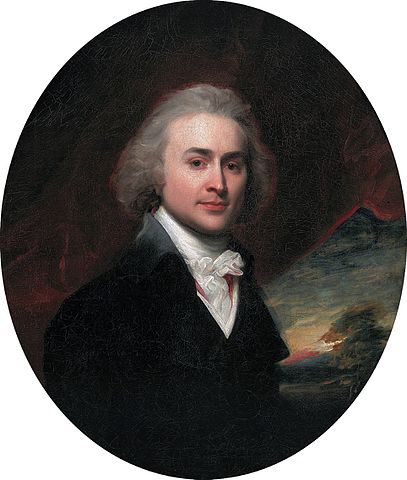
Eldest son John Quincy Adams (shown above) had graduated from Harvard the year before and gone to Newburyport to study law. On breaks he got together with both younger brothers. On 2 Feb 1788, after one such visit, John Q. wrote in his diary:

I had with Mr. Shaw some conversation upon the subject of the disorders which happened at College, in the course of the last quarter: his fears for my brothers are greater than mine: I am perswaded that Charles did not deserve the suspicions which were raised against him: and I have great hopes that his future conduct, will convince the governors of the University, that he was innocent.
The Rev. John Shaw had tutored both Charles and Thomas Boylston Adams to prepare them for college, as well as other boys. (Including Charles’s first roommate or “chum,” who’d gotten into worse trouble—but I’ll talk about that some other time.) Shaw was clearly worried about Charles’s behavior while John Q. tried to stand up for him.

Two weeks later John wrote to Dr. Tufts for some spending money, noting that he’d asked Charles to pass on the request but, well, “I am apprehensive he forgot to deliver my message.” Like many oldest sons, he seems to have felt both protective of his little brothers and convinced they were incurable idiots.

John Q. went on with more hopeful comments about the situation:
The riotous ungovernable spirit, which appeared among the students at the university in the course of the last quarter gave me great anxiety; particularly as I understood, that one of my brothers, was suspected of having been active in exciting disturbances; but from his own declarations and from the opinion I have of his disposition, I hope those suspicions, were without foundation—I conversed with him largely upon the subject, and hope, his conduct in future, will be such as to remove, every unfavourable impression.
Others in the family were adding their voices, perhaps less optimistically. The next day, 17 February, Aunt Elizabeth wrote to Aunt Mary:
I long to hear from Charles & Thomas I charged them to write to me— I do not know that Mr Shaw & I could have given them better advice if they had been our own Sons— I hope they will conduct agreeable to it—& be wiser than they have been, & more cautious of abusing Government, for what they from choice suffer—the Ten shillings penalty, I mean—
As I wrote a couple of days ago, I think the record shows that only Charles had been fined the ten shillings and Tommy still had a near-spotless record at college. But he was the little brother, and the family didn’t want Charles to lead him astray.

Unfortunately, all those admonitions didn’t keep Charles out of trouble in his senior year.

TOMORROW: A rough winter in Cambridge.

Tuesday, September 03, 2019

Moving into a Harvard Dormitory in 1785

At this time of year young people are settling in at college, including my godson at Cambridge. So I’m looking at the process of entering college in 1785.

Fifteen-year-old Charles Adams started at Harvard College that year. His parents, Abigail and John, were across the Atlantic in London, so he was under the wing of relatives on his mother’s side.

Charles had been studying for the entrance exam with the Rev. John Shaw of Haverhill, an uncle by marriage. On 9 May Charles wrote to his cousin William Cranch: “we study in the bedroom as usual two young fellows from Bradford being added to our number, One of whom will be my chum if we get in and who I should be very glad to introduce to you.”

By “chum,” Charles meant a college roommate. That prospect was Samuel Walker (1768–1846). When Charles’s older brother John Quincy Adams visited that summer, he immediately assured their mother that Samuel was “a youth, whose thirst for knowledge is insatiable.”

Unfortunately, the dormitory wasn’t working out so smoothly. On 14 August, Abigail’s older sister, Mary Cranch, reported to her:
I have just heard that cousin Charles is not like to have the chamber he petition’d for, nor any other. Half his class will be oblig’d to Board out in the Town. Mr. Cranch and I are going tomorrow to see how it is, and to procure him a place if necessary. . . .

You cannot think how sorrowful your son looks about the loss of his chamber, but I hope to make him happy yet. I have got all the Furniture ready, (this is the part he is to find). The Bed and Linnin is found by his chum a very worthy pretty youth, who study’d with him at Mr. Shaws. Walker is his name, he is from Bradford.
Fortunately, the situation was soon resolved. On 17 August, Aunt Mary wrote:
Charles is happy he has got his chamber. I return’d last night. I found he had his petition’d granted. He is in the same college with Billy [Cranch,] has a Room upon the lower Floor [of Hollis Hall].

I have got him a pine Table made to stand under his looking glass. It doubles over like a card Table and is painted Marble colour and looks very well. He has the Square Tea Table to stand in his study. I got a few things for him in Boston as I came from Cambridge, and now I think he is equip’d and will go tomorrow with the best advice I can give him.
Charles Adams’s dorm room thus included a “Bed and Linnin” brought by his chum Samuel, a “looking glass,” a pine table painted like marble, and a “Square Tea Table,” among other things.

All four Harvard students I’ve mentioned went on to study the law. John Quincy Adams had a long and successful career while his brother Charles did not. William Cranch became a judge in Washington, D.C. Samuel Walker practiced in Rutland, Vermont, for a quarter-century.

Before then, however, Walker was rusticated for a year in 1787 for “stealing from his class mates.” And he seemed like such a studious boy.

Sunday, January 22, 2017

John Quincy Adams Prepped for College

When John Quincy Adams prepared to enter Harvard College, he was not a typical college student.

At eighteen, he was older than most undergraduates in that period. He had already studied some subjects at the University of Leiden in Holland.

More important, the young man had worked and traveled in far higher circles than other teenagers, and than most Harvard professors. He’d been a diplomatic assistant to his father and then Francis Dana, the Congress’s minister to Russia. He’d seen several European capitals.

And, let’s face it, he was John Quincy Adams. His parents worried about his progress, but he was one of the smartest and more diligent young men around. Of course, there was still the formality of passing the college entrance exam.

As recorded in his diary (the diary he kept regularly until 1848), John Quincy arrived home in Massachusetts in the summer of 1785. Over the next several months, he visited various relatives, including his younger brother Charles, already at Harvard on the normal schedule.

As I quoted yesterday, John Adams had sent Prof. Benjamin Waterhouse a letter asking him to put in a good word for his eldest son. John Quincy finally connected with the man in Boston on 28 September, writing in his diary: “Upon Change I met Dr. Waterhouse; and found him the same man, he was four years, ago, when I was acquainted with him in Holland.” But to his sister Nabby he added:
I met on the exchange, Dr. Waterhouse, who has been at Providence these 6 weeks, delivering lectures upon natural Philosophy. He did not know me at first, and I was obliged to introduce myself to him. As soon as he found me out, he was as sociable as ever.
Waterhouse had lived with the Adams family in 1781, so clearly John Quincy had grown a great deal since he was fourteen.

The young man decided to enter the college at the end of April 1786, in time to take a couple of science classes. He would be ranked as a junior. That fall, John Quincy went out to Haverhill live with his aunt Elizabeth and her husband, the Rev. John Shaw, and refresh his knowledge before the entrance test.

And then the college sped up the schedule. In March John Quincy told his sister why he’d become too busy to write:
At the beginning of the year I was informed…I must come by the middle of March, in order to attend two courses of experimental philosophy. I might have waited till next commencement [in July], and then entered as senior;…but I should have missed one course of lectures. Besides, I had undertaken last fall, to be ready to enter before the class began upon natural philosophy.

When I found my time shortened, I determined to lay aside every thing else, and attend only to my present business. . . . And to enter here, it is not necessary to know any thing but what is found in a certain set of books, and I have heard it asserted, that some of the best scholars, after having taken their degrees, would not be received if they offered as freshmen, because they commonly forget those parts of learning which are required in a freshman. Since the first of January, I have not, upon an average, been four hours in a week (Sundays excepted) out of Mr. Shaw’s house.
So John Quincy had spent nearly the whole winter cramming.

TOMORROW: Entrance exam time at last.