J. L. BELL is a Massachusetts writer who specializes in (among other things) the start of the American Revolution in and around Boston. He is particularly interested in the experiences of children in 1765-75. He has published scholarly papers and popular articles for both children and adults. He was consultant for an episode of History Detectives, and contributed to a display at Minute Man National Historic Park.

Subscribe thru Follow.it


•••••••••••••••••


Showing posts with label Benjamin Davis. Show all posts

Thursday, August 13, 2026

“A fire broke out in the barracks of the 65th regiment”

When the British army returned to central Boston in 1774, Benjamin Davis, Sr., rented his store on the south side of the Town Dock as a barracks.

Davis later told the Loyalists Commission that he “put his own goods in a Cellar” to make room for the redcoats. That turned out to be a costly decision.

On 24 May 1775, Isaiah Thomas’s Massachusetts Spy reported that on 17 May:
a fire broke out in the barracks of the 65th regiment on the south side of the Town-Dock, occasioned by a serjeant of said regiment delivering cartridges to the men by candle-light, a spark from the candle falling amongst them, set fire thereto and immediately the building was in a blaze.

Upon discovery of the fire the troops immediately beat to arms, which being unusual upon such occasions, caused great consternation amongst the inhabitants, and but few dared to leave their habitations; some that did repaired to the engine houses as usual, but to their surprize were told, the engines were not to be delivered without an order from the General [Thomas Gage] (he having a few days before taken the engines under his care, information being given to him, as he said, that when the inhabitants had removed some desperate people, purposely left, were to set fire to the town;)

by this delay the fire got to so great a height, as put it out of the power of the people to stop its progress speedily: It raged with uncommon fury till near three o’clock next morning, in which time all the barracks on the Dock, with a number of stores adjoining, near thirty buildings in the whole, were entirely consumed, with merchandize to a great amount.

The merchandize was chiefly taken out of the stores and put upon the wharf, and might have been saved had not the Admiral [Samuel Graves] some time before taken every boat from the town, and at the time of the fire cruelly refused any assistance.

It was the opinion of the inhabitants, that had the engines been in their hands as formerly, or could they have got them in any season, the fire might have been stopped at the first barrack.
Earlier in the occupation, redcoats and locals had worked together to stop a fire. But with the town besieged and the military commanders on edge, there was more finger-pointing than cooperation.

TOMORROW: Eyewitness reports.

Wednesday, August 12, 2026

Benjamin Davis, Jr., at the Boston Massacre

On 4 Apr 1756, Trinity Church in Boston recorded the baptism of “Benjamin Davis, Son of Benj. & [blank].”

Benjamin, Jr.’s mother was Elizabeth (Phillips) Davis, a convert to the Church of England. She bore a third child in 1757 but must have died in the few years following.

Presumably Benjamin, Jr., was baptized a few days after birth, meaning he was born in the spring of 1756. However, when he died on 28 Dec 1836, Boston newspapers reported that he was eighty-one, so it’s also possible his baptism was delayed a few months.

In 1762 Benjamin, Sr., married a second time, to Anstis Greenleaf, daughter of Suffolk County sheriff Stephen Greenleaf. She died in 1764, after giving birth, and Benjamin, Sr., remarried again to Alice Whipple of Rhode Island—and we all know how that turned out.

As a teenager, Benjamin, Jr., was present at the shooting on King Street in March 1770. He was called to testify at the soldiers’ trial, identified as “son to Mr. Davis a former witness.”

Here, as taken down by John Hodgson, is what Benjamin, Jr., experienced:
On the evening of the 5th March last, near the bottom of Royal exchange-lane, I saw a mob by Mr. [John] Greenleaf’s, I went right along into King street, I saw the Sentinel [Hugh White]; a barber’s boy [Edward Garrick] was there crying, and said the Sentry had struck him, and asked him what business he had to do it:

I went home and staid at the gate in Green’s lane some time,

Samuel Gray (one of the persons killed that night in King-street) came along, and asked where the fire was?

I said there was no fire, it was the soldiers fighting, he said, damn it, I am glad of it, I will knock some of them on the head; he ran off, I said to him, take heed you do not get killed in the affray yourself, he said, do not fear, damn their bloods.

Q. Had he a stick in his hand?

A. He had one under his arm.

Q. What sort of a stick was it?

A. I did not take notice.

Q. How long was this before the firing?

A. I do not suppose he could have got into King-street two minutes before the firing.
Benjamin’s father was also observing the action from a different angle, and his uncle Edward’s family had a clear view across the street at the Customs office. They were all defense witnesses at various trials.

TOMORROW: Fire!

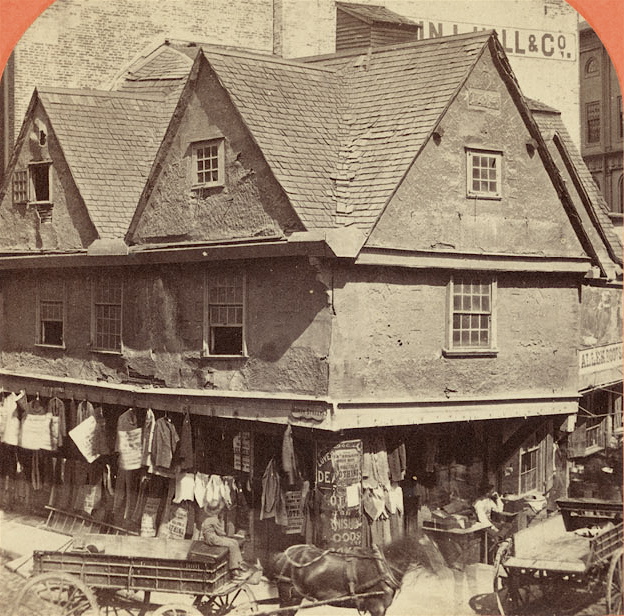
(Based on Benjamin’s quick description, I’m guessing he first spotted the crowd near John Greenleaf’s apothecary store, which survived into the late 1800s as the Old Feather Store at Dock Square, shown above.)

Tuesday, August 11, 2026

“We went to see Mr. Davis in Jail”

As I wrote back here, the lore in Benjamin Davis’s family was that his third wife, Alice, left him soon after their marriage in 1768 because she couldn’t stand how he worshipped with the Sandemanians.

Reportedly the men of the sect agreed that Davis could remarry if he chose. In a profile of Davis written for the Colonial Society of Massachusetts, Henry H. Edes said:
If Mr. Davis married a fourth wife, it is probable that she was Katharine Overlick, whose Intention of Marriage with Benjamin Davis was entered 24 April, 1773, but as we find no record of a marriage, and do find that Catharine Overlick,—presumably the same woman—entered her Intention of Marriage with John Clows 10 November, 1774, it is doubtful if Mr. Davis made another matrimonial alliance.
Alice (Whipple) Davis died in Cranston, Rhode Island, in 1795.

When captured on the Peggy sailing from Halifax to New York in July 1776, Benjamin Davis was accompanied only by his son and an enslaved man. In contrast, a couple of other merchants on the same ship were traveling with their wives, most notably Robert and Mary Semple, formerly Mary Wheat of Lincoln.

In her journal, published by the Essex Institute in 1868, Mary Holyoke (1737–1802, shown above) of Salem wrote:
July 28. Mr. Ben. Davis taken and put into Jail at Boston, and on the 31st Mrs. Davis spent the day with us at Mrs. Minott’s; we went to see Mr. Davis in Jail.
It appears that this “Mrs. Davis” wasn’t Benjamin Davis’s wife but a friend and/or relative of Mary Holyoke whom she mentioned many other times. But this Mrs. Davis could also have been related to Benjamin, giving him a courtesy call.

Life in the Boston jail wasn’t easy. The mates on the British transport ship Anne, James Young and John M’Kurdy, escaped from custody in Massachusetts and provided this intelligence on 24 August:
That Mr. Benjamin Davis, and several others were passengers, and that they treated Mr. Davis very ill. That they do not give the prisoners sufficient provisions, but offer them good wages to enter on board their privateers, and that many do enter.
The captain of the Peggy, James Kennedy, even petitioned the Massachusetts Council on 13 August for release on the grounds that he didn’t deserve to be associated with his passenger:
As your Petitioner had a Man on Board by the Name of Davis whose Character he did not know till he was brought into this Place, he beleives is the Occasion of his receiving different punishment from other Masters of Vessells.
Kennedy was indeed let out of the jail. According to the Naval Documents of the American Revolution editors, four other men gained release through “similar petitions.”

TOMORROW: Junior.

Sunday, August 09, 2026

“The Women from the Windows asking Davis whether he wanted any Gingerbread”

Massachusetts ships captured the Peggy on its voyage from Halifax to New York on 22 July 1776, as described yesterday.

The civilians aboard that ship were taken to Marblehead, then to Boston under guard. Word spread quickly that one of them was Benjamin Davis, a merchant who had left town months before.

On 28 July, Joseph Ward wrote to John Adams from Boston about the ship: “There are many Tories on board, among whom is the noted Benjamin Davis.”

The next day, Ezekiel Price put in his diary: “Brought to town Benjamin Davis and a number of other Tories, who were committed to jail.”

Why was Davis being singled out? He’d made himself notorious in some way, and we have a couple of hints about how.

David Cobb wrote to Robert Treat Paine on 29 July:
Just now the Tories were Landed at the Long Wharf from Marblehead & were attended from thence to the Prison by 2 thousand people; the Women from the Windows asking Davis whether he wanted any Gingerbread, refering to his treatment of the little Chreldren when they were going out of Town last Year. I wish the Devil had ’em.
Abigail Adams alluded to the same scuttlebut in her letter to John the same day:
we have taken a vessel from Halifax bound to New York, which we should call a prize but that it containd about 14 Tories among whom is that infamous Wretch of a Ben Davis the Ginger Bread Robber. How many little ones can say I was an Hungry and you gave me no Bread, but inhumanely took what little I had from me. I wish the Sea or any other Element had them rather than we should be tormented with them.
The editors of the Adams and Paine Papers weren’t sure what to make of those remarks about gingerbread.

I can’t find any sources providing a definite answer, but here’s my guess. At the start of the war, many families sought to leave Boston. Gen. Thomas Gage didn’t want refugees to take out food, which his army needed, or weapons, which the provincial army needed. So the governor set up a system of passes and inspections using both military and civilian administrators.

In the 5 June 1775 Boston Gazette, Benjamin Edes published an open letter addressed “To the perfidious, the truce breaking THOMAS GAGE” and signed “Massachusettensis.” (This was not, presumably, the Loyalist political writer.) Among its complaints about Gage was:
Nay, have not you, and your associates by your orders, been mean enough to steal rum and sugar from a poor teamster, half a cake of gingerbread, a nutmeg, and half a bisket from a poor woman who was flying half famished out of Boston from your low lived tyranny and oppression?
That item was reprinted in several other Massachusetts and Connecticut newspapers over the next couple of weeks. It’s the one gingerbread-related complaint I could find from the period.

That complaint shows that people working for the royal government were confiscating food from folks trying to leave Boston, even mundane food like gingerbread, even from “a poor woman.”

I suspect that Benjamin Davis had agreed to work for Gage’s royal government as some sort of inspector or administrator. At some point that spring, he took gingerbread from a family or two trying to leave town. Children may have cried. That incident didn’t get into the newspapers, but it made him notorious enough that citizens yelled at “Ben Davis the Ginger Bread Robber” more than a year later.

And, unlike Hopestill Capen, few people in Boston minded seeing Davis locked up.

(The picture above shows the Pennsylvania politician Joseph Galloway, not mentioned anywhere in this posting. In September 1774 John Adams wrote in his diary that he was “introduced to Mr. Galloway, the Speaker of the House in Pensylvania. He looks like Ben. Davis the Sandimanian.”)

Saturday, August 08, 2026

“Fell in with two Arm’d Schooners”

Yesterday I wrote about Benjamin and Edward Davis, two brothers who were mercantile partners in Boston until religion and Revolutionary politics split them apart.

Benjamin became a Sandemanian, devoutly guided not to oppose British Crown policies by, for instance, signing on to the non-importation boycotts.

Edward remained an Anglican, attending Trinity Church. By late 1774 the Whigs coopted him into helping to enforce their strongest boycott, the Continental Association.

Both brothers remained in Boston during the siege. But when the British military evacuated, Edward stayed while Benjamin sailed away to Halifax, Nova Scotia. In April 1776 the Patriot authorities ordered magistrates to question Edward about his loyalty, but evidently he passed muster.

Around the start of July, Benjamin Davis boarded the ship Peggy, headed for New York. Along with him came his son Benjamin, Jr., who turned twenty that year; an enslaved man; half a dozen other Loyalist men; and a few Loyalist women.

Evidently those refugees saw business opportunities supplying the huge British and Hessian army assembling at New York. The Peggy was loaded with provisions, including 2,648 “mutton hams,” 311 “tierces salted beef,” fish, flour, snuff, cloth, stockings, and a large quantity of alcohol in various forms.

The Peggy also carried six 3-pounder and two 2-pounder cannon. It sailed in convoy with dozens of other merchant ships and troop transports, all escorted by two Royal Navy warships. The sea voyage probably seemed safe.

We have the ship captain’s account of what happened next:
I James Kennedy, Master of the Ship Peggy, in the Merchant Service, declare that I left Hallifax about the first Inst. [i.e., of this month] under Convoy of the Renown of Fifty Guns, with a Fleet of sixteen [torn] Transports containing the 42nd & 71 Scotch Regiments & Fraziers new rais’d Regiment, about 3000 in all, & three Large Ships with Hessian Troops on board, about 600 in all, & one Ship with 5 companys of English foot Guards, & four Victualling Ships, the whole Fleet bound for New York.

Off Nantucket Shoals we fell in with the Flora Frigate of Thirty Guns & four Transports with Highland Troops, these had been in Boston Bay, where they got information from a Fisherman that the Town was Evacuated, on which they Stood for Hallifax untill they met with us, they then joyn’d our Fleet for New York.

The Scotch Troops were all to be of Coll [Archibald] Campbells division (of the Grand Army in America, the whole of which Army I was informd, would by the last of July, amount, to 50,000.) the Hessian Troops left England about the 12th of May, some of the Officers informd me they came out with 304 Sail under the Command of Commodore Hawtham [William Hotham], on board of whom were 10,000 Foreign Troops & some English Troops (number unknown).

last Fryday sennight [19 July] in a gale of wind & thick weather I lost the Fleet & on monday [22 July] I fell in with two [American] Arm’d Schooners, Capts. [John] Skimmer & [Samuel] Tucker, to whom I surrendered after a short engagement, in which I had only one man Wounded.

The day after the Fleet left Hallifax, I saw from my Deck forty Sail of Ships standing in for that Harbour, & which I suppose to be part of the Fleet under Commodore Hawtham.
Skimmer commanded the Franklin and Tucker the Hancock, schooners originally launched under the authority of the Continental Army commander. They were now sailing for Massachusetts.

The Patriot authorities who took Capt. Kennedy’s deposition were evidently pumping him for intelliegence on what other British ships and troops were out there rather than details of his engagement with the schooners.

For Benjamin Davis, all that mattered now was that he was a prisoner of the state he’d left four months before.

TOMORROW: The gingerbread man.

Friday, August 07, 2026

“The extraordinary self-denials and usages of the Sandemanians”

Hopestill Capen wasn’t the only Sandemanian clapped into the Boston jail in the summer of 1776, as discussed yesterday.

Another merchant who had joined that sect, Benjamin Davis (1729–1805), had been locked up since 26 July.

Like Capen, Davis was from an old New England family. For years he and his brother, Edward Davis (1730–1811), ran a mercantile firm located on the “South Side of the Town Dock.”

Among the European goods Benjamin and Edward Davis advertised for sale were coal, ale, cheese, snuff, salt, and stoneware. In return, they offered farmers money for flaxseed and potash.

Family sources say the Davis brothers’ partnership came apart during the non-importation campaign of 1768–70. Indeed, as of May 1771 the shop on “the South Side the Dock” was “Benj. Davis’s Store.” Having advertised their firm for many years, the brothers’ names appeared in only one more newspaper notice together: in August 1772 they offered “Two new Copper Stills & Worms,” perhaps their last joint property.

The Davis brothers definitely started to split politically in those years. On 28 Oct 1769, Edward was one of three angry merchants who confronted printer John Mein about how he was printing Customs house records. Mein stated, “Davis first made a push at me with his Cane which struck me on the left side of the belly.”

On 5 Mar 1770, Benjamin Davis was out in the evening about nine o’clock as locals faced off against soldiers at the Customs office. According to Robert Treat Paine’s notes from Capt. Thomas Preston’s trial, Davis testified: “Some body clap’d me on sholder and asked me if I would go and help fight the Soldiers. I said no.” He was a defense witness in the Boston Massacre trials.

Meanwhile, Edward Davis was watching the dispute with other merchants from the stoop of Edward Payne’s house, opposite the Customs office. At a bail hearing for Edward Manwaring in April and then at Manwaring’s trial, Davis and members of his family testified that they had seen no guns fired from the Customs building. In fact, Davis said that “soon after the firing he saw two women standing in the chamber of the Custom-house…with their hands under their aprons, in the posture of spectators.”

After the death of his wife, the former Ruth Vassall, in January 1774, Edward became a more active Whig. By the end of the year he was serving on Boston’s committee to enforce the Continental Association boycott.

In contrast, once Benjamin joined the Sandemanians in the 1760s, he appears to have sworn off actions to resist the royal government. In October 1774, John Andrews reported, “Ben Davis has let his Store on the Dock for the use of the troops.” He signed the usual Loyalist addresses and protests.

The mercantile house wasn’t the only partnership Benjamin Davis gave up for his faith. He married his third wife, Alice Whipple, daughter of a former lieutenant governor of Rhode Island, in 1768. According to family lore published by the Colonial Society of Massachusetts:
The lady’s amour propre was offended and her philosophy over-taxed by the extraordinary self-denials and usages of the Sandemanians. Following the example of the early Christian Church, it was their custom to hold a love-feast on Sunday at one another’s houses, at which only Sandemanians were present. The wives who were not members of the Sect, naturally did not take kindly to their exclusion from their own tables, and, at last, the third Madam Davis felt constrained to return to her family, thus, practically, deserting her husband.

A legal divorce being then unobtainable, the Sandemanians took the matter under consideration and concluded to sanction another matrimonial alliance on the part of Mr. Davis, declaring his to be one of those cases where voluntary abandonment by the wife justifies the dissolution of the marriage tie in the sight of Heaven.
Benjamin Davis didn’t actually remarry, though.

Unlike Capen, Davis chose to sail away to Nova Scotia with the British military in March 1776. But then he got on a ship headed to New York, presumably to help supply or administer Britain’s reinvasion.

TOMORROW: Captured at sea.

(The John S. Copley portrait above shows Anstice [Greenleaf] Davis, Benjamin’s second wife, courtesy of the Brooklyn Museum. She died in 1764, only two years after their marriage.)

Wednesday, April 29, 2026

“Prisoners in Boston Goal” in February 1777

On 18 Feb 1777, deputy jailer Joseph Otis wrote down “A List of Prisoners in Boston Goal,” transcribed and published by the Colonial Society of Massachusetts.

This document says:
Doctṛ̣ [Benjamin] Church for holding a Tratirus Correspondence with the Enemy

John Hill for being Enemical to the States

Thoṣ̣ Mews for ditto

Thoṣ̣ Edwards for ditto

Crean Brush for ditto

Benjạ̣ Davis for ditto

Hopestill Capen for ditto

Miss [Elizabeth?] Hill & Daughter for attempting to Carry Intillegence to the Enemy

John Dean Whitworth A prisoner of War

Seven Men & two Women prisoners of War taken Near fort Cumberland

Richḍ̣ Luby for theft Sentens’d

Mary Young Sentens’d

Mary Voax Sentens’d

John Lovell for theft not had his trial

Five Debtors
It’s no surprise that Dr. Church headed this list. But it is surprising to see Brush listed fifth, given his notoriety. But perhaps the order reflects their cell assignments or some other factor.

I’ve just written about how John Hill was jailed in May, and his wife and daughter arrested in October. Those two women were the only ones explicitly locked in Boston’s jail for actions to aid the enemy, as opposed to being prisoners of war or criminals.

As for the other political prisoners, Thomas Mewse was an English “wollen-manufacturer,” as the Massachusetts Spy once put it. William Molineux had recruited him into a public-works scheme that ended with the two men suing each other. Aside from that, I know no reason to think him “Enemical.”

Thomas Edwards is usually identified as the 1771 Harvard graduate and former Braintree schoolteacher who became suspect because he apprenticed in law to a Tory. Within a couple of years, however, that Thomas Edwards was a high-ranking Continental Army officer, and he went on to a long political career. I have yet to see any contemporaneous sources describing that man as a suspected Loyalist. So I wonder if there might have been two Thomas Edwardses.

Benjamin Davis and Hopestill Capen were merchants who had sided with the Crown. Davis was captured while sailing from Halifax to New York in June 1776. Capen had stayed in Boston after the evacuation was undoubtedly regretting that decision. I may discuss them, as well as Lt. John Dean Whitworth of the Queen’s Rangers, at more length in the future.

By the time Joseph Otis wrote out this list, John Hill had been imprisoned for nine months, his wife and daughter for four. It looks like they were held separately. And it would be several more months before their situation changed.

COMING UP: An exchange.

Tuesday, April 07, 2020

“Liberated upon each of them giving bail”

Back on 27 March, I described how a Suffolk County grand jury indicted four civilians for murder in the Boston Massacre.

As acting governor Thomas Hutchinson wrote, those four men had been “committed to close prison, where they lay about a fortnight,” because of the testimony of Charles Bourgate.

That “French boy” claimed that his master, Edward Manwaring, had fired a gun out of the Customs House window. The other three men were charged with being part of the fatal conspiracy simply because they testified in support of Manwaring’s denial.

Ordinarily, there was no bail for people charged with murder. But some Superior Court judges thought the evidence against those men was weak enough to make an exception.

According to an anonymous correspondent keeping track of events in Boston for the Customs service, the town committee gathering evidence about the Massacre “threw every obstacle in the way in order to prevent this affair coming to a hearing by informing the Court that they daily expected new Witnesses from the Country.”

Eventually the court scheduled a bail hearing on Saturday, 7 Apr 1770—250 years ago today. According to the diary of acting Chief Justice Benjamin Lynde, it took “all forenoon.” The anonymous report described the event this way:
The Witnesses brot. against the Custom house People Manwarings french boy and one [Samuel] Drown, the former had sworn to so many falsities that the Court paid no regard to his evidence—the latter was proven in Court to be a fool, unable to utter one coherent sentence. . . .

Upwards of 40 Creditable people were summoned by Manwaring to disprove Guns being fired out of the Custom house but only the family of Mr. [Benjamin or Edward] Davis who lives directly opposite was examined—they all declared they had their eye upon the Custom house during the whole affair, and that they saw no Guns fired nor believ’d any were fired. their Evidences were so very clear that the Court thought it unnecessary to examine any other of his exculpatory Witnesses.
Lynde was nonetheless still inclined not to grant bail. Judge Peter Oliver (shown above), brother of province secretary Andrew Oliver and related by marriage to Hutchinson, already believed there was “little cause of Confinement.” Judge John Cushing (1695-1778) cast the deciding vote.

The court let the four men out of jail pending trial if they paid bail of £400 each. As comparison, in 1770 Paul Revere paid £213 for an entire house in the North End. With the help of sixteen sureties, the defendants came up with the necessary money. They still had to go on trial, but until then they were free.