J. L. BELL is a Massachusetts writer who specializes in (among other things) the start of the American Revolution in and around Boston. He is particularly interested in the experiences of children in 1765-75. He has published scholarly papers and popular articles for both children and adults. He was consultant for an episode of History Detectives, and contributed to a display at Minute Man National Historic Park.

Subscribe thru Follow.it


•••••••••••••••••


Showing posts with label William Lee/Billy Lee. Show all posts

Friday, July 15, 2022

“If the burning the Gaspee schooner was a matter of serious importance…”

Benjamin Galloway was indeed at Mount Vernon on 1–5 January 1773, much as he described decades later. The evidence for that is George Washington’s own diary.

The anecdote Galloway told about Washington hinged on him reading an article from a recent newspaper, one of several fetched by William Lee from Alexandria, which described the destruction of H.M.S. Gaspee in Rhode Island.

The Gaspee was burned in June 1772, however. Would it have still been hot news in Virginia early the next year?

As I discussed back here, the initial news stories on the Gaspee affair were quite low-key, considering it was an armed attack on a Royal Navy schooner. The American Whig press didn’t make a big deal out of it, as if the event was an embarrassment.

Only one issue of the three Virginia Gazette newspapers—Purdie and Dixon’s for 9 July—carried a report of the burning. Through the end of the year, the rare follow-up items were short dispatches reporting on government actions, such as offering rewards for information and setting up an investigatory commission.

However, in December Rhode Island politicians began to write to local newspapers and to colleagues in other colonies, like Samuel Adams in Massachusetts and Richard Henry Lee in Virginia. They highlighted how that commission might send defendants and witnesses to Britain for treason trials. That would violate sacred British rights, they declared.

The 30 Dec 1772 Pennsylvania Journal joined that campaign by reprinting three separate items about the Gaspee affair from New England newspapers. Under the dateline of Boston, 17 December, printer William Bradford (shown above) combined an angry report on the commission from the 17 December Massachusetts Spy and this commentary from the 21 December Boston Gazette:
If the burning the Gaspee schooner was a matter of serious importance, much more so are the methods pursued by the British administration in consequence of it. This affair was transacted within the body of a county, in a free English government; one would think therefore it should be the subject of the inquiry of the grand jury of inquest for the same county: Instead of which we are told, that five gentlemen, four of whom are of superior rank in different colonies, the other indeed a judge of the admiralty, are appointed by commission to make the enquiry.

By a gentleman lately from Rhode-Island, we are informed, that three of these commissioners are empowered to act, at whose call the army and navy are to attend; that any persons accused, against whom the commissioners shall judge there is evidence sufficient to convict them, are to be apprehended, and together with the evidences [i.e., witnesses] sent to England for trial. And that Capt. [Robert] Keeler, of the Mercury, has notified Gov. [Joseph] Wanton, in consequence of orders, that his ship is ready to receive such persons for the purpose aforesaid.

[Boston News-Letter printer Richard] Draper tells us, that “Admiral [John] Montagu is ordered to hoist his flag in Newport harbour.” The purport of this parade is obvious to common sense. The Admiral will no doubt acquit himself to the satisfaction of his masters upon this occasion. It is said that he has recommended that those who, it is supposed, can give evidence of this matter, and refuse to do it, be put on board the men of war, and there kept until they do; which perhaps may be rather more eligible of the two, than the torture of the RACK.

The indignity offered to all the Colonies, and particularly Rhode-Island, says a gentleman of a neighbouring town in a letter to his friend in this, is not to be equalled. To have a set of crown officers commissioned by the ministry, and supported by ships and troops to enquire into offences against the crown, instead of the ordinary and constitutional method of a grand jury carries an implication that the people of that colony are all so deeply tinctured with rebellious principles, as that they are not to be trusted by the crown.

The inhabitants of this town and province can feel for their brethren of Rhode-Island, having themselves tasted of the cup of ministerial vengeance; when to aid and protect the commissioners of the customs, in carrying into execution a revenue act of the British parliament, Hillsborough’s troops were stationed in the capital, and the city turned into a garrison!—And though these troops, after slaughtering some of our innocent inhabitants, were obliged to retire from the town, they are yet posted in the principal fortress and key of the province.

What shall hinder the like scene of blood, rapine and slaughter in the capitol of Rhode-Island, if the commissions of enquiry there, should so readily call for the military aid as the commissioners of the customs did here? Such treatment of the colonies calls for the most serious attention; and however prophane it may be called by Mr. Draper’s writer the Yeoman, or his canting neighbour, we have reason with firm affiance in HIM who hateth oppression and tyranny, devoutly to acclaim, How Long!—O LORD!—How Long!
That was immediately followed by similar news from the 19 December Providence Gazette, which concluded:
The idea of seizing a number of persons, under the points of bayonets, and transporting them three thousand miles for trial, where, whether guilty or innocent, they must unavoidably fall victims alike to revenge or prejudice, is shocking to humanity, repugnant to every dictate of reason, liberty and Justice, and in which Americans and Freeman ought never to acquiesce.
And then material from the 21 December Newport Mercury, including a letter from a Bostonian warning that three army regiments were soon to march into Rhode Island and another from a Londoner saying:
Our tyrants in administration are greatly exasperated with the late manoeuvre of the brave Rhode-Islanders. . . . We believe that the ancient British spirit of independence which once blest this island, has improved by transportation, and preserves its vigour in the breasts of Americans; cherish it my dear friends! And by relieving yourselves save the small remnant of the virtuous in Britain.
Washington could have received this newspaper among others in early 1773. Living on Virginia’s northern border, he was almost as close to Philadelphia as to Williamsburg, and Philadelphia was a dynamic port with a freer press.

Thus, a newspaper delivered to Mount Vernon in the first days of 1773 could have ignited a dinner-table discussion about the Gaspee affair, British rights, and the use of the military to put down protests and tax resistance, as Galloway described. Those topics were all over the Pennsylvania Journal.

On the other hand, that newspaper did not include the details about how the Gaspee ran aground chasing a smuggling ship, details that Galloway explicitly recalled reading out to the company. He must have picked up that part of the story from other sources.

TOMORROW: George Washington’s other diary.

Monday, July 11, 2022

“A deathlike silence to Col. Washington”

Yesterday I quoted a letter that appeared in the Washington Republican newspaper in September 1822, describing a conversation at Mount Vernon almost fifty years before.

I found another version of the same anecdote, reportedly published in the Hagerstown Torch Light on 21 Dec 1818. Unlike the Washington Republican letter, this article didn’t spark any reprints in other newspapers that I could locate.

My access to back issues of the Hagerstown Torch Light being limited, I actually read this letter in Thomas J. C. Williams’s A History of Washington County, Maryland, published in 1906. (The following year, Williams abridged his text for an article in the Maryland Historical Magazine.)

Here’s the text as published in 1906, with added paragraph breaks:
A large company being at the supper table the last evening they were at Mount Vernon, Col. [George] Washington’s well known servant man, named Billy, entered the room from Alexandria, to which place he had been sent by Col. Washington for newspapers and letters, and delivered some newspapers to Col. Washington, who cast them about midway the table, and requested those who took them up to read aloud such articles of intelligence as they might judge would be desirable to the company.

I being seated in a chair which enabled me to lay my hand on one of the newspapers, took the liberty of so doing, and soon announced to the company a very interesting fact, to-wit: The destruction of the King of England’s sloop of war, called Gaspee, by a party of Yankees; she having when in close pursuit (heavy gale of wind) of a Brother Jonathan coaster (smuggling) missed stays and being so near to the shore, the commander of the Gaspee lost all command of her, and she was run ashore high and dry. The Yankees in a short space of time collected in sufficient force and burnt her.

Captain [Edward] Foye asked me to pass the newspaper from which I had communicated to the company the foregoing (I will venture to say to him) bitter pill read the article and instantaneously declared ore rotundo, that blood must be drawn from the Yankees before they would be taught to conduct themselves as obedient subjects ought to do; and insolently said that he, yes, that he would engage to put down all opposition to the execution of revenue acts which had been lately passed, by the King and Parliament of Great Britain; and moreover that he would undertake so to do at the head of five thousand British troops; which he would march from Boston to Charleston, South Carolina.

Col. Washington was engaged in perusing one of the newspapers, whilst Captain Foye was uttering these insulting and audacious words. Col. Washington withdrew his eyes from the newspaper, placed them steadfastly on Captain Foye, and observed that he (Col. W.) entertained no doubt that Capt. Foye could march at the head of five thousand British troops from Boston to Charleston, South Carolina, but added that he should be obliged to Capt. Foye to inform him (Col. W.) whether he meant as a friend or as an adversary! “If as an adversary,” said Col. Washington, “and you, sir would inform me of your intention so to do a few weeks previous to your entry into the ancient dominion, I would engage to give you a handsome check with the Virginia riflemen alone!”

There were on the supper table, at the time when Col. Washington favored Capt. Foye with the above stated retort courteous, twelve or fifteen wine glasses and two or three decanters of excellent old Madeira. At the instant that Col. Washington uttered the words Virginia riflemen alone, he struck the table with his right hand so violently that the decanters and glasses leaped from their proper places and I expected to have beheld them all prostrate on the table.

Capt Foye made no reply but immediately addressed his conversation to Mrs. [Martha] Washington, at whose left hand he was seated; and during the remainder of the evening he observed a deathlike silence to Col. Washington. Capt. Foye and Lord Sterling departed from Mount Vernon immediately after breakfast the next morning.
This anecdote is very similar to the one quoted yesterday, even including some of the same phrasing. There are also some differences in wording and level of detail, though nothing directly contradictory. That suggests the person telling this tale was rather practiced at it.

The biggest difference between the two versions is that this one didn’t include the paragraph about the Rev. Walter Magowan telling other guests at Mount Vernon that he’d never seen Washington so upset.

I don’t know whether the Hagerstown Torch Light included the name of the person who told this story, but Williams included it in his local history: Benjamin Galloway.

TOMORROW: Who was Benjamin Galloway?

Sunday, July 10, 2022

“He had never seen the master of Mount Vernon so displeased”

Last month I addressed the idea that George Washington attended fireworks in celebration of the second anniversary of the Gaspee attack in 1774.

I found that claim to be unsupported by any evidence in Washington’s writings or in the newspapers of Williamsburg, Virginia.

Taverns occasionally displayed fireworks, Washington occasionally attended, and in this case the date of a fireworks show simply coincided with the anniversary of an event in another colony many miles away.

Another source describes Washington showing a strong response to the Gaspee affair—or, more accurately, a strong response to a Crown official’s response to the Gaspee affair.

This story starts with the founding of the Washington Republican newspaper in August 1822 by the printer Thomas L. McKenny to support the political career of John C. Calhoun, then U.S. Secretary of War. McKenny invited his new readers to send material for him to print. Early the next month, someone from western Maryland supplied McKenny with this letter:
Mr. Printer: The authenticity of the following communication may be confidently relied on by the public, as there are now alive those who heard the person that now furnishes it, narrate the facts contained therein, immediately after his return from Mount Vernon to the city of Annapolis, precisely as he is now about to state them.
B. G.

Washington County, Sept. 5, 1822.

...just after the cloth was removed from the supper table, a man of colour named Billy, Col. Washington’s favourite servant, who had been sent by his master to Alexandria for letters and newspapers, entered the supper room and delivered to his master a large bundle containing letters and newspapers. Col. Washington, with a cast of his hand, placed the newspapers about mid way the supper table, around which there were then sitting a large company, Lord Sterling on the right, and Capt. [Edward] Foye on the left hand of Mrs. [Martha] Washington. When Col. Washington so placed the papers, he requested that if they contained any important information, it might be read aloud to the company.

It so happened that I laid my hand on an Eastern paper, which contained an article of intelligence to the following effect: “That a Yankee smuggler, being pursued by one of the King’s vessels of war, (and I think she was called the Gaspee,) hugged the shore so closely that the former (the wind then blowing extremely hard) missed stays, and ran plump ashore. The neighbouring brother Jonathans quickly collected in great numbers, the tide being at ebb, they soon boarded and burned her.”

I read said article aloud to the company, and was immediately requested by Captain Faye to pass the newspaper to him, who, when he had read the article, he had the audacity to declare that “The Yankees must be phlebotomized!” and that he, yes, that he, “would engage, at the head of five thousand British regulars, to march from Boston to Charleston, South Carolina, and put down all opposition to the revenue acts,” that had been recently passed by the British Parliament for the purpose of raising a revenue in the British colonies.

Col. Washington, at the close of this insulting declaration, instantly fixing his eyes on Capt. Foye, observed: “I question not, Sir, that you could march from Boston to Charleston, South Carolina, at the head of five thousand British regulars: but do you mean to say, Sir, that you could do so, as a friend, or as an enemy? If as the latter, and you will allow me a few weeks notice of your intention, I will engage to give you a handsome check with the Virginia riflemen alone.” When Col. Washington was uttering the words with the Virginia riflemen alone, he struck the table so violently with his clenched hand, that some wine glasses and a decanter near him with difficulty maintained their upright positions.

Captain Foye made no reply; but turned his face immediately towards Mrs. Washington, said a few words to her, looked very silly, and soon after requested to be showed to his chamber!

Col. Washington appeared to be very much displeased. Not a word was said by any of the company, in reference to said article of intelligence, while they remained in the room; but when the Rev. Walter Magowan, who was one of the company, and who had resided some years before in the Mount Vernon family as a private tutor to young [John Parke] Custis, had, with two other gentlemen and myself, arrived at our bed chamber, he remarked that, during the whole time he had lived in Col. Washington’s family, he had never seen the master of Mount Vernon so displeased as he appeared to have been that evening with Captain Foye.
I transcribed this from the 18 Sept 1822 Daily National Intelligencer, one of several newspapers that republished the Washington Republican item in late 1822 and early 1823. I couldn’t unearth the Republican itself. (As usual, I’ve broken the long block of text into paragraphs for easier reading on the web.) 

This letter has rarely been republished or cited since. In fact, I couldn’t find a single Washington biographer who quoted what this correspondent said he witnessed around the start of the year 1773.

TOMORROW: Another version of the same tale.

Friday, February 21, 2020

Peale’s Portrait of an Elderly Black Man

In the late nineteenth and early twentieth century, people believed this painting by Charles Willson Peale was a portrait of William Lee, enslaved at Mount Vernon for the last thirty years of George Washington’s life.

Peale and Lee did cross paths. Peale first visited Mount Vernon in the early 1770s, when Lee was a teenaged house servant. Peale returned thirty years later, as his biographer Charles Coleman Sellers wrote in 1947:
The travellers made a pilgrimage to Mount Vernon [in 1804], Peale full of reminiscences of his visits there in the General's lifetime. All that remained now of the family was one slave, old Billy Lee, Washington's body servant through the war, whom Peale found in an outbuilding, a cripple now, cobbling shoes. The two sat down alone together and talked of past days and of the important subject of good health.
Lee became free on Washington’s death, but he was disabled by bad knees and remained on the estate for the rest of his life.

Peale kept a diary in 1804, so I presume that was the basis of this vignette. It would be nice to know exactly what Peale himself wrote of his conversation with Lee.

C. W. Peale died in 1827 at the age of eighty-five. The museum he‘d assembled on the upper floor of what is now Independence Hall was broken up in 1854. In the ensuing sale a man named Charles S. Ogden bought a Peale painting of the young George Washington and what he thought was “a portrait in oil, by the same artist, of Bill Lee, familiarly known as ‘Billy,’ Washington’s favorite military servant during the war for Independence.”

That identification reflects how Washington’s celebrity made Americans fascinated in his former slaves—or supposed former slaves. In 1835 an elderly enslaved woman named Joice Heth played the role of Washington’s former nursemaid, over 160 years old, for paying audiences in New York. Until recently, a painting in a Spanish museum was widely but not wisely identified as showing Washington’s cook, Hercules Posey.

Sometimes those stories were more accurate. In 1845, a New Hampshire journalist interviewed Oney Judge, who had escaped from the President’s Philadelphia mansion in 1796.

In that atmosphere, people appear to have decided that the elderly black man Peale painted must have had some connection to Washington. Or maybe the exhibitors realized that making that claim made their painting and the museum more valuable. William Lee, by then mentioned in memoirs and popular histories as “Billy Lee,” was the most famous elderly black man from Mount Vernon, so people attached his name to the picture.

In 1892, Ogden donated the two paintings to the Historical Society of Pennsylvania. At some point, and I’m not sure when, scholars realized that the painting that Ogden believed showed William Lee was actually Peale’s 1819 portrait of a man named Yarrow Mamout. Peale described the sitting in detail in his diary.

Mamout had been born in Guinea, brought to Maryland as a slave, and freed around age sixty. He became a well known businessman and property owner in Washington, D.C. in the early republic. He maintained his Islamic faith, making this the first portrait of an individual Muslim American. In his eighties, Mamout claimed to be even older—140 years old, which was probably why Peale painted him.

In concentrating its holdings on documents, the H.S.P. transferred the Mamout painting to the Philadelphia History Museum and then recently assented to its sale to the Philadelphia Museum of Art, which owns other Peale portraits. But none of William Lee.

Thursday, February 20, 2020

“He was Billy, and the old servant of General Washington”?

In 1777 a London printer issued a pamphlet titled Letters from General Washington, to Several of His Friends in the Year 1776.

James Rivington, New York’s leading Loyalist printer (shown here, courtesy of the New-York Historical Society), soon reprinted those letters in his Royal Gazette newspaper. He issued a pamphlet of his own, adding a couple of genuine American letters to fill out the pages. Other Loyalist printers issued a particularly embarrassing private letter on handbills.

The preface to the pamphlet offered this explanation of how the person publishing the documents had come by them:
Among the prisoners at Fort-Lee, I espied a mulatto fellow, whom I thought I recollected, and who confirmed my conjectures by gazing very earnestly at me. I asked him, if he knew me. At first, he was unwilling to own it; but when he was about to be carried off, thinking, I suppose, that I might perhaps be of some service to him, he came and told me, that he was Billy, and the old servant of General Washington. He had been left there on account of an indisposition which prevented his attending his master.

I asked him a great many questions, as you may suppose; but found very little satisfaction in his answers. At last, however, he told me that he had a small portmanteau of his master’s of which, when he found that he must be put into confinement, he entreated my care. It contained only a few stockings and shirts; and I could see nothing worth my care, except an almanack, in which he had kept a sort of a journal, or diary of his proceedings since his first coming to New-York:

there were also two letters from his lady, one from Mr. Custis, and some pretty long ones from a Mr. Lund Washington. And in the same bundle with them. the first draughts, or foul copies, of answers to them. I read these with avidity; and being highly entertained with them, have shown them to several of my friends, who all agree with me, that he is a very different character from what they had supposed him.
The letters were addressed to Martha Washington, her son Jack Custis, and Lund Washington, the cousin managing Mount Vernon at the time. They portrayed Washington as disillusioned with the Continental Congress and hoping for a negotiated peace. They were entirely fake.

Whoever wrote those letters was familiar enough with life at Mount Vernon to have been in the Washingtons’ circle in Virginia. The general suspected John Randolph, the Loyalist father of his former and future aide, Edmund Randolph. Scholars have theorized that the Rev. John Vardill guided this and other propaganda efforts.

Describing the letters as having been captured with an enslaved servant also reminded readers that Washington and many of his biggest American supporters were slaveholders. That was a big talking-point in British political writing at the time, not out of any abolitionist sentiment but to undercut the Continental claim to be fighting for “liberty.”

In 1795, as domestic political disputes heated up, American printers opposed to President Washington’s policies pulled out this pamphlet and reprinted its contents, not necessarily claiming the letters were authentic but just stirring the pot.

Eventually Washington wrote to several of his associates in the war reminding them that these “spurious letters, [were] known at the time of their first publication…to be forgeries,” as he told Benjamin Walker. He asked them to remind other people, too.

The President added:
But of all the mistakes which have been committed in this business, none is more palpable, or susceptible of detection than the manner in which it is said they were obtained, by the capture of my Mulatto Billy, with a Portmanteau. All the Army, under my immediate command, could contradict this; and I believe most of them know, that no Attendant of mine, or a particle of my baggage ever fell into the hands of the enemy during the whole course of the War.
To that we can add that in 1776 William Lee was not an “old servant” of the general but only in his early twenties.

Those letters from the 1790s are the only time that Washington referred to his former body servant William Lee as “Billy” after 1771. And he wasn’t really referring to Will—he was referring to the fictional version of his servant described by a British propagandist using that name.

Washington hoped that Rivington, who appears to have become an American intelligence source by the end of the war, would be able to reveal the author of the letters. That didn’t happen. Rivington probably knew as little about their origin as anyone else in America.

Wednesday, February 19, 2020

“Calling himself William Lee”

In October 1767, George Washington bought two “Mulatto” boys named Will and Frank and two “Negro” boys named Adam and Jack from Mary Lee, widow of Col. John Lee of Westmoreland County.

John Lee (1724-1767) had married the young widow Mary (Smith) Ball in 1749. They had no children together before he died. Given how the enslaved mulatto boys were Col. Lee’s property and later took his surname, he’s the man most likely to have been their father. In any event, his widow sent them off with another master soon after the colonel’s death.

Mary went on to wed John Smith in August 1768, and Washington dined with that couple the day after their marriage. There were so many Smiths, Lees, and Balls in Virginia that I can’t tell if John or Mary Lee was related to Washington’s mother’s Ball family or the Lee family his descendants married into, but they were in the same social circle.

Washington paid £61.15s for Will and Frank, more than three times the £19 he paid for the other two youths. All four slaves were probably teenaged males with many productive years before them, but the brothers’ lighter skin made them particularly valuable as domestic servants.

The Washington Papers include lists of “tithables” on his lands each June for many years. High among the “Ho[use]. Servants” on those lists from 1768 to 1771 was “Billy.” On 8 Oct 1770, Washington wrote in his diary about “my boy Billy who was taken sick.”

In September 1771, however, Washington recorded paying for a “pair of Boots for Will.” The editors of the papers wrote that there were enslaved men named Will on different farms, but those boots mostly likely went to the house servant he had bought in 1767, now close to manhood.

After that point, Washington stopped referring to the young man as “Billy,” at least in writing (except indirectly in connection with one incident I’ll discuss tomorrow). On the tithables lists “Will” appeared starting in 1772. His brother “Frank” had arrived on those list of house servants in 1771, along with “Herculas,” most likely Hercules Posey.

When Washington rode off to war in 1775, he brought Will with him as a body servant. The young man, then probably in his twenties, was at the commander’s headquarters in Cambridge, where on 22 Feb 1776 the steward recorded this expense in his: “Paid Margaret Thomas for making three shirts for William.”

Ten years later, on 18 Feb 1786, Washington made a comprehensive list of his human property. At the top was “Will Val de Chambre,” followed by waiter “Frank” and soon after cook “Herculus.” In that decade Will suffered two falls that injured his knees badly so he was no longer able to wait on Washington as had trained to do. He became a shoemaker at Mount Vernon.

In his 1799 will, Washington granted freedom and a pension to “my Mulatto man William (calling himself William Lee)”—the first time he referred to his wartime companion with a surname.

In a memoir first extracted in the American Turf Register and Sporting Magazine in 1829, Washington’s step-grandson, George Washington Parke Custis, referred to “his huntsman, Will Lee.” But he also wrote that that servant “was better known in Revolutionary lore as Billy.”

Indeed, while Washington himself never wrote of his body servant as “Billy” after 1771, other people referred to him by that diminutive. For example, on 27 Apr 1789 Clement Biddle wrote to the new President from Philadelphia, “I have frequently called to see Billy.” William Lee continued to live at Mount Vernon until his death around 1824, and nineteenth-century articles and memoirs about visiting there, such as the one by Elkanah Watson, called him “Billy.”

Nineteenth-century authors therefore developed a new way of referring to Washington’s body servant Will—as “Billy Lee,” a combination of names the general himself never used in writing. That’s become a standard reference. It shows up in, for instance, this month’s History Channel series about Washington, at least from some commentators.

But is that how historians should refer to the man, especially during the war years? We don’t know what Gen. Washington called him in conversation, but in writing it was always “William” or “Will.” We also know that William Lee kept the surname of his first owner (and father?) more than thirty years after coming to Mount Vernon.

“Billy” is of course a diminutive, and American slaveholders and racists used such nicknames to belittle black men. Yet we also use such names for friends; it’s possible that Washington’s valet was happy to answer to that name from people he knew well. It’s also conceivable that when Will Lee became disabled, still only in his late thirties and enslaved, he was reduced to such a state of dependency that people started to infantilize him as “Billy” again.

All those are conjectural possibilities, however. We know from Washington’s will that in middle age his former valet was “calling himself William Lee,” and that’s the name I use.

Tuesday, March 19, 2019

Hercules Posey, Cook in New York

Craig LaBan’s article for the Philadelphia newspapers about the mysteries surrounding George Washington’s escaped cook Hercules didn’t stop at debunking the claim that he was the black man wearing a tall white hat in a widely reprinted portrait.

LaBan also reported new information about what really happened to Hercules. The last known trace of him had been a 15 Dec 1801 letter from Martha Washington to the mayor of New York, thanking him for seeking Hercules and concluding, “I have been so fortunate as to engage a white cook who answers very well. I have thought about it therefore better to decline taking Hercules back.”

That hinted that the Washingtons, having previously sought Hercules in Philadelphia, came to suspect he was in New York.

Back in 2016, a children’s book about Hercules was abruptly canceled just before publication, as discussed back here. The author who had been recruited to write that book, Ramin Ganeshram, had already been working on a novel about the cook and the painter Gilbert Stuart, inspired by the mistaken belief that LaBan wrote about. That book, The General’s Cook, was published last year.

Ganeshram is also the executive director of the Westport Historical Society in Connecticut, and as doubts arose about the “Hercules portrait” that inspired her fiction she wanted to find out more about the real man. Ganeshram and her colleague Sara Krasne, an archivist, looked at New York records for traces.

The crucial clue was that Washington had bought Hercules as a young man from another Virginia planter named John Posey. We know that William Lee, the general’s body servant during the war, continued to use the surname of his first owner throughout his life. Had Hercules done the same?

The New York city directory for 1812 listed a black man named Hercules Posey living on Orange Street. On 15 May of that year, that Posey died of consumption. The death record stated that he was sixty-four years old and had been born in Virginia, which is a reasonable match for what little we know about Hercules the cook.

As described in this blog post, New York City archivists found evidence from a few years later that Posey’s address was in a neighborhood of black workers.

I’m adding another breadcrumb to this cook’s trail. The 1812 directory listed Posey as a laborer. The 1808 edition of Longworth’s American Almanac: New York Register and City Directory listed him at another address on Orange Street, and identified him as a cook.

ADDENDUM: After I wrote about this posting on Twitter, Sara Krasne replied that she and Ramin Ganeshram had just found Hercules Posey listed as a cook in an 1807 New York city directory.

Tuesday, May 12, 2009

More Suggestions for Whom to Follow through the Revolution

On Monday, guest blogger Ray Raphael asked which eighteenth-century Americans you might follow to tell the story of the overall Revolution. I shared some of my ideas this morning.

Boston 1775 reader David Churchill Barrow braved the challenge and suggested:

  • Nathaniel Greene: Lapsed Quaker, so perhaps there was some struggle of conscience, or a rebellion against upbringing. Saw and influenced the war in both the north and the south. Washington would have wanted him as his own replacement, should he have gone down in the fight.
  • Benedict Arnold: Saw the war from both sides. Snubbed early hero. Very complex character, and again with a family background that may have inspired him for both good and bad. He and Peggy were an “it” couple, Like Brad Pitt and whoever today.
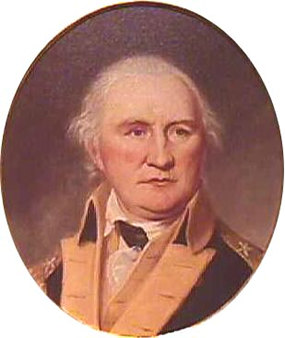
  • Daniel Morgan [shown here]: Coolest and most mysterious character of them all. Makes Davy Crockett look like a mere piker.
  • William Lee (Washington’s valet): Personal perspective from inside the inner circle. Also an African-American point of view.
  • Andrew Jackson (as a boy): How the hardships of the war had lasting effects.
Ooh—a young person’s experience! Intriguing. And good coverage of the crucial southern theater.

In addition, Bloomfield Bob commented:
I, for one, hope James Otis is a character! I'd love to learn more about this guy.
Otis is indeed a fascinating character, but his story really ends before the war begins. Though he lived to 1783, Otis was so mentally unstable after 1770 that the Boston Whigs had to worry about him more than the Crown. The best modern discussion of him appears in John J. Waters’s The Otis Family in Provincial and Revolutionary Massachusetts (1968).

More suggestions and comments welcome!

Wednesday, December 20, 2006

Rediscovering Oscar Marion?

A posting at A Student of History, by John Maass, alerted me to a recent ceremony in Washington, D.C., respecting Oscar Marion, enslaved servant of Revolutionary War general Francis Marion (1732-1795).

As the Washington Post reported, many nineteenth-century images of Gen. Marion include a black servant in the background. The best known of these is "General Marion Inviting a British Officer to Share His Meal," now hanging on the Senate's side of the U.S. Capitol. The black man is never identified in those paintings, but genealogist Tina Jones recovered the knowledge that Marion was served throughout the war by an enslaved man named Oscar.

The Post quotes Jones as saying of Oscar Marion, "He is not just some obscure figure in the background. This person had a name. He had a life and a separate contribution." Which is true, but it's very hard to tell what his individual life and thoughts were since (a) he was trapped within the American slavery system, and (b) our sources seem to be all generated by his master's family. Presiding over the recent ceremony, George W. Bush praised Oscar Marion's "devoted and selfless consecration to the service of our country," but of course the man didn't have a free choice. He was "selfless" first because American law assigned his self to another man.

John Blake White (1781-1859) created the painting at the Senate in the 1820s, after Francis Marion's death. The artist said he had met the general when he was a boy, and painted the man's face from memory. But White made no such claim of accuracy about the other men in the painting. There thus seems to be no evidence that White tried to paint the individual Oscar Marion, or met the enslaved man at the same time he met the general.

Instead, I think the painting shows little more than a symbol of a helpful enslaved servant. The black man's features aren't distinctive, and even his pose reflects the notion of servitude: kneeling to prepare food for the white men who stand above him. The individual whom Gen. Marion called Oscar is still probably faceless.

Similarly, a black servant stands in the background of a couple of paintings of George Washington: John Trumbull's 1780 portrait and Edward Savage's 1796 picture of the Washington family. In recent years people have rushed to identify those figures as William Lee, the enslaved bodyservant who accompanied the Washington throughout the Revolutionary War.

Both Trumbull and Savage painted from life. Trumbull probably encountered Lee many times when he served as an aide at the general's headquarters in Cambridge, so he could have indeed painted the individual Lee. But the face in Trumbull's painting looks like a caricature. As for Savage, when he described his painting, he didn't even mention the black man in the background, just as he didn't mention the table at the center. I think we might be wishful to interpret these paintings as containing portraits of individual black men.

(We have more evidence about Will Lee as an individual and his relationship to George Washington; see the Boston 1775 posting on Margaret Thomas.)

Friday, November 03, 2006

Margaret Thomas: free black woman at Washington's headquarters

Margaret Thomas was a free black woman who joined the staff of Gen. George Washington's headquarters in February 1776, according to the accounts of his household manager Ebenezer Austin. At that time, Washington was living in the Cambridge mansion now known as Longfellow House, trying to push the British military out of Boston.

Thomas's duties included washing and mending clothes. She seems to have remained with the commander-in-chief's shifting headquarters throughout the first years of the war, judging by such documents as this 1778 receipt she signed at the bottom (courtesy of the Library of Congress's online collection of Washington papers). At the end of her service, she apparently went to live in Philadelphia, and the general never expected to see her again.

But in 1784, Washington's bodyservant and riding companion Will Lee came to him with a request, as he described in this 28 July letter to his Philadelphia agent, Clement Biddle:

The mulatto fellow William, who has been with me all the War is attached (married he says) to one of his own colour a free woman, who, during the War was also of my family.

She has been in an infirm state of health for sometime, and I had conceived that the connection between them had ceased, but I am mistaken; they are both applying to me to get her here, and tho' I never wished to see her more yet I cannot refuse his request (if it can be complied with on reasonable terms) as he has lived with me so long and followed my fortunes through the War with fidility.

After promising thus much, I have to beg the favor of you to procure her a passage to Alexandria either by Sea, by the passage Boats (if any there be) from the head of Elk, or in the Stage as you shall think cheapest and best, and circumstances may require.

She is called Margaret Thomas als. Lee (the name which he has assumed) and lives at Isaac and Hannah Sills, black people who frequently employ themselves in Cooking for families in the City of Phila.
As I read this letter, Washington was skeptical that Will Lee and Margaret Thomas were truly married. He may have suspected they had come up with this plan to secure Thomas a more comfortable home while she was sick. The general worried about creating resentment among his enslaved workers at Mount Vernon by employing free blacks, and he had no individual liking for Thomas.

Yet Washington didn't feel he could refuse Lee's request. He agreed to do a big favor for his long-time slave. To borrow an analogy from former Mount Vernon staffer Bruce Harris (now head of the Literary Trail of Greater Boston), since Washington had been raised to consider slaves as property, this was rather like one of us agreeing to make space for another refrigerator because our current refrigerator asked.

There's no evidence that Margaret Thomas ever made it to Virginia, however. It's unclear whether Biddle found her in Philadelphia, if she was in shape to travel, or if she cared to.

Washington freed Will Lee in his will, leaving it to his widow Martha to complete the emancipation of the rest of their human property. Lee remained at Mount Vernon until 1828, working for wages as a shoemaker. There's a chapter about him in Fritz Hirschfeld's George Washington and Slavery: A Documentary Portrayal.