J. L. BELL is a Massachusetts writer who specializes in (among other things) the start of the American Revolution in and around Boston. He is particularly interested in the experiences of children in 1765-75. He has published scholarly papers and popular articles for both children and adults. He was consultant for an episode of History Detectives, and contributed to a display at Minute Man National Historic Park.

Subscribe thru Follow.it


•••••••••••••••••


Showing posts with label shipping. Show all posts

Thursday, September 17, 2026

“The Prize Papers of the American War” Workshop, 8 Oct.

On Friday, 8 October, the Prize Papers Project at Britain’s National Archives will host an international symposium on “The Prize Papers of the American War of Independence.”

Online registration to this event is available, but folks should know that it will take place in London. The discourse will start at 4:30 A.M., Boston time.

The workshop description says:
Bringing together specialists on prize law, the American War of Independence and the Prize Papers, the workshop approaches the collection as a transnational archive of wartime capture and its afterlives. The workshop creates a forum for sustained international exchange and collaboration.

The year 2026 marks the 250th anniversary of both the Declaration of Independence of the United States of America in July and the opening of the British Vice-Admiralty Court in newly-captured New York City in September 1776. Although exceptionally rich, the prize papers of this court have been largely inaccessible. The newly catalogued papers of the New York court (and its mother-court in London) provide new perspectives on the War of Independence at sea, and on lived experiences of the time, through the intercepted papers and letters found by the British on merchant and fighting ships.

Maritime warfare was central to the War of Independence. Controlling, disrupting, and capturing shipping was crucial to the war on both sides. America started privateering early, in 1775, and sought new (previously forbidden) trading partners. From 1778, French naval and privateering activity expanded the war against Britain, followed by Spain and the Netherlands. British naval forces and loyalist privateers sought to stop American and allied shipping, enforce their imperial authority, and weaken the Continental cause. The conflict eventually extended far beyond the North American seaboard.

An initial group of papers from 150 captured ships, American or supporting America, will be published online on 8 October in the Prize Papers Portal, the open-access online database of the Prize Papers Project. . . . Major bodies of captured material from American, French, Spanish, Dutch and recaptured British vessels will be published in the coming months and years…
Presentations schduled for 8 October include:
  • Amanda Bevan & Luan Cakolli: “A Voyage of Discovery and Delivery … and what we’re learning along the way”
  • Suzanne Foxley: “American Experience of British Prize Law”
  • Séverine Angers: “Write to me by different ships as the English capture many”
  • Randolph Cock: “Piecing Together Clues from the U.S.S. Lexington, 1777: A Whodunnit”
  • Rebekah Harbord: “Behind the Scenes: Preparing documents from the Prize Papers for digitisation”
  • Bethany Groff Dorau: “‘Taken by 64 Guns’: A Case Study of Dalton Marine Captain Offin Boardman”
  • Christopher Minty: “‘False & Colourable’: The Brigantine Adventure and the Paper War of the American Revolution”
  • Abby Mullen: “Mutiny or Loyalty?: Revolt from the Enemy in American Prizes”
  • Graham Moore: “Revolution 250: Exhibiting the Prize Papers at The National Archives”
  • John Beiner & Lucas Haasis: “History at the Helm: The Prize Papers and the Making of the Videogame Ahoy”
The keynote address to close out Friday will be delivered by Nathan Perl-Rosenthal, author of The Age of Revolutions and the Generations Who Made It (Basic Books, 2024).

The Prize Papers Project is run by the National Archives, U.K., and the University of Oldenburg, Germany. Other organizers of this event are the German Maritime Museum Bremerhaven and the German Historical Institute London. The workshop will be hosted by Nele Popp, Amanda Bevan, Oliver Finnegan, and Lucas Haasis.

This symposium occurs alongside an exhibit at the National Archives in Kew titled “Revolution 250: America's Independence Story 1763–1783,” which will run through 29 November.

Sunday, September 06, 2026

“Came under the bottom of the ship”

After his brother Ezra Bushnell fell ill, the inventor David Bushnell asked Gen. Samuel Holden Parsons to send three men who might be able to operate his submarine against the Royal Navy in New York harbor.

Parsons already had a list of volunteers ready to sail a fireship toward the fleet, another risky venture. One of them was his brother-in-law, Sgt. Ezra Lee (1749–1821, shown here).

Bushnell brought the machine back to Saybrook, Connecticut, for the three men to practice. Eventually Lee got the assignment. His mission: Screw a timed explosive charge (Bushnell’s other invention, called the “magazine”) to the hull of H.M.S. Asia.

Lee went into action on 6 Sept 1776, 250 years ago today. Decades later, in 1815, he wrote an account of his mission for David Humphreys:
We set off from the City—the Whale boats towed me as nigh the ships, as they dared to go, and then cast me off—I soon found that it was too early in the tide, as it carried me down by the ships—I however hove about, and rowed for 5 glasses, by the ships’ bells, before the tide slacked so that I could get along side of the man of war, which lay above the transports—

The Moon was about 2 hours high, and the daylight about one—when I rowed under the stern of the ship, could see the men on deck, & hear them talk—I then shut down all the doors, sunk down, and came under the bottom of the ship, up with the screw against the bottom but found that it would not enter—

I pulled along to try another place, but deviated a little one side, and immediately rode with great velocity, and come above the surface 2 or 3 feet between the ship and the daylight—then sunk again like a porpoise I hove partly about to try again, but on further thought I gave out, knowing that as soon as it was light the ships boats would be rowing in all directions, and I thought the best generalship, was to retreat, as fast as I could as I had 4 miles to go, before passing Governor’s Island.—

So I jogg’d on as fast as I could, and my compass being then of no use to me, I was obliged to rise up every few minutes to see that I sailed in the right direction, and for this purpose keeping the machine on the surface of the water, and the doors open—

I was much afraid of getting aground on the island as the Tide of the flood set on the north point While on my passage up to the City, my course owing to the above circumstances, was very crooked & zig zag, and the enemy’s attention was drawn towards me, from Governors Island—

When I was abreast of the fort on the island 3 or 400 men got upon the parapet to observe me,—at leangth a number came down to the shore, shoved off a 12 oar’d barge, with 5 or 6 sitters, and pulled for me—I eyed them, and when they had got within 50 or 60 yards of me, I let loose the magazine, in hopes, that if they should take me, they would likewise pick up the magazine, and then we should all be blown up together, but as kind Providence would have it, they took fright, and returned to the island, to my infinite joy.—

I then weathered the Island, and our people seeing me, came off with a whaleboat, and towed me in—

The Magazine after getting a little past the Island, went off with a tremendous explosion, throwing up large bodies of water to an immense height.
On seeing that explosion, Humphreys wrote, Gen. Israel Putnam shouted, “God’s curse ’em, that’ll do it for ’em.” But the bomb merely startled the enemy, not doing any physical damage.

Why hadn’t Sgt. Lee been able to attach that bomb to H.M.S. Asia as planned? Humphreys explained:
The reason why the screw would not enter, was that the ship’s bottom being coppered it would have been difficult under any circumstances to have peirced through it—but on attempting to bore with the auger, the force necessary to be used in pressing against the ships bottom, caused the machine to rebound off
In this series about David Bushnell and his submarine, I’ve cut down long letters that the U.S. Navy has collected on this website. Though the submarine was a top-secret operation in 1776, men like Humphreys and Thomas Jefferson made a concerted effort after the war to gather information about the machine and its operation.

Authors have written several books about the submarine. I’m linking to Arthur S. Lefkowitz’s The American Turtle Submarine because he gave me a nifty cap.

TOMORROW: Bushnell’s secrets.

Saturday, September 05, 2026

“The first essays with the submarine Vessel”

On 2 Feb 1776, David Bushnell journeyed from his workshop in Saybrook, Connecticut, to Lebanon to meet with Gov. Jonathan Trumbull and his Council, telling those gentlemen about his “machine contrived to blow ships.”

After Bushnell left the room, the officials voted to keep the conversation secret and to send Matthew Griswold, the deputy governor, to Bushnell with £60 to encourage his work.

Back home, Bushnell resumed work on his machine—the first submarine to be deployed in warfare.

Years later, Bushnell described his invention to a curious Thomas Jefferson:
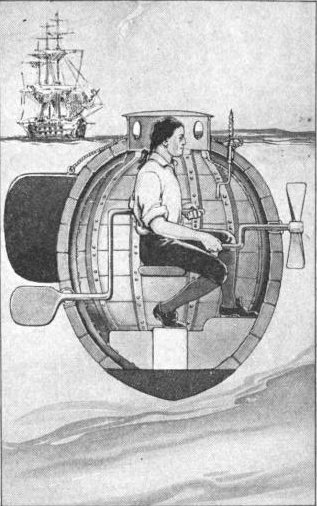
The external shape of the Submarine Vessel bore some resemblance to two upper tortoise shells of equal size, joined together: the place of entrance into the Vessel being represented by the opening, made by the swell of the shells, at the head of the animal. The inside was capable of containing the Operator, and air, sufficient to supply him, thirty minutes, without receiving fresh air.

At the bottom, opposite to the entrance, was fixed a quantity of lead for ballast. At one edge, which was directly before the operator, who sat upright, was an oar, for rowing forward or backward. At the other edge, was a rudder for steering. An aperture, at the bottom, with its valve, was designed to admit water for the purpose of descending; & two brass forcing pumps served to eject the water within, when necessary for ascending. At the top, there was likewise an oar, for ascending or descending, or continuing at any particular depth. A Watergage or Barometer, determined the depth of descent, a compass directed the course, & a ventilator within, supplied the Vessel with fresh air, when on the surface. . . .

The skilful operator could swim so low on the surface of the water, as to approach very near a Ship, in the Night, without fear of being discovered, and might if he chose, approach the stem or stern, above water, with very little danger. He could sink very quick, keep at any depth he pleased, and row a great distance, in any direction he desired, without coming to the surface; & when he rose to the surface, he would soon obtain a fresh supply of air, when, if necessary, he might descend again and pursue his course. . . .

In the first essays with the submarine Vessel, I took care to prove its strength to sustain the great pressures of the incumbent water when sunk deep, before I trusted any person to descend much below the surface: and I never suffered any person to go under water without having a strong piece of rigging made fast to it, until I found him well acquainted with the operations necessary for his safety. After that I made him descend and continue at particular depths, without rising or sinking, row by the compass, approach a Vessel, go under her, and fix the Woodscrew…into her Bottom, &c. until I thought him sufficiently expert to put my design into execution.

I found agreeably to my expectation, that it required many trials to make a person of common ingenuity, a skilful operator. The first I employed was very ingenious and made himself master of the business, but was taken sick in the campaign of 1776 at N.York, before he had an opportunity to make use of his skill, and never recovered his health sufficiently afterwards.
David Bushnell’s first operator was his own brother Ezra. They had inherited a farm together, and Ezra had bought out David’s interest to give him the capital to attend Yale College—an unusual course for a man in his late twenties.

Jefferson had Bushnell’s detailed description of his invention published by the American Philosophical Society in 1799. Those documents serve as the source for all attempts to depict and recreate the submarine, such as the 1916 illustration above.

TOMORROW: Into action.

Thursday, August 27, 2026

“Arnold’s Defeat or Ultimate Victory?” Conference at Fort Ti, 9–10 Oct.

On 9–10 Oct 2026, Fort Tionderoga will host a Special 250th Conference on “Arnold’s Defeat or Ultimate Victory?: Perspectives on the 1776 Campaign,” covering the Battle of Valcour Island and surrounding events.

The venue explains:
The failure of the British to seize Ticonderoga in the fall of 1776 was a critical, vital victory for the Americans in the early years of the Revolutionary War—acknowledged even at the time. But who gets the credit for the year’s victory? Benedict Arnold and his lake fleet? Horatio Gates and the defenses of Ticonderoga and Mount Independence? Sharing new perspectives and new research from a variety of disciplines, our panelists will detail, and debate, the critical actions of the campaign to better understand the impact of October 1776.
The event starts with optional programs on Friday:
  • 11 A.M.: Tour of Liberty Hill and the Outer Defenses of Fort Ticonderoga with Stuart Lilie, Vice President of Public History.
  • 1:15 P.M.: Crewing a Bateau—Join the fort’s Maritime Trades staff, take an oar, and head out on Lake Champlain in a bateau.
  • 3 P.M.: Ticonderoga’s Treasures: The 1776 Campaign on Lake Champlain with Dr. Matthew Keagle, Curator.
These programs have limited space and additional fees ranging from $35 to $50.

Here are the conference presentations scheduled for the Saturday conference:
  • “Carleton’s Race to Ticonderoga: His Opponents and Why He Lost” by Don Hagist, editor of the Journal of the American Revolution.
  • “Crafting Independence: The Work Behind the Battle of Valcour Island” by Kenneth Cohen, Chair of the Division of Military & Society at the Smithsonian’s National Museum of American History.
  • “‘To prevent Shipping coming past’: Ticonderoga’s Amphibious Fortifications” by Stuart Lilie, Vice President of Public History at Fort Ticonderoga.
  • “The day must shortly come when these facts will be known to the World” by Eric Schnitzer, ranger and military historian at Saratoga National Historical Park.
  • “‘An Active Part in Our Favour’: The Stockbridge Mohican Indians” by Mark R. Anderson, author of Down the Warpath to the Cedars.
  • “The Archaeology of ‘Destruction Bay’ and the Events of October 13, 1776” by Christopher Sabick, executive director of the Lake Champlain Maritime Museum.
The sessions will end with a panel discussion collecting all the speakers and moderator Dr. Matthew Keagle, Curator of Fort Ticonderoga.

The fort also organized a Sunday cruise on Lake Champlain, following the maritime action, but that’s already sold out.

The presentations will be livestreamed so people can register to listen online. For more information, including cost, meals, and schedule, visit the conference webpage.

And while you’re there, also check out Fort Ti’s annual conference on the American Revolution, scheduled 26–27 September.

Monday, August 17, 2026

The Losses of Benjamin Davis

In the newspaper reports on the May 1775 fire on Boston’s Town Dock, Benjamin Davis’s name appears only as the man who used to use (“improve”) the building where the fire started.

Davis had “Let General Robenson [James Robertson] have his store for the Brit Troops in the year 1775,” as he told the Loyalists Commission years later.

In his testimony to that commission Davis said he’d lost a great deal of property in the fire: “his story & wharf & Goods in the cellar were destroyed to amount of £900.”

In addition, Davis said that he was out:
  • £56 in whaling supplies on a ship “the Rebels” seized in Salem
  • £375 more in goods left behind in Boston in March 1776
  • £200 in household furniture in Boston
  • about £3,666 in uncollected debt due to him through his old partnership with his brother Edward
  • £700 in “Money & Wine” confiscated when he was captured in July 1776
Davis also said he “Was robbed of £400 on his way to Halifax,” but I can’t tell whether that was in 1776 or at the end of the war.

Most of Davis’s commission hearing involved discussing financial details like a mortgage or the value of certain land. He asked to be compensated for a total of £4,865 in losses, according to E. Alfred Jones’s The Loyalists of Massachusetts.

The commissioners awarded Davis only £300, suggesting they thought his claims were too high or too poorly documented, and/or that he had already been compensated enough through his wartime business with the government.

TOMORROW: Junior.

Tuesday, August 11, 2026

“We went to see Mr. Davis in Jail”

As I wrote back here, the lore in Benjamin Davis’s family was that his third wife, Alice, left him soon after their marriage in 1768 because she couldn’t stand how he worshipped with the Sandemanians.

Reportedly the men of the sect agreed that Davis could remarry if he chose. In a profile of Davis written for the Colonial Society of Massachusetts, Henry H. Edes said:
If Mr. Davis married a fourth wife, it is probable that she was Katharine Overlick, whose Intention of Marriage with Benjamin Davis was entered 24 April, 1773, but as we find no record of a marriage, and do find that Catharine Overlick,—presumably the same woman—entered her Intention of Marriage with John Clows 10 November, 1774, it is doubtful if Mr. Davis made another matrimonial alliance.
Alice (Whipple) Davis died in Cranston, Rhode Island, in 1795.

When captured on the Peggy sailing from Halifax to New York in July 1776, Benjamin Davis was accompanied only by his son and an enslaved man. In contrast, a couple of other merchants on the same ship were traveling with their wives, most notably Robert and Mary Semple, formerly Mary Wheat of Lincoln.

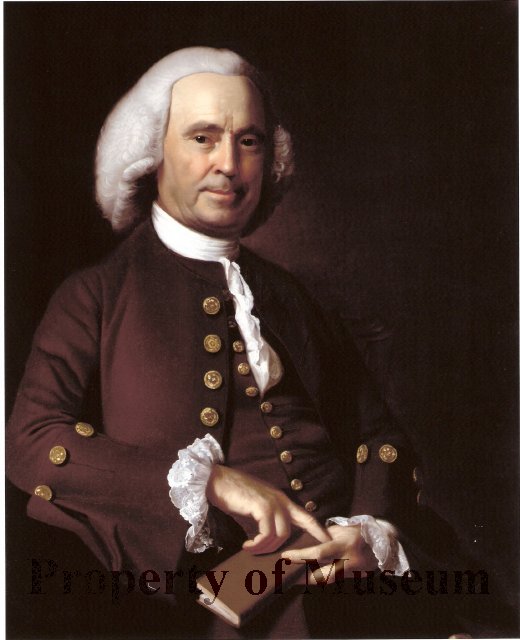
In her journal, published by the Essex Institute in 1868, Mary Holyoke (1737–1802, shown above) of Salem wrote:
July 28. Mr. Ben. Davis taken and put into Jail at Boston, and on the 31st Mrs. Davis spent the day with us at Mrs. Minott’s; we went to see Mr. Davis in Jail.
It appears that this “Mrs. Davis” wasn’t Benjamin Davis’s wife but a friend and/or relative of Mary Holyoke whom she mentioned many other times. But this Mrs. Davis could also have been related to Benjamin, giving him a courtesy call.

Life in the Boston jail wasn’t easy. The mates on the British transport ship Anne, James Young and John M’Kurdy, escaped from custody in Massachusetts and provided this intelligence on 24 August:
That Mr. Benjamin Davis, and several others were passengers, and that they treated Mr. Davis very ill. That they do not give the prisoners sufficient provisions, but offer them good wages to enter on board their privateers, and that many do enter.
The captain of the Peggy, James Kennedy, even petitioned the Massachusetts Council on 13 August for release on the grounds that he didn’t deserve to be associated with his passenger:
As your Petitioner had a Man on Board by the Name of Davis whose Character he did not know till he was brought into this Place, he beleives is the Occasion of his receiving different punishment from other Masters of Vessells.
Kennedy was indeed let out of the jail. According to the Naval Documents of the American Revolution editors, four other men gained release through “similar petitions.”

TOMORROW: Junior.

Saturday, August 08, 2026

“Fell in with two Arm’d Schooners”

Yesterday I wrote about Benjamin and Edward Davis, two brothers who were mercantile partners in Boston until religion and Revolutionary politics split them apart.

Benjamin became a Sandemanian, devoutly guided not to oppose British Crown policies by, for instance, signing on to the non-importation boycotts.

Edward remained an Anglican, attending Trinity Church. By late 1774 the Whigs coopted him into helping to enforce their strongest boycott, the Continental Association.

Both brothers remained in Boston during the siege. But when the British military evacuated, Edward stayed while Benjamin sailed away to Halifax, Nova Scotia. In April 1776 the Patriot authorities ordered magistrates to question Edward about his loyalty, but evidently he passed muster.

Around the start of July, Benjamin Davis boarded the ship Peggy, headed for New York. Along with him came his son Benjamin, Jr., who turned twenty that year; an enslaved man; half a dozen other Loyalist men; and a few Loyalist women.

Evidently those refugees saw business opportunities supplying the huge British and Hessian army assembling at New York. The Peggy was loaded with provisions, including 2,648 “mutton hams,” 311 “tierces salted beef,” fish, flour, snuff, cloth, stockings, and a large quantity of alcohol in various forms.

The Peggy also carried six 3-pounder and two 2-pounder cannon. It sailed in convoy with dozens of other merchant ships and troop transports, all escorted by two Royal Navy warships. The sea voyage probably seemed safe.

We have the ship captain’s account of what happened next:
I James Kennedy, Master of the Ship Peggy, in the Merchant Service, declare that I left Hallifax about the first Inst. [i.e., of this month] under Convoy of the Renown of Fifty Guns, with a Fleet of sixteen [torn] Transports containing the 42nd & 71 Scotch Regiments & Fraziers new rais’d Regiment, about 3000 in all, & three Large Ships with Hessian Troops on board, about 600 in all, & one Ship with 5 companys of English foot Guards, & four Victualling Ships, the whole Fleet bound for New York.

Off Nantucket Shoals we fell in with the Flora Frigate of Thirty Guns & four Transports with Highland Troops, these had been in Boston Bay, where they got information from a Fisherman that the Town was Evacuated, on which they Stood for Hallifax untill they met with us, they then joyn’d our Fleet for New York.

The Scotch Troops were all to be of Coll [Archibald] Campbells division (of the Grand Army in America, the whole of which Army I was informd, would by the last of July, amount, to 50,000.) the Hessian Troops left England about the 12th of May, some of the Officers informd me they came out with 304 Sail under the Command of Commodore Hawtham [William Hotham], on board of whom were 10,000 Foreign Troops & some English Troops (number unknown).

last Fryday sennight [19 July] in a gale of wind & thick weather I lost the Fleet & on monday [22 July] I fell in with two [American] Arm’d Schooners, Capts. [John] Skimmer & [Samuel] Tucker, to whom I surrendered after a short engagement, in which I had only one man Wounded.

The day after the Fleet left Hallifax, I saw from my Deck forty Sail of Ships standing in for that Harbour, & which I suppose to be part of the Fleet under Commodore Hawtham.
Skimmer commanded the Franklin and Tucker the Hancock, schooners originally launched under the authority of the Continental Army commander. They were now sailing for Massachusetts.

The Patriot authorities who took Capt. Kennedy’s deposition were evidently pumping him for intelliegence on what other British ships and troops were out there rather than details of his engagement with the schooners.

For Benjamin Davis, all that mattered now was that he was a prisoner of the state he’d left four months before.

TOMORROW: The gingerbread man.

Tuesday, May 19, 2026

“They talk of sinking Hulks by the Castle”

On 29 Apr 1776, one week after writing the letter to John Adams that I quoted yesterday, the Rev. Dr. Samuel Cooper wrote to Samuel Adams:
this Town…is now in some better Posture of Defence, but the Works proceed slowly. I must repeat what I said to you in my last, There is an absolute Necessity of some able active Commander here, such as [Nathanael] Green, [John] Sullivan, [Israel] Putnam &c upon other Accounts besides fortifying, tho this is of extreme Importance in our Situation— . . .

We have some good Lines, excellent Cannon at Fort Hill; this is all our Defence at present, except the Works thrown up at Dorchester Point which are said to be good—We are now going to erect Works at the Castle, & hope to have a Line of Guns well defended, on the Eastern Point; & are preparing to sink Hulks, between the Rocks of Castle Island, & the lower middle Ground.

The Enemy employ’d no little Time in ruining all the old Works there, and destroying the Guns…
Cooper still wanted someone besides Gen. Artemas Ward to supervise the defense of Boston, but his description of the town’s defenses was a little advanced from the previous week.

A 22 April letter from Boston quoted in the Connecticut Gazette of New London also said: “Tomorrow they talk of sinking Hulks by the Castle.” Those hulks were the keels of old ships, meant to impede Royal Navy warships from sailing easily into the inner harbor.

Of course, those same obstacles would also be a problem for merchant vessels, or American warships. On 30 April James Warren told John Adams: “No hulks as yet sunk; the people of Boston seem much against it; and whether it will be done or not I can’t say.” After all, Warren was merely the speaker of the Massachusetts house.

On 9 May that legislature directed its harbor defense committee “without delay to sink the Hulks.” But on 23 May the Boston town meeting voted (unanimously, it was later said) against that measure. The General Court on 5 June suspended the operation, though empowering the committee to proceed “upon any sudden Alarm or appearance of danger.”

Soon enough, fear of British warships invading Boston waned. No hulks were sunk in the harbor.

Monday, May 04, 2026

The Hill Brothers Settle in Canada at Last

On 27 Apr 1782, Elizabeth Hill died, “greatly lamented by her Family and Neighbours,” the New-York Gazette reported two days later.

In that news item her husband, John Hill, had “Esq.” after his name, a genteel reflection of his service to the Crown inspecting the Brooklyn ferry.

Also by that time, the Americans had won the war. Gen. Guy Carleton was about to be appointed commander of the British forces, charged with holding things together till the end. Gen. George Washington’s Continental Army was pressuring New York City, but not trying anything too risky. Lt. Col. Benjamin Thompson was getting his combat experience by leading dragoons on Long Island. But basically people were waiting for the final peace terms to be settled.

John’s brother Richard led one of the first contingents of Loyalists to leave New York, embarking in June 1783. He was in Carleton, Nova Scotia (which would become St. John, New Brunswick), in September when he wrote back to John about a ship captain named John Mason who had tried to make off with the vessel under his command.

Richard Hill was described as the first Loyalist to build a frame house in the town of Digby, Nova Scotia. He became a justice of the peace and a vestryman.

John Hill and his family evacuated New York late in 1783, eventually joining his brother in Digby. By the next year, John had remarried. His household consisted of him, his wife, a child over age ten, and three “servants” over age ten.

In 1786 the Loyalists Commission held hearings at Halifax. John Hill applied for “half pay, as a Quarter Master, but was told by their Honors that Pensions, and Half Pay, was to be Settled in England.” Four years later he was in London, petitioning for support for himself and his brother. Returning to Digby, he managed a store and was first treasurer of the local Freemasons’ lodge.

People think that Richard Hill died around 1803, three years after his wife Jane (her gravestone shown above).

John died on 23 Nov 1817—forty years after he had been released from the Boston jail, accused of helping to loot the town during the evacuation.

Sunday, April 19, 2026

The Case of the Stolen Fishing Boat

Ashley Bowen was a sailrigger in Marblehead who kept a diary for many years, published in print and online by the Colonial Society of Massachusetts.

On 29 February 1776, Bowen recorded a waterfront crime:
This night some seamen took Eleazer Ingalls’s boat and went to the Nautilus.
H.M.S. Nautilus was a Royal Navy sloop, rated for sixteen guns, under the command of Cdr. John Collins. It patrolled outside Marblehead harbor, hunting for the Continental schooners and trading ships. Or, as Bowen wrote on 1 March:
The Nautilus layeth a mile below our Fort. Much ice about her. Ingalls’s boat astern.
The next day the warship sailed out of sight “and carried Ingalls’s boat with her.”

A month later, Bowen started to record details about the Loyalists captured on the Elizabeth:
5 [April:] … Admiral John Manley arrived at Beverly [other sources say Gloucester] with 13 of the King’s troops on board, prisoners whom he had taken out of a brig he took bound from Boston for Halifax and carried in to Portsmouth, laden mostly with English dry goods, one [William] Jackson merchant. . . .

9 [April:] … I find Captain Samuel Tucker hath brought the inhabitants that was taken by Manley from Cape Ann and landed them here, and they are housed at Mr. William Rogers’s house at Nick Cove. . . .

10 [April:] Sam Tucker went out and returned to Beverly as his cruise is up. Passed a ship for Boston. The 3 men are taken up that stole Eleazer Ingalls’s boat and carried her to the ship.
The authorities had cracked the case of the missing boat! On 17 April Joseph Orne reported to the Massachusetts Council on behalf of the Marblehead committee of safety:
The Committe of Correspondence upon a ReExamination of the Prisoners, (taken by Capn Manly on board the Brig Sally [sic] bound to Hallifax) have made a Discovery of Joseph Wheaton & his Brother Caleb Wheatons Stealing & Carrg away a Fishing Boat in the night of the 28th Feby last, from Eleazer Ingalls of this Town, & then made their Escape to one of the Men of Warr Station’d here—

An Acct of the Boats amount with stores &c, Will be forwarded by the Owner who also Attends to Wait your Honours Determination respecting what Steps He shall pursue in the Recovery of his Intrest Again—

We are with the Greatest Respect
In behalf of the Committee
Joshua Orne Chairm.

P S Phineas Jones one of the Prisoners & who was also concerned in the above Theft Eloped the 10th Inst—notwithstandg he was under the Care of the Guards
Before reading these sources, I pictured Caleb Wheaton, Sr., going into Boston just before the war began or shortly afterward, and his wife and family joining him there (perhaps reluctantly for some) in the spring or summer of 1775.

The way Orne wrote about this theft suggests a different scenario: Phineas Jones, Joseph Wheaton, and Caleb Wheaton, Jr., stole Ingalls’s boat in order to get to H.M.S. Nautilus and thus into Boston. If so, those Wheaton brothers were inside the besieged town for only a couple of weeks before it was time to leave.

TOMORROW: A summons to Watertown.

Friday, April 17, 2026

“The honor of this enterprise belongs to Joseph Wheaton”

Yesterday I shared part of a letter Joseph Wheaton wrote in 1818 about how men from Machias, Maine, captured H.M.S. Margaretta early in the Revolutionary War.

In 1824, Charles W. Goldsborough quoted that letter in The United States Naval Chronicle. Many other chroniclers drew on it to describe the fight, sometimes said (by people not from Fairhaven) to be the first naval battle of the war.

In The Pictorial Field-book of the Revolution (1852), Benson J. Lossing said in a footnote:
The honor of this enterprise belongs to Joseph Wheaton, a native of New York, then residing at Machias. He was an energetic young man of twenty years. He proposed the expedition, but modestly named [Jeremiah] O’Brien for commander. He was active in the whole affair, and in person seized the colors of the Margaretta.
However, in a 1975 article for Maine History titled “The Historiography of The Margaretta Affair, Or, How Not To Let the Facts Interfere With a Good Story,” Edwin A. Churchill grouped Wheaton’s description of events with other unsupported or untenable tales. Churchill referred to “the self-centered bragging of Joseph Wheaton” and said his memory was “notoriously bad.”

Churchill’s main targets were two big errors that he said “traditionalist” authors kept making in their accounts of the Margaretta affair. It wasn’t sparked by conflict over a Liberty Pole, he insisted, and Benjamin Foster’s ship didn’t run aground before the fight. Wheaton wrote nothing about a pole, but he left Foster out of his account entirely. 

I won’t continue to quote Wheaton’s account, which you can read in full here, thanks to Maine Memory. Nor will I try to pick apart its details, much as I like doing that. Other people, closer to Machias geographically and emotionally, can handle that task.

Instead, I’ll consider how Joseph Wheaton’s account of the Margaretta capture fits, or doesn’t fit, with his status in March 1776: in the family of a royal appointee evacuating Boston with the British military.

It’s possible that Joseph Wheaton did take part in the attack on the Royal Navy sloop in 1775, despite (or because of) how that would have angered his father, a local Customs officer and Loyalist. He wouldn’t have been the only Revolutionary veteran to muddle details of events forty years before and put himself and his friends at the center of an event. He definitely did join the Continental Army a couple of years later.  

On the other hand, coming from a Loyalist family gave Joseph Wheaton a strong incentive to play up his Patriot credentials. In 1776 Massachusetts authorities even confined him as a suspected Loyalist. Telling the story of helping to capture the Margaretta let Wheaton claim that he’d fought for what became the U.S. from (nearly) the start of the war.

And Wheaton told that story a lot.

TOMORROW: Over the decades.

Thursday, April 16, 2026

“I said to him—Dennis let us go and take that Schooner”

Where were Caleb Wheaton, Sr.’s sons when the Revolutionary War began in April 1775?

Wheaton made his home on a substantial riverside plot in Machias, Maine, but he also owned real estate in Dedham. It’s conceivable an older son was farming that land.

The newspaper articles I quoted here suggest Wheaton himself was traveling in his home town of Rehoboth and nearly Providence, Rhode Island, in February.

But I haven’t found any statement from Caleb Wheaton about why or when he left Machias, when he went into Boston, or how many family members were with him.

In contrast, Caleb’s son Joseph Wheaton left a definite and detailed account of how he saw the war begin. In a letter to Gideon O’Brien, written on 23 Apr 1818 and held and published by the Maine Historical Society, Joseph Wheaton stated:
Before the Battle of Concord 19. Apr 1775—the Margarette Schooner Capt Moore—saild from Boston and came to Machias to escort convoy two sloops owned by Ichobod Jones with lumber for Boston & for the use of the British Governmt

while those vessels were loading. their came to Machias a vessel, & brought the news of the Battle of Concord—and communicated it to the people, on a Saturday Evening—

the next Morning Sunday it was proposed to take the officers when at public worship, and thereby obtain the vessel in retaliation for Concord & Lexington,

in attempting this, the officers Capt Moore & others escaped and got on board the Schoon—and fell down to Scotts Wharf—Where they were fired upon by a party who had come there headed by Mr [Benjamin] Foster from the East river—but as it fell dark very soon the Margarette fell down the river near where my family then lived

on Monday morning the people being yet together at Scotts—the Schooner in view. Your Brother Dennis and Myself were Standing on the Wharf by ourselves—when I said to him—Dennis let us go and take that Schooner—

how will you do it Said Dennis—

I said, we can take Job Hains’s Sloop, get the people on board her, the Sloop will out Sail the Margarette, we can board her and take her—

with all my heart said Dennis—

we then called to our aid two youths and renewed the proposition to which they agreed—we four immediately steped into a boat and went on board the Job Hains’s sloop and demand him to take the sloop to Scotts Wharf which with some little opposition was effected—

so soon as we steped on shore and gained the Bank before Scotts house, we four took off our Hatts and gave three cheers—when your Brother Jeremiah steped forward, yourself & Brother John & called upon the people to undertake the interprise to which all consented
We know from other sources that Lt. James Moore brought H.M.S. Margaretta to Machias in early June 1775, well after news that a war had started. That should be our first tip-off not to take the story that Joseph Wheaton told more than forty years later at face value.

TOMORROW: Maine memories. 

Saturday, April 11, 2026

“Itt’s said she has a large quantity of the Stolen goods”

It didn’t take long for New England Patriots to realize that Cdre. John Manley’s capture of the Elizabeth on 2 April 1776 was a big deal.

On 6 April, Isaac Smith, Sr. (1719–1787, shown here courtesy of the Yale University Art Gallery), wrote to his niece Abigail’s husband, John Adams, from Salem:
Commodore Manleys fleet has taken a brigantine bound to Halifax on board of which is Bill Jackson and all his Effects and itt’s said she has a large quantity of the Stolen goods—

and there is on board likewise One Greenbrush, receiver general of the stolen goods and has distinguisht himself in that way by demanding People’s propaty from them. Itts said he came from York and itts said those Carpenters and runagarders from that way has behaved worse than any Others.—

A sloop is on shore at the Cape, beleive nothing very Valuable on board but itt Appears they (the inhabitants) went away in a most dismal Cituation, not haveing even Water sufficient and crowded and some sick with the small pox.
That sloop was the Sally, commissioned by Jolley Allen and captained by no one who knew what he was doing, as described back here.

As a merchant in Boston before the siege, Isaac Smith knew William Jackson and his troubles well. But Smith wasn’t familiar with Crean Brush, who had arrived from New York after the siege began—hence his reference to the man as “One Greenbrush.”

John Rowe was all too familiar with Brush, having watched that royal appointee confiscate some of his property. On 8 April he wrote in his diary with surprising calm:
Capt. Manly is come to Town & brings the Accot. of his Taking Crian Brush Wm. Jackson & Twenty other passengers in A Brigg bound with The Fleet—

This Vessell tis Said has Twenty five Thousand pound Sterling On board—in English Goods & Other Merchandise—

among the Prisoners is A Sergiant & 12 Men of the Kings Troops
On 8 April Rowe added:
There is a Confirmation of Crean Brush & Wm. Jackson being taken & also My Negro Fellow Adam
Adam was one of the four enslaved people found aboard the Elizabeth. Remarkably, this is the only time in his published diary that Rowe mentioned the man. We therefore have no clue about how he came to be on the brig. Had Adam asked to evacuate the town, or had Rowe sent him away?

TOMORROW: Following the money.

Friday, April 03, 2026

All Aboard the Elizabeth

When Cdre. John Manley captured the brigantine Elizabeth, evacuating from Boston, in April 1776, he saw that he’d hooked an important—and potentially lucrative—prize.

Manley sent some of the people aboard that ship to Gloucester on the Lee under Capt. Daniel Waters. He kept the rest on the Elizabeth and escorted that ship to Portsmouth, New Hampshire.  

That harbor was appropriate since it was the Elizabeth’s home port. Back in October 1775 H.M.S. George had captured that brig on its way back from Montserrat. The local merchant Richard Hart (c.1744–1820) was glad to see his ship return.

The Elizabeth was still carrying the seventeen hogsheads of rum and four hogsheads of sugar that it had picked up in the West Indies. And it was loaded with other cargo. There were household and mercantile goods that passengers were taking with them from Boston and, most valuably, a large quantity of linen and woolen cloth.

Sadly, the property on board the ship also included four enslaved people, listed in a public document a couple of months later as:
A negro man named Adam, John Rowe, Esq owner.
A negro man named Scip, Harrison Gray Esq: owner.
A negro woman named Belinder, Benjamin Austin Esq: owner.
A negro woman named Brada, a widow Kitpath, owner.
Rowe, Gray, and Austin were all rich Boston merchants, but they were in different political situations. Gray, also royal treasurer of Massachusetts, had left with the fleet. Austin was on the Patriot side. And Rowe was trying to find his usual place in the middle, having stayed in Boston through the siege but then stayed in town after the siege as well. (I can’t identify the widow.)

The Elizabeth was also carrying “a Serjeant & twelve privates of the 4th or Kings own Regiment,” who were now prisoners of war. At least some of those soldiers had wives and children with them.

In all, there were forty-six civilians on board the Elizabeth, including the ship’s captain, Peter Ramsey, and the crew. The most prominent of the Loyalist passengers were:
And Brush had made himself notorious inside besieged Boston.

TOMORROW: Where those woolens came from.

Wednesday, April 01, 2026

“This captain of ours was at the greatest loss”

Yesterday I started to tell the story of how Jolley Allen evacuated Boston with the British fleet in March 1776—or tried to.

Quoting Allen’s own narrative of course gives away the fact that he survived to tell his tale. But it’s such a sarcastically detailed account that I can’t resist.

We left Allen on the morning after the British ships left Boston harbor. Along with his large family and almost two dozen other people, he was on sloop Sally, and it was sinking.

Allen had come to the realization that the man he’d hired to captain that vessel, Robert Campbell, knew nothing about navigating the ocean or even how a sailing ship worked.

That meant for a tense few hours in the early morning of 28 Mar 1776. But then at seven o’clock Campbell “said he saw a vessel.”

Allen urged Campbell to chase after it. Campbell replied that “did not understand steering the vessel he was in, so well as he knew how to give directions to another.” Allen pointed out that he hadn’t hired anyone else who knew how to steer it any better.

Some time later, Campbell announced “he thought he never saw so large a Ship before.” Allen looked and saw the man was pointing at a stretch of land.
I applied to him and asked him what land he thought it was. He told me that he was fully convinced that it was Nantucket. I told him, if that was the case, we must all perish very soon; for the amazing rocks and shoals that lay off Nantucket I could remember very well, as I saw them above Twenty-Two years ago on my passage when I came from London. . . .

This captain of ours was at the greatest loss to know what to do in this situation, seeing land, for want of a map (which I am of opinion had there been one on board he knew no more what to do with than a rat).
The two men called everyone up on deck to discuss what to do. Some passengers feared drowning most. Some had more fear of falling into rebel hands—though Nantucket would prove to be neutral territory for most of the war. Allen advocated running the sloop on shore. Campbell suggested going back out to sea and hoping a Royal Navy ship would come by. Showing their confidence in the captain, the group voted to try the shore.

With the help of a handy current, the Sally moved inland, then struck a sandbar “violently either seven, eight, or nine different times.” Waves lifted the sloop over the bar, but the anchor caught for a while. About 2 P.M. the sloop reached calmer water
with all our sails hoisted, as we had hoisted in Nantasket Road; some all the way up, some half the way up, and some not a quarter of the way up; torn, to appearance, into ten hundred thousand pieces, all flying.

The captain says to me, by way of adviseing with me, seeing no boat come off to us, whether or no we had not better hoist a signal of a white sheet or table-cloth, to let them know we was in distress for want of a boat. The answer I made him was that I thought the above signals was quite sufficient
Eventually a man appeared on shore. The people on the Sally waved. More men appeared. Those men stood and talked with each other.
At last, to our great joy, we saw a cart with a boat (or cano) in it drawn by ten oxen, and six men more, which came down to our assistance. They soon got the boat into the sea, and two men in it to know from whence we came.
Those two oarsmen hadn’t had smallpox, and one of the women on board was dying from the disease (though Allen didn’t come right out and say that). So the passengers had to wait for two different men with immunity to bring out the rowboat. At about seven in the evening the locals started to ferry the people on the Sally to shore. Allen wrote:
I asked them the name of the place; they told me it was Cape Cod. I told them my captain told me, and insisted upon it, that this place was Nantucket. They answered me that Nantucket was above four days’ sail from Cape Cod with a fair wind.
Allen and Campbell hadn’t managed to escape rebel Massachusetts. They hadn’t even managed to get out of Cape Cod Bay.

TOMORROW: More Loyalists at sea.

Tuesday, March 31, 2026

“I told him I was sorry we had not a boat”

Not everyone who evacuated Boston in March 1776 actually got to Halifax.

Back on 11 March, the British-born merchant Jolley Allen rented a sloop called the Sally to evacuate with his wife and seven children. It looks like his party also included “Sally Bradford; servant maid,” and “Lilla Coppinger, belonging to Mr. Allen’s family.”

To command that ship Allen hired a man named Robert Campbell, and Campbell hired a small crew. Allen also authorized his captain to sell space to other passengers: five women, three of them with children along. When the Sally left the dock on 14 March, it carried thirty people, only six of them men.

Capt. Robert Campbell was an experienced mariner working out of New York, as shown by many newspaper entries. Unfortunately, in March 1776 that man was stuck on Antigua, contesting the seizure of his ship America by Capt. Samuel Graves of H.M.S. Viper, as he described at length.

The Robert Campbell whom Allen had hired was, according to New Brunswick Loyalist Journeys, “a farmer and tavern keeper in Monmouth County,” New Jersey, who for political reasons had fled to New York and then to Boston in October. Campbell’s tavern in Freehold continued to be a landmark until at least 1780, so perhaps Robert’s wife Mary and children stayed to run it after he left.

This Robert Campbell’s lack of seagoing experience wasn’t evident when boats towed the Sally out past the Castle on 17 March, then down to the Nantasket Road. The sloop was assigned to be part of the second division of the evacuation fleet, receiving the signal to sail for open waters on 27 March. And then everything started to go wrong.

First the Sally suffered two collisions in Boston harbor, its bowsprit ripping off parts of two larger ships. Then the sloop ran aground. It fell behind the rest of the fleet. Darkness came, and the small crew lost sight of the other ships ahead. By this time Allen had discovered that Campbell couldn’t tell which way the tide was flowing without an almanac, tie a sailor’s knot, or assemble the pumps.

By midnight a corner of the main sail had ripped loose and been jury-rigged to the pumps. The barrel of fresh water had leaked out. The kitchen apparatus (the “cabose”) was knocked overboard. Ice was coating the lines and the deck. And by the early hours of 28 March, “a plank in the side of the vessel had given way, and the sea was pouring in, and the vessel was sinking.”

Allen wrote:
I then desired the Captain to come upon deck with me, which he did; and I asked him whereabout he thought we was at sea.

He told me he could not tell.

I then asked him what distance we was from land.

He said that was impossible for him to tell, for he had not kept any reckoning, and the reason he gave me for it was that he had forgot to bring pens, ink, and paper.

I told him, if he had applyed to me, I had all these things.

He then made me answer he had never learned navigation, and that he never was on salt water before; but he knew how to row a boat in a river;

on which I told him I was sorry we had not a boat, that we might save our lives at the sinking of the vessel, and at the same time I told him, if we had a boat with oars, it was my opinion he knew as little of it as he did of navigation
The two men stayed on deck the rest of the night, not speaking to each other.

TOMORROW: Can this sloop be saved?

Monday, March 30, 2026

“The Prospect of this Country is very Sterile”

Capt.-Lt. Archibald Robertson, British military engineer, sailed out of Boston harbor on 25 Mar 1776.

Robertson’s ship was an army transport called the Thames. It was in the first contingent of vessels heading for Halifax—forty-nine in all, per his count.

Three days later, Robertson recorded in his diary, the Thames crew spotted Cape Sable, the island at the southernmost corner of Nova Scotia. The next day, the ship “made the light house west of the harbour of Halifax and came to an Anchor about 2 o’clock off Chebucto point in the harbour.”

On 30 March, 250 years ago today, Robertson’s ship moored alongside a wharf, and Loyalist refugees presumably started to disembark at their new home.

The young officer examined his new base with an eye for its defenses. He wrote:
The Prospect of this Country is very Sterile and unimprovable, The Bay very good and extensive and if the Ground was Cultivated or Capable of being so would be very beautifull.

The Town which is long and Stragling built of wood on the side of a hill, and the Dock Yard, are so Commanded by Different heights that it appears to me to be impossible to fortify them without a Multiplicity of Works and more troops than could possibly be spared.

The Ships in the Harbour opposite the Dock Yard could Easily be drove away from either side and the Dock Yard destroy’d from the East side which is not above 1400 Yards across.
Adm. Molyneux Shuldam, Gen. William Howe, and most of the rest of the evacuation fleet arrived from Boston on 2 April.

The picture above is Robertson’s “Sketch of the Harbour & Town of Halifax with our fleet turning up,” now in the collections of the New York Public Library.

Friday, March 27, 2026

“Here I took my leave of that once happy country”

Even after the destruction of Castle William, described yesterday, Judge Peter Oliver’s ship Pacific remained in Boston’s outer harbor, waiting for the right weather.

On 24 March, Oliver recorded, the night was so cold “that the vessell’s bows and cables were loaded with ice.”

The next day the winds were more favorable. A packet ship sailed for London, carrying Oliver’s son Peter, Jr., and his wife Sally; Sally’s brother Thomas Hutchinson, Jr., and his wife Sarah (who was also the judge’s niece); and their children among the passengers. At the same time, the “first Division” of the Loyalist fleet headed toward Halifax.

Still, Oliver’s ship remained. On 26 March he was rowed over to H.M.S. Renown and dined with “Commodore [Francis] Banks,” that ship’s captain.

On 27 March, 250 years ago today, Adm. Molyneux Shuldam (c. 1717–1798, shown above) was ready to sail, his flagship H.M.S. Chatham leading a fleet of Royal Navy warships, army troop transports, and merchant vessels to Nova Scotia. But first he wrote out orders for Capt. Banks:
You are hereby required and directed to employ His Majesty’s Ship under your Command, in such manner as you shall judge best, either by Cruizing or Anchoring occasionally in preventing all communication or Commerce with the Town and Harbour of Boston; And whereas many Vessels are daily expected here with Stores and Provisions for the use of His Majesty’s Fleet and Army, which are in extreme want of them; You are to take under your Command the Ships and Vessels mentioned in the Margin and employ them in Cruizing between the Latitudes of Cape Cod, and Cape Anne at such distance from the Shore, where they are most likely to fall in with the above Expected Vessels, which you are to direct them to see in safety to Halifax, and then return to you.

You are also hereby required and directed on the Arrival of any of His Majesty’s Ships and Vessels at Nantasket (except those you have Orders to take under your Command) to give their Commanders Orders to proceed immediately to join me at Halifax, or where ever else you shall from good Authority hear I may be.

You are to take, sink, burn, or destroy, all Rebel Armed Vessels you may meet with, and to continue upon this Service till further Order, Governing yourself in the Executing of it, by the General Code of Orders and Instructions, you have already received from me, sending all Vessels you may seize or detain to Halifax, to be proceeded against according to Law, and giving me an Account of your Proceedings by all opportunities that offer.
The naval ships that the admiral listed in the margin were the frigates Lively, Niger, and Fowey; the sloop Swan; the brigs Hope and Bolton; and the schooner Dispatch. That flotilla would remain to limit New England shipping.

Judge Oliver wrote in his diary for that day:
I sailed from Nantasket, abt. 3 o’clock, afternoon, in the 2nd and last Division of the fleet, about 70 sail, for Hallifax, under convoy of the Chatham, Admiral Shuldham, and of the Centurion, Capn. [Richard] Braithwaite.

Here I took my leave of that once happy country, where peace and plenty reigned uncontrouled, till that infernal Hydra Rebellion, with its hundred Heads, had devoured its happiness, spread desolation over its fertile fields, and ravaged the peacefull mansions of its inhabitants, to whom late very late if ever, will return that security and repose which once surrounded them; and if in part restored, will be attended with the disagreeable recollection of the savage barbarities, and diabolical cruelties which had been perpetrated to support rebellion, and which were instigated by Leaders who were desperate in their fortunes, unbounded in their ambition and malice, and infernal in their dictates.

Here I drop the filial tear into the Urn of my Country.

O fortunatos nimium, sua si bona norint—Nov-Anglicanos!

And here I bid A Dieu to that shore, which I never wish to tread again till that greatest of social blessings, a firm established British Government, precedes or accompanies me thither.
Oliver’s Latin riffed off of one of Virgil’s lines in Georgics, saying that the farmers (or New Englanders) would count themselves lucky if only they knew how good they had it.

Peter Oliver was one of the wealthier Loyalists, as well as having a royal appointment (and salary). He soon moved on from Halifax to London, where he lived the rest of his life until 1795.

Oliver’s diary of departing Massachusetts was published in a volume of his friend and in-law Thomas Hutchinson’s diary and letters. Oliver also left of bitter, detailed, and gossipy account of the coming of the Revolution, written in the early 1780s and finally published in 1961. (Highly recommended.)

Thursday, March 26, 2026

The Last of Castle William

On 10 Mar 1776, the last royal chief justice of Massachusetts, Peter Oliver, boarded a ship called the Pacific, which usually sailed between India and Britain. He called it “a very commodious vessell, which General [William] Howe was so polite as to appropriate to the accomodation of my friends and me.”

For the next week, Oliver recorded periodic artillery exchanges between Boston and the Continental lines. On 17 March, he wrote, “The troops at Boston embarked, and about 20 sail fell down into King Road by 11 o’clock this morning.” The next day, he watched the army start to destroy Castle William.

One of the Royal Artillery engineers involved in that operation was Capt.-Lt. Archibald Robertson. In his diary that officer wrote, “In the Morning went to Castle William to see the mines prepar’d; found them ready for Loading.” 

The next day, Robertson “found the mines all loaded but 12 which were again unloaded as the General wanted them not to be ready for some days.” Gen. William Howe was shifting some troops onto transport ships that had just arrived from Halifax, and the 64th Regiment was still holding the Castle, exchanging cannon fire with the mainland.

That night, Judge Oliver reported, the “south Blockhouse of the Castle was burnt, and some of the walls of it blown up.”

On 20 March, Capt.-Lt. Robertson wrote:
At 3 o’clock Colonel [Alexander] Leslie came to the Castle from the General with orders to load the mines. We began immediately and had 63 done by 7 o’clock.

As the night had the Appearance of Rain and the wind fair it was thought proper for the 64th to Embark. . . . Accordingly at 8 o’clock 6 Companies Embark’d and the Boats lay off untill the mines were fired, which was done 1/2 an hour Afterwards and they had a very good Effect.

The Barracks and other houses were then set on fire, and at 9 the Rear Guard consisting of 3 Companies, the Artillery, etc. Embark’d, and we got all safe on board the Transports.
Judge Oliver’s description of this spectacle was:
The blowing up of the Castle Walls continued: and at night all the combustible part of the Castle was fired. The conflagration was the most pleasingly dreadful that I ever beheld: sometimes it appeared like the eruption of Mount Etna; and then a deluge of fire opened to the view; that nothing could reconcile the horror to the mind, but the prevention of such a Fortress falling into the hands of rebels, who had already spread such a conflagration of diabolical fury throughout America, which scarce anything can quench but the— metu tremefacit Olympum.
That Latin phrase meant “He makes Olympus tremble,” hinting at a supernatural power.

Capt.-Lt. Robertson’s watercolor of Castle William being consumed by fire appears above; “a very good Effect” indeed.

TOMORROW: Leaving America behind.

Wednesday, March 25, 2026

“Near or quite fifty Sail are got out to Sea”

Lt. Nahum Ward, son of Gen. Artemas Ward, carried Gen. George Washington’s letter (quoted yesterday) to Josiah Quincy, Esq. (shown here), of Braintree on 24 Mar 1776.

The squire, encouraged, started to make detailed notes about what the British fleet was doing out on the Nantasket Road, the shipping channel in the outer harbor.

“The Admiral [Molyneux Shuldam] has a Signal now flying at his main top mast Head,” Quincy wrote the next day, 250 years ago today. “I wish it was in my Power to construe it.” Yes, that would have been more helpful.

But then he saw movement.
11 OClock. This Moment an Explanation of the above Signal occurrs: Part of the Fleet are come to Sail: I shall proceed, journalwise, to inform your Excellency of their Movements, ’till the Bearer, who is gone to see Colo. [Benjamin] Tupper, returns.

1 OClock They are still coming to sail: near or quite fifty Sail are got out to Sea; about half of them Brigs, Schooners, and Sloops; one or two Frigates, and the remainder Transport Ships; their Course shaped for Cape Cod: May not this Division be bound for Martha’s Vineyard, and the Islands in that Sound to procure fresh Provision for the Fleet, which is to rendevous at Hallifax, and from thence to proceed to Quebec?

3 OClock My Servant, who was directed to take an Account of the Number that have sailed, informs me, there are in all fifty two: One transport Brig: is just arrived: . . .

5 OClock The Adml has just now hoisted another Signal a Pendant under his Flagg two more Ships are under Sail going out of the Harbor: 7 O’Clock, Mr Ward & Colo. Tupper are just arrived: They are of Opinion, that the Ships which sailed to Day, have carried off the Tories, and are bound with them to Lewisburgh.

Tuesday Morng [26 March] Mr Ward’s tarrying in Town, gives me a further Opportunity to inform your Excellency that the Fleet, consisting of about 100 Sail, chiefly large Ships, remain as they were last Night.

10 OClock The same Signal is now flying at the Admiral’s Main top mast Head as was hoisted yesterday morning: Scarce hoisted before it was lower’d again, & in abt ½ an hour a blew [blue] flag is flying at mizen Top mast Head and a Pendant at his mizen Peek.

11 O’Clock The above Signals are changed, for a red Ensign hoisted just under his Mizen Yard: A signal is just now hoisted upon the Top of the Light House, for Vessels in the Offing; and immediately followed, by a blew broad Pendant from the middle of the Tower: In less than 10 Minutes the Signal first mentioned vizt a Pendant is flying from his main top mast Head.

12 O’Clock A red Ensign is now flying at his mizen top mast Head; a blew Ensign at his starboard mizen Shrouds, and a pendant thrown out between, by hand, & immediately taken in again.

2 OClock The 60 gun Ship in King Road is come to Sail & going down to Nantasket: The Admiral’s red Ensign is struck; the blew one remains: a large transport Ship and a Brig are just arrived within the Light.
Quincy wasn’t sure all that detail could be useful, but he promised Washington he’d keep sending it until the general said otherwise. He really wanted to be part of the effort to defeat the British.

About half of the fleet had moved off, heading for the safe port of Halifax, Nova Scotia. Most of the rest would follow by the end of 26 March. A few warships stayed behind to patrol Boston harbor.

TOMORROW: Aboard one of those ships.