J. L. BELL is a Massachusetts writer who specializes in (among other things) the start of the American Revolution in and around Boston. He is particularly interested in the experiences of children in 1765-75. He has published scholarly papers and popular articles for both children and adults. He was consultant for an episode of History Detectives, and contributed to a display at Minute Man National Historic Park.

Subscribe thru Follow.it


•••••••••••••••••


Showing posts with label Elizabeth Randolph. Show all posts

Monday, June 27, 2022

The Marriage of Edmund and Elizabeth Randolph

Edmund Randolph and his future wife, Elizabeth Carter Nicholas, were born only a day apart in 1753. They learned to read at the same school.

Edmund returned to Virginia in late 1775 after a few months as an aide de camp to Gen. George Washington in Cambridge. He rekindled his acquaintance with Elizabeth, whom he called Betsey. In August 1776 they married.

Edmund later said he was a deist at that time, but Elizabeth’s faith won him back to Episcopal worship. They had children about once every two years while he rose in state politics.

From all accounts, Elizabeth Randolph wasn’t interested in politics or public life. People didn’t speak of her as a beauty or a glittering conversationalist, and she often complained of illness. But Edmund was devoted to her.

Having served as U.S. attorney general and secretary of state, Edmund Randolph’s career in government ended badly in a tiff with Washington and a costly lawsuit. In the early 1800s the Randolphs settled in Richmond, where Edmund commissioned the house shown above and practiced law, including representing Aaron Burr at his treason trial. Most of their children had grown up to marry other elite Virginians.

Elizabeth Randolph died on 6 Mar 1810. Nineteen days later, Edmund wrote a long letter to their children about their lives and emotional bond. He concluded:
My eyes are every moment beholding so many objects with which she was associated; I sometimes catch a sound which deludes me so much with the similitude of her voice; I carry about my heart and hold for a daily visit so many of her precious relics; and, above all, my present situation is so greatly contrasted by its vacancy, regrets, and anguish, with the purest and unchequred bliss, so far as it depended on her, for many years of varying fortune, that I have vowed at her grave daily to maintain with her a mental intercourse.
After visiting his Betsey’s grave on 9 April, Edmund suffered what he told President James Madison was a “dreadful attack from a hemiplegia, with which, by a kind of sympathy with my poor wife, I was afflicted in a few weeks from her death.”

Edmund reported that the stroke “happily affected no faculty of my mind,” and also reported that he felt “no pain,” but he developed trouble walking and came to “require in rough ground the aid of a crutch.” He cut back on his law practice and tried warm springs, but never fully regained his health. 

Edmund Randolph died on 12 Sept 1813 at age 60 while staying with a friend. He was buried in the nearby churchyard, his grave unmarked until decades later.

Sunday, June 26, 2022

“My affectionate bosom friend will be with me”

I told the story of Elizabeth and Edmund Randolph’s distress over a miscarriage through Edmund’s correspondence with James Madison.

Since the Randolphs were together at the time, there were of course no letters between them. But I find that Edward had written to Elizabeth just before he came home from New York, telling her he was moving the family to the capital for his job, and he knew she wouldn’t be happy about that.

Edmund wrote on 14 Feb 1790:
My dearest Betsy:

I can now inform you with certainty that I shall return to Virginia to bring my treasures thence; and indeed if the importunity of the President with me to stay had not been overwhelming I should not have hesitated about a resignation. . . .

The President insists, and I have promised to be here by the 20th April precisely. We must therefore without fail begin our journey on the first day of April. . . .

I am afraid it may be inconvenient and indeed painful to you, my dear wife, but I candidly tell you that I shall not be able to return to accompany you after the present trip. Let us not, I beseech you, be longer separated than the strange vicissitudes of life render indispensable. Prepare yourself and the girls for the trip. I shall provide the conveyances. . . .

My two chief anxieties on this subject are the difficulty of your travelling in your present situation [i.e., pregnancy], and the preference you would give to being confined in Virginia rather than here. But what am I to do, thou dearest object of my soul? I will consent to any thing but an absence from you. I will provide you with a gentle and easy passage.

I undergo a mixture of sensations when I think of our new plans. But it comforts me to think that my affectionate bosom friend will be with me, and that I really believe she may be happy. Until we meet, keep in remembrance my never-failing love for the best of women. Adieu, my dearest girl.
That text is quoted from Omitted Chapters of History Disclosed in the Life and Papers of Edmund Randolph by Moncure Daniel Conway.

It shows that Elizabeth was already reluctant to make a big move, even before her pregnancy went awry. It also states exactly when Randolph had promised to be back at George Washington’s side while the new federal governmet took shape. The attorney general missed that deadline by weeks, so no wonder he was anxious about what the President would say.

At the same time, this letter shows how Edmund was still gushing with affection for Elizabeth fourteen years after their marriage—though also cajoling her into what he wanted.

TOMORROW: The farewell.

Saturday, June 25, 2022

“The escape of our friend from the most critical danger”

As I’ve been recounting, in the spring of 1790 Edmund Randolph felt torn between his family responsibilities and his duties to the new federal government.

On the one hand, his wife Elizabeth was carrying an apparently dead fetus and fearing she might die.

On the other hand, Edmund had just become the first attorney general of the U.S. of A., and President George Washington was expecting him to return to New York as fast as possible.

On 27 April, Randolph wrote to his friend James Madison, who was in the capital as a member of Congress: “I see no other alternative, than this; that I must surrender the office, if my absence cannot be dispensed with.”

Randolph had asked Madison to tell the President why he couldn’t immediately come to New York. Well, not “tell” exactly. The younger men seem to have been squeamish about informing Washington frankly about Elizabeth Randolph’s medical condition.

On 6 May, Madison tried to assure his friend:
I can not suppose that under your circumstances any criticism can be made on your absence from this place, or that you are under the least necessity of deciding on the alternative which you state.
But he still didn’t report that he’d told the President what was happening, or what the man’s response was.

Fortunately, fate provided a way out of the dilemma. Washington himself got sick! On 19 May, Madison wrote:
The President has been critically ill for some days past, but is now we hope out of danger. His complaint is a peripneumony, united probably with the Influenza. Since my last I have found that I did not go too far in intimating that the cause of your delay would forbid the smallest criticism on it. I earnestly pray that you may no longer have occasion to plead that apology.
And on the same day the situation in Virginia resolved itself as well as could be expected. Well before he got Madison’s news about the President, Randolph wrote on 20 May:
Very unexpectedly a diminished fœtus appeared; manifesting, that it had lost every energy of life for more than four months. The gloom of our house is converted into general satisfaction, at the escape of our friend from the most critical danger.

I have this moment informed the president, that I shall accompany my family by sea, or the head of the bay; and that we shall have no delay, but what may be necessary for Mrs. R. to recover from her temporary weakness.
Elizabeth Randolph did recover, make the trip north, and live for another twenty years. She may not have had another pregnancy after this one; capsule biographies say the Randolphs had six children, but I find lists of only five, the last born in 1788.

TOMORROW: Randolph looks back.

Friday, June 24, 2022

“To intimate the circumstances which you wish him to know”

As I recounted yesterday, in March 1790 Edmund Randolph wrote from Williamsburg, Virginia, to Rep. James Madison (shown here) in New York.

The sad news was that Randolph’s wife Elizabeth appeared to have lost the unborn child she was carrying.

The more dire news was that Randolph wouldn’t be able to come back to New York to resume his job as U.S. attorney general until Elizabeth had passed the fetus and was out of danger—and he wanted Madison to tell that to President George Washington.

On 23 March, Randolph sent Madison his third letter in the space of two weeks: “My dear wife is not better, than when I wrote to you last. I expect something determinate in a few days.”

The mail was unusually slow, so Madison didn’t respond to any of Randolph’s missives until 30 March:
Your favr. of the 15. which requests an immediate acknowledgment, by some irregularity did not come to hand till I had recd. that of the 18, nor till it was too late to comply with the request by the last mail. I have been so unlucky also as to miss seeing the President twice that I have waited on him in order to intimate the circumstances which you wish him to know. I shall continue to repeat my efforts until I shall have an opportunity of executing your commands.
As the end of April approached, Elizabeth Randolph still had the unmoving fetus inside her, and Edmund was feeling even more torn. On 27 April he told Madison:
I have been looking most anxiously for the second communication, which you promised me, as soon as you should have had an interview with the President.

Many times have I endeavoured to break in an easy way to my wife the necessity of my return to N. Y; in order to try her spirits, should I go off. As often has she been thrown into an agitation of real agony.

Prepared as I am, I would have entered upon the journey long ago; and were her indisposition of a common kind, or her situation no more than an usual approach to the increase of our family, I should quit her without hesitation. But she is impressed with a belief, that she cannot escape death, and, altho’ tolerably lively now, would sink, I suspect, into despair, were I to leave her.

What am I to do?
Stay with a wife who’s afraid she’s about to die or hurry back to President Washington? A tough choice for an eighteenth-century American gentleman!

TOMORROW: Can this marriage be saved?

Thursday, June 23, 2022

“The situation of my wife was very alarming”

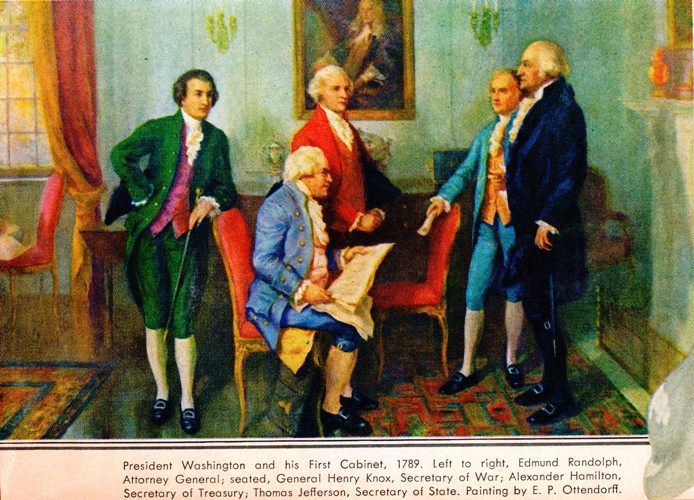
In February 1790, Edmund Randolph (1753–1813) became the first attorney general of the U.S. of A.

As a young lawyer, Randolph had been one of Gen. George Washington’s first aides de camp to during the siege of Boston. He didn’t stay long, however. The death of his uncle Peyton Randolph in October 1775 took him back to Virginia to manage family affairs.

The next year, Randolph married Elizabeth Nicholas. He remained in Virginia during the war, serving in political posts, and won a term as governor in 1786.

At the Constitutional Convention of 1787, Randolph declined to sign the document. Nonetheless, as chair of his state’s ratifying convention, Randolph convinced some fellow skeptics to vote for the document while hoping for amendments.

President Washington pressed Randolph to join him in setting up the federal government in New York. Randolph started work as attorney general, then returned to his home in Williamsburg, Virginia, to fetch his family. On 10 March, he wrote back to a fellow Virginian in the capital, James Madison:
After a fatiguing journey we arrived here on sunday evening, when I found all my family well, except my wife, who, I fear, is incumbered with a dead fœtus of more than seven months old. I am endeavouring to ward off by medical aid the consequences of this event. She is now in good spirits, and therefore I trust, that the mischief will not be fatal.
Five days later, the attorney general wrote with more anxiety about Elizabeth Randolph:
When I came home, I found my family in a really deplorable condition. Not to mention my children, most of whom were sick, the situation of my wife was very alarming. She gave every symptom of a painful and dangerous abortion being at hand. It is now a fortnight since she was first confined to her room, and every appearance grows more and more critical. It is almost certain, that the fœtus, now about six months old, is dead.
At this time “abortion” meant what we call a miscarriage; it could be either natural or induced. [I came across these letters while searching for what the correspondents on Founders Online had to say about what we call abortion.]

Randolph had something else on his mind: what would Washington think of his extended absence? And how to tell him?
Altho’ I know your readiness to sympathize with me, I should not have troubled you with this detail, were it not for a wish, that the outlines of it should be conveyed to the ears of the president. I would write to him; but the subject does not become an official letter, to be filed away in the public archives; and a private letter, does not seem adviseable, when the design is to premonish him of the cause of any delay, which may occur in my return. But I do not mean by this, that it is improbable that my return should be by the stipulated day; for if an abortion should take place, or there is a likelihood of a mature delivery, or in short if my absence would not precipitate her death I shall leave home, without any hesitation, that my family may follow in the summer.

I feel this request, not a little awkward to me, by being perhaps not less so to you. But the peculiarity of my situation will, I hope, apologize for the intrusion. Let me have a single line from you, as soon as you receive this.
But no response came for weeks.

TOMORROW: Madison’s advice at last.