J. L. BELL is a Massachusetts writer who specializes in (among other things) the start of the American Revolution in and around Boston. He is particularly interested in the experiences of children in 1765-75. He has published scholarly papers and popular articles for both children and adults. He was consultant for an episode of History Detectives, and contributed to a display at Minute Man National Historic Park.

Subscribe thru Follow.it


•••••••••••••••••


Showing posts with label Edward Savage. Show all posts

Sunday, January 29, 2023

Naming Names

In my recent sampling of historical fiction set in the Revolutionary period, I see authors having difficulty giving their characters authentic names.

Sometimes they fall into the trap of using given names familiar to us today but not in use then, such as “Suzanne” instead of “Susanna.” But more often writers go the other way and choose names that resonate with so much quaint historicity that we rarely see them today, such as “Norbert” or “Tristram”—but people of Revolutionary times didn’t see those names, either.

The problem is that the most common given names in Revolutionary times are quite familiar. Daniel Scott Smith showed this in a study of Massachusetts’s 1771 tax lists, published in the William & Mary Quarterly in 1994.

Among men, the names most frequently found were: John, Samuel, Joseph, William, Jonathan, Thomas, James, Benjamin, Daniel, and David.

Among women, the top names were: Mary, Elizabeth, Sarah, Hannah, Abigail, Lydia, Ann (or Anne or Anna), Rebecca, Martha, and Ruth.

All of those names are familiar today and have been familiar for a long time, meaning they don’t evoke any particular era. We have to go down the list to #11 for men and #12 for women before finding names we rarely use now: Ebenezer and Mehetabel.

What’s more, common names were more common in 1771—meaning that more of the men and women you met had the same popular given names. About 46% of all taxpaying men had one of those top-ten names listed above.

Among women, there was even less diversity. Slightly over two-thirds of all female taxpayers in Massachusetts shared the ten given names above. If you’ve ever done genealogy in this period, it feels like half of all the women are named Mary, Elizabeth, Sarah, Hannah, or Abigail. Smith’s number-crunching showed that’s actually a slight understatement. The correct figure is 52.8%.

In contrast, in the decades since World War 2, and especially in the decades since 1980, American parents have chosen an increasingly wider range of names, Sam Weinger reported through Medium. Notably, female names are now far more diverse than male names.

In 2014, a FiveThirtyEight article stated, “almost 30 percent of Americans have a given name that appears in the top 100 list.” Back in 1771, 30% of Massachusetts male taxpayers had a given name appearing in the top 5 list, and 27% of women were named either Mary or Elizabeth.

Monday, December 30, 2019

Legends of Nathaniel Balch

As I discussed back here, the hatter Nathaniel Balch was well known in post-Revolutionary Boston for his sense of humor and his friendship with Gov. John Hancock.

The Genealogy of the Balch Families in America (1897) shared a family tradition about one of the jokes that Hancock and Balch shared:

Governor Hancock one day said to Balch, ”Come up and see a Savage I have locked in my garret.”

He complied, and found that the Governor was protecting a portrait painter named Savage from arrest for debt. Savage was engaged on a portrait of the Governor, and at the request of Hancock, also made one of Balch.
Edward Savage (1761-1817) was a native of Princeton, Massachusetts. He trained as a goldsmith but by the late 1780s was making copies of Copleys and evidently learning a lot from them. Around 1788 Savage painted a full-length portrait of John and Dorothy Hancock, which I believe is now at the Katzen Art Center of American University. I don’t have any evidence to confirm that Savage was hiding out from creditors at the time.

Savage’s smaller portrait of the hatter, labeled on the back “painted by the artist Savage by order of Governor Hancock of Massachusetts,” descended in the Balch family into this century.

In 1840 the writer E. S. Thomas recalled about Gov. Hancock, “such was the mutual attachment between the governor and Mr. Balch, that if the former was called away, no matter what distance, ’Squire Balch attended him, like his shadow.”

In fact, Balch’s entertaining personality could overshadow the governor. This item in the 31 July 1792 Argus became a little famous for joking about that:

TOMORROW: Mrs. Balch and Mr. Paine.

Saturday, August 06, 2016

Ebenezer Stevens Exhibit in New York

The New-York Historical Society is featuring what I expect is a small but thorough exhibit on Ebenezer Stevens, a lieutenant colonel in the Continental artillery.

Stevens was a Boston mechanic who participated in the Tea Party, carefully avoiding the view of his brother-in-law Alexander Hodgdon, a mate aboard one of the ships. Sometime in the next few months Stevens and John Crane, a fellow carpenter and Tea Party veteran, moved to Rhode Island—perhaps because Boston’s economy was squeezed by the Boston Port Bill, perhaps because they feared arrest.

In December the Rhode Island assembly voted to form an artillery unit. As I’ll discuss in a talk for the Newport Historical Society late this year, the commanders of that unit were men from Boston, including Crane and Stevens. They returned to Massachusetts at the start of the siege.

At first Stevens served as one of Col. Crane’s subordinate officers, but he had further ambitions. He led a separate Provisional Artillery Battalion in the Saratoga campaign. Finally, he switched to Col. John Lamb’s artillery regiment to become a lieutenant colonel.

After the war, Stevens settled in New York and raised his family there while building a mercantile business. His descendants included the novelist Edith Wharton. And his papers and souvenirs of military service went to the New-York Historical Society. This exhibit includes “Stevens’ Society of Cincinnati badge and officer’s tailcoat.”

The Ebenezer Stevens display will be up through 2 October. That means it coincides with some other exhibits of interest at the N.Y.H.S.:

Friday, March 21, 2014

A Miniature Henry Knox

In Dealings with the Dead (1856), Lucius Manlius Sargent told this anecdote about the Rev. Mather Byles, Sr., a Loyalist minister who stayed in Boston after the siege and became notorious for being unable to resist a pun:
He was intimate with General [Henry] Knox, who was a bookseller, before the war. When the American troops took possession of the town, after the evacuation, Knox, who had become quite corpulent, marched in, at the head of his artillery.

As he passed on, Byles, who thought himself privileged, on old scores, exclaimed, loud enough to be heard—“I never saw an ox fatter in my life.” But Knox was not in the vein. He felt offended by this freedom, especially from Byles, who was then well known to be a tory; and replied, in uncourtly terms, that he was a “—— fool.”
That anecdote has been republished in biographies of both Knox and Byles, and in other books as well. It’s too good to resist.

But I’ve long wondered whether Henry Knox was really that fat at the time. The picture above shows a miniature of Gen. Knox by Charles Willson Peale, dated 1778 and now in the collection of the Metropolitan Museum of Art. In this image Knox, while not miniature, doesn’t appear any fatter than many other gentlemen of his time.

When Peale painted Knox again around 1784, the general’s face had grown noticeably more jowly.

That might have been a peak point for Knox’s weight because on 18 May 1788 Abigail Smith wrote to her mother, Abigail Adams: “The General is not half so fat as he was.” (In his 1873 biography of the general, Francis S. Drake combined this remark with what Smith wrote about Lucy Knox on 15 June 1788.) At that time Smith was returning to America after some years in Europe, so she was comparing Knox in 1788 with him a few years earlier.

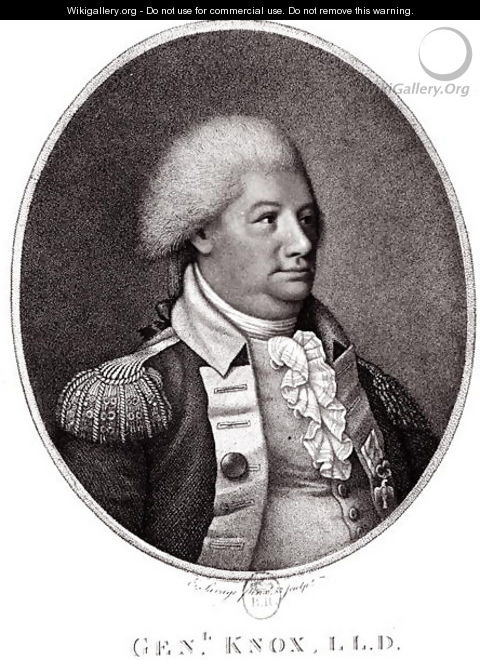
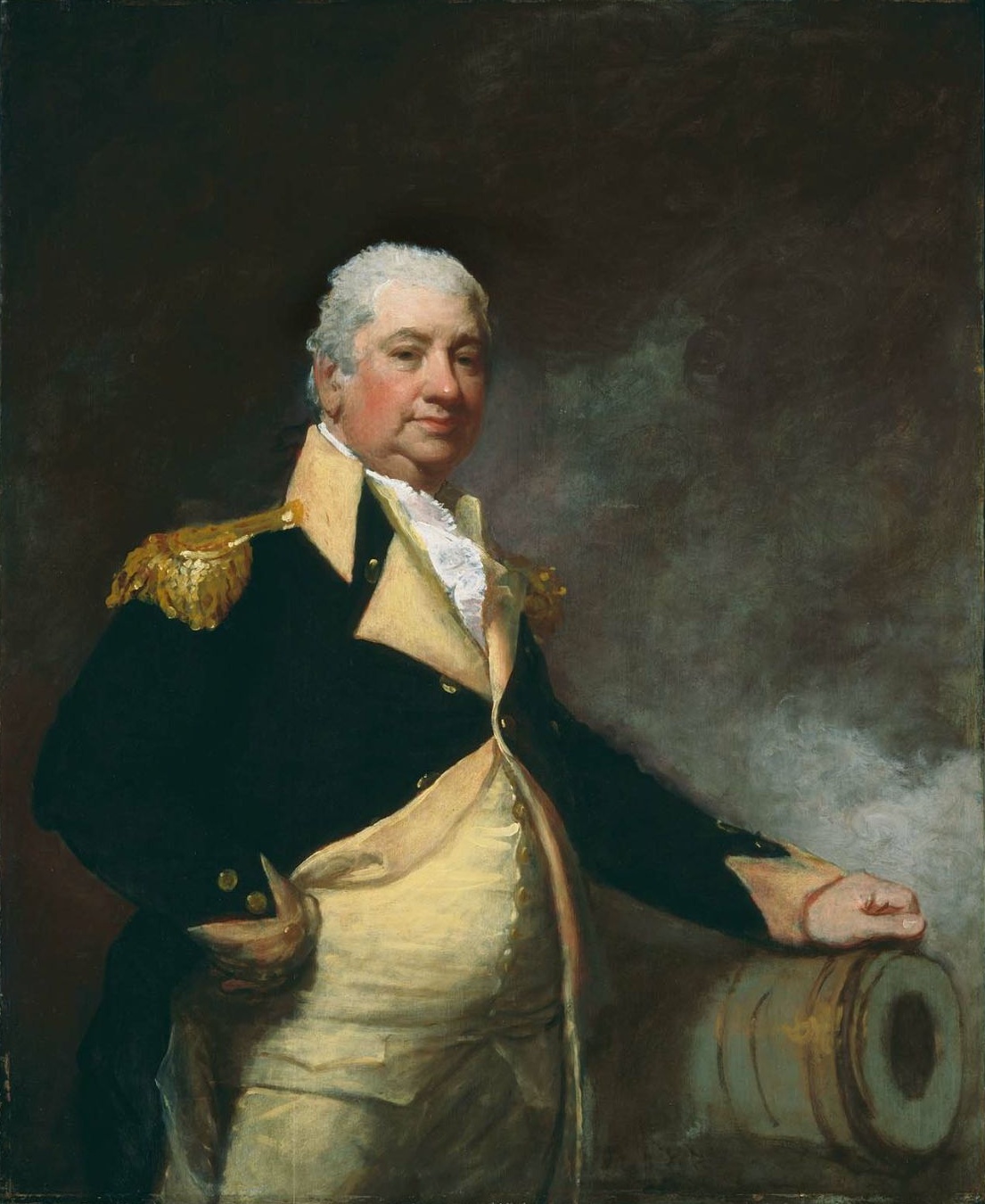
Knox’s later portraits by Edward Savage around 1790 and and Gilbert Stuart are also on the heavy side. (Mid-nineteenth-century American artists shaved down Knox’s belly like magazine art directors using Photoshop.) There’s no question Knox was a big man, but in 1776, when he was still in his mid-twenties, was he truly as fat as an ox?

Friday, June 22, 2012

Visiting William Carpenter at the Worcester Art Museum

This is Ralph Earl’s portrait of William Carpenter, an English lad about twelve years old in 1779. It’s not the most graceful painting, but it conveys a lot of personality. It’s also one of many pieces of visual evidence that the preferred hairstyle for British and American boys in the 1770s was, alas, the mullet.

William Carpenter lives at the Worcester Art Museum, which has just reopened its grand front doors and is offering free admission in July and August.

Here are articles on the museum from the Boston Globe and Worcester Telegram & Gazette. Its Early American Art collection includes paintings by John Singleton Copley, Joseph Badger, Joseph Blackburn, and the mind-blowing Edward Savage.

Tuesday, September 13, 2011

A Baseball Mystery from the Late 1700s

Back in 2010, Doug Tribou reported for WBUR radio’s high-brow sports show, Only a Game, on a mysterious painting that appeared in an advertisement by the Bonhams auction house in 1975.

It shows two boys, dressed similarly in late eighteenth-century style, holding a ball and bats.

Other portraits of children from the same period show similar sports equipment, such as the 1789 painting of the Wood children I linked to here. If this picture is from about the same time and if it was produced in America, it could be the earliest visual representation of American baseball.

Another intriguing detail is that bigger boy appears to have darker skin than the smaller. But the boys’ dress and body language reflects affection and equality, not subservience—the bigger boy’s right hand rests on the smaller one’s shoulder. Since all we have is a black-and-white reproduction, it’s unclear exactly how the bigger boy’s skin was painted. And since there are no names attached to the portrait, we don’t know who these boys were.

One man researching this painting theorized that it was created by Ralph Earl, active in Connecticut and Britain and finally back in America. However, Earl didn’t paint such monstrously small hands. Edward Savage did, toward the start of his career, but so might other self-taught artists.

The final mystery: evidently no one knows where this painting is now.