J. L. BELL is a Massachusetts writer who specializes in (among other things) the start of the American Revolution in and around Boston. He is particularly interested in the experiences of children in 1765-75. He has published scholarly papers and popular articles for both children and adults. He was consultant for an episode of History Detectives, and contributed to a display at Minute Man National Historic Park.

Subscribe thru Follow.it


•••••••••••••••••


Showing posts with label William Cooper. Show all posts

Friday, June 19, 2026

“Intrenched on the southerly part of Charlestown Hill”

In his History of the Siege of Boston, Richard Frothingham published a letter about the Battle of Bunker Hill written by Samuel Gray in Roxbury on 12 July 1775.

That letter was addressed to a “Mr. Dyer.” I agree with Bernard Knollenberg’s guess that Samuel Gray was from Windham, Connecticut, probably the man born in 1751 who served as a Continental Army commissary, and “Mr. Dyer” was his uncle Eliphalet Dyer, or another maternal relation.

Gray provided an account of the battle that gives us a different name for where the provincials dug their redoubt:
Friday night, after the 16th of June, a large part of the Continental army intrenched on the southerly part of Charlestown Hill, on the height toward Charles River. North of this hill lies Bunker Hill, adjoining East or Mystic River. Between these two is a valley. North of Bunker Hill is a low, flat, narrow neck of land, the only avenue to the hill and town. The low neck and the valley (both which must be passed in advancing to or retreating from the intrenchment) are exposed to a cross fire from the ships and floating batteries on each side, and the valley to the fire of the battery on Copps Hill, in Boston.

About sunrise, the 17th, our intrenchment was discovered, and a heavy fire immediately began from the ships and batteries, which continued with very little cessation till about one o’clock, when a large party of the ministerial troops landed on a point of land S. E. from the intrenchment, about 4 o’clock. The savages set fire to the town, beginning with the meeting-house. A heavy fire from the cannon and musketry was kept up on both sides till about five o’clock, when our men retreated:…
Gray thus referred the high spot above the Charlestown waterfront as “Charlestown Hill,” different from “Bunker Hill” to the north. And he apparently thought Dyer would recognize those designations.

I haven’t found “Charlestown Hill” in any newspaper, but some other eighteenth-century sources use the term:
  • Isaac Winslow, 10 July: “We were alarmed by the firing of guns the morning of the seventeenth of last month and found the country people had erected a work on Charlestown Hill.”
  • James Jeffry, 7 July, in QuĂ©bec: “This day four or five topsail vessels arrived, a transport or two from Boston. The report off the Capt. of one of the transports is that the battle was at Charlestown hill; that a party of Provincials were on the evg. of the 17th. entrenching themselves there & a party of the Regulars were sent out to dislodge them.”
  • William Cooper, 3 Jan 1776 letter: “an attested Copy of the account of the Battle on Charlestown Hill”
But of course that nomenclature isn’t entirely clear for us. Decades earlier, Judge Samuel Sewall wrote in his diary on 5 Oct 1709, “As came homeward went over Charlestown Hill on the Neck of Land; and came into the Rode again by Mr Emerson’s.” That appears to use the same term to refer to Bunker’s Hill.

And in a 26 Jan 1776 letter from Boston, Lt. William Carter twice used “Charles-Town Hill” to mean Bunker’s Hill since he was writing about the promontory that the British army had fortified against the Continentals.

At the very least, these sources offer more evidence that “Breed’s Hill” hadn’t yet solidified as the name of the place where the provincials built their redoubt.

TOMORROW: The choice.

Friday, November 22, 2024

“Weak in Arms Void of Virtue, Honor, or Honesty”

Here are some more of the slashing character sketches published in the 8 May 1770 Nova Scotia Chronicle in the guise of detailing a “Tragi-comic Farce” about to the published.
John Dupe, Esq; A Senator, a Man of Fortune, but not of his own acquiring---A Man of weak Capacity and like tainted Meat devoured by the Vermin about them, who drew his Money out of the Cashiers Hands Not trusting to the Loyalty of his Country Men—He is remarkably melancholy on his Loss of Lady Beaver.

Poor Iammy, a Senator, who was the Leading Man in Politicks, but disappointed in Offices of Profit—He stands now ready arm’d to kill any Person who may be mader than himself.

Maria—His Wife, a worthy virtuous good Woman, comforting her Children, and bemoaning his unhappy Fate.

Thomas Wister, an Man weak in Arms Void of Virtue, Honor, or Honesty, whose compounds has poison’d his own Body and Soul, since that he has been finding out an Art to poison the Minds—Private Confessor to Admiral Renegado.

William Town, Regulating Clerk to the Parish—Procurer of Knights of the Post, and Secretary to Admiral Renegado, and Justice Gutts; also Secretary to the Caulkers Club, and chief Compiler of the Country Parish Resolves.
I think these are allusions to merchant John Hancock, lawyer James Otis, his wife Ruth Otis, most likely Dr. Thomas Young, and Boston town clerk William Cooper, respectively.

John Mein identified Hancock as “John Dupe” in his “Key to a certain Publication,” now at the Houghton Library, so that’s an easy one.

Back in October, Mein called Otis “Counsellor Muddlehead,” but by this time people recognized that he was mentally ill. Otis’s wife was indeed known as a Loyalist.

I’m guessing the references to “compounds” and “poison” were hints that “Thomas Wister” was a physician, hence the radical Dr. Young. This page never introduced “Admiral Renegado” at all despite these two allusions to that character. But the 5 Feb 1770 Boston Chronicle had used “Admiral Renegado” as another name for William Molineux, already introduced in the Nova Scotian item as “William the Knave.”

The paragraph on “William Town” contains several pointers to William Cooper, plus a reference to the “Caulkers Club” or caucus. This might be the first publication connecting that mysterious word for a political group to the profession of caulking, and it appears to be a joke.

The article offers no explanation of “Justice Gutts,” and I can’t find the Boston Chronicle using that name anywhere. Perhaps that was an alternate name for the next entry in the article: “Richard Glutton, Esq; a regulating Magistrate.” But I’m not sure who that’s meant to be.

TOMORROW: Mysteries and questions.

Sunday, August 04, 2024

John Hancock’s Busy Spring and Silent Summer

On 5 Mar 1774, Bostonians applauded John Hancock as he delivered that year’s oration commemorating the Boston Massacre.

The next week, he led the Company of Cadets as an honor guard in the funeral procession of Lt. Gov. Andrew Oliver.

Later that month, the town reelected Hancock as a selectman, and another town meeting in May sent him to the Massachusetts General Court once more.

On 17 May, Hancock was once again at the head of the Cadets, welcoming the new governor, Gen. Thomas Gage. As with the Oliver funeral, not all of Hancock’s political allies liked that, but he insisted he was obliged to respect royal offices even if he opposed the men who held them.

Hancock was present when the legislature convened in Boston on 25 May. The next day, he was named to a committee to consider Gov. Gage’s speech stating he would move the General Court to Salem.

But Hancock doesn’t appear to have gone to Salem himself. His name is nowhere in the assembly’s official record of that short session, and usually he was quite active on committees and in carrying news from the house to the Council and governor.

Furthermore, Hancock also didn’t attend meetings of the Boston selectmen between 9 March, right after his oration, through 8 September. In that period town clerk William Cooper usually recorded which selectmen were at each meeting.

The one possible exception was on 20 July, when Cooper’s notes say all seven selectmen had a special session on Deer Island. But those notes are strange, recording that the board approved paying certain men but leaving blanks for how much. So it’s conceivable that page isn’t accurate.

On 12 August, the Boston selectmen received “a Billet” from the governor, summoning them to the Province House the next day. Gen. Gage entered and, “without any ceremony of any kind,” told the men he’d just received the Massachusetts Government Act and Boston would need his approval before convening another town meeting.

The selectmen answered that “we had no need of calling a Town Meeting for we had two now alive by Adjournment, one of them to be some time this month, the other to be held in October.” This response made Gage look “serious” and say “he must think upon that.” The governor spoke, according to Cooper’s notes, “with some degree of temper.”

Hancock was the only selectmen not present for that important conversation.

TOMORROW: Where was John Hancock in the summer of 1774?

Thursday, August 01, 2024

“The Majority were four to One against them”

On 28 June 1774, the Boston town meeting witnessed “long Debates” about the committee of correspondence’s call for a non-consumption agreement, according to town clerk William Cooper’s record.

In his diary the merchant John Rowe confirmed, “The Debates very warm on both sides.” Unlike the previous day, alas, he didn’t record any of the speakers.

But the group urging a repudiation of the committee consisted mainly of major merchants, some with positions within the royal government. They worried that this boycott, on top of the Boston Port Bill, would doom the town’s economy.

The leaders of the Whigs, in reply, argued that standing up to Parliament’s Coercive Acts by not buying any more from Britain was their best way to force the repeal of those laws.

Eventually the meeting held a vote on the merchants’ motion to censure. Cooper recorded that “a great Majority” voted against repudiating the committee.

Rowe expressed disappointment, at least in his diary:
the Committee are wrong in the matter. The Merchants have taken up against them, they have in my Opinion exceeded their Power & the Motion was Put that they should be dismissed. the Gentlemen that made & supported this Motion could not Obtain their Vote, the Majority were four to One against them.

this affair will cause much evil one against the other. I wish for Peace in this Town I fear the Consequences.
The Whigs then sought to affirm the town’s support for the committee by offering their own motion:
That the Town bear open Testimony that they are abundantly satisfied of the upright Intentions, and much approve the honest Zeal of the Comittee of Correspondence & desire that they would persevere with their usual Activity & Firmness, continuing stedfast in the Way of well Doing
A “Vast” majority approved that.

After that, Samuel Adams returned to the chair, the committee on employing the poor said they were once again not ready to report, and the meeting adjourned until July.

That was the last attempt of the Boston Loyalists and/or merchants to curb the Whigs electorally, and they fell far short. Which wasn’t a surprise. The Whigs won every vote along the way, even on matters like which men would go ask if the gathering could move to the Old South Meeting-House.

The Boston town meeting would remain stalwart and implacably opposed to the royal administration until the war began.

COMING UP: Protests against the protest.

Thursday, July 18, 2024

“Like a torrent are rushing upon it with increasing violence”

As I wrote yesterday, the text of the Solemn League and Covenant that towns like Westford and Attleboro approved was not the first version of that document printed in an American newspaper.

On 22 June 1774, one day before Margaret Draper published the agreement in Boston, William Bradford’s Pennsylvania Journal issued a “Postscript” or supplement that included an article datelined “Philadelphia.” It began:
The following is a Circular Letter, written by the Committee of the Town of BOSTON, to the neighbouring towns with a copy of an agreement, which was to begin signing in every town in that government nearly at the same time.
The newspaper then printed William Cooper’s 8 June letter followed by a text that started the same way as what would appear in Draper’s Boston News-Letter.

But at the end of the second point, this text added the phrase “and never to renew any commerce or trade with them.”

Then it went on in a different direction. This text didn’t include an oath for retailers to swear. It included language not seen in the News-Letter version:
And, Whereas the promoting of industry, œconomy, arts and manufactures among ourselves is of the last importance to the civil and religious welfare of a community; we engage,

3dly, That from and after the first day of October next ensuing, we will, not by ourselves, or any for, by, or under us, purchase or use any goods, wares, manufactures or merchandize, whensoever or howsoever imported from Great Britain, until the harbour of Boston shall be opened, and our charter rights restored. And,

Lastly, As a refusal to come into any agreement which promises the deliverance of our country from the calamities it now feels, and which, like a torrent are rushing upon it with increasing violence, must evidence a disposition enimical to, or criminally negligent of, the common safety…
Both versions conclude with similar promises to shun doing business with any “contumacious importers.” The News-Letter text said signers wouldn’t buy “any article whatever” from those people. The Pennsylvania Journal text said they would be shunned “forever.” Both absolutes, but in different dimensions.

In comparing these two texts in 1915, Albert Matthews called the version that first surfaced in Philadelphia “Form B.” He didn’t cite that newspaper article but rather drew on a broadside at the American Antiquarian Society.

Matthews concluded that Form A was Boston’s proposed text and Form B originated in Worcester, created because Boston’s was “too drastic.” More recent scholars disagree.

COMING UP: The Worcester connection.

Tuesday, July 16, 2024

“The foregoing is a Copy of a Covenant…”

The Boston committee of correspondence’s Solemn League and Covenant went further than previous boycotts by having ordinary people pledge not to buy any goods from Britain after a certain date, and to shun business with anyone who continued to sell.

That’s why the 30 May town meeting voted “That the Comittee of Correspondence be & hereby are directed, to comunicate the Non Consumption Agreement aforesaid to the other Towns in the Province.” Not just non-importation by merchants but non-consumption by everyone.

According to the merchant John Andrews, that agreement was “sent out in printed copies by the Clerk to the Committee. W[illiam]. Cooper,” along with his printed letter dated 8 June 1774.

One might think that it would therefore be easy to identify the official text of that boycott agreement.

But there’s a lingering mystery about the Solemn League and Covenant. Two different texts were printed in American newspapers by the end of the month. Both also exist as broadsides carrying the date of June 1774. To add to the muddle, a third text was also printed as a broadside.

In 1915 Albert Matthews compared the two June 1774 texts for the Colonial Society of Massachusetts, calling them Form A and Form B. I guess I’ll call that third version Form C when I get to it.

Normally the Boston town government favored the Edes and Gill print shop. The letter and broadside might well have come from its presses. On 20 June Edes and Gill’s Boston Gazette editorialized in favor of it:
The Solemn League & Covenant for a non-consumption of British Merchandize is an Ax to the Root of the tree; by coming into it we establish our own Manufactures, save our Money, and finally our Country from the destruction that threatens it.
But that newspaper didn’t report the actual text of the new agreement. The Boston committee evidently didn’t want to publicize details of the boycott in town, at least not until a lot of rural communities had signed on to it.

Instead, the recently widowed Margaret Draper printed the document in her Boston News-Letter on 23 June. This wasn’t an official release. The document was prefaced with a request to print it and followed by:
The foregoing is a Copy of a Covenant, which I am told great Pains are now taking to promote in the Country. As I think it is of the most pernicious Tendency, as at present circumstanced, I beg Leave through your Paper to propose some Questions relating thereto.
Nearly a full column of political questions and argument followed. Then came an even longer series of questions leading to the suggestion not to take any action until “the approaching Congress.”

Four days later Mills and Hicks’s Boston Post-Boy printed the entire text of Cooper’s letter followed by the same form of the Solemn League and Covenant as in the News-Letter.

In other words, the Solemn League and Covenant wasn’t announced by Boston’s committee of correspondence. It was leaked by opponents through the Loyalist press.

TOMORROW: Form A.

Monday, July 15, 2024

“For every inhabitant in each town to sign”

Among the Bostonians objecting to the town committee of correspondence’s Solemn League and Covenant of June 1774 was John Andrews. Normally a supporter of the Whigs, that merchant wrote on 12 June:
Our committee of correspondence, not content with the calamities already come upon us, have issued out letters to every town in the province (without consulting ye. town in regard to the expediency of such a measure) accompanied with a Solemn League and covenant, so stil’d, for every inhabitant in each town to sign, whereby they obligate themselves by the most sacred oaths not to purchase any kind of goods fabricated in England, either already here, or that may be hereafter imported.

Such is the cursed zeal that now prevails: animosities run higher than ever, each party charging the other as bringing ruin upon their country; that unless some expediency is adopted to get the Port open by paying for the tea (which seems to be the only one) am afraid we shall experience the worst of evils, a civil war, which God avert! . . .

those who have govern’d the town for years past and were in a great measure the authors of all our evils, by their injudicious conduct—are grown more obstinate than ever, and seem determin’d to bring total destruction upon us: which may be sufficiently evinced by all their conduct. They not only intend to deprive us of trade in future, but render us utterly incapable of contributing that assistance which will be absolutely necessary for the support of the indigent the approaching fall and winter, by their cruel endeavors to stop the little inland trade we expected.
Andrews hadn’t seen the text of the Solemn League and Covenant as of 12 June, but obviously he didn’t like what he’d heard about it.

The complaint that the committee had acted “without consulting ye. town” isn’t entirely fair. A vote in the town meeting had ordered the committee to send a non-consumption agreement to other towns. Another vote scheduled the next meeting session more than two weeks away with no indication that the committee should hold their work until then. But clearly Andrews wished he (or like-minded colleagues) had had a chance to review the details.

There may also have been pushback from the other Massachusetts towns who received the printed letter from Boston, accompanied by a printed pledge with blanks to fill in. On 10 June, only two days after sending out his first letter, town clerk William Cooper sent a follow-up, also printed:
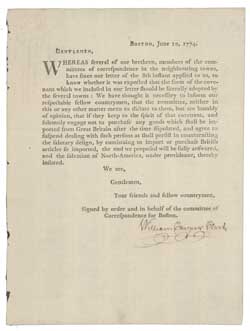
Whereas several of our brethren, members of the committees of correspondence in the neighbouring towns, have since our letter of the 8th instant applied to us, to know whether it was expected that the form of the covenant which we inclosed in our letter should be literally adopted by the several towns:

We have thought it necessary to inform our respectable fellow countrymen, that the committee, neither in this or any other matter mean to dictate to them, but are humbly of opinion, that if they keep to the spirit of that covenant, and solemnly engage not to purchase any goods which shall be imported from Great Britain after the time stipulated, and agree to suspend dealing with such persons as shall persist in counteracting the salutary design, by continuing to import or purchase British articles so imported, the end we proposed will be fully answered, and the salvation of North-America, under providence, thereby insured.
That suggests other towns’ selectmen or committees resented something about the Boston documents. Did the problem lie in the parameters of the boycott, the language, or the speed of the campaign? Or simply in Boston appearing to issue forms for smaller towns to fill out?After all, this was a crusade for local self-government.

TOMORROW: Conflicting texts.

Sunday, July 14, 2024

“Universally come into a solemn league”

By the end of May 1774, Boston had held several sessions of a town meeting about how to respond to the Boston Port Bill.

On the afternoon of 13 May, the meeting had resolved, with no dissent, that some sort of continent-wide boycott was the solution to the crisis.

Over the next couple of sessions, the meeting kept asking for its committee to recommend a specific plan. Thomas Cushing kept replying that the committee didn’t yet have a report. Then the town would ask the committee to “sit again”—i.e., get to work.

On 30 May, the town meeting spelled out what it wanted by voting:
That the Committee appointed to receive Proposals & consider of Ways & Means, be desired to prepare a Paper, to be carried to each Family in the Town, the Report of which to be, not to purchase any Articles of British Manufactures, that can be obtained among Ourselves, & that they will purchase Nothing of, but totally desert those who shall Counter-work the Salutary Measures of the Town.

Voted, That the Comittee of Correspondence be & hereby are directed, to comunicate the Non Consumption Agreement aforesaid to the other Towns in the Province.
The meeting also said that the next session would be on 17 June. The committee shouldn’t expect any more guidance until then.

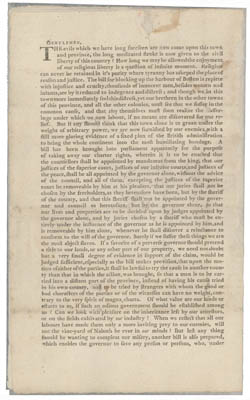
The committee of correspondence acted on 8 June. Town clerk William Cooper sent out a two-page printed letter to rural towns that began:
GENTLEMEN,

THE evils which we have long foreseen are now come upon this town and province, the long meditated stroke is now given to the civil liberty of this country? How long we may be allowed the enjoyment of our religious liberty is a question of infinite moment. . . .
How the committee got from trade restrictions to “our religious liberty” isn’t at all clear, but they definitely played on New England’s religious sentiment and tradition.

Boston’s letter said the people of Massachusetts should “universally come into a solemn league, not to import goods from Great Britain, and not to buy any goods that shall hereafter be imported from thence.” That phrase “solemn league” echoed the name of an agreement from 1643, early in the English Civil War. The actual agreement the committee sent included another word from that original, “covenant.” As a result, this boycott agreement came to be known as the Solemn League and Covenant, usurping that label from the earlier document.

On the day Cooper sent his circular letter, Cushing, Samuel Adams, and other elected politicians were in Salem for a session of the Massachusetts General Court. Perhaps Cushing’s caution and Adams’s savvy might have moderated the committee’s call for a boycott, or at least toned down the language. Or perhaps those leaders had signed off on the drafts before going to Salem.

In any event, some people thought the committee had gone too far.

TOMORROW: Complaints in and out of town.

Tuesday, July 02, 2024

“On the Conduct of the Comittee of Correspondence”

On Monday, 27 June 1774, the political argument over Boston’s committee of correspondence came to a head.

Merchants and friends of the royal government felt that the committee was wielding too much power, dragging the entire community into a costly and treasonous confrontation with the Crown.

Parliament’s Boston Port Bill was stifling every Bostonian’s livelihood, but that problem could go away at the (admittedly significant) cost of £9,660.

The committee’s Solemn League and Covenant boycott was going further than any non-importation measure so far, not only proscribing more goods from Britain and making people pledge not to do any business with people who did import goods. Was that going too far for the country folk?

The Boston Whigs, who had established the standing committee of correspondence back in November 1772, stuck to their position that for the people to make any retreat or compromise would be giving up their British constitutional rights.

The Boston town meeting resumed in Faneuil Hall at 10:00 A.M. His work with the Massachusetts General Court in Salem done (since the Massachusetts General Court in Salem was done), Samuel Adams was once again in the chair.

A motion passed that the meeting should review all the letters the committee of correspondence had written to other towns and colonies about the Port Bill.

But then came another motion: “that this Meeting be adjourned to the Old South Meeting House, the Hall not being sufficient to contain all the Inhabitants assembled.”

The committee chosen to go to Old South and ask if the town could use that space consisted of William Molineux, town clerk William Cooper, and Dr. Benjamin Church, Jr.—all radical Whigs. That alone signaled that their party had the votes to control the meeting. But what if more people came for one side or the other?

In Old South, the meeting reaffirmed its earlier vote to review the correspondence. Cooper began to read the letters aloud. After a while the crowd became bored, and they amended their earlier vote to cover only the Solemn League and Covenant, the letter sent out with that proposal, and “any other Letters that may be particularly called for.”

Eventually someone moved “that some Censure be now passed By the Town on the Conduct of the Comittee of Correspondence; and that said Committee be annihilated.” That would be a total repudiation of the committee and its work.

Adams stated that “he had the Honor of being a Member” of that committee, so someone else should moderate that discussion. By stepping away from the podium for a while, Adams not only made a point of being scrupulously fair but also allowed himself to speak, since the moderator usually didn’t express opinions on motions.

As the temporary chair, the meeting chose Thomas Cushing—merchant, speaker of the House, and another member of the Boston Whigs (though in the moderate set). Again, that showed how that group was in control of this body.

Nonetheless, the debate went on until dark, and still the opponents of the committee said “they had farther to offer.” The meeting voted to adjourn until the next morning at 10:00 A.M.

TOMORROW: The speakers and the vote.

Monday, July 01, 2024

“Deliberating upon the Steps to be taken on the present Exigencies”

On 17 June 1774, as Samuel Adams was orchestrating what would be the last session of the Massachusetts General Court under royal rule, his cousin John took the chair of Boston’s town meeting.

In Faneuil Hall, the first item of business was a report from the committee on ways and means.

The Adams family physician, Dr. Joseph Warren, stood up and said “they thought it best to defer making Report, till they had heard from the other Governments.” So enough of that.

Then the meeting got to the article stated in the warrant—i.e., the official reason for this meeting:
To consider & determine what Measures are proper to be taken upon the present Exigency of our public Affairs, more especially relative to the late Edict of the British Parliament for Blocking up the Harbour of Boston, & annihilating the Trade of this Town
Town clerk William Cooper recorded that there were “very serious Debates” on that very broad question. He also put on paper that only one brave voter (his name not recorded) dissented from this resolution:
That the Comittee of Correspondence be enjoined forthwith to write to all the other Colonies, acquainting them that we are not idle, that we are deliberating upon the Steps to be taken on the present Exigencies of our public Affairs; that our Brethren the landed Interest of the Province, with an unexampled Spirit and Unanimity, are entring into a NonConsumption agreement; And that we are waiting with anxious Expectation for the Result of a Continental Congress; whose Meeting we impatiently desire, & in whose Wisdom & Firmness we can Confide, & in whose Determinations we shall chearfully acquiesce
The meeting then broke for midday dinner, reconvening at 3:00 P.M.

The afternoon session, John Adams still in the chair, the gathering authorized the committee of correspondence to send thanks to other towns and colonies for their support, and then thanked the committee itself.

Some of those towns and colonies were sending donations for the Boston poor. The meeting delegated the distribution of that aid to the elected Overseers of the Poor “in Concert with the Comittee lately appointed by this Town for the Consideration of the Ways & Means of Employing the Poor.”

Finally, the meeting ordered Cooper to “Publish the Proceedings,” paying the town’s chosen printers, Edes and Gill, to issue a broadside based on his record.

All those afternoon actions were obviously designed to show support for the standing committees, validating them in defying the Crown and refusing to seek a compromise.

By the end of the month, there would be pushback.

TOMORROW: The same town meeting continues, ten days later.

Thursday, January 11, 2024

Who wrote, “we can make every Tory tremble”?

Earlier this year, I saw a tweet crediting Samuel Adams with the line: “With ladies on our side, we can make every Tory tremble.”

Adams wasn’t usually that pithy, and the statement doesn’t appear in the four volumes of The Writings of Samuel Adams.

The line first appeared in a letter to Daniel Fowle’s New-Hampshire Gazette published on 22 July 1774. Here’s more context:
The Consumption of TEA I think is in a fair Way of being totally laid aside in this Town, as there are but very few indeed, that will refuse to sign or solemnly ingage not to suffer it used in their Families;

and what adds a great Pleasure to us all, is, that the Fair Sex universally consent to give up, this detested superfluous Article; and under the Auspices of the worthy Doctor Clement Jackson, we hope soon to see a glorious List of Female Worthies, whose Virtue can withstand every daring Insult when put to the Test; and we all desire their Names may be recorded in the Town Books, to perpetuate their Memories:---

Then let us see who will sell that obnoxious Herb, for with the Ladies on our side, we can make every Tory tremble; as it is generally agreed upon, not to frequent those Shops were TEA is sold.
The signature, under a Latin quotation, was “AMICUS.”

A few weeks later, on 26 August, the New-Hampshire Gazette published another letter, addressed to the people of New Hampshire and signed “AMICUS PATRIAE.” It urged people in that colony to support Boston, suffering under Parliament’s Coercive Acts, with donations for the poor.

Both letters show a pattern of short italicized phrases and occasional all-capitalized nouns. Both end with Latin quotations. The signatures overlap. I therefore think it’s likely the two letters came from the same pen.

In his History of New-Hampshire (1792), the Rev. Jeremy Belknap printed a letter from New Hampshire governor John Winthrop to the Earl of Dartmouth dated 29 August, which said:
The town-clerk of Boston [William Cooper], who is said to be a zealous leader of the popular opposition, has been in this town about a week; immediately appears a publication in the New-Hampshire Gazette, recommending donations for Boston…
Belknap added a footnote to that sentence:
The publication here referred to was written by a person whom the Governor did not suspect, and the town-clerk knew nothing of it.
But Belknap obviously did know the author. In fact, his granddaughter Jane Belknap Marcou wrote in her 1847 biography that she had found “the imperfect manuscript [i.e., draft] remaining among Mr. Belknap’s papers.” In other words, he’d written it himself.

Back in 1774, Jeremy Belknap was the minister in Dover, New Hampshire. Ministers weren’t supposed to get directly involved in politics, but as “AMICUS PATRIAE” he had things to tell his fellow citizens. And Belknap also appears to have been the most likely author of the line “With ladies on our side, we can make every Tory tremble.” (I wonder if a draft of that essay might be in his papers at the Massachusetts Historical Society.)

The line resurfaced in John C. Miller’s Origins of the American Revolution (1943) as an example of American Whig sentiment before the war. Philip Foner picked it up in his History of the Labor Movement in the United States (1947), crediting the sentiment to “Sons of Liberty.” Charles O. F. Thompson included the line in A History of the Declaration of Independence: A Story of the American Patriots who Brought about the Birth of Our Nation (1947), curiously tossing in the word “blessed” ahead of “Tory.” Other books followed.

From there it appears that an author or authors decided that “Sons of Liberty” meant Samuel Adams. In the current century several books and authoritative websites attribute the statement to Adams, usually saying “often quoted” or “reported to have said” as a signal that the writers can’t find the words in those four volumes of Writings. In several places the quotation has also lost the article “the” before “Ladies.”

In conclusion, while it’s definitely possible to quote the line “with the Ladies on our side, we can make every Tory tremble” from the Revolutionary era, it should be tentatively attributed to Jeremy Belknap, not Samuel Adams.

Thursday, December 14, 2023

The Committee of Correspondence and the Stringer Bell Rule

The Boston Tea Party Ships & Museum social media has been sharing an image from the Boston committee of correspondence records, showing what that group of hard-core activists was doing in December 1773.

Or rather, not showing.

These records are now held by the New York Public Library. The pages in question are in the subcollection “Minutes,” volume 6, pages 463–4. The whole collection is digitized but not transcribed, so you have to read a lot of pages or know what you’re looking for.

The committee of correspondence was an official arm of the Boston town meeting, and thus had some responsibility to keep public records. Most of those records are the letters the committee sent to committees in other towns and colonies, copied by town clerk William Cooper. It was a committee of correspondence, after all.

However, like the Continental Congress making itself a committee of the whole to debate sensitive matters like a little light treason off the record, the Boston committee had ways around openness.

As Stringer Bell reminded us on The Wire, you don’t take notes on a criminal conspiracy.

On Sunday, 12 December, a day after sending a subcommittee to meet with Francis Rotch about his ship Dartmouth and a day before meeting with colleagues from neighboring towns, the Boston committee gathered at the selectmen’s chamber in Faneuil Hall after dark on the Sabbath. But the record of that meeting is:
No Business transacted to be made matter of Record
The discussions with the other towns’ committees “continued thru. the Evening” on Monday. Not that we know what anyone said.

On Tuesday, the Boston men gathered again in the morning.
No Business transacted, matter of Record—
And in the evening.
No Business transacted, matter of Record—
There were no meetings on 15–16 December. Presumably all the committee members were busy at Old South Meeting-House and, well, elsewhere.

On 17 December, with tea leaves floating in the harbor, the committee chose five members of their group to write a “Declaration” about the destruction of the tea. Those men included several of the most radical writers in Boston: Samuel Adams, Dr. Benjamin Church, Dr. Thomas Young, and Dr. Joseph Warren. The fifth was Nathaniel Appleton (1731–1798), since these committees needed someone to represent the town’s merchants.

Tuesday, November 07, 2023

“To wait upon the Messrs. Hutchinsons at Milton”

Over the two days of 5–6 Nov 1773, the Boston town meeting tried to finish the job an informal committee of businessmen (and rioters) had failed to do: convince the East India Company’s agents in Boston to resign from that responsibility.

The first step was getting those men to actually admit to having been appointed. Although there were plenty of reports that the company had decided to sell its tea through Thomas and Elisha Hutchinson, Richard Clarke and Sons, and Benjamin Faneuil and Joshua Winslow, no official paperwork had arrived.

Furthermore, those merchants were keeping low profiles after their confrontation with the crowd on 3 November.

The official record of the town meeting describe how that effort played out.

On the morning of 5 November, the meeting named a high-powered committee to ask those agents to resign: John Hancock as meeting moderator; merchants Henderson Inches, Benjamin Austin, and Jonathan Mason; and all the selectmen—Hancock again, plus John Scollay, Timothy Newell, Thomas Marshall, Oliver Wendell, Samuel Austin, and John Pitts.

Those men evidently went out with their message during the dinner break. At 3:00 P.M. the town meeting resumed with the committee’s report that Clarke and Faneuil had declined to respond on the excuse that they couldn’t consult with the Hutchinson brothers, who were out at their father’s house in Milton.

The meeting then named Samuel Adams, William Molineux, and Dr. Joseph Warren—three men not currently active as merchants but among the most radical political leaders—to deliver a more forceful demand to Clarke and Faneuil. They came back with a promise of a reply in half an hour.

The gathering then decided that Hancock, Pitts, Adams, Warren, William Powell, and Nathaniel Appleton would go out to Milton with the same message for the Hutchinsons.

Someone brought in Clarke and Faneuil’s written message on behalf of their firms. Those men stated that since they didn’t yet have the details of the tea consignment, they couldn’t comply with the town’s request. The town unanimously voted that response unsatisfactory.

The meeting resumed the next day at 11:00 A.M., “still continuing very full.” Town clerk William Cooper recorded:
The Committee appointed to wait upon the Messrs. Hutchinsons at Milton—Reported—That they had enquired the last Evening and this Morning at the House of Elish Hutchinson Esq. in this Town, and were informed that those Gentlemen were at Milton;

the Committee proceeded this Morning to Milton and calling at the Governors Seat were informed that only Mr. Elisha Hutchinson lodged there the last Night, who had set out early this Morning for Boston;

on their return they called at his House, and were told that he had been at home this Morning but had again set off for Milton—

they then went to the House of Thomas Hutchinson Esq. who was then at home, where they read and delivered to him an attested Copy of the Towns Vote, when he acquainted the Committee, that the Town might expect his answer in one quarter of an Hour—

The following Letter was soon after sent into the Moderator, signed Thomas Hutchinson, which was read, vizt.
Sir

I have nothing relative to the Teas referred to in the request or Vote of the Town, except that one of my Friends has signified to me by Letter, that part of it he had reason to believe would be Consigned to me and my Brother Jointly, but upon what terms he could not then say——

Under these circumstances I can give no other answer to the Town, at present, then that if the Teas should arrive & we should be appointed Factors, we shall then be sufficiently informed to answer the request of the Town—

I am for my Brother & self
Sir Your humble Servant
T. Hutchinson Junr.
The meeting voted that unsatisfactory with no dissent. Then the citizens declared, once against unanimously, that all the tea consignees’ behavior was “Daringly Affrontive.” They voted to send the record of this meeting to every town in Massachusetts, and thus to the newspapers.

There was one last action:
A Motion was then made, that the Thanks of the Town be given to the Honble. John Hancock Esq. the Moderator of this Meeting for the dispatch he has given to the Business thereof—but the Motion was objected to by himself and Mr. Adams, and it seemed to be the sense of the Town, that a Vote of Thanks should be only given upon very special and signal services performed for the Publick——
Hancock and his colleagues had, after all, simply been carrying out their duties as patriotic citizens. (Though I’m sure Hancock enjoyed the gesture of public praise.)

Meanwhile, in between those two town meeting sessions Boston had observed its traditional Pope Night.

TOMORROW: And how had that gone?

(The picture above, courtesy of the Milton Historical Society, is the only known image of Gov. Thomas Hutchinson’s country mansion in Milton, where his son Elisha spent the night of 5 Nov 1773. John Ritto Penniman painted this picture in 1827, so it shows the house as it existed fifty years after the Revolution, having perhaps been remodeled.)

Monday, November 06, 2023

Fallout from the “Tradesmen’s Protest”

Bostonians gathered on short notice in Faneuil Hall for a town meeting on 5 Nov 1773. Their first act was to choose John Hancock as moderator.

The reason for this meeting was the news that the East India Company was shipping tea to America. By a process not spelled out, the result would be: “our liberties for which we have long struggled, will be lost to them and their Posterity.”

The town’s eventual response to that news was to endorse the resolutions of a Philadelphia meeting condemning the Tea Act, the company, and anyone who cooperated with it.

A closer problem, however, was that some locals had distributed a handbill titled “Tradesmen’s Protest Against the Proceedings of the Merchants Relative to the New Importation of Tea,” printed by Ezekiel Russell. The Massachusetts Historical Society has digitized that flyer here.

A group of merchants, claiming to speak for Boston’s business community, had issued a call to boycott tea. The “Tradesmen’s” handbill responded in kind, also claiming to speak for local businessmen. “You are hereby advised and warned by no means to be taken in by the deceitful Bait of those who falsely stile themselves Friends of Liberty,” it said. “WE are resolved, by Divine Assistance,…to Buy and Sell when and where we please; herein hoping for the Protection of good Government.”

At the town meeting, someone moved for all tradesman to gather on the south side of the hall so they could vote on whether they agreed with this handbill. This question “passed in the Negative, unanimously—there being in the estimation of the Town at least four hundred Tradesmen present.”

That afternoon Ezekiel Russell appeared and addressed the gathering. The official record reads:
He then acquainted the Town that he was the Printer of the Paper called the Tradesmen’s Protest against the Merchants, & that he was paid for the same by the Person who Employed him.—this Information was not given at the desire of the Town; it being their sense, that as a Town they had nothing to do with the Printer or Author of the said Paper——
Russell had a reputation for printing almost anything as long as he was paid. I can’t tell if in this case he kept the name of his customer secret or if town clerk William Cooper chose not to record it. In any event, the point of this item in the meeting record was that Russell was below official notice.

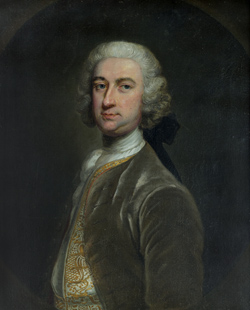
In the morning, “one of the Inhabitants openly declared that he saw Charles Paxton one of the Commissioners of the Customs, giving them away the Day before in Kings Street.” Paxton (shown above) had been one of the most disliked royal officials in Boston for over a decade.

On 10 November, Commissioner Paxton went to justice of the peace Edmund Quincy and swore to a deposition:
WHEREAS a Number of the Inhabitants of the Town of Boston being assembled at Faneuil-Hall on Friday the 5th of November Instant, unanimously voted that I the Subscriber was a Distributor of a Paper called the Tradesmen’s Protest—

Now I solemnly declare, that I never was possessed of more than one of said Papers, which I bought for Three Half-Pence of a Boy in the Street, and not finding it worth Notice, in a few Minutes after I gave it to a Bystander, whom to my Knowledge, I never saw before nor since.—And I further declare, that I never before heard such a Paper was published or intended to be published.
Paxton had that testimony published in the Boston News-Letter and Boston Post-Boy, two Loyalist newspapers, over the following week. He remained unpopular.

TOMORROW: Talking to the tea consignees.

Thursday, July 13, 2023

The Gap in the Town Clerk’s Records

The official published records of the town of Boston say that on Monday, 3 Apr 1775, the inhabitants held a meeting in Faneuil Hall.

With Samuel Adams busy at the Massachusetts Provincial Congress at Concord, that meeting chose Samuel Swift to preside in his place.

Voters filled some offices that the men they elected in the preceding month had declined. For instance, this town meeting chose the sons of William Molineux and Royall Tyler to be clerks of the market, an entry-level job for young gentlemen.

The other agenda item was collecting a tax approved in July 1774 “for the Relief of the Poor”—a response to the Boston Port Bill. A committee recommended naming collectors, but the citizens put off a decision until their next gathering.

To get around the Massachusetts Government Act’s limit on town meetings without Gov. Thomas Gage’s approval, the citizens then voted to adjourn to 17 April. As long as they kept the same meeting going by adjournment, they were within the law, right?

If a town meeting took place as scheduled on that day, it wasn’t recorded on the following page. That’s because the town clerk, William Cooper, slipped out of Boston around 10 April. He was apparently acting in response to intelligence that the secretary of state, Lord Dartmouth, had recommended to Gage that he start arresting leaders of the rebellion in Massachusetts.

Cooper took the notebooks that recorded town meetings with him. Some of the selectmen remained in town: Timothy Newell, John Scollay, Thomas Marshall, and Samuel Austin. In the following months, as Newell’s journal shows, they tried to document the damages and injustices of war and to stand up for their fellow citizens.

According to Cooper’s records, the next Boston town meeting took place in Watertown on 5 March. This was the annual oration in memory of the Boston Massacre, delivered that year by the Rev. Peter Thacher. That was, of course, the same day the British army saw the Continental fortifications on the Dorchester heights, so Thacher’s speech probably didn’t command people’s total attention.

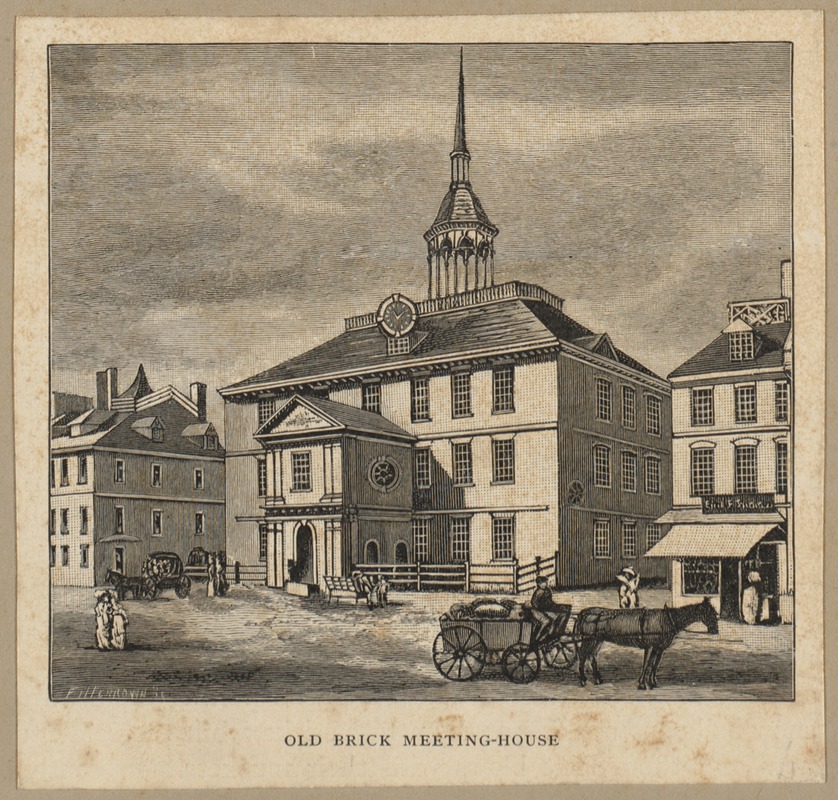
The British military sailed away on 17 March. Bostonians gathered for another town meeting twelve days later, on 29 March. They met in the Rev. Dr. Charles Chauncy’s church, the “old Brick Meeting House” (shown above). The main order of business was to elect officials for the upcoming year, starting with the town clerk. William Cooper continued to fill that role until his death in 1809.

However, there were at least two town meetings held inside besieged Boston that never got recorded in Cooper’s notes.

TOMORROW: The first lost meeting.

Thursday, November 25, 2021

Meeting the Clerks of Faneuil Hall Marketplace

Just to make matters confusing, the twelve men elected by the Boston town meeting to be clerks of the market for one year weren’t the only people in town with that title in the eighteenth century.

The town also chose one full-time clerk for each market. This man was in charge of assigning stalls to different provisioners, collecting rents, enforcing rules, and maintaining the infrastructure.

In the early eighteenth century Boston had three marketplaces, each with its own full-time clerk. After some argument, in 1742 the town consolidated those commercial spaces into one near the center of town. Thus, we need context to know what “Clerk of the Market” referred to.

In September 1742, the merchant Thomas Jackson was announced as “Clerk of the Market on Dock-Square.” According to Abram Brown’s Faneuil Hall and Faneuil Hall Market or, Peter Faneuil and His Gift (1901), the town gave Peter Faneuil the honor of naming the superintendent since he’d paid for the building. Jackson in turn hired Joseph Grey as assistant in charge of sweeping. When Faneuil died the next March, the market was named after him.

By 1749, Abijah Adams was the full-time clerk of Faneuil Hall Market, and Samuel Adams was an elected clerk of the market, starting his political career. There was a bad fire in 1761, and Abijah Adams rescued valuable goods and papers from the building, only to have to wait for the town to rebuild and repair it.

Abram Brown erred in writing that Adams was succeeded by Benjamin Clark as the pre-Revolutionary turmoil heated up; Clark was one of the elected clerks. The published selectmen’s records show how they chose a man to replace Adams in 1767 and what the daily duties of the clerk of Faneuil Hall Marketplace were:
The Selectmen having appointed Capt. James Clemmens to be Clerk of Faneuil Hall Market in the room of Mr. Abijah Adams who is in a declining state and as it is feared not like to appear abroad again, the following Orders were given said Clemmens, which bears date the Day on which he entred upon duty—vizt.—

Boston August 13. 1767
Capt. James Clemmens
Sir

You being by the Selectmen of Boston chosen to act as Clerk of Faneuil Hall Market it is our directions That you observe that the Butchers who hire the Stalls do conform to their Leases. Vizt.—

That they bring into the Market all the Hydes Skins and Tallow of all such Creatures as they kill; that they keep their respective Stalls clear, and at the shutting up of the Market at One O’Clock carry out all the Hydes Skins and Tallow and also all the Beef that shall be cut up that is less than a Quarter and all other sorts of Meal of what kind so ever—

that those Butchers who occupy the Stalls do not bring into the Market any kind of Poultry other than of their own raising to sell—

You’l Observe that every Person who erects a Stall or puts their Panyers or Carts, within the limits of the Market do pay for the same as follows—Vizt.—
  • For every Stand or Stall from the middle West Door on each side down to the Street Eight Shillings p. Month or eight Coppers p. Day,
  • for each Stand or Stall on the other parts of the West end of the Market Six Coppers p. Day—
  • For each Cart with Beef or Sauce or any other Article for Sale that stands in any other place within the Limmits of the Market four Coppers p. Day—
  • For each pair of Panyers two Coppers p. Day.
By Order of the Selectmen
WILLIAM COOPER Town Clerk.
Abijah Adams died a few months later in February 1768, aged 66 years.

James Clemens had been a sea captain, then a seller of spermaceti candles. In 1763 he announced he had become a licensed gauger, checking weights and measures, so people had come to trust him. Capt. Clemens died inside besieged Boston in February 1776, and in June the town chose George Lindsay Wallace to take his place.

Sunday, March 07, 2021

“Emptied and threw the Tea into the Water”

On Sunday, 6 Mar 1774, as described yesterday, the brig Fortune carried 28 1/2 chests of tea into Boston harbor, along with “Gun-Powder, Duck and Hemp.”

“The next day,” Gov. Thomas Hutchinson wrote, “the vessel was haled to the wharffe, where the vessels lay which had the East India Company’s tea.” And we know what had happened to that tea the preceding December.

That same Monday, the Boston Gazette ran this calm and measured item:

Messi’rs Edes & Gill, PUBLISH THIS!

It is said that Capt. [Benjamin] Gorham who is just arrived from London, has brought Forty Chests of that baneful, detested, dutied Article TEA, shipped by the East-India Company, their Brokers or Employers, and consigned to HENRY LLOYD, Esq; of this Town, Merchant.

Justice to ourselves and to AMERICA—Justice even to the other Consignees—A Regard to our own Reputation and Honor—Every Obligation binds us most SOLEMNLY, at once to DETERMINE ABSOLUTELY to oppose its Landing—Experience has fully convinced us that the Governor and the Custom-House Officers concern’d will lay INSUPERABLE Bars in the Way of sending it back to London. The Consent of the Consignee to have it return’d would be to no Purpose, if he be waited upon to request it.

The SACHEMS must have a Talk upon this Matter—Upon THEM we depend to extricate us out of this fresh Difficulty; and to THEIR Decisions all the GOOD People will say, AMEN!
That dispatch got some factual details wrong—namely, the number of tea chests, who had sent them, and who was to receive them.

But the Whig newspaper was accurate in predicting the royal authorities would make no compromises to allow the tea to be returned to Britain.

The owners of the FortuneThomas Walley, Peter Boyer, and William Thompson—laid out what they were doing that Monday in the next Boston News-Letter. With Lloyd, who had been sent sixteen tea chests; Henry Bromfield, who owned much of the ship’s cargo; and Gorham they “applied to the Collector and Comptroller of the Customs, and unitedly requested a Qualification for the Vessel to return with the Tea.” Because otherwise, they declared, there was “Danger of this Tea’s being destroyed.”

The Customs officers replied:
it was absolutely contrary to their Duty, and therefore could not give any Papers to qualify the Vessel to go back; and that although no Report [legal notice of the arrival] had been then made, yet she could not go away without being liable to be seized, and that even if they should give a Clearance, she would inevitably be stopped by the Officers of the King’s Ships, who were also Custom-House Officers . . . moreover that she could not be reported that Day after two o’Clock, and if not reported within 24 Hours the Capt. as liable to a Penalty of £100 Sterling.
Seeing where his interest lay, Capt. Gorham quickly reported the ship’s arrival and “took out a Permit to unlade the Gun-Powder.” Everyone agreed that was a good idea.

As for further steps, Boston town clerk William Cooper wrote to the Brookline committee of correspondence, seeking to rebuild the united front that had formed the preceding December:
We think it our duty to acquaint you that a Brigantine Benjamin Gorham Master is just arrived from London with a quantity of Tea on board liable to a duty: We ask the favor of your Company at the Selectmens Chamber in Boston toMorrow afternoon 3. OClock in order for a joint consultation, relative to this matter——
As it turned out, that meeting became moot.

Evening fell. Illuminated pictures of the Boston Massacre shone out from the windows of Mary Clapham’s Royal Exchange Tavern on King Street. (That display had been postponed from the 5th because that fell on the eve of the Sabbath.) As I recounted back here, in 1774 there was a new image attacking Gov. Hutchinson and Chief Justice Peter Oliver.

Bostonians had spent weeks talking about what to do with the first three shiploads of tea. They had no patience left for the Fortune. In the words of a petition from shippers in London:
about Eight o’Clock in the Evening…a great Number of Persons all of whom were unknown to the Captain and many of them disguised and dressed and talking like Indians armed with Axes and Hatchets with Force and violence entered on Board the said Vessel and broke open the Hatches and proceeded to rummage the Hold and hoisted out Twenty eight Chests of Tea…upon the Deck of the said Vessel and there with Hatchets axes and Clubs broke open the said Chests and emptied and threw the Tea into the Water whereby the same was wholly lost and destroyed.
That was the lesser-known second Boston Tea Party on the night of 7 Mar 1774.

COMING UP: John Adams surveys the scene.

Friday, February 05, 2021

“The printed Narratives of the late horred Massacre”

This week I watched an online talk by Robert Darnton about his new book Pirating and Publishing: The Book Trade in the Age of Enlightenment. He described various stratagems printers and booksellers used to get around two stifling forces in ancien rĂ©gime France: censorship by the government and monopoly by Paris’s licensed printers and booksellers. 

That topic made me think of another event from 1770 Boston in that I didn’t mention on its Sestercentennial anniversary, in part because it was kept low-key to avoid attracting too much attention.

Compared to France, the late-1700s British Empire had very free publishing laws. But in March 1770 the Boston town meeting imposed a specific bookselling ban: it commissioned Benjamin Edes and John Gill and the Fleet brothers to print the Short Narrative of the Horrid Massacre, but forbade them from selling copies locally.

The town itself dispatched copies of that report to Britain. William Molineux sent a copy to Robert Treat Paine to help him prepare for the trials. Copies were shipped to other colonial ports. But the Boston Whigs wanted to avoid any complaints that the report had prejudiced the Suffolk County jury pool against the Boston Massacre defendants, so they banned local sales.

After copies of the Short Narrative reached London, Whiggish printers there produced their own editions to satisfy public interest. William Bingley approximated the Boston publication’s layout. Edward and Charles Dilly, working with John Almon, commissioned a copy of the engraved image of the shooting made by Henry Pelham and Paul Revere and added that as a frontispiece, as shown above.

By July 1770, copies of those British editions had arrived back in Boston, along with evidence of other responses to the Massacre in London, such as Capt. Thomas Preston’s “Case,” the Fair Account of the Late Unhappy Disturbance, and Andrew Oliver’s description of the actions of Massachusetts Council. Those got most of the attention from top local Whigs, but the printers had their own interest.

At a 10 July town meeting, the Short Narrative’s original printers noted that, since the London edition was circulating, the jury pool was already tainted with no local getting any benefit. The town considered “A Motion made that the printed Narratives of the late horred Massacre, which had been retained by order of the Town in the hands of the Committee; may now be sold by the Printers.”

Town clerk William Cooper’s notes say it “Passed in the Narrative”—a slip of the pen for “Negative.” In other words, the printers had to keep sitting on their costly investment in paper and labor.

TOMORROW: Getting to market anyway.

Wednesday, September 09, 2020

The Cradle of Liberty’s Doorways into the Past

In the early designs of Faneuil Hall, I believe, the bottom level of the building was surrounded by a series of arches open to the air. In the 1800s some of those arches were turned into windows, others into doors.

I once heard Massachusetts Historical Society president Bill Fowler say to members on a tour of the fire-suppression system, “Each of these tanks represents a naming opportunity.” In the same way, I propose, each of those doors is a chance to honor more Bostonians who contributed to the Cradle of Liberty and to tell the public more about its history.

Now here’s where not being able to visit the hall easily these days gets in my way. I’m not sure how many doors there are and which offer public access. Photographs indicate there are three doors on the west side (facing Congress Street) and five on the east side (facing Quincy Market), plus a ramp to a door on the north for people with limited mobility. There are probably other doors on the north and south sides, but perhaps not for the public.

So here’s a proposal on designating those doors in the Hall Formerly Known as Faneuil.

We can name the three central entrances on the east side “The Freeholders’ Entrance,” “The People’s Entrance,” and “The Inhabitants’ Entrance.” That would reflect the three types of meetings that took place in Faneuil Hall when it was the seat of Boston’s government:
  • ordinary town meetings, described in official records as “a Meeting of the Inhabitants of the Town of Boston, at Faneuil Hall,…”
  • meetings of inhabitants meeting a higher property requirement (“freeholders”) to elect Boston’s representatives to the Massachusetts General Court.
  • meetings of “the Body of the People” with no legal authority but expressing popular sentiment on non-importation, tea, slavery, and other issues. 
For visitors, the different designations on those doors could spur questions about who had a voice in Boston’s government.

The remaining two doors on the east side could be named to honor the selectmen and the town clerk (and other employees) who kept Boston’s government running. Ideally, those portals would be close to the selectmen’s and clerk’s chambers, but I don’t know if that’s possible. I’m tempted to name the entrances in specific honor of:
  • William Cooper, town clerk from 1761 to 1809, or more than half the time Faneuil Hall was the seat of Boston’s government.
  • Harbottle Dorr as representative of all the selectmen in that period, if only so we could refer to “the Dorr Door.”
Over on the west side, I propose to call the central door, right behind the statue of Samuel Adams, the Adams Entrance. The Boston town meeting was Adams’s main base of support. Of course, his surname prompts thoughts of his relatives from Braintree, but they had much less to do with Faneuil Hall.

Another west door would become the Nell Entrance in honor of William Cooper Nell, Boston historian and civil rights activist. In response to the U.S. Supreme Court’s Dred Scott decision, Nell organized a commemoration of the Boston Massacre inside the hall in 1858, one of many protests he led in the ante-bellum period. Nell also wrote two books about African-American soldiers in the Revolutionary War, arguing that black men had always contributed to the nation and deserved equal rights within it.

The third door on the west side would be the Stone Entrance in honor of Lucy Stone, advocate not only for racial equality but for extending the vote to the half of the population who are women. She organized and spoke at the New England Women’s Tea Party held in Faneuil Hall on 15 Dec 1873, timing the event to the centenary of the most famous Boston Tea Party. Like Nell, Stone used the building’s Revolutionary fame to advance rights for more Americans.

Along the sides, I’d call one door the Peter Faneuil Entrance (or Exit), acknowledging his original gift to Boston. This could be in the portion of the building that he originally funded. That designation would allow signage to discuss both his gift to Boston and the businesses that money came from.

I’d name another side doorway as the Bulfinch Entrance, recognizing Charles Bulfinch, the local architect who expanded the hall to its present dimensions in 1806.

If there are more side doors, there are other historic figures associated with the Cradle of Liberty. James Otis, Jr., was very active at Boston town meetings during the 1760s, and the city may lack monuments that reflect his importance. Wendell Phillips came to prominence with anti-slavery speeches in Faneuil Hall. Boston politics owes a lot to Elisha Cooke, Sr., and Elisha Cooke, Jr., organizers of the town’s first political machine, though neither lived to see Faneuil Hall.

And there may well be other figures I haven’t thought of. There may be convincing arguments besides historical inertia for retaining the building’s original name and set-up. This proposal is just my attempt to communicate through public memorials at a prominent civic site how:

  • Our society no longer overlooks the enslaved people who suffered for Peter Faneuil’s wealth.
  • We maintain the memory of local slavery and the efforts it took to correct it.
  • We recognize historical change and the possibility of change in the future.