


J. L. BELL is a Massachusetts writer who specializes in (among other things) the start of the American Revolution in and around Boston. He is particularly interested in the experiences of children in 1765-75. He has published scholarly papers and popular articles for both children and adults. He was consultant for an episode of History Detectives, and contributed to a display at Minute Man National Historic Park.

Subscribe thru Follow.it


•••••••••••••••••


Showing posts with label Henry Vassall. Show all posts

Saturday, September 07, 2024

Gunshots in the Countryside
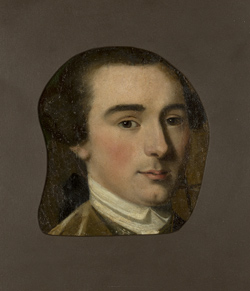
On 7 Sept 1774, 250 years ago today, Henry Vassall was riding in Lincoln when he heard a gunshot.

The only Henry Vassall I was able to find on the family tree at this time was a nineteen-year-old son of William Vassall, discussed yesterday.

Henry was either visiting or staying with his cousin Elizabeth, wife of Dr. Charles Russell (1739–1780, shown here). I wonder if he was studying medicine.

Later that month Henry Vassall told the Charlestown committee of correspondence about his experience. He then wrote out an account for two Middlesex County magistrates, Henry Gardner of Stow and Dr. John Cuming of Concord:
Passing between the House of Mrs. Rebecca Barons [?] & Doct. Russell’s between the Hours of 7 & 9 in the Evening of the 7 instant [i.e., this month] & to the best of my Knowledge as I rose [?] a little Hill a little a past the first Canopy [?] I heard the report of a Gun saw the light and a Ball Enter’d the Carriage which I was in being Doct. Russells.

I immediately step’d out of the Carriage & stood about five or six Minutes & then stepp’d into the Carriage Again & road in haste to the Doctor when I had gone a small Distance from the Place where the Gun was discharged I met a person on Horse back

when I had past a small Distance further I met several Persons riding on two Horses,

whether the Ball was aim’d at the Carriage I can’t say I further declare I do not know or even suspect who the Person was that Discharg’d the Gun as above mentioned . . .

NB. The above affair I declar’d to no person in Lincoln but the Revd. Mr. [William] Lawrence & desired him to keep it secret—Till the Friday Following.
Gardner and Cuming also gathered statements from a local man named Joseph Peirce and Luck, enslaved to Dr. Russell. Both declared that they had been traveling near young Vassall and had heard no gunshot.

Three members of the Lincoln committee of correspondence then wrote back to Charlestown agreeing that they detested “the Crime of Assassination” but casting doubt on Vassall’s complaint:
We shall only add that as the evening on which this event was said to have happened was very calm it is the general opinion here that it is very improbable if not utterly impossible that a gun should be Discharged at that time & place without being heard by many persons, you have Doubtless seen the impression in the Carriage & are able to judge & Declare whether it is the efect of a Bullet Discharged from a Gun or Not as well as any person in this town
This incident provided yet another reason for members of the Vassall family to seek safety surrounded by the king’s soldiers. (And on the same day that the magistrates wrapped up their investigation, people in Bristol, Rhode Island, threw stones at the chaise of Henry’s father and stepmother, William and Margaret Vassall. Newspapers reported that “next morning [they] set out for Boston.”)

This shot in Lincoln is only the second example I’ve found of someone in Massachusetts firing a gun at a supporter of the royal government. The first had occurred a couple of weeks earlier in Taunton.

According to Daniel Leonard, a veteran of the last war named Job Williams came to his house with a warning that “the People were to assemble” to protest how he had joined the mandamus Council. Leonard left, thinking that would head off the problem. Instead, on 22 August , or perhaps make it clear he wouldn’t be welcomed back. That crowd did arrive. Leonard wrote:
about five hundred persons assembled, many of them Freeholders and some of them Officers in the Militia, and formed themselves into a Battalion before my house; they had then no Fire-arms, but generally had clubs. . . .

My Family supposing all would remain quiet, went to bed at their usual hour; at 11 o’Clock in the evening a Party fixed upon the house with small arms and run off; how many they consisted of is uncertain, I suppose not many; four bullets and some Swan-shot entered the house at the windows, part in a lower room and part in the chamber above, where one Capt. Job Williams lodged. The balls that were fired into the lower room were in a direction to his bed, but were obstructed by the Chamber floor. . . . I conclude it possible that the attack upon the house was principally designed for him.
Back in 1769–1770, there had been three increasingly notorious incidents of government supporters shooting at crowds of protestors: the “Neck Riot,” Ebenezer Richardson killing Christopher Seider, and of course the Boston Massacre. But even in that period Massachusetts protestors had never shot at royal officials or their supporters.

These untraceable gunshots in the late summer of 1774 show that some people in Massachusetts were starting to think it was acceptable to use that level of violence against Loyalists.

Friday, October 19, 2012

The Vassalls of Cambridge

Although the title of my book-length study for the National Park Service is Gen. George Washington’s Headquarters and Home—Cambridge, Massachusetts, it gets a running start with the building of that house sixteen years before Washington arrived.

In 1759 John Vassall (1738-1797) turned twenty-one and came into his inheritance of large sugar plantations on Jamaica. He had the best upbringing that his maternal grandfather, Lt. Gov. Spencer Phips, could provide. He had a Harvard degree. And from his late father he had farmland in Cambridge with a house on the north side of the road out to Watertown.

But that house evidently wasn’t exactly what John Vassall wanted, so he had it torn down and a handsome new Georgian mansion built nearby. Over the next fifteen years Vassall added to the estate until he owned 90 acres, paying more real-estate tax than anyone else in Cambridge.

In January 1761, John Vassall married Elizabeth Oliver (1741-1807), daughter of a Dorchester man with Caribbean plantations. Seven months earlier, John’s sister Elizabeth had married Elizabeth’s brother Thomas Oliver. Miss Elizabeth Vassall thus became Mrs. Elizabeth Oliver, and Miss Elizabeth Oliver became Mrs. Elizabeth Vassall. In 1766, the Olivers moved to Cambridge, commissioning a handsome mansion of their own, now called Elmwood.

John Vassall’s life in Cambridge in the late 1760s would have given Bertie Wooster fits: he was surrounded by aunts. His father’s brother Henry Vassall and wife Penelope lived pretty much across the street. Near the college was his father’s sister, Anna Borland, and her husband. Two of his mother’s sisters, Mary Lechmere and Rebecca Lee, lived along the Watertown road to the west with their husbands. Then came another paternal aunt, Susanna Ruggles, with hers. And finally the Olivers. All those houses are still intact, too, though one has been moved. They comprise most of “Tory Row.”

This chapter describes the “Powder Alarm” of 2 Sept 1774 from the Vassalls’ point of view. Imagine being Spencer Vassall, John and Elizabeth’s ten-year-old second son, watching 4,000 men with sticks march past your house to the town common to demand that all the men appointed to the new royal Council step down. Then watching those thousands of men walk back past your house to your uncle’s, where they threatened his life until he signed a resignation under protest. Did Spencer know that his father had recently told Gov. Thomas Gage he was willing to sit on the Council as well? (That news was kept secret, and John Vassall never actually took the seat.)

The Vassalls left their Cambridge home for their Boston home that September, then left Boston for Halifax in 1775 and were in London by June 1776. With most of his wealth coming from Jamaica, John Vassall easily weathered the loss of his Massachusetts properties. In fact, the memorial inscriptions for him and his wife in St. Paul’s Church in Bristol don’t even mention Massachusetts, where both were born and where they had seven of their eight children (two dying young).

And what about Spencer Vassall? He was ready to fight in the American war. His father bought him an army commission, and he apparently entered the service in 1778 at the age of fourteen. Lt. Vassall served at Gibraltar from October 1782 to the end of the war; for the British, staving off Spain’s attempt to regain this territory was an important and heroic campaign. Vassall remained in the army through the wars with Revolutionary and Napoleonic France, serving in Flanders, Antigua, France, Spain, Holland, Ireland, and South Africa. He died leading a British attack on Montevideo, Uruguay, in 1807.

Amelia Opie wrote an epitaph to Capt. Spencer Vassall that began:
Stranger, if e’er you honor’d Sidney’s fame,
If e’er you lov’d Bayard’s reproachless name,
Then on this marble gaze with tearful eyes,
For kindred merit here with Vassall lies!…
The first chapter of the report includes more mediocre poetry about the captain, plus the family’s vital records, descriptions of John Vassall’s social and public life, details of a mysterious shooting in Lincoln, and remarks on whether Vassall was really a figure in Mercy Warren’s The Group or involved in a Loyalist disinformation campaign during the war.

Wednesday, June 30, 2010

Tunnel Under Brattle Street?

On Sunday I was at the Longfellow National Historic Site in Cambridge, and the question of tunnels surfaced. Apparently some visitors have asked about tunnels from the house either down to the Charles River, or under the Charles River to Boston. Supposedly Gen. George Washington made use of these tunnels while he lived in that house during the siege of Boston. It’s not clear. Then again, it’s not true.

The old tunnel story involving that house is that its first owner, John Vassall, commissioned a passage under what is now Brattle Street to his uncle Henry Vassall’s house nearby. This story was circulating in the mid-1800s. Isabella James, née Batchelder, who grew up in that other house across the road, wrote about it in Theatrum Majorum: The Cambridge of 1776, published in 1875:

A strong belief prevails in Cambridge that a subterranean passage connects this house with Mr. H. W. Longfellow’s, and that it was constructed to enable the two Vassall families to visit each other without exposure to the outside world. Many years ago the writer with her brothers and a brother of the Poet made a progress through the cellars in a vain search after this mysterious and mythical passage-way, one of the party only retaining a conviction that if a walled-up arch of solid masonry could be opened the entrance might be found.
The “brother of the Poet” could have been Samuel, Stephen, or Alexander Wadsworth (Waddy) Longfellow; I’ll have to check with the staff at the House to know which one is most likely.

Oliver Bronson Capen’s 1904 article “Country Homes of Famous Americans” in the magazine Country Life in America apparently alluded to that exploration:
There is a tradition, the origin of which is lost in obscurity, that a subterranean passage connects the houses. A generation or so ago the children of the neighborhood set about to discover this tunnel. Sentinels were posted in both cellars, but diligent knocking of the walls and the most vigorous efforts of youthful lungs failed to unravel the mystery.
Finally, Samuel F. Batchelder, who I think was Isabella James’s little brother, tried to put the story to rest in a 1914 article for the Cambridge Historical Society called “Col. Henry Vassall and His Wife Penelope Vassall with Some Account of His Slaves.” He wrote:
A tradition of delicious mystery connects the two houses by a secret underground passage. A bricked-up arch in Colonel Henry's cellar wall appears to be the foundation of both the tradition and that part of the building. We may assume, from what we know of the owner, that the feature was much more probably the entrance to a wine vault.

Although this primitive “subway” has caved in under the prodding of modern investigation, the touch of romance indispensable for a historic mansion was supplied, up to living memory, by an absolutely authentic secret recess closed by a sliding panel. Since the “secret” of its location—by the fireplace in one of the oldest rooms—was as usual public property, there was, naturally, nothing in it.
And yet the tunnel rumor lives on today, now even longer and attached to the name of Gen. Washington.