J. L. BELL is a Massachusetts writer who specializes in (among other things) the start of the American Revolution in and around Boston. He is particularly interested in the experiences of children in 1765-75. He has published scholarly papers and popular articles for both children and adults. He was consultant for an episode of History Detectives, and contributed to a display at Minute Man National Historic Park.

Subscribe thru Follow.it


•••••••••••••••••


Showing posts with label Samson Occom. Show all posts

Friday, June 05, 2026

“I know that our way will bring us there”

Yesterday’s posting mentioned the Rev. Samuel Ashbow, a Baptist minister from the Mohegan community in Connecticut.

A lot of information about Ashbow comes from Samson Occom and the Christian Indians of New England by W. DeLoss Love (1899). Both Ashbow and Occom studied with the Rev. Eleazer Wheelock and worked on his conversion missions before breaking with him theologically and organizationally.

The Rev. David McClure (1748–1820, shown here) also left a glimpse of Ashbow in his diary. This passage comes from the summer of 1768 when McClure was an undergraduate at Yale College. He “took a ride to the Sea Shore & in company with Mr. Chester Bingham tarried a few days at Narraganset,” the Native community in what’s now Charlestown, Rhode Island.
Sabbath, attended the Indian meeting, at their meeting house, which was small & about the size of a common school house. About 50 Indians were present. They were mostly elderly people. They sung, prayed & exhorted. There were 4 or 5 who exhorted. The principal speaker was called Sam’l Ashpo.

They were all very earnest in voice & gesture, so much so that some of them foamed at the mouth & seemed transported with a kind of enthusiasm. When they prayed, all spake audibly, some in english & some in Indian. It was indeed a confused noise. . . .

I stood near to Ashpo, and noticed the following expressions in his prayer er in confession of sins. We must allow for grossness of the style, from his imperfect knowledge. “Lord, thou knowest what a poor vile sinner I have been; how I have been a vile drunkard, and like a beast have lain drunk in my own spue, all night at taverns and on the road; but O Lord, thou has forgiven me my sins, for the sake of our blessed Saviour Jesus Christ, who can save the vilest sinner” &c.— . . .

As a sample of their ready wit even in serious things, among other instances, after meeting passing the house of one of the speakers, standing in his door, He said to me, “How do you like our way of worship?[”] I replied some things are very good; but would it not be more edifying, in prayer for one to pray & the congregation to join?—He replied “that will never do. Must make ’em all pray. Plaguy apt to cheat.”

When in the Meeting, one of the Exhorters addressed me & my companion, & said “this is the way that we Indians have to get to Heaven. You white people have another way. I don't know but your way will bring you there, but I know that our way will bring us there.”
Though McClure was contemptuous about the worshippers’ “simple and vulgar” way of expressing their understanding, I thought the metaphors he recorded them using were actually quite evocative.
One of the exhorters said, “I have been up the North ward in the french war, and when cold weather come on orders come—Go into winter quarters. This was dreadful news, to stay there all winter in cold & hunger; but soon word come again, strike your tents & home boys home. Then was all glad, and so it is with a christian going to Heaven.”

Another said, “I have been to New Port & down the wharf, & seen a ship just going to sea. There friends shake hands, and cry farewell, soon the sails are up & the wind comes & she goes, & all hands huzza, (hurraw) so it is with a christian going to Heaven.”
Three or four of Ashbow’s sons died fighting for the Continental cause, starting with Samuel, Jr., at Bunker Hill. He remained in Connecticut after the war while many other Christian Natives in the northeast, including Occom, were pushed to the Brotherton community in upstate New York and then on to Wisconsin. 

Friday, August 17, 2018

Phillis Wheatley Day at Old South, 18 Aug.

The Old South Meeting House traditionally observes 18 August as Phillis Wheatley Day, commemorating the anniversary of when the young African-born poet joined the congregation in 1771.

This year that date falls on this coming Saturday. At 12:00 noon and 1:00 P.M. a Freedom Trail Foundation Player will portray Wheatley, sharing with visitors her experiences as an enslaved writer in colonial Boston. This program will be free as part of paid admission to the historic site.

Here’s some of Wheatley’s writing on her faith as it pertained to her African heritage and enslavement. The first is the poem “On Being Brought from Africa to America,” composed in 1768 when she was still in her teens and published in her 1773 volume:
’Twas mercy brought me from my Pagan land,
Taught my benighted soul to understand
That there’s a God, that there’s a Saviour too:
Once I redemption neither sought nor knew.
Some view our sable race with scornful eye,
“Their colour is a diabolic die.”
Remember, Christians, Negros, black as Cain,
May be refin’d, and join th’ angelic train.
On 11 Feb 1774, after becoming free, Wheatley wrote to the Rev. Samson Occom, a Mohegan minister, with more thoughts on the state of slavery:
I have this Day received your obliging kind Epistle and am greatly satisfied with your Reasons respecting the Negroes, and think highly reasonable what you offer in Vindication of their natural Rights: Those that invade them cannot be insensible that the divine Light is chasing away the thick Darkness which broods over the Land of Africa; and the Chaos which has reign’d so long, is converting into beautiful Order, and reveals more and more clearly, the glorious Dispensation of civil and religious Liberty, which are so inseparably united, that there is little or no Enjoyment of one without the other:

Otherwise, perhaps, the Israelites had been less solicitous for their Freedom from Egyptian Slavery; I don't say they would have been contented without it, by no Means, for in every human Breast, God has implanted a Principle, which we call love of Freedom; it is impatient of Oppression, and pants for Deliverance; and by the Leave of our modern Egyptians I will assert that the same Principle lives in us. God grant Deliverance in his own Way and Time, and get him honor upon all those whose Avarice impels them to countenance and help forward the Calamities of their fellow Creatures.

This I desire not for their Hurt, but to convince them of the strange Absurdity of their Conduct whose Words and Actions are so diametrically opposite. How well the cry for Liberty, and the reverse Disposition for the exercise of oppressive Power over others agree,—I humbly think it does not require the Penetration of a Philosopher to determine.
In both documents Wheatley adopted the western notion of Africa, which she must have barely remembered and then through the lens of trauma, as a “Pagan land” of “thick Darkness.” And in both she presents Christianity as a source of redemption and refinement. But in the latter letter, which was published in New England newspapers, Wheatley challenged Americans sounding “the cry for Liberty” to live up to that Christian ideal.

Tuesday, May 29, 2018

Meeting “Capt. Yoking”

Here’s more from the diary of the Rev. David Avery, who as chaplain accompanied a regiment to Chelsea in the wake of the fight over Hog and Noddle’s Island.

This is Avery’s entry from 29 May 1775 as the provincial forces finished salvaging useful material from H.M.S. Diana, which had run aground during the fighting.
29. Monday. Lodged last night in a comfortable bed. Went down to the Ferry, much treasure was got out to-day. Two large anchors & one Kedge & several large square pig iron as ballast, with several articles of consequence & a barrel of pork
When this diary was published in the D.A.R.’s American Monthly Magazine in 1900, the word I typed as “Kedge” (a sort of small anchor) was transcribed as “Kelly.” I haven’t seen the original document to confirm my guess.

Avery’s entry continued:
About noon Capt. Yoking, a Stockbridge Indian & I reconnoitered the Ground East of the schooner & judged that the taking off the cattle was practicable. The Capt. with 3 men took a canoe & went about a mile & a quarter upon the north side of the river from the Ferry & went across to Noddle’s Island & reconnoitered & scouted round about an hour & a quarter, when he fixed his centuries & another canoe went over to his assistance & soon took 2 horses & mired a 3d when a cannon ball fell pretty near them & four barges landed upon which all the scout retreated to the main shore & came over.

Upon that I advised that they should go back & get the stock. Accordingly they got off the Stock about sunset.

Stood upon guard two hours near Winnisimmit Ferry. Prayed with company.
The reference to “Capt. Yoking, a Stockbridge Indian” is very interesting.

Massachusetts Soldiers and Sailors of the Revolutionary War notes one state record of a captain named Jehoiakim Youkin in Col. John Paterson’s regiment. The same name also shows up on the records of Gen. George Washington’s headquarters. In August 1775 the general’s military secretary, Joseph Reed, paid Jehoiakim Youkin for digging necessaries—though perhaps he was collecting money for other men.

According to Patrick Frazier’s The Mohicans of Stockbridge, Jehoiakim Yokun or Yokum was a Mahican leader and landowner in western Massachusetts in the mid-1700s. Sites in the region still bear the Yokun name.

When the war began, Jehoiakim’s son Timothy Yokun became the first sergeant in Capt. William Goodrich’s company of Stockbridge Indians within Col. Paterson’s regiment. These soldiers were part of the Massachusetts forces and yet set apart in their style of living and fighting. Most company records don’t list Jehoiakim Yokun’s name at all. But evidently he was in command alongside Goodrich, perhaps particularly in combat. Less than two months into the war, Avery was calling him “Captain.”

One historian appears to have conflated father and son, saying Timothy gained the rank of captain during the war. Yet other authors list Timothy Yokun among the Stockbridge soldiers killed by Lt. Col. John Graves Simcoe’s rangers near Yonkers, New York, in August 1778. Diaries of the Sullivan expedition, the postwar diaries of the Rev. Samson Occom, the pension application of David Freemoyer, and an early history of the town of Stockbridge all refer to a “Captain Yoke or Yokun” active later in the war and returning to Stockbridge afterwards. That was most likely Jehoiakim.

Another source tells us the name of one of the Stockbridge men who went out onto Noddle’s Island and brought back those two horses. As quoted here, he was Henries Vomhavi. The Provincial Congress granted him the smaller of those two horses as a reward.

Saturday, July 01, 2017

A Common-place Sampling

The online history magazine Common-place just released a new issue featuring thirteen essays by young scholars on thirteen varied texts from or about early America. Each short essay is accompanied by a link, so it functions as an introduction to that work. Here are the pieces on eighteenth-century material.

Early America’s Guide to Sex: Aristotle’s Masterpiece
Sarah Schuetze
It is not hard to imagine the allure of such a work for readers—modest or otherwise—for it provided a rare detailed discussion of sex.

Poetic Order in Sarah Kemble Knight’s Journal
Kimberly Takahata
By liberating her thoughts from the space of prose and her account from the limitations of physicality, Knight can transform the landscape through her narration, using poetry to “divert” and contain the threat of the unfamiliar.

On Virtue: Phillis Wheatley with Jonathan Edwards
Michael Monescalchi
Wheatley’s saying that her soul touched by Virtue can “guide [her] steps” is thus more than just a metaphor for God’s ability to change a converted person’s life: it is an acknowledgment of the immense power that God’s virtuous character can have over a person’s body and soul.

Samson Occom’s Missionary Correspondence and the Common Pot
Lauren Grewe
Creating a literary genealogy linking Occom and Wheatley could change conceptions of early American Indian and African American writing and missionary work.

America, the “Rebellious Slut”: Gender & Political Cartoons in the American Revolution
Stephanie McKellop
Combining Revolutionary politics with the social and cultural valences of gender, race, class, nation, and power, this political cartoon serves as a multidimensional cipher which people at every knowledge level can participate in analyzing.

Introduction to The History of a French Louse
Julia Dauer
The satire’s narrator is a louse who has lived on a series of heads in and around Paris and been witness to the political maneuverings happening behind the scenes of the American Revolution.

Gallows Respectability
Ajay Kumar Batra
Sentimental reformist oration, fugitive confession, and the personal epistle are all represented in this text [the address of a African-American man named Abraham Johnstone being hanged—unjustly, he says—for murder in 1797].

Saturday, March 21, 2015

A Mohegan Woman’s Deathbed Remarks

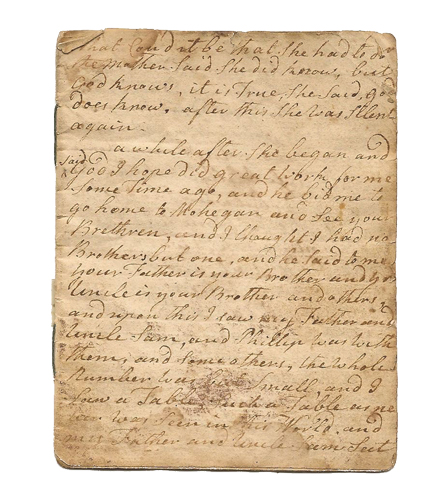
A recent issue of the Yale magazine offered a look at a newly recognized document in the handwriting of the Rev. Samson Occom. Apparently in 1776 he took down the deathbed statement of a young woman:
That December, a daughter of Mohegan leader Robert Ashbow, motivated by a religious vision, returned home after what appears to have been a long absence. By the end of the month, the young woman was dying. On Christmas Eve, Occom wrote an account of the last moments of her life, which included a conversation with her mother. (The daughter’s name, unfortunately, is never given.)

The beginning is typical for Christian deathbed narratives—a confirmation of belief in God and an acceptance of death. But then the woman declares, “No one that fights Shall ever enter the Kingdom of Heaven, nor them that Cary Sharp Weapons and Heavy things for the first Christians did not fight but were Loving.” She adds that her aunt Hannah thought herself “better and above” Hannah’s daughter-in-law, Jerusha, but Jerusha had “better inheritance.” These are unusual, unexplained statements.

At first, we thought “inheritance” referred to spiritual redemption. But as we reconstructed the lives of the people in the narrative, another explanation seemed plausible. Hannah’s husband, we found, was Rev. Samuel Ashbow, Robert Ashbow’s brother. The couple had lost one of their sons, Samuel Jr., at Bunker Hill—the first Native American killed in the Revolution. For Hannah and Samuel, that death would begin their family tragedy: they would lose three more sons before the war was over. On the other hand, Jerusha, the widow of Samuel Jr., had a young son whose life was just beginning. Were the dying woman’s remarks a comment on the futility of war? A portent of the immense physical and cultural losses the Mohegans would endure as a result of that war?
Did they reflect that particular moment during the war in late 1776, when the royal forces were handily dispatching the Continental Army and armed resistance seemed like a poor idea? With so few written sources preserved, we‘re unlikely to have the answers to those questions.

The same magazine also notes a rare harpsichord from about 1770 that somebody decided to make look like an even rarer harpsichord from several decades before.

Sunday, October 19, 2014

Samson Occom’s Harsh Words for Eleazar Wheelock

The Occom Circle is an interesting online collection from the Dartmouth Library.

In past decades, this collection might have been presented under the name of the Rev. Eleazar Wheelock, writer or recipient of most of the documents, or of the college he founded in New Hampshire.

But here they’re organized around the Rev. Samson Occom (1727-1792, shown here), a Mohegan Presbyterian missionary who studied under Wheelock in Connecticut.

Occom was quite a curiosity in the eighteenth-century British Empire. Wheelock sent him to Britain to raise funds for a new project: a seminary to train more Native American ministers to convert more Native Americans, and so on.

That project led to Dartmouth College, whose students were mostly white. In July 1771 Occom broke with Wheelock as a mentor in a dramatic letter shown and transcribed here:
I am very Jealous that instead of Your Seme­nary Becoming alma Mater, She will be too alba mater to Suckle the Tawnees, for She is already aDorn’d up too much like the Popish Virgin Mary She’ll be Naturally asham’d to Suckle the Tawnees for She is already equal in Power Honor and Authority to and any College in Europe, I think your College has too much wordly Grandure for the Poor Indians they’ll never have much benefet of it . . .

Your having So many white Scholars and So few or no Indian Scholars, gives me great Discouragement — I verily thought once that your Institution was Indtended Purely for the poor Indians with this thought I Chearfully Ventur’d my Body & Soul, left my Country my poor Young Family all my Friends and Relations, to Sail over the Boisterous Seas to England, to help forward your School, Hoping, that it may be a lasting Bene­fet to my poor Tawnee Brethren, with this View I went a Volunteer — I was quite willing to become a Gazing stock, Yea Even a Laughing Stock, in Strange Countries to Promote your Cause — we Loudly Proclaimd before Multitudes of People from Place to Place, that there was a most glorious Prospect of Spreading the gospel of the Lord Jesus to the furtherest Savage Nations in the wilderness, thro’ your Institution, we told them that there were So many Missionaries & So many Schoolmasters already Sent out, and a greater Number woud Soon follow

But when we got Home behold all the glory had decayd and now I am afr’aid, we Shall be Deem’d as Liars and Deceivers in Europe, unless you gather Indians quickly to your College, in great Numbers and not to have So many Whites in the Charity, — I understand you have no Indians at Present except two or three Mollatoes — — this I think is quite Contrary to the Minds of the Donors, we told them, that we were Beging for poor Miserable Indians
In addition to this dispute over the Dartmouth student body, Occom also resented how his family had not received the support Wheelock had promised.

For the rest of his life, Occom lived with his Christian Mohegan community, moving from Connecticut to the Oneida lands in New York in 1785.

Monday, September 24, 2012

More to Read, So Much More

The University of Pennsylvania Press recently announced the contents of two journals with several intriguing articles, a couple of which I believe I read in draft as part of the Boston Area Early American History Seminar, which is about to start up again for this academic year.

In the fall 2012 issue of Early American Studies:
  • Mary Kelley, “‘While Pen, Ink & Paper Can Be Had’: Reading and Writing in a Time of Revolution.”
  • Karin Wulf, “Bible, King, and Common Law: Genealogical Literacies and Family History Practices in British America.”
  • Christopher M. Parsons and Kathleen S. Murphy, “Ecosystems under Sail: Specimen Transport in the Eighteenth-Century French and British Atlantics”
  • Kelly Wisecup, “Medicine, Communication, and Authority in Samson Occom’s Herbal.”
  • Sarah Fatherly, “Tending the Army: Women and the British General Hospital in North America, 1754–1763”
  • Michael Hoberman, “‘Under Their Captivity & Dispersion’: The Story of Boston’s First Jewish Business Venture.” (I recently noted a lecture by Prof. Hoberman.)
  • Jasper M. Trautsch, “‘Mr. Madison’s War’ or the Dynamic of Early American Nationalism?”
And in the fall 2012 issue of The Journal of the Early Republic:
  • Gloria L. Main, “Women on the Edge: Life at Street Level in the Early Republic.”
  • Ruth Wallis Herndon, “Poor Women and the Boston Almshouse in the Early Republic.”
  • Monique Bourque, “Women and Work in the Philadelphia Almshouse, 1790–1840.”
  • three more articles about poor American women in the early nineteenth century.
The latter also includes reviews of Contesting Slavery: The Politics of Bondage and Freedom in the
New Nation; Whose American Revolution Was It?: Historians Interpret the Founding; Liberty’s Exiles: American Loyalists in the Revolutionary World; The Limits of Optimism: Thomas Jefferson’s Dualistic Enlightenment; Jonathan Fisher of Blue Hill, Maine: Commerce, Culture, and Community on the Eastern Frontier; A Place in History: Albany in the Age of the Revolution, 1775–1825; and more.