J. L. BELL is a Massachusetts writer who specializes in (among other things) the start of the American Revolution in and around Boston. He is particularly interested in the experiences of children in 1765-75. He has published scholarly papers and popular articles for both children and adults. He was consultant for an episode of History Detectives, and contributed to a display at Minute Man National Historic Park.

Subscribe thru Follow.it


•••••••••••••••••


Showing posts with label William Williams. Show all posts

Monday, July 07, 2025

“The Colony of Connecticut must raise 6,000”

As I quoted last week, on 23 Apr 1775 the Massachusetts Provincial Congress resolved to raise an army of 30,000 men, 16,400 of them coming from outside the province.

In this Journal of the American Revolution article from last year, I discussed how early in 1775 the congress had set up liaisons with the governments of Connecticut, Rhode Island, and New Hampshire in case war broke out.

The Massachusetts Patriots had alerted their colleagues in those colonies about the fighting on 19 April. And now they asked for troops.

In Connecticut, Gov. Jonathan Trumbull supported the Patriots. As soon as he heard the news from Lexington, he agreed to call the legislature into session to take official action. On 21 April, William Williams, the Connecticut assembly speaker and Trumbull’s son-in-law, wrote with two other politicians to the Massachusetts congress:
Every preparation is making to Support your Province— . . . the Ardour of Our People is such that they can’t be kept back;—The Colonels are to forward part of the best men & most Ready, as fast as possible; the remainder to be ready at a Moments warning
Some militia officers were already on the move. Israel Putnam was in Concord on 21 April as the Massachusetts congress met. He wrote back:
I have waited on the Committee of the Provincial Congress, and it is their Determination to have a standing Army of 22,000 men from the New-England Colonies, of which, it is supposed, the Colony of Connecticut must raise 6,000, and begs they would be at Cambridge as speedily as possible, with Conveniences; together with Provisions, and a Sufficiency of Ammunition for their own Use.
Col. Benedict Arnold and his volunteers left New Haven on 22 April and arrived in Cambridge one week later. On 23 April a letter from Wethersfield to New York said:
We are all in motion here, and equipt from the Town, yesterday, one hundred young men, who cheerfully offered their service; twenty days provision, and sixty-four rounds, per man. They are all well armed, and in high spirits. . . . Our neighbouring Towns are all aiming and moving. Men of the first character and property shoulder their arms and march off for the field of action. We shall, by night, have several thousands from this Colony on their march. . . .

We fix on our Standards and Drums, the Colony Arms, with the motto, “qui transtulit sustinet,” round it in letters of gold, which we construe thus: “God, who transplanted us hither, will support us.”
On 27 April the Connecticut legislature voted to enlist 6,000 soldiers—six regiments of about a thousand men each. Joseph Spencer was appointed general of this army with Putnam next in seniority. (David Wooster remained in Connecticut to oversee defending its coast or New York as needed.)

Notably, Connecticut asked men to enlist in its army only until 10 December, not the end of the year as other New England colonies did. That became a problem when December rolled around and lots of Connecticut companies wanted to leave early (as Gen. George Washington viewed it) or on time (as their enlistment papers said). I discussed that conflict back here.

TOMORROW: Rhode Island’s observers.

Monday, June 02, 2025

“General Spencer’s uneasiness, &c., at being overlooked, &c.”

According to the young Connecticut officer Samuel Blachley Webb, when Gen. Joseph Spencer learned the Continental Congress had ranked Israel Putnam over him, “He began to speak very freely; and finally, persuaded the officers, to remonstrate to the Assembly of Connecticut; and he set off immediately for home.”

Spencer was older than Putnam. He had raised a company for King George’s War in the 1740s while Putnam’s vaunted military career began in 1755. The Connecticut legislature had granted Spencer seniority, and he wanted to keep that status.

Forty-nine Connecticut officers signed a letter to their legislature that praised Spencer’s “exemplary life, good conduct, prudence, and courage.” It said:
You are sensible it will be with great reluctance our Troops at Roxbury could see their General superseded by an officer in previous lower command. We have no objection to the appointment of Generals [George] Washington and [Charles] Lee, and shall endeavour to preserve the good order and submission to their government as hath before distinguished this part of the Connecticut Troops whilst under General Spencer’s command; but the late arrangement so far removes General Spencer from his former command, that he cannot and will not continue in the service under this arrangement.
In his home colony, Spencer seemed to get the support he was after. In Lebanon on 13 July, Gov. Jonathan Trumbull showed his Council a draft letter to Gen. Washington about the issue. The official record of that meeting says the letter was
hinting at General Spencer’s uneasiness, &c., at being overlooked, &c., and that it was beside our expectations, &c., and proposing, &c., that said General Spencer may remain stationed at Roxbury with the body of Connecticut Troops now there, &c.; which are approved, though a small alteration was made in the Letter to gratify Gen. Spencer after he came in, &c.
Two politicians, Samuel Huntington and William Williams (the governor’s son-in-law and speaker of the assembly), went to the tavern where Spencer was staying to hear him out about “his dissatisfaction, &c.” They tried to “reconcile him cheerfully to pursue the service.”

That afternoon, Gov. Trumbull and the Council invited Spencer to join their meeting. They
had a long conference with him on the subject matter of his being superseded by the General Congress, in putting Gen. Putnam above him &c., which he thinks very hard of and resents &c., and is at length persuaded to return to the army and not at present quit the service as he proposed; and Genl. Spencer set out on his return to camp with the letters to Genl. Washington.
Trumbull’s letter to Gen. Washington said that “Generals [David] Wooster and Spencer will think they have reason to complain” about their ranking relative to Putnam and suggested a “Method to obviate the difficulties that are apprehended”:
The Army before Boston is necessarily thrown into two Grand Divisions. General Spencer with a Number of Our Troops hath hitherto been at Roxbury, and General Putnam at Cambridge —That Destination continued and Observed, may prevent uneasy Competition; preserve good order, and promote the public Service.
Spencer arrived back on the siege lines around Boston on 19 July.

TOMORROW: A triumphant return?

Sunday, November 17, 2024

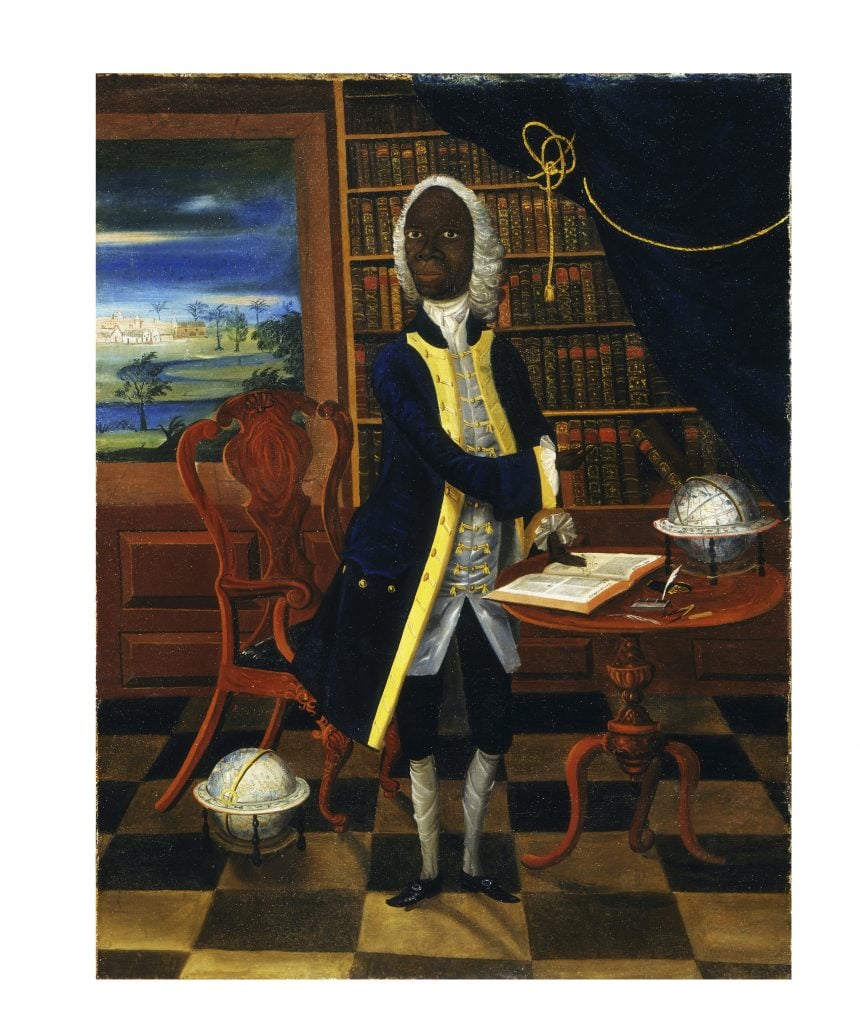
More Light from the Portrait of Francis Williams

Earlier in the month I reported on Fara Dabhoiwala’s work on the portrait of Francis Williams based on two news articles.

I’ve now read Prof. Dabhoiwala’s own article in the London Review of Books, and he has even more to say.

About the painter:
The only oil painter known to have been active in Jamaica during these years was an Anglo-American artist called William Williams, who was then in his early thirties. This Williams, the son of an ordinary mariner, had been born in Bristol in 1727. He’d always loved to draw. Sent to sea as a youth, he abandoned his crew in Virginia and spent a few years knocking around the West Indies and Central America, sometimes living among Indians, learning their language and trying his luck as a painter for the local colonists.

Eventually, around 1747, he ended up in Philadelphia, where he worked for a theatre, painting sets and backdrops, and in a boatyard, painting ships, as well as doing sign-painting and lettering, teaching music, writing poetry and composing what is now regarded as the first American novel.

Though he was entirely self-taught, he also made landscapes and portraits; he collected engravings; he used a camera obscura as a drawing aid; he studied the lives of the great artists and wanted to be one himself. He was the earliest teacher of the young Benjamin West, who…in the 1770s commemorated his old mentor by including his likeness in one of his monumental historical canvases.

William Williams kept a list of every painting he ever made. The original doesn’t survive, but in the 19th century someone jotted down a summary of it. In the spring of 1760, Williams travelled from Philadelphia to Jamaica to offer his services as an artist. His list recorded that during his months in Jamaica, he painted 54 pictures. None of these has ever been found. I am confident that the portrait of Francis Williams is one of them.

There is in fact a scientific test that could prove this, because it has recently been discovered that William Williams prepared his canvases with a distinctive and very unusual triple layer of underpainting. I’m pressing the V&A [Victoria & Albert Museum] to undertake this new test as soon as possible.
Dabhoiwala also posits that the painting depicts not only the page in Newton’s Principia showing how to calculate the path of a comet but Halley’s comet itself. I’m not entirely convinced by this because the visual clues aren’t distinct. Then again, neither are comets a lot of the time. And the painter was definitely charting something in that portion of the canvas:
We can see that on the infrared scans of the picture. When William Williams made his first pencilled marks on this canvas, to plot the composition, he carefully ruled a series of lines to show where that white object in the sky should go – and to mark its relation to the constellations he was told to paint below. His sitter made sure of that, as he made sure of every other carefully placed detail in his portrait.

The portrait of Francis Williams is the only painting ever made of Halley’s comet in 1759, on its momentous first predicted return. 

Saturday, November 09, 2024

The Intriguing Portraits of William Williams

[Today’s posting would be simpler if so many of the people involved weren’t named Williams.]

Yesterday I passed on articles about Fara Dabhoiwala’s conclusions about a painting of the Jamaican scholar Francis Williams.

Dabhoiwala hypothesizes that this portrait was made in or shortly after 1759 by the artist William Williams, born in Wales in 1727 but active in the American colonies.

William Williams is known for a couple of other portraits of unusual men in Britain’s American empire.

One portrait, now lost, showed the Haudenosaunee leader Theyanoquin, often called “King Hendrick” by British sources. In January 1755, Theyanoquin was in Philadelphia meeting with Gov. John Penn and the Council about a land dispute. At the time, British authorities were pleased to have the Haudenosaunee as allies in their growing conflict with the French.

The Fishing Company of Fort St. David’s, a genteel men’s club, commissioned William Williams to paint Theyanoquin’s portrait, and club records show it was displayed in their clubhouse. (This club later merged with the Schuylkill Fishing Company, discussed here.)

Later in 1755, Theyanoquin led a contingent of Native soldiers in a British force commanded by Sir William Johnson. Col. Ephraim Williams, Jr., led the Massachusetts contingent. (His brother, Dr. Thomas Williams of Deerfield, came along as a surgeon, and their relative, the Rev. Stephen Williams, as a chaplain.)

That British force clashed with the French beside Lake George on 8 September. Col. Williams and Theyanoquin were both killed, though ultimately Johnson claimed victory.

That event made Theyanoquin, or Hendrick, a martyr for people in Britain. Elizabeth Bakewell and Henry Parker issued an engraved portrait of him titled “The Brave old Hendrick the great Sachem or Chief of the Mohawk Indians” (shown above). That print isn’t dated, and its source is uncertain, but scholars appear to believe that it was most likely based on the William Williams painting. If so, it’s the only remaining version of that image.

In the same decade, Williams painted the radical Quaker Benjamin Lay. The earliest trace of this portrait appears to be a remark in Benjamin Franklin’s 10 June 1758 letter from London to his wife Deborah. The retired printer wrote: “I wonder how you came by Ben. Lay’s Picture.”

Unfortunately, Deborah’s letters to Benjamin before and after that one don’t survive, so we don’t know what she’d told him about that picture or how she answered his query. Franklin had published some of Lay’s writing decades earlier, but the man wrote a lot, and I don’t see signs of a close friendship.

Deborah Franklin might have commissioned William Williams to paint Lay because she sensed public interest in an engraved portrait. At some point such an engraving appeared, credited to painter “W. Williams” and engraver “H.D.” That was Henry Dawkins, another British-born craftsman who had come to the Middle Colonies of America to be a bigger fish in a smaller pond. (It’s also possible Dawkins published that engraving himself and the “Picture” Benjamin Franklin wrote about was a print, not the painting.)

That brings us back to Francis Williams, the Jamaican polymath. Did William Williams paint his portrait with an eye toward its eventual engraving? No such engraving survives.

The painting went into the hands of the planter and lawyer Edward Long (1734–1813), who published a history of Jamaica in 1774. That book includes a poem by Francis Williams and a short, inaccurate, racist biography of him. Did Long at some point also think of putting an illustration of Williams into the book?

For more about those unusual portrait subjects, see Eric Hinderaker’s The Two Hendricks: Unraveling a Mohawk Mystery, Marcus Rediker’s The Fearless Benjamin Lay, and Vincent Carretta’s article “Who Was Francis Williams?” in Early American Literature.

Friday, November 08, 2024

New Light on the Portrait of Francis Williams

Last month Artnet and the Guardian reported on historian Fara Dabhoiwala’s findings about a painting I discussed in 2009.

The painting shows Francis Williams (1697–1762), a Jamaican of African ancestry. Born into a free and prospering family with special legal status, he went to London for education and then returned to the family estate.

The painting is in the collection of the Victoria and Albert Museum, and fifteen years ago I quoted its webpage as saying:
Some writers have suggested that the painting is a caricature of Francis as he has been depicted with a large head and skinny legs. . . . Other critics have considered that the ‘unnaturalistic’ depiction may have been intended to emphasise the subject’s intellectual skills over his physical stature (Francis was alive at the time of the painting’s creation and may even have commissioned it). It may, more simply, be a reflection of the artist’s limited skills.
The new research connects the creation of the painting to a specific historical, and astronomical event.

The Guardian report explains:
Dabhoiwala…discovered the significance of the page number carefully inscribed on the book Williams is reading: it is the page in the third edition of Newton’s Principia that discusses how to calculate the trajectory of a comet by reference to the constellations around it.

An X-ray of the window scene depicted in the background of the painting showed lines intersecting what appears to be a luminous white comet, streaking through the sky at dusk, and connecting – with stunning accuracy – to constellations of stars. These stars would have been visible in that position in the firmament when Halley’s comet was in the sky over Jamaica in 1759, according to research by Dabhoiwala.
In other words, this picture shows a particular moment when Halley’s comet appeared over Williams’s estate, and it shows him as an educated gentleman who knew how to calculate the path of that comet.

Artnet adds:
As for the painting’s creator, Dabhoiwala is confident it’s the work of William Williams, an English-American artist who traveled to Jamaica in the 1760s. The comet together with the appearance [in the bookcase] of [Dr. Samuel] Johnson’s Dictionary, which was first published in 1755, align with this timing and the painting’s style is similar to other early Williams portraits of Benjamin Lay, a Quaker abolitionist, and Hendrick Theyanoguin, a Mohawk Indian.
The Lay portrait, now at the Smithsonian’s National Portrait Gallery, also shows a man “with a large head and skinny legs.” Like Williams, Lay (c. 1681–1759) was notable for standing out in British-American society rather than fitting in. Williams (1727–1791) might have specialized in such subjects.

TOMORROw: More on William Williams’s work.

Sunday, February 06, 2022

Spreading the Story of Benjamin Lay

Benjamin Lay (1682-1759) was one of the most unusual people in Britain’s early eighteenth-century American colonies.

Lay was only a little over four feet tall and hunchbacked, though fit enough to work as a sailor. He became a vegetarian and lived in caves. He owned hundreds of books, and he published scores of pamphlets, mostly jeremiads about social ills.

Born into an English Quaker family, Lay first encountered slavery on a large scale on Barbados. After that, he became a vocal abolitionist. At the time, the Society of Friends hadn’t yet adopted that position, much less Lay’s unwillingness to compromise on or shut up about it. 

After moving to Pennsylvania in 1731, Lay joined the Abington Friends Meeting, but that didn’t last. In 1737 he had Benjamin Franklin print his pamphlet All Slave Keepers That Keep the Innocent in Bondage, Apostates. As the modern meeting says on its website:
Benjamin Lay was written out of membership at Abington Monthly Meeting on the thirtieth day, eleventh month, 1737 (which by the Quaker calendar, while the Julian calendar was in use, would have been January 30, 1738), because his zealous actions were considered disruptive.

It is now known that at least two of the Friends who led the discernment about writing Benjamin Lay out of membership in the Society of Friends were slave-owners and were likely targeted by Benjamin Lay’s anti-slavery activism. Benjamin Lay was disowned decades before Quakers were disowned for being slave-owners.
Abolitionists such as Dr. Benjamin Rush, Roberts Vaux, and Lydia Maria Child wrote biographies of Lay in the early 1800s. Many featured portraits ultimately derived from a painting, shown above, that Deborah Franklin commissioned from William Williams (1727-1791) as a gift for her husband. But when slavery was no longer a burning political issue, Benjamin Lay became obscure again.

During the Bicentennial, that portrait was spotted at an auction and recognized. It was restored for the National Portrait Gallery. Nonetheless, Lay remained a footnote, occasionally profiled in an article or short entry in a larger book.

In 2010 Alexander Lagos, Joseph Lagos, and Steve Walker made Benjamin Lay a character in their two-volume Sons of Liberty graphic novel, a superhero story set in pre-Revolutionary Pennsylvania. Frankly, I didn’t think it was a good comic, but an uncompromising abolitionist dwarf mentor fit right into the genre.

Seven years later, Marcus Rediker published the first modern scholarly biography of the man, The Fearless Benjamin Lay: The Quaker Dwarf Who Became the First Revolutionary Abolitionist. He spoke at the Abington Friends Meeting, part of an effort coordinated with the organization to repudiate the disowning of 1737 and honor Lay for his egalitarianism. The meeting’s website details the results.

Rediker has now collaborated with David Lester and Paul Buhle to produce a graphic biography, Prophet Against Slavery, ensuring the memory of Benjamin Lay will continue to spread.

Wednesday, July 04, 2018

John Adams and America’s First Fourth

As many people know, John Adams lauded the Continental Congress’s vote for independence by writing home, “The Second Day of July 1776, will be the most memorable Epocha, in the History of America.”

Adams didn’t realize that the Congress’s public Declaration of why it had voted that way—a document he was contributing to—would end up being much more prominent than the actual vote and thus define independence in the American people’s minds.

I wondered how long it took for Americans, and for Adams in particular, to adopt 4 July as the important anniversary. And the answer is: not long at all.

On 5 July 1777 Adams wrote to his preteen daughter Nabby:
Yesterday, being the anniversary of American Independence, was celebrated here with a festivity and ceremony becoming the occasion. . . .

The thought of taking any notice of this day, was not conceived, until the second of this month, and it was not mentioned until the third. It was too late to have a sermon, as every one wished, so this must be deferred another year.

Congress determined to adjourn over that day, and to dine together. The general officers and others in town were invited, after the President [Thomas Wharton, Jr.] and Council, and Board of War of this State.

In the morning the Delaware frigate, several large gallies, and other continental armed vessels, the Pennsylvania ship and row gallies and guard boats, were all hawled off in the river, and several of them beautifully dressed in the colours of all nations, displayed about upon the masts, yards, and rigging.

At one o’clock the ships were all manned, that is, the men were all ordered aloft, and arranged upon the tops, yards, and shrowds, making a striking appearance—of companies of men drawn up in order, in the air.

Then I went on board the Delaware, with the President [Wharton again? or John Hancock, head of the Marine Committee] and several gentlemen of the Marine Committee, soon after which we were saluted with a discharge of thirteen guns, which was followed by thirteen others, from each other armed vessel in the river; then the gallies followed the fire, and after them the guard boats. Then the President and company returned in the barge to the shore, and were saluted with three cheers, from every ship, galley, and boat in the river. The wharves and shores, were lined with a vast concourse of people, all shouting and huzzaing, in a manner which gave great joy to every friend to this country, and the utmost terror and dismay to every lurking tory.

At three we went to dinner, and were very agreeably entertained with excellent company, good cheer, fine music from the band of Hes­sians taken at Trenton, and continual vollies between every toast, from a company of soldiers drawn up in Second-street before the city tavern, where we dined. The toasts were in honour of our country, and the heroes who have fallen in their pious efforts to defend her.

After this, two troops of light-horse, raised in Maryland, accidentally here in their way to camp, were paraded through Second-street, after them a train of artillery, and then about a thousand infantry, now in this city on their march to camp, from North Carolina. All these marched into the common, where they went through their firings and manoeuvres; but I did not follow them.

In the evening, I was walking about the streets for a little fresh air and exercise, and was surprised to find the whole city lighting up their candles at the windows. I walked most of the evening, and I think it was the most splendid illumination I ever saw; a few surly houses were dark; but the lights were very universal. Considering the lateness of the design and the suddenness of the execution, I was amazed at the universal joy and alacrity that was discovered, and at the brilliancy and splendour of every part of this joyful exhibition.

I had forgot the ringing of bells all day and evening, and the bonfires in the streets, and the fireworks played off.

Had General Howe been here in disguise, or his master, this show would have given them the heart-ache.
So as early as 1777 John Adams was calling the 4th of July “the anniversary of American Independence.” And for once, he wasn’t the grumpiest member of the Congress. The Connecticut delegate William Williams (shown above) wrote to Gov. Jonathan Trumbull the same day:
Yesterday was in my opinion poorly spent in celebrating the anniversary of the Declaration of Independance, but to avoid singularity and Reflection upon my dear Colony, I thot it my Duty to attend the public Entertainment; a great Expenditure of Liquor, Powder etc. took up the Day, and of Candles thro the City good part of the night. I suppose and I conclude much Tory unilluminated Glass will want replacing etc.
Within there months Gen. William Howe was in Philadelphia, as Adams had only imagined. The Continental Congress and Pennsylvania government had fled to Lancaster. And the U.S.S. Delaware was in British hands.

Tuesday, February 04, 2014

The Memory of Samuel Ely

For the last two days I’ve quoted advertisements from Connecticut newspapers spelling out a dispute between militia colonel William Williams of Wilmington, Vermont, and the former minister Samuel Ely. That wasn’t the last dispute that Ely got into.

In April 1782, while living in Conway, Massachusetts, Ely led a crowd that kept the Hampshire County court closed, just as similar crowds had done in 1774 and throughout the war. Though Massachusetts had a new constitution, Ely and the scores of men who supported him didn’t think the system was fair to poor farmers. Ely is described as picking up a stick and shouting, “Come on, my brave boys, we’ll go to the woodpiles and get clubs enough to knock their grey wigs off!” State authorities arrested Ely, but a crowd of over a hundred men broke him out of the Northampton jail.

Ely returned to Wilmington, Vermont, for refuge, only to find the same issues in that little nation. By the end of the year Ely was convicted for saying, “The state of Vermont is a damned state, and the act for the purpose of raising ten shillings upon every hundred acres of land is a cursed act, and they that made it are a cursed body of men.” Vermont officials happily gave Ely back to Massachusetts, which locked him up for a while.

After winning his release, Ely seems to have laid low, or perhaps he just got lost in the crowds of the Shays’ Rebellion. But he resurfaced in Maine in 1790, and was soon leading a settlers’ campaign against big landowner Henry Knox. While hiding from legal authorities he managed to publish pamphlets with titles like The Unmasked Nabob of Hancock County; or, The Scales Dropt from the Eyes of the People and The Deformity of a Hideous Monster, Discovered in the Province of Maine, by a Man in the Woods, Looking after Liberty. Ely finally died in the late 1790s.

In short, Samuel Ely was a radical organizer, constantly fighting against economic inequality according to his interpretation of Christian scripture. He wasn’t the sort of Revolutionary whom America’s wealthy liked to remember.

In Travels in New-York and New-England, Timothy Dwight (1752-1817, shown above) called Ely “the great fomenter of discontent, confusion, and sedition, in Massachusetts,” and wrote, “The remainder of his life was a tissue, woven of nothing but guilt and infamy.” Dwight had the most to say about Ely’s early work as a minister in Somers, Connecticut:
Ely was an unlicensed and disorderly preacher, and could not obtain an ordination. His character even at that time, although less known and probably less corrupted than it was afterwards, was yet so stained, as to render it impossible for him to enter the ministry. But he possessed the spirit, and so far as his slender abilities would permit the arts, of a demagogue in an unusual degree. He was voluble, vehement in address, bold, persevering, active, brazen-faced in wickedness, and under the accusation and proof of his crimes would still wear a face of serenity, and make strong professions of piety. At the same time he declared himself, everywhere, the friend of the suffering and oppressed, and the champion of violated rights. Wherever he went, he industriously awakened the jealousy of the humble and ignorant against all men of superior reputation, as haughty, insolent, and oppressive. Jealousy he knew to be, among human passions, the most easily and certainly kindled. Both his character and his circumstances were in his own view deplorable; and he felt therefore, that he had nothing to lose beside his neck; a loss too uncommon, in this state, to be seriously dreaded, except in the case of murder. Of course, he undauntedly applied himself to any wickedness, which promised him either consequence or bread.
In fact, Ely was qualified to preach as a graduate of Yale, the same college where Dwight was president for twenty-two years. Dwight was an arch-conservative of early America, so of course he hated Ely’s preaching against the upper class. Despite the omissions and obvious political leaning of Dwight’s statement, later authors repeated his judgment on Ely.

In 1858 Benjamin H. Hall’s History of Eastern Vermont described Samuel Ely’s military career this way:
A bold, but rash and impetuous man, he had served in the battle of Bennington as a volunteer, and being connected with no company or regiment had fought without the advice or direction of any person. He had been court-martialed after the action on account of his singular conduct in retaining a large amount of valuable plunder, but had been honorably discharged on proof that he had taken only such articles as he had won in his own independent method of warfare.
That account said nothing about Ely commanding of the Wilmington militiamen after their colonel had left, as three of them later wrote. Instead, it painted Ely as unable to get along with any group, and getting away with looting on that account. (Hall had only good things to say about Ely’s accuser William Williams, though he had to note that Williams had ended up moving to Canada.)

Another Yale-connected author actually concealed some favorable information about Ely. In Yale and Her Honor-roll in the American Revolution, 1775-1783 (1888), Henry P. Johnston quoted the 1778 advertisements from Ely’s supporters in Vermont, but incompletely. He left out the part about Ely leading the Wilmington militia and the Vermont men’s denunciations of Williams for plundering himself. Johnston did state: “After the war Mr. Ely agitated socialistic views, got into trouble, defied the authorities in Massachusetts, was denounced as a ‘mobber,’ and arrested.”

It wasn’t until the Depression that historians began to recognize Samuel Ely as a political leader, albeit an unsuccessful one. In 1932 the New England Quarterly published an article by Robert E. Moody titled “Samuel Ely: Forerunner of Shays.” In 1986 the Maine Historical Society Quarterly published Alan Taylor’s “The Disciples of Samuel Ely: Settler Resistance against Henry Knox on the Waldo Patent, 1785-1801.” And now the new Massachusetts Historical Review offers Shelby M. Balik’s “‘Persecuted in the Bowels of a Free Republic’: Samuel Ely and the Agrarian Theology of Justice, 1768-1797.”


Monday, February 03, 2014

Samuel Ely and the “Plunder Master General”

It took several months for Samuel Ely to respond to the accusation that militia colonel William Williams lobbed down at him from Vermont after the Battle of Bennington. But when he did, Ely had some impressive allies on his side.

On 13 Nov 1778, the Connecticut Gazette of New London published two new messages from Vermont:
Benington, Sep. 5, 1778.

These Certify, that Mr. Samuel Ely, the Preacher, who [was] in the two bloody Battles at Benington, and behaved with the greatest Honor, Valiantry and Courage in both Actions, and all the other Accounts did, when desired, appear before the Court of Enquiry, and made a handsome Defence relative to the Plunder he had taken; as he said what he had taken was at the point of the Sword, as a Volunteer for his groaning, bleeding Country; and he further said, he supported himself and lived upon his own Money while in Camp, and was at no charge to his Country. And the Court being fully satisfied with what he said and what he did, they never ordered Mr. Ely to be advertised, nor stigmatized, to my certain Knowledge, as I was both a Member and Clerk of that Court, at the same Time. This I solemnly declare as real Fact, and accordingly I request this to be published both by my own and Mr. Ely’s desire.

SAM ROBISON; Captain, and Clerk of that Court of Enquiry.

Wilmington, Sept. 11, 1788.
To the PUBLIC.

We the Committee of Safety, are very sorry we are obliged to inform the World, that Williams, who advertised Mr. Ely in Hartford Papers, after Benington Battle, should act such a dirty, scurrilous Part as to advertise Mr. Ely in the Name of the Court of Enquiry, when we are absolutely certain the Court never had it in their Hearts to do it, as appears by the Records of the Clerk and other good Evidence we have obtained; and what adds to the Guilt of Williams in his cruel and abusive Conduct towards Mr. Ely is his boldly and openly denying that he ever ordered Mr. Ely to be advertised, but as he did prove a Coward in leaving the Field in Time of Action, so Mr. Ely taking his Place and Command, the World will at once judge why he wickedly advertised Mr. Ely; We therefore declare that Williams whom the Soldiers universally called Plunder Master General, has acted like himself, and abused Mr. Ely without the least Cause or Reason; And as to Mr. Ely, we all know that General [John] Stark said, if he had five Thousand such Men as Mr. Ely, he would drive Burgoyne and his Army to the D___. Besides, we are sorry that Mr. Ely should be so treated by Williams and some others, when no Man could exert himself more for his distressed Country then he has done in various Instances.

Signed by the Committee of Safety for Wilmington, in Vermont State.
JOHN RUGG,
JOSEPH HARTWELL,
BENJ. PIERCE.

N.B. This we request to be printed in any of the Printing-Offices in Connecticut.
So according to those four men (whose names I confirmed are in Vermont records), Williams had neither a valid reason nor the authority to call for Ely’s arrest. And according to three of them, Williams had shirked his own duty as a militia officer during the Bennington campaign even though that meant forgoing his habitual opportunities for plunder.

In fact, if those Vermonters were telling the truth, the list of things Williams had accused Ely of stealing the year before while leading the Wilmington militia might actually have been items he would have taken for himself. (So no wonder Williams was so upset.)

TOMORROW: How this dispute has been treated in the history books.

[The image above is a latter-day portrait of Gen. John Stark.]

Sunday, February 02, 2014

The Rev. Samuel Ely at Bennington

The latest issue of The Massachusetts Historical Review, for the year 2013, contains Shelby M. Balik’s paper “‘Persecuted in the Bowels of a Free Republic’: Samuel Ely and the Agrarian Theology of Justice, 1768-1787.”

Ely was from Connecticut, born in 1740 and educated at Yale. He became minister in Somers, Connecticut, in 1769 and was ousted in 1771—a remarkably short time, even for someone so fervent about arguing the New Light side of the period’s favorite religious controversy. As time went on, however, Ely only became more fervent and more radical.

In August 1777, he took part in the Battle of Bennington. Evidently not as part of any particular company, because he wasn’t the sort of man to take orders, but as an unattached volunteer.

On 7 Oct 1777, on the top of its center column, the Connecticut Courant of Hartford ran this notice from militia colonel William Williams of Wilmington, Vermont:
Run away from Head Quarters, about the 5th instant, with the following valuable articles, one infamaus, loquacious SAMUEL ELY, of Somers, formerly an itinerant preacher, and auctioneer of the gospel. This inhuman, plundering villain may be distinguished by his being constantly found cloathed with a face of brass, and armed with a lying tongue in his own vindication and defence, when most guilty.

ARTICLES.
A number of silk and worsted hose, one British officers coat, one gold diamond ring, one pair of shoes, a number of holland shirts, several pair of breeches, (some of which he sold to the prisoners for solid coin) one gold eppalet, one lawn apron, a considerable quantity of linnen, some engineers instruments, a pocket book, and many other articles too numerous to mention; all of which he knew to be in direct opposition to general orders.

It is earnestly requested of all comittees of safety and others in authority, in the neighbouring towns; to apprehend the said Ely and convey him to this place, or confine him so that he may be brought to justice, for which they shall receive ten dollars reward and have all necessary charges allowed them.

By order of the Court of Enquiry,
WILLIAM WILLIAMS President.
Reading between the lines, one suspects that Williams didn’t much like Mr. Ely.

TOMORROW: Samuel Ely’s side of the story.