


J. L. BELL is a Massachusetts writer who specializes in (among other things) the start of the American Revolution in and around Boston. He is particularly interested in the experiences of children in 1765-75. He has published scholarly papers and popular articles for both children and adults. He was consultant for an episode of History Detectives, and contributed to a display at Minute Man National Historic Park.

Subscribe thru Follow.it


•••••••••••••••••


Showing posts with label John Glynn. Show all posts

Tuesday, October 15, 2024

“Not the only Instances of the unexampled Goodness”
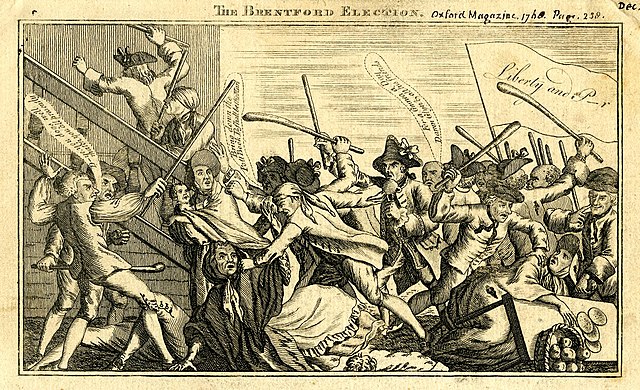
As I quoted yesterday, on 24 May 1773 the Boston Gazette ran a delightfully bitter attack on Commissioner Charles Paxton for finding a job for Ebenezer Richardson in the Philadelphia Customs office.

A couple of paragraphs below that invective, Edes and Gill printed:
Some Time last Week Ebenezer Richardson, Esq; who lately had such a fortunate and surprizing Escape from the Gallows for the Murder of young SEIDER; through the extraordinary Clemency of our pious and gracious Monarch, set out for the City of Philadelphia, being appointed an Officer in the Customs, for this notable Exertions in Behalf of Government———

Balf, McQuirk & Kennedys are not the only Instances of the unexampled Goodness of George the Third.
This writer obviously expected readers to recognize those names, but I didn’t.

Laurence Balfe and Edward McQuirk (or Quirk or Kirk) were accused of hitting George Clarke on the head during a riot sparked by a by-election at Brentford in West London on 8 Dec 1768, as shown above.

The rival candidates in that election were Sir William Beauchamp-Proctor, a Rockingham Whig, and John Glynn, lawyer for the radical John Wilkes. (Glynn won and served in Parliament till his death in 1779.)

A “gentleman of very considerable fortune” testified that he had seen McQuirk and Balfe among Proctor’s supporters on the first day of voting. The two men were carrying clubs, and McQuirk was “very active in the fray.”

That night, the wealthy gentleman spoke to McQuirk and Balfe, letting them believe he was on their side. McQuirk admitted to having been in the brawl and hinted he might have to flee the country. Balfe said he’d been paid “a guinea for going down to Brentford.”

The gentleman took his information to a “parson Horne,” no doubt the political radical John Horne, then still a Wilkes ally. That man arranged for McQuirk and Balfe to be arrested by Sir John Fielding, the London magistrate. Clarke died on 14 December, elevating the charge to murder.

In January 1769 McQuirk and Balfe were convicted of murder at the Old Bailey, with the jury deliberating only twenty minutes. Proctor immediately launched a public campaign for royal clemency, calling this verdict unjust.

Advocates for mercy pointed out that the prosecutors never accused either defendant of hitting Clarke. Indeed, there was no evidence Balfe hit anyone, just that he was in the crowd. The Earl of Rochford also reported there was “some doubt whether Clarke’s death happened in consequence of the blow he received.”

On 10 March, the Crown pardoned McQuirk and Balfe.

Proctor was a supporter of the Marquess of Rockingham, and Rockingham had been mostly supportive of America during this first term as prime minister in 1765–1766. Furthermore, the case against McQuirk and Balfe really was flimsy, and they were obviously pawns in a much bigger game. We might therefore expect colonials to support clemency for them.

However, American Whigs were enamored of John Wilkes. They suspected any attack on his party as oppression by the establishment. Thus, Edes and Gill could present “Balf [and] McQuirk” as an example of George III or the ministers around him abusing the royal pardon power to benefit political supporters, just like Ebenezer Richardson.

TOMORROW: The case of the Kennedys.

Friday, November 17, 2017

A Letter on London Politics

Edward Griffin Porter’s Rambles in Old Boston (1886) quotes this letter sent to the private teacher John Leach in Boston. It offers a glimpse of radical politicians in London and of the Boston Whigs’ attempts to make common cause with them.

The writer was the London printer John Meres (1733-1776). He had inherited the Daily Post newspaper from his namesake father, who had gotten in trouble multiple times for printing news the government didn’t like. The younger Meres followed in the family tradition.

Meres’s letter is datelined “Old Baily, May 21, 1769,” and evidently replies to a political essay Leach had sent to the imperial capital:
Dr. Cozn.,—

I had the Pleasure of receiving your political Creed accompanied with the Presents, the One agreeable to my Sentiments, the Other to my Fancy.

Your Letter I presented to Mr. [John] Wilkes, who read it with much Satisfaction; desired me to leave it with him & begg’d I would present his best Respects to you unknown & hoped there were many of the same Opinion as yourself; it was shown to Mr. Serjt. [John] Glynn [shown above], the only worthy Member [of Parliament] for the County of Middlesex, who thought it rather too dangerous for the Press except the Inflamatory Paper I now publish entitled the Nh. Briton, the Government having after a serious of Insults upon the People deprived me of printing The London Evening Post, & that Paper is now become the tame Vehicle for Ministers and their Ductiles. The Duke of Grafton promised me in private that nothing should be done prejudicial to me or my Interest, but are Jockeys Words to be taken? but alas! our Ministry consist of few others than that class—but to return.

Mr. Wilkes has been three Times elected Member for the County of Middlesex & was refused his seat in any House (except the King’s Bench). He was chosen by the Inhabitants of the Ward, Alderman for Farringdon Without (the largest in the City), in which I reside; the Court of Aldermen would not swear him in; the Inhabitants rechose him, Ditto, so that the Ward being without an Alderman, the Inhabitants will not pay the Taxes, not being properly represented & the Ward Books not signed by Mr. Alderman Wilkes.

I could add much more of the above Gentles. sufferings, but cannot write with propriety being much afflicted with the Gout…

I remain, your Lovg. Cozn.
J. MERES.
The 103rd issue of the North Briton, dated 22 Apr 1769, says it was “Printed for W. BINGLEY, at the King’s-Bench Prison, and sold by J. MERES, in the Old Bailey.” The issue dated one day before this letter indicates that William Bingley was out of jail and back at his shop in the Strand. By then Meres was not only selling the latest issue but all back issues as well.

The magazines didn’t say who did the actual printing, but Bingley spent two years in prison without trial and is usually credited as the publisher of the magazine. However, at least to his cousin in Boston, Meres claimed in May 1769 to “now publish” the North Briton.

John Meres had two sons who became teen-aged Royal Navy officers during the Revolutionary War.